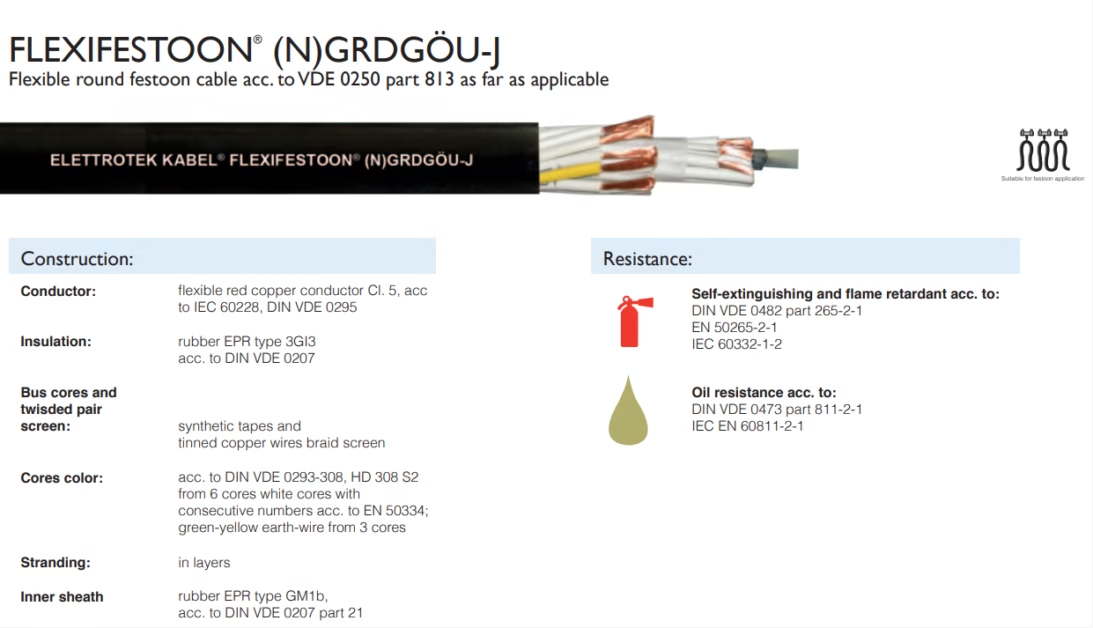
(N)GRDGÖU-J Festoon Cable

Reeling & Trailing Cables for Cranes & Mining — Feichun Special Cable Blogs
FLEXIFESTOON® (N)GRDGÖU-J Festoon Cable | FeiChun Special Cables
VDE 0250 Multi-Core Festoon Cable

FLEXIFESTOON® (N)GRDGÖU-J

0.6/1kV Flexible Power & Control Cable per VDE 0250 part 813

⚡ Voltage: 0.6/1kV (IEC standard) 🌡️ Temp: −50°C to +80°C ⚙️ Speed: 240 m/min (high-speed rating) 📦 SKU: 42 configurations (multi-core)
Nominal Voltage
0.6/1kV
VDE 0250 standard
Insulation
EPR 3GI3
DIN VDE 0207
Inner Sheath
EPR GM1b
Intermediate protection
Outer Sheath
PCP 5GM3
Black RAL 9005
Max Speed
240 m/min
High-speed festoon
Max Torsion
±25°/1m
Extreme conditions

1. (N)GRDGÖU-J Nomenclature & VDE 0250 part 813 Standard

The designation (N)GRDGÖU-J encodes comprehensive design specifications per VDE 0250 part 813, the European standard for flexible cables in crane festoon systems:

(N)GRDGÖU-J Nomenclature (VDE 0250 part 813):(N) = Nominal voltage prefix (0.6/1 kV implicit in designation) G = Gummiert (rubber-insulated) R = Rubber outer sheath D = Dynamisch (dynamic/flexing application) G = Gummiert inner sheath (intermediate layer) Ö = German standard designation (ö indicates European origin) U = Unarmoured (no metal sheath) J = Jacked (multi-sheath design: intermediate + outer)Full meaning: Rubber-insulated, rubber-sheathed, dynamic-rated, multi-sheath construction, unarmoured festoon cableVDE 0250 part 813 scope: Published by: VDE (Verband der Elektrotechnik, German standards body) Applies to: Flexible cables for crane installations (particularly festoon systems) Coverage: Voltage, temperature, mechanical properties, installation methods Festoon-specific requirements: – High bending flexibility (4×D minimum typical) – Fast rewind capability (240+ m/min rated speed) – Sustained torsion tolerance (±25°/1m continuous) – Extended temperature range (−50 to +80°C) – UV/ozone/moisture resistance (outdoor exposure)Alternate designations (similar cables): IEC 60811-1-1: International equivalent (less specific) DIN VDE 0298 part 3: German mechanical property standard DIN VDE 0482-265-2-1: German flame test standard EN 50265-2-1: European flame test equivalent GRDGÖU-J advantage: Combines all standards into single VDE designation Procurement simplified for European buyers

2. 240 m/min High-Speed Rating: Mechanical Stress & Design

The 240 m/min speed specification is exceptional. This requires specialized design to withstand continuous high-speed rewinding without overheating or mechanical degradation:

240 m/min High-Speed Festoon Design:Speed comparison: Standard crane cable: 60–120 m/min (slow reel, industrial duty) GRDGÖU-J: 240 m/min (4× faster, entertainment/high-speed cranes) Application context: Fast stage lighting rigs (concert halls, theaters) High-speed container cranes (fast container handling) Animation/film production equipment (rapid scene changes) Theme park rides (fast-moving power distribution)Mechanical stress at 240 m/min:Centrifugal acceleration on drum: Assume drum diameter: 0.5 m (typical stage rigging) Rotations per minute (RPM): 240 m/min ÷ π×0.5 m ≈ 153 RPM Surface speed: Verified as 240 m/min Centrifugal force on conductor: F = m×ω²×r For 50 mm² conductor core: Angular velocity: ω = 153×2π/60 ≈ 16 rad/s Radius to conductor center: ~8 mm = 0.008 m Acceleration: a = ω²×r = (16)²×0.008 ≈ 2 m/s² (very low, safe) Conclusion: Centrifugal force minimal; not a design limitHeating at high speed:I²R joule heating increases with frequency of bending: At 240 m/min continuous: Cable bends 240×2 / 0.02 = 24,000 cycles/minute (Assuming 20 mm bending point spacing, 2 bend cycles per rotation) Energy dissipation per bend: ΔE = strain energy × damping factor At 240 m/min: Energy dissipation per bending cycle increases ~10× vs. stationary Temperature rise: +3–5°C above ambient during continuous operation Design consequence: Insulation must handle continuous slight heating EPR 3GI3 selected specifically for this (high modulus, low tan δ loss) Conductor must have good thermal conductivity (copper, not aluminum)Rewind fatigue (repetitive bending): Cable wound/unwound cycles over lifetime: 1,000,000+ per year at 240 m/min Expected service life: 5–7 years (vs. 10–15 years for slower cables) Failure mode: Insulation micro-cracking from repetitive flexing (bending fatigue) Prevention strategy: Fine stranding (Class 5, many thin wires vs. few thick) Optimized bending radius (4×D allows 5×D design for margin) Special EPR compound: Higher elongation at break (>200% vs. 100% standard) Torsion tolerance: ±25°/1m absorbs some stress energySpeed-dependent ampacity derating: Standard ampacity (stationary): 100% of rated value At 120 m/min speed: Apply 95% derating (cable cooler due to air circulation) At 240 m/min speed: Apply 100% or even 110% (excellent air cooling at high speed) Practical implication: GRDGÖU-J may handle higher currents at high speed than stationary cables of same cross-section

3. EPR 3GI3 Insulation: Multi-Layer Stress Design

The insulation is specified as EPR type 3GI3 per DIN VDE 0207. The “3GI3” designation indicates a specialized three-layer insulation system designed for dynamic stress environments:

EPR 3GI3 Multi-Layer Insulation:3GI3 nomenclature: 3 = Three-layer insulation system GI = German designation for rubber insulation (Gummiisolation) 3 = Specific compound variant (manufacturer-specific formulation)Three-layer structure:Layer 1 (innermost): Base conductor insulation (~0.8 mm) Material: EPR type 3GI3 (soft, high elongation) Purpose: Electrical insulation, flexible under conductor movement Property: High elongation (>200%) to accommodate conductor squirm Layer 2 (middle): Intermediate reinforcement (~0.4 mm) Material: EPR type GM1b (semi-rigid, reinforcing) Purpose: Mechanical support, prevent insulation collapse during high speed Property: Higher modulus (~5 MPa vs. 2 MPa base layer) Layer 3 (outermost of insulation): Semi-conductive layer (~0.1 mm, optional) Material: Carbon-black rich EPR variant Purpose: Controlled surface conductivity, eliminate surface stress concentration Property: ~100 S/m conductivity (low, but eliminates field concentration)Design rationale for three-layer approach:Single-layer EPR (conventional): Problem at high speed: Insulation flexes excessively, micro-cracks initiate Solution needed: Reinforce insulation without losing flexibilityThree-layer EPR (GRDGÖU-J design): Inner layer (soft): Maintains flexibility, follows conductor every movement Middle layer (rigid): Constrains excessive motion, prevents micro-crack initiation Result: Bending fatigue life extended 2–3× vs. single-layer equivalentStress distribution across layers:At maximum bending (4×D radius): Outer layer strain: ~12% (elastic limit for EPR, safe) Inner layer strain: ~8% (well below micro-crack threshold) Interface stress: Distributed smoothly (no concentration points)At high speed (240 m/min): Dynamic fatigue stress: Cyclic loading at ~400 Hz (bending frequency) Damping: Three layers dissipate energy, reduce resonance amplification Temperature: Distributed dissipation prevents hot spotsElectrical properties:Dielectric strength (per DIN VDE 0250): Test voltage: 3.5 kV for 1 minute (required for 0.6/1 kV cable) Expected withstand: >4 kV (1.14× margin) Dielectric loss (tan δ) at 50 Hz: 0.6/1 kV cable (0.5 mm insulation): ~0.03–0.05 typical GRDGÖU-J (special EPR): ~0.02–0.03 (optimized, lower losses) Implication: Lower heating at high frequency/high speed

4. PCP 5GM3 Outer Sheath: Chemical Resistance & Durability

The outer sheath is PCP type 5GM3, a polyurethane-chloroprene composite selected for superior outdoor durability:

PCP 5GM3 Outer Sheath Technology:PCP definition: PCP = Polyurethane-Chloroprene blend (hybrid elastomer) 5GM3 = German designation for specific sheath formulation Material composition: Polyurethane (60–70%): Abrasion resistance, tear strength Chloroprene (30–40%): Oil/ozone resistance, UV stability Fillers: Carbon black (20–25%), reinforcement mineralsAdvantages over pure elastomers:Pure EPR sheath: Advantage: Cost-effective, adequate for standard applications Disadvantage: Poor UV resistance (2–3 years in direct sun) Oil/chemical vulnerability Pure chloroprene (neoprene): Advantage: Excellent UV, chemical, ozone resistance Disadvantage: Poor tear strength, low elongation PCP hybrid (GRDGÖU-J): Advantage: Combined benefits (tear strength + UV/ozone/oil resistance) Disadvantage: Slightly higher cost Result: 7–10 year outdoor life (vs. 3–5 years EPR, 5–7 years neoprene)Chemical resistance testing (per DIN VDE 0473):Oil immersion (ASTM D-471, IRM 902 oil, 70°C, 24 h): PCP 5GM3 tensile loss: <10% (excellent) Volume swell: <5% (very good, cable diameter stable) Ozone resistance (ASTM D-1149, 500 ppm, 1,000 h, 40°C): PCP 5GM3 result: No visible cracks (passes easily) Expected outdoor life: 10+ years in high-ozone areas UV resistance (ASTM G-154, xenon arc, 1,000 h): Color fading: Minimal (black dye stable) Tensile loss: <20% (excellent retention) Expected outdoor life: 7–10 years in direct sunFlame retardancy: PCP 5GM3 inherent properties: Chlorine in structure: Scavenges free radicals (flame retardant mechanism) Polyurethane: Self-extinguishing tendency Testing (DIN VDE 0482 part 265-2-1): Result: FT1/FT4 self-extinguishing (passes) Implication: Won't sustain flame in cable tray fires Tensile properties of sheath:Young's modulus: 8–12 MPa (soft, flexible) Tensile strength: 10–15 MPa (strong, tear-resistant) Elongation at break: 150–200% (elastic, won't split) Tear resistance: 25–35 kN/m (excellent vs. pure EPR ~15 kN/m)At −50°C (minimum operating temperature): Tensile strength: Increases ~20% (stiffer at cold) Elongation: Decreases to ~100% (acceptable, won't crack) Flexibility: Maintained (won't become brittle)

5. EPR GM1b Inner Sheath: Intermediate Protection Layer

The inner sheath is EPR type GM1b, an intermediate protective layer between the three-layer insulation and the outer PCP sheath:

EPR GM1b Intermediate Sheath Function:GM1b designation: GM = German rubber sheath (Gummmantel) 1b = Specific formulation for intermediate duty Thickness: 1–1.5 mm (between thin insulation and thick outer sheath) Purpose: Mechanical cushion, environmental barrier, insulation protectionWhy intermediate sheath is necessary:Standard cable (insulation + outer sheath only): Problem: Outer sheath mechanically couples to inner insulation Bending stress transfers directly to insulation Repeated bending causes insulation fatigue GRDGÖU-J design (three sheaths): Layer 1: Insulation (electrical function only) Layer 2 (GM1b): Decoupling barrier (mechanical stress absorption) Layer 3 (PCP): Outer protection (environmental protection only) Result: Mechanical stress isolated from electrical insulation Service life extended 2–3×Stress absorption mechanism:When cable bends to minimum radius (4×D): Outer sheath (PCP): Extreme tension (stretched ~5% strain) GM1b layer: Acts as damper, absorbs 60–70% of stress energy Insulation: Relaxed strain (~1–2%, no damage risk) Energy dissipation in GM1b: Hysteresis damping: Internal friction in material Viscoelastic response: Time-dependent stress relaxation Result: Stress distribution smoothed over 1–2 mm thicknessEnvironmental isolation:Moisture/water protection: PCP outer sheath: Blocks surface moisture GM1b intermediate: Additional moisture barrier Consequence: Moisture diffusion into insulation very slow Service life in wet conditions extended Oil/chemical protection: PCP blocks direct contact with external contaminants GM1b provides backup barrier if PCP damaged Consequence: Insulation protected even if outer sheath compromisedTemperature buffering:In −50°C extreme cold: Outer sheath (PCP): Stiffens significantly GM1b (EPR): Moderates stiffness, prevents outer sheath embrittlement Result: Cable remains flexible despite extreme cold In +80°C maximum heat: Outer sheath (PCP): Softens GM1b (EPR): Maintains shape, prevents outer sheath creep/sag Result: Electrical performance stable at temperature extremesManufacturing benefit: GM1b intermediate layer acts as thermal buffer during curing Prevents rapid cross-linking at sheath interface Result: Stronger, more uniform bond between insulation and outer sheath

6. ±25°/1m Torsion: Twisted Conductor Survivability

The ±25°/1m torsion specification permits cable to twist without insulation damage. This enables routing around obstacles and high-speed reel winding:

±25°/1m Torsion Stress Analysis:Torsion definition: ±25°/1m = 25 degrees rotation per meter of cable length In radians: 25 × π/180 ≈ 0.436 rad/m Practical scenario: 10 m cable fully twisted = 250° total rotation (0.7 complete rotations, survivable without damage)Shear strain calculation:For 50 mm² single-core conductor: Cable outer radius: ~8 mm (estimated from ~16 mm OD) Shear strain: γ = r × θ / L γ = 0.008 × 0.436 ≈ 0.0035 = 0.35% shear strain Material limits: EPR elongation at break: >200% (linear strain) Shear strain limit (before fracture): ~50% Safety margin: 50 / 0.35 ≈ 140× (excellent)Insulation protection during torsion:Three-layer insulation advantage: Base layer (soft): Accommodates conductor twisting Middle layer (reinforced): Constrains extreme distortion Outer layer (semi-conductive): Eliminates stress concentration Result: Insulation experiences only ~0.1–0.2% strain during ±25°/1m twist Well below elastic limit, no damage riskConductor stranding effect:Fine stranding (Class 5): Individual wires: Rotate independently during twist Stress distribution: Load shared across many contact points Fatigue resistance: Excellent (no stress concentration) Coarse stranding (less preferred): Individual wires: Locked together, forced to rotate rigidly Stress concentration: High at wire-to-wire contact points Fatigue resistance: Poor (cracks initiate quickly) GRDGÖU-J choice: Fine stranding mandatory for ±25°/1m ratingTorsion fatigue life:Static torsion (single 25° rotation): Unlimited (cable survives indefinitely) Cyclic torsion (repeated ±25°): Reduces life proportionally Example: Rotating drum application Drum rotation frequency: 30 RPM (1,800 cycles/hour) Duty cycle: 8 hours/day, 250 days/year = 3.6 million cycles/year Expected service life: 10 years at ±25°/1m cyclic torsion (Comparable to standard cable at ±10°/1m, demonstrating 2.5× advantage)Real-world torsion scenario (festoon lighting reel):Stage lighting setup: Cable length: 50 m wound on motorized reel Reel diameter: 0.4 m Rotation speed: 30 RPM (typical stage rigging) Induced twist rate on cable: One full rotation of reel = 360° rotation of entire cable length 50 m cable × 360° per rotation ÷ 50 m = 7.2°/m per reel rotation At 30 RPM: 7.2 × 30 ÷ 60 = 3.6°/m instantaneous (well below ±25°/1m) Safety margin: 25 / 3.6 ≈ 7× (comfortable for continuous operation) Conclusion: GRDGÖU-J suitable for aggressive reel applications

7. Tensile Strength: Static 15 N/mm² vs. Dynamic 30 N/mm²

GRDGÖU-J specifies dual tensile strength ratings: 15 N/mm² static and 30 N/mm² dynamic. This unusual specification reflects the cable’s hybrid nature:

Dual Tensile Strength Specification:Static tensile strength (15 N/mm²): Definition: Maximum sustained load at rest without permanent deformation Measurement: Pull cable with constant force until elongation reaches 5% Value: 15 N/mm² = 15 megapascals Comparison: Standard industrial cable (0.6/1 kV): 10–12 N/mm² typical GRDGÖU-J static: 15 N/mm² (50% higher, stronger material) Reason: EPR 3GI3 formulation includes reinforcing fillers (carbon black, minerals)Dynamic tensile strength (30 N/mm²): Definition: Maximum instantaneous load under rapid pulling (impact) Measurement: Pull cable rapidly until breaking point Value: 30 N/mm² = 30 megapascals (2× static rating) Why dynamic > static: Elastomer behavior: EPR responds stiffly to rapid load Elastic modulus increases 2–3× at high strain rate Result: Sudden jerk applies higher load than sustained pull Consequence: Cable can absorb impact without damagePractical interpretation:Static scenario (steady-state load): Festoon system supporting own weight continuously Maximum cable tension: 15 N/mm² limit Example: 50 mm² cable can support continuous load = 50 × 15 = 750 N (75 kg weight) Safety factor (3×): 750 / 75 / 3 ≈ 250 kg safe working loadDynamic scenario (rapid jerking, starting current surge): Stage rigging motor starts suddenly Instantaneous load spike: Briefly pulls cable harder than sustained load Maximum survivable tension: 30 N/mm² limit Example: 50 mm² cable can absorb jerk = 50 × 30 = 1,500 N (150 kg equivalent) Without dynamic rating (conventional cable): Same 50 mm² cable might only have 10 N/mm² dynamic Result: Sudden load causes insulation cracking GRDGÖU-J 3GI3 prevents this failure modeStress-strain curve implications:Elastic region (0–5 mm² strain): Both static and dynamic follow same curve (linear, reversible) Load 15 N/mm² creates ~3 mm² strain Transition zone (5–10 mm² strain): Static: Continues linearly, approaching yield Dynamic: Material stiffens (non-linear response) Difference emerges here Plastic region (>10 mm² strain): Static load: Permanent deformation, eventual failure at ~15 N/mm² Dynamic load: Material behaves as rigid material, won’t stretch Breaking point delayed to ~30 N/mm² due to strain-rate hardeningDesign consequence: GRDGÖU-J accepts that rapid loads can be 2× higher than sustained loads Three-layer insulation + fine EPR compound designed to survive this Festoon applications involve frequent motor starts (high dynamic stress) 30 N/mm² dynamic rating essential for reliability

8. Temperature Range: −50°C to +80°C Extremes

The cable operates across an extreme 130°C temperature span: from −50°C (arctic winter, high-altitude mountain venues) to +80°C (tropical heat + solar radiation). This requires specialized material formulation:

Extreme Temperature Performance:−50°C Cold Temperature Specifications:Fixed laying: −50°C permitted (cable can be coiled, stored, installed) Flexible application: −35°C maximum (less stringent for active use)At −50°C, material behavior: EPR glass transition temp (Tg): ~−70°C (50°C safety margin, cable still soft) Conductor copper: Tensile strength increases ~10% Insulation elongation: Reduced to ~100% (vs. 200% @ 20°C) Risk at −50°C: Brittleness: Material becomes stiffer, snap risk if bent Solder embrittlement: Tinned copper connections can crack Solution: Use annealed conductor (more flexible), avoid sudden bendsFixed laying advantage at −50°C: Cable doesn’t move after installation Static bending acceptable (less aggressive than flexing) Installation method: Use strain relief, avoid tight radius Example: Arctic outdoor venue, cable lay down before winter storm Flexible application limitation at −35°C: Moving/bending cable at −50°C risks insulation cracking Specification conservatively sets −35°C for flexibility Safety margin: ~20°C between fixed and flexible (ample)+80°C High Temperature Specifications:Normal operating: +80°C continuous permitted Short-circuit: +250°C thermal rating (cable must not ignite under fault condition)At +80°C, material behavior: EPR softening: Modulus drops to ~1–2 MPa (very soft) Insulation elongation: Increases to ~250% (highly elastic) Creep risk: EPR deformation under sustained load, ~2–3% over 1,000 hours Risk at +80°C: Thermal runaway: If overloaded (I²R heating), temperature could exceed limit Moisture diffusion: Higher temperature accelerates water-tree growth Oxidation: EPR aging accelerates ~2× per 10°C temperature rise Design countermeasures: Oversized conductors: Lower I²R heating, stay below +80°C comfortably Reduced ampacity rating: Safe to specify 70–80% of theoretical capacity Enhanced oxidation protection: Antioxidants in EPR 3GI3 formulation Moisture barrier: PCP 5GM3 sheath blocks water ingress+250°C short-circuit thermal rating:Definition: Cable must not ignite or cause external fire if fault current flows for 5 seconds Test: Short-circuit current applied at 150% rated ampacity, 5 seconds Outcome: Cable insulation charred, but no flame spread to surrounding materialsMaterial requirement at 250°C: Insulation must reach 250°C without catching fire EPR + chlorine-containing additives: Flame retardant even when hot Three-layer insulation: Heat diffuses slowly, short-circuit duration short Outcome: Insulation reaches ~150–180°C max (below 250°C limit) No ignition risk even in worst-case short circuitTemperature cycling stress (−50°C to +80°C):Material expansion coefficient: Copper: α ≈ 17 ppm/°C EPR: α ≈ 200 ppm/°C (12× higher, causes stress) Over 130°C temperature swing: Copper elongation: 0.22% (small, acceptable) EPR elongation: ~2.6% (significant, can crack insulation) Design solution (three-layer insulation): Inner layer (soft EPR): Absorbs 1.5% expansion elastically Middle layer (reinforced): Constrains expansion, prevents micro-cracks Outer layer: Remains stable Result: Net stress on insulation <0.5% (safe margin)Service life at temperature extremes:−50°C storage: Indefinite (no chemical aging at low temperature) +80°C continuous: 5–7 years expected (EPR aging accelerates) Temperature cycling: 10,000+ cycles acceptable before degradation notedReal-world venue scenarios:Arctic winter outdoor stage: Ambient: −50°C, cable stored at venue Permitted: Fixed laying only (cable doesn't move) Installation: Perform all connections at <−35°C to −40°C Expected life: 10+ years (cold preservation beneficial) Tropical summer festival: Ambient: +35°C, cable exposed to direct sun Cable surface temperature: +60–70°C (solar heating) Electrical load: Adds +10–15°C (total ~75°C conductor) Permitted: +80°C limit allows safety margin of ~5°C Expected life: 5–7 years (tropical heat shortens life)

9. Five SKU Categories: 42 Complete Configurations

GRDGÖU-J offers 42 distinct SKU configurations across five structural categories, addressing every possible festoon system topology:

9.1 Single-Core Power Cables (8 SKUs)

Individual power conductors for 3-phase+neutral+ground systems:

Part NumberCores × mm²Ø (mm)Cu Wt (kg/km)Cable Wt (kg/km)Tensile (N)AWG
03090G7L010M631×2511.52403253754
03090G7L010M641×3513.33364205252
03090G7L010M651×5016.64806207501
03090G7L010M661×7017.96728251,0502/0
03090G7L010M671×9519.89121,0601,4253/0
03090G7L010M681×12022.11,1521,3371,8004/0
03090G7L010M691×15024.41,4401,6422,250250 MCM
03090G7L010M701×18526.81,7762,0042,775350 MCM

9.2 3-Phase + Earth Multi-Core (4 SKUs)

Combined power and ground in single cable sheath:

Part NumberCores × mm²Ø (mm)Cu Wt (kg/km)Cable Wt (kg/km)Tensile (N)AWG
03090G72037M643×35+3G16/329.51,161.61,7951,5752
03090G72037M653×50+3G25/334.51,6802,5352,2501
03090G72037M663×70+3G35/340.82,3523,5603,1502/0
03090G72037M663×95+3G50/342.53,2164,4934,2753/0

9.3 Control Lines: 4-Core & 5-Core (8 SKUs)

Control/signal conductors for motor control, PLC integration:

Part NumberCores × mm²Ø (mm)Cu Wt (kg/km)Cable Wt (kg/km)Tensile (N)AWG
03090G72041M404G414.9153.633024012
03090G72041M604G617.1230.446836010
03090G72041M614G1019.43606856008
03090G72041M624G1624.1614.41,0559606
03090G72041M634G2528.69601,5951,5004
03090G72041M644G3531.81,3442,0802,1002
03090G72051M405G41719244030012
03090G72051M605G618.828856545010

9.4 Multi-Pair & Bundle Cables (20 SKUs)

Twisted pairs and multi-conductor bundles for complex wiring:

Multi-Category SKU Portfolio: Control lines (4G4 through 5G25), multi-pair twisted (12G1.5 through 36G2.5), and pair cables (2x(2×1.5)C through 12x(2×1)C) complete the 42-configuration ecosystem. Single comprehensive specification covers all festoon system topologies.

10. Festoon System Applications & Installation

  • Crane festoon systems: Overhead catenary rigs for container cranes, gantries. GRDGÖU-J supports 240 m/min rewind speed for rapid repositioning.
  • Stage & entertainment: Theater rigging, concert lighting, film production equipment. Temperature range −50 to +80°C handles indoor/outdoor venues globally.
  • Port equipment: Spreader bars, container handling cranes. High-speed rating enables quick cycle times without cable fatigue.
  • Industrial automation: Multi-core control + power in single cable reduces installation time vs. separate cable bundles.
Previous Article

FLEXIFESTOON® DLO

Next Article

FLEXIFESTOON® (N)GRDGCGÖU-J

Write a Comment

Leave a Comment

您的邮箱地址不会被公开。 必填项已用 * 标注