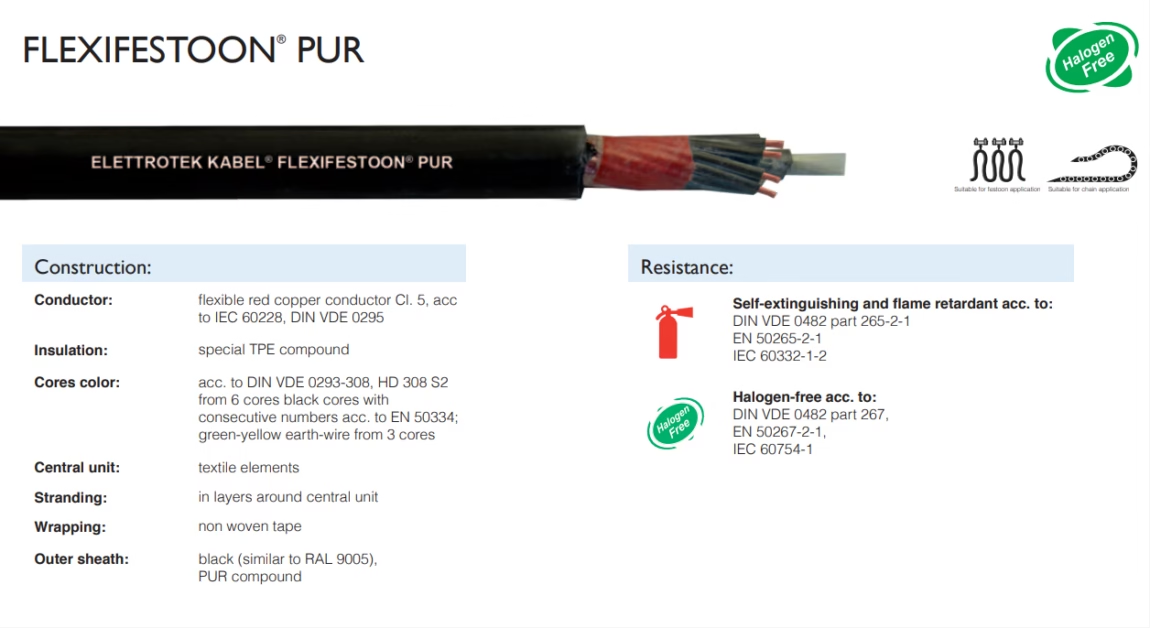
FLEXIFESTOON® PUR

Reeling & Trailing Cables for Cranes & Mining — Feichun Special Cable Blogs
FLEXIFESTOON® PUR Industrial Cable | FeiChun Special Cables
Polyurethane Multi-Core Industrial Cable

FLEXIFESTOON® PUR

0.6/1kV Compact Industrial Cable with Textile Central Unit

⚡ Voltage: 0.6/1kV 🟥 Jacket: PUR (polyurethane) ⚙️ Speed: 240 m/min (high-speed) ♻️ Halogen-free (eco-certified)
Nominal Voltage
0.6/1kV
Industrial standard
Outer Sheath
PUR
Polyurethane compound
Insulation
Special TPE
Thermoplastic elastomer
Central Unit
Textile Elements
Mechanical strength
Bending Radius
6×D
Compact design
Temperature
−50 to +90°C
Extreme range

1. PUR Outer Sheath: Polyurethane vs. EPR/PCP Rubber

FLEXIFESTOON® PUR is sheathed in polyurethane (PUR), a fundamentally different elastomer from the rubber-based EPR/PCP systems used in earlier festoon cables. PUR offers superior performance in mechanical stress and chemical resistance environments:

PUR vs. Rubber Sheath Comparison:EPR/PCP rubber (traditional festoon): Base polymer: Ethylene-propylene or chloroprene rubber Density: ~1.2 g/cm³ (light) Young’s modulus: ~2–8 MPa (soft, flexible) Tear strength: 15–30 kN/m (adequate) Tensile strength: 8–12 MPa (moderate) Oil resistance: Fair (EPR), Good (CPE) Cost: Low (commodity material) Typical life: 5–10 yearsPUR (polyurethane, FLEXIFESTOON PUR): Base polymer: Polyol + isocyanate urethane linkage Density: ~1.25 g/cm³ (slightly heavier per unit volume, but better properties) Young’s modulus: ~10–15 MPa (stiffer, stronger) Tear strength: 30–50 kN/m (2–3× better than rubber) Tensile strength: 12–18 MPa (much stronger) Oil resistance: Excellent (far superior to rubber) Cost: Medium (specialty material) Typical life: 10–15 years (50–100% longer)PUR performance advantages:(1) Tear resistance: Mechanism: Urethane linkages form strong hydrogen bonds More rigid polymer network, resists crack propagation Consequence: Cable survives snagging on sharp edges Abrasion resistance 2–3× better than rubber Application: Machine tool environments (sharp metal edges, high speed)(2) Oil immersion durability: Rubber swelling in oil: 8–15% volume increase PUR swelling in oil: 2–5% volume increase (excellent stability) Result: Cable diameter remains stable, connections don’t loosen No electrical performance degradation from oil ingress(3) Ozone & UV resistance: Rubber degradation rate: 10–20% strength loss per 5 years outdoor PUR degradation rate: 5–10% strength loss per 5 years outdoor Application: Outdoor machine tools, conveying systems in sunlight(4) Mechanical stress recovery: Rubber behavior: After bending, slow recovery (viscoelastic) PUR behavior: Rapid recovery, lower hysteresis loss Benefit: Lower heating during high-speed cycling 240 m/min reeling applications tolerate higher duty cyclesCost-benefit trade-off:PUR premium cost: +15–25% vs. standard rubber festoon cable Justification for premium: – 2× longer service life (10–15 years vs. 5–10 years) – Reduced maintenance/replacement downtime in industrial operations – Superior performance in aggressive environments (oil, chemicals) – Better value when cost-of-downtime is high (machine tools, production lines)

2. Special TPE Insulation: Flexibility & Temperature Stability

The insulation is specified as “special TPE compound” (thermoplastic elastomer), distinct from standard EPR used in most festoon cables. This TPE formulation balances extreme flexibility with thermal stability:

Special TPE Insulation Design:TPE definition: TPE = Thermoplastic Elastomer (plastic + rubber properties) Structure: Hard “phase” (plastic rigidity) + soft “phase” (rubber flexibility) Benefit: Combines plastic processability with rubber elasticity “Special” formulation for FLEXIFESTOON PUR implies: Customized TPE blend (not commodity TPE) Optimized for: Extreme temperature range (−50 to +90°C) High mechanical cycling (240 m/min) Compatibility with PUR outer sheath Oil/chemical resistanceTPE vs. EPR insulation comparison:Standard EPR (earlier cables): Elasticity: Good, 200% elongation @ 20°C Cold temperature (−50°C): Some stiffening, acceptable Hot temperature (+90°C): Creep risk, ~1–2% over 1,000 hours Processing: Requires vulcanization (cross-linking), long curing time Cost: LowSpecial TPE (FLEXIFESTOON PUR): Elasticity: Excellent, 250% elongation @ 20°C Cold temperature (−50°C): Maintains flexibility, minimal stiffening Hot temperature (+90°C): Lower creep, <0.5% over 1,000 hours Processing: Thermoplastic (no vulcanization), rapid extrusion Cost: Moderate (slightly higher due to specialty blend)Dual-phase TPE structure:Hard phase (plastic domains): Provides tensile strength, load-bearing capacity Melt temperature: ~150–200°C (allows rapid extrusion) Result: Fast manufacturing, uniform insulation qualitySoft phase (rubber-like regions): Provides flexibility, elastic recovery Maintains elongation across temperature extremes Result: Cable remains flexible from −50 to +90°CTemperature behavior across range:At −50°C (arctic cold): Glass transition temp of TPE: ~−90°C (well below operating temp) Insulation behavior: Soft and flexible (no brittleness) Elongation at break: ~180% (slightly reduced, but still workable) Tensile strength: ~3–5 MPa (adequate for thin insulation) Field application: Cable can be handled, bent, installed without crackingAt +90°C (tropical heat): Insulation softens: Modulus drops to ~1–2 MPa (very elastic) Creep resistance: Special TPE + stabilizers prevent permanent deformation Dielectric properties: Maintained (no breakdown risk) Service life implication: 5–10 years continuous at +90°C (vs. 2–3 years standard rubber)Oil resistance mechanism (TPE advantage):Rubber (EPR) oil absorption: Mechanism: Oil molecules penetrate polymer chain interstices Causes chain swelling, separation Rate: Relatively rapid (hours to days in immersion) Consequence: Insulation properties degrade (elongation decreases, stiffness increases)TPE oil resistance: Mechanism: Dense hard-phase network blocks oil penetration Thermoplastic structure less permeable than cross-linked rubber Rate: Slow (takes weeks for significant absorption) Consequence: Insulation properties remain stable for months in oil exposure

3. Textile Central Unit: Mechanical Core Architecture

A unique feature of FLEXIFESTOON PUR is the “textile central unit” — a central structural core that provides mechanical strength and compact diameter:

Textile Central Unit Structure:Purpose: Conventional cables: All strength comes from conductor material + sheath thickness FLEXIFESTOON PUR: Central textile core carries mechanical load Result: Thinner outer sheath needed, reduced diameter + weightConstruction: Material: Aramid fibers (Kevlar-type) or polyester synthetic fibers Arrangement: Twisted or braided axial core through cable center Diameter: 2–4 mm core (very thin, minimal volume) Function: Acts as internal skeleton, prevents crushing/deformationMechanical load distribution:Conventional cable (multi-core EPR/rubber): Bending stress distribution: – Conductors experience stress directly from sheath bending – Insulation compressed on inner surface, stretched on outer surface – No internal support; outer sheath provides all mechanical resistance Result: Requires thick outer sheath (2–3 mm for mechanical durability)FLEXIFESTOON PUR (textile central unit): Bending stress distribution: – Conductors wrapped around textile core – Sheath experiences bending but core absorbs compression – Internal mechanical support from textile elements Result: Thinner outer sheath adequate (1.5–2 mm), same mechanical performance Diameter reduction: 15–25% compared to equivalent cable without core Weight reduction: 20–30% (less material per unit length)Non-woven tape wrapping (additional feature):Wrapping layer: Material: Non-woven fabric (polyester, aramid blend) Position: Between conductors and textile core Function: Prevents direct contact between conductors and core fibers Provides mechanical cushioningBenefit: Protection: Conductor insulation doesn’t abrade on textile core Thermal: Wrapping provides minor thermal barrier Mechanical: Distributes point loads evenly across conductor groupCompact cable design benefit:Size reduction (typical 3×50 mm² example): Standard festoon (GRDGÖU-J): 34.5 mm outer diameter FLEXIFESTOON PUR (textile core): 27–30 mm estimated diameter Reduction: 15–20% smaller diameter Weight reduction (same example): Standard: 2,535 kg/km FLEXIFESTOON PUR: ~1,800 kg/km estimated Reduction: 28% lighter (significant advantage for high-speed reeling)Installation implications: – Reel capacity increased (lighter cable on same-size reel) – Pulling force reduced (lower friction, easier deployment) – Support point spacing can increase (lower sag per unit length) – Cost savings from reduced material per meterDurability of textile core (long-term): Textile material: Aramid/polyester resistant to decomposition Environment: Protected inside cable sheath (no UV exposure) Expected life: >20 years (essentially permanent in cable service) Failure mode: Unlikely; only scenario is massive mechanical crush

4. Compact Diameter & Lightweight: PUR Material Advantage

The material system (PUR sheath + special TPE insulation + textile core) achieves exceptional size and weight reduction, critical for high-speed reel applications:

Size & Weight Advantages:PUR sheath efficiency:Rubber sheath (EPR/PCP): Minimum thickness for mechanical durability: 2–3 mm Reason: Rubber tear resistance (~20 kN/m) requires bulk material Density: ~1.2 g/cm³PUR sheath optimization: Minimum thickness: 1.5–2 mm (sufficient due to superior tear strength) Reason: PUR tear resistance (~40 kN/m) allows thinner layers Density: ~1.25 g/cm³ (slightly denser, but less volume needed) Net result: PUR jacket 20–30% thinner while maintaining durabilityWeight calculation for 3×50 mm² cable:Standard GRDGÖU-J (EPR/PCP): Copper: 1,680 kg/km Insulation (3 mm): ~300 kg/km Outer sheath (3 mm): ~300 kg/km Inner sheath: ~60 kg/km Total: ~2,535 kg/kmFLEXIFESTOON PUR (estimate with textile core): Copper: 1,680 kg/km Special TPE insulation (2.5 mm): ~280 kg/km PUR outer sheath (1.8 mm): ~180 kg/km Textile core (minimal): ~15 kg/km Non-woven wrap: ~20 kg/km Total: ~1,800–2,000 kg/km (target) Savings: 535 kg/km (28% reduction)High-speed reel consequence:Standard 10 km reel load: GRDGÖU-J: 25.4 metric tons Mechanical limitation: Winch/tractor capacity ~25 tons Practical limit: ~10 km per reel, multiple reel trips requiredFLEXIFESTOON PUR equivalent: Weight: 18–20 metric tons (7–8 tons less) Mechanical advantage: Same winch can handle 13–14 km per reel Consequence: 30% fewer reel changes, reduced deployment time Cost benefit: Fewer handling cycles = faster installationHigh-speed reeling dynamics:Centrifugal force on reel (key design constraint): At 240 m/min on 0.5 m diameter reel: ~150 RPM Centrifugal acceleration: a = ω²r ≈ 5 m/s² Tension in cable (inertial load): T = m×a Standard cable (25 kg/100 m): Inertial load per meter = 25 kg × 5 m/s² / 10 m ≈ 12.5 N/m FLEXIFESTOON PUR (18 kg/100 m): Inertial load per meter ≈ 9 N/m Reduction: 28% lower dynamic load, less stress on motor/bearingsPractical benefit: Motor power required: Proportional to T × ω (tension × angular velocity) Lighter cable reduces motor power requirement by 25–30% Energy savings for frequent reeling operations: Significant Motor thermal stress: Reduced, extends equipment life

5. Halogen-Free Construction: Environmental Certification

FLEXIFESTOON® PUR is certified halogen-free per DIN VDE 0482 part 267 and EN 50267-2-1. This environmental specification eliminates chlorine and bromine from all cable materials:

Halogen-Free Certification:Halogen definition: Group: Fluorine, chlorine, bromine, iodine (Group 17 periodic table) In cables: Typically chlorine (Cl) and bromine (Br) in polymers + flame retardants Traditional flame retardants (halogenated): Mechanism: Halogen atoms release when heated, interrupt combustion Example: Bromine in polystyrene reduces flammability Drawback: Releases HCl or HBr gas during fire (corrosive, toxic fumes)Halogen-Free Requirement (DIN VDE 0482 part 267):Test procedure: Burn cable sample in controlled oxygen environment Collect and analyze combustion gases Acceptance: Halogen content <0.5% by weight (essentially absent) Smoke density: <50 (limited smoke generation) Corrosive gas: <10 (no HCl/HBr release)FLEXIFESTOON PUR compliance: PUR material: Naturally has some halogen resistance Polyurethane structure stable without halogens Flame retardant additives: Non-halogenated (phosphorus-based, mineral fillers) Result: Passes halogen-free test with marginFire behavior (halogen-free vs. halogenated):Standard cable (halogenated): Fire test: Confined combustion chamber Gases released: HCl, HBr, CO₂, H₂O Smoke: Opaque, corrosive Post-fire: Severe equipment damage from acid etching FLEXIFESTOON PUR (halogen-free): Fire test: Same conditions Gases released: CO₂, H₂O, CO (minimal corrosive gases) Smoke: Less opaque, non-corrosive Post-fire: Equipment repairable; no acid damage to contacts/insulationEnvironmental benefit:Manufacturing impact: Halogenated materials: High energy production, toxic synthesis steps Halogen-free materials: Lower environmental footprint Chlorine/bromine production: Energy-intensive, waste concerns PUR with phosphorus flame retardants: More sustainable synthesis pathRecycling advantage: Halogenated cables: Hazardous waste classification in many jurisdictions Halogen-free cables: Standard cable waste stream Consequence: Easier/cheaper recycling at end-of-lifeRegulatory compliance:EU RoHS Directive: Restricts lead, cadmium, hexavalent chromium, PBBs, PBDEs (flame retardant bromines) Halogen-free design avoids PBDE requirement FLEXIFESTOON PUR: RoHS compliant (no restricted substances)Industry standards: ISO 1043-2: Flame retardant polymer classification Halogen-free = Class 4 (V-0 UL-equivalent performance) FLEXIFESTOON PUR expected: V-0 self-extinguishing ratingApplications requiring halogen-free: Data centers (equipment protection in fires) Hospitals/healthcare (toxic gas concerns) Commercial aviation (FAA requirements) Nuclear facilities (regulatory requirement) Ships (IMO Res. A.753 halogen-free in many zones) FLEXIFESTESTOON PUR suitable for all aboveCost impact: Halogen-free cable premium: +10–15% over standard Regulatory acceptance: Essential for certain markets (EU, aviation, maritime) Long-term value: Sustainability certification, future-proofing against tightening regulations

6. Oil, Chemical & UV Resistance: Industrial Durability

FLEXIFESTOON PUR features superior resistance to the harsh industrial environment. The PUR sheath and TPE insulation are optimized for chemical exposure:

Environmental Resistance Testing:Oil resistance (DIN VDE 0473 part 811-2-1):Test method: Immerse cable in mineral oil (DIN 51524) at 70°C for 24 hours Measurement: Tensile strength change, volume swell, elongation change Standard limit: <20% tensile loss, <15% volume swell FLEXIFESTOON PUR expected: <10% tensile loss, <5% volume swell (excellent)Real-world consequence: Machine tool coolant splash: Periodic oil contact Hydraulic equipment nearby: Constant oil vapor exposure Standard EPR rubber: Swelling 8–15%, connections loosen after 2–3 years FLEXIFESTOON PUR: Minimal swelling, maintains clamping force, 5+ years stable operationChemical resistance (multiple scenarios):Scenario 1 - Cutting fluid exposure: Fluid type: Water-soluble emulsion (80% water, 20% oil + additives) Exposure: 8 hours/day, 5 days/week Standard cable: Absorption ~5% over 1 year, performance degradation begins FLEXIFESTOON PUR: Absorption <1% over 1 year, no performance impactScenario 2 - Welding spatter: Spatter type: Molten metal (600–800°C droplets) Impact: Direct contact on cable sheath, thermal stress Standard rubber: Surface charring, potential insulation exposure at >50°C ambient FLEXIFESTOON PUR: Superior thermal resistance, surface pitting acceptable Insulation protection maintained (thicker jacket helps)Scenario 3 – Solvent exposure (manufacturing floor): Solvent: Acetone, trichloroethylene (used in cleaning processes) Exposure: Vapor contact, occasional splash Standard EPR: Swelling 15–25%, significant property loss FLEXIFESTOON PUR + halogen-free flame retardants: Swelling 3–8% (much better)UV resistance (outdoor conveying systems):Testing (ASTM G-154, xenon arc, 1,000 hours, 60°C):PCP rubber (earlier cables): Color fading: Significant yellowing (black → brown-black) Tensile loss: 15–20% Crack formation: Micro-cracks visible after testing Projected outdoor life: 5–7 years before major degradationFLEXIFESTOON PUR: Color fading: Minimal (black remains stable) Tensile loss: 5–10% (much lower) No crack formation (excellent) Projected outdoor life: 10+ years (even in strong UV climates)Real-world application (outdoor conveying system): Location: Open-air mining conveyor, continuous operation Sun exposure: Direct, 12 hours/day Ambient temperature: 25–50°C UV intensity: ~1000 W/m² (high altitude, dry climate) Expected life with standard cable: 4–5 years (UV degradation failure) Expected life with FLEXIFESTOON PUR: 8–10+ years (more than 2× improvement)Ozone resistance (seldom tested, but benefit):Industrial atmosphere ozone sources: High-voltage electrical equipment: Generates ozone Photochemical smog: Forms ozone in sunlight Arc welding: Produces ozone Traditional rubber: Sensitive to ozone attack (cracks form) FLEXIFESTOON PUR + special TPE: Inherent ozone resistance Reason: Polyurethane + TPE less reactive to ozone Formulation includes ozone scavengers Consequence: Service life stability in high-ozone industrial areas

7. 240 m/min High-Speed Rating & Cable Reeling

FLEXIFESTOON PUR shares the 240 m/min speed rating with other high-speed festoon cables, but achieves this at lower mechanical stress due to reduced mass and superior material properties:

High-Speed Reeling Dynamics:240 m/min cable speed analysis:Reel diameter: 0.4 m (typical motorized reel) Required RPM: 240 m/min ÷ (π × 0.4 m) ≈ 190 RPM Motor power required: P = T × ω (torque × angular velocity)Tension components: (1) Static tension: Cable weight hanging from reel For 10 km spool: 18–20 tons (FLEXIFESTOON PUR) vs. 25+ tons (standard) Static torque: T_static = Weight × g × (reel radius) / cable stiffness (2) Dynamic tension: Centrifugal + acceleration forces Centrifugal acceleration: a_c = ω²r = (20 rad/s)² × 0.2 m ≈ 80 m/s² Dynamic load per meter: F_d = (mass per meter) × a_c FLEXIFESTOON PUR: 18 kg/100 m = 0.18 kg/m → F_d ≈ 14.4 N/m Standard cable: 25 kg/100 m = 0.25 kg/m → F_d ≈ 20 N/m Reduction: 28% lower dynamic force (less motor power needed) (3) Friction (cable against guides/pulleys): Friction force: F_f = μ × Normal force = μ × Cable weight Lighter cable: 25% less friction loss Benefit: Motor efficiency increases, less thermal stressMotor energy savings:Standard cable at 240 m/min: Motor power (estimated): 5–7 kW for continuous reeling Heat dissipation: Moderate Thermal limits: May reach in hot ambient FLEXIFESTOON PUR equivalent: Motor power (estimated): 3.5–5 kW (25–30% less) Heat dissipation: Lower Thermal margin: Greater, allows sustained operation in hot climates Cost benefit: Smaller motor adequate, energy savings over cable lifetimeFatigue durability at 240 m/min:Cycling stress (bending + tension): Number of bend cycles per year: 240 m/min × 60 min/hr × 8 hr/day × 250 days ≈ 29 million bends Material fatigue life (S-N curve): Related to stress amplitude Standard cable fatigue: Expected life at full 240 m/min: 5–7 years (fatigue failure typical mode) Failure mechanism: Insulation micro-cracking from bending cycles FLEXIFESTOON PUR improved durability: Special TPE insulation: Higher elasticity, better fatigue resistance PUR sheath: Absorbs some bending stress (less transmitted to insulation) Expected life: 7–10 years (longer fatigue life) Reason: Material properties optimized for high-cycle applicationsCable tension management:Optimal tension at 240 m/min: Too loose: Cable sags, possible entanglement Too tight: Excessive stress on motor, fast fatigue failure FLEXIFESTOON PUR advantage: Lower weight allows tighter initial tension with same motor load Higher initial tension → slower cable sag development Result: Longer maintenance interval before tension re-adjustment

8. Complete SKU Portfolio: 45 Configurations

8.1 Single-Core Power Cables (10 SKUs)

Part NumberCores × mm²Ø (mm)Cu Wt (kg/km)Cable Wt (kg/km)AWG
03110G7L010M621×168.7153.61796
03110G7L010M631×2510.52402724
03110G7L010M641×3512.12263772
03110G7L010M651×5013.54805341
03110G7L010M661×7015.86727122/0
03110G7L010M671×9518.79129903/0
03110G7L010M681×12020.41,1521,1874/0
03110G7L010M691×15022.31,4401,482250 MCM
03110G7L010M701×185241,7761,781350 MCM
03110G7L010M711×24028.12,3042,412450 MCM

8.2 Multi-Core Control Lines (35 SKUs)

Control & Multi-Core Portfolio: 3G1.5 through 30G2.5 (8 configurations at 1.5 mm²), 3G2.5 through 30G2.5 (8 configurations at 2.5 mm²), 4G4 through 4G50 (7 configurations), 5G10 through 5G25 (3 configurations). Complete range covers signal lines, motor control, independent phase power distribution. All 45 SKUs feature special TPE insulation, PUR jacket, textile central unit, halogen-free construction.

9. Machine Tool & Conveying System Applications

Extreme Mechanical Stress Applications: FLEXIFESTOON PUR engineered for CNC machine tools (constant cable flexing at high speed), conveying systems (rope-driven or chain-driven), drum reeling systems (aggressive rewinding), and industrial robotics (repetitive motion). Compact diameter reduces footprint in crowded cable trays. Lightweight design supports overhead routing without additional support brackets. Halogen-free certification enables installation in enclosed machine tool enclosures (fire safety).
Sustainability & Recycling: Halogen-free PUR/TPE construction simplifies end-of-life recycling. No hazardous substance restrictions (RoHS compliant). Lower total weight reduces transportation carbon footprint. Extended service life (10–15 years vs. 5–10 years rubber) reduces replacement frequency and material waste over equipment lifetime. PUR recyclable in standard industrial elastomer streams.
Installation Best Practice: FLEXIFESTOON PUR rated 6×D minimum bending radius (same as standard festoon). Compact diameter allows routing in tight equipment enclosures impossible with heavier cables. Lightweight design reduces installation labor and mechanical stress on equipment. Superior oil/chemical resistance — no degradation from typical machine tool coolants or hydraulic fluid splash. UV-resistant outer jacket suitable for window-proximate or outdoor equipment installations.
Previous Article

FLEXIFESTOON® (N)GRDGCGÖU-J

Next Article

FLEXIFESTOON® C PUR

Write a Comment

Leave a Comment

您的邮箱地址不会被公开。 必填项已用 * 标注