Cable For Shore-Connection systems

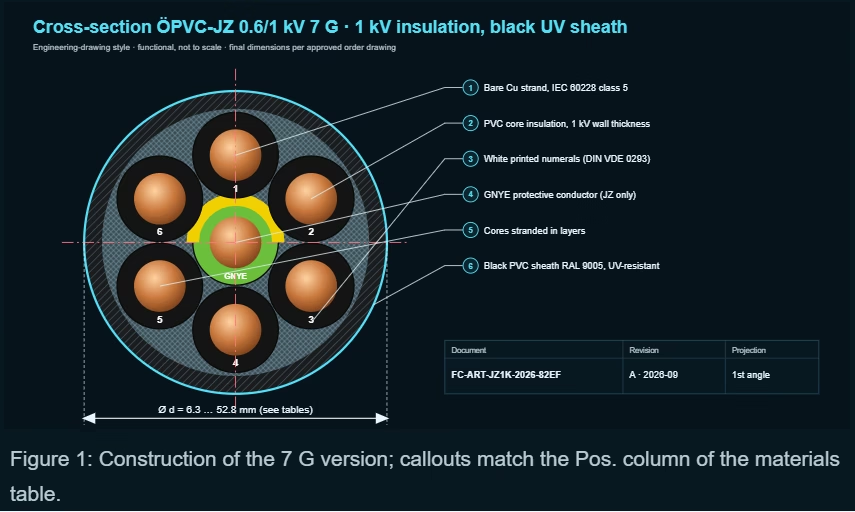
GAALFLEX® CONTROL 1000 H: Fire-Safe Zero-Halogen Low-Smoke Multi-Core Control Cable for Critical Infrastructure and Fire-Code-Regulated Installations (0.6/1 kV Nominal Voltage, 4 kV Test Voltage per DIN VDE 0281, Class 5 Flexible Red Bare Copper per IEC 60228 and DIN VDE 0295, Halogen-Free TI6 Core Insulation per DIN VDE 0482 and IEC 60754-1, Black (RAL 9005) UV-Resistant Halogen-Free Compound Type TM7 Outer Sheath Enabling Complete Zero Halogenated Acid Gas Release (HCl/HBr/HF

GAALFLEX® CONTROL 1000 H

GAALFLEX® CONTROL 1000 H: Fire-Safe Zero-Halogen Low-Smoke Multi-Core Control Cable for Critical Infrastructure and Fire-Code-Regulated Installations (0.6/1 kV Nominal Voltage, 4 kV Test Voltage per DIN VDE 0281, Class 5 Flexible Red Bare Copper per IEC 60228 and DIN VDE 0295, Halogen-Free TI6 Core Insulation per DIN VDE 0482 and IEC 60754-1, Black (RAL 9005) UV-Resistant Halogen-Free Compound Type TM7 Outer Sheath Enabling Complete Zero Halogenated Acid Gas Release (HCl/HBr/HF
HT-PNCT-F cable, Korean standard cable, high tension cable, port equipment cable, festoon-reel cable, unloader cable, stacker cable, reclaimer cable, gantry crane cable, tape braid reinforcement, 0.6/1KV cable, KSC 3317, IEC 60502-1, tape reinforcement, braid reinforcement, cable architecture, layer structure, synthetic tape, polyester tape, polypropylene tape, braid layer, glass-fiber reinforced nylon, hybrid reinforcement, tape-braid hybrid, load-carrying mechanism, copper conductor, Class 2 stranding, EP rubber insulation, chloroprene sheath, outer diameter, cable weight, conductor resistance, insulation resistance, test voltage, dielectric strength, tensile strength, flex-cycle endurance, impact resistance, bending flexibility, reelability, environmental durability, saltwater resistance, UV resistance, thermal cycling, flame retardance, operational temperature, 3-core configuration, 4-core configuration, conductor size range, ship unloader, gantry crane, stacker reclaimer, mobile harbour crane, conveyor drive system, reel preparation, minimum bend radius, cable winding, slip ring termination, preventive maintenance, insulation resistance test, quality assurance, electrical testing, mechanical testing, reinforcement layer testing, environmental testing, reel-specific testing, ASTM B117, IEC 60811, ISO 12947, IEC 60331-1, Feichun HT-PNCT-F, HT-PNCT-F-S shielded, HT-PNCT-F-EX enhanced braid, HT-PNCT-F-SX full premium, VFD cable, EMI shielding, port terminal, Busan port, Korean Industrial Standard, festoon power supply, reel-mounted equipment

HT-PNCT-F Korean Standard High Tension Cables

HT-PNCT-F cable, Korean standard cable, high tension cable, port equipment cable, festoon-reel cable, unloader cable, stacker cable, reclaimer cable, gantry crane cable, tape braid reinforcement, 0.6/1KV cable, KSC 3317, IEC 60502-1, tape reinforcement, braid reinforcement, cable architecture, layer structure, synthetic tape, polyester tape, polypropylene tape, braid layer, glass-fiber reinforced nylon, hybrid reinforcement, tape-braid hybrid, load-carrying mechanism, copper conductor, Class 2 stranding, EP rubber insulation, chloroprene sheath, outer diameter, cable weight, conductor resistance, insulation resistance, test voltage, dielectric strength, tensile strength, flex-cycle endurance, impact resistance, bending flexibility, reelability, environmental durability, saltwater resistance, UV resistance, thermal cycling, flame retardance, operational temperature, 3-core configuration, 4-core configuration, conductor size range, ship unloader, gantry crane, stacker reclaimer, mobile harbour crane, conveyor drive system, reel preparation, minimum bend radius, cable winding, slip ring termination, preventive maintenance, insulation resistance test, quality assurance, electrical testing, mechanical testing, reinforcement layer testing, environmental testing, reel-specific testing, ASTM B117, IEC 60811, ISO 12947, IEC 60331-1, Feichun HT-PNCT-F, HT-PNCT-F-S shielded, HT-PNCT-F-EX enhanced braid, HT-PNCT-F-SX full premium, VFD cable, EMI shielding, port terminal, Busan port, Korean Industrial Standard, festoon power supply, reel-mounted equipment
The TRATOSFLEX-ES3-FO® Type K with BiTservo LED revolutionizes deepwater drilling operations by embedding permanent illumination directly into the deployment cable infrastructure. The Four-Capability Integration Advantage No previous deepwater cable has combined these four capabilities in a single product: Ultra-High-Speed Reeling (200 m/min): Deploys 3000 metres of cable in 15 minutes (vs. 45–60 minutes on conventional systems), reducing surface vessel idle time and mission costs. Self-Luminous LED Illumination: No external power, no ROV-mounted lights—just electromagnetic-powered continuous illumination along the entire riser deployment, enabling visual confirmation of BOP positioning and subsea equipment status. Fiber Optic Real-Time Telemetry: 24 fiber cores (single-mode + multi-mode selectable) transmit sensor data, video, and control signals at 10+ Gbps bandwidth, enabling autonomous BOP control and real-time decision support. Distributed Temperature Sensing (DTS): Every 1 metre along the cable, optical temperature sensing measures riser temperature, enabling thermal profiling of subsea conditions and wellbore integrity assessment without additional sensors.

TRATOSFLEX-ES3-FO® Type K + BiTservo LED

The TRATOSFLEX-ES3-FO® Type K with BiTservo LED revolutionizes deepwater drilling operations by embedding permanent illumination directly into the deployment cable infrastructure. The Four-Capability Integration Advantage No previous deepwater cable has combined these four capabilities in a single product: Ultra-High-Speed Reeling (200 m/min): Deploys 3000 metres of cable in 15 minutes (vs. 45–60 minutes on conventional systems), reducing surface vessel idle time and mission costs. Self-Luminous LED Illumination: No external power, no ROV-mounted lights—just electromagnetic-powered continuous illumination along the entire riser deployment, enabling visual confirmation of BOP positioning and subsea equipment status. Fiber Optic Real-Time Telemetry: 24 fiber cores (single-mode + multi-mode selectable) transmit sensor data, video, and control signals at 10+ Gbps bandwidth, enabling autonomous BOP control and real-time decision support. Distributed Temperature Sensing (DTS): Every 1 metre along the cable, optical temperature sensing measures riser temperature, enabling thermal profiling of subsea conditions and wellbore integrity assessment without additional sensors.
The BiTmining® (N)TMCGCWOEU single-core cable represents a specialized category of flexible medium-voltage power conductors designed for point-to-point connections in mining and industrial applications. Unlike three-phase trailing cables (such as the (N)3GHSSYCY), which bundle all three conductors plus grounding and monitoring wires into one integrated package, single-core cables deliver individual high-voltage conductors for use in short-length, targeted applications: switchgear cubicle connections, mobile transformer substations, power feeder distribution, and inter-equipment busbar connections.

FeiChun BiTmining® LED Self-Luminous Single-Core Cable

The BiTmining® (N)TMCGCWOEU single-core cable represents a specialized category of flexible medium-voltage power conductors designed for point-to-point connections in mining and industrial applications. Unlike three-phase trailing cables (such as the (N)3GHSSYCY), which bundle all three conductors plus grounding and monitoring wires into one integrated package, single-core cables deliver individual high-voltage conductors for use in short-length, targeted applications: switchgear cubicle connections, mobile transformer substations, power feeder distribution, and inter-equipment busbar connections.
H07ZZ-F® is the premium safety-critical flexible cable engineered specifically for applications where fire risk mitigation and occupant protection are non-negotiable priorities: data centres with mission-critical servers and power distribution infrastructure, hospitals and healthcare facilities where patient safety depends on reliable systems, schools and universities with dense occupancy, hospitality venues with premium safety requirements, and all building installations where minimizing fire risk and toxic gas exposure is mandated by building codes and regulatory authorities. Unlike standard cables that release deadly toxic halogenated gases when exposed to fire, the H07ZZ-F features halogen-free FRNC insulation and sheath, minimal smoke production, and EI8 heat-resistant rubber construction designed to limit fire spread, minimize smoke evacuation hazards, and provide maximum time for occupant escape in fire emergencies

H07ZZ-F® Premium Flexible Cable

H07ZZ-F® is the premium safety-critical flexible cable engineered specifically for applications where fire risk mitigation and occupant protection are non-negotiable priorities: data centres with mission-critical servers and power distribution infrastructure, hospitals and healthcare facilities where patient safety depends on reliable systems, schools and universities with dense occupancy, hospitality venues with premium safety requirements, and all building installations where minimizing fire risk and toxic gas exposure is mandated by building codes and regulatory authorities. Unlike standard cables that release deadly toxic halogenated gases when exposed to fire, the H07ZZ-F features halogen-free FRNC insulation and sheath, minimal smoke production, and EI8 heat-resistant rubber construction designed to limit fire spread, minimize smoke evacuation hazards, and provide maximum time for occupant escape in fire emergencies
Not every STS crane needs ETFE insulation, 56 cores, or integrated fiber optics. The vast majority of the world's operational STS crane fleet — thousands of cranes at hundreds of terminals — uses a simple, proven, 36-core control cable on the spreader reel. That cable is the Cordaflex® (N)SHTOEU (SMK)-V-S: a single-configuration workhorse with basic EPR insulation that every port electrician can strip and terminate using standard tools, a 36×2.5 + protective conductor core count that covers the circuit requirements of standard (non-automated) spreaders, and a construction that shares the premium vertical-rated architecture (Class FS, aramide, PCP rubber, ±50°/m torsion) of its more exotic siblings.

Cordaflex® (N)SHTOEU (SMK)-V-S

Not every STS crane needs ETFE insulation, 56 cores, or integrated fiber optics. The vast majority of the world’s operational STS crane fleet — thousands of cranes at hundreds of terminals — uses a simple, proven, 36-core control cable on the spreader reel. That cable is the Cordaflex® (N)SHTOEU (SMK)-V-S: a single-configuration workhorse with basic EPR insulation that every port electrician can strip and terminate using standard tools, a 36×2.5 + protective conductor core count that covers the circuit requirements of standard (non-automated) spreaders, and a construction that shares the premium vertical-rated architecture (Class FS, aramide, PCP rubber, ±50°/m torsion) of its more exotic siblings.
URSUS VS replacement, Aristoncavi URSUS alternative, NSHTOU cable, NSHTOU-O, NSHTOU-J, URSUS reeling cable, heavy duty rubber reeling cable, 0.6/1kV reeling cable, vertical reeling cable, container crane power cable, tinned copper class 5, 30 N/mm2 tensile cable, anti torsion rubber cable, 5GM5 rubber sheath, yellow elastomer cable, dynamic load crane cable, Feichun reeling cable, Feichun crane cable, Chinese premium crane cable, import substitution cable, 180 m/min crane cable, continuous flexing rubber cable, UV resistant reeling cable, ozone resistant crane cable, flame retardant rubber cable, harbour crane electrification, material handling cable, heavy machinery wiring, robust industrial rubber cable, flexible power transmission, torsional stress cable, high tensile strength crane cable, port terminal electrification, mechanical stress reeling, offshore crane power cable, motorized drum cable, European standard equivalent, Prysmian reeling alternative, Draka crane equivalent, Lapp cable alternative, TF Kable reeling equivalent, sanction free crane cable, direct factory reeling cable, custom crane cable, heavy duty hoist cable, extreme tension crane cable, VDE standard reeling cable, underground tunneling cable, high speed winding cable, STS crane power cable

URSUS® VS 0.6/1 kV

URSUS VS replacement, Aristoncavi URSUS alternative, NSHTOU cable, NSHTOU-O, NSHTOU-J, URSUS reeling cable, heavy duty rubber reeling cable, 0.6/1kV reeling cable, vertical reeling cable, container crane power cable, tinned copper class 5, 30 N/mm2 tensile cable, anti torsion rubber cable, 5GM5 rubber sheath, yellow elastomer cable, dynamic load crane cable, Feichun reeling cable, Feichun crane cable, Chinese premium crane cable, import substitution cable, 180 m/min crane cable, continuous flexing rubber cable, UV resistant reeling cable, ozone resistant crane cable, flame retardant rubber cable, harbour crane electrification, material handling cable, heavy machinery wiring, robust industrial rubber cable, flexible power transmission, torsional stress cable, high tensile strength crane cable, port terminal electrification, mechanical stress reeling, offshore crane power cable, motorized drum cable, European standard equivalent, Prysmian reeling alternative, Draka crane equivalent, Lapp cable alternative, TF Kable reeling equivalent, sanction free crane cable, direct factory reeling cable, custom crane cable, heavy duty hoist cable, extreme tension crane cable, VDE standard reeling cable, underground tunneling cable, high speed winding cable, STS crane power cable
BiTcrane® (N)3GRD5G is not one cable—it is an entire festoon cable system. With over 40 standard configurations spanning four distinct product families—single-core power, multi-core control, three-phase motor power, and paired signal cables—BiTcrane provides every cable type needed to build a complete crane festoon electrical system from a single manufacturer, a single specification, a single rubber compound system, and a single 240 m/min speed rating.

BiTcrane® (N)3GRD5G

BiTcrane® (N)3GRD5G is not one cable—it is an entire festoon cable system. With over 40 standard configurations spanning four distinct product families—single-core power, multi-core control, three-phase motor power, and paired signal cables—BiTcrane provides every cable type needed to build a complete crane festoon electrical system from a single manufacturer, a single specification, a single rubber compound system, and a single 240 m/min speed rating.
SPREADERFLEX BSKT XPRT SYSLTOE FO is the most specialised cable in the entire port crane electrification portfolio—a 0.6/1 kV composite power and fiber optic basket festoon cable engineered by Anhui Feichun Special Cable Co., Ltd. exclusively for the vertical basket festoon systems that connect container crane spreaders to the trolley structure. No other application on Earth subjects a cable to this specific combination of mechanical stresses: the cable must hang vertically under its own weight for up to 50 metres, fold and unfold inside a guide basket as the spreader rises and descends, travel at speeds up to 160 m/min during container lift and lower cycles, and simultaneously carry up to 48 copper conductor cores for power and control alongside up to 18 optical fibers for high-speed data communication—all without tangling, twisting, kinking, or damaging the fragile glass fibers.

SPREADERFLEX BSKT XPRTSYSLTOE FO

SPREADERFLEX BSKT XPRT SYSLTOE FO is the most specialised cable in the entire port crane electrification portfolio—a 0.6/1 kV composite power and fiber optic basket festoon cable engineered by Anhui Feichun Special Cable Co., Ltd. exclusively for the vertical basket festoon systems that connect container crane spreaders to the trolley structure. No other application on Earth subjects a cable to this specific combination of mechanical stresses: the cable must hang vertically under its own weight for up to 50 metres, fold and unfold inside a guide basket as the spreader rises and descends, travel at speeds up to 160 m/min during container lift and lower cycles, and simultaneously carry up to 48 copper conductor cores for power and control alongside up to 18 optical fibers for high-speed data communication—all without tangling, twisting, kinking, or damaging the fragile glass fibers.
Manufacturer's technical guide: PROTOLON (SB) NTSCGEWOEU-LED, FeiChun's VDE 0250-813 and MSHA P-189-4 certified MV trailing cable with integrated self-powered LED illumination rated for −50 °C. Split earth three-core design. SHD-GC type. Shovel visibility. Dragline tail-rope illumination. Zero external DC supply. Direct factory manufacturer.

TENAX-CORD (RTS) NSHTOEU-LED 0,6/1 kV: Self-Powered LED Spreader Reeling Cable for High-Speed Container Crane Systems

TENAX-CORD (RTS) NSHTOEU-LED | 0,6/1 kV | FC-TPU™ P-Series Translucent Sheath | 7 Constructions 36×2.5–72×2.5 mm | Up to 3,300 A (44×2.5 core) | Port, Container Terminal, Automated Handling Applications | 240 m/min Vertical Reeling Speed
TFCrane replacement, TF Kable TFCrane alternative, Tele-Fonika crane cable, STS crane reeling cable, RTG crane power cable, motorized drum cable, heavy duty reeling cable, Feichun reeling cable, Feichun crane cable, Chinese premium crane cable, import substitution crane, VDE 0250-814 cable, NSHTOU equivalent, NTSCGEWOU equivalent, anti torsion cable, torsion resistant reeling, EPR insulation 3GI3, 5GM5 outer sheath, neoprene trailing cable, continuous flexing cable, dynamic load reeling, high tensile strength reel, corkscrew resistant cable, flame retardant drum cable, oil resistant reeling cable, UV resistant crane cable, weather resistant reeling, ship unloader cable, RMG crane cable, tinned copper class 5, multi core reeling cable, heavy machinery wiring, industrial heavy flex, European standard equivalent, Prysmian PROTOMONT alternative, Nexans RHEYFIRM equivalent, Lapp crane alternative, sanction free crane cable, direct factory reeling cable, port terminal electrification, thick rubber sheath cable, mechanical stress cable, offshore crane power, mobile substation reeling, high speed winding cable, Feichun special cable, flexible power cable, dragline reeling cable, port equipment electrification, container handling cable

TFCrane Equivalent Reeling Cable for STS and RTG Cranes: TF Kable (Tele-Fonika) to FeiChun Drop-In Replacement — VDE 0250-814 / 0250-813, Anti-Torsion Braid Engineering, High-Speed Motorised Drum Compatibility

TFCrane replacement, TF Kable TFCrane alternative, Tele-Fonika crane cable, STS crane reeling cable, RTG crane power cable, motorized drum cable, heavy duty reeling cable, Feichun reeling cable, Feichun crane cable, Chinese premium crane cable, import substitution crane, VDE 0250-814 cable, NSHTOU equivalent, NTSCGEWOU equivalent, anti torsion cable, torsion resistant reeling, EPR insulation 3GI3, 5GM5 outer sheath, neoprene trailing cable, continuous flexing cable, dynamic load reeling, high tensile strength reel, corkscrew resistant cable, flame retardant drum cable, oil resistant reeling cable, UV resistant crane cable, weather resistant reeling, ship unloader cable, RMG crane cable, tinned copper class 5, multi core reeling cable, heavy machinery wiring, industrial heavy flex, European standard equivalent, Prysmian PROTOMONT alternative, Nexans RHEYFIRM equivalent, Lapp crane alternative, sanction free crane cable, direct factory reeling cable, port terminal electrification, thick rubber sheath cable, mechanical stress cable, offshore crane power, mobile substation reeling, high speed winding cable, Feichun special cable, flexible power cable, dragline reeling cable, port equipment electrification, container handling cable
The (N)TSFLCGEWÖU 4x185 0.6/1kV heavy-duty festoon cable has a nominal weight of 10,500 kg/km (kilograms per kilometer), which converts to 7.06 lbs/ft (pounds per foot) in imperial units. The copper conductor weight alone is approximately 7,104 kg/km (4.77 lbs/ft), meaning the insulation, sheath, and other components add roughly 3,396 kg/km of additional mass. These figures assume production to standard VDE 0250-809 specifications with typical EPR (Ethylene Propylene Rubber) insulation and polychloroprene outer sheath. The actual weight of any individual cable can vary by ±5% to ±8% depending on the specific rubber compound formulation, the density of the materials used, and the precision of the extrusion process employed by the manufacturer.

Weight Calculator for (N)TSFLCGEWÖU 4×185 0.6/1kV Festoon Cable: kg/km and lbs/ft Conversions

The (N)TSFLCGEWÖU 4×185 0.6/1kV heavy-duty festoon cable has a nominal weight of 10,500 kg/km (kilograms per kilometer), which converts to 7.06 lbs/ft (pounds per foot) in imperial units. The copper conductor weight alone is approximately 7,104 kg/km (4.77 lbs/ft), meaning the insulation, sheath, and other components add roughly 3,396 kg/km of additional mass. These figures assume production to standard VDE 0250-809 specifications with typical EPR (Ethylene Propylene Rubber) insulation and polychloroprene outer sheath. The actual weight of any individual cable can vary by ±5% to ±8% depending on the specific rubber compound formulation, the density of the materials used, and the precision of the extrusion process employed by the manufacturer.
Prysmian TECWATER 3x120 mm² submersible pump cable has a standardized maximum operating depth of approximately 10 meters under the VDE certification standard (DIN VDE 0298-300) in typical industrial environments. This 10-meter specification assumes normal freshwater conditions, moderate water quality without unusual corrosive properties, and water temperature not exceeding 40°C. However, in extended applications involving less corrosive water sources (such as industrial cooling water circuits, mining surface drainage, or rainwater collection systems) where inspection and maintenance requirements are relaxed, the cable can operate at depths up to 500 meters, provided all mechanical stresses are carefully managed and the cable is protected from snapping or mechanical damage during deployment. The relationship between depth and service life is non-linear and governed by hydrostatic pressure physics, material science principles regarding polymer behavior under sustained compression, and the synergistic effects of pressure and temperature on insulation degradation. Understanding the distinction between the standardized 10-meter specification and the extended 500-meter capability requires appreciation for how hydrostatic pressure actually affects cable materials, what additional engineering controls are necessary at greater depths, and what real-world scenarios justify each depth rating. A cable suitable for a 10-meter municipal wastewater pumping station is fundamentally different in its application requirements from a cable operating at 500 meters in a deep mining shaft, yet both use the same basic material formulation because the cable itself is equally capable—the difference lies in system design, installation procedures, and operational monitoring protocols.

Water Submersion Depth: Maximum Continuous Operating Depth for Prysmian TECWATER 3×120 mm² Submersible Pump Cable

Prysmian TECWATER 3×120 mm² submersible pump cable has a standardized maximum operating depth of approximately 10 meters under the VDE certification standard (DIN VDE 0298-300) in typical industrial environments. This 10-meter specification assumes normal freshwater conditions, moderate water quality without unusual corrosive properties, and water temperature not exceeding 40°C. However, in extended applications involving less corrosive water sources (such as industrial cooling water circuits, mining surface drainage, or rainwater collection systems) where inspection and maintenance requirements are relaxed, the cable can operate at depths up to 500 meters, provided all mechanical stresses are carefully managed and the cable is protected from snapping or mechanical damage during deployment. The relationship between depth and service life is non-linear and governed by hydrostatic pressure physics, material science principles regarding polymer behavior under sustained compression, and the synergistic effects of pressure and temperature on insulation degradation. Understanding the distinction between the standardized 10-meter specification and the extended 500-meter capability requires appreciation for how hydrostatic pressure actually affects cable materials, what additional engineering controls are necessary at greater depths, and what real-world scenarios justify each depth rating. A cable suitable for a 10-meter municipal wastewater pumping station is fundamentally different in its application requirements from a cable operating at 500 meters in a deep mining shaft, yet both use the same basic material formulation because the cable itself is equally capable—the difference lies in system design, installation procedures, and operational monitoring protocols.
The NSHTÖU-J 4G95 0.6/1kV heavy-duty reeling cable has a nominal 1-second short-circuit current rating of 9,000 amperes, with typical field variations ranging between 8,500 and 10,200 amperes depending on conductor material purity, cable geometry variations, and reference test conditions. This rating represents the maximum instantaneous fault current the cable can safely withstand for exactly one second of duration before the copper conductor temperature exceeds the absolute thermal limit of 250°C, at which point irreversible thermal damage to the EPR insulation and conductor structure begins. The cable features four 95 mm² conductors (including one integrated green/yellow earth core) of Class 5 tinned copper, an outer diameter of approximately 53–57.5 mm, and a total weight of approximately 7,600 kg/km. Under normal continuous operation at 30°C ambient temperature in free air, the cable safely carries 301 amperes without exceeding 90°C conductor temperature. However, when a short circuit occurs and fault current reaches 9,000 amperes, the same conductor experiences a 100-fold increase in current density, generating extreme Joule heating that raises conductor temperature from the pre-fault state (typically 50–70°C under load) to 250°C within one second. The underlying calculation governing this short-circuit rating is the adiabatic heating formula, a fundamental electrical engineering principle that engineers must understand to properly coordinate protection devices and prevent cable failure during electrical faults.

Short-Circuit Rating: What is the 1-Second Short-Circuit Current for NSHTÖU-J 4G95 0.6/1kV?

The NSHTÖU-J 4G95 0.6/1kV heavy-duty reeling cable has a nominal 1-second short-circuit current rating of 9,000 amperes, with typical field variations ranging between 8,500 and 10,200 amperes depending on conductor material purity, cable geometry variations, and reference test conditions. This rating represents the maximum instantaneous fault current the cable can safely withstand for exactly one second of duration before the copper conductor temperature exceeds the absolute thermal limit of 250°C, at which point irreversible thermal damage to the EPR insulation and conductor structure begins. The cable features four 95 mm² conductors (including one integrated green/yellow earth core) of Class 5 tinned copper, an outer diameter of approximately 53–57.5 mm, and a total weight of approximately 7,600 kg/km. Under normal continuous operation at 30°C ambient temperature in free air, the cable safely carries 301 amperes without exceeding 90°C conductor temperature. However, when a short circuit occurs and fault current reaches 9,000 amperes, the same conductor experiences a 100-fold increase in current density, generating extreme Joule heating that raises conductor temperature from the pre-fault state (typically 50–70°C under load) to 250°C within one second. The underlying calculation governing this short-circuit rating is the adiabatic heating formula, a fundamental electrical engineering principle that engineers must understand to properly coordinate protection devices and prevent cable failure during electrical faults.
In the Nexans handling cable catalog, yellow outer sheaths are predominantly used for low-voltage (0.6/1 kV) RHEYCORD® series cables, while red outer sheaths identify medium-voltage (3–30 kV) RHEYFIRM® series cables. This color differentiation serves as a critical visual safety indicator for voltage level identification in industrial environments. 在耐克森搬运电缆目录中,黄色外护套主要用于低压(0.6/1 kV) RHEYCORD®系列电缆,而红色外护套用于标识中压(3–30 kV) RHEYFIRM®系列电缆。这种颜色区分是工业环境中电压等级识别的重要视觉安全指标。

Yellow vs. Red Sheath: Decoding Nexans RHEYFIRM® Color Codes

In the Nexans handling cable catalog, yellow outer sheaths are predominantly used for low-voltage (0.6/1 kV) RHEYCORD® series cables, while red outer sheaths identify medium-voltage (3–30 kV) RHEYFIRM® series cables. This color differentiation serves as a critical visual safety indicator for voltage level identification in industrial environments. 在耐克森搬运电缆目录中,黄色外护套主要用于低压(0.6/1 kV) RHEYCORD®系列电缆,而红色外护套用于标识中压(3–30 kV) RHEYFIRM®系列电缆。这种颜色区分是工业环境中电压等级识别的重要视觉安全指标。
RHEYFIRM cable, RHEYFIRM RTS, RHEYFIRM RS, NTSCGEWTOEUS, NTSKCGECWÖU, Kevlar reinforced cable, aramid fiber cable, DIN VDE 0250-813, medium voltage reeling cable, ultra-long vertical travel cable, deep shaft mining cable, mine hoist cable, STS crane cable, ship-to-shore crane cable, RMG crane cable, trailing cable, EPR insulated cable, rubber sheathed flexible cable, 高压卷筒电缆, 凯夫拉加强电缆, 矿用电缆, 起重机电缆, Nexans equivalent cable, Prysmian alternative cable, coal cutter cable, tunnel boring machine cable, TBM cable, elevator traveling cable, high-rise elevator cable, steel core vs Kevlar cable, aramid strength member cable, DIN VDE 0250 Part 813 compliant, VDE mining cable, 6/10kV reeling cable, 12/20kV trailing cable, 18/30kV power cable, open-pit mining cable, underground mining cable, flexible power cable for cranes, material handling cable, tinned copper conductor cable, flame retardant mining cable, oil resistant reeling cable, ozone resistant cable, Feichun special cable, 安徽飞纯电缆, 飞纯特种电缆, NSSHCGEWÖU cable, continuous miner cable, dragline cable, stacker reclaimer cable, excavator power cable

RHEYFIRM® (RS) vs. RHEYFIRM® (RTS): When to Choose RHEYFIRM® KE Kevlar (N)TSKCGECWÖU for Ultra-Long Vertical Travel

RHEYFIRM cable, RHEYFIRM RTS, RHEYFIRM RS, NTSCGEWTOEUS, NTSKCGECWÖU, Kevlar reinforced cable, aramid fiber cable, DIN VDE 0250-813, medium voltage reeling cable, ultra-long vertical travel cable, deep shaft mining cable, mine hoist cable, STS crane cable, ship-to-shore crane cable, RMG crane cable, trailing cable, EPR insulated cable, rubber sheathed flexible cable, 高压卷筒电缆, 凯夫拉加强电缆, 矿用电缆, 起重机电缆, Nexans equivalent cable, Prysmian alternative cable, coal cutter cable, tunnel boring machine cable, TBM cable, elevator traveling cable, high-rise elevator cable, steel core vs Kevlar cable, aramid strength member cable, DIN VDE 0250 Part 813 compliant, VDE mining cable, 6/10kV reeling cable, 12/20kV trailing cable, 18/30kV power cable, open-pit mining cable, underground mining cable, flexible power cable for cranes, material handling cable, tinned copper conductor cable, flame retardant mining cable, oil resistant reeling cable, ozone resistant cable, Feichun special cable, 安徽飞纯电缆, 飞纯特种电缆, NSSHCGEWÖU cable, continuous miner cable, dragline cable, stacker reclaimer cable, excavator power cable
Let us begin by establishing what we mean by "standard" or "RS" (Regular Service) mining cables. These cables represent the baseline specification for mining operations in what we might call "normal" industrial environments—regions where winter temperatures might drop to minus 25 or minus 40 degrees Celsius, but where sustained exposure to minus 50 degrees Celsius or colder represents an exceptional rather than routine condition. Standard mining cables manufactured to specifications like ICEA S-75-381/NEMA WC-58 typically specify cold bend capability down to -40°C, which handles the vast majority of mining operations worldwide, including winter operations in Canada, northern United States, northern Europe, and parts of Russia.

How Does the “Extreme” Version Differ from Standard (RS) for Operations in -50°C Arctic Mines?

Let us begin by establishing what we mean by “standard” or “RS” (Regular Service) mining cables. These cables represent the baseline specification for mining operations in what we might call “normal” industrial environments—regions where winter temperatures might drop to minus 25 or minus 40 degrees Celsius, but where sustained exposure to minus 50 degrees Celsius or colder represents an exceptional rather than routine condition. Standard mining cables manufactured to specifications like ICEA S-75-381/NEMA WC-58 typically specify cold bend capability down to -40°C, which handles the vast majority of mining operations worldwide, including winter operations in Canada, northern United States, northern Europe, and parts of Russia.
(N)TSFLCGEWÖU cable designation follows German DIN VDE standards and represents a specific type of flat flexible cable designed for festoon applications. Understanding the nomenclature and specifications is essential for selecting cables that will perform optimally within Conductix-Wampfler festoon systems.

Conductix-Wampfler Festoon Systems: Choosing the Right (N)TSFLCGEWÖU Flat Cable

(N)TSFLCGEWÖU cable designation follows German DIN VDE standards and represents a specific type of flat flexible cable designed for festoon applications. Understanding the nomenclature and specifications is essential for selecting cables that will perform optimally within Conductix-Wampfler festoon systems.
The Atlas Copco Boltec series represents a range of mechanized rock bolting rigs designed for underground mining and tunneling operations. These machines are engineered to install rock bolts efficiently in challenging subterranean environments, requiring robust electrical systems capable of withstanding extreme mechanical stress, moisture exposure, and continuous operational demands. 阿特拉斯·科普柯 Boltec 系列是专为地下采矿和隧道作业设计的机械化锚杆钻机。这些设备在恶劣的地下环境中高效安装锚杆,其电气系统需要承受极端机械应力、潮湿环境和持续运行的考验。

Atlas Copco Boltec: Feed Cable Selection & Replacement Guide

The Atlas Copco Boltec series represents a range of mechanized rock bolting rigs designed for underground mining and tunneling operations. These machines are engineered to install rock bolts efficiently in challenging subterranean environments, requiring robust electrical systems capable of withstanding extreme mechanical stress, moisture exposure, and continuous operational demands. 阿特拉斯·科普柯 Boltec 系列是专为地下采矿和隧道作业设计的机械化锚杆钻机。这些设备在恶劣的地下环境中高效安装锚杆,其电气系统需要承受极端机械应力、潮湿环境和持续运行的考验。
To understand why cable sheaths in underground coal mines must be electrically conductive, we need to first explore the fundamental physics of static electricity and why it poses such an extraordinary danger in mining environments. This requirement, mandated by AS/NZS 1802:2018, is not merely a technical specification but rather a critical safety measure that has evolved from decades of mining experience and, unfortunately, from lessons learned through tragic accidents. 要理解为什么地下煤矿中的电缆护套必须具有导电性,我们首先需要探讨静电的基本物理原理,以及为什么它在采矿环境中构成如此巨大的危险。AS/NZS 1802:2018要求的这一规定不仅仅是一个技术规范,而是一项从数十年的采矿经验以及不幸的事故教训中演变而来的关键安全措施。

Explosion Risk Prevention: Why AS/NZS 1802 Cable Sheaths Must Be Electrically Conductive

To understand why cable sheaths in underground coal mines must be electrically conductive, we need to first explore the fundamental physics of static electricity and why it poses such an extraordinary danger in mining environments. This requirement, mandated by AS/NZS 1802:2018, is not merely a technical specification but rather a critical safety measure that has evolved from decades of mining experience and, unfortunately, from lessons learned through tragic accidents. 要理解为什么地下煤矿中的电缆护套必须具有导电性,我们首先需要探讨静电的基本物理原理,以及为什么它在采矿环境中构成如此巨大的危险。AS/NZS 1802:2018要求的这一规定不仅仅是一个技术规范,而是一项从数十年的采矿经验以及不幸的事故教训中演变而来的关键安全措施。
Before we can properly discuss earthing techniques, we need to build a solid understanding of what (N)TSCGECEWÖU cables are and why their semiconductive screens require such careful attention. These cables represent one of the most sophisticated designs in medium voltage flexible power transmission, and understanding their construction will help you see why proper earthing is not just important but absolutely critical for safe operation.

How to properly earth the semiconductive screen of an (N)TSCGECEWÖU cable to prevent arcing?

Before we can properly discuss earthing techniques, we need to build a solid understanding of what (N)TSCGECEWÖU cables are and why their semiconductive screens require such careful attention. These cables represent one of the most sophisticated designs in medium voltage flexible power transmission, and understanding their construction will help you see why proper earthing is not just important but absolutely critical for safe operation.
NSSHÖU cables represent a specialized category of heavy-duty rubber mining cables designed to operate in the most demanding industrial environments. These cables conform to VDE 0250 part 812 specifications, which establish rigorous requirements for cables subjected to high mechanical stress during mining operations, construction equipment applications, and mobile machinery installations. The outer sheath of NSSHÖU cables provides critical protection against abrasion, cutting, tearing, oil penetration, and water ingress, making its integrity essential for maintaining safe electrical performance and achieving IP67 water resistance ratings.

How to Repair a Torn Outer Sheath on NSSHÖU Cable to Maintain IP67 Water Resistance

NSSHÖU cables represent a specialized category of heavy-duty rubber mining cables designed to operate in the most demanding industrial environments. These cables conform to VDE 0250 part 812 specifications, which establish rigorous requirements for cables subjected to high mechanical stress during mining operations, construction equipment applications, and mobile machinery installations. The outer sheath of NSSHÖU cables provides critical protection against abrasion, cutting, tearing, oil penetration, and water ingress, making its integrity essential for maintaining safe electrical performance and achieving IP67 water resistance ratings.
(N)TSCGEWÖU cable designation represents a specialized category of medium-voltage flexible power cables manufactured according to the stringent requirements of German standard DIN VDE 0250-813. These cables are specifically engineered for demanding applications in underground mining operations, tunnelling projects, and heavy industrial installations where conventional power cables would fail under the combined stresses of mechanical loading, chemical exposure, and harsh environmental conditions. The nomenclature follows German cable designation conventions where "T" indicates fine-stranded conductors for maximum flexibility, "SC" denotes semiconductive screening layers, "G" represents flexible insulation compound, "E" signifies earth conductors, "W" indicates oil-resistant properties, and "Ö" confirms oil and chemical resistance of the outer sheath.

Ampacity Derating: How Much Current Can (N)TSCGEWÖU Carry When Wound in 3 Layers on a Drum?

(N)TSCGEWÖU cable designation represents a specialized category of medium-voltage flexible power cables manufactured according to the stringent requirements of German standard DIN VDE 0250-813. These cables are specifically engineered for demanding applications in underground mining operations, tunnelling projects, and heavy industrial installations where conventional power cables would fail under the combined stresses of mechanical loading, chemical exposure, and harsh environmental conditions. The nomenclature follows German cable designation conventions where “T” indicates fine-stranded conductors for maximum flexibility, “SC” denotes semiconductive screening layers, “G” represents flexible insulation compound, “E” signifies earth conductors, “W” indicates oil-resistant properties, and “Ö” confirms oil and chemical resistance of the outer sheath.
In industrial cable applications involving continuous reeling and unreeling operations, cable integrity under mechanical stress is paramount. One critical structural element that ensures operational reliability is the anti-torsion braid, also known as an embedded textile mesh, positioned within the cable sheath. This technical component plays a vital role in maintaining cable performance in demanding environments such as crane systems, hoists, conveyor belts, and mobile machinery. 在涉及连续收卷和放卷操作的工业电缆应用中,机械应力下的电缆完整性至关重要。确保操作可靠性的一个关键结构元件是反扭转编织层,也称为嵌入式纺织网,位于电缆护套内。该技术组件在起重机系统、提升机、传送带和移动机械等苛刻环境中维护电缆性能方面起着至关重要的作用。

How Does the Anti-Torsion Braid Prevent Cable Twisting During Reeling?

In industrial cable applications involving continuous reeling and unreeling operations, cable integrity under mechanical stress is paramount. One critical structural element that ensures operational reliability is the anti-torsion braid, also known as an embedded textile mesh, positioned within the cable sheath. This technical component plays a vital role in maintaining cable performance in demanding environments such as crane systems, hoists, conveyor belts, and mobile machinery. 在涉及连续收卷和放卷操作的工业电缆应用中,机械应力下的电缆完整性至关重要。确保操作可靠性的一个关键结构元件是反扭转编织层,也称为嵌入式纺织网,位于电缆护套内。该技术组件在起重机系统、提升机、传送带和移动机械等苛刻环境中维护电缆性能方面起着至关重要的作用。
While both (N)TSCGEWÖU and (N)TMCGEWÖU are premium rubber-sheathed medium voltage cables designed for dynamic applications, they serve fundamentally different mechanical purposes. The core distinction lies in the letter "S" versus "M" in their VDE designation, which dictates their internal structural reinforcement. 虽然 (N)TSCGEWÖU 和 (N)TMCGEWÖU 都是专为动态应用设计的优质橡胶护套中压电缆,但它们在机械用途上有着本质的区别。核心区别在于其 VDE 型号中的字母“S”与“M”,这决定了它们内部的结构增强方式。

What are the key design differences between (N)TSCGEWÖU (High Voltage Reeling) and (N)TMCGEWÖU (Medium Voltage Trailing)?

While both (N)TSCGEWÖU and (N)TMCGEWÖU are premium rubber-sheathed medium voltage cables designed for dynamic applications, they serve fundamentally different mechanical purposes. The core distinction lies in the letter “S” versus “M” in their VDE designation, which dictates their internal structural reinforcement. 虽然 (N)TSCGEWÖU 和 (N)TMCGEWÖU 都是专为动态应用设计的优质橡胶护套中压电缆,但它们在机械用途上有着本质的区别。核心区别在于其 VDE 型号中的字母“S”与“M”,这决定了它们内部的结构增强方式。
Medium voltage reeling cables conforming to DIN VDE 0250-813 employ a systematic letter coding system that communicates precise information about cable construction, materials, and performance characteristics. Within this nomenclature, each letter position corresponds to a specific structural element or material property, enabling engineers to identify critical design features at a glance.[1][2] 符合DIN VDE 0250-813标准的中压卷筒电缆采用系统性的字母编码系统,传达电缆结构、材料和性能特性的精确信息。在该命名法中,每个字母位置对应特定的结构元素或材料属性,使工程师能够一目了然地识别关键设计特征。

What Does the Letter “C” Indicate in (N)TSCGEWÖU Versus “K” in (N)TSKCGEWÖU?

Medium voltage reeling cables conforming to DIN VDE 0250-813 employ a systematic letter coding system that communicates precise information about cable construction, materials, and performance characteristics. Within this nomenclature, each letter position corresponds to a specific structural element or material property, enabling engineers to identify critical design features at a glance.[1][2] 符合DIN VDE 0250-813标准的中压卷筒电缆采用系统性的字母编码系统,传达电缆结构、材料和性能特性的精确信息。在该命名法中,每个字母位置对应特定的结构元素或材料属性,使工程师能够一目了然地识别关键设计特征。
NSHTÖU Standard Reeling Cable General-purpose low voltage reeling cable for RTG main power distribution and RMG trolley festoon applications. Features robust chloroprene rubber (CR) outer sheath providing excellent weather, oil, and abrasion resistance for outdoor port environments.

Gantry Crane Cable Systems: Complete Technical Guide for RTG and RMG Container Terminals

Beyond mechanical flexibility, EPR demonstrates superior resistance to thermal aging compared to PVC alternatives. Spreader cables, hanging vertically in outdoor service, experience continuous UV radiation exposure along their entire suspended length. EPR compounds formulated for outdoor cable service incorporate carbon black and antioxidant additives that protect against UV-induced degradation, maintaining insulation integrity and mechanical properties over decades of exposure. The material also resists ozone attack, another common degradation mechanism for elastomeric materials in outdoor industrial environments where electrical equipment generates ozone as a byproduct of corona discharge and sparking.
PROTOMONT(MT) (N)SHOEU

PROTOMONT(MT) (N)SHOEU 1 kV

PROTOMONT MT SHOEU cable, light flexible mining cable, conveyor belt cable, submersible pump 500m, upper lower car connection, shiftable unit cable, material handling cable, cable suspension, water resistant mining cable
PROTOMONT EMV-FC (N)SSHCOEU 1 kV: Technical Guide for Variable Frequency Drive Cables with EMC Shielding and Submersible Capability for Mining Material Handling Equipment

PROTOMONT EMV-FC (N)SSHCOEU 1 kV

PROTOMONT EMV-FC cable, SSHCOEU VFD cable, variable frequency drive cable, frequency converter cable, EMC shielded motor cable, submersible mining cable, cable boom power, upper lower car connection, VFD mining cable
PROTOMONT TBM cable, TSCGECWHXOEU halogen-free, tunnel boring machine cable, TBM reeling cable, 6/10 kV tunneling cable, halogen-free mining cable, EVA sheath cable, fire resistant TBM cable, underground tunneling power

PROTOMONT TBM (N)TSCGECWHXOEU 6/10 kV

PROTOMONT TBM cable, TSCGECWHXOEU halogen-free, tunnel boring machine cable, TBM reeling cable, 6/10 kV tunneling cable, halogen-free mining cable, EVA sheath cable, fire resistant TBM cable, underground tunneling power
PROTOMONT(MT) (N)SHOEU

PROTOMONT(MT) (N)SHOEU 1 kV Light & Flexible Rubber Cable

The designation (N)SHOEU within the German VDE cable nomenclature system identifies a specific cable construction optimized for applications requiring exceptional flexibility and reduced weight while maintaining robust environmental protection characteristics essential for industrial and mining applications. The single “S” designation, distinguishing (N)SHOEU from the double “SS” in NSSHOEU variants, signifies Strapazierfähig (heavy-duty) rather than Spezial Strapazierfähig (special heavy-duty), indicating an optimized balance between mechanical strength and flexibility. This optimization enables (N)SHOEU cables to achieve approximately fifteen to twenty-five percent weight reduction compared to NSSHOEU equivalents while maintaining adequate mechanical properties for applications not subjected to the most extreme stress conditions characteristic of coal cutter cable chain operations or heavy continuous miner trailing cable applications.
PROTOMONT(V) NTSKCGECWOEU MV Chain Cable Advanced Double Screen Technology with Cold Removable Semi-Conductive Layer for Underground Mining Applications

PROTOMONT(V) NTSKCGECWOEU MV Chain Cable

PROTOMONT(V) NTSKCGECWOEU represents a pinnacle achievement in mining cable technology, specifically engineered for medium voltage chain cable applications in underground coal mining operations. This advanced cable system integrates double screen technology with cold removable semi-conductive layers, delivering unprecedented reliability in the most demanding underground environments where mechanical stress, temperature extremes, and continuous operation are standard requirements.