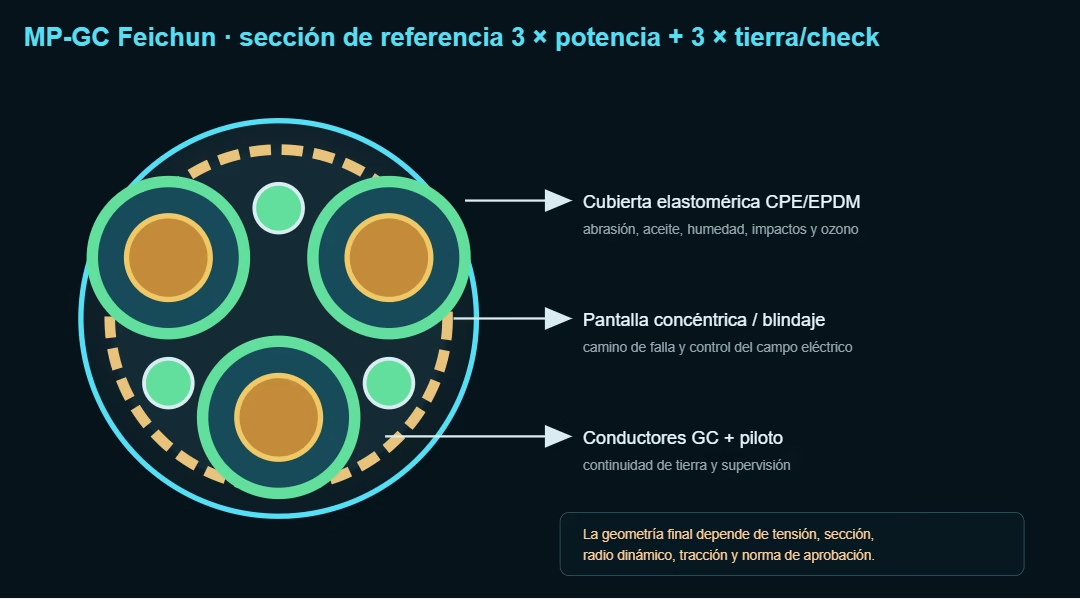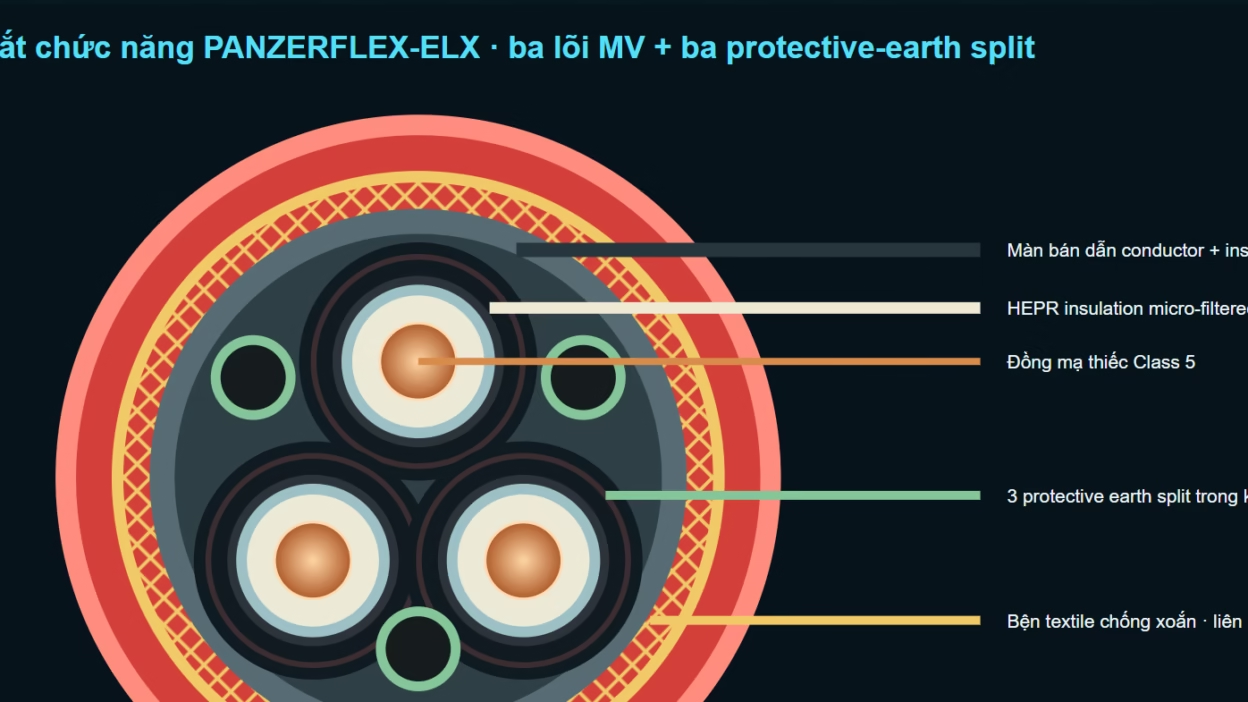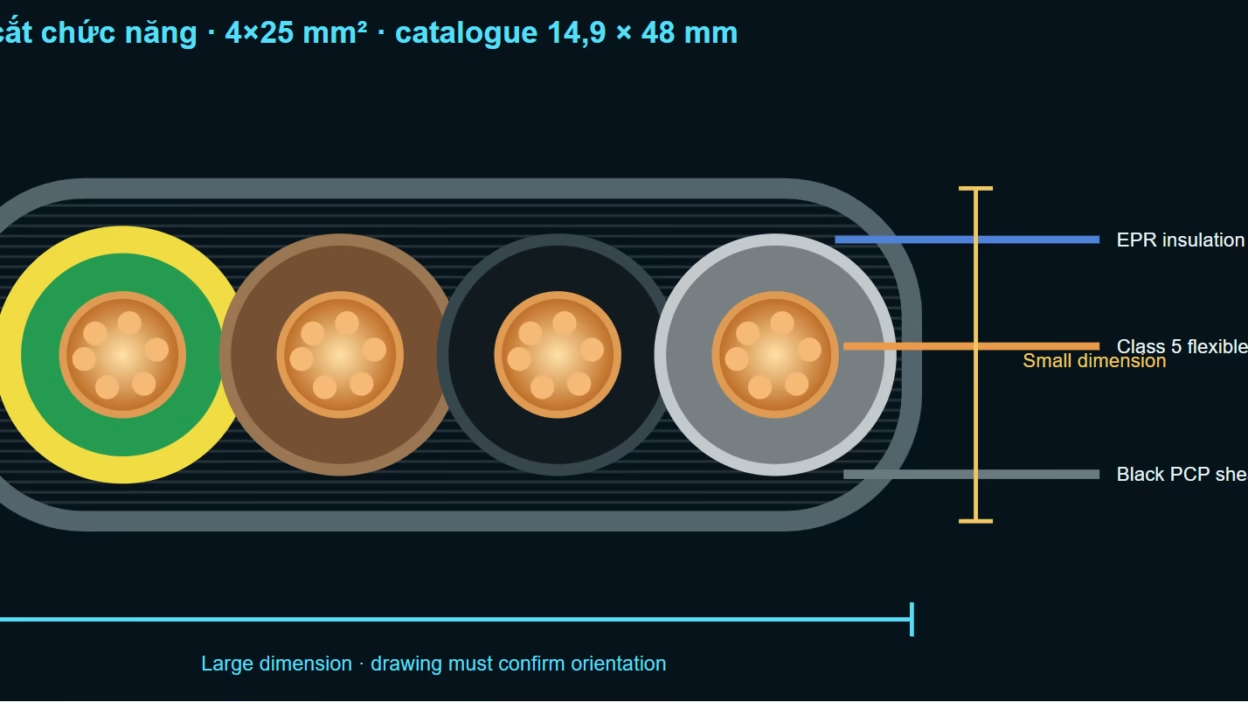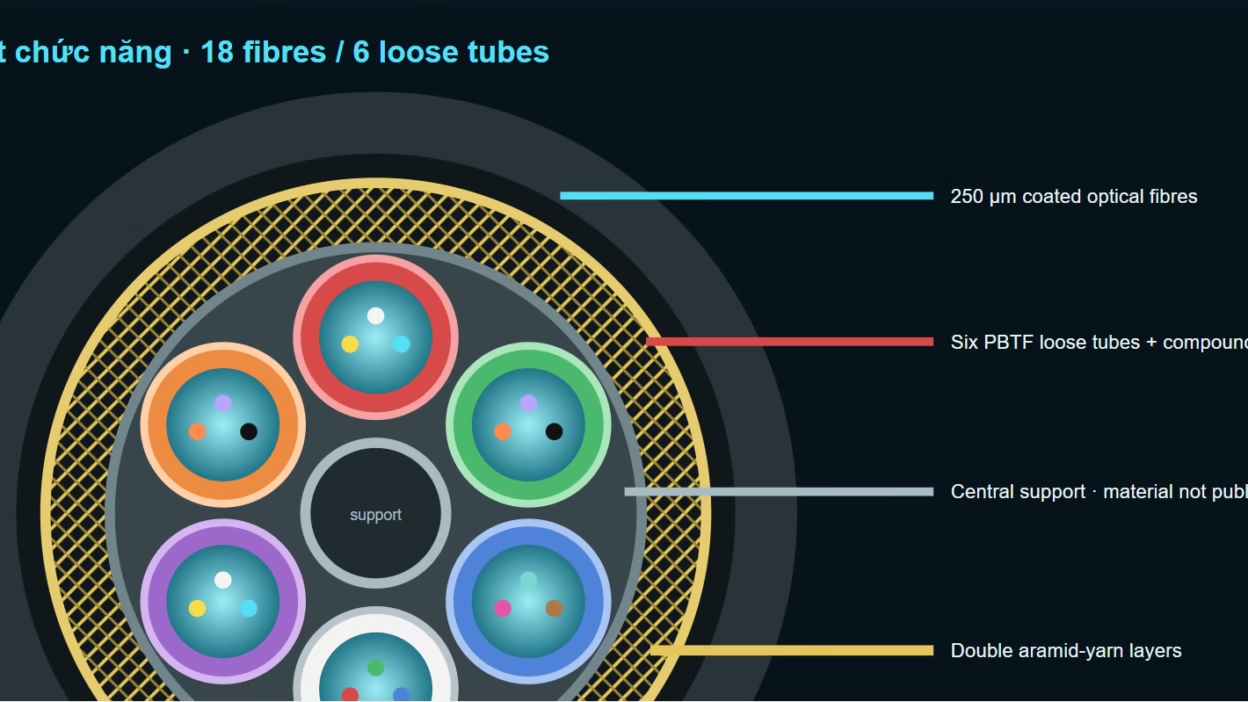
DIN VDE 0250 Mining Cable

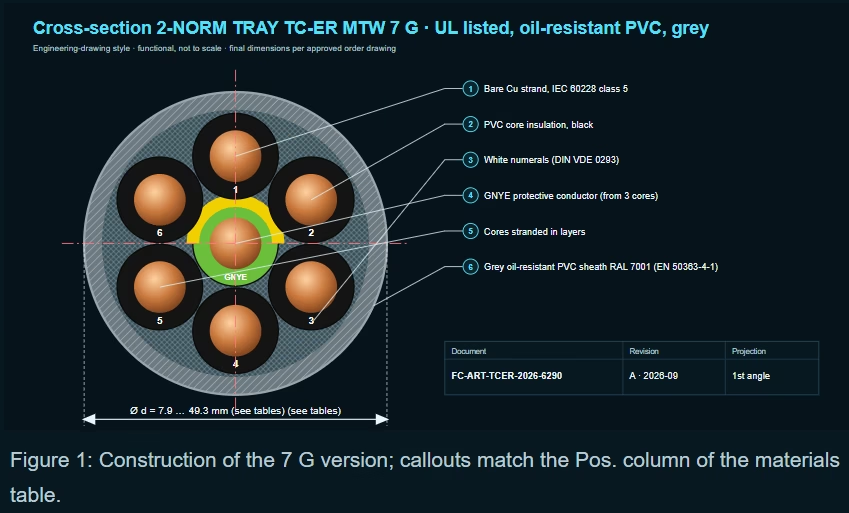
GAALFLEX® CONTROL 600 MTW: Type MTW Industrial Machinery Multi-Core Control Cable for North American Manufacturing Environments (UL 600V [CSA 1000V Option] Nominal Voltage, 4 kV Test Voltage, Comprehensive 3–50 Multi-Core Portfolio with 1–35 mm² Continuous Cross-Section Range Enabling Complete Machinery Control Specification Without Product Fragmentation, Cable-Tray-Rated Flexible Architecture Enabling Overhead Routing in Industrial Facilities and Manufacturing Floors, Impact and Crushing Resistance per UL 1277 Supporting Machinery Vibration Environments and Equipment Mechanical Stress, NFPA 79 Industrial Machinery Certification Enabling Direct Integration into Manufacturing Equipment OEM Systems, Small 4×D Fixed-Laying Bending Radius Enabling Tight Equipment Room and Machinery Routing, Special PVC/Nylon Compound Insulation Optimized for Industrial Durability and Oil Resistance, Grey (RAL 7001) Outer Sheath, Black EN 50334 Numbered Cores (2–5 Cores) or DIN VDE 0293-308 Color-Coded Cores (from 6 Cores) plus Green-Yellow Earth Protection (from 3 Cores), Layered Stranding Architecture Supporting Mechanical Flexibility and Durability, UL VW-1 and CSA FT1-FT2 Flame-Retardant Certification, Temperature Range −40 to +90°C Fixed Installation / −25 to +90°C Flexible Deployment Optimized for North American Climate Variations, Complete North American Industrial Compliance Enabling Machinery OEM Acceptance, UL AWM Style 2587/21216 Certification, RoHS and CE Certification, Engineered for North American Industrial Machinery Electrical Distribution, Cable-Tray Installations, Manufacturing Equipment Interconnection, Industrial Plant Control Systems, Heavy Equipment Operations, and Applications Where Type MTW Certification, Cable-Tray Rating, Complete Multi-Core Standardization, Impact and Crushing Durability, NFPA 79 Industrial Machinery Compliance, and Professional Industrial Machinery Reliability Are Mission-Critical Requirements)

GAALFLEX® CONTROL 600 MTW CY Lean

GAALFLEX® CONTROL 600 MTW: Type MTW Industrial Machinery Multi-Core Control Cable for North American Manufacturing Environments (UL 600V [CSA 1000V Option] Nominal Voltage, 4 kV Test Voltage, Comprehensive 3–50 Multi-Core Portfolio with 1–35 mm² Continuous Cross-Section Range Enabling Complete Machinery Control Specification Without Product Fragmentation, Cable-Tray-Rated Flexible Architecture Enabling Overhead Routing in Industrial Facilities and Manufacturing Floors, Impact and Crushing Resistance per UL 1277 Supporting Machinery Vibration Environments and Equipment Mechanical Stress, NFPA 79 Industrial Machinery Certification Enabling Direct Integration into Manufacturing Equipment OEM Systems, Small 4×D Fixed-Laying Bending Radius Enabling Tight Equipment Room and Machinery Routing, Special PVC/Nylon Compound Insulation Optimized for Industrial Durability and Oil Resistance, Grey (RAL 7001) Outer Sheath, Black EN 50334 Numbered Cores (2–5 Cores) or DIN VDE 0293-308 Color-Coded Cores (from 6 Cores) plus Green-Yellow Earth Protection (from 3 Cores), Layered Stranding Architecture Supporting Mechanical Flexibility and Durability, UL VW-1 and CSA FT1-FT2 Flame-Retardant Certification, Temperature Range −40 to +90°C Fixed Installation / −25 to +90°C Flexible Deployment Optimized for North American Climate Variations, Complete North American Industrial Compliance Enabling Machinery OEM Acceptance, UL AWM Style 2587/21216 Certification, RoHS and CE Certification, Engineered for North American Industrial Machinery Electrical Distribution, Cable-Tray Installations, Manufacturing Equipment Interconnection, Industrial Plant Control Systems, Heavy Equipment Operations, and Applications Where Type MTW Certification, Cable-Tray Rating, Complete Multi-Core Standardization, Impact and Crushing Durability, NFPA 79 Industrial Machinery Compliance, and Professional Industrial Machinery Reliability Are Mission-Critical Requirements)
GAALFLEX® CONTROL 1000 P PUR: Professional Subsea Hydrolysis-Resistant PUR Control Cable for Deepwater Underwater Environments up to 1000 Meters Depth with Comprehensive Salt-Water and Fresh-Water Durability (0.6/1 kV Nominal Voltage, 3 kV Test Voltage per DIN VDE 0281, Hydrolysis-Resistant GAALTHERM® 585 Insulation Providing Long-Term Dimensional Stability in Continuous Saltwater Immersion, Orange (RAL 2004) GAALTHERM® 630 Outer Sheath Engineered for Subsea Temperature Cycling and Pressure Resistance, Abrasion and Notch Resistance Enabling Robust Seafloor Routing Through Rocky Terrain and Pipe Clamp Integration, Low-Adhesion Surface Chemistry Preventing Biofouling and Sediment Accumulation, Microbe-Resistant Additive Technology Preventing Bacterial and Fungal Colonization During Extended Underwater Deployment, Class 5 Flexible Red Bare Copper per IEC 60228, Ultra-Compact 4×D Fixed Laying / 12.5×D Flexible Installation Bending Radius Enabling Space-Efficient Subsea Manifold Integration and Compact Umbilical Bundle Routing, Orange High-Visibility Outer Sheath Enabling Underwater Equipment Location and Identification During Remotely Operated Vehicle (ROV) Operations, UV and Ozone Resistance Supporting Surface-Deployed Cable Staging and Deck-Exposed Surface-to-Subsea Routing, Zero-Halogenated-Acid-Gas Release per IEC 60754-1, Low-Corrosive-Gas per IEC 60754-2 Preventing Electronic Equipment Corrosion in Subsea Cabinet Environments, Comprehensive Single-Core Portfolio (1×50–240 mm²) for Large Deepwater Power Distribution and Multi-Core Configurations (2–25 cores, 0.5–70 mm²) for Integrated Subsea Control and Signal Distribution, Temperature Range −40 to +90°C Fixed Installation / −25 to +80°C Flexible Deployment Optimized for Deepwater Thermocline Variations, RoHS and CE Certified, Engineered for Offshore Oil & Gas Subsea Systems, Deepwater Umbilical Integration, Subsea Manifold Control, ROV Tether Integration, Marine Infrastructure, and Deepwater Applications Where Continuous Saltwater Immersion, Hydrolysis Resistance, Abrasion Durability, and Comprehensive Subsea Environmental Resistance Are Mission-Critical Requirements)

GAALFLEX® CONTROL 1000 P

GAALFLEX® CONTROL 1000 P PUR: Professional Subsea Hydrolysis-Resistant PUR Control Cable for Deepwater Underwater Environments up to 1000 Meters Depth with Comprehensive Salt-Water and Fresh-Water Durability (0.6/1 kV Nominal Voltage, 3 kV Test Voltage per DIN VDE 0281, Hydrolysis-Resistant GAALTHERM® 585 Insulation Providing Long-Term Dimensional Stability in Continuous Saltwater Immersion, Orange (RAL 2004) GAALTHERM® 630 Outer Sheath Engineered for Subsea Temperature Cycling and Pressure Resistance, Abrasion and Notch Resistance Enabling Robust Seafloor Routing Through Rocky Terrain and Pipe Clamp Integration, Low-Adhesion Surface Chemistry Preventing Biofouling and Sediment Accumulation, Microbe-Resistant Additive Technology Preventing Bacterial and Fungal Colonization During Extended Underwater Deployment, Class 5 Flexible Red Bare Copper per IEC 60228, Ultra-Compact 4×D Fixed Laying / 12.5×D Flexible Installation Bending Radius Enabling Space-Efficient Subsea Manifold Integration and Compact Umbilical Bundle Routing, Orange High-Visibility Outer Sheath Enabling Underwater Equipment Location and Identification During Remotely Operated Vehicle (ROV) Operations, UV and Ozone Resistance Supporting Surface-Deployed Cable Staging and Deck-Exposed Surface-to-Subsea Routing, Zero-Halogenated-Acid-Gas Release per IEC 60754-1, Low-Corrosive-Gas per IEC 60754-2 Preventing Electronic Equipment Corrosion in Subsea Cabinet Environments, Comprehensive Single-Core Portfolio (1×50–240 mm²) for Large Deepwater Power Distribution and Multi-Core Configurations (2–25 cores, 0.5–70 mm²) for Integrated Subsea Control and Signal Distribution, Temperature Range −40 to +90°C Fixed Installation / −25 to +80°C Flexible Deployment Optimized for Deepwater Thermocline Variations, RoHS and CE Certified, Engineered for Offshore Oil & Gas Subsea Systems, Deepwater Umbilical Integration, Subsea Manifold Control, ROV Tether Integration, Marine Infrastructure, and Deepwater Applications Where Continuous Saltwater Immersion, Hydrolysis Resistance, Abrasion Durability, and Comprehensive Subsea Environmental Resistance Are Mission-Critical Requirements)
GAALFLEX® CONTROL 750 BCY Lean: Cost-Optimized Ultra-Compact Industrial EMI-Suppressed Multi-Core Control Cable for Factory Automation and Control Panel Integration (450/750 V Nominal Voltage, 4 kV Test Voltage per DIN VDE 0281, Class 5 Flexible Red Bare Copper per IEC 60228 and DIN VDE 0295, PVC Type TI1 Core Insulation, Ultra-Compact 7.5×D Minimum Bending Radius Enabling 30–50% Space Savings in Control Panel Routing Compared to Standard 10–15×D Competitors, Tinned Copper Wire Braid Overall Screen Achieving ≥80 dB EMI Attenuation Across Industrial 10 Hz–1 MHz Frequency Spectrum, Oil-Resistant PVC Type TM2 Grey (RAL 7001) Outer Sheath, DIN VDE 0293 Color-Coded Core Identification per HD 308 S2 Standard with Green-Yellow Earth Protection Conductors from 3 Cores, Flame-Retardant and Self-Extinguishing per DIN VDE 0482 EN 50265-2-1 and IEC 60332-1-2, Unprecedented Standardized SKU Portfolio Spanning 2 to 61 Core Configurations with Cross-Section Range from 0.5 mm² to 95 mm² per Core Enabling Single-Product Standardization Across Complete Industrial Machinery and Factory Automation Electrical Distribution Systems, RoHS and CE Certified, Engineered for Factory Automation Equipment, Control Panel Electrical Integration, Industrial Machinery Control Harnesses, Distributed Motor Drive Systems, Proportional Valve Control Circuits, PLC and Distributed I/O Integration, Manufacturing Process Control Systems, and Cost-Sensitive Industrial Applications Requiring Electromagnetic-Interference Suppression, Color-Coded Identification, Compact Routing, and Production-Scale Standardization)

GAALFLEX® CONTROL 750 BCY Lean

GAALFLEX® CONTROL 750 BCY Lean: Cost-Optimized Ultra-Compact Industrial EMI-Suppressed Multi-Core Control Cable for Factory Automation and Control Panel Integration (450/750 V Nominal Voltage, 4 kV Test Voltage per DIN VDE 0281, Class 5 Flexible Red Bare Copper per IEC 60228 and DIN VDE 0295, PVC Type TI1 Core Insulation, Ultra-Compact 7.5×D Minimum Bending Radius Enabling 30–50% Space Savings in Control Panel Routing Compared to Standard 10–15×D Competitors, Tinned Copper Wire Braid Overall Screen Achieving ≥80 dB EMI Attenuation Across Industrial 10 Hz–1 MHz Frequency Spectrum, Oil-Resistant PVC Type TM2 Grey (RAL 7001) Outer Sheath, DIN VDE 0293 Color-Coded Core Identification per HD 308 S2 Standard with Green-Yellow Earth Protection Conductors from 3 Cores, Flame-Retardant and Self-Extinguishing per DIN VDE 0482 EN 50265-2-1 and IEC 60332-1-2, Unprecedented Standardized SKU Portfolio Spanning 2 to 61 Core Configurations with Cross-Section Range from 0.5 mm² to 95 mm² per Core Enabling Single-Product Standardization Across Complete Industrial Machinery and Factory Automation Electrical Distribution Systems, RoHS and CE Certified, Engineered for Factory Automation Equipment, Control Panel Electrical Integration, Industrial Machinery Control Harnesses, Distributed Motor Drive Systems, Proportional Valve Control Circuits, PLC and Distributed I/O Integration, Manufacturing Process Control Systems, and Cost-Sensitive Industrial Applications Requiring Electromagnetic-Interference Suppression, Color-Coded Identification, Compact Routing, and Production-Scale Standardization)
RHEYFESTOON® (N)3GRD5G's missing "(C)" (concentric shielding in VDE 0250-812 nomenclature) is not cost-cutting, but precision engineering optimization. Shielding adds material cost (USD 0.8–1.5/meter), weight (+20–35%), and flexibility constraints. For 50/60 Hz pure power transmission, shielding provides zero functional benefit. Load currents (100–600 A) and voltage drops (

RHEYFESTOON® (N)3GRD5G: Chemistry-Electromagnetics-Mechanics Deep Analysis

RHEYFESTOON® (N)3GRD5G’s missing “(C)” (concentric shielding in VDE 0250-812 nomenclature) is not cost-cutting, but precision engineering optimization. Shielding adds material cost (USD 0.8–1.5/meter), weight (+20–35%), and flexibility constraints. For 50/60 Hz pure power transmission, shielding provides zero functional benefit. Load currents (100–600 A) and voltage drops (
Кабель RHEYFIRM®(SI) NTMCGCWOEUS представляет собой современное решение в области гибких однопроводных кабелей высокого напряжения. Данный кабель разработан специально для применений, требующих гибкости, надежности и стойкости к внешним воздействиям. Основная область применения — коротких соединений между высоковольтными выключателями и мобильными трансформаторами в энергетических системах, промышленных установках и распределительных сетях. Исторически кабели этого класса использовались в европейской электроэнергетике и зарекомендовали себя как надежные системы, способные обеспечить безопасность при передаче высокого напряжения. RHEYFIRM кабель продолжает эту традицию, добавляя инновационные материалы и конструкции, которые повышают производительность и безопасность. Компания Anhui Feichun Special Cable Co., Ltd. предлагает данный кабель в соответствии со всеми международными и немецкими стандартами DIN VDE, обеспечивая высокое качество и надежность каждого производимого изделия.

RHEYFIRM®(SI) NTMCGCWOEUS

Кабель RHEYFIRM®(SI) NTMCGCWOEUS представляет собой современное решение в области гибких однопроводных кабелей высокого напряжения. Данный кабель разработан специально для применений, требующих гибкости, надежности и стойкости к внешним воздействиям. Основная область применения — коротких соединений между высоковольтными выключателями и мобильными трансформаторами в энергетических системах, промышленных установках и распределительных сетях. Исторически кабели этого класса использовались в европейской электроэнергетике и зарекомендовали себя как надежные системы, способные обеспечить безопасность при передаче высокого напряжения. RHEYFIRM кабель продолжает эту традицию, добавляя инновационные материалы и конструкции, которые повышают производительность и безопасность. Компания Anhui Feichun Special Cable Co., Ltd. предлагает данный кабель в соответствии со всеми международными и немецкими стандартами DIN VDE, обеспечивая высокое качество и надежность каждого производимого изделия.
HKIV Wire Architecture & Equipment Wiring Design Strategy Purpose & Application Scope: HKIV (Heat-resistant Flexible Vinyl Insulated wire) represents the engineered solution for electrical wiring inside appliances, equipment, and control circuits where compact size, heat resistance, and flexibility enable practical integration within device enclosures. Unlike power distribution cables designed for external installation, HKIV wires are specifically engineered for internal equipment routing where space constraints require compact conductor sizing, heat generation from nearby components demands superior temperature tolerance, and moisture/chemical exposure creates durability requirements. Core Engineering Philosophy: HKIV wire design emphasizes compact size, heat tolerance, and internal equipment integration rather than power transmission capacity. Class 5 ultra-flexible stranding enables routing through tortuous paths within appliance enclosures without mechanical damage. Heat-resistant PVC formulation maintains electrical and mechanical properties during sustained 90°C operation near heat-generating components (motors, transformers, resistive elements). Moisture and abrasion-resistant PVC enables reliable operation in humid appliance environments (kitchens, bathrooms, laundry) and within industrial equipment exposed to fluid splash and mechanical stress. Market Position & Regulatory Compliance: HKIV wires comply with K 60227 IEC 08 international standard specifications, equivalent to IEC 60227-2-4 standards addressing flexible cords for appliances and portable equipment. The 450/750V rating addresses internal equipment voltages up to 400V AC three-phase or approximately 230V single-phase—standard industrial and appliance supply voltages worldwide. Appliance manufacturing standards in most jurisdictions mandate heat-resistant wire for internal equipment wiring where sustained elevated temperatures could compromise insulation of conventional materials.

K 60227 IEC 08 (HKIV) 450/750V Heat-Resistant Flexible Single-Core Wire

HKIV Wire Architecture & Equipment Wiring Design Strategy Purpose & Application Scope: HKIV (Heat-resistant Flexible Vinyl Insulated wire) represents the engineered solution for electrical wiring inside appliances, equipment, and control circuits where compact size, heat resistance, and flexibility enable practical integration within device enclosures. Unlike power distribution cables designed for external installation, HKIV wires are specifically engineered for internal equipment routing where space constraints require compact conductor sizing, heat generation from nearby components demands superior temperature tolerance, and moisture/chemical exposure creates durability requirements. Core Engineering Philosophy: HKIV wire design emphasizes compact size, heat tolerance, and internal equipment integration rather than power transmission capacity. Class 5 ultra-flexible stranding enables routing through tortuous paths within appliance enclosures without mechanical damage. Heat-resistant PVC formulation maintains electrical and mechanical properties during sustained 90°C operation near heat-generating components (motors, transformers, resistive elements). Moisture and abrasion-resistant PVC enables reliable operation in humid appliance environments (kitchens, bathrooms, laundry) and within industrial equipment exposed to fluid splash and mechanical stress. Market Position & Regulatory Compliance: HKIV wires comply with K 60227 IEC 08 international standard specifications, equivalent to IEC 60227-2-4 standards addressing flexible cords for appliances and portable equipment. The 450/750V rating addresses internal equipment voltages up to 400V AC three-phase or approximately 230V single-phase—standard industrial and appliance supply voltages worldwide. Appliance manufacturing standards in most jurisdictions mandate heat-resistant wire for internal equipment wiring where sustained elevated temperatures could compromise insulation of conventional materials.
Ethylene Propylene Rubber (EPR) insulated cables represent the professional approach to flexible electrical distribution—cables engineered to accommodate dynamic deployment, repetitive coiling/uncoiling, temperature variation, and mechanical stress inherent in portable and industrial equipment applications. Unlike fixed-installation cables optimized for stationary performance, EPR cables balance electrical performance, mechanical flexibility, environmental durability, and cost-effectiveness required for equipment requiring frequent relocation or deployment flexibility. Fundamental Design Philosophy: EPR cables employ elastomeric insulation material (ethylene propylene rubber) selected specifically for flexibility maintenance across wide temperature range. This material provides sustained flexibility even at cold temperatures (−40°C minimum), maintains electrical properties across elevated temperature range (continuous operation to +100°C), and demonstrates superior resistance to ozone, UV radiation, and environmental contamination characteristic of portable equipment deployment. Conductor Architecture for Flexibility: Rather than single-strand conductors (rigid, prone to breaking under flex stress), EPR cables employ multi-strand conductor design—typically 7, 19, 37, or 61 individual wires woven together. This multi-strand architecture enables smooth bending without conductor fracture, distributes mechanical stress across multiple strands preventing single-point failure, and maintains consistent electrical performance through tens of thousands of flex cycles. Voltage Rating & Safety Margin: Standard 0.6/1KV rating provides nominal 600V operating margin with 1000V safety ceiling—appropriate for most industrial equipment, portable power systems, and temporary installations. The dual rating nomenclature indicates 0.6KV continuous operating voltage with 1KV maximum transient voltage tolerance, providing balanced safety margin against impulse transients and surge events.

Ethylene Propylene Rubber (EPR) Insulated Cable Family

Ethylene Propylene Rubber (EPR) insulated cables represent the professional approach to flexible electrical distribution—cables engineered to accommodate dynamic deployment, repetitive coiling/uncoiling, temperature variation, and mechanical stress inherent in portable and industrial equipment applications. Unlike fixed-installation cables optimized for stationary performance, EPR cables balance electrical performance, mechanical flexibility, environmental durability, and cost-effectiveness required for equipment requiring frequent relocation or deployment flexibility. Fundamental Design Philosophy: EPR cables employ elastomeric insulation material (ethylene propylene rubber) selected specifically for flexibility maintenance across wide temperature range. This material provides sustained flexibility even at cold temperatures (−40°C minimum), maintains electrical properties across elevated temperature range (continuous operation to +100°C), and demonstrates superior resistance to ozone, UV radiation, and environmental contamination characteristic of portable equipment deployment. Conductor Architecture for Flexibility: Rather than single-strand conductors (rigid, prone to breaking under flex stress), EPR cables employ multi-strand conductor design—typically 7, 19, 37, or 61 individual wires woven together. This multi-strand architecture enables smooth bending without conductor fracture, distributes mechanical stress across multiple strands preventing single-point failure, and maintains consistent electrical performance through tens of thousands of flex cycles. Voltage Rating & Safety Margin: Standard 0.6/1KV rating provides nominal 600V operating margin with 1000V safety ceiling—appropriate for most industrial equipment, portable power systems, and temporary installations. The dual rating nomenclature indicates 0.6KV continuous operating voltage with 1KV maximum transient voltage tolerance, providing balanced safety margin against impulse transients and surge events.
PNCT-R high-voltage reel cables represent an advanced evolution in portable power distribution—engineered specifically for container cranes, ship unloaders, cargo handling systems, and bulk terminal equipment where electrical power must be delivered dynamically through mechanically spooled cable reels. Unlike stationary cable installations with fixed routing and stress patterns, reel-deployed cables experience continuous repetitive flex-cycling, abrupt acceleration/deceleration forces, and environmental exposure across multiple geographic locations and climate conditions. Fundamental Design Challenge: Traditional high-voltage cables designed for fixed installations fail catastrophically when deployed on mechanical reels. The repetitive flex-cycling—where individual cable cross-sections bend and straighten thousands of times per shift—creates progressive internal stress concentration and insulation degradation. External mechanical stresses from reel spooling, retraction, equipment vibration, and wind loading accelerate conductor separation and sheath cracking. Standard copper braiding provides insufficient tensile support for repeated dynamic loads. Engineering Solution — Kevlar-Reinforced Architecture: PNCT-R cables integrate specialized Kevlar aramid fiber reinforcement layers—a material system engineered to absorb mechanical stress and prevent internal conductor displacement during dynamic cycling. Rather than relying solely on copper or aluminum tensile components, Kevlar fibers provide sustained tensile support through tens of thousands of flex cycles, maintaining conductor geometry integrity and preventing the progressive insulation failure characteristic of standard high-voltage cables deployed on reels. Feichun engineers have developed proprietary Kevlar weaving methodologies that integrate the reinforcement material within the cable architecture—not as external wrapping (which adds excessive weight), but as strategically positioned internal tensile layers coordinated with specialized sheath formulations. This integrated architecture enables PNCT-R cables to withstand 2+ million repetitive flex cycles at full operational stress without performance degradation.

PNCT-R High-Voltage Reel Cable Family

PNCT-R high-voltage reel cables represent an advanced evolution in portable power distribution—engineered specifically for container cranes, ship unloaders, cargo handling systems, and bulk terminal equipment where electrical power must be delivered dynamically through mechanically spooled cable reels. Unlike stationary cable installations with fixed routing and stress patterns, reel-deployed cables experience continuous repetitive flex-cycling, abrupt acceleration/deceleration forces, and environmental exposure across multiple geographic locations and climate conditions. Fundamental Design Challenge: Traditional high-voltage cables designed for fixed installations fail catastrophically when deployed on mechanical reels. The repetitive flex-cycling—where individual cable cross-sections bend and straighten thousands of times per shift—creates progressive internal stress concentration and insulation degradation. External mechanical stresses from reel spooling, retraction, equipment vibration, and wind loading accelerate conductor separation and sheath cracking. Standard copper braiding provides insufficient tensile support for repeated dynamic loads. Engineering Solution — Kevlar-Reinforced Architecture: PNCT-R cables integrate specialized Kevlar aramid fiber reinforcement layers—a material system engineered to absorb mechanical stress and prevent internal conductor displacement during dynamic cycling. Rather than relying solely on copper or aluminum tensile components, Kevlar fibers provide sustained tensile support through tens of thousands of flex cycles, maintaining conductor geometry integrity and preventing the progressive insulation failure characteristic of standard high-voltage cables deployed on reels. Feichun engineers have developed proprietary Kevlar weaving methodologies that integrate the reinforcement material within the cable architecture—not as external wrapping (which adds excessive weight), but as strategically positioned internal tensile layers coordinated with specialized sheath formulations. This integrated architecture enables PNCT-R cables to withstand 2+ million repetitive flex cycles at full operational stress without performance degradation.
HT-PNCT cable family represents a comprehensive, professional ecosystem of high-tension power distribution cables engineered to serve the complete spectrum of port equipment applications. Rather than a single cable type, HT-PNCT encompasses a carefully developed family of variants, each optimized for specific application requirements, electrical loads, environmental conditions, and operational constraints. The family architecture is organized around five core cable types: 1. HT-PNCT-RF — Reinforced Festoon variant with large conductor sizes (240–300 sq mm) and flexible sheath options (1.5, 2.5, 4.0 mm). Optimized for extended-span festoon applications with demanding tensile and environmental requirements. 2. HT-PNCT (Standard) — Non-shielded multi-core configuration (3–30 conductor cores) with optimized conductor size and sheath thickness combinations. Base specification for equipment without sensitive electronics or electromagnetic sensitivity. 3. HT-PNCT(S) — Shielded variant of standard cable featuring tinned copper braid shield. Engineered for equipment with variable frequency drive (VFD) motors, crane controls, and sensitive automation electronics requiring electromagnetic interference (EMI) attenuation. 4. HT-PNCT-R — Reinforced non-shielded variant with enhanced mechanical strength and extended tensile capacity. For applications requiring maximum tensile strength without electromagnetic protection needs. 5. HT-PNCT(S)-R — Premium reinforced-shielded variant combining maximum tensile strength with full electromagnetic protection. For next-generation high-power equipment with VFD systems and extreme service life requirements. This family structure enables terminal operators to select the optimal cable for each specific application—balancing performance, cost, environmental requirements, and operational constraints. The shared engineering platform across family members ensures interoperability and simplifies spare cable management.

Complete HT-PNCT High Tension Cable Family

HT-PNCT cable family represents a comprehensive, professional ecosystem of high-tension power distribution cables engineered to serve the complete spectrum of port equipment applications. Rather than a single cable type, HT-PNCT encompasses a carefully developed family of variants, each optimized for specific application requirements, electrical loads, environmental conditions, and operational constraints. The family architecture is organized around five core cable types: 1. HT-PNCT-RF — Reinforced Festoon variant with large conductor sizes (240–300 sq mm) and flexible sheath options (1.5, 2.5, 4.0 mm). Optimized for extended-span festoon applications with demanding tensile and environmental requirements. 2. HT-PNCT (Standard) — Non-shielded multi-core configuration (3–30 conductor cores) with optimized conductor size and sheath thickness combinations. Base specification for equipment without sensitive electronics or electromagnetic sensitivity. 3. HT-PNCT(S) — Shielded variant of standard cable featuring tinned copper braid shield. Engineered for equipment with variable frequency drive (VFD) motors, crane controls, and sensitive automation electronics requiring electromagnetic interference (EMI) attenuation. 4. HT-PNCT-R — Reinforced non-shielded variant with enhanced mechanical strength and extended tensile capacity. For applications requiring maximum tensile strength without electromagnetic protection needs. 5. HT-PNCT(S)-R — Premium reinforced-shielded variant combining maximum tensile strength with full electromagnetic protection. For next-generation high-power equipment with VFD systems and extreme service life requirements. This family structure enables terminal operators to select the optimal cable for each specific application—balancing performance, cost, environmental requirements, and operational constraints. The shared engineering platform across family members ensures interoperability and simplifies spare cable management.
Japanese Standard High Tension (HT) cables with Kevlar® reinforcement represent the pinnacle of specialized power distribution technology for demanding marine port applications. Engineered to conform to Japanese Industrial Standards (JIS C 3317, JIS C 3350), these cables incorporate integrated aramid reinforced layers that dramatically enhance tensile strength while maintaining the flexibility required for reel-mounted equipment operation. The term "high tension" in Japanese maritime engineering refers specifically to the mechanical tension and longitudinal stress experienced by cables subjected to extreme operational demands—including extended unsupported spans, repetitive reel cycling, heavy dynamic loading, and sustained exposure to marine environments. Unlike standard port cables, Japanese Standard HT cables with Kevlar® reinforcement are engineered for applications where: • Unsupported cable spans exceed 40–60 meters between ship and shore equipment or between reel stations • Combined electrical load and mechanical tension create dual stress conditions requiring advanced material science • Long service life expectancy (7–10+ years) justifies premium reinforcement material investment • Environmental exposure to saltwater aerosol, UV radiation, and thermal cycling demands superior polymer formulation • High-availability terminal operations cannot tolerate premature cable failure and operational downtime The integration of Kevlar® aramid reinforcement layers represents a fundamental departure from conventional cable design. Rather than relying solely on rubber insulation and polymer sheathing to provide mechanical strength, Kevlar-reinforced cables employ a specialized tension layer that carries a portion of the cable's weight and operational stress, thereby reducing stress on the insulation and extending overall cable service life by 40–60% compared to unreinforced designs.

Japanese Standard High Tension Cables with Kevlar® Reinforcement

Japanese Standard High Tension (HT) cables with Kevlar® reinforcement represent the pinnacle of specialized power distribution technology for demanding marine port applications. Engineered to conform to Japanese Industrial Standards (JIS C 3317, JIS C 3350), these cables incorporate integrated aramid reinforced layers that dramatically enhance tensile strength while maintaining the flexibility required for reel-mounted equipment operation. The term “high tension” in Japanese maritime engineering refers specifically to the mechanical tension and longitudinal stress experienced by cables subjected to extreme operational demands—including extended unsupported spans, repetitive reel cycling, heavy dynamic loading, and sustained exposure to marine environments. Unlike standard port cables, Japanese Standard HT cables with Kevlar® reinforcement are engineered for applications where: • Unsupported cable spans exceed 40–60 meters between ship and shore equipment or between reel stations • Combined electrical load and mechanical tension create dual stress conditions requiring advanced material science • Long service life expectancy (7–10+ years) justifies premium reinforcement material investment • Environmental exposure to saltwater aerosol, UV radiation, and thermal cycling demands superior polymer formulation • High-availability terminal operations cannot tolerate premature cable failure and operational downtime The integration of Kevlar® aramid reinforcement layers represents a fundamental departure from conventional cable design. Rather than relying solely on rubber insulation and polymer sheathing to provide mechanical strength, Kevlar-reinforced cables employ a specialized tension layer that carries a portion of the cable’s weight and operational stress, thereby reducing stress on the insulation and extending overall cable service life by 40–60% compared to unreinforced designs.
JIS C 3327 designation system is elegant in its logic. Every cable name follows a predictable, parseable structure where each character or character group carries a specific, unambiguous meaning. Once you understand the five material symbols and the four flexibility classes, you can decode any of the 15 cable types defined by the standard—and immediately know what the cable is made of, how flexible it is, and what applications it is suited for.

JIS C 3327 Cable Code Designation

JIS C 3327 designation system is elegant in its logic. Every cable name follows a predictable, parseable structure where each character or character group carries a specific, unambiguous meaning. Once you understand the five material symbols and the four flexibility classes, you can decode any of the 15 cable types defined by the standard—and immediately know what the cable is made of, how flexible it is, and what applications it is suited for.
600V 2TC-RB is the TRACAB® product line cable designed to perform reliably across all three transport methods: curtain (festoon), carrier drum (reeling), and cableveyor (enclosed track). Manufactured to JIS C 3327 Class 2, this cable combines the proven EP rubber insulation and polychloroprene rubber sheathing platform with Class 2 conductor construction optimised for the specific bending profiles and fatigue modes encountered in each transport architecture. The Kevlar® para-aramid fibre braided tensile reinforcement provides the mechanical backbone that enables a single cable design to absorb the dynamic loads generated by catenary suspension, drum winding, and track-guided travel without transferring stress to the conductors or insulation system.

600V 2TC-RB TRACAB® Kevlar®-Reinforced Crane Cable

600V 2TC-RB is the TRACAB® product line cable designed to perform reliably across all three transport methods: curtain (festoon), carrier drum (reeling), and cableveyor (enclosed track). Manufactured to JIS C 3327 Class 2, this cable combines the proven EP rubber insulation and polychloroprene rubber sheathing platform with Class 2 conductor construction optimised for the specific bending profiles and fatigue modes encountered in each transport architecture. The Kevlar® para-aramid fibre braided tensile reinforcement provides the mechanical backbone that enables a single cable design to absorb the dynamic loads generated by catenary suspension, drum winding, and track-guided travel without transferring stress to the conductors or insulation system.
6600V 3PNCT cable, manufactured to the Japanese Industrial Standard JIS C 4353 Class 3, is the purpose-built high voltage cable solution for these demanding applications. It combines the same fundamental material technologies proven in the 600V 2PNCT family—EP rubber insulation, polychloroprene rubber sheathing, tinned copper conductors, tinned copper/cotton yarn braid shielding, and Kevlar® para-aramid fibre braided tensile reinforcement—but with substantially enhanced insulation systems and construction techniques required for safe, reliable operation at 6,600V. The cable features a semiconductive stress-grading layer at the conductor/insulation interface, 5.0–5.5 mm thick EP rubber insulation (compared to 0.8–2.5 mm in 600V cables), a metallic braid shield for electric field containment, and a dual-layer polychloroprene sheath with an intermediate reinforcement layer for maximum mechanical protection.

6600V 3PNCT Kevlar®-Reinforced High Voltage Crane Cable

6600V 3PNCT cable, manufactured to the Japanese Industrial Standard JIS C 4353 Class 3, is the purpose-built high voltage cable solution for these demanding applications. It combines the same fundamental material technologies proven in the 600V 2PNCT family—EP rubber insulation, polychloroprene rubber sheathing, tinned copper conductors, tinned copper/cotton yarn braid shielding, and Kevlar® para-aramid fibre braided tensile reinforcement—but with substantially enhanced insulation systems and construction techniques required for safe, reliable operation at 6,600V. The cable features a semiconductive stress-grading layer at the conductor/insulation interface, 5.0–5.5 mm thick EP rubber insulation (compared to 0.8–2.5 mm in 600V cables), a metallic braid shield for electric field containment, and a dual-layer polychloroprene sheath with an intermediate reinforcement layer for maximum mechanical protection.
The 600V 2TC Light (600V 2PNCT) cable, manufactured to the Japanese Industrial Standard JIS C 3327, represents one of the most proven and widely deployed cable designs for port crane and ship unloader applications worldwide. This cable combines ethylene propylene (EP) rubber insulation for superior dielectric performance, polychloroprene rubber sheathing for environmental protection, and—critically—a Kevlar® para-aramid fibre braided tensile reinforcement layer that transforms the cable from a simple electrical conductor into a load-bearing mechanical component capable of supporting its own weight and absorbing the extreme dynamic forces generated by crane operation.

600V 2TC Light (2PNCT) Kevlar®-Reinforced Crane Cable

The 600V 2TC Light (600V 2PNCT) cable, manufactured to the Japanese Industrial Standard JIS C 3327, represents one of the most proven and widely deployed cable designs for port crane and ship unloader applications worldwide. This cable combines ethylene propylene (EP) rubber insulation for superior dielectric performance, polychloroprene rubber sheathing for environmental protection, and—critically—a Kevlar® para-aramid fibre braided tensile reinforcement layer that transforms the cable from a simple electrical conductor into a load-bearing mechanical component capable of supporting its own weight and absorbing the extreme dynamic forces generated by crane operation.
crane cable range is a complete family of six specialised cable types engineered to cover every electrical and data connection on modern port cranes — from the simplest yard crane spreader circuit to the most complex automated STS crane with integrated fibre optic networking. The family is divided into two series: the WS-RLIN series for motorised cable reel systems, and the WS-SPRD series for gravity collector basket (festoon basket) systems. Every cable in the range shares a common engineering foundation: JIS C 3327 compliance for rubber-insulated machinery cables, chloroprene rubber (CR) sheathing for oil/ozone/UV resistance, EPR insulation rated to 90°C, and an ambient temperature range of −40°C to +90°C that covers every port environment on earth from arctic to tropical. Within this shared foundation, each cable type is differentiated by its reinforcement system, voltage class, conductor range, and application-specific optimisations.

WALSREEN® Complete Port Crane Cable Range

crane cable range is a complete family of six specialised cable types engineered to cover every electrical and data connection on modern port cranes — from the simplest yard crane spreader circuit to the most complex automated STS crane with integrated fibre optic networking. The family is divided into two series: the WS-RLIN series for motorised cable reel systems, and the WS-SPRD series for gravity collector basket (festoon basket) systems. Every cable in the range shares a common engineering foundation: JIS C 3327 compliance for rubber-insulated machinery cables, chloroprene rubber (CR) sheathing for oil/ozone/UV resistance, EPR insulation rated to 90°C, and an ambient temperature range of −40°C to +90°C that covers every port environment on earth from arctic to tropical. Within this shared foundation, each cable type is differentiated by its reinforcement system, voltage class, conductor range, and application-specific optimisations.
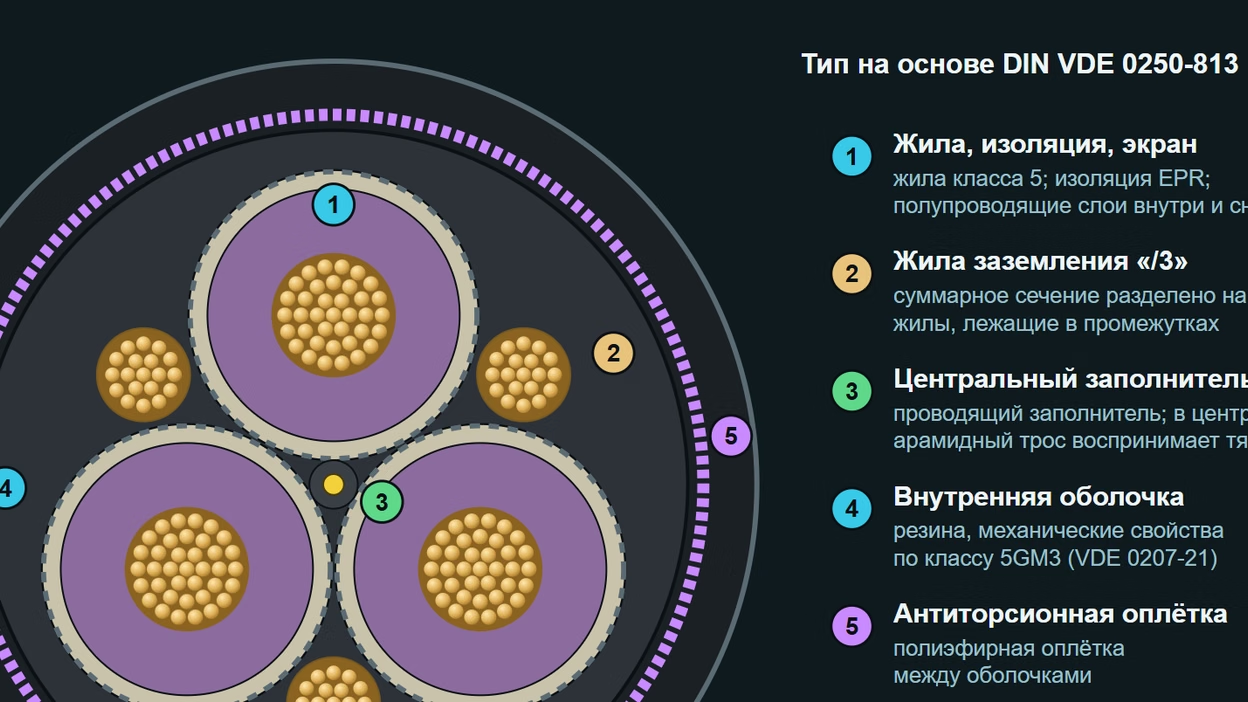
WS-SPRD-2PNCT was engineered specifically for this unforgiving application. It combines high-core-count construction (30, 36, or 42 cores at 3.5 mm²) to carry the full complement of spreader control and signal circuits in a single cable, steel-wire-stranded conductors for tension resistance under self-weight suspension, chloroprene rubber sheathing for oil, ozone, and UV resistance in coastal port environments, and a cable geometry specifically optimised for the continuous lateral bending and catenary formation cycles unique to gravity collector basket systems. Manufactured to dual standards — JIS C 3327 (rubber-insulated machinery cables) and VDE 0250-813 (flexible cables) — the WS-SPRD-2PNCT represents dedicated engineering for a niche but mission-critical application. A failed spreader basket cable means a stopped crane, a grounded spreader, and halted container operations. There is no redundancy — the cable is the sole electrical lifeline between the crane's trolley and the spreader that grips the containers.

WALSREEN® WS-SPRD-2PNCT Spreader Basket System Flexible Cable

WS-SPRD-2PNCT was engineered specifically for this unforgiving application. It combines high-core-count construction (30, 36, or 42 cores at 3.5 mm²) to carry the full complement of spreader control and signal circuits in a single cable, steel-wire-stranded conductors for tension resistance under self-weight suspension, chloroprene rubber sheathing for oil, ozone, and UV resistance in coastal port environments, and a cable geometry specifically optimised for the continuous lateral bending and catenary formation cycles unique to gravity collector basket systems. Manufactured to dual standards — JIS C 3327 (rubber-insulated machinery cables) and VDE 0250-813 (flexible cables) — the WS-SPRD-2PNCT represents dedicated engineering for a niche but mission-critical application. A failed spreader basket cable means a stopped crane, a grounded spreader, and halted container operations. There is no redundancy — the cable is the sole electrical lifeline between the crane’s trolley and the spreader that grips the containers.
WS-RLIN-3PNCT-OF is the engineering answer to this convergence challenge. It integrates three-phase medium-voltage power conductors (3 × 38–60 mm² at AC 6,600 V) with a dedicated neutral/earth return conductor and six optical fibres housed in individually colour-coded ETFE protective tubes — all within a single Kevlar®-reinforced, chloroprene-sheathed cable construction. This hybrid design eliminates the need for separate power and fibre optic cables on the reel system, reducing reel complexity, installation time, maintenance burden, and total cable weight, while ensuring perfect synchronisation between power and data paths — because both travel through the same physical cable at all times.

WALSREEN® WS-RLIN-3PNCT-OF Hybrid Power & Fibre Optic Reel System Flexible Cable

WS-RLIN-3PNCT-OF is the engineering answer to this convergence challenge. It integrates three-phase medium-voltage power conductors (3 × 38–60 mm² at AC 6,600 V) with a dedicated neutral/earth return conductor and six optical fibres housed in individually colour-coded ETFE protective tubes — all within a single Kevlar®-reinforced, chloroprene-sheathed cable construction. This hybrid design eliminates the need for separate power and fibre optic cables on the reel system, reducing reel complexity, installation time, maintenance burden, and total cable weight, while ensuring perfect synchronisation between power and data paths — because both travel through the same physical cable at all times.
Feltoflex® LED Self-Luminous Single Core Cable addresses this application niche with revolutionary integration of electromagnetic induction self-powered LED illumination into a premium single-core cable architecture. Unlike three-phase mining cables designed for kilometre-long trunk distribution, Feltoflex LED cables serve the critical short-distance interconnection role—where visibility, flexibility, durability, and compact form factor are paramount. Switchgear rooms and transformer chambers are typically underground or in poorly lit industrial areas. When technicians need to work on cable terminations, identify connection points, or troubleshoot equipment, they currently rely on portable lamps, headlamps, or external lighting. The Feltoflex LED cable illuminates itself as it carries power, providing integrated visibility that enhances safety, accelerates maintenance procedures, and requires zero external infrastructure.

Feltoflex® LED Self-Luminous Single Core Cable

Feltoflex® LED Self-Luminous Single Core Cable addresses this application niche with revolutionary integration of electromagnetic induction self-powered LED illumination into a premium single-core cable architecture. Unlike three-phase mining cables designed for kilometre-long trunk distribution, Feltoflex LED cables serve the critical short-distance interconnection role—where visibility, flexibility, durability, and compact form factor are paramount. Switchgear rooms and transformer chambers are typically underground or in poorly lit industrial areas. When technicians need to work on cable terminations, identify connection points, or troubleshoot equipment, they currently rely on portable lamps, headlamps, or external lighting. The Feltoflex LED cable illuminates itself as it carries power, providing integrated visibility that enhances safety, accelerates maintenance procedures, and requires zero external infrastructure.
FABER® (N)3GHSSYCY cable solves the pit equipment power distribution challenge through two integrated innovations: Galvanized Steel Wire Braid Armor (75% minimum coverage): Resists puncture from sharp rocks, crushing from equipment treads (500+ tonne axle loads), and abrasion from rocky terrain. Service life extended 3–5× vs. unarmored cables in identical pit conditions. Integrated Monitoring Core: Continuously measures insulation resistance, detecting degradation 4–8 weeks before insulation failure becomes critical. This early warning enables planned maintenance before unexpected equipment shutdown.

FABER® (N)3GHSSYCY

(N)3GHSSYCY is the integrated copper wire monitoring core spun on the first inner sheath. This dedicated conductor continuously measures insulation resistance between phase conductors and ground reference, enabling early warning of insulation degradation. Three-Stage Insulation Degradation Detection Stage 1 – Incipient Degradation (4–8 weeks before failure): Insulation resistance drops from >1000 MΩ to 100–500 MΩ range. Monitoring systems alert maintenance teams; scheduled cable replacement planned during next equipment maintenance window. Stage 2 – Advanced Degradation (1–4 weeks before failure): Resistance drops to 10–50 MΩ. Equipment operations reduced; high-priority replacement initiated (completed within 1–7 days). Stage 3 – Critical Failure (imminent): Resistance drops below 1 MΩ. Equipment immediately shut down; emergency cable replacement executed (8–12 hours typical). Monitoring Core Measurement Technology The monitoring core interfaces to pit electrical control systems via standard 24 VDC measurement electronics. A precision insulation resistance tester (1000 V minimum) measures leakage current across the monitoring core at 30-minute intervals, recording continuous insulation resistance trending. This trending data provides quantitative assessment of cable aging, enabling predictive maintenance planning based on actual cable condition rather than calendar time.
The TRATOSFLEX-ES3-FO® Type K with BiTservo LED revolutionizes deepwater drilling operations by embedding permanent illumination directly into the deployment cable infrastructure. The Four-Capability Integration Advantage No previous deepwater cable has combined these four capabilities in a single product: Ultra-High-Speed Reeling (200 m/min): Deploys 3000 metres of cable in 15 minutes (vs. 45–60 minutes on conventional systems), reducing surface vessel idle time and mission costs. Self-Luminous LED Illumination: No external power, no ROV-mounted lights—just electromagnetic-powered continuous illumination along the entire riser deployment, enabling visual confirmation of BOP positioning and subsea equipment status. Fiber Optic Real-Time Telemetry: 24 fiber cores (single-mode + multi-mode selectable) transmit sensor data, video, and control signals at 10+ Gbps bandwidth, enabling autonomous BOP control and real-time decision support. Distributed Temperature Sensing (DTS): Every 1 metre along the cable, optical temperature sensing measures riser temperature, enabling thermal profiling of subsea conditions and wellbore integrity assessment without additional sensors.

TRATOSFLEX-ES3-FO® Type K + BiTservo LED

The TRATOSFLEX-ES3-FO® Type K with BiTservo LED revolutionizes deepwater drilling operations by embedding permanent illumination directly into the deployment cable infrastructure. The Four-Capability Integration Advantage No previous deepwater cable has combined these four capabilities in a single product: Ultra-High-Speed Reeling (200 m/min): Deploys 3000 metres of cable in 15 minutes (vs. 45–60 minutes on conventional systems), reducing surface vessel idle time and mission costs. Self-Luminous LED Illumination: No external power, no ROV-mounted lights—just electromagnetic-powered continuous illumination along the entire riser deployment, enabling visual confirmation of BOP positioning and subsea equipment status. Fiber Optic Real-Time Telemetry: 24 fiber cores (single-mode + multi-mode selectable) transmit sensor data, video, and control signals at 10+ Gbps bandwidth, enabling autonomous BOP control and real-time decision support. Distributed Temperature Sensing (DTS): Every 1 metre along the cable, optical temperature sensing measures riser temperature, enabling thermal profiling of subsea conditions and wellbore integrity assessment without additional sensors.
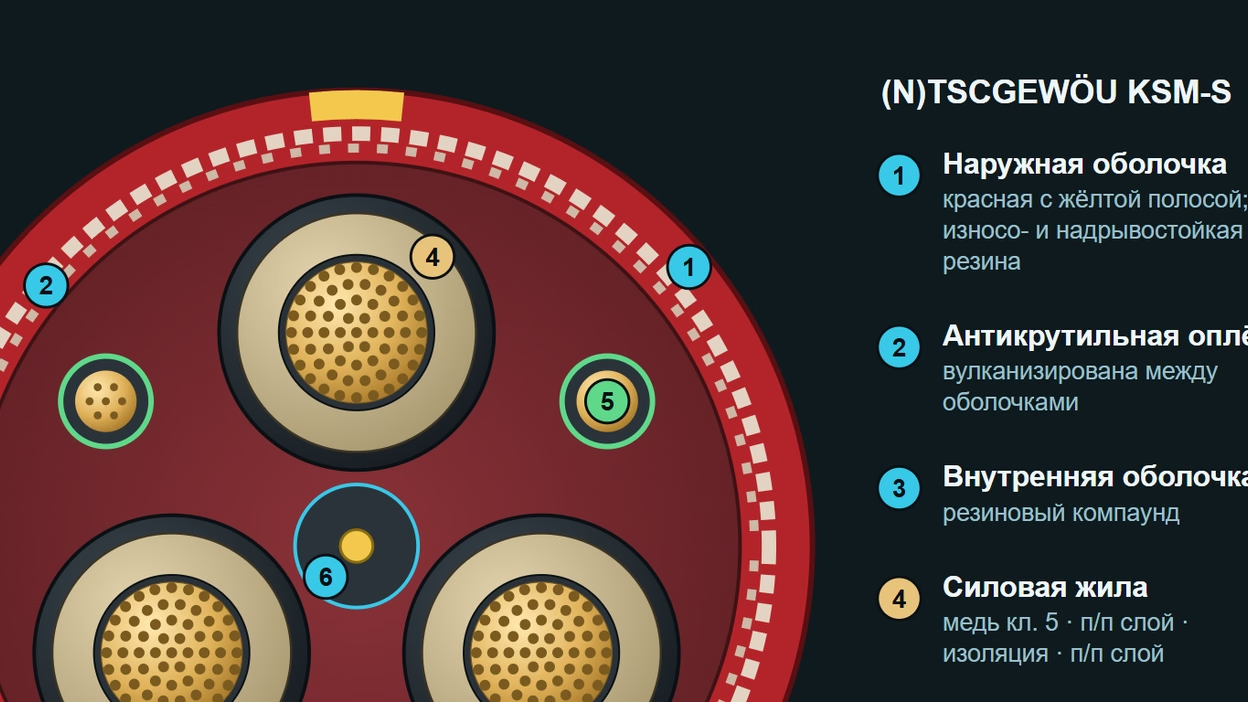
BiTcrane® (N)TSCGEWOEU-SR FO cable revolutionizes port crane architecture by integrating fiber optic communication and screened control signaling directly into the reeling cable structure. This enables: Real-Time Load Sensing: Optical load cells transmit actual container weight and load distribution across the fiber optic core, enabling sophisticated anti-sway algorithms and dynamic positioning. Anti-Collision Systems: Integrated control cores and fiber optics enable simultaneous position/velocity data transmission from three independent sensors, supporting autonomous crane systems that avoid collisions with adjacent cranes or adjacent gantries. Predictive Maintenance Monitoring: Integrated temperature and vibration sensors on control cores transmit cable and motor health metrics, alerting maintenance teams to incipient failures before breakdown occurs. Safety Emergency Stop: Dedicated screened control cores provide redundant emergency stop signaling, independent of power circuits, enabling fail-safe descent during electrical system failures. 60 m/min Continuous Operation: Synthetic torsion-protection braid enables extreme rotation resistance (±20–30°/m), supporting rapid container cycling without cable fatigue or control signal degradation.

BiTcrane® (N)TSCGEWOEU-SR FO

BiTcrane® (N)TSCGEWOEU-SR FO cable revolutionizes port crane architecture by integrating fiber optic communication and screened control signaling directly into the reeling cable structure. This enables: Real-Time Load Sensing: Optical load cells transmit actual container weight and load distribution across the fiber optic core, enabling sophisticated anti-sway algorithms and dynamic positioning. Anti-Collision Systems: Integrated control cores and fiber optics enable simultaneous position/velocity data transmission from three independent sensors, supporting autonomous crane systems that avoid collisions with adjacent cranes or adjacent gantries. Predictive Maintenance Monitoring: Integrated temperature and vibration sensors on control cores transmit cable and motor health metrics, alerting maintenance teams to incipient failures before breakdown occurs. Safety Emergency Stop: Dedicated screened control cores provide redundant emergency stop signaling, independent of power circuits, enabling fail-safe descent during electrical system failures. 60 m/min Continuous Operation: Synthetic torsion-protection braid enables extreme rotation resistance (±20–30°/m), supporting rapid container cycling without cable fatigue or control signal degradation.
The PRYSMIAN Protolon® (SMK-200)-LWL cable eliminates this bottleneck through ultra-high-speed monospiral reeling capability at 200 metres per minute (one-way operation). This 2–4× speed increase over conventional cables enables: Reduced Deployment Time: A 10-kilometre umbilical deploys to 5000-metre depth in 50 hours (vs. 100–200 hours), cutting deployment cycle time in half or more. Lower Vessel Operating Costs: 2–4 day reduction in vessel time on station translates to $200,000–800,000 operational savings per deployment, plus enabling multiple deployment cycles per vessel contract. Increased Project Throughput: Offshore wind farms can install subsea cables 2–3× faster, enabling completion of larger farm capacity in shorter timeframes, accelerating wind energy deployment. Emergency Response Capability: Subsea equipment failures can be addressed rapidly; intervention vessels can deploy repair umbilicals in hours instead of days.

PRYSMIAN Protolon® (SMK-200)-LWL

The PRYSMIAN Protolon® (SMK-200)-LWL cable eliminates this bottleneck through ultra-high-speed monospiral reeling capability at 200 metres per minute (one-way operation). This 2–4× speed increase over conventional cables enables: Reduced Deployment Time: A 10-kilometre umbilical deploys to 5000-metre depth in 50 hours (vs. 100–200 hours), cutting deployment cycle time in half or more. Lower Vessel Operating Costs: 2–4 day reduction in vessel time on station translates to $200,000–800,000 operational savings per deployment, plus enabling multiple deployment cycles per vessel contract. Increased Project Throughput: Offshore wind farms can install subsea cables 2–3× faster, enabling completion of larger farm capacity in shorter timeframes, accelerating wind energy deployment. Emergency Response Capability: Subsea equipment failures can be addressed rapidly; intervention vessels can deploy repair umbilicals in hours instead of days.
The FeiChun (N)3GHSSHCH Self-Luminous LED Mining Cable represents the international gold standard for underground mining electrical infrastructure, combining three critical technological advances: three-phase efficient power transmission, advanced halogen-free fire safety, and passive electromagnetic induction LED illumination. This model designation has become the specification of choice across coal mining operations in China, Poland, Germany, Australia, and South Africa—regions representing 60% of global mining output.

FeiChun® (N)3GHSSHCH Self-Luminous LED Mining Cable

The FeiChun (N)3GHSSHCH Self-Luminous LED Mining Cable represents the international gold standard for underground mining electrical infrastructure, combining three critical technological advances: three-phase efficient power transmission, advanced halogen-free fire safety, and passive electromagnetic induction LED illumination. This model designation has become the specification of choice across coal mining operations in China, Poland, Germany, Australia, and South Africa—regions representing 60% of global mining output.
The (N)3GHSSYCY-LED cable represents a revolutionary advancement in mining electrical infrastructure: a heavy-duty MV armored trailing cable enhanced with self-powered LED illumination. Unlike traditional approach es that treat cable visibility as an afterthought, the (N)3GHSSYCY-LED integrates electromagnetic induction energy harvesting directly into the cable's core construction, generating continuous warning-red LED illumination (620–630 nm) with zero external power supply, zero additional infrastructure modifications, and zero operational maintenance.

(N)3GHSSYCY-LED Cable

The (N)3GHSSYCY-LED cable represents a revolutionary advancement in mining electrical infrastructure: a heavy-duty MV armored trailing cable enhanced with self-powered LED illumination. Unlike traditional approach es that treat cable visibility as an afterthought, the (N)3GHSSYCY-LED integrates electromagnetic induction energy harvesting directly into the cable’s core construction, generating continuous warning-red LED illumination (620–630 nm) with zero external power supply, zero additional infrastructure modifications, and zero operational maintenance.
H07BN4-F® is the heavy-duty industrial rubber cable engineered specifically for power distribution in the harshest real-world environments: wind turbine installations at exposed high-altitude and coastal sites, temporary construction power systems on job sites, outdoor industrial machinery exposed to sun and weather, renewable energy systems requiring rugged reliability, and portable equipment power circuits subject to continuous flexing and mechanical stress. Unlike standard commercial cables that degrade or fail within months under industrial abuse, the H07BN4-F features EI7 heat-resistant rubber insulation, EM7 oil-resistant rubber sheath, and Class 5 very flexible bare copper conductors designed to deliver uninterrupted power through decades of real-world industrial operations.

H07BN4-F® Industrial Cable

H07BN4-F® is the heavy-duty industrial rubber cable engineered specifically for power distribution in the harshest real-world environments: wind turbine installations at exposed high-altitude and coastal sites, temporary construction power systems on job sites, outdoor industrial machinery exposed to sun and weather, renewable energy systems requiring rugged reliability, and portable equipment power circuits subject to continuous flexing and mechanical stress. Unlike standard commercial cables that degrade or fail within months under industrial abuse, the H07BN4-F features EI7 heat-resistant rubber insulation, EM7 oil-resistant rubber sheath, and Class 5 very flexible bare copper conductors designed to deliver uninterrupted power through decades of real-world industrial operations.
FABER® A05RN-F roller blind cable is the specialized control cable engineered specifically for motorized roller blind drives, Venetian blind automation systems, jalousie window controls, and building facade shade management. Unlike general-purpose motor control cables that degrade when exposed to continuous UV sunlight and ozone in outdoor environments, the A05RN-F features UV and ozone-resistant rubber sheathing, EPR thermoset insulation, and flame-retardant construction that maintains electrical and mechanical integrity through decades of permanent outdoor exposure.

FABER® A05RN-F Roller Blind Cable

FABER® A05RN-F roller blind cable is the specialized control cable engineered specifically for motorized roller blind drives, Venetian blind automation systems, jalousie window controls, and building facade shade management. Unlike general-purpose motor control cables that degrade when exposed to continuous UV sunlight and ozone in outdoor environments, the A05RN-F features UV and ozone-resistant rubber sheathing, EPR thermoset insulation, and flame-retardant construction that maintains electrical and mechanical integrity through decades of permanent outdoor exposure.
TML® submersible pump cable is the professional-grade electrical solution designed specifically for permanent submersion in drinking water systems, deep well applications, underwater pump installations, and saltwater coastal environments. Unlike general-purpose control cables that degrade when exposed to continuous moisture, the TML cable family features tinned copper conductors, AD8 water-resistant rubber insulation, and robust rubber sheathing engineered to maintain electrical integrity even after months or years of 24/7 submersion.

TML® Submersible Pump Cable

TML® submersible pump cable is the professional-grade electrical solution designed specifically for permanent submersion in drinking water systems, deep well applications, underwater pump installations, and saltwater coastal environments. Unlike general-purpose control cables that degrade when exposed to continuous moisture, the TML cable family features tinned copper conductors, AD8 water-resistant rubber insulation, and robust rubber sheathing engineered to maintain electrical integrity even after months or years of 24/7 submersion.
The H07RN-F cable represents the pinnacle of industrial-grade rubber insulated cable design, engineered for demanding applications where extreme flexibility, superior environmental resistance, and uncompromising reliability are non-negotiable. Developed per DIN EN 50525-2-21 (VDE 0285-525-2-21), the H07RN-F combines advanced vulcanization technology with chloroprene (CR) EM2 elastomer sheath composition to deliver exceptional performance across construction sites, industrial machinery, marine installations, and professional electrical systems.

TRIFLEX Plus H07RN-F®

The H07RN-F cable represents the pinnacle of industrial-grade rubber insulated cable design, engineered for demanding applications where extreme flexibility, superior environmental resistance, and uncompromising reliability are non-negotiable. Developed per DIN EN 50525-2-21 (VDE 0285-525-2-21), the H07RN-F combines advanced vulcanization technology with chloroprene (CR) EM2 elastomer sheath composition to deliver exceptional performance across construction sites, industrial machinery, marine installations, and professional electrical systems.
The H07RN-F cable represents the pinnacle of DIN EN 50525-2-21 industrial cable performance—engineered specifically for applications where household cables fail. Unlike H05-series cables limited to 60°C conductor temperature and 500V operating voltage, the H07RN-F operates at 85°C continuous conductor temperature and 750V nominal voltage, with complete environmental resistance to UV radiation, oils, and ozone degradation.

H07RN-F®

The H07RN-F cable represents the pinnacle of DIN EN 50525-2-21 industrial cable performance—engineered specifically for applications where household cables fail. Unlike H05-series cables limited to 60°C conductor temperature and 500V operating voltage, the H07RN-F operates at 85°C continuous conductor temperature and 750V nominal voltage, with complete environmental resistance to UV radiation, oils, and ozone degradation.
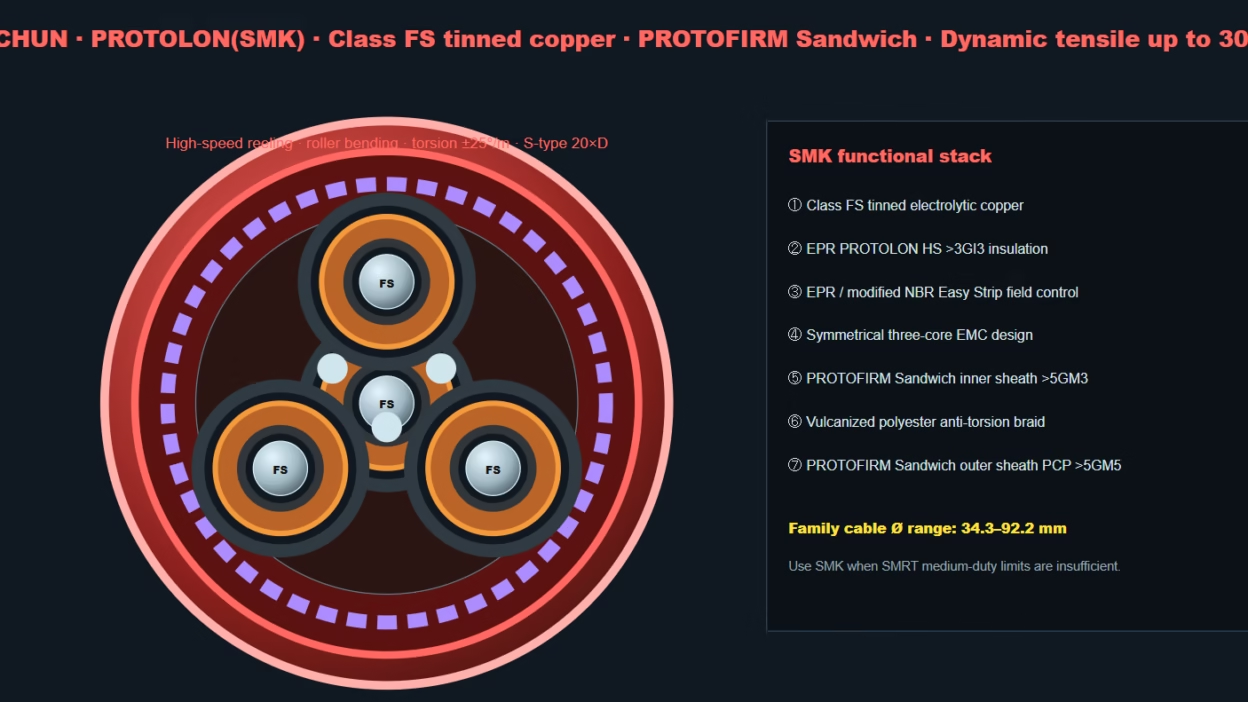
PRYSMIAN CORDAFLEX® (SMK) (N)SHTOEU is not merely a cable — it is an entire reeling cable programme contained within a single product designation. With 38 standard configurations spanning four distinct architecture types (three-phase power, multi-core power, multi-core control, and hybrid power+screened control), cross-sections from 1.5 mm² to 240 mm², ampacities from 13.7 A to 540+ A, and weights from 257 kg/km to nearly 12,000 kg/km — the CORDAFLEX (SMK) covers every motorised drum reeling application in port crane, mining, and heavy industrial operations.

PRYSMIAN CORDAFLEX® (SMK) (N)SHTOEU

PRYSMIAN CORDAFLEX® (SMK) (N)SHTOEU is not merely a cable — it is an entire reeling cable programme contained within a single product designation. With 38 standard configurations spanning four distinct architecture types (three-phase power, multi-core power, multi-core control, and hybrid power+screened control), cross-sections from 1.5 mm² to 240 mm², ampacities from 13.7 A to 540+ A, and weights from 257 kg/km to nearly 12,000 kg/km — the CORDAFLEX (SMK) covers every motorised drum reeling application in port crane, mining, and heavy industrial operations.
The PRYSMIAN Cordaflex® (N)SHTÖU (SMK)-V is the most configuration-diverse vertical spreader cable without fiber optics — offering six distinct configurations that span three fundamentally different spreader architecture types. Where the (SMK)-V-S offers a single 36×2.5 configuration and the REEL XPRT offers four standard configurations, the (SMK)-V delivers six configurations including two that exist nowhere else in the Klaus Faber catalogue: a 49×1.0 signal-only variant for spreaders with dedicated power cables, and a 20×2.5+3×CAN-BUS+2×(2×2.5)C variant with integrated digital fieldbus communication and screened control pairs.

PRYSMIAN Cordaflex® (N)SHTÖU (SMK)-V

The PRYSMIAN Cordaflex® (N)SHTÖU (SMK)-V is the most configuration-diverse vertical spreader cable without fiber optics — offering six distinct configurations that span three fundamentally different spreader architecture types. Where the (SMK)-V-S offers a single 36×2.5 configuration and the REEL XPRT offers four standard configurations, the (SMK)-V delivers six configurations including two that exist nowhere else in the Klaus Faber catalogue: a 49×1.0 signal-only variant for spreaders with dedicated power cables, and a 20×2.5+3×CAN-BUS+2×(2×2.5)C variant with integrated digital fieldbus communication and screened control pairs.
Cordaflex SMRT replacement, Prysmian Cordaflex alternative, NSHTOU cable, NSHTOEU SMRT, black rubber reeling cable, split earth reeling cable, VFD optimized crane cable, 0.6/1kV reeling cable, STS crane main power cable, 3 phase split ground cable, 5GM5 rubber sheath, heavy duty rubber cable, dynamic load crane cable, Feichun reeling cable, Feichun crane cable, Chinese premium crane cable, import substitution cable, 200 m/min crane cable, continuous flexing rubber cable, UV resistant reeling cable, carbon black rubber cable, ozone resistant crane cable, flame retardant rubber cable, harbour crane electrification, material handling cable, heavy machinery wiring, robust industrial rubber cable, flexible power transmission, torsional stress cable, high tensile strength crane cable, port terminal electrification, mechanical stress reeling, offshore crane power cable, motorized drum cable, European standard equivalent, Lapp cable alternative, TF Kable reeling equivalent, sanction free crane cable, direct factory reeling cable, custom crane cable, heavy duty hoist cable, VDE 0250-814 reeling cable, EMI cancellation cable, common mode current reduction, VFD motor power cable, port crane upgrade wiring, mobile crusher power cable, ERTG power cable, anti torsion rubber cable, Class 5 copper reeling

PRYSMIAN Cordaflex® SMRT (N)SHTOEU

Cordaflex SMRT replacement, Prysmian Cordaflex alternative, NSHTOU cable, NSHTOEU SMRT, black rubber reeling cable, split earth reeling cable, VFD optimized crane cable, 0.6/1kV reeling cable, STS crane main power cable, 3 phase split ground cable, 5GM5 rubber sheath, heavy duty rubber cable, dynamic load crane cable, Feichun reeling cable, Feichun crane cable, Chinese premium crane cable, import substitution cable, 200 m/min crane cable, continuous flexing rubber cable, UV resistant reeling cable, carbon black rubber cable, ozone resistant crane cable, flame retardant rubber cable, harbour crane electrification, material handling cable, heavy machinery wiring, robust industrial rubber cable, flexible power transmission, torsional stress cable, high tensile strength crane cable, port terminal electrification, mechanical stress reeling, offshore crane power cable, motorized drum cable, European standard equivalent, Lapp cable alternative, TF Kable reeling equivalent, sanction free crane cable, direct factory reeling cable, custom crane cable, heavy duty hoist cable, VDE 0250-814 reeling cable, EMI cancellation cable, common mode current reduction, VFD motor power cable, port crane upgrade wiring, mobile crusher power cable, ERTG power cable, anti torsion rubber cable, Class 5 copper reeling