DIN VDE 0250 Mining Cable

飞纯 Type 412 是依据 AS/NZS 2802:2000 标准体系设计的 1.1/1.1KV 矿用柔性铠装馈电电缆。 产品采用绿黄接地芯和可弯曲钢丝铠装, 主要用于存在较高机械损伤风险的矿山供电场景。 当电缆在砂矿作业区受到石块、机械设备、车辆、 拖拉、挤压或其他外部因素影响时,电缆损伤可能导致供电中断。 Type 412 设置可弯曲镀锌低碳钢丝铠装, 目的在于增强机械保护并减少因电缆损坏造成的高成本停机。 根据产品应用说明,Type 412 特别适合安装为 砂矿开采作业中的馈电电缆。 其结构兼顾柔性导体、电气绝缘、接地保护和金属铠装机械保护。

什么是 5GM5 重载橡胶电缆

5GM5 并不是聚氨酯(PUR)材质。在德国 VDE 0207-21 护套料标准体系中,PUR 的代码是 11Y(热塑性聚氨酯弹性体),而 5GM5 代表”特种重载合成橡胶/弹性体护套材料”,通常是高级特种氯丁橡胶(PCP/CR)或高性能氯化聚乙烯(CPE)的改性配方。二者材质不同,却常被放在一起对比——因为它们都是各自领域里抗撕裂、耐磨损、防油性最顶级的”硬核”存在。区别在于主场:PUR 统治高动态、高柔性、轻量场合;而 5GM5 统治大规格、中高压、极端重工业,如矿山、港口吊机、大吨位卷筒
飞纯 Type 241 Superflex 是基于 AS/NZS 1802:2003 卷筒与拖曳电缆 标准体系设计的矿用超柔性电缆,电压范围覆盖 1.1 至 6.6KV。它与 Type 241 电缆结构相似,但更加柔软,并具有更小的自然弯曲半径。 该系列特别适合作为 单轨吊电缆 使用。单轨吊系统中,电缆通常以环状方式悬挂或移动,如果电缆自然弯曲半径较大,电缆环会占用更多空间,也更容易与其他设备、支架或结构发生挂碰。Type 241 Superflex 通过更高柔性的导体和结构设计,使电缆环更窄,为其他设备留出更多空间,并减少电缆被挂住、刮碰或卡滞的机会。

什么是高弹性螺旋弹簧电缆:KPUR / PUR-Spiral、LiY11Y-HN、H07BQ-F Helix

聚氨酯(PUR)拥有一种其他材料难以企及的机械特性——弹性记忆力:被拉伸后能完美回弹、恢复原状而不松垮、不变形。正因如此,市面上 95% 以上的高端弹簧线都用 PUR 制造。这类螺旋(Spiral / Helix)电缆平时盘缩成紧凑的螺旋,需要时拉长伸展,用完自动缩回,专为”伸缩取电/取信号”的场景而生。本文逐一解析三种主力:通用型 KPUR / PUR-Spiral(手持扫描枪、仪器仪表)、重载拉伸的 LiY11Y-HN(卡车牵引头、物流输送线)、以及基于重型欧标结构的 H07BQ-F Helix(升降台、大型电动工具电源延伸)
飞纯 Type A 与 Type B 是依据 AS/NZS 1972:2006 设计的 1.1/1.1KV 矿用动力电缆, 用于矿井范围内的电力分配, 并适合地下煤矿环境。 电缆采用三根绞合镀锡退火铜动力导体, 每根导体外设置 EPR 绝缘和铜线屏蔽, 内部使用弹性体中心填充, 外部采用重型 PCP 护套。 Type A 与 Type B 的主要区别是 Pilot 配置: Type A 可选配三根 Pilot 芯,Type B 不配置 Pilot 芯。

什么是新能源汽车充电桩专用 PUR 电缆:H05BZ-F / H07BZ5-F / EVC750-PUR / EVC1000-PUR

新能源汽车充电枪电缆长期暴露在户外,要面对烈日曝晒、车辆油污、反复拖拽乃至车辆碾压——这是普通工业电缆从不经历的环境虐待。PUR(聚氨酯)是当前直流/交流充电枪线的主流护套材料,遵循 EN 50620 / IEC 62893-3 标准。本文逐一解析这一族充电电缆:轻型单相交流的 H05BZ-F、重型三相大电流的 H07BZ5-F(市面绿色、橙色大功率充电枪的主体力缆),以及面向最高 1000V DC 高压快充的国产企标 EVC750-PUR / EVC1000-PUR 液冷/非液冷特种大电流充电电缆。
飞纯 Type 241 Superflex 是基于 AS/NZS 1802:2003 卷筒与拖曳电缆 标准体系设计的矿用超柔性电缆,电压范围覆盖 1.1 至 6.6KV。它与 Type 241 电缆结构相似,但更加柔软,并具有更小的自然弯曲半径。 该系列特别适合作为 单轨吊电缆 使用。单轨吊系统中,电缆通常以环状方式悬挂或移动,如果电缆自然弯曲半径较大,电缆环会占用更多空间,也更容易与其他设备、支架或结构发生挂碰。Type 241 Superflex 通过更高柔性的导体和结构设计,使电缆环更窄,为其他设备留出更多空间,并减少电缆被挂住、刮碰或卡滞的机会。

什么是 PUR-C-JZ / PUR-C-OZ:镀锡铜网编织屏蔽聚氨酯控制电缆

PUR-C-JZ / PUR-C-OZ 是在 PUR-JZ / OZ 非屏蔽控制电缆基础上,增加一层镀锡铜丝编织屏蔽(代号 C)的版本,专为变频器、伺服驱动等强电磁干扰环境下的控制与信号回路设计。它们沿用同一套内核——第 5 类细绞铜导体、300/500 V 额定、黑色芯线 + 白色数字编号、PUR 聚氨酯护套带来的耐磨耐油无卤——核心区别只有一个:在缆芯外、护套内加了一层镀锡铜网,把外界电磁干扰挡在芯线之外。两者之间仍以 J(带黄绿保护接地芯)/ O(不带地线)区分。
飞纯 Type 412 是依据 AS/NZS 2802:2000 标准体系设计的 1.1/1.1KV 矿用柔性铠装馈电电缆。 产品采用绿黄接地芯和可弯曲钢丝铠装, 主要用于存在较高机械损伤风险的矿山供电场景。 当电缆在砂矿作业区受到石块、机械设备、车辆、 拖拉、挤压或其他外部因素影响时,电缆损伤可能导致供电中断。 Type 412 设置可弯曲镀锌低碳钢丝铠装, 目的在于增强机械保护并减少因电缆损坏造成的高成本停机。 根据产品应用说明,Type 412 特别适合安装为 砂矿开采作业中的馈电电缆。 其结构兼顾柔性导体、电气绝缘、接地保护和金属铠装机械保护。

什么是 PUR-JZ / PUR-OZ / PUR-JB / PUR-OB:聚氨酯护套非屏蔽控制电缆

PUR-JZ / OZ / JB / OB 是同一族聚氨酯护套柔性控制电缆,用于机床、自动化设备、装配线与移动机械的控制、信号与测量回路连接。它们共享同一套技术内核——第 5 类细绞铜导体、300/500 V 额定、PUR 聚氨酯护套带来的耐磨、耐油、无卤——区别只在两个互相独立的二选一维度:J(带绿/黄接地芯)还是 O(不带地线),以及 Z(黑色芯线 + 白色数字编号)还是 B(彩色色标区分芯线)。理解了这两个维度的排列组合,就理解了这四个型号的全部分工。
飞纯 Type 441 Class 1 是依据 AS/NZS 2802:2000 设计的矿用卷筒与拖曳电缆, 覆盖 3.3KV、6.6KV、11KV 和 22KV 系列。 该系列适用于多种矿山机械和设备的移动供电, 既适合电缆随设备拖曳运行, 也适合通过卷筒进行反复收放。 Type 441 Class 1 配置一根中央可伸长 Pilot, 并采用半导电 PCP 托架支撑和保护三根动力线芯。 这一结构使动力芯在电缆受到挤压或压扁时不容易发生异常位移和内部损伤。

什么是 NSSHOEU / NTSWOEU 矿用潜水电缆(最高 6kV):橡套潜水泵电缆

Feichun NSSHOEU / NTSWOEU 是一类专为工业用水与矿井排水潜水泵设计的柔性橡套潜水电缆,额定电压覆盖 0.6/1 kV 至 3.6/6 kV。它采用第 5 类细绞镀锡铜导体、耐热 EPR 绝缘、GM1b 橡胶内护套与氯化橡胶外护套(0.6/1 kV 用 5GM5,中压用 5GM3),用于将岸上或井口配电与浸没在水中的电气运行设备连接起来。其中 3 芯无地芯结构是一项典型而关键的工程设计:当上升管(排水立管)本身可作为接地导体时,电缆省去独立地芯,从而减小外径、降低重量、便于盘绕与悬垂下放——这正是深井与矿坑排水场景下被反复验证的成熟做法。
飞纯 Type 209 是飞纯电缆基于 AS/NZS 1802:2003 卷筒与拖曳电缆 体系设计的矿用柔性馈电与拖曳电缆系列,电压范围覆盖 1.1 至 11KV。根据产品资料,Type 209 系列电缆主要作为矿山机械柔性馈电电缆使用,更适合作为拖曳电缆而不是高频卷筒电缆。较小规格适用于钻机、手持工具和移动设备。 这一定义是理解 Type 209 的关键。Type 209 不是普通工业橡套软电缆,也不只是单纯的矿山供电线。它的核心定位是 矿山机械柔性馈电电缆,也就是为矿山机械提供可移动、可拖曳、可适应复杂作业路径的供电系统。同时,它更适合作为 拖曳电缆,即跟随设备移动的电缆,而不是长期高频卷绕使用的卷筒电缆。

什么是 NSSHÖU …/3E + ST 0.6/1kV 重型柔性矿用电缆

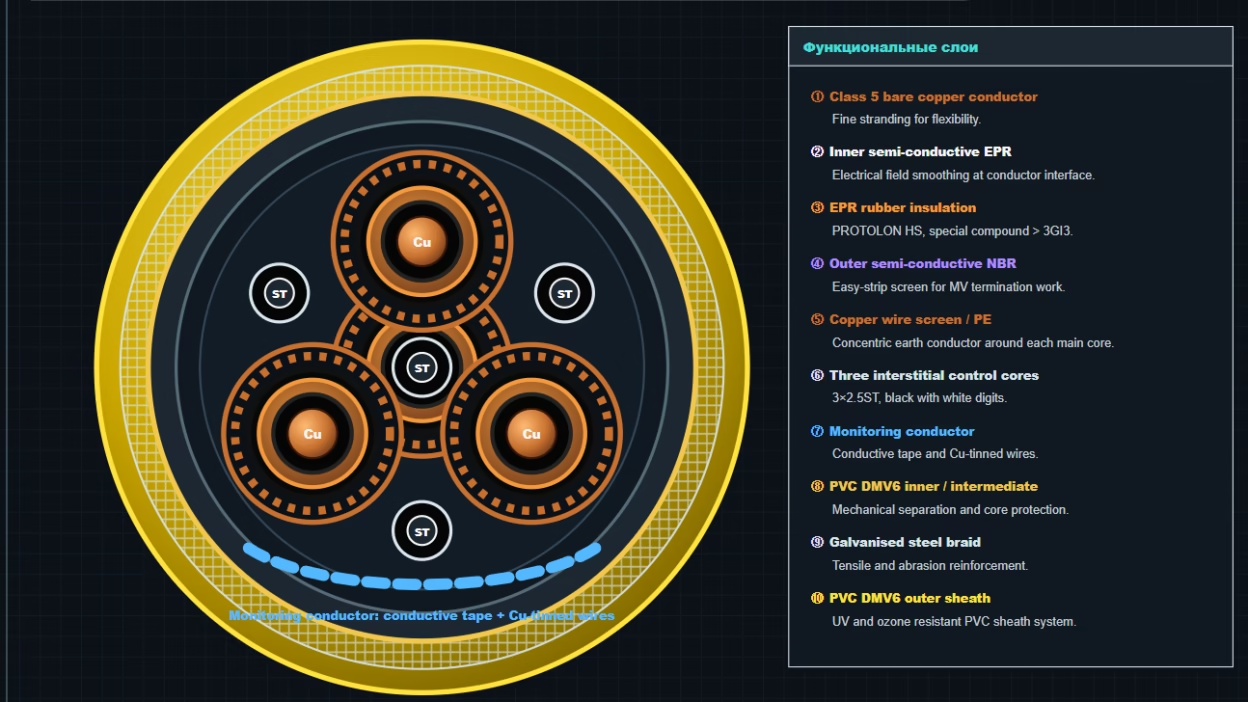
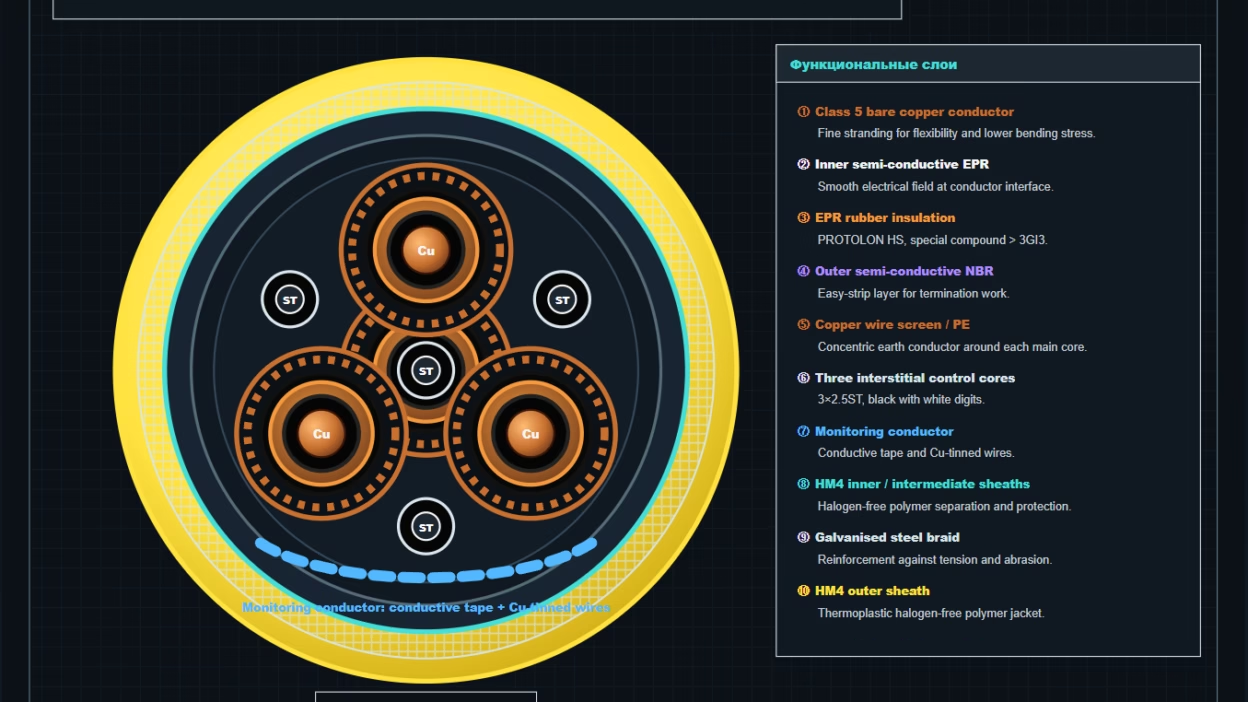
NSSHÖU …/3E + ST 0.6/1kV 是一款为承受极高机械负荷的移动设备与机械供电而设计的重型橡套柔性电缆。它采用第5类镀锡软铜导体、EPR 3GI3 耐热绝缘、3E 螺旋分布式接地(或 KON 同心接地结构)、置于间隙中的 ST 控制芯、GM1b 橡胶内护套与 5GM5 氯化橡胶耐磨外护套。其核心定位是:在干燥与潮湿区域、户外以及防爆危险区域中——尤其是采矿、工业、采石场与建筑工地——为持续移动、拖拽、弯折与受冲击的设备提供既能传输动力、又能集成控制信号、且具备耐磨耐油阻燃能力的单一柔性电缆解决方案。
飞纯 Type 245 是基于 AS/NZS 1802:2003 卷筒与拖曳电缆 标准体系设计的矿用非常柔性长壁采煤机电缆,电压范围覆盖 1.1 至 6.6KV。根据产品资料,该电缆主要用作长壁采煤机电缆,也可用于连续采煤机和长壁外围电缆。 Type 245 的关键结构特征是 三根中央可伸长 Pilot / 控制芯线。这三根中央 Pilot 芯线可用于 接地连续性监测 和 控制回路。对于长壁采煤机来说,电缆不仅要传输动力电能,还要承担设备控制、保护联锁、接地连续性确认和移动工况下的安全监测任务。

什么是 NSSHOEU-O/J 0.6/1kV Heavy Duty Flexible Cable

NSSHOEU-O/J 0.6/1kV Heavy Duty Flexible Cable 是 Feichun 面向矿山、工业、采石场、建筑工地、户外、干燥和潮湿区域以及爆炸危险区域移动设备开发的重载柔性橡套电缆。资料说明,该电缆用于连接承受非常高机械负载的移动设备和机器,特别适用于 mining and industry、quarries and building sites。其核心结构包括 Class 5 柔性镀锡铜导体、耐热 EPR type 3GI3 绝缘、GM1b/5GM3 橡胶内护套和 PCP/CR type 5GM5 氯化橡胶外护套。
飞纯 Type 209 是飞纯电缆基于 AS/NZS 1802:2003 卷筒与拖曳电缆 体系设计的矿用柔性馈电与拖曳电缆系列,电压范围覆盖 1.1 至 11KV。根据产品资料,Type 209 系列电缆主要作为矿山机械柔性馈电电缆使用,更适合作为拖曳电缆而不是高频卷筒电缆。较小规格适用于钻机、手持工具和移动设备。 这一定义是理解 Type 209 的关键。Type 209 不是普通工业橡套软电缆,也不只是单纯的矿山供电线。它的核心定位是 矿山机械柔性馈电电缆,也就是为矿山机械提供可移动、可拖曳、可适应复杂作业路径的供电系统。同时,它更适合作为 拖曳电缆,即跟随设备移动的电缆,而不是长期高频卷绕使用的卷筒电缆。

什么是 (N)SSHOEU 0.6/1kV Heavy Duty Flexible Cable

(N)SSHOEU 0.6/1kV Heavy Duty Flexible Cable 是 Feichun 面向矿山、采石场、建筑工地、户外、干燥与潮湿区域以及爆炸危险区域移动设备开发的重载柔性橡套电缆。资料说明,该电缆用于连接承受非常高机械负载的移动设备和机器,尤其适用于 mining、quarries 和 building sites。其典型结构包括 Class 5 柔性铜导体、3GI3 橡胶绝缘、可选 pilot cores、镀锡铜丝螺旋接地导体、GM1b 橡胶内护套和 5GM5 橡胶外护套。
飞纯 Type 412 是依据 AS/NZS 2802:2000 标准体系设计的 1.1/1.1KV 矿用柔性铠装馈电电缆。 产品采用绿黄接地芯和可弯曲钢丝铠装, 主要用于存在较高机械损伤风险的矿山供电场景。 当电缆在砂矿作业区受到石块、机械设备、车辆、 拖拉、挤压或其他外部因素影响时,电缆损伤可能导致供电中断。 Type 412 设置可弯曲镀锌低碳钢丝铠装, 目的在于增强机械保护并减少因电缆损坏造成的高成本停机。 根据产品应用说明,Type 412 特别适合安装为 砂矿开采作业中的馈电电缆。 其结构兼顾柔性导体、电气绝缘、接地保护和金属铠装机械保护。

什么是 NSSHCGEOEU 0.6/1kV Coal Cutter Cable (Low Tensile Stress) 

NSSHCGEOEU 0.6/1kV Coal Cutter Cable (Low Tensile Stress) 是 Feichun 面向地下矿山采煤机和移动机械开发的低拉伸应力型采煤机电缆。资料说明,该电缆用于承受极高机械负载的移动机器,主要应用于矿山场景,例如 coal-cutting machines,尤其适合低拉伸应力下的极端弯曲负载。与高拉伸应力版本相比,低拉伸应力版本的结构重点从“铜钢丝编织抗拉铠装”转向“铜钢丝螺旋同心接地结构 + 玻纤带 + 外护套嵌入防移位设计”,更适合弯曲频繁但持续牵引张力较低的采煤机连接场景。
飞纯 Type 245 是基于 AS/NZS 1802:2003 卷筒与拖曳电缆 标准体系设计的矿用非常柔性长壁采煤机电缆,电压范围覆盖 1.1 至 6.6KV。根据产品资料,该电缆主要用作长壁采煤机电缆,也可用于连续采煤机和长壁外围电缆。 Type 245 的关键结构特征是 三根中央可伸长 Pilot / 控制芯线。这三根中央 Pilot 芯线可用于 接地连续性监测 和 控制回路。对于长壁采煤机来说,电缆不仅要传输动力电能,还要承担设备控制、保护联锁、接地连续性确认和移动工况下的安全监测任务。

什么是 NSHTOEU 0.6/1kV LHD Cables

NSHTOEU 0.6/1kV LHD Cables 是 Feichun 面向地下矿山 LHD、scoops 以及频繁动态负载卷盘系统开发的矿山移动电缆。资料说明,该电缆用于 frequently changing dynamic loads,典型应用为 underground mines 中 scoops / LHDs 的 reeling cables,并适用于 mono-spiral reels 和 cylindrical reels。其核心结构由柔性镀锡铜导体、3GI3 EPR 绝缘、可选中心承力元件、5GM5 PCP 内护套、硫化结合在内外护套之间的聚酯纱增强抗扭编织,以及 5GM5 PCP 外护套组成。
现代割吸挖泥船和潜水泵系统日益采用复杂的强制导向电缆路由配置,其中电缆部署必须适应多方向偏转(水平和垂直弯曲同时)、高部署速度(150-200 m/min运行范围)、以及锚地迁移周期期间由卷轴轴旋转惯性施加的动态扭转应力。常规高柔性电缆(非专化防旋转架构)遭遇关键运行局限:电缆绞合不平衡在快速部署中产生螺旋旋转扭矩,导致电缆扭转积累和操作员控制的手动反扭转循环,中断挖泥生产力并在卷轴处理期间引入安全危害。此外,不受控制的电缆扭转诱发导体绞合中的永久微变形和绝缘压缩,加速疲劳裂纹和提前服役寿命故障。 FLEXIDRUM® MEDIUM RS防旋转变体代表对这些部署约束的专化工程响应,集合合成纤维防旋转矩阵(S-玻璃纤维或芳纶复合加强)在电缆结构内集中铺设于内部PCP护套和外部专化PCP复合体之间。这个支撑屏障架构直接解决旋转扭矩机制:合成纤维矩阵抵抗否则会产生旋转扭矩的螺旋绞合几何,维持电缆中性扭转条件贯穿部署周期。现场验证跨北海、中东和东南亚挖泥设施记录了显著运营改进:消除手动反扭转需求、20-30%锚地迁移周期时间减少,以及通过扭转诱发疲劳机制消除延长服役耐久性。

飞纯港口与矿山移动设备电缆技术访问中心

面向电气工程师、设备维护人员、港机与矿山项目采购团队,把分散的技术文章整理为可检索、可分类、可直接访问的专业资料入口。
AS/NZS 1802 电缆型号

AS/NZS 1802/2802 矿用卷筒/拖曳电缆选型计算器:载流量、电压降、短路热稳定一页算清

面向电气工程师的 AS/NZS 1802/2802 电缆工具箱:从负载电流、卷筒降额到功率因数补偿和年损耗,快速形成选型依据
飞纯 Type 441 是一种依据 AS/NZS 2802:2000 设计的 Class 2 矿用卷筒与拖曳电缆, 额定电压为 1.1/1.1KV。 该系列面向多种矿山移动供电用途。 与只强调拖曳或只强调卷筒运行的电缆不同, Type 441 明确适用于 拖曳应用和卷筒收放应用。 Type 441 在电缆中心设置一根可伸长 Pilot, 同时采用半导电 PCP 托架支撑三根动力线芯。 这一支撑结构有助于

飞纯 Type 441(Class 2)1.1/1.1KV:兼顾拖曳与卷筒应用的矿用柔性电缆技术解析

飞纯 Type 441 是一种依据 AS/NZS 2802:2000 设计的 Class 2 矿用卷筒与拖曳电缆, 额定电压为 1.1/1.1KV。 该系列面向多种矿山移动供电用途。 与只强调拖曳或只强调卷筒运行的电缆不同, Type 441 明确适用于 拖曳应用和卷筒收放应用。 Type 441 在电缆中心设置一根可伸长 Pilot, 同时采用半导电 PCP 托架支撑三根动力线芯。 这一支撑结构有助于维持动力芯的位置与结构稳定, 使电缆在受到挤压或压扁时不易发生内部芯线损伤。
飞纯 Type 241 Superflex 是基于 AS/NZS 1802:2003 卷筒与拖曳电缆 标准体系设计的矿用超柔性电缆,电压范围覆盖 1.1 至 6.6KV。它与 Type 241 电缆结构相似,但更加柔软,并具有更小的自然弯曲半径。 该系列特别适合作为 单轨吊电缆 使用。单轨吊系统中,电缆通常以环状方式悬挂或移动,如果电缆自然弯曲半径较大,电缆环会占用更多空间,也更容易与其他设备、支架或结构发生挂碰。Type 241 Superflex 通过更高柔性的导体和结构设计,使电缆环更窄,为其他设备留出更多空间,并减少电缆被挂住、刮碰或卡滞的机会。

飞纯 Type 241 Superflex 1.1 至 6.6KV:基于 AS/NZS 1802:2003 的澳洲矿用超柔性单轨吊电缆技术解析

飞纯矿用电缆 Type 241 Superflex 与 Type 241 电缆结构相似,但更加柔软,并具有更小的自然弯曲半径。该电缆适合作为单轨吊电缆使用,在电缆环更窄的工况下仍能保持良好弯曲适应性,从而为其他设备留出更多空间,并减少电缆被挂碰、缠绕或卡滞的风险。
LIFT-2S (European) vs. LIFT-1S UL (North American): LIFT-2S characteristics: Voltage: 300/500V (European standard, lower voltage) Temperature: −40°C to +70°C (moderate range) Standards: VDE 0482 part 265-2-1, EN 50265-2-1, IEC 60332-1-2 Design philosophy: Safety by material redundancy (2 steel cores) Steel cores: 2× cores provide mechanical backup Conductor: Class 6 (European, ~150–200 wires per mm²) Cost: Lower (proven European manufacturing) Market: Europe, Asia-Pacific, most of world LIFT-1S UL characteristics: Voltage: 600V (North American standard, higher voltage) Temperature: −25°C to +105°C (extreme range, high-temp optimized) Standards: UL 2562, UL 62, CSA C22.2 No.210.2 Design philosophy: Safety by certification (single core + redundant control) Steel core: 1× core (sufficient with nylon covering) Conductor: Class M (UL, extra fine ~300+ wires per mm²) Cost: Higher (UL testing, certification documentation) Market: North America (USA, Canada), Mexico UL 2562 specialty certification: UL 2562 scope: Elevator and Dumbwaiter Cables Specific requirements: 1. Pendant cable design (cable hangs freely, no duct support) 2. Vertical orientation (designed for gravity-loaded suspension) 3. Repeated flex cycles (cable moves up/down frequently) 4. Safety-critical function (failure = personnel risk) Consequence: More stringent than general-purpose cables Testing includes: Bend cycle fatigue, heat aging, compression resistance Test procedures (unique to UL 2562): Bend cycle test: 1,000+ cycles at minimum bending radius Cable must pass insulation resistance after cycling Heat aging: 500+ hours at 105°C continuous Tensile strength retention minimum 70% Compression: 1,000+ hours under sustained compression Cable cross-section must not exceed 5% permanent deformation LIFT-2S (no UL 2562): Tests per VDE are less stringent on fatigue/cycling Assumes cable mostly static, not repeated flex Adequate for European elevator duty (lower speed, fewer cycles) LIFT-1S UL: All UL 2562 tests passed (proven for North American elevators) Faster cycle times, more frequent motion → more fatigue stress Extra testing ensures reliability under North American elevator duty Market requirement (regulatory): Europe/International: CE mark required (European conformity) VDE/EN/IEC standards sufficient No UL certification needed (not recognized in EU) LIFT-2S is sufficient North America (USA, Canada): UL certification mandatory for elevators UL 2562 specifically for elevator cables CSA dual certification required in Canada LIFT-2S NOT acceptable (lacks UL 2562) LIFT-1S UL mandatory Cost implication: UL certification: ~$5,000–15,000 per product per region Testing duration: 3–6 months per model Documentation: Comprehensive test reports, technical files Result: LIFT-1S UL 20–30% higher cost than equivalent European cable

DR 717 P Highflex: высокогибкий барабанный кабель PUR/TMPU для пружинных кабельных барабанов на сценах и в театрах

DR 717 P Highflex — это высокогибкий кабель для пружинных кабельных барабанов, применяемых на сценах и в театрах. Кабель разработан для намотки и размотки, имеет специально подобранную послойную скрутку вокруг центрального несущего элемента, оболочку PUR/TMPU, поддерживающий экран из высокотехнологичной нити, малый наружный диаметр, небольшой вес и высокую механическую стойкость.
FLEXIFESTOON® SEOOW YELLOW represents FeiChun's entry into the low-voltage festoon and temporary power market. The nomenclature requires careful explanation to distinguish this product from the high-voltage FLEXIDRUM series: FLEXIFESTOON Product Nomenclature: FLEXIFESTOON® = Product family name Flex = Flexible (emphasis on bending & handling) Festoon = Strung overhead in continuous runs (typical festoon lighting application) SEOOW = Industry-standard designation S = Service cord (temporary, not permanent installation) E = Elastomer jacket (flexible sheath) OO = Oil-resistant conductor insulation (TPE qualifies as oil-resistant) W = Weather-resistant sheath (water, ozone, UV resistant) SEOOW is defined in: UL 62 (Standard for Flexible Cords and Cables) CSA 22.2 No. 49 (Canadian equivalent) NFPA 70 National Electrical Code (NEC) Article 400 YELLOW designation: Color: RAL 1021 (traffic yellow, high visibility) Safety significance: Yellow cords attract attention in job sites Practical purpose: Easy to identify, prevent trips/entanglement Contrast with FLEXIDRUM series: FLEXIDRUM (High-Voltage MV Cable): Voltage: 3.6 kV to 20/35 kV (power distribution) Temperature: −40 to +80°C (standard industrial) Application: Mobile mining/tunneling equipment (capital-intensive) Size: Large diameter, heavy (3–12 kg/km) FLEXIFESTOON (Low-Voltage Service Cord): Voltage: 600V (light/power temporary use) Temperature: −60 to +105°C (extreme environmental range) Application: Festoon lighting, temporary site power, outdoor events Size: Small diameter, lightweight (0.05–0.3 kg/m) Cost: Consumer/contractor-grade (not specialty industrial)

(N)SHÖU для общего применения: силовой кабель 0,6/1 kV для карьеров, конвейеров, горных и тоннельных площадок

Кабель (N)SHÖU предназначен для тяжёлых условий эксплуатации: открытые горные работы, карьеры, линии рядом с конвейерными лентами, оборудование для обработки материалов, тоннельные площадки и сходные промышленные установки. Его инженерная ценность заключается в сочетании гибкой медной жилы класса 5, эластомерной изоляции 3GI3, внутренней эластомерной оболочки и тяжёлой наружной оболочки 5GM5 жёлтого или чёрного цвета.
UNE 22511 — formally titled "Cables flexibles para minería subterránea con tensiones de 1,8/3 kV con aislamiento de caucho, sin armadura" (Flexible cables for underground mining, 1.8/3 kV, rubber-insulated, unarmoured) — is the definitive Spanish standard for heavy-duty power cables connecting underground mobile mining equipment to fixed electrical distribution networks. Published and maintained by AENOR (Asociación Española de Normalización y Certificación), it operates as a specialized overlay on IEC 60502-1, extending that base standard's electrical requirements with the stringent mechanical, safety, and flame-retardancy requirements specific to enclosed underground environments. Despite its Spanish origin, UNE 22511 enjoys a geographic reach far exceeding Iberia. The standard has been adopted — formally or by reference — across the major Spanish-speaking mining economies: Chile, Peru, Colombia, Bolivia, and Mexico, where AENOR-certified cables are accepted by national mining safety regulators as the primary qualification pathway for underground mobile equipment power supply cables. In Chile alone, UNE 22511 cables are installed across dozens of operations including major copper and coal mines. The standard's engineering DNA can be described in a single imperative: extreme dynamic flexibility combined with superior resistance to combined torsional and bending fatigue. This is not merely a performance aspiration — it is a structural requirement that shapes every material choice and geometric decision in the cable's construction. The logic proceeds as follows: Underground mobile equipment (continuous miners, shearers, shuttle cars) moves continuously and repeatedly during operation, dragging its power cable behind it or winding and unwinding it from a cable reel. This motion imposes cyclic bending, axial tension, and torsional loads on the cable simultaneously — a multi-axis fatigue regime of a severity not encountered in any other industrial cable application. Standard fixed-installation cables, even those classified as "flexible," are not designed for this loading regime and will fail in fatigue within weeks to months when installed in drag duty. Therefore, every structural element of a UNE 22511 cable — conductor wire diameter, insulation compound, earth core geometry, armour exclusion, sheath specification — is selected to maximize multi-axis fatigue endurance, not any single performance parameter. ⛏ The Founding Engineering Principle UNE 22511 is an unarmoured drag cable standard. The deliberate absence of any metallic armour — which might superficially seem to reduce robustness — is in fact the defining engineering choice that makes the standard viable. Steel wire or tape armour in a continuously torsionally-loaded cable acts as a progressive-failure torsional spring: each twist cycle accumulates irreversible plastic strain in the armour wires, leading to wire fractures within 10,000–30,000 cycles. For a shuttle car cable experiencing 80,000+ torsional cycles per year, armour represents not additional protection but a built-in scheduled failure mechanism. The UNE 22511 design eliminates this failure mode at source.

PROTOMONT、PROTOLON、TENAX、CORDAFLEX、NSSHOEU、TUNNELFLEX、MINEMASTER、SHD-GC、G-GC、MT 818 与光纤电缆工程指南

在矿山、隧道和散料输送行业,mining cable 并不是一种单一产品,而是一张工程地图:卷筒电缆、拖曳电缆、馈电电缆、固定敷设电缆、隧道电缆、疏浚与潜水泵电缆、ground-check 电缆、光纤通信电缆以及 OEM 定制电缆系统都属于其中。一个矿山项目可能同时使用 LHD 低压 0.6/1 kV 卷筒电缆、露天挖掘机中压拖曳电缆、TBM 6/10 至 18/30 kV 中压卷筒电缆、隧道固定馈电电缆和矿山自动化光纤网络。因此,正确选型不是先问品牌名称,而是先问应用:电缆如何运动、如何弯曲、如何接地、承担什么电压、适用哪个区域标准、护套会受到什么环境攻击。
Marine & Port Drag Cable — High-Flexibility Saltwater-Resistant System A comprehensive engineering dissection of heavy-duty marine drag cables for port equipment, container terminals, and offshore platforms — from conductor architecture and EPR insulation to steel wire armour (M2) design rationale, galvanic corrosion protection mechanisms, environmental compliance, and validated performance benchmarking against Nexans Eproneo Port and Prysmian marine systems.

Mining Cable Families at a Glance: An Engineering Guide to PROTOMONT, PROTOLON, TENAX, CORDAFLEX, NSSHOEU, TUNNELFLEX, MINEMASTER, SHD-GC, G-GC, MT 818 and Fibre Optic Cables

In mining, tunnelling and bulk material handling, the term mining cable does not describe one universal product. It describes an engineering map: reeling cables, trailing cables, feeder cables, fixed installation cables, tunnel cables, dredger and submersible pump cables, ground-check cables, fibre optic cables and custom OEM cable systems. A single mine may use low-voltage 0.6/1 kV reeling cables for LHD machines, medium-voltage trailing cables for excavators, TBM reeling cables from 6/10 to 18/30 kV, fixed feeder cables in tunnels and optical fibre networks for monitoring and automation. The correct selection starts not with a brand name, but with the application: how the cable moves, how it bends, how it is grounded, what voltage it carries, what regional standard applies and how the surrounding mine environment attacks the sheath.
Marine & Port Drag Cable — High-Flexibility Saltwater-Resistant System A comprehensive engineering dissection of heavy-duty marine drag cables for port equipment, container terminals, and offshore platforms — from conductor architecture and EPR insulation to steel wire armour (M2) design rationale, galvanic corrosion protection mechanisms, environmental compliance, and validated performance benchmarking against Nexans Eproneo Port and Prysmian marine systems.

Горные кабельные семейства at a glance: инженерный обзор PROTOMONT, PROTOLON, TENAX, CORDAFLEX, NSSHOEU, TUNNELFLEX, MINEMASTER, SHD-GC, G-GC, MT 818 и Fibre Optic

В горнодобывающей промышленности термин mining cable не означает один универсальный кабель. Это целая карта семейств: reeling cables, trailing cables, feeder cables, fixed installation cables, tunnel cables, dredger and submersible pump cables, ground-check cables, fibre optic cables and custom OEM solutions. В одном проекте могут одновременно работать низковольтные 0,6/1 kV кабели для LHD, средневольтные trailing cables для экскаваторов, TBM reeling cables 6/10–18/30 kV, фиксированные feeder cables в тоннеле и оптическая сеть для мониторинга. Поэтому инженерный выбор начинается не с названия бренда, а с приложения: где кабель движется, как он изгибается, чем питается машина, какая среда вокруг и какой стандарт применим в регионе.
UNE 22511 — formally titled "Cables flexibles para minería subterránea con tensiones de 1,8/3 kV con aislamiento de caucho, sin armadura" (Flexible cables for underground mining, 1.8/3 kV, rubber-insulated, unarmoured) — is the definitive Spanish standard for heavy-duty power cables connecting underground mobile mining equipment to fixed electrical distribution networks. Published and maintained by AENOR (Asociación Española de Normalización y Certificación), it operates as a specialized overlay on IEC 60502-1, extending that base standard's electrical requirements with the stringent mechanical, safety, and flame-retardancy requirements specific to enclosed underground environments. Despite its Spanish origin, UNE 22511 enjoys a geographic reach far exceeding Iberia. The standard has been adopted — formally or by reference — across the major Spanish-speaking mining economies: Chile, Peru, Colombia, Bolivia, and Mexico, where AENOR-certified cables are accepted by national mining safety regulators as the primary qualification pathway for underground mobile equipment power supply cables. In Chile alone, UNE 22511 cables are installed across dozens of operations including major copper and coal mines. The standard's engineering DNA can be described in a single imperative: extreme dynamic flexibility combined with superior resistance to combined torsional and bending fatigue. This is not merely a performance aspiration — it is a structural requirement that shapes every material choice and geometric decision in the cable's construction. The logic proceeds as follows: Underground mobile equipment (continuous miners, shearers, shuttle cars) moves continuously and repeatedly during operation, dragging its power cable behind it or winding and unwinding it from a cable reel. This motion imposes cyclic bending, axial tension, and torsional loads on the cable simultaneously — a multi-axis fatigue regime of a severity not encountered in any other industrial cable application. Standard fixed-installation cables, even those classified as "flexible," are not designed for this loading regime and will fail in fatigue within weeks to months when installed in drag duty. Therefore, every structural element of a UNE 22511 cable — conductor wire diameter, insulation compound, earth core geometry, armour exclusion, sheath specification — is selected to maximize multi-axis fatigue endurance, not any single performance parameter. ⛏ The Founding Engineering Principle UNE 22511 is an unarmoured drag cable standard. The deliberate absence of any metallic armour — which might superficially seem to reduce robustness — is in fact the defining engineering choice that makes the standard viable. Steel wire or tape armour in a continuously torsionally-loaded cable acts as a progressive-failure torsional spring: each twist cycle accumulates irreversible plastic strain in the armour wires, leading to wire fractures within 10,000–30,000 cycles. For a shuttle car cable experiencing 80,000+ torsional cycles per year, armour represents not additional protection but a built-in scheduled failure mechanism. The UNE 22511 design eliminates this failure mode at source.

Cáp Cuộn (Reeling)Sổ tay Kỹ thuật

Tuổi thọ của cáp di động loại cuộn (reeling), treo (festoon) và giỏ (basket) phụ thuộc phần lớn vào việc lắp đặt và thiết kế hệ thống quấn cáp. Sổ tay này trình bày bán kính uốn cong, bộ dẫn hướng, bảo vệ lực căng, neo giữ, lựa chọn tang cuộn và xử lý xoắn, cùng với các phương pháp điện về khả năng tải dòng, hệ số chiết giảm, sụt áp và ngắn mạch.
(N)GRDGÖU-J Nomenclature (VDE 0250 part 813): (N) = Nominal voltage prefix (0.6/1 kV implicit in designation) G = Gummiert (rubber-insulated) R = Rubber outer sheath D = Dynamisch (dynamic/flexing application) G = Gummiert inner sheath (intermediate layer) Ö = German standard designation (ö indicates European origin) U = Unarmoured (no metal sheath) J = Jacked (multi-sheath design: intermediate + outer) Full meaning: Rubber-insulated, rubber-sheathed, dynamic-rated, multi-sheath construction, unarmoured festoon cable VDE 0250 part 813 scope: Published by: VDE (Verband der Elektrotechnik, German standards body) Applies to: Flexible cables for crane installations (particularly festoon systems) Coverage: Voltage, temperature, mechanical properties, installation methods Festoon-specific requirements: - High bending flexibility (4×D minimum typical) - Fast rewind capability (240+ m/min rated speed) - Sustained torsion tolerance (±25°/1m continuous) - Extended temperature range (−50 to +80°C) - UV/ozone/moisture resistance (outdoor exposure) Alternate designations (similar cables): IEC 60811-1-1: International equivalent (less specific) DIN VDE 0298 part 3: German mechanical property standard DIN VDE 0482-265-2-1: German flame test standard EN 50265-2-1: European flame test equivalent GRDGÖU-J advantage: Combines all standards into single VDE designation Procurement simplified for European buyers

Reeling CableTechnical Manual

The service life of reeling, festoon and basket-type mobile cables depends, to a large extent, on the installation and the design of the winding system. This manual covers bending radii, guides, tension protection, anchoring, reel selection and twist removal, together with the electrical methods for current rating, derating, voltage drop and short-circuit.
LIFT-2S (European) vs. LIFT-1S UL (North American): LIFT-2S characteristics: Voltage: 300/500V (European standard, lower voltage) Temperature: −40°C to +70°C (moderate range) Standards: VDE 0482 part 265-2-1, EN 50265-2-1, IEC 60332-1-2 Design philosophy: Safety by material redundancy (2 steel cores) Steel cores: 2× cores provide mechanical backup Conductor: Class 6 (European, ~150–200 wires per mm²) Cost: Lower (proven European manufacturing) Market: Europe, Asia-Pacific, most of world LIFT-1S UL characteristics: Voltage: 600V (North American standard, higher voltage) Temperature: −25°C to +105°C (extreme range, high-temp optimized) Standards: UL 2562, UL 62, CSA C22.2 No.210.2 Design philosophy: Safety by certification (single core + redundant control) Steel core: 1× core (sufficient with nylon covering) Conductor: Class M (UL, extra fine ~300+ wires per mm²) Cost: Higher (UL testing, certification documentation) Market: North America (USA, Canada), Mexico UL 2562 specialty certification: UL 2562 scope: Elevator and Dumbwaiter Cables Specific requirements: 1. Pendant cable design (cable hangs freely, no duct support) 2. Vertical orientation (designed for gravity-loaded suspension) 3. Repeated flex cycles (cable moves up/down frequently) 4. Safety-critical function (failure = personnel risk) Consequence: More stringent than general-purpose cables Testing includes: Bend cycle fatigue, heat aging, compression resistance Test procedures (unique to UL 2562): Bend cycle test: 1,000+ cycles at minimum bending radius Cable must pass insulation resistance after cycling Heat aging: 500+ hours at 105°C continuous Tensile strength retention minimum 70% Compression: 1,000+ hours under sustained compression Cable cross-section must not exceed 5% permanent deformation LIFT-2S (no UL 2562): Tests per VDE are less stringent on fatigue/cycling Assumes cable mostly static, not repeated flex Adequate for European elevator duty (lower speed, fewer cycles) LIFT-1S UL: All UL 2562 tests passed (proven for North American elevators) Faster cycle times, more frequent motion → more fatigue stress Extra testing ensures reliability under North American elevator duty Market requirement (regulatory): Europe/International: CE mark required (European conformity) VDE/EN/IEC standards sufficient No UL certification needed (not recognized in EU) LIFT-2S is sufficient North America (USA, Canada): UL certification mandatory for elevators UL 2562 specifically for elevator cables CSA dual certification required in Canada LIFT-2S NOT acceptable (lacks UL 2562) LIFT-1S UL mandatory Cost implication: UL certification: ~$5,000–15,000 per product per region Testing duration: 3–6 months per model Documentation: Comprehensive test reports, technical files Result: LIFT-1S UL 20–30% higher cost than equivalent European cable

PANZERFLEX-ELX MV — средневольтный барабанный кабель с двумя защитными жилами и элементом 60F

Гибкий кабель для горнодобывающего и перегрузочного оборудования, работающего при частых изгибах, кручении, быстрых перемещениях и значительных ускорениях. Представленная таблица относится к конфигурации 3 основные жилы + 2 разделённые защитные жилы + 1 дополнительный элемент 60F.
Advanced High-Flexibility Salt-Fog Resistant Port Cable: Engineering Excellence for Extreme Maritime Environments A comprehensive technical deep-dive into Feichun's purpose-engineered high-flexibility port cable platform combining advanced electrochemical conductor protection, specialized EPR insulation, proprietary hydrophobic semi-conductive interfaces, and innovative outer-sheath chemistry—delivering extended service-life durability (12–15+ years field-validated) for demanding dredging, pumping, and floating-crane applications operating in harsh tropical and subtropical saltwater port facilities worldwide.

RS-(N)TSCGEWOEU-TUNNELFLEX-TX — средневольтный кабель для тоннельного мобильного оборудования

RS-(N)TSCGEWOEU-TUNNELFLEX-TX — средневольтный силовой кабель от 3,6/6 kV до 12/20 kV для питания мобильного оборудования в тоннельных применениях. Кабель предназначен для условий с высоким риском механического повреждения и поставляется в исполнении without antitwisting protection.
FLEXIFESTOON® SEOOW YELLOW represents FeiChun's entry into the low-voltage festoon and temporary power market. The nomenclature requires careful explanation to distinguish this product from the high-voltage FLEXIDRUM series: FLEXIFESTOON Product Nomenclature: FLEXIFESTOON® = Product family name Flex = Flexible (emphasis on bending & handling) Festoon = Strung overhead in continuous runs (typical festoon lighting application) SEOOW = Industry-standard designation S = Service cord (temporary, not permanent installation) E = Elastomer jacket (flexible sheath) OO = Oil-resistant conductor insulation (TPE qualifies as oil-resistant) W = Weather-resistant sheath (water, ozone, UV resistant) SEOOW is defined in: UL 62 (Standard for Flexible Cords and Cables) CSA 22.2 No. 49 (Canadian equivalent) NFPA 70 National Electrical Code (NEC) Article 400 YELLOW designation: Color: RAL 1021 (traffic yellow, high visibility) Safety significance: Yellow cords attract attention in job sites Practical purpose: Easy to identify, prevent trips/entanglement Contrast with FLEXIDRUM series: FLEXIDRUM (High-Voltage MV Cable): Voltage: 3.6 kV to 20/35 kV (power distribution) Temperature: −40 to +80°C (standard industrial) Application: Mobile mining/tunneling equipment (capital-intensive) Size: Large diameter, heavy (3–12 kg/km) FLEXIFESTOON (Low-Voltage Service Cord): Voltage: 600V (light/power temporary use) Temperature: −60 to +105°C (extreme environmental range) Application: Festoon lighting, temporary site power, outdoor events Size: Small diameter, lightweight (0.05–0.3 kg/m) Cost: Consumer/contractor-grade (not specialty industrial)

FG7ORPu-TUNNELFLEX 0,6/1 kV — гибкий силовой кабель для шахт, тоннелей и мобильного оборудования

TUNNELFLEX предназначен для питания мобильного оборудования в горнодобывающей промышленности и тоннельных работах, где существует высокий риск механического повреждения кабеля. Кабель применяется в условиях, где изгиб происходит только в одной плоскости. Максимальная скорость движения — до 60 м/мин.
UNE 22512 — formally titled "Cables flexibles para minería subterránea con tensiones de 1,8/3 kV y 0,6/1 kV con aislamiento de caucho, con armadura" (Flexible cables for underground mining, rubber-insulated, armoured) — exists as a parallel but fundamentally distinct standard from its unarmoured sibling UNE 22511. Where UNE 22511 is engineered as a torsion-optimized drag cable for mobile equipment, UNE 22512 is engineered as a crush-and-cut protected feeder cable for semi-fixed installations where mechanical damage from external forces (falling rock, equipment impact, floor pressure) is a documented operational risk, but the extreme torsional loading of continuously moving equipment is not. The addition of metallic armour — specifically, galvanized steel wire braid forming what the standard designates as M2 GSWB — is the defining structural choice that reshapes every downstream design decision in the cable. The armour is not merely a protective layer added to an otherwise standard cable; rather, it fundamentally alters the cable's mechanical behavior, installation requirements, cost structure, and applicable fatigue loading regimes. Understanding UNE 22512 therefore requires understanding not just what the armour is, but why its presence necessitates a completely different engineering philosophy compared to unarmoured cables. The standard was developed by AENOR (Asociación Española de Normalización y Certificación) to address a specific operational problem encountered in Spanish and Latin American underground mining installations. While drag cables experience cyclic torsional loading as the controlling mechanical stress, semi-fixed installation cables experience something categorically different: static or low-cycle crushing and cutting stresses from external impacts, combined with continuous exposure to abrasive underground surfaces and sharp rock edges. A cable optimized exclusively for torsional fatigue — such as UNE 22511 — when installed in a semi-fixed route subject to crushing and cutting, experiences mechanical failure not through fatigue mechanisms but through acute sheath penetration, insulation damage, and moisture ingress. Conversely, an armoured cable optimized for crush protection, if inappropriately installed in a drag duty application, fails not through crushing (which the armour prevents) but through torsional fatigue of the armour wires themselves — a more insidious failure mode that occurs entirely within the armour structure, invisible until complete armour failure exposes the underlying insulation.

卷筒电缆技术手册操作安装与电气

本手册中的弯曲半径、载流量、降容系数、压降与短路数据,依据 DIN VDE 0298-4、VDE 0250、IEC 等公开标准的通用工程值,适用于一般卷筒/移动电缆的技术说明与方案初选。具体工程须按项目实际工况核算;飞纯具体产品的型号、外径、重量、电缆盘规格等参数,以飞纯正式产品规格书与实测数据为准。安装应由专业人员执行,并参照适用标准与现场条件。
DM1N and 2M2N designations represent the apex of mining cable complexity — flexible armoured cables engineered for medium-voltage (1.8/3 kV, 3.6/6 kV) mobile equipment operating in the most mechanically extreme underground environments. These cables are specified for longwall coal shearers, hydraulic drill jumbos, and other continuous-operation mobile equipment that simultaneously demand ultra-high mechanical durability and medium-voltage electrical capability. The fundamental engineering challenge that defines DM1N/2M2N is this: medium-voltage cables require internal semi-conductive layers and sophisticated insulation architecture to prevent corona discharge (electrical breakdown at high voltage), but they must simultaneously maintain the extreme mechanical flexibility required for cable reel winding and equipment drag duty. This convergence is far more difficult than it might appear, because the semi-conductive layers and additional insulation walls that prevent corona also inherently reduce mechanical flexibility and increase cable stiffness.

PROTOLON (M) R-(N)TSCGEWOEU Arctic -50C:低温柔性中压卷筒电缆工程解析

PROTOLON (M) R-(N)TSCGEWOEU Arctic -50C 是一种低温柔性中压卷筒电缆,资料定义为 Medium Voltage reeling cables, cold flexible to -50°C。它用于露天矿大型物料处理机械,例如挖掘机、自卸设备、移动破碎机,并适用于单螺旋卷筒和圆柱卷筒。该 Arctic 系列的关键价值在于:在高机械应力卷筒运行条件下,仍可支持低至 -50°C 的完全柔性运行
What Are UNE 22560 and UNE 22561? Scope, Definitions, and Core Purpose The UNE 22560 and UNE 22561 standards represent the final and often most underestimated element of the Spanish and Latin American underground mining cable ecosystem. Where UNE 22511 and UNE 22512 govern the power distribution cables that energize mining equipment, the 22560 and 22561 standards govern the signal, control, and interlock cables that command and protect that equipment. These are the "nervous system" cables of a mine — the communication network that tells a continuous miner when to advance and when to halt, that triggers emergency stops, that monitors hoisting rope tension on shaft equipment, that controls conveyor sequencing, and that enables the protective interlocking that prevents a piece of equipment from operating unless all safety preconditions are met. UNE 22560 formally defines flexible multi-core cables for underground mining with voltage ratings up to 500 V or 0.6/1 kV, with no metallic armour protection — designed for installation within equipment enclosures, along protected cable trays in main gate roads, or in areas where mechanical damage risk is minimal. UNE 22561 is its armoured sister standard, incorporating steel wire braid or steel tape protection, specified for installation in rough terrain areas where mechanical damage from rock fall, equipment collision, or floor contact is a credible risk. Both standards mandate that the cable be designed as a multi-core concentric stranded bundle — not the parallel-laid three or four conductors common in power cables, but rather seven, twelve, nineteen, or more individually insulated cores twisted concentrically around a central axis, allowing compact packaging of numerous independent control circuits within a single cable jacket. The distinction between these standards is not merely mechanical armour presence or absence. Control cables are tested against an entirely different set of safety criteria than power cables because their failure mode is fundamentally different. A power cable failure results in loss of energy to equipment — dangerous but localized. A control cable failure can disable the interlock system that prevents a continuous miner from advancing into unsafe ground, or can disable the emergency stop circuit that should halt a conveyor if a worker falls into it. A control cable fire, burning in a tightly bundled cable tray with other control cables, must not spread flame between cables because control cables are typically routed in shared ducts and cable carriers where one cable's ignition could cascade to adjacent circuits. Therefore, control cables are tested for bundle flame propagation (EN 60332-3) rather than single-cable flame propagation tests — a more stringent requirement that demands careful attention to outer sheath formulation and cable spacing in bundle installation.

PROTOLON (M) R-(N)TSCGEWOEU LWL 3.6/6KV 至 18/30KV:集成光纤中压卷筒电缆全系列工程解析

PROTOLON (M) R-(N)TSCGEWOEU LWL 是一种集成光纤的中压卷筒电缆,适用于露天矿大型物料处理机械,例如大型挖掘机、自卸设备、移动破碎机,以及配合单螺旋卷筒和圆柱卷筒运行的高机械应力移动供电系统。当前资料覆盖 3.6/6KV、8.7/15KV、12/20KV 和 18/30KV 四个系列,均采用三芯中压结构、分裂接地导体、LWL / FO 光纤单元、PROTOLON EPR 绝缘、聚酯编织增强和 PCP 外护套
Marine & Port Drag Cable — High-Flexibility Saltwater-Resistant System A comprehensive engineering dissection of heavy-duty marine drag cables for port equipment, container terminals, and offshore platforms — from conductor architecture and EPR insulation to steel wire armour (M2) design rationale, galvanic corrosion protection mechanisms, environmental compliance, and validated performance benchmarking against Nexans Eproneo Port and Prysmian marine systems.

什么是 PROTOLON (M) R-(N)TSCGEWOEU LWL 6/10KV:集成光纤的高机械应力中压卷筒电缆工程解析

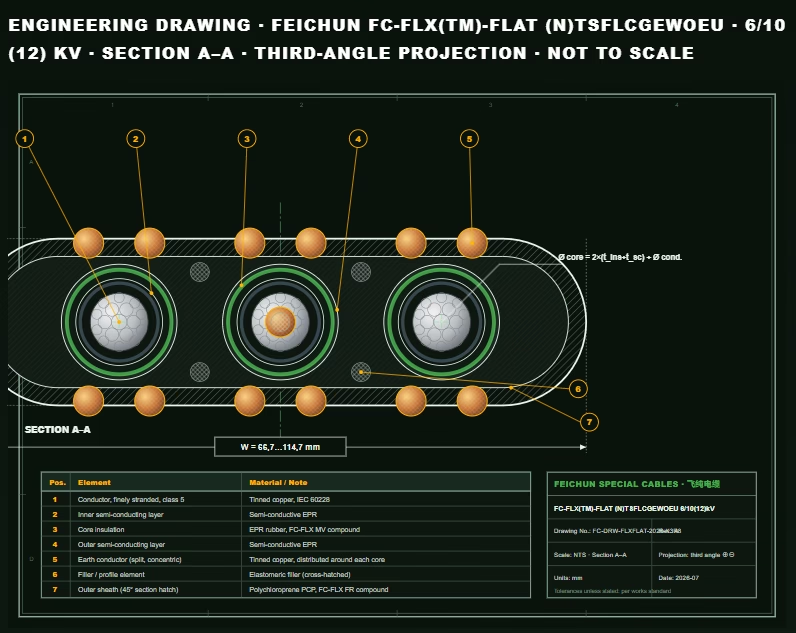
PROTOLON (M) R-(N)TSCGEWOEU LWL 6/10KV 是一种带集成光纤单元的中压卷筒电缆,适用于露天矿大型物料处理机械,例如挖掘机、自卸设备、移动破碎机,以及需要承受高机械应力的单螺旋卷筒和圆柱卷筒系统。它将 6/10 (12) kV 中压动力传输、分裂接地导体、光纤通信单元、聚酯编织增强和耐油、耐臭氧、耐 UV、耐海水外护套集成在同一柔性卷筒电缆结构中
(N)GRDGÖU-J Nomenclature (VDE 0250 part 813): (N) = Nominal voltage prefix (0.6/1 kV implicit in designation) G = Gummiert (rubber-insulated) R = Rubber outer sheath D = Dynamisch (dynamic/flexing application) G = Gummiert inner sheath (intermediate layer) Ö = German standard designation (ö indicates European origin) U = Unarmoured (no metal sheath) J = Jacked (multi-sheath design: intermediate + outer) Full meaning: Rubber-insulated, rubber-sheathed, dynamic-rated, multi-sheath construction, unarmoured festoon cable VDE 0250 part 813 scope: Published by: VDE (Verband der Elektrotechnik, German standards body) Applies to: Flexible cables for crane installations (particularly festoon systems) Coverage: Voltage, temperature, mechanical properties, installation methods Festoon-specific requirements: - High bending flexibility (4×D minimum typical) - Fast rewind capability (240+ m/min rated speed) - Sustained torsion tolerance (±25°/1m continuous) - Extended temperature range (−50 to +80°C) - UV/ozone/moisture resistance (outdoor exposure) Alternate designations (similar cables): IEC 60811-1-1: International equivalent (less specific) DIN VDE 0298 part 3: German mechanical property standard DIN VDE 0482-265-2-1: German flame test standard EN 50265-2-1: European flame test equivalent GRDGÖU-J advantage: Combines all standards into single VDE designation Procurement simplified for European buyers

TROMMELFLEX (K) NSHTOEU:中等机械应力低压卷筒电缆的工程深度解析

TROMMELFLEX (K) NSHTOEU 是一种 0.6/1kV 柔性低压卷筒电缆,设计应用场景为 medium mechanical stresses,即中等机械应力下的 reeling operation。 与极重载矿山拖拽或超高速港口卷筒电缆相比,它更适合受控张力、受控速度、较规范卷盘路径和中等动态频率的移动供电系统。 从深度使用者角度看,这类电缆的真正价值不是“越重越好”,而是以合理重量、足够柔性、耐磨外护套、抗扭结构和标准化电气性能,解决大量中低压移动设备中最常见的卷绕、拖曳、磨耗、油污和维护问题。
GAALFLEX® VFD NYCWY: 600V/1000V European Standard Power Cable with Concentric Copper Conductor Shielding, Underground Direct-Burial Installation Capability, Frequency Converter Integration, Control Impulse & Test Data Transmission, 2–4 Cores, 10–240 mm² Solid/Stranded Red Copper, PVC DIV4 Insulation, Corrugated Copper Wire + Tape Screening, Self-Extinguishing Flame-Retardant, DIN VDE 0276/IEC 60502 Compliance, Utility Substation & Subscriber Network Deployment | European Underground Utility VFD Power Cable UL-certified European standard 600V/1000V underground direct-burial power cable with unique concentric copper conductor shielding combining solid or stranded red copper with PVC DIV4 insulation, corrugated copper wire + tape concentric shielding, and professional utility-grade grounding continuity—addressing underground direct-burial specification (subscriber networks, power stations), dual-voltage power distribution (600V/1000V), frequency converter system integration, control signal and test data transmission, utility substation infrastructure, and comprehensive European underground power distribution infrastructure simultaneously.

What is TROMMELFLEX PUR-HF D12Y11YU11Y: An In-Depth Engineering Analysis of the Halogen-Free PUR Low Voltage Reeling Cable

TROMMELFLEX PUR-HF D12Y11YU11Y-J/O is a flexible 0.6/1 kV low voltage reeling cable for high mechanical stress applications. Its engineering value is not only the voltage rating, but the combination of class 5 flexible plain copper conductors, halogen-free polyester-based insulation, a central textile carrier unit, short-length core lay, PUR inner sheath, open support braiding and black halogen-free flame-retardant polyurethane outer sheath. For port cranes, ship loaders, festoon systems, mobile machines and wet outdoor cable routes, the design targets a rare performance window: 25 N/mm² tensile load, ±50°/m torsional stress, 6×D minimum bending radius, 90°C conductor operation and permanent use in water up to 50 m diving depth.
GAALFLEX® TRAY VFD 1400: UL-Certified 1000V Standard Industrial Cable Tray Variable Frequency Drive Inverter Connection Cable for International Cable Tray Industrial Systems Using Metric Conductor Sizing (IEC 60228 Class 5 Flexible Red Copper per DIN VDE 0295), Frequency Converter Integration, Hazardous-Area Installations, and Cost-Sensitive Industrial Applications (1000 V Nominal Voltage [UL WTTC Rating], UL Type TC-ER c(UL) Type CIC FT4 Fire Classification Certification, Comprehensive Dual-Configuration Portfolio [4-Core and 3+3 Earth Conductor Versions], 1.5–240 mm² Conductor Range Enabling Complete International Tray VFD Specification from Control Circuits Through Maximum Industrial Motor Systems, Flexible Class 5 Red Copper per IEC 60228 / DIN VDE 0295, Special PVC/Nylon Insulation Providing Electrical Stability and Flame-Retardant Performance, Aluminum Tape + PETP Foil + Tinned Copper Braid + Tinned Copper Drain Wire Triple-Layer Shielding Providing Effective EMI Suppression and Signal Integrity, High-Strength Ripcord Under Outer Sheath Enabling Field Installation, Black RAL 9005 Standard PVC [Polyvinyl Chloride] Halogen-Free Outer Sheath with UV Resistance Enabling Industrial Outdoor Installation, Temperature Range −25 to +90°C [Fixed and Flexible Installation] with 6×D Minimum Bending Radius Supporting Cable Tray Routing, UL Type TC-ER Approval Enabling International Tray Installation, Oil Resistance Grade I per UL 1277, Electromagnetic Compatibility per EN 55011 / DIN VDE 0875 / EN 61800-3, Self-Extinguishing and Flame-Retardant per c(UL) FT4 Vertical Flame Propagation Testing, Optional UL 1277 60°C 600V Upgrade Available, Optional Tinned Copper Upgrade Available, MSHA [Mine Safety and Health Administration] Approval for Hazardous-Area Mining Applications, RoHS Approved, UL/CSA Standards Compliance [ASTM B-3, UL 66, UL 83, UL 1277, CSA C22.2 230/239], and Complete International VFD Infrastructure Compliance Enabling Cost-Effective OEM Tray Cable Integration and Process Automation Acceptance for Standard Industrial Environments)

PROTOLON(SC) 6/10 kV: Medium Voltage Cable for Shore-Connection Systems — An In-Depth Engineering Analysis for HVSC, Cold Ironing and Ship-to-Shore Power

PROTOLON(SC) 6/10 kV is a medium voltage flexible cable architecture for High Voltage Shore Connection Systems (HVSC), designed for both onboard vessel sections and onshore cable-handling systems. Based on DIN VDE 0250-813 and IEC/ISO/IEEE 80005-1, it combines 6/10 kV EPR-insulated power cores, semiconductive rubber field control, integrated control cores, optional fibre optics, an aramid-reinforced central support element, EPR inner sheath and an abrasion- and tear-proof CM/CPE outer sheath. Its technical role is not simply to transmit power: it must survive repetitive shore-connection handling, marine outdoor exposure, oil contamination, UV, ozone, moisture and permanent water immersion while maintaining electrical integrity, control-circuit reliability and safe operation around ships and quay equipment.
FLEXIDRUM® R 702: Advanced Salt-Spray Resistant Multi-Core Cable for Maritime Port Infrastructure and Container Handling Systems Engineered for extreme corrosive marine environments, the FLEXIDRUM® R 702 delivers proven salt-fog resistance combined with Class 5 flexible conductor technology, GAALTHERM® 630 thermoplastic insulation, and advanced anti-twisting textile reinforcement. Designed for automated container spreader bars, vertical lifting platforms, and offshore equipment exposed to continuous salt-spray cycles—meeting DIN VDE, EN, and IEC standards with reduced weight and diameter for enhanced installation flexibility in modern port automation infrastructure.

PROTOLON SMRT vs XPRT: Техническое Руководство по Выбору Кабеля

PROTOLON семейство кабелей разрабатывалось Prysmian Group на протяжении двух декад как ответ на эволюцию портового оборудования. Исторически, первые портовые краны (1980–1990) использовали более простые кабели с меньшими требованиями к скорости и гибкости. Но по мере того как портовые операции интенсифицировались и оборудование становилось быстрее (контейнерные краны STS с циклами 40–60 секунд вместо 5–10 минут), потребность в кабелях, способных выдерживать высокие скорости развертывания и динамические нагрузки, стала критической. PROTOLON SMRT (Standard Medium Reeling Technology) был введен как решение для кранов с **среднего уровня механическим напряжением**: скорость развертывания 160–200 м/мин, динамические нагрузки до 20 N/mm², типичные для портальных кранов и RTG (резиновошинных портовых краны) 1990–2010 годов разработки. PROTOLON XPRT (eXtreme Performance Reeling Technology) был введен позже (2000s–2010s) для **высокопроизводительных операций**: скорость развертывания 240 м/мин, динамические нагрузки до 25 N/mm², для самых современных STS кранов и мобильных портовых оборудований. Обе линейки соответствуют DIN VDE 0250-813, но с различными требованиями к гибкости и механической прочности проводника.