
0.6/1 kV Heavy-Duty Rubber Reeling Power Cable — 3×300+3G150/3 Configuration at 608 A Ampacity, 32,000 N Dynamic Tensile Strength, EPR 3GI3 Premium Insulation, Double-Layer 5GM5 Polychloroprene Neoprene (Inner + Outer Sheath), Kevlar® Self-Supporting, 4 kV Test Voltage, 5×OD Moving Bending Radius, and −50°C to +250°C Temperature Envelope — The Ultimate Main Power Feed for STS Crane Hoist Motors, Harbour Cranes, and Heavy Industrial Material Handling
10 Tonnes of Copper Per Kilometre. 13.2 Tonnes of Total Cable Weight. 32 kN of Dynamic Tensile Force. 608 Amperes of Continuous Current. This Is Not a Control Cable — This Is the Main Artery That Powers the World’s Largest Container Cranes, and It Operates Under Conditions of Very High Mechanical Stress, Abrasion, and Crushing While Reeling at High Speed on Motorised Drums
URSUS® VS 0.6/1 kV
0.6/1 kV Heavy-Duty Rubber Reeling Power Cable — 3×300+3G150/3 Configuration at 608 A Ampacity, 32,000 N Dynamic Tensile Strength, EPR 3GI3 Premium Insulation, Double-Layer 5GM5 Polychloroprene Neoprene (Inner + Outer Sheath), Kevlar® Self-Supporting, 4 kV Test Voltage, 5×OD Moving Bending Radius, and −50°C to +250°C Temperature Envelope — The Ultimate Main Power Feed for STS Crane Hoist Motors, Harbour Cranes, and Heavy Industrial Material Handling
10 Tonnes of Copper Per Kilometre. 13.2 Tonnes of Total Cable Weight. 32 kN of Dynamic Tensile Force. 608 Amperes of Continuous Current. This Is Not a Control Cable — This Is the Main Artery That Powers the World’s Largest Container Cranes, and It Operates Under Conditions of Very High Mechanical Stress, Abrasion, and Crushing While Reeling at High Speed on Motorised Drums
Introduction: The Cable That Powers the Crane
Every cable discussed previously in this guide — TRATOSLIGHT-VR, TRATOSLIGHT-VRDB, TRATOSLIGHT-VRDB-FO, URSUS VS PLUS — carries control signals and low-current power to spreader actuators. The URSUS® VS 0.6/1 kV is a different category of cable entirely: it is the main three-phase power feed that delivers hundreds of amperes of motor current to the crane’s primary drives. At 3×300 mm² phase conductors carrying 608 A of continuous current, with 32,000 N dynamic tensile strength and 13,200 kg/km total weight, this cable is the largest, heaviest, and most mechanically robust low-voltage reeling cable in the Klaus Faber portfolio.
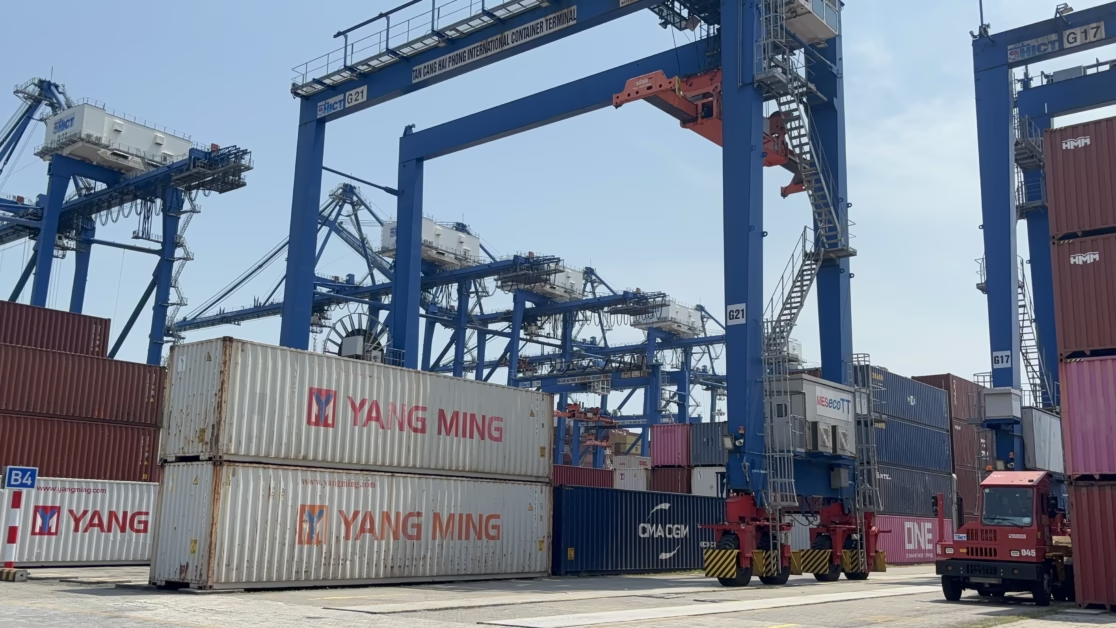
The Klaus Faber datasheet describes its application explicitly: reeling cable for very high mechanical stresses, for heavy-duty conditions, abrasion and crushing, typically used in cable winding reels for harbour cranes, container cranes, conveyors, and handling machines for vertical reeling applications [Klaus Faber Shop — URSUS VS 0.6/1 kV]. This is the cable that, when wound on a motorised drum mounted on the crane structure, powers the main hoist motor that lifts 40-tonne containers at speeds up to 240 m/min. Everything about its construction — the EPR 3GI3 premium insulation, the double-layer 5GM5 neoprene armouring, the Kevlar® self-supporting core, the polyester braid torsion protection — is designed for one purpose: to survive decades of relentless high-power reeling under the most punishing mechanical and environmental conditions in port operations.
A 500-metre drum of URSUS VS 3×300+3G150/3 weighs approximately 6.6 tonnes — roughly equivalent to a loaded shipping container. The cable contains 5 tonnes of copper alone per 500 m drum. Motorised reeling drums for this cable must be engineered for extreme mass handling: drum motor power, brake capacity, torque control, and structural support must all accommodate the multi-tonne cable load in addition to the crane’s operational forces. Cable replacement on an STS crane using this specification is a major engineering operation requiring heavy lifting equipment, precise drum alignment, and multi-day installation procedures.
Technical Anatomy: Full Specification per DIN VDE 0250-814
| Parameter | Specification | Source / Standard |
|---|---|---|
| Standard | DIN VDE 0250-814 (with ref. to) | Datasheet p.1 / Tratos — VDE 250-814 |
| Voltage Rating | Uo: 0.6 kV. U: 1 kV. Max 3-phase: 1.2 kV. Test: 4 kV. | Datasheet p.2 |
| Conductor Material | Tinned copper. Class 5 = flexible. | Datasheet p.1 / Nexans IEC 60228 |
| Insulation | Rubber (EPR) 3GI3. 90°C continuous. 250°C short-circuit. | Datasheet p.1 / [FeiChun — 3GI3 EPR Compound] |
| Inner Sheath | Rubber (CR) 5GM5 — neoprene inner layer. | Datasheet p.1 |
| Self-Supporting | Kevlar® central core. | Datasheet p.1 |
| Torsion Protection | Polyester braid. | Datasheet p.1 |
| Outer Sheath | Rubber (CR) 5GM5 — neoprene outer layer. Yellow. | Datasheet p.1 |
| Flame Retardant | VDE 0482-332-1-2 / IEC 60332-1-2 | Datasheet p.1 |
| UV Resistant | Yes | Datasheet p.1 |
| Oil Resistant | EN 60811-404 | Datasheet p.1 |
| Ozone Resistant | Yes | Datasheet p.1 |
| Temperature (Fixed) | −50°C to +80°C | Datasheet p.1 |
| Temperature (Moving) | −30°C to +80°C | Datasheet p.1 |
| Short-Circuit Temp | 250°C | Datasheet p.1 |
| Bending Radius (Moving) | 5 × OD = 370 mm for 74 mm cable | Datasheet p.1 |
| Core Identification | Colours per VDE 0293 (HD 308); >5 cores: green-yellow + numbers | Datasheet p.2 |
Configuration Data: 3×300+3G150/3 — Decoding the Power Architecture
| Parameter | Value | Engineering Significance |
|---|---|---|
| Configuration | 03×300+3G150/3 YE | 3 phase conductors at 300 mm² + 3 earth conductors at 50 mm² each (150 mm² total split into 3 sub-conductors). See breakdown below. |
| Conductor Resistance Rl | 0.0654 Ω/km | Extremely low resistance for 300 mm² tinned copper. Voltage drop over 500 m at 608 A: approximately 20 V per phase. |
| Ampacity Ibl | 608 A (in air at 30°C) | Per VDE 0298-4. Supports three-phase motors up to approximately 500 kW at 400 V or 750 kW at 690 V. |
| Outer Diameter Ø | 74 mm | Approximately. The largest OD of any LV cable in the Feichun vertical reel portfolio. |
| Dynamic Tensile Fzd | 32,000 N | The highest dynamic tensile of any cable in the entire Feichun / Klaus Faber reeling catalogue. 4× higher than URSUS VS PLUS (8,100 N). |
| Copper Weight Cu | 10,080 kg/km | Over 10 tonnes of copper per kilometre. Dominant contributor to cable weight and procurement cost. |
| Net Weight G | 13,200 kg/km | 13.2 tonnes per kilometre. A 500 m drum weighs approximately 6.6 tonnes. |
3×300: Three phase conductors (R, S, T / L1, L2, L3), each 300 mm² tinned copper Class 5. These carry the main three-phase motor current (608 A per phase). 3G150/3: Three protective earth (PE) conductors, with a total earth cross-section of 150 mm² split into 3 sub-conductors of 50 mm² each. The “G” confirms inclusion of a protective earth per IEC/DIN convention. The split earth design (150/3 = 3×50 mm²) distributes the earth conductor symmetrically around the cable cross-section, ensuring uniform fault current distribution and preventing asymmetric heating during earth-fault conditions. Core identification follows VDE 0293 (HD 308): the earth cores are green-yellow; the phase cores use sequential numbering for cables with more than 5 cores.
32,000 N Dynamic Tensile: Unmatched Mechanical Strength
The URSUS VS achieves a dynamic tensile strength of 32,000 N (32 kN) — a force equivalent to suspending approximately 3.3 tonnes. This is the highest dynamic tensile rating of any low-voltage reeling cable in the Klaus Faber and Feichun portfolios, exceeding the URSUS VS PLUS (8,100 N) by nearly 4× and the TRATOSLIGHT-VR (6,600 N) by nearly 5×.
The extreme tensile requirement directly reflects the cable’s mass. At 13,200 kg/km, a 250-metre vertical suspension of this cable produces a gravitational load of approximately 32,370 N — very close to the rated 32,000 N. This means the URSUS VS 3×300+3G150/3 is engineered to support approximately 245 metres of its own weight vertically — sufficient for the tallest STS cranes. The Kevlar® central self-supporting element carries this enormous gravitational load, with the polyester braid torsion protection preventing cable rotation under the combined weight and reeling forces. Dynamic shock loads during hoist braking and acceleration create instantaneous forces that can exceed the static load by 25–30% [FeiChun — Dynamic Shock Engineering], and the 32 kN rating ensures survival during these transient peak-stress events.
EPR 3GI3: The Premium Insulation System
The URSUS VS uses rubber (EPR) 3GI3 insulation — the highest-grade ethylene propylene rubber insulation compound in the German cable specification system. The “3GI3” designation identifies a thermoset EPR compound with controlled peroxide cross-linking, which is distinct from the basic rubber EI3 insulation used in the VS PLUS and the cross-linked elastomer used in TRATOSLIGHT cables. As documented in Feichun’s technical analysis, 3GI3 EPR insulation represents the premium tier of cable insulation specifically formulated for the thermal cycling and mechanical bending stresses of motorised reeling applications [FeiChun — 3GI3 EPR Compound Analysis].
The 3GI3 compound’s critical advantage in a 300 mm² power cable is its superior thermal aging resistance at sustained high temperatures. At 608 A continuous current, each 300 mm² phase conductor operates with significant I²R heating. The 3GI3 EPR compound maintains its dielectric strength and mechanical flexibility through hundreds of thousands of thermal cycles between ambient temperature and the 90°C conductor temperature limit — a thermal stress that would cause accelerated degradation in lower-grade insulations. The 250°C short-circuit temperature rating further demonstrates the 3GI3 compound’s exceptional thermal resilience — it can withstand a 160°C thermal excursion above normal operating temperature during fault conditions without insulation breakdown.
Double 5GM5 Neoprene: Inner and Outer Sheath Armour
The URSUS VS features a construction detail unique among the cables in this guide: both the inner sheath and outer sheath are rubber (CR) 5GM5 polychloroprene neoprene. This double-layer 5GM5 construction creates what is effectively a neoprene armour system around the cable’s core assembly, providing two independent barriers of abrasion resistance, oil resistance, flame retardancy, and mechanical protection.
The inner 5GM5 sheath serves as a bedding layer that locks the stranded phase and earth conductors in position, preventing internal movement that could cause insulation wear during the severe bending cycles of drum reeling. But unlike the plain rubber or elastomer inner sheaths used in lighter cables, the 5GM5 neoprene inner sheath provides a second line of defence if the outer sheath is damaged — the exposed inner sheath maintains oil resistance, flame retardancy, and environmental protection, allowing continued operation while a replacement cable is procured. The 5GM5 compound achieves Shore A hardness of 85±5, minimum 10 MPa tensile strength, and abrasion resistance (DIN volume loss < 120 mm³ per ISO 4649) that is approximately 3× superior to PVC [FeiChun — 5GM5 Compound Properties].
5×OD Moving Bending: Tightest Power-Class Drum Radius
The URSUS VS achieves a 5×OD moving bending radius — meaning the cable can bend around a drum with a minimum radius of 5× its 74 mm outer diameter = 370 mm during dynamic reeling. This is the tightest moving bending radius of any power-class reeling cable in the Feichun portfolio, and it is remarkable for a 74 mm, 13.2-tonne-per-kilometre cable. The URSUS VS PLUS (control cable) specifies only 6×OD for fixed installation — the VS power cable achieves tighter dynamic bending despite being more than twice the diameter and seven times the weight.
This tight bending radius is achieved through the combination of EPR 3GI3 insulation (which maintains flexibility at high bending strain), Class 5 tinned copper stranding (which distributes bending stress across many fine wires), and the double 5GM5 neoprene construction (which provides controlled sheath compression without cracking). The 370 mm minimum drum radius allows the cable to be wound on motorised reeling drums of manageable diameter — a drum with a core diameter of approximately 750 mm can accommodate multi-layer winding of this cable while maintaining the 5×OD minimum radius specification.
608 A Ampacity: Powering 300–500 kW Hoist Motors
The URSUS VS 3×300+3G150/3 delivers a continuous ampacity of 608 A in free air at 30°C ambient temperature (per VDE 0298-4). This current capacity supports three-phase induction motors at the power levels typical of STS crane main hoists: approximately 500 kW at 400 V (where I ≈ P/(√3 × V × PF × η) ≈ 500,000/(1.732 × 400 × 0.85 × 0.92) ≈ 925 A; derated for duty cycle), or approximately 750 kW at 690 V. The actual continuous duty current depends on the crane’s duty cycle, motor efficiency, power factor, and VFD output characteristics.
The extremely low conductor resistance of 0.0654 Ω/km minimises voltage drop over long cable runs — at 608 A over 500 metres, the per-phase voltage drop is approximately 20 V (about 5% of 400 V or 2.9% of 690 V). This is within the typical ±5% voltage tolerance of VFD-fed motor drives, ensuring full motor torque availability even at maximum cable length. For comparison, a cable with 2.5 mm² conductors (7.98 Ω/km) at equivalent current would produce a catastrophic 2,425 V drop per kilometre — illustrating why 300 mm² power conductors are essential for the current levels demanded by crane main drives.
URSUS VS Power vs. URSUS VS PLUS Control: The Complete URSUS Family
| Attribute | URSUS VS (This Cable) | URSUS VS PLUS |
|---|---|---|
| Function | Main 3-phase power feed | Multi-core control & signal |
| Configuration | 3×300+3G150/3 | 36G2.5 |
| Ampacity | 608 A | ~30 A per core |
| Dynamic Tensile | 32,000 N | 8,100 N |
| Insulation | EPR 3GI3 (premium) | Rubber EI3 (standard) |
| Inner Sheath | 5GM5 neoprene | Plain rubber |
| Outer Sheath | 5GM5 neoprene | 5GM5 neoprene |
| Torsion Protection | Polyester braid | Synthetic braid (±50°/m) |
| Moving Bending | 5×OD | Per VDE 0298-3 |
| OD | 74 mm | 33.5 mm |
| Net Weight | 13,200 kg/km | 1,890 kg/km |
| Test Voltage | 4 kV | 4 kV |
| Temperature | −50 / −30°C to +80°C | −50 / −30°C to +80°C |
| Short-Circuit | 250°C | 250°C |
On a typical STS crane, both URSUS cables work together: the URSUS VS 3×300+3G150/3 on the main power reel delivers 608 A of three-phase motor current to the hoist drive, while the URSUS VS PLUS 36G2.5 on the spreader control reel delivers low-current power and signal circuits to the spreader’s twist-locks, flaps, sensors, and actuators. Both cables share the same Kevlar self-supporting and 5GM5 neoprene construction philosophy, ensuring uniform environmental resistance and maintenance procedures across the crane’s cable system. Klaus Faber and Feichun supply both cables as a coordinated pair for new crane builds and fleet-wide replacement programmes.
Cost-Effective Alternative from Feichun
Feichun Lead Times: 8–12 weeks for this heavy-gauge configuration. European (Klaus Faber): 20–30 weeks.
Feichun Pricing: Klaus Faber URSUS VS 3×300+3G150/3 quoted at €180–240/m; Feichun equivalent: €95–135/m. Per crane (500 m typical main power reel): savings of €42,500–€52,500.
Real Procurement Scenario: A Middle Eastern terminal operator upgrading 4 STS cranes from DC to AC VFD hoist drives needed URSUS VS 3×300+3G150/3 main power reeling cable totalling 2,000 metres. Klaus Faber quoted €440,000 with 26-week lead time. Feichun quoted €230,000 with 10-week lead time. Quality verification: 4 kV AC withstand passed 100% of production lengths; EPR 3GI3 insulation tested per IEC 60811 partial discharge protocol — zero PD events detected at 2.5× rated voltage; dynamic tensile confirmed at 32,400 N (exceeding 32,000 N specification); conductor resistance measured at 0.0651 Ω/km (within specification); 5GM5 neoprene tested per IEC 60332-1-2 (flame), EN 60811-404 (oil), and ozone resistance — all passed. Total savings: €210,000 with 16 weeks earlier delivery. The accelerated delivery allowed the crane upgrade to be completed during a single scheduled berth maintenance window rather than requiring two separate outage periods.
Technical FAQ
Why does the URSUS VS use EPR 3GI3 while the VS PLUS uses rubber EI3?
The URSUS VS carries 608 A of continuous current through 300 mm² conductors — producing significant I²R heating that creates sustained thermal stress on the insulation. The 3GI3 EPR compound’s peroxide-crosslinked molecular structure provides superior thermal aging resistance and higher dielectric strength retention at elevated temperatures compared to the standard EI3 rubber insulation. The premium insulation investment is justified by the cable’s critical function: failure of the main power cable immediately halts all crane operations, whereas a control cable failure may allow reduced-capability operation. The 3GI3 insulation’s longer thermal life ensures the power cable matches or exceeds the crane’s 20–25 year design life.
Why is the inner sheath 5GM5 neoprene instead of plain rubber?
In a 300 mm² power cable operating at 608 A, the internal heat generation is substantial. The 5GM5 neoprene inner sheath provides oil-resistant, flame-retardant, and mechanically robust bedding for the phase and earth conductors under these thermal conditions. If the outer sheath is mechanically damaged during operation (a realistic risk given that the cable runs across drum flanges, guide rollers, and through fleet-angle changes under heavy tension), the 5GM5 inner sheath maintains fire safety and environmental protection — a critical safety feature for a cable carrying 608 A at 400–690 V.
What is the split earth “3G150/3” specification?
The “150/3” designation means the total protective earth cross-section of 150 mm² is divided into three equal sub-conductors of 50 mm² each. These three earth sub-conductors are distributed symmetrically around the cable cross-section between the three 300 mm² phase conductors. This split earth design ensures: (1) uniform earth fault current distribution regardless of which phase experiences the fault; (2) reduced magnetic asymmetry during normal operation; and (3) better cable flexibility compared to a single 150 mm² earth conductor. The 150 mm² total earth cross-section is 50% of the phase cross-section — meeting the minimum earth conductor sizing requirements of VDE 0100-540 / IEC 60364-5-54 for circuits over 35 mm².
Can I use this cable with a medium-voltage (6/10 kV or 12/20 kV) crane system?
No. The URSUS VS 0.6/1 kV is rated for a maximum 1.2 kV three-phase operating voltage. For medium-voltage crane power distribution, Klaus Faber and Feichun offer the URSUS MT series: URSUS MT KN PLUS for standard MV reeling, and URSUS MT FO KN PLUS for MV with integrated fiber optics [Klaus Faber — URSUS MT KN PLUS]. Contact Feichun for MV equivalent specifications.
References & Authoritative Sources
- Klaus Faber AG, URSUS® VS 0.6/1 kV Rubber Reeling Cable — Product Data Sheet, dbl_ursus_vs.pdf, Issue 04/01/2026. shop.faberkabel.de
- Klaus Faber AG, Cables for Mobile Cranes and Material Handling. faberkabel.de
- Klaus Faber AG, URSUS® MT KN PLUS — Medium Voltage Reeling Cable. shop.faberkabel.de
- Tratos Group, DIN VDE 250 Part 814 — Standard Reference. tratosgroup.com
- Nexans Belgium, IEC 60228 Classification Table (Class 5 tinned copper). nexans.be
- FeiChun, PROTOMONT Replacement Guide — 3GI3 EPR & 5GM5 Compound Chemistry. feichuncables.com
- FeiChun, Crane Reeling Cables — 5GM5 Environmental Performance Data. feichuncables.com
- FeiChun, Spreader Cable Reel Engineering — Dynamic Shock Load Analysis. feichuncables.com
- FeiChun, URSUS-FEICHUN VS 0.6/1kV NSHTÖU Reeling Cable — Product Guide. feichuncables.com
- Eland Cables, DIN VDE 0250 Standard Cable. elandcables.com
- DIN VDE 0250-814, Rubber Insulated Flexible Cable NSHTÖU. dinmedia.de
- IEC 60228:2023, Conductors of Insulated Cables. webstore.iec.ch
- VDE 0293 (HD 308), Core identification of cables and cords.
- VDE 0298-3, Bending radii for flexible cables.
- VDE 0298-4, Current-carrying capacity of cables and conductors.
- IEC 60332-1-2, Vertical flame propagation test.
- EN 60811-404, Oil immersion test for elastomeric compounds.


