
A comprehensive electrical engineering guide to understanding the ampacity specifications of the Type SHD-GC heavy-duty mining trailing cable, including how conductor temperature, ambient conditions, and installation method affect the maximum safe current, plus practical derating calculations for real-world field deployment.
— 深入解读 Type SHD-GC 重型矿用拖曳电缆的载流量规格、温度影响、安装方式和实际野外部署的降容计算指南。
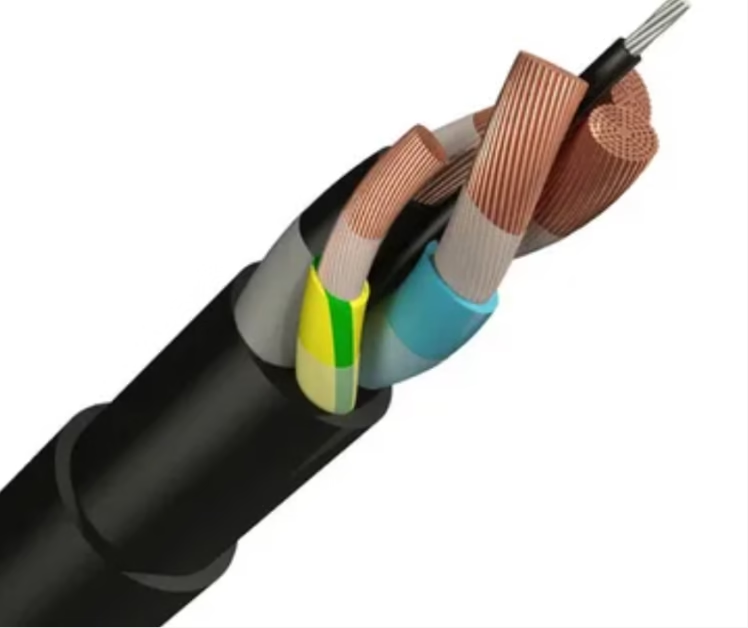
Ampacity Rating Guide: How Much Current Can a Type SHD-GC 3/C 4/0 AWG 8kV Cable Handle?
A comprehensive electrical engineering guide to understanding the ampacity specifications of the Type SHD-GC heavy-duty mining trailing cable, including how conductor temperature, ambient conditions, and installation method affect the maximum safe current, plus practical derating calculations for real-world field deployment. — 深入解读 Type SHD-GC 重型矿用拖曳电缆的载流量规格、温度影响、安装方式和实际野外部署的降容计算指南。
1. What Is Ampacity and Why Does It Matter? 什么是载流量,为什么很重要?
Ampacity is the maximum electric current that a conductor can safely carry continuously without exceeding a specified temperature limit, usually 90°C for power cables used in mining and industrial applications. The word itself is a contraction of “ampere” and “capacity,” and it represents a fundamental constraint imposed by the physics of electrical resistance and heat dissipation. Understanding ampacity is not an academic exercise — it is the critical foundation for ensuring that your mining equipment receives reliable power, that cables do not overheat and fail prematurely, and that your operation avoids unplanned downtime due to cable damage or failure. 载流量是导体在不超过指定温度限值(通常为90°C)的条件下能连续安全承载的最大电流。
Every cable has a maximum current it can carry safely. When you exceed this limit, the cable’s resistance causes it to generate heat (a phenomenon governed by Joule’s law, where heat equals current squared times resistance). This heat raises the cable’s conductor temperature above the design limit, which degrades the insulation material chemically. The degradation accelerates exponentially with temperature — a cable that operates at 110°C instead of 90°C will degrade roughly three times faster. Eventually, the insulation becomes brittle and develops micro-cracks, allowing moisture to penetrate and leading to electrical faults, arc-flashes, and catastrophic failure.
Ampacity ratings are established through extensive testing and modeling, and are codified in industry standards such as ICEA S-75-381 (for portable and feeder cables used in mining) and NEMA WC-58. These standards provide ampacity tables that account for conductor material, insulation thickness, installation method, and ambient temperature. When you select a cable for a specific application, you must verify that the cable’s ampacity rating exceeds the maximum current you expect to demand from it. This simple but critical discipline prevents most cable-related failures in the field. 根据 ICEA S-75-381 和 NEMA WC-58 标准,ampacity 表考虑了导体材料、绝缘厚度、安装方式和环境温度。
2. Type SHD-GC Cable Overview and Application Context Type SHD-GC 电缆概况与应用背景
The designation “Type SHD-GC” stands for “Shielded, Heavy Duty, Ground Check” — a naming convention that tells you immediately that this is a premium industrial cable engineered for the most demanding environments. The “Shielded” element refers to the tinned copper wire braid or fabric shield that surrounds the three power conductors, providing electromagnetic shielding and ensuring that electrical faults are contained rather than radiating outward. The “Heavy Duty” specification indicates that both the insulation and the outer jacket are engineered with extra thickness and chemical resistance to withstand the mechanical abuse and chemical exposure typical of mining sites. The “Ground Check” feature means that the cable incorporates a dedicated pilot conductor — a smaller gauge wire running alongside the main power conductors — that continuously monitors the integrity of the outer sheath and alerts operators to any breach or damage. “Type SHD-GC” 代表”屏蔽、重型、地线监测”,表示这是为最恶劣环境设计的高端工业电缆。
Type SHD-GC cables are specifically designed for use as trailing cables on electric rope shovels, draglines, and other mobile equipment in open-pit mining operations. The cable is spooled and unspooled repeatedly as the equipment moves around the pit, dragged over rocky terrain, exposed to extreme temperatures, oil splash from hydraulic systems, and weather ranging from arctic cold to intense sun. The 4/0 AWG size (4/0 is the largest single-conductor size in the American Wire Gauge system) makes this a heavy-duty, high-current cable suitable for powering large electric motors and control systems that demand hundreds of amperes. The 8 kV voltage rating indicates that this cable is suitable for medium-voltage distribution systems — typically the secondary output of a pit transformer that steps down incoming utility power (13.8 kV or higher) to the 8 kV level that is fed to mobile equipment substations.
3. The Rated Ampacity: 321 Amps at Standard Conditions 额定载流量:标准条件下 321 安培
The fundamental answer to the question “how much current can this cable handle?” is straightforward: 321 amperes at standard reference conditions. These standard conditions, as defined by ICEA S-75-381 and NEMA WC-58, are specifically: conductor temperature of 90°C, ambient air temperature of 40°C (104°F), and installation in open air where the cable has adequate ventilation and is not bundled with other cables. 在标准条件下(导体温度 90°C、环境温度 40°C、电缆在空气中安装),额定载流量为 321 安培。
This 321 A rating is not arbitrary. It is derived through a rigorous process: the cable manufacturer measures the electrical resistance of the 4/0 AWG conductor at 20°C (a reference temperature), calculates the heat generation at different current levels using Ohm’s law and the heat equation, models the heat dissipation assuming cylindrical thermal conduction through the insulation to the surrounding air, and then solves for the current at which the conductor would reach exactly 90°C when the ambient air is at 40°C. To provide a safety margin, manufacturers typically test cables at slightly higher currents and temperatures to verify that the insulation has not degraded, and then de-rate the theoretical maximum by perhaps 10-15% to create the published ampacity rating. The result is a rating that is conservative, reliable, and verified by decades of field experience.
Critical Point 关键点: The 321 A rating assumes constant, steady-state current under ideal cooling conditions. In real mining operations, the actual duty cycle may involve intermittent high current draws (such as during the acceleration phase when a shovel bucket is loading), followed by lower current periods. This intermittent duty can actually allow the cable to operate somewhat cooler on average than steady-state, which means the cable might tolerate brief current spikes above 321 A. However, you should never rely on this — always design your system so that the maximum continuous current demand does not exceed 321 A, and use emergency load-shedding or equipment shutdown logic to prevent sustained overloads.
4. Understanding the Physics Behind the Rating 理解额定值背后的物理原理
To truly understand why the Type SHD-GC cable can carry exactly 321 A and not more, it helps to walk through the underlying electrical physics. The phenomenon that limits ampacity is called resistive heating, expressed mathematically as the Joule heating equation: Q = I² × R × t, where Q is heat energy generated, I is current in amperes, R is resistance in ohms, and t is time. Notice that heat generation scales with the square of the current — this is crucial. If you double the current flowing through a cable, the heat generation quadruples. This nonlinear relationship means that small increases in current can cause large increases in heat, which is why ampacity limits are so important and must be respected scrupulously.
The 4/0 AWG conductor used in Type SHD-GC cables has a resistance of approximately 0.000049 ohms per foot at 20°C, or roughly 0.000161 ohms per meter. When 321 A flows through a 1,000-meter cable length, the total resistance is about 0.161 ohms, and the power dissipated as heat is 321² × 0.161 = approximately 16.6 kilowatts. This 16.6 kW of heat is generated along the entire length of the cable and must be dissipated through the insulation and outer jacket into the surrounding air. The insulation has a thermal conductivity (a measure of how readily it conducts heat) that is much lower than copper — roughly 100 to 200 times lower. This thermal resistance (the inverse of conductivity) means that there is a temperature gradient from the hot conductor in the center to the cooler outer surface. When the ambient air is 40°C and the cable dissipates 16.6 kW per kilometer, the conductor temperature rises to approximately 90°C. This 50°C temperature rise (from 40°C ambient to 90°C conductor) is the design margin built into the cable and the ampacity rating.
4.1 Why Conductor Resistance Increases with Temperature 为什么导体电阻随温度升高而增加
As the conductor heats up, its electrical resistance increases slightly — about 0.4% per degree Celsius for copper. This temperature coefficient of resistance means that if a cable starts at 40°C with a given resistance, and then heats to 90°C, its resistance increases by roughly 20%. This creates a feedback loop: as current causes the cable to heat, the resistance increases, which causes more heating, which causes more resistance increase. This positive feedback is one reason why exceeding ampacity is so dangerous — the system becomes unstable, and a small overcurrent can snowball into a rapid temperature rise that quickly degrades the insulation. The ampacity rating is established with this feedback mechanism in mind, creating a stable operating point where the heat generated by the current exactly balances the heat dissipated into the air, maintaining a steady 90°C conductor temperature.
5. Complete Electrical & Physical Specifications 完整的电气与物理规格
To make informed decisions about using Type SHD-GC 3/C 4/0 AWG 8kV cable in your mining operation, you need to understand not just the ampacity, but the full constellation of technical characteristics. The following table consolidates the key specifications and serves as a quick-reference engineering data sheet.
| Parameter 参数 | Specification 规格 | Unit |
|---|---|---|
| CONDUCTOR PROPERTIES 导体特性 | ||
| Phase Conductor Type 电力导体类型 | 3 × Stranded Copper (Rope Lay, Class C), tinned | — |
| Phase Conductor Size 电力导体规格 | 4/0 AWG per ASTM B-8 | — |
| Phase Conductor Cross-Section 电力导体截面 | 107.22 mm² (per conductor) | mm² |
| Total Phase Conductor Area 总电力导体面积 | 321.66 mm² | mm² |
| Conductor Stranding 导体绞合 | 532 Strands (Class C Flexible) | — |
| Conductor Material 导体材料 | Annealed copper, ASTM B-33, tinned finish | — |
| Grounding Conductor Type 接地导体类型 | 2 × Stranded Copper, tinned | — |
| Grounding Conductor Size 接地导体规格 | 1 AWG per ASTM B-8 | — |
| Grounding Conductor Cross-Section 接地导体截面 | 42.41 mm² (per conductor) | mm² |
| Ground Check Conductor Size 地线监测导体规格 | 8 AWG | — |
| Ground Check Cross-Section 地线监测截面 | 8.37 mm² | mm² |
| ELECTRICAL PROPERTIES 电气特性 | ||
| Voltage Rating 额定电压 | 8,000 Volts (8 kV) | — |
| Maximum System Voltage 最高系统电压 | 7,200–8,400 V (3-phase, balanced) | — |
| Ampacity (Standard Conditions) 载流量(标准条件) | 321 Amperes | A |
| Standard Conditions 标准条件 | 40°C ambient, 90°C conductor, open air | — |
| Conductor DC Resistance @ 20°C 导体直流电阻 | 0.000049 Ω/ft (4/0 AWG) | Ω/ft |
| Conductor DC Resistance @ 20°C 导体直流电阻 | ~0.000161 Ω/m | Ω/m |
| Inductive Reactance (typical) 感抗(典型) | 0.0350 Ω/1000 ft | Ω/kft |
| INSULATION & JACKET 绝缘与护套 | ||
| Insulation Material 绝缘材料 | Ethylene Propylene Rubber (EPR), Type A per ASTM D2932 | — |
| Insulation Thickness 绝缘厚度 | 0.150 inches (3.81 mm) | in / mm |
| Outer Jacket Material 外护套材料 | Chlorinated Polyethylene (CPE) or Thermoplastic Polyurethane (TPU) | — |
| Jacket Thickness 护套厚度 | 0.060 inches (1.52 mm) | in / mm |
| Shielding Type 屏蔽类型 | Tinned copper braid, 100% coverage with fabric liner | — |
| PHYSICAL PROPERTIES 物理特性 | ||
| Outer Diameter (approx.) 外径(约) | 69.8–72.0 mm (2.75–2.83 inches) | mm / in |
| Weight (Copper content) 重量(铜含量) | ~3,685 kg/km | kg/km |
| Total Cable Weight 电缆总重 | 7,917–8,713 kg/km (depending on jacket) | kg/km |
| Bending Radius (minimum, installation) 弯曲半径(最小,安装) | 15 × cable OD | — |
| Minimum Bend Diameter (approx.) 最小弯曲直径(约) | 1,050–1,080 mm (42–43 inches) | mm / in |
| OPERATING CONDITIONS 工作条件 | ||
| Conductor Temperature — Normal Operation 导体温度——正常运行 | 90°C (194°F) continuous | °C |
| Conductor Temperature — Emergency 导体温度——应急 | 130°C (266°F) up to 100 hours | °C |
| Short-Circuit Temperature 短路温度 | 250°C (482°F) max for 5 seconds | °C |
| Ambient Temperature Range (installation) 环境温度范围(安装) | −25°C to +50°C | °C |
| Ambient Temperature Range (operation) 环境温度范围(运行) | −40°C to +50°C | °C |
| STANDARDS & COMPLIANCE 标准与合规 | ||
| Primary Standards 主要标准 | ICEA S-75-381, NEMA WC-58 | — |
| Conductor Standard 导体标准 | ASTM B-8, ASTM B-33 | — |
| Insulation Standard 绝缘标准 | ASTM D2932 (EPR Type A) | — |
| MSHA Certification MSHA 认证 | Yes — Approved for mining use in USA | — |
| Flame Retardancy 阻燃性 | Pass per ASTM D6166 | — |
| Oil Resistance 耐油性 | Pass per ASTM D1418 | — |
| UV Resistance 耐紫外线性 | Pass per ASTM G154 | — |
6. Derating Factors: When Conditions Are Not Ideal 降容系数:当条件不理想时
The 321 A rating assumes perfect conditions: the cable is installed in open air, ambient temperature is exactly 40°C, the conductor temperature is allowed to rise to exactly 90°C, and the cable is not bundled with other cables. In real mining operations, conditions are almost never this perfect. Cables are often deployed in groups, bundled together on reels or in cable trays. The ambient temperature at ground level in an open pit might be 50°C on a hot summer day, or the cable might be partially submerged in equipment cooling water. When any of these non-ideal conditions exist, you must apply a “derating factor” — a multiplier less than 1.0 that reduces the ampacity to account for the degraded cooling conditions. 当条件不理想时,如电缆捆绑、环境温度高、或多根电缆集中安装,必须应用”降容系数”来降低允许的载流量。
The mathematics behind derating factors is grounded in the heat transfer equation. When ambient temperature increases, the temperature difference between the hot conductor and the cooler surroundings decreases, reducing the rate at which heat can be dissipated. If you want to maintain the conductor at 90°C and the ambient has risen from 40°C to 50°C, the available temperature differential for heat transfer has shrunk from 50°C to 40°C — a 20% reduction. Since the rate of heat dissipation decreases proportionally with temperature difference, the allowable current must also decrease. More precisely, because heat dissipation scales roughly linearly with temperature difference (under the assumptions of cylindrical thermal conduction), a 20% reduction in temperature difference allows approximately 20% less current. The derating factor would thus be approximately 0.80. 降容因子通常在 0.70 至 0.95 之间,具体取决于实际部署条件。
| Condition 条件 | Ambient Temperature 环境温度 | Derating Factor 降容系数 | Derated Ampacity 降容后载流量 |
|---|---|---|---|
| Single cable, open air (reference) | 40°C | 1.00 | 321 A |
| Single cable, open air | 45°C | 0.94 | 301 A |
| Single cable, open air | 50°C | 0.88 | 283 A |
| Single cable, open air | 55°C | 0.82 | 263 A |
| Two cables, bundled or touching 两根电缆捆绑或接触 | 40°C | 0.80 | 257 A |
| Three cables, bundled or touching 三根电缆捆绑或接触 | 40°C | 0.70 | 225 A |
| Four or more cables, bundled 四根或更多电缆捆绑 | 40°C | 0.65 | 209 A |
| Buried in soil or enclosed duct 埋在土壤中或密闭导管中 | 30°C soil | 0.60 | 193 A |
| Installed in cable tray with 50% fill 电缆盘内50%填充 | 40°C ambient | 0.75 | 241 A |
| Installed in cable tray with 100% fill 电缆盘内100%填充 | 40°C ambient | 0.65 | 209 A |
| In underground mine, no ventilation 地下矿井,无通风 | 35°C (mine air) | 0.70 | 225 A |
Practical Safety Alert 实际安全警示: Many field failures of Type SHD-GC cables occur because operators and electricians are unaware of derating factors and simply apply the 321 A rating without accounting for real-world installation conditions. A cable installed in a bundle of three other cables in summer heat (ambient 50°C) would have an effective ampacity of roughly 283 A × 0.82 × 0.70 = 163 A — less than half the nameplate rating. If the equipment is connected to this bundle and draws 300 A continuously, the cables will rapidly overheat and fail. To prevent this disaster, always calculate the effective derated ampacity for your specific installation conditions, document it, and communicate it clearly to all personnel responsible for operating the equipment.
7. Ambient Temperature Effects on Current Capacity 环境温度对电流容量的影响
Ambient temperature is perhaps the single most significant factor affecting ampacity in real mining operations. The distinction between the 321 A rating (at 40°C) and the actual usable ampacity depends directly on what temperature the cable’s environment will reach during operation. To understand this relationship quantitatively, it helps to think of the cable as a thermal system in equilibrium: the heat generated by I²R losses must equal the heat dissipated to the surroundings. If the ambient temperature rises, less heat can be dissipated for a given cable temperature rise, so the current must decrease proportionally to maintain equilibrium.
The ICEA and NEMA standards provide detailed tables that account for ambient temperature variations, but the general rule of thumb is that the allowable current decreases by roughly 0.5% for every 1°C rise in ambient temperature above the 40°C reference. This means that a 10°C increase in ambient (from 40°C to 50°C) reduces ampacity by approximately 5%, from 321 A to about 305 A. A 20°C increase (to 60°C ambient) reduces ampacity by roughly 10%, to about 289 A. This degradation continues as temperature rises, and eventually reaches a point where further increases in ambient would require such a large derating factor that the cable becomes impractical for its intended use.
7.1 Summer Heat and Pit Temperature Monitoring 夏季高温和矿坑温度监测
In open-pit mines located in hot climates, the ground surface temperature during peak summer heat can easily exceed 55°C, and in some desert regions can reach 65°C or higher. At such temperatures, an assumed 40°C ambient in your equipment design is dangerously optimistic. The responsible engineering practice is to identify the worst-case ambient temperature that your mining site experiences during peak operating season, and to use that temperature when calculating the derated ampacity. If your site operates primarily at night or during cooler months, you might use a lower ambient temperature. But if year-round operations are planned, use the highest ambient temperature you expect to encounter. This conservative approach prevents overloads and extends cable life.
8. Multiple-Cable Installations and Bundling Effects 多根电缆安装和捆绑效应
A common scenario in mining pit operations is that several Type SHD-GC trailing cables are deployed simultaneously on a single reel, or are bundled together in a cable tray as they leave the pit substation and route to various pieces of equipment. When two or more cables carrying current are placed close together, the heat from one cable raises the temperature of the adjacent cable. This heat interaction means that each cable receives less effective cooling from the surrounding air than it would if it were installed in isolation. The derating factors in Table 2 quantify this effect: two cables that are touching or in close proximity must each be de-rated to 80% of their isolated ampacity (each cable can carry 0.80 × 321 = 257 A), and three cables must be de-rated to 70%.
The physics here is straightforward thermal conduction. When a single cable radiates heat to the surrounding air, the air at the cable surface reaches a higher temperature, but the air farther away remains cooler, creating a steep temperature gradient. The cable radiates energy at a rate proportional to the fourth power of its absolute temperature (Stefan-Boltzmann law), and the temperature difference drives this radiation. When a second cable is placed nearby, it radiates additional heat that warms the local air mass, raising the background temperature. This higher ambient temperature reduces the temperature gradient and the radiant heat dissipation from all cables. The cumulative effect is that the cables as a group can dissipate less total heat than the sum of their individual dissipations would be in isolation.
Installation Best Practice 安装最佳实践: If you deploy multiple Type SHD-GC cables together, provide physical separation between them. Space them at least 10–15 cm (4–6 inches) apart, and orient them vertically or at an angle to promote air circulation between them. If cables must be bundled (for example, in a confined space), apply aggressive derating factors (0.65 to 0.70) to ensure safe operation. A small investment in cable routing infrastructure during pit design can pay major dividends in cable reliability and operational safety.
9. Voltage Drop Calculations and Power Loss 电压降计算和功率损耗
While ampacity answers the question of how much current the cable can safely carry, a related engineering question is how much voltage will be lost along the length of the cable due to its resistance. Understanding voltage drop is critical for ensuring that the equipment connected to the far end of the cable receives adequate voltage to operate correctly. In mining applications, a large electric shovel or dragline may be connected via 500 meters of Type SHD-GC cable to a pit substation. At maximum current draw of, say, 280 A (a derated value accounting for field conditions), what voltage loss occurs, and is it acceptable?
The voltage drop in a conductor is calculated using Ohm’s law: V_drop = I × R × L / 1000, where I is current in amps, R is the conductor resistance per 1000 feet (or per meter if you adjust the formula accordingly), and L is the total conductor length in feet (or meters). For 4/0 AWG copper at 20°C, the resistance is 0.000049 ohms per foot, or roughly 0.000161 ohms per meter. For a 500-meter cable length carrying 280 A, the voltage drop in one conductor would be: 280 × 0.000161 × 500 / 1000 = 0.0225 × 500 = 11.25 volts in a single conductor. Since an AC three-phase system has current returning through two conductors simultaneously, the effective voltage drop is somewhat complex to calculate precisely, but a reasonable approximation for a three-phase system is to use 1.732 (the square root of 3) to account for the phase relationships. The three-phase voltage drop would be approximately 11.25 / 1.732 ≈ 6.5 volts.
For an 8 kV rated cable, a 6.5 V drop represents 6.5 / 8000 = 0.081% voltage drop — a negligible amount. In general, mining cables of this size have low enough resistance that voltage drop is not a limiting factor unless the cable runs are extremely long (over 2 km) or the current draws are enormous (approaching the short-circuit limit). However, for equipment that is sensitive to voltage (such as sensitive control electronics or variable-frequency drives), even small voltage drops can cause nuisance tripping or performance degradation, so it is worth calculating voltage drop as part of the design process.
10. Practical Applications: Draglines, Shovels, and Cranes 实际应用:拉铲、铲车和起重机
To make the abstract concept of ampacity rating concrete, it is helpful to consider how Type SHD-GC cables are actually used in the field. An electric rope shovel in a modern large-pit mining operation typically has an installed electrical power rating of 1,500 to 3,500 kW, supplied via three-phase 8 kV power from the pit substation. At full load, this translates to a current of approximately P / (√3 × V × power factor) = 2,000 kW / (1.732 × 8 kV × 0.95) ≈ 152 A per phase conductor. A single Type SHD-GC 4/0 cable can easily handle this load — 152 A is less than half the 321 A rating. This means that a shovel’s power can be reliably delivered even accounting for derating factors due to bundling and ambient temperature.
A walking dragline, by contrast, is an enormous piece of equipment that can consume 5,000 to 8,000 kW. At 6,000 kW and 8 kV, the current demand is approximately 6,000 / (1.732 × 8 × 0.95) ≈ 456 A. This exceeds the 321 A capacity of a single Type SHD-GC cable. A dragline therefore requires either two cables (456 / 2 = 228 A per cable, safely within limits) operating in parallel, or a larger cable size such as 250 kcmil or 350 kcmil. The choice depends on cost (larger cables are more expensive), space constraints (a larger cable has a larger diameter and may not fit on the reel), and reliability considerations (two cables provide redundancy, but add complexity). This practical example shows that ampacity rating directly influences equipment design and economics.
11. Comparison with Competing Cable Types 与竞品电缆类型的比较
To provide context for the 321 A ampacity rating of the Type SHD-GC 4/0 AWG cable, it is useful to compare with other cables of similar size and application. The following table shows how the SHD-GC cable compares to alternative cable types used in mining.
| Cable Type & Manufacturer 电缆类型与制造商 | Size 规格 | Voltage 电压 | Ampacity 载流量 | Primary Application 主要应用 |
|---|---|---|---|---|
| Type SHD-GC (Southwire, etc.) Type SHD-GC | 4/0 AWG | 8 kV | 321 A | Rope shovel, dragline (single) |
| Type SHD (unshielded variant) | 4/0 AWG | 8 kV | 318 A | Mine power distribution |
| Type GC-EP (General Cable) | 4/0 AWG | 8 kV | 319 A | Portable power for mining |
| Type SOOW (general industrial) | 4/0 AWG | 600 V | 405 A | Not suitable for 8 kV |
| Type SHD-GC (Southwire) | 250 kcmil | 8 kV | 224 A | Smaller shovel, auxiliary power |
| Type SHD-GC (Southwire) | 350 kcmil | 8 kV | 301 A | Dragline, large shovel |
| (N)TSCGEWÖU (Prysmian) VDE 0250-813 German standard | 3×185 mm² | 6/10 kV | 462 A | Mining (European standard) |
The Type SHD-GC cable is essentially unique in the North American mining industry for the combination of shielding (“GC” ground-check) and heavy duty construction. Unshielded variants have slightly lower ampacity (around 318–319 A) due to the absence of the copper braid shield, which otherwise adds some thermal mass and shielding. For very high current applications, manufacturers offer larger sizes (350 kcmil, 500 kcmil) that have proportionally higher ampacity ratings. In Europe, the VDE 0250-813 standard cables such as (N)TSCGEWÖU offer comparable or even higher ampacity ratings, reflecting different design philosophies and insulation materials, but these are not directly interchangeable with Type SHD-GC due to differences in conductor sizing conventions (metric vs. AWG) and connector specifications.
12. Standards, Testing, and Compliance Verification 标准、测试和合规验证
The 321 A ampacity rating for Type SHD-GC 4/0 AWG 8kV cable is not an arbitrary manufacturer claim — it is an established value derived from the ICEA S-75-381 and NEMA WC-58 standards, which are the authoritative technical documents governing portable and feeder cables used in mining in North America. These standards prescribe rigorous testing protocols to verify ampacity, including heat cycling tests where cables are loaded at specified currents while temperature is monitored to verify that the conductor temperature does not exceed the design limit. The standards also specify the materials that are acceptable (EPR insulation, copper conductors to ASTM B-33, etc.), the voltage testing procedures, and the mechanical properties that must be verified.
When you purchase Type SHD-GC cable from a reputable manufacturer such as Southwire, Nexans AmerCable, General Cable, or Anhui Feichun (which manufactures similar cables under the VDE standard), you receive documentation certifying that the cable meets ICEA S-75-381 / NEMA WC-58 specifications. This documentation is your assurance that the ampacity rating is valid. If a vendor offers cable at a lower price and cannot provide certification, exercise caution — it may be substandard or counterfeit material. The cost of a cable is typically 5–15% of the cost of a complete shovel cable deployment (including reel, connectors, installation labor); purchasing substandard cable to save a few percentage points is false economy if it results in field failure and unplanned downtime.
Verification Checklist 验证清单: When accepting Type SHD-GC cable delivery, request and verify: (1) A test report from the manufacturer certifying ICEA S-75-381 / NEMA WC-58 compliance; (2) Physical inspection of the cable for consistency in outer diameter, insulation appearance, and shielding coverage; (3) A continuity and insulation resistance test using calibrated equipment (megger) to verify that conductors are not shorted and insulation is intact; (4) Documentation of the manufacturing batch/lot number and date code. Do not accept material without these verifications.
13. Field Installation Verification and Safety Checks 现场安装验证和安全检查
Once Type SHD-GC cable is installed on your equipment or in your pit, the ampacity rating is only meaningful if the actual operating conditions remain within the design assumptions. To ensure safe long-term operation, perform the following verification and monitoring procedures throughout the cable’s service life.
First, verify that the cable connections at both ends are properly made using connectors rated for the 4/0 AWG conductor size and 8 kV voltage. An undersized connector will have higher resistance at the lug-to-conductor interface, generating localized heating that can damage the cable before the bulk conductor reaches 321 A. Second, monitor the conductor temperature during initial commissioning and periodically thereafter. Modern mining equipment often includes infrared thermography or embedded temperature sensors; use these to verify that at maximum expected current, the conductor temperature does not exceed 90°C (ideally, keep it 10–20°C below this limit for safety margin). Third, check for any visible signs of cable damage or degradation: outer jacket cracks, missing or damaged shielding, discoloration (which can indicate internal overheating), or moisture ingress at connector interfaces. Fourth, if the cable is reeled or unspooled regularly, inspect the bending stresses at the drum interface — sharp bends or pinching can damage insulation and reduce ampacity over time.
Finally, document the operating conditions whenever you operate near the ampacity limit. Record ambient temperature, current draw, conductor temperature (if measured), and cable condition. Over time, this documentation reveals trends that can guide maintenance schedules and flag problems before they become critical failures. A cable that shows a slight increase in measured conductor temperature over a period of months may be developing internal damage (such as partial insulation breakdown) that will eventually lead to fault. Early detection through monitoring allows planned replacement rather than emergency repair.
References & Sources 参考文献
- ICEA S-75-381 / NEMA WC-58:2019 — “Portable and Power Feeder Cables for Use in Mines and Similar Applications.” Insulated Cable Engineers Association and National Electrical Manufacturers Association, jointly published.
- ASTM B-8:2020 — “Standard Specification for Concentric-Lay-Stranded Copper Conductors Having Copper Wire in the Outer Layers.” ASTM International, West Conshohocken, PA.
- ASTM B-33:2019 — “Standard Specification for Tinned Soft or Annealed Copper Wire.” ASTM International.
- ASTM D2932:2021 — “Standard Classification System for Elastomer Compounds Based on Polymer Composition.” ASTM International.
- ASTM D1418:2023 — “Standard Classification System for Elastomers Based on Chemical Composition.” ASTM International.
- ASTM D6166:2022 — “Standard Test Method for Determining the Comparative Flame Propagation Performance of Electric Utility Cables for Cable Trays.” ASTM International.
- ASTM G154:2016 — “Standard Practice for Operating Xenon Arc Light Apparatus for Exposure of Non-Metallic Materials.” ASTM International.
- Southwire Company — “Type SHD-GC Shielded Ground Check Cable Product Data Sheet.” Technical documentation, 2023. Available at: southwire.com
- Nexans AmerCable — “Mining Cable Solutions: Ampacity and Application Guide.” Engineering white paper, 2022.
- General Cable (Prysmian Group) — “Portable Mining Cables Specification.” Technical datasheet, 2023.
- Anhui Feichun Special Cable Co., Ltd. — “Mining Trailing Cables: Specifications and Ampacity Tables.” Engineering reference, 2024. Available at: feichuncables.com
- IEC 60050-195:2020 — “International Electrotechnical Vocabulary — Part 195: Cables, wires and cords.” International Electrotechnical Commission, Geneva.
- IEEE Std 835-2019 — “IEEE Standard Power Cable Ampacity Tables.” IEEE Standards Association.
- Mine Safety and Health Administration (MSHA) — “Electrical Safety Standards for Mining Operations.” U.S. Department of Labor, 30 CFR Part 56/57.
- Prysmian Group — “DIN VDE 0250-813 Compliance and International Equivalents.” Technical comparison guide, 2023.
Contact Anhui Feichun Special Cable 联系安徽飞纯特种电缆
For Type SHD-GC cable ampacity verification, derating calculations, cable sizing for your mining application, testing reports, or technical consultation on current-carrying capacity, contact our engineering team. 如需 Type SHD-GC 电缆载流量验证、降容计算、矿山应用电缆选型或技术咨询,请与我们的工程团队联系。


