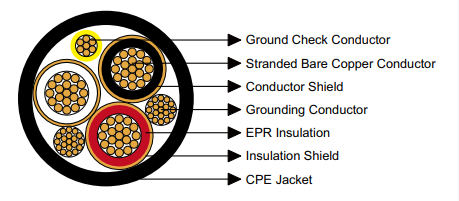
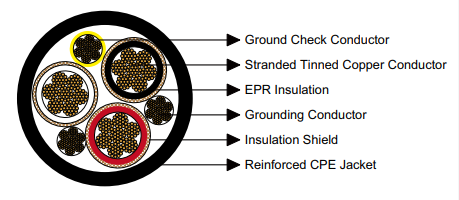
CPE Jacket

Type SHD-GC 3/C 250 MCM 25kV trailing cable is rated for 400 amperes in controlled free-air environments and 320 amperes under typical mining duty cycles, with an outer diameter of 104 to 110 millimeters and total weight of approximately 10,500 to 11,500 kilograms per kilometer. The cable features three 250 MCM (approximately 127 mm²) phase conductors plus dedicated ground-check and grounding conductors, EPR insulation rated for 90°C continuous operation, and an outer sheath formulation in either heavy-duty CPE (chlorinated polyethylene) or upgraded TPU (polyurethane) designed for abrasion and tear resistance. However, the direct engineering answer to whether this cable can "handle" continuous granite dragging without supplementary protection is not a simple affirmation. Sharp granite and quartzite surfaces act as natural cutting tools under the sustained dragging loads of 3,000 to 8,000 newtons that are typical in dragline and shovel mining operations, and will progressively abrade even the most robust elastomer sheath formulations. Even cables featuring premium TPU jackets offering five times the abrasion resistance of standard CPE will experience significantly accelerated wear rates when dragged continuously across sharp granite compared to smoother surfaces. Therefore, the realistic answer requires an important qualification: the Type SHD-GC 3/C 250 MCM 25kV cable can indeed survive granite dragging operations, but only when supplemented with active protective strategies including cable handlers that minimize ground contact, polyurethane guard sleeves in high-wear sections, operational derating to reduce thermal stress that compounds mechanical wear, and proper cable routing that avoids the sharpest rock concentrations. Without these supplementary measures, the cable's service life in granite mining environments is reduced from the 5 to 10 years typical in moderate operating conditions to perhaps 2 to 3 years of intensive dragging. With proper protection strategies implemented from the outset, service life can be extended to 4 to 7 years—representing a substantial return on the modest investment in protective equipment and engineering attention.

Draglines & Shovels: Can Type SHD-GC 3/C 250 MCM 25kV Handle Continuous Dragging on Sharp Granite Rocks?

Type SHD-GC 3/C 250 MCM 25kV trailing cable is rated for 400 amperes in controlled free-air environments and 320 amperes under typical mining duty cycles, with an outer diameter of 104 to 110 millimeters and total weight of approximately 10,500 to 11,500 kilograms per kilometer. The cable features three 250 MCM (approximately 127 mm²) phase conductors plus dedicated ground-check and grounding conductors, EPR insulation rated for 90°C continuous operation, and an outer sheath formulation in either heavy-duty CPE (chlorinated polyethylene) or upgraded TPU (polyurethane) designed for abrasion and tear resistance. However, the direct engineering answer to whether this cable can “handle” continuous granite dragging without supplementary protection is not a simple affirmation. Sharp granite and quartzite surfaces act as natural cutting tools under the sustained dragging loads of 3,000 to 8,000 newtons that are typical in dragline and shovel mining operations, and will progressively abrade even the most robust elastomer sheath formulations. Even cables featuring premium TPU jackets offering five times the abrasion resistance of standard CPE will experience significantly accelerated wear rates when dragged continuously across sharp granite compared to smoother surfaces. Therefore, the realistic answer requires an important qualification: the Type SHD-GC 3/C 250 MCM 25kV cable can indeed survive granite dragging operations, but only when supplemented with active protective strategies including cable handlers that minimize ground contact, polyurethane guard sleeves in high-wear sections, operational derating to reduce thermal stress that compounds mechanical wear, and proper cable routing that avoids the sharpest rock concentrations. Without these supplementary measures, the cable’s service life in granite mining environments is reduced from the 5 to 10 years typical in moderate operating conditions to perhaps 2 to 3 years of intensive dragging. With proper protection strategies implemented from the outset, service life can be extended to 4 to 7 years—representing a substantial return on the modest investment in protective equipment and engineering attention.
(N)TSCGEWÖU 3x120+3x70/3 12/20kV cable is the correct choice for most tunnel boring machine main cutterhead power supplies operating at medium voltage with cutterhead thrust loads in the range of 8,000 to 12,000 kilonewtons, featuring three 120 mm² phase conductors providing approximately 350 to 380 amperes current capacity in free-air installation at 30°C ambient and 90°C conductor operating temperature. The cable's nominal outer diameter is 73 to 81 millimeters, with total weight of approximately 9,800 to 10,500 kilograms per kilometer, making it manageable for most standard cable spools while still providing sufficient conductor cross-section to limit voltage drop to acceptable levels over tunnel distances extending several kilometers. The cable features Class 5 tinned copper conductors engineered for fatigue resistance in continuously flexing applications, EPR insulation maintaining exceptional thermal stability even when subjected to the 90°C conductor temperature that results from high-current excavation duty, semi-conductive shielding layers that uniformly distribute electric stress and prevent partial discharge initiation in the high-voltage environment, and a heavy-duty CPE jacket providing abrasion resistance in the confined underground spaces where the cable is routed. However, the critical distinction between simply selecting a cable model and properly sizing a cable for your specific tunnel boring installation lies in understanding the difference between the cable's theoretical free-air current capacity and its actual safe operating current when coiled on a cable drum—a difference that can reduce safe current by 30 to 50 percent depending on the spooling configuration. For tunnel boring machines operating in continental European or Asian tunneling projects with tunnel lengths of 5 to 15 kilometers and cutterhead thrust loads in the moderate to high range, the 3x120+3x70/3 12/20kV cable provides excellent balance between current capacity, voltage drop performance, mechanical durability, and cost. However, for shorter tunnels where voltage drop is not a concern, smaller conductor sizes (such as 3x95 mm²) may provide adequate performance at lower material cost, while for exceptionally long tunnels or extremely high thrust conditions, larger sizes (such as 3x150 mm² or 3x185 mm²) become necessary to maintain safe operating currents and acceptable voltage drop. Proper cable sizing requires engineering analysis specific to your tunnel length, expected cutterhead current demand, acceptable voltage drop limits, available cable drum diameters, and operational duty cycle.

Tunnel Boring Machines (TBM): Sizing (N)TSCGEWÖU 3×120+3×70/3 12/20kV for the Main Cutterhead Power Supply

(N)TSCGEWÖU 3×120+3×70/3 12/20kV cable is the correct choice for most tunnel boring machine main cutterhead power supplies operating at medium voltage with cutterhead thrust loads in the range of 8,000 to 12,000 kilonewtons, featuring three 120 mm² phase conductors providing approximately 350 to 380 amperes current capacity in free-air installation at 30°C ambient and 90°C conductor operating temperature. The cable’s nominal outer diameter is 73 to 81 millimeters, with total weight of approximately 9,800 to 10,500 kilograms per kilometer, making it manageable for most standard cable spools while still providing sufficient conductor cross-section to limit voltage drop to acceptable levels over tunnel distances extending several kilometers. The cable features Class 5 tinned copper conductors engineered for fatigue resistance in continuously flexing applications, EPR insulation maintaining exceptional thermal stability even when subjected to the 90°C conductor temperature that results from high-current excavation duty, semi-conductive shielding layers that uniformly distribute electric stress and prevent partial discharge initiation in the high-voltage environment, and a heavy-duty CPE jacket providing abrasion resistance in the confined underground spaces where the cable is routed. However, the critical distinction between simply selecting a cable model and properly sizing a cable for your specific tunnel boring installation lies in understanding the difference between the cable’s theoretical free-air current capacity and its actual safe operating current when coiled on a cable drum—a difference that can reduce safe current by 30 to 50 percent depending on the spooling configuration. For tunnel boring machines operating in continental European or Asian tunneling projects with tunnel lengths of 5 to 15 kilometers and cutterhead thrust loads in the moderate to high range, the 3×120+3×70/3 12/20kV cable provides excellent balance between current capacity, voltage drop performance, mechanical durability, and cost. However, for shorter tunnels where voltage drop is not a concern, smaller conductor sizes (such as 3×95 mm²) may provide adequate performance at lower material cost, while for exceptionally long tunnels or extremely high thrust conditions, larger sizes (such as 3×150 mm² or 3×185 mm²) become necessary to maintain safe operating currents and acceptable voltage drop. Proper cable sizing requires engineering analysis specific to your tunnel length, expected cutterhead current demand, acceptable voltage drop limits, available cable drum diameters, and operational duty cycle.
Type SHD-GC 3/C 4/0 AWG 8kV trailing cable, rated for 321 to 327 amperes continuous current at sea level (0 meters) assuming typical mining conditions with natural air cooling, experiences substantial reduction in current-carrying capacity when deployed at 4,000 meters elevation in the Andes Mountains. At 4,000 meters, the atmospheric pressure is only approximately 60 percent of sea-level pressure, and air density is reduced proportionally. This thin-air environment reduces the cable's cooling efficiency dramatically, resulting in derated ampacity of approximately 185 to 210 amperes—a reduction of 40 to 45 percent compared to sea-level capacity. This derating is not optional or conservative—it is physically necessary to prevent the cable conductor from exceeding the maximum allowable operating temperature of 90°C under continuous load. If a cable rated at 321A at sea level were operated at full sea-level ampacity while installed at 4,000 meters elevation, the conductor temperature would rise to approximately 120°C to 140°C or higher, severely accelerating insulation degradation and risking catastrophic failure within months. The derating magnitude is driven by fundamental thermodynamic principles: as altitude increases and air density decreases, the convective heat transfer coefficient that governs how efficiently the cable surface transfers heat to the surrounding air decreases proportionally. The relationship between air density and cooling efficiency is not linear—it follows approximately the 0.6 power relationship, meaning that reducing air density to 60 percent of sea-level value reduces cooling efficiency to approximately 70 percent. Additionally, in high-altitude Andes mining regions where ambient temperatures reach 25°C to 35°C in tropical regions or 40°C to 50°C in equipment enclosures, the combined effect of altitude derating plus temperature derating can reduce ampacity to values as low as 150 to 160 amperes—less than half the sea-level rating. Understanding and properly accounting for altitude derating in equipment selection, protection device settings, and operational procedures is essential for safe and reliable operation of power distribution systems at high-altitude mining facilities.

High-Altitude Ampacity Derating: How Does Operating at 4,000m in the Andes Mountains Affect Type SHD-GC 3/C 4/0 AWG 8kV Cable Current Capacity?

Type SHD-GC 3/C 4/0 AWG 8kV trailing cable, rated for 321 to 327 amperes continuous current at sea level (0 meters) assuming typical mining conditions with natural air cooling, experiences substantial reduction in current-carrying capacity when deployed at 4,000 meters elevation in the Andes Mountains. At 4,000 meters, the atmospheric pressure is only approximately 60 percent of sea-level pressure, and air density is reduced proportionally. This thin-air environment reduces the cable’s cooling efficiency dramatically, resulting in derated ampacity of approximately 185 to 210 amperes—a reduction of 40 to 45 percent compared to sea-level capacity. This derating is not optional or conservative—it is physically necessary to prevent the cable conductor from exceeding the maximum allowable operating temperature of 90°C under continuous load. If a cable rated at 321A at sea level were operated at full sea-level ampacity while installed at 4,000 meters elevation, the conductor temperature would rise to approximately 120°C to 140°C or higher, severely accelerating insulation degradation and risking catastrophic failure within months. The derating magnitude is driven by fundamental thermodynamic principles: as altitude increases and air density decreases, the convective heat transfer coefficient that governs how efficiently the cable surface transfers heat to the surrounding air decreases proportionally. The relationship between air density and cooling efficiency is not linear—it follows approximately the 0.6 power relationship, meaning that reducing air density to 60 percent of sea-level value reduces cooling efficiency to approximately 70 percent. Additionally, in high-altitude Andes mining regions where ambient temperatures reach 25°C to 35°C in tropical regions or 40°C to 50°C in equipment enclosures, the combined effect of altitude derating plus temperature derating can reduce ampacity to values as low as 150 to 160 amperes—less than half the sea-level rating. Understanding and properly accounting for altitude derating in equipment selection, protection device settings, and operational procedures is essential for safe and reliable operation of power distribution systems at high-altitude mining facilities.
Type SHD-GC 3/C #1 AWG 8kV trailing cable has a DC resistance of approximately 0.161 ohms per kilometer measured at the reference temperature of 20°C (68°F). This DC resistance value represents the pure ohmic resistance of the copper conductor when direct current flows through it—a condition that occurs in short-circuit analysis and DC testing procedures. However, when this same cable carries the alternating current typical of mining equipment operations (at the standard operating temperature of 90°C), the AC resistance increases to approximately 0.363 ohms per kilometer due to the combined effects of temperature rise and skin effect phenomena. The substantial difference between 0.161 Ω/km (DC, 20°C) and 0.363 Ω/km (AC, 90°C)—more than a 2.25 times increase—demonstrates a critical principle that engineers must account for in real-world voltage drop calculations: laboratory DC resistance values are not directly applicable to field voltage drop analysis. The cable features three 107.2 mm² (1 AWG equivalent) phase conductors of Class 5 tinned copper, with an additional ground-check conductor for continuous monitoring of cable integrity during operation, an outer diameter of approximately 53–58 mm, and a total weight of approximately 6,200–6,800 kg/km. Understanding both the DC baseline resistance and the elevated AC resistance at operating temperature is essential for accurately predicting voltage drop over long cable runs in open-pit mining operations where power distribution distances frequently exceed 500 meters.

Voltage Drop Calculation: Resistance (Ohms/km) for Type SHD-GC 3/C #1 AWG 8kV Trailing Cable

Type SHD-GC 3/C #1 AWG 8kV trailing cable has a DC resistance of approximately 0.161 ohms per kilometer measured at the reference temperature of 20°C (68°F). This DC resistance value represents the pure ohmic resistance of the copper conductor when direct current flows through it—a condition that occurs in short-circuit analysis and DC testing procedures. However, when this same cable carries the alternating current typical of mining equipment operations (at the standard operating temperature of 90°C), the AC resistance increases to approximately 0.363 ohms per kilometer due to the combined effects of temperature rise and skin effect phenomena. The substantial difference between 0.161 Ω/km (DC, 20°C) and 0.363 Ω/km (AC, 90°C)—more than a 2.25 times increase—demonstrates a critical principle that engineers must account for in real-world voltage drop calculations: laboratory DC resistance values are not directly applicable to field voltage drop analysis. The cable features three 107.2 mm² (1 AWG equivalent) phase conductors of Class 5 tinned copper, with an additional ground-check conductor for continuous monitoring of cable integrity during operation, an outer diameter of approximately 53–58 mm, and a total weight of approximately 6,200–6,800 kg/km. Understanding both the DC baseline resistance and the elevated AC resistance at operating temperature is essential for accurately predicting voltage drop over long cable runs in open-pit mining operations where power distribution distances frequently exceed 500 meters.
Type W 4/C 2/0 AWG 2000V portable power cables represent the heavy-duty backbone of North American mining operations, temporary power distribution systems, and construction equipment supply chains. These cables deliver 237 amperes continuously while withstanding the mechanical abuse, thermal cycling, oil exposure, and moisture ingress endemic to underground mining, drilling rig operations, and industrial emergency power applications. The designation "Type W" codifies a specific engineering philosophy: maximum flexibility through extreme copper stranding (259 to 342 fine wires per conductor), robust outer sheathing rated for tractor drag and ground abrasion, and flame-retardant chemistry meeting the rigorous MSHA standards that govern underground coal mining environments.

Sourcing Type W 4/C 2/0 AWG 2000V: Generic Equivalents Meeting MSHA Standards

Type W 4/C 2/0 AWG 2000V portable power cables represent the heavy-duty backbone of North American mining operations, temporary power distribution systems, and construction equipment supply chains. These cables deliver 237 amperes continuously while withstanding the mechanical abuse, thermal cycling, oil exposure, and moisture ingress endemic to underground mining, drilling rig operations, and industrial emergency power applications. The designation “Type W” codifies a specific engineering philosophy: maximum flexibility through extreme copper stranding (259 to 342 fine wires per conductor), robust outer sheathing rated for tractor drag and ground abrasion, and flame-retardant chemistry meeting the rigorous MSHA standards that govern underground coal mining environments.
Ampacity is the maximum electric current that a conductor can safely carry continuously without exceeding a specified temperature limit, usually 90°C for power cables used in mining and industrial applications. The word itself is a contraction of "ampere" and "capacity," and it represents a fundamental constraint imposed by the physics of electrical resistance and heat dissipation. Understanding ampacity is not an academic exercise — it is the critical foundation for ensuring that your mining equipment receives reliable power, that cables do not overheat and fail prematurely, and that your operation avoids unplanned downtime due to cable damage or failure. 载流量是导体在不超过指定温度限值(通常为90°C)的条件下能连续安全承载的最大电流。

Ampacity Rating Guide: How Much Current Can a Type SHD-GC 3/C 4/0 AWG 8kV Cable Handle?

Ampacity is the maximum electric current that a conductor can safely carry continuously without exceeding a specified temperature limit, usually 90°C for power cables used in mining and industrial applications. The word itself is a contraction of “ampere” and “capacity,” and it represents a fundamental constraint imposed by the physics of electrical resistance and heat dissipation. Understanding ampacity is not an academic exercise — it is the critical foundation for ensuring that your mining equipment receives reliable power, that cables do not overheat and fail prematurely, and that your operation avoids unplanned downtime due to cable damage or failure. 载流量是导体在不超过指定温度限值(通常为90°C)的条件下能连续安全承载的最大电流。
When electrical engineers and equipment operators discuss the capacity of a dragline or shovel reeling cable, they often refer to a specification that seems disconnected from the typical electrical characteristics — the maximum permissible tensile load, expressed in units of pounds per thousand circular mills (lbs/mcm). This specification is fundamentally different from ampacity (which measures the cable's ability to safely carry electrical current) or voltage rating (which specifies the insulation quality). Instead, tensile load capacity describes the maximum mechanical force that the cable can withstand before the metallic conductors themselves begin to yield, stretch, or break. For a reeling cable used on heavy dragline or shovel equipment, this mechanical specification is often more critical to equipment safety and service life than the electrical specifications, because the cable is typically exposed to enormous pulling forces that can exceed the weight of the equipment being supported.

Type SHD-GC (Reeling): Maximum Permissible Tensile Load for Heavy-Duty Dragline Cable Reels

When electrical engineers and equipment operators discuss the capacity of a dragline or shovel reeling cable, they often refer to a specification that seems disconnected from the typical electrical characteristics — the maximum permissible tensile load, expressed in units of pounds per thousand circular mills (lbs/mcm). This specification is fundamentally different from ampacity (which measures the cable’s ability to safely carry electrical current) or voltage rating (which specifies the insulation quality). Instead, tensile load capacity describes the maximum mechanical force that the cable can withstand before the metallic conductors themselves begin to yield, stretch, or break. For a reeling cable used on heavy dragline or shovel equipment, this mechanical specification is often more critical to equipment safety and service life than the electrical specifications, because the cable is typically exposed to enormous pulling forces that can exceed the weight of the equipment being supported.
Underground room-and-pillar mining operations present unique challenges for trailing cables. The Komatsu Joy 12HM series continuous miners must navigate through tight corners and confined spaces while maintaining continuous power supply. The trailing cable—connecting the miner to the power distribution system—must bend around right-angle turns, withstand crushing forces from equipment run-over, and maintain electrical integrity through thousands of flexing cycles without failure. 地下房柱式采矿作业对拖缆提出了独特的挑战。小松Joy 12HM系列连续采煤机必须在保持连续供电的同时穿越紧凑的转角和狭窄空间。连接采煤机与配电系统的拖缆必须能够绑过直角弯道,承受设备碾压的压力,并在数千次弯曲循环中保持电气完整性而不发生故障。

Komatsu Joy 12HM31 Continuous Miner: High-Flexibility Trailing Cables for Tight Corners

Underground room-and-pillar mining operations present unique challenges for trailing cables. The Komatsu Joy 12HM series continuous miners must navigate through tight corners and confined spaces while maintaining continuous power supply. The trailing cable—connecting the miner to the power distribution system—must bend around right-angle turns, withstand crushing forces from equipment run-over, and maintain electrical integrity through thousands of flexing cycles without failure. 地下房柱式采矿作业对拖缆提出了独特的挑战。小松Joy 12HM系列连续采煤机必须在保持连续供电的同时穿越紧凑的转角和狭窄空间。连接采煤机与配电系统的拖缆必须能够绑过直角弯道,承受设备碾压的压力,并在数千次弯曲循环中保持电气完整性而不发生故障。
Type W and Type G-GC cables represent two of the most critical portable power cable designs for mining and heavy industrial applications. Both cable types are engineered to withstand extreme mechanical stress, chemical exposure, and demanding electrical requirements while maintaining safety compliance with the Mine Safety and Health Administration (MSHA) regulations under 30 CFR Part 75 and Part 77. Type W和Type G-GC电缆是矿业和重工业应用中最关键的两种便携式电力电缆设计。这两种电缆均经过工程设计,能够承受极端的机械应力、化学暴露和苛刻的电气要求,同时保持符合美国矿山安全与健康管理局(MSHA)根据30 CFR第75和77部分制定的安全合规要求。

Type W vs. Type G-GC: The Definitive Guide to Ground Check Conductors for MSHA Compliance

Type W and Type G-GC cables represent two of the most critical portable power cable designs for mining and heavy industrial applications. Both cable types are engineered to withstand extreme mechanical stress, chemical exposure, and demanding electrical requirements while maintaining safety compliance with the Mine Safety and Health Administration (MSHA) regulations under 30 CFR Part 75 and Part 77. Type W和Type G-GC电缆是矿业和重工业应用中最关键的两种便携式电力电缆设计。这两种电缆均经过工程设计,能够承受极端的机械应力、化学暴露和苛刻的电气要求,同时保持符合美国矿山安全与健康管理局(MSHA)根据30 CFR第75和77部分制定的安全合规要求。
DLO TORSIONFLEX RHH/RHW-2 represents an advanced category of portable power cables specifically engineered for demanding industrial applications, including wind turbine installations where torsional flexibility and multi-environment performance are critical requirements. This cable type combines the proven durability of Diesel Locomotive (DLO) construction with enhanced torsion resistance, making it uniquely suited for wind energy systems where cables must accommodate continuous nacelle rotation while maintaining electrical integrity.

What is DLO TORSIONFLEX RHH/RHW-2 2000V Wind Turbine Cable?

DLO TORSIONFLEX RHH/RHW-2 represents an advanced category of portable power cables specifically engineered for demanding industrial applications, including wind turbine installations where torsional flexibility and multi-environment performance are critical requirements. This cable type combines the proven durability of Diesel Locomotive (DLO) construction with enhanced torsion resistance, making it uniquely suited for wind energy systems where cables must accommodate continuous nacelle rotation while maintaining electrical integrity.
Complete Guide to UL 1650:2025 Portable Power Cable Type G, Type G-GC, Type W, MP-GC & SHD-GC Mining Cables — Technical Specifications, Compliance Standards, Safety Guidelines and Applications

Complete Guide to UL 1650:2025 Portable Power Cable

UL 1650, UL 1650:2025, portable power cable, mining cable, Type G cable, Type G-GC cable, Type W cable, MP-GC cable, SHD-GC cable, MSHA approved cable, EPR insulation, CPE jacket, trailing cable, mining equipment cable UL 1650 is the primary safety standard for portable power cables used in industrial and mining applications across North America. The UL 1650:2025 edition, published by Underwriters Laboratories and ANSI approved in November 2025, establishes comprehensive requirements for portable power cables designed for use in accordance with the National Electrical Code (NFPA 70).[1] This standard covers various types of portable power cables including Type G, Type G-GC, Type W, MP-GC, and SHD-GC cables that are essential for powering mobile and stationary mining equipment in both surface and underground operations. The cables manufactured under UL 1650 must undergo rigorous testing per UL 2556 (Wire and Cable Test Methods) to ensure safety and reliability in demanding industrial environments.[2]
Reeling & Trailing Cables for Cranes & Mining — Feichun Special Cable Blogs

2kV SHD-GC Portable Power Cable Complete Range | Underground Mining Ground Check System | Continuous Miner, Face Drill, Loader, Roadheader Cable | Feichun Cables

Complete SHD-GC 2kV portable power cable range with ground check conductor for underground mining. 13 conductor sizes 3×6 AWG to 3×500 kcmil, ampacity 93-536A. Continuous miners, face drill rigs, underground loaders, shotcrete machines, roadheaders. Yellow polypropylene ground check conductor, EPR insulation, CPE jacket. ICEA S-75-381 compliant.
NSSHOEU .../3E + ST 0.6/1kV Heavy Duty Flexible Cables

Type G Two-Conductor Flat Mining Power Cable 2kV | DC Equipment Solutions

Type G flat parallel cable systems are meticulously engineered for demanding DC off-track mining operations. These robust electrical solutions provide reliable power transmission for mission-critical underground equipment including DC shuttle cars, precision drilling machinery, cutting equipment, and continuous loading systems.
Advanced NSGAFOEU/NSHXAFOE single core medium voltage cables for transportation electrification. EPR insulation, halogen-free options, 1.8/3kV-3.6/6kV ratings. Rail, bus, and mobile equipment applications.

Type W Five-Conductor Round Advanced Mining Cable 2kV | Automation Control Systems | Multi-Wire Power Distribution

Type W five-conductor round portable mining cable 2kV with reinforced CPE jacket, EPR insulation. Advanced mining automation, control systems, VFD applications. Continuous miners, sophisticated drilling equipment. ICEA S-75-381 certified five-conductor round construction.
Reeling & Trailing Cables for Cranes & Mining — Feichun Special Cable Blogs

Type W Single Conductor Portable Mining Power Cable 2kV | Industrial Grade EPR Insulation | Feichun Cables

Type W Single Conductor Portable Mining Power Cable 2kV Heavy-Duty Industrial Grade Electrical Cable Engineered for Extreme Mining & Mobile Equipment Applications Professional-grade portable power transmission solution featuring EPR insulation technology and reinforced CPE jacket construction designed specifically for demanding industrial environments including underground mining operations, mobile equipment systems, and gathering-reel locomotive applications.