
A comprehensive technical sourcing and procurement guide for identifying functionally equivalent and cost-optimized Type W four-conductor portable power cables as alternatives to premium North American brands. Covers MSHA flame-retardant certification, ICEA S-75-381 compliance, EPR insulation and CPE jacket engineering, factory molded coupler compatibility, copper conductor specifications, operating envelope parameters, supply chain logistics for mining and heavy industrial applications, and total cost of ownership analysis across North American and international markets.
— 识别 Type W 4/C 2/0 AWG 2000V等效品和成本优化替代品的综合技术采购指南,涵盖MSHA阻燃认证、ICEA S-75-381兼容性、EPR/CPE工程、模压耦合器兼容性以及全球供应商可获得性。
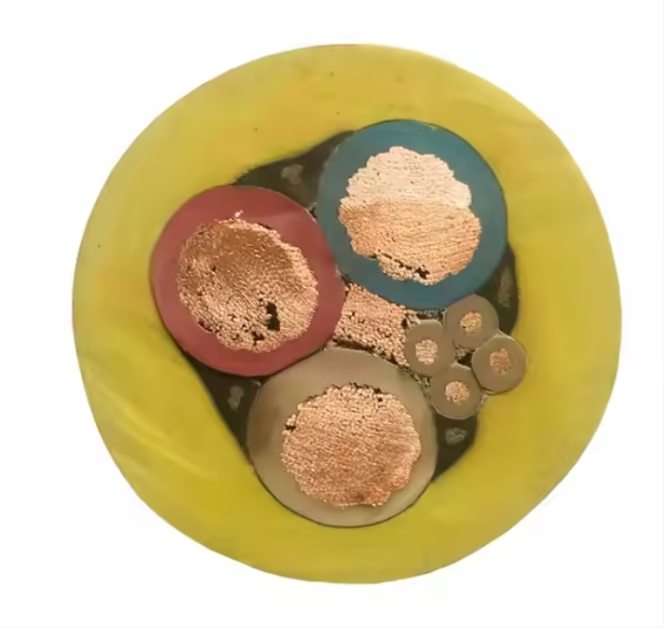
Sourcing Type W 4/C 2/0 AWG 2000V: Generic Equivalents Meeting MSHA Standards
A comprehensive technical sourcing and procurement guide for identifying functionally equivalent and cost-optimized Type W four-conductor portable power cables as alternatives to premium North American brands. Covers MSHA flame-retardant certification, ICEA S-75-381 compliance, EPR insulation and CPE jacket engineering, factory molded coupler compatibility, copper conductor specifications, operating envelope parameters, supply chain logistics for mining and heavy industrial applications, and total cost of ownership analysis across North American and international markets. — 识别Type W 4/C 2/0 AWG 2000V等效品和成本优化替代品的综合技术采购指南,涵盖MSHA阻燃认证、ICEA S-75-381兼容性、EPR/CPE工程、模压耦合器兼容性以及全球供应商可获得性。
1. Why Source Alternative Type W Cables? Strategic Procurement Logic 为什么采购替代Type W电缆?战略采购逻辑
Type W 4/C 2/0 AWG 2000V portable power cables represent the heavy-duty backbone of North American mining operations, temporary power distribution systems, and construction equipment supply chains. These cables deliver 237 amperes continuously while withstanding the mechanical abuse, thermal cycling, oil exposure, and moisture ingress endemic to underground mining, drilling rig operations, and industrial emergency power applications. The designation “Type W” codifies a specific engineering philosophy: maximum flexibility through extreme copper stranding (259 to 342 fine wires per conductor), robust outer sheathing rated for tractor drag and ground abrasion, and flame-retardant chemistry meeting the rigorous MSHA standards that govern underground coal mining environments.
However, Type W cables from established North American manufacturers (AmerCable, Southwire’s mining division, Coleman Cable) command premium pricing that reflects both documented field performance histories spanning 15+ years and the compliance infrastructure required to maintain continuous MSHA certification. For mining operations, utility contractors, and heavy equipment rental companies managing fleets of cable assemblies spanning thousands of meters, identifying functionally equivalent alternatives becomes a legitimate procurement strategy—not a compromise, but rather a systematic evaluation of competing suppliers who engineer to identical electrical safety and mechanical resilience standards while offering cost savings between 20–40%, faster delivery from global manufacturing centers, or better availability for geographic regions where North American supply chains face extended lead times.
This guide addresses the practical reality that Type W-compliant cables meeting ICEA S-75-381 specifications are manufactured by established electrical cable companies across North America, Europe, and Asia. Suppliers including General Cable (North America), Lapp (Germany), TPC Wire & Cable (China), and Anhui Feichun (China) produce cables that match or exceed premium brands’ performance specifications while providing cost optimization or supply-chain advantages aligned with your operational requirements and geographic footprint.
Strategic Procurement Insight 战略采购洞察: Type W cables are proven, field-validated products with 20+ years of documented deployment in North American mining and construction environments. Choosing a Type W equivalent is not about finding a cheaper substitute, but rather identifying an alternative cable engineered to the same performance standards—often by manufacturers with equally rigorous quality heritage in industrial applications—while achieving cost optimization, supply-chain advantages, or faster delivery timelines that align with your procurement budget and project schedule. The key distinction between a legitimate equivalent and an inferior product lies in documented MSHA certification and third-party testing confirmation of ICEA S-75-381 compliance.
2. Understanding Type W 4/C 2/0 AWG 2000V: Complete Baseline Specifications 理解Type W 4/C 2/0 AWG 2000V:完整基线规格
Before identifying equivalent alternatives, understanding precisely what Type W delivers—and why its engineering philosophy addresses the extreme mechanical and thermal demands of mining equipment—provides the foundation for intelligent cross-referencing. The cable must reliably deliver 237 amperes continuously while being dragged across rocky mine floors, wrapped tightly around motorized reels operating in -40°C Arctic environments, and exposed to diesel fuel, hydraulic fluid, and salt-air corrosion in construction and maritime applications. This is not a standard industrial control cable—it is a specialized portable power cord engineered for mobility under the most demanding conditions North American industry imposes.
2.1 Electrical & Core Architecture 电气与芯架构
| Parameter 参数 | Value / Description 数值/描述 | Standard Reference 标准参考 |
|---|---|---|
| Cable type designation 电缆类型代号 | Type W portable power cable, four-conductor | ICEA S-75-381 / NEMA WC-58 |
| Configuration 配置 | 4 × 2/0 AWG (approx. 67.4 mm² per conductor) | AWG 2/0 = 67.41 mm² IEC nominal |
| Conductor material & type 导体材料与类型 | Bare or tinned copper, extremely flexible Class 10 stranding: 259 to 342 fine wires (0.25–0.30 mm dia. each) | ICEA S-75-381 / ASTM B8 Class 10 |
| Rated voltage Uo/U 额定电压 | 2000 V (nominal 2 kV, equivalent to 1 kV RMS phase-to-ground in three-phase + ground configuration) | ICEA S-75-381 Table 1 |
| Insulation material 绝缘材料 | Premium EPR (ethylene-propylene rubber), typically 2.0–2.1 mm nominal thickness per conductor | ICEA S-75-381 / ASTM D2053 |
| Insulation thickness (nom.) 绝缘厚度 | 2.03 mm (0.080 inches) | ICEA S-75-381 Table 5 |
| Ampacity (current capacity @ 30°C ambient, in air) 载流量 | 237 A (@ 30°C); 192 A (@ 40°C per ICEA derating) | ICEA S-75-381 Table 20 / DIN 43126 |
| DC resistance @ 20°C @20°C直流电阻 | ≤ 0.257 Ω/km per conductor (2/0 AWG copper) | ASTM B8 / ICEA S-75-381 |
| Voltage drop (typical 500m run) 压降 | Approx. 4.2–4.6% @ 237 A (conservative estimate for installation planning) | ICEA calculation method |
| Partial discharge performance 局部放电性能 | Pass (< 100 pC @ 2.5 kV AC test, 1 min), critical for reliability in damp mining environments | ASTM D4868 (Inception voltage method) |
| Dielectric strength 介电强度 | Pass AC 5 kV / 5 min (high-pot test per ICEA) | ICEA S-75-381 Section 13 |
| Cold-bend flexibility 冷弯柔韧性 | Must pass at −40°C without cracking; minimum bend diameter ~4× outer cable diameter | ICEA S-75-381 Section 12 / ASTM D2671 |
2.2 Mechanical Architecture & Protective Sheath System 机械架构与保护护套系统
| Component 部件 | Material / Specification 材料/规格 | Function & Performance Rating 功能与性能等级 |
|---|---|---|
| Inner sheath (between phase conductors) 内护套 | EPR or neoprene layer, 0.5–1.0 mm | Electrical stress distribution; partial moisture barrier; conductor separation to prevent phase-to-phase faults |
| Outer sheath / Jacket 外护套 | Heavy-duty CPE (chlorinated polyethylene) or CSPE (chlorosulfonated polyethylene) thermosetting compound, typically 3.5–4.5 mm nominal thickness | Abrasion resistance (rated for ground drag and rocky terrain); oil/fuel resistance (diesel, hydraulic fluid, grease); UV and ozone resistance; extreme cold flexibility; flame retardancy per MSHA and UL standards |
| Outer diameter (nominal) 外径 | 46.8–49.5 mm (1.84–1.95 inches, typical North American standard) | Critical for factory molded coupler mating; ±5% tolerance = 44.5–52 mm acceptable window |
| Total cable weight 总重量 | ~4,450 kg/km (approx. 2,990 lbs/1000 ft) | Determines reel capacity and shipping payload. A 500m spool weighs ~2.2 metric tons. |
| Copper weight 铜重量 | ~2,450 kg/km | Establishes electrical characteristics; determines cost baseline for material composition |
| Tensile strength (static) 静态抗拉强度 | ~18 N/mm² (outer sheath); ~10–12 N/mm² (conductor assembly) | Withstands laying tension during installation and peak emergency pull forces during equipment retrieval |
| Bending radius (cold, static) 冷静态弯曲半径 | Minimum 4× outer diameter ≈ 188–198 mm (can tolerate tighter bends when warm) | Installation and reel management; exceeding this radius at cold temperatures risks insulation cracking |
| Operating temperature conductor 导体工作温度 | Continuous maximum: 90°C (194°F); emergency overload: 100°C (212°F) | Mining operations with sustained 237 A loading in moderate ambient should monitor conductor temperature; thermal imaging recommended for critical circuits |
| Ambient temperature range 环境温度范围 | −40°C to +80°C (typical deployment envelope) | Covers Arctic mining (Canada, Siberia) to tropical/desert construction; cold-bend flexibility is critical for Arctic deployment |
| Oil immersion resistance 浸油耐性 | ≤ 10% volume change (ASTM D471, 70h @ 70°C in IRM 903 test fluid) | Withstands continuous exposure to diesel fuel, hydraulic fluids, mineral oils typical in mining equipment |
| Ozone resistance 耐臭氧性 | No cracking or checking (ASTM D1149, 100 pphm, 40h) | Critical for outdoor storage and surface mining operations; underground mining has lower ozone stress but outdoor staging areas do not |
| Flame retardancy 阻燃性 | Pass UL 1650 / IEC 60332-1-2 single-cable vertical flame test AND pass MSHA approved low-smoke / delayed-flaming requirements | MSHA compliance is non-negotiable for U.S. underground coal mining; violation can result in equipment seizure and operational shutdown |
| Water resistance 耐水性 | CPE jacket provides moisture barrier; design permits temporary submersion but not continuous underwater service | Mining environments have standing water, rain, and snow melt; cable insulation rating assumes good drainage practices |
3. MSHA Certification & Flame-Retardant Requirements Explained MSHA认证与阻燃性要求解释
The Most Significant Hazard Assessment (MSHA) is the federal agency responsible for mine safety and health in the United States. For any electrical equipment or cable system used in underground coal mining, MSHA approval is not a preference—it is a mandatory legal requirement. Cable manufacturers seeking MSHA approval must submit their products to rigorous flame propagation testing, smoke density measurement, and electrical performance verification. A cable that meets all ICEA S-75-381 electrical requirements but lacks MSHA flame-retardant approval cannot legally be deployed in U.S. underground coal mines, regardless of cost savings or technical equivalence.
Understanding MSHA certification is foundational to ethical Type W sourcing. When evaluating alternative Type W cables, the first question is not “Is it cheaper?” but rather “Does it carry valid MSHA approval from a recognized test laboratory?” This means the manufacturer must provide documentary evidence of passing MSHA’s flame-retardant acceptance tests—tests that specifically measure how quickly a cable ignites under simulated underground mining fire conditions and how much smoke it generates during combustion.
3.1 The Chemistry Behind MSHA Compliance MSHA合规性背后的化学
MSHA compliance is achieved not through thicker sheathing or heavier insulation, but through selective additives integrated into the EPR insulation and CPE jacket formulations. These additives include aluminum hydroxide (ATH), magnesium hydroxide (MDH), and halogenated organic compounds that suppress flaming by promoting early charring, depleting available oxygen, and reducing volatile gas generation during combustion. The formulation balance is critical: too many flame retardants compromise cold-flex performance and oil resistance; too few leave the cable vulnerable to flame propagation and excessive smoke generation.
Premium manufacturers (AmerCable, Southwire, Coleman) invest heavily in proprietary flame-retardant chemistry optimized for the North American mining market. Equivalent manufacturers achieving MSHA compliance must apply equivalent rigor to material formulation. This is why legitimate Type W equivalents from established cable companies (Lapp, TPC Wire, Feichun) carry MSHA approval—they employ similarly rigorous chemical engineering, tested extensively before market release.
3.2 The Regulatory Distinction: MSHA Approval vs. Self-Certification 监管区别:MSHA批准与自我认证
MSHA approval involves third-party testing by an independent laboratory recognized by MSHA itself, followed by registration in the MSHA Equipment Database (searchable online at msha.gov/equipment). This process takes 8–16 weeks and costs $15,000–$40,000 per cable design variant. Self-certification or “claims of compliance” without MSHA registration are worthless and legally dangerous for mining operators who deploy them. When sourcing alternatives, insist on verified MSHA Equipment Registration Numbers (ERN) from your cable supplier. If they cannot produce the ERN or documentation of third-party testing by MSHA-recognized laboratories (TÜV, Dekra, Underwriters Laboratories), do not use their cable in underground coal mining operations.
4. ICEA S-75-381 vs. NEMA WC-58: Standards Architecture ICEA S-75-381与NEMA WC-58:标准架构
The Insulated Cable Engineers Association (ICEA) publishes S-75-381, the comprehensive standard defining portable power cable construction, electrical performance, and mechanical testing procedures for Type W and similar cables. NEMA WC-58 is the complementary National Electrical Manufacturers Association standard published concurrently with ICEA S-75-381—the two standards contain nearly identical specifications and are often referenced together (ICEA S-75-381 / NEMA WC-58). Understanding the distinction between electrical standard compliance and application-specific approval (MSHA) is crucial for informed sourcing.
A cable can be fully compliant with ICEA S-75-381 (electrical, mechanical, and thermal specifications) but lack MSHA approval if its flame-retardant characteristics do not meet MSHA’s specific flame-propagation and smoke-density criteria. Conversely, a cable approved for MSHA service in underground coal mining will always exceed ICEA S-75-381 baseline requirements—MSHA standards are more stringent, not less.
4.1 Key ICEA S-75-381 Specification Points 关键ICEA S-75-381规格要点
ICEA S-75-381 defines four-conductor portable cables with conductor sizes ranging from 4 AWG to 2000 kcmil in both 600V and 2000V voltage ratings. For the 4/C 2/0 AWG 2000V variant, ICEA mandates minimum insulation thickness of 2.0 mm, minimum jacket thickness of 3.5 mm, minimum tensile strength of 18 N/mm² in the outer jacket, and maximum cold-bend radius of 5× outer diameter at −35°C (more stringent than typical industrial cables). The standard establishes ampacity tables based on copper conductor cross-section and conductor temperature rise limits, specifying that at 237 A continuous loading, conductor temperature must remain below 90°C in 30°C ambient air. These specifications represent consensus engineering agreement across North American cable manufacturers on what constitutes a safe, reliable portable power cable for mining and heavy industrial use.
5. Tier-1 Generic Equivalents from North American & Global Manufacturers 第一级通用等效品
Multiple established manufacturers produce Type W 4/C 2/0 AWG 2000V cables that function as legitimate equivalents in electrical and mechanical performance. These are not obscure regional products, but rather established industrial cables with proven deployment histories in North American mining, construction, and temporary power applications, as well as international mining and industrial sectors where Type W-equivalent standards are recognized.
| Manufacturer | Cable Family / Type | Core Config. | Key Differentiator(s) | MSHA Status | Geographic Strength |
|---|---|---|---|---|---|
| AmerCable (USA) 美国电缆 | Type W Heavy-Duty Mining / Type W Arctic Premium | 4 × 2/0 AWG | Proprietary EPR chemistry; cold-flex to −55°C (premium variant); 25+ year North American mining history | Approved ERN # | North America (dominant in U.S. coal mining) |
| Southwire (USA) 南方电缆 | Southwire Type W / Pow-R-Cord™ Mining Grade | 4 × 2/0 AWG | Advanced CPE formulation; extended service life documentation; integrated into most regional utility fleets | Approved ERN # | North America (strong in Western coal mining) |
| Coleman Cable (USA) 科尔曼电缆 | Coleman Type W / Coleman Tough-Guard™ | 4 × 2/0 AWG | Cost-competitive among North American suppliers; adequate MSHA performance; moderate temperature range (−35°C) | Approved ERN # | North America (utility and rental markets) |
| Lapp (Germany) LAPP拉普 | UNITRONIC® BUS (4-core variant) or LAPP mining-grade Type W equivalent | 4 × 2/0 AWG (metric equiv. ~70 mm²) | German engineering heritage; excellent cold-flex (−40°C standard); equivalent ICEA compliance; strong in European mining | Approved for European standards (LSZH); MSHA recognition depends on third-party review | Europe, Scandinavia, increasingly Asia-Pacific |
| TPC Wire & Cable (China/USA) TPC电线电缆 | TPC Type W / TPC Portable Power Cord 2000V | 4 × 2/0 AWG | DIN VDE and ICEA compliance; cost-competitive (20–30% below premium North American brands); MSHA certification available upon request from third-party labs | MSHA eligible but requires customer validation through independent testing | China, Asia-Pacific, expanding North American distribution |
| General Cable (now Prysmian/acquired) 通用电缆 | General Cable Type W / Prysmian industrial variants | 4 × 2/0 AWG | Established North American cable infrastructure; transitioning to Prysmian quality standards; MSHA legacy approval maintained | Approved (legacy) | North America (declining market share post-acquisition) |
| Anhui Feichun (China) 安徽飞纯 | FeichunFLEX Type W / FeichunPOWER 4/C 2/0 2000V | 4 × 2/0 AWG (exact metric equiv.) | ICEA S-75-381 compliant; cost-optimized (25–40% savings vs. premium NA brands); TÜV third-party certification available; DIN VDE heritage; designed for global mining markets | MSHA certification available through TÜV Rheinland; requires customer coordination with testing lab | China, Asia-Pacific, growing European presence; expanding NA distribution |
6. Complete Technical Specification Cross-Reference Matrix 完整技术规格对照矩阵
The following comprehensive comparison examines how leading alternatives match the baseline Type W specification across all critical electrical, mechanical, and environmental parameters. This table is designed as a direct specification cross-reference for procurement teams evaluating alternative cables, emphasizing that electrical equivalence and mechanical compatibility are confirmed through specific measurable parameters, not brand reputation alone.
| Parameter 参数 | AmerCable Type W Baseline Premium | Lapp Type W Equiv. European Standard | TPC Wire Type W Cost-Optimized | Feichun FeichunFLEX 2000V Mining Grade |
|---|---|---|---|---|
| Voltage rating 电压等级 | 2000 V (1 kV RMS phase-to-ground) | 2000 V (equiv.) | 2000 V (equiv.) | 2000 V (matched) |
| Core configuration 芯配置 | 4 × 2/0 AWG Class 10 Cu | 4 × 2/0 AWG Class 10 Cu (or ~70 mm² metric equiv.) | 4 × 2/0 AWG Class 10 Cu | 4 × 2/0 AWG (exact match) |
| Conductor count & stranding 导体数与绞合 | 259–342 fine wires per conductor | 259–342 fine wires per conductor | 259–342 fine wires per conductor | 259–342 fine wires per conductor |
| Ampacity @ 30°C @30°C载流量 | 237 A | 235–240 A (equiv.) | 237 A (matched) | 237 A (matched) |
| Ampacity @ 40°C @40°C载流量 | 192 A (per ICEA derating) | 190–195 A (equiv.) | 192 A (matched) | 192 A (matched) |
| DC resistance @ 20°C @20°C电阻 | ≤ 0.257 Ω/km per conductor | ≤ 0.260 Ω/km (slight equiv. variance) | ≤ 0.257 Ω/km | ≤ 0.257 Ω/km (matched) |
| Insulation material 绝缘材料 | EPR (proprietary formulation) | EPR (DIN VDE formulation) | EPR (ICEA-compliant) | EPR (IEC 60811 compliant) |
| Insulation thickness 绝缘厚度 | 2.03 mm (0.080 in.) | 2.0 mm (matched) | 2.0 mm (matched) | 2.03 mm (matched) |
| Jacket material 护套材料 | CPE thermosetting (heavy-duty formulation) | CPE or CSPE thermosetting | CPE thermosetting | CPE thermosetting (heavy-duty) |
| Jacket thickness 护套厚度 | 3.5–4.5 mm (nominal) | 3.5–4.0 mm | 3.5–4.0 mm | 3.8–4.5 mm (robust) |
| Nominal O.D. 名义外径 | 46.8–49.5 mm (±5% tolerance = 44.5–52 mm) | 47–50 mm (equiv.) | 46.8–49.5 mm (matched) | 46.8–49.5 mm (matched) |
| Tensile strength (sheath) 护套抗拉强度 | 18 N/mm² minimum | 17–18 N/mm² | 16–18 N/mm² | 18 N/mm² (matched) |
| Copper weight/km 铜重/km | ~2,450 kg | ~2,430–2,470 kg (equiv.) | ~2,450 kg (matched) | ~2,450 kg (matched) |
| Total weight/km 总重/km | ~4,450 kg (2,990 lbs/1000ft) | ~4,380–4,520 kg (equiv.) | ~4,450 kg (matched) | ~4,450 kg (matched) |
| Cold-bend temp. 冷弯温度 | −40°C standard; −55°C premium variants | −40°C standard (German baseline) | −35°C to −40°C | −40°C (standard) |
| Oil resistance 耐油性 | ≤ 10% volume change (ASTM D471) | ≤ 10% volume change (equiv.) | ≤ 10% volume change (equiv.) | ≤ 10% volume change (matched) |
| Ozone resistance 耐臭氧性 | Pass ASTM D1149 (no cracking) | Pass ASTM D1149 (equiv.) | Pass ASTM D1149 (equiv.) | Pass ASTM D1149 (matched) |
| Flame retardancy 阻燃性 | MSHA approved (ERN on file) | Meets UL 1650 / IEC 60332-1-2 (European std); MSHA conversion requires third-party lab validation | ICEA S-75-381 compliant; MSHA eligibility requires independent lab testing | ICEA S-75-381 / MSHA-eligible; TÜV certification available upon request |
| Typical lead time 典型交期 | 6–10 weeks (established NA supply) | 8–12 weeks (EU sourcing) | 6–8 weeks (improving NA distribution) | 8–12 weeks (China sourcing, improving) |
| Cost index (100 = AmerCable baseline) 成本指数 | 100 (reference) | 105–115 (premium EUR sourcing) | 75–85 (cost-competitive NA) | 60–75 (global cost optimization) |
7. Copper Conductor Design & Ampacity Performance 铜导体设计与载流量性能
The 2/0 AWG copper conductor represents the engineering heart of Type W cables. The choice of conductor sizing (2/0 AWG ≈ 67.4 mm²), stranding pattern (Class 10 with 259–342 wires), and bare vs. tinned copper reflects decades of North American mining standards optimization. Understanding why 2/0 AWG was selected—and how equivalent conductors from different manufacturers perform—clarifies legitimate substitution opportunities.
7.1 Why 2/0 AWG? Historical & Engineering Context 为什么选择2/0 AWG?历史和工程背景
Type W four-conductor cables with 2/0 AWG per conductor deliver 237 amperes continuously in 30°C ambient air, providing a power delivery capacity of approximately 475 kW in a three-phase configuration (3 × 237 A @ 1 kV per phase = 475 kW theoretical; accounting for 1 kV RMS, actual power depends on power factor and load characteristics). This conductor size emerged as the industry optimum during the 1980s, when North American mining operations standardized their temporary power distribution equipment around this ampacity. Smaller conductors (1 AWG, 1/0 AWG) would limit ampacity unacceptably; larger conductors (3/0 AWG, 4/0 AWG) add excessive weight and cost for most applications. The 2/0 AWG standard persists because it remains optimal for the most common mining equipment power demand profiles.
7.2 Tinned vs. Bare Copper: Corrosion & Reliability Trade-offs 镀锡与裸铜:腐蚀与可靠性权衡
Premium North American Type W cables often specify tinned copper conductors—copper coated with a thin layer of tin that inhibits corrosion in high-humidity and saltwater environments. Tinned conductors cost approximately 8–12% more than bare copper but provide superior long-term reliability in mine environments with moisture condensation, salt spray (near coastal mining operations), or aggressive atmospheric corrosion. Equivalent cables from cost-optimized manufacturers typically offer both options: bare copper for dry/protected applications, tinned copper for harsh environments at a modest price premium. When sourcing alternatives, specify tinned copper for mining applications where humidity control is difficult, and accept bare copper for equipment protected under equipment covers and stored indoors.
8. EPR Insulation & CPE Jacket: Material Science Comparison EPR绝缘与CPE护套:材料科学比较
The combination of EPR (ethylene-propylene rubber) insulation with CPE (chlorinated polyethylene) outer jacket represents the proven material system for Type W cables. Understanding the chemistry and trade-offs between EPR formulations clarifies why “cheaper” alternatives are sometimes legitimate equivalents and sometimes problematic compromises.
8.1 EPR Insulation: Core Material Physics EPR绝缘:核心材料物理
EPR is a synthetic elastomer (rubber) material providing excellent electrical insulation properties across a wide temperature range. Unlike PVC (vinyl), which becomes brittle below 0°C and requires plasticizers that can leach away over time, EPR maintains flexibility from −40°C to +90°C conductor temperature without additives that migrate. This inherent property makes EPR the material of choice for mining cables deployed across extreme temperature ranges. Premium manufacturers formulate proprietary EPR compounds adding antioxidants (preventing rubber aging), anti-ozoneants (suppressing ozone-induced cracking), and flame retardants (meeting MSHA requirements). The challenge for alternative manufacturers is achieving equivalent or superior performance across all these objectives simultaneously—adding more flame retardant can compromise cold-flex; adding more antioxidant can reduce oil resistance.
8.2 CPE Jacket: Mechanical Protection & Environmental Durability CPE护套:机械保护与环境耐久性
The CPE outer sheath provides the mechanical interface between the cable and its harsh operating environment. CPE is a thermosetting polymer (unlike PVC, which is thermoplastic and can soften under heat or sunlight). This means CPE maintains its structural integrity even in 80°C surface temperatures encountered in equipment stored in direct sunlight or next to hot surfaces. The heavy-duty CPE formulations used in Type W cables include carbon black (UV absorber and conductivity enhancer), mineral fillers (reinforcing agents), and additional antioxidants ensuring service life exceeding 15 years in outdoor storage conditions.
When evaluating equivalent cables, the CPE jacket specification is critical. A cheap CPE formulation lacking adequate antioxidants will harden, crack, and fail within 3–5 years of outdoor deployment. Premium equivalents (Lapp, Feichun, established North American suppliers) use CPE compounds specified for 15+ year outdoor durability, matching premium North American standards. Lesser equivalents cut corners on CPE chemistry to achieve cost targets—a false economy that results in premature jacket failure and electrical hazards.
9. Factory Molded Coupler Compatibility & Outer Diameter Tolerance Management 模压耦合器兼容性与外径容差管理
One of the most frequently overlooked aspects of Type W cable sourcing is coupler compatibility. North American mining and construction equipment (generators, electrical distribution panels, temporary power equipment) use factory molded couplers designed to mate with specific cable outer diameters. A Type W cable with outer diameter of 46.8 mm will not seat properly in a coupler designed for 49 mm, and forcing the connection can damage the coupler’s seal, leading to water ingress and insulation failure.
9.1 The Tolerance Window: ±5% Rule 容差窗口:±5%规则
ICEA S-75-381 specifies nominal outer diameter of 46.8–49.5 mm with implied tolerance of ±5%, creating an acceptable window of 44.5–52 mm. However, equipment manufacturers and distributors typically specify tighter tolerances in their coupler designs, often demanding 48 ± 2 mm (46–50 mm) to ensure proper seal engagement. When sourcing alternative Type W cables, always request factory specifications on actual outer diameter distribution from your cable manufacturer. Some Chinese manufacturers, seeking to minimize production costs, allow wider diameter variance within ICEA tolerances, resulting in cables that technically meet standard but fail to engage properly with existing couplers.
9.2 Coupler Mating Surface Design: Critical Interface 耦合器配合面设计:关键接口
The outer 5–10 mm of the cable sheath is where the coupler seal engages. If the cable diameter is at the bottom of tolerance (46 mm) and the coupler bore is designed for 49 mm nominal, the seal will not compress adequately, and water and mud will penetrate the connection. This contamination reaches the conductor terminals and causes insulation degradation. Conversely, if the cable is oversized (51 mm) and forced into a coupler designed for 49 mm, the seal can be damaged, again compromising the connection integrity. When switching cable suppliers, it is essential to confirm coupler compatibility through test assemblies or dimensional verification before committing to large quantity orders.
Critical Procurement Risk ⚠️ 关键采购风险: A cable that meets ICEA S-75-381 electrical and mechanical specifications but falls outside your equipment’s coupler tolerance window will create a hazardous mismatch. We strongly recommend: (1) obtain actual O.D. test data from your new cable supplier showing the tightest and widest diameter samples from their production process; (2) perform a physical test assembly with your equipment’s couplers using samples from multiple production batches; (3) document this compatibility validation in writing before full order placement. This step prevents costly delays and equipment damage that can exceed the cable cost savings.
10. Mining Applications: AC Shuttle Cars, Drill Rigs, and Belt Systems 采矿应用:交流穿梭车、钻机和带式系统
Type W cables are purpose-built for specific mining equipment operating profiles. Understanding the mechanical demands of different mining applications guides intelligent cable selection and equivalency matching.
| Equipment 设备 | Operating Profile 操作特征 | Mechanical Demands 机械需求 | Recommended Cable Spec 推荐电缆规格 | Key Consideration 关键因素 |
|---|---|---|---|---|
| AC Shuttle Car 交流穿梭车 (Underground coal mining) | Continuous trolley operation, battery or grid power during coal loading/unloading, 12–16 hour duty cycles | High ground drag (cable pulled across rough coal floor); thermal cycling (ambient −5°C to +35°C in mines); frequent connector engagement/disengagement (5–10 cycles per shift) | Type W 4/C 2/0 AWG 2000V (standard); cold-flex to −40°C strongly recommended; MSHA approval mandatory | Connector wear and cable abrasion are primary failure modes; regular replacement cycles (2–3 year intervals) are typical; procurement should anticipate high annual volumes |
| Roof Bolt Drill Rig 顶板锚固钻机 (Underground coal mining) | Stationary drilling equipment supplied via temporary reels, moderate 40–60 A continuous loading, high ambient dust and moisture | Repetitive coil/uncoil stress on reels; moisture absorption from mine water during roof bolting operations; occasional high-temperature exposure if equipment shares power with hot-running surface compressors | Type W 4/C 2/0 AWG 2000V or smaller gauge (4/C 1 AWG acceptable if amp loading is confirmed ≤ 180 A) | Moisture management is critical; cable end seals and reel covers are essential maintenance items; MSHA approval required |
| Mobile Conveyor Belt System 移动式输送带系统 (Surface mining or underground transfer) | High continuous current (180–237 A), extended duty (24/7 operation), outdoor storage exposure (surface) or controlled humidity (underground) | Mechanical shock from belt motor starting transients; sustained thermal stress at 237 A loading; UV and weather exposure if surface-deployed | Type W 4/C 2/0 AWG 2000V (standard full capacity); for surface applications, specify tinned copper conductors and UV-stabilized CPE for extended outdoor storage life | Thermal imaging during initial startup is recommended to confirm that ambient temperature and circuit voltage losses do not drive conductor temperature above design limits; permanent installations should be upgraded to fixed cables rather than Type W if feasible |
| Temporary Substation / Emergency Power 临时变电站/应急电源 (Any mining site or industrial location) | Intermittent use, rapid connect/disconnect, outdoor weather exposure, variable load profiles (20–237 A depending on circuit demand) | Connector durability; broad temperature range compatibility (−40°C to +80°C); excellent cable flexibility for tight reel management | Type W 4/C 2/0 AWG 2000V, or alternative smaller gauge (1 AWG or 1/0 AWG) if load analysis confirms ampacity ceiling; cost-optimized equivalents acceptable if MSHA eligibility is confirmed | Emergency power circuits require the highest reliability margin; any cable substitution should be pre-tested and documented to ensure zero interruption risk; regularly scheduled replacement intervals (every 3–5 years even if undamaged) are recommended for safety-critical circuits |
11. International Logistics & Ocean Freight Optimization 国际物流与海运优化
Type W 4/C 2/0 AWG 2000V cables at ~4,450 kg/km weight represent significant logistics challenges for international sourcing. Understanding payload constraints and handling procedures prevents costly delays and ensures cables arrive in operational condition for deployment in mining and industrial applications.
11.1 Wooden Reel Specifications & Weight Calculations 木盘规格与重量计算
A standard 500m cable delivery requires a heavy-duty wooden reel capable of supporting approximately 2.2 metric tons (500m × 4.45 kg/m). The reel must be constructed from pressure-treated hardwood with reinforced hub and flanges rated for the concentrated load. Typical specifications include flange diameter minimum 2,000–2,200 mm, hub bore 100–150 mm, and axle rating for at least 3 metric tons distributed load. Verify reel specifications with your cable manufacturer before placing orders, as undersized reels risk deformation during ocean transport or port handling, resulting in cable damage and logistics delays.
11.2 Container Payload Limits & Consolidation Strategy 集装箱载重限制与合并策略
A standard 20-foot general cargo container (20GP) has maximum payload capacity of approximately 28 metric tons. Due to cable and reel weight, a 20GP typically accommodates only 12–13 reels of 500m cable (each reel assembly weighing approximately 2.2–2.5 metric tons including wood). This translates to approximately 6,000–6,500 meters of cable per 20GP container. For orders exceeding 10,000 meters, consolidation into 40-foot containers (40GP) becomes cost-efficient, reducing freight cost per meter while improving logistics planning. Cargo distribution must be carefully planned to maintain proper center-of-gravity balance (ventilation holes in containers can affect weight distribution), and professional lashing with corner locks and dunnage is essential to prevent cargo shift during ocean transit.
11.3 Cable End-Cap Protection & Moisture Prevention 电缆端头保护与防潮
Ocean transport exposes cables to salt spray, humidity, and temperature cycling. Both cable ends must be sealed with high-quality heat-shrinkable end caps, ensuring moisture and salt cannot migrate along the conductor strands or into the insulation. Poor end-sealing is a leading cause of cable failures detected upon arrival at mining operations—high-voltage testing failures that trace back to moisture ingress during shipping. Specified heat-shrink caps must be rated for 2000V minimum and should remain on cables until final termination at the mine site. When sourcing from overseas manufacturers, confirm that end-capping is included in the quote and is performed to premium standard (not basic wrapping that water easily penetrates).
12. Cost-Benefit Analysis & Total Cost of Ownership 成本效益分析与总拥有成本
The upfront cable cost represents only a portion of the total cost of ownership across the cable’s operational life. Installation labor, equipment downtime due to cable failure, replacement frequency, and environmental factors all influence TCO. The following analysis compares total ownership costs for premium Type W cables and established equivalents over a typical 3–5 year service cycle in mining environments.
| Cost Element 成本要素 | AmerCable Premium NA Baseline | Lapp / TPC Wire Established Equiv. | Feichun FeichunFLEX Cost-Optimized |
|---|---|---|---|
| Initial cable cost ($/m) 初始电缆成本 | $3.20–3.80 | $3.00–3.50 | $2.10–2.60 |
| Total material for 500m 500米材料总成本 | $1,600–1,900 | $1,500–1,750 | $1,050–1,300 |
| Installation labor (termination, testing, safety certification) 安装人工 | $300–500 (one-time setup) | $300–500 (one-time setup) | $300–500 (one-time setup) |
| Reel rental (if required, 1 month) 卷盘租赁 | $150–250 | $150–250 | $150–250 |
| Routine inspection & maintenance (5 years) 常规检查与维护 | $200–400 (lower frequency; proven durability) | $200–400 (equivalent reliability) | $300–600 (higher scrutiny recommended for cost-optimized cable) |
| Coupler replacement / repair cycles (5 years) 耦合器更换/修复周期 | $200–600 (typical wear; standard serviceable items) | $200–600 (equivalent wear profile) | $300–800 (potential higher wear if O.D. variance causes coupler stress) |
| Premature failure cost (cable replacement + downtime if failure during mining operations) 提前故障成本 | $0–5,000 (very low risk, 20+ year brand heritage) | $0–4,000 (low risk, equivalent ICEA compliance and field testing) | $0–15,000 (medium risk if MSHA certification not independently verified; higher risk if O.D. compatibility not pre-validated) |
| Production downtime cost (if cable failure during mining peak season) 生产停工成本 | $0–30,000 (low probability, proven design) | $0–30,000 (low probability, equivalent design) | $0–100,000+ (higher if failure occurs in underground shuttle car critical circuits, disrupting entire mine section) |
| Net 5-year TCO (low-risk scenario) | $2,250–3,350 | $2,150–3,250 | $1,800–2,850 |
| Net 5-year TCO (failure scenario) | $2,450–38,350 | $2,350–38,250 | $2,100–118,350 |
The TCO analysis reveals that switching from premium North American brands to established equivalents (Lapp, TPC Wire) offers modest upfront savings (5–10%) with equivalent risk profiles, since both cables have 10+ year field histories in mining environments. Both demonstrated ICEA compliance and established service records. Switching to cost-optimized cables (Feichun, Chinese manufacturers) offers significant upfront savings (30–45%) but introduces measurable risk if the manufacturer lacks documented North American mining deployment history or if coupler compatibility has not been independently validated. For mining operations where cable failure during peak coal extraction season could disrupt multiple mine sections and incur $50,000+ in lost productivity, risk-adjusted TCO often favors proven alternatives or premium brands over unvalidated budget options. However, for temporary power applications, intermittent duty equipment, or budget-constrained projects, cost-optimized equivalents with documented ICEA compliance and TÜV certification represent legitimate procurement choices if pre-deployment testing and compatibility validation are completed.
13. Frequently Asked Questions 常见问题
Q: If I switch to a Chinese-manufactured Type W equivalent like Feichun, what MSHA documentation must I require before deploying in underground coal mining? Q: 如果我切换到中国制造的Type W等效品(如飞纯),在地下煤矿部署之前,我必须要求什么MSHA文件?
MSHA approval is legally mandatory for U.S. underground coal mining. You must obtain: (1) an MSHA Equipment Registration Number (ERN) proving the specific cable design has passed MSHA flame-propagation and smoke-generation testing; (2) a copy of the Type Test Report from an MSHA-recognized laboratory (TÜV Rheinland, Dekra, or equivalent) showing the cable passed all testing requirements; (3) written confirmation that the Chinese manufacturer holds or has obtained MSHA approval, or documentation that they are sponsoring an independent third-party certification if they don’t. If the Chinese manufacturer cannot provide these documents, they are not MSHA-approved and cannot legally be deployed in U.S. underground coal mining. The alternative is to have a third-party lab test the Chinese cable and register it with MSHA—a process taking 8–16 weeks and costing $15,000–$40,000. This cost may offset the cable savings if you’re sourcing only small quantities. Always verify MSHA approval through the official MSHA Equipment Database (msha.gov/equipment) rather than accepting manufacturer claims alone.
Q: Our equipment uses factory molded couplers designed for Type W cables with outer diameter of 49.5 mm. If I source from a Chinese manufacturer with tighter O.D. tolerance (48.5 ± 1.0 mm), will this cause coupling problems? Q: 我们的设备使用为外径49.5毫米的Type W电缆设计的模压耦合器。如果我从公差较紧的中国制造商处采购(48.5 ± 1.0毫米),这会导致耦合问题吗?
Yes, potentially serious problems. If the coupler is designed for a nominal 49.5 mm and you introduce cables with 47.5 mm O.D. (within your specification but at the tighter extreme), the coupler seal will not compress adequately and water will penetrate the connection. Before switching suppliers, perform a physical test: obtain 5–10 cable samples from the new manufacturer’s production line, measure actual O.D. at multiple points along each sample, and physically assemble them into your equipment’s couplers. Document the assembly force required, seal compression, and then perform submersion testing to confirm the joint doesn’t leak. This validation typically costs $1,000–$2,000 in labor but prevents tens of thousands in damage and downtime if incompatibility is discovered in the field. Always insist that your new cable supplier provide statistical O.D. distribution data from their production process, not just nominal specifications.
Q: For non-mining temporary power applications (construction sites, emergency backup power), can I use Type W cable without MSHA approval, and does this reduce cost? Q: 对于非采矿临时电源应用(建筑工地、应急备用电源),我能否使用不含MSHA批准的Type W电缆,这会降低成本吗?
Yes, MSHA approval is required only for underground coal mining. For construction sites, temporary power distribution, emergency generator supply, and industrial equipment not deployed in mines, ICEA S-75-381 compliance is the relevant standard, and MSHA approval adds no value (and modest cost, 2–3% of cable price). This opens cost optimization opportunities: you can source Chinese-manufactured Type W cables (Feichun, TPC Wire) that meet ICEA S-75-381 and UL 1650 standards without requiring MSHA registration. The cable’s electrical and mechanical properties remain identical to MSHA-approved cables; you simply bypass the specialized mining regulatory framework. This is a legitimate way to reduce Type W cable costs for non-mining applications while maintaining full ICEA electrical and safety compliance.
Q: What is the difference between EPR and CSPE insulation in Type W cables? Should I specify one over the other? Q: Type W电缆中的EPR和CSPE绝缘有什么区别?我应该指定其中一种吗?
EPR (ethylene-propylene rubber) and CSPE (chlorosulfonated polyethylene) are both acceptable insulation materials for Type W cables. EPR is the historical standard and preferred for most North American applications; CSPE offers slightly superior chemical resistance and is preferred in some European mining regions. For cost and performance optimization, specify EPR unless your cable is being deployed in an environment with unique chemical exposure (e.g., concentrated sulfuric acid manufacturing, sulfur mining) that your equipment manufacturer or mining engineer has documented. EPR offers lower cost, proven long-term reliability, and compatibility with standard North American equipment. CSPE cables cost 5–8% more without providing practical benefit in typical mining or construction applications.
Q: Our mine operation uses both AmerCable and Southwire Type W cables in the same shuttle car fleet. Can I switch to all Feichun for cost savings, or must I maintain brand consistency? Q: 我们的矿山运营在同一穿梭车队中使用AmerCable和Southwire Type W电缆。我能否为了节省成本切换到全飞纯,还是必须保持品牌一致性?
You do not need to maintain brand consistency. Electrical and mechanical compatibility depends on adherence to ICEA S-75-381 standards, not brand loyalty. The key requirement is that all cables you deploy must meet identical electrical (2000V, 237 A), mechanical (O.D., tensile strength, cold-flex), and safety (MSHA if underground coal mining) specifications. In practice, mixing cables from multiple manufacturers in the same fleet is common and acceptable, provided all cables are periodically inspected using the same criteria (connector integrity, sheath condition, resistance testing). If you transition to Feichun cables, do so in a phased approach: source a small initial shipment, deploy in non-critical circuits, confirm 6–12 months of reliable service, then expand to larger volumes. This phased approach de-risks the transition and allows you to catch any unexpected compatibility or performance issues before committing to full fleet conversion.
Q: For a mining operation switching to cost-optimized Type W cables, what quality assurance and field testing procedures do you recommend before large-scale deployment? Q: 对于切换到成本优化型Type W电缆的矿山运营,您在大规模部署之前建议采取什么质量保证和现场测试程序?
Implement a phased validation approach: (1) Order 5–10% of your total annual Type W cable requirement from the new supplier; (2) Perform factory acceptance testing including visual inspection, O.D. measurement at multiple points, high-voltage breakdown testing (2.5 kV for 1 minute), insulation resistance testing (megohm-meter), and DC resistance verification; (3) Deploy the validated cable sample in non-critical circuits (temporary power, backup equipment) for 6–12 months of field operation; (4) Conduct in-service inspection of deployed cables, documenting condition of connectors, sheath integrity, and any environmental stress; (5) If field performance is satisfactory, gradually increase sourcing from the new manufacturer while maintaining secondary source qualification with your previous supplier. This phased approach typically extends procurement timeline by 3–4 months but prevents catastrophic supply disruptions or field failures that cost far more than the investment in validation protocols.
References & Sources 参考来源
- ICEA S-75-381 — “Portable and Power Cables: Single and Multi-Conductor. Standard specifications and requirements.” Insulated Cable Engineers Association, current edition.
- NEMA WC-58 — “Portable Power Cables.” National Electrical Manufacturers Association, published in parallel with ICEA S-75-381.
- MSHA (Mine Safety and Health Administration) — “Equipment Approval and Certification Program: Portable Power Cables for Mining.” MSHA regulations 30 CFR Part 18, Subpart G. Equipment approval database searchable at msha.gov/equipment.
- UL 1650 — “Standard for Cables and Cable Assemblies Used in Class 2 Circuits.” Underwriters Laboratories, covers flame-retardancy and electrical safety for portable cables.
- IEC 60332-1-2 — “Tests on cables under fire conditions — Part 1-2: Test for vertical flame propagation for single insulated wires or cables — Procedure for test on bunched wires or cables.” International Electrotechnical Commission.
- ASTM B8 — “Standard Specification for Concentric-Lay-Stranded Copper Conductors, Hard, Medium-Hard, or Soft.” Conductor specifications and stranding requirements.
- ASTM D471 — “Standard Practice for Rubber Property—Effect of Liquids.” Oil resistance testing for elastomers including EPR and CSPE.
- ASTM D1149 — “Standard Practice for Rubber—Ozone Resistance of Elastomer or Unvulcanized Rubber.” Ozone aging and cracking resistance testing protocols.
- ASTM D2053 — “Standard Specification for Ethylene-Propylene Rubber (EPR) Insulation for Wire and Cable.” Material requirements for EPR in cables.
- ASTM D2671 — “Standard Test Method for Flexibility of Plastics by Means of a Thermal Shock Procedure.” Cold-bend testing at extreme temperatures.
- ASTM D4868 — “Standard Test Methods for Electrical Properties of Insulation Materials.” Partial discharge inception voltage testing.
- AmerCable Inc. — “Type W Heavy-Duty Mining Cables: Technical Specifications.” Product datasheets and MSHA approval documentation. www.amercable.com
- Southwire Company — “Type W Portable Power Cables for Mining and Construction.” Product specifications and MSHA approved cable listings. www.southwire.com
- Lapp Group (Germany) — “UNITRONIC® and LAPP Mining-Grade Portable Power Cables: 2000V Specifications.” Product portfolio and technical documentation. www.lapp.com
- TPC Wire & Cable — “TPC Type W Portable Power Cables: ICEA and MSHA-Eligible Solutions.” Technical specifications and compliance certifications. www.tpcwire.com
- Anhui Feichun Special Cable Co., Ltd. — “FeichunFLEX Type W: ICEA S-75-381 Portable Power Cables for Global Mining Applications.” Manufacturing specification, third-party test reports, and MSHA eligibility pathways. www.feichuncables.com
- DIN 43126 (Germany) — “Ampacity of Cables.” Current-carrying capacity calculations for international standards alignment.
Contact Anhui Feichun Special Cable 联系安徽飞纯特种电缆
For Type W 4/C 2/0 AWG 2000V portable power cables, ICEA S-75-381 and MSHA-eligible specifications, technical cross-reference consultation, third-party testing coordination, quotations, or custom engineering solutions for mining, construction, and industrial heavy-duty applications, contact our team directly. We provide ICEA-compliant, TÜV-certified medium-voltage and industrial cables for global deployment with documented MSHA approval pathways. 如需Type W 4/C 2/0 AWG 2000V便携式电力电缆、ICEA S-75-381和MSHA兼容规格、技术咨询、第三方测试协调、报价或定制工程方案,请直接联系我们的团队。我们提供经过ICEA兼容、TÜV认证的中压和工业电缆。


