
A comprehensive technical guide to understanding the precise outer diameter specifications, tolerance windows, and manufacturing variations of (N)TSCGEWÖU 3×185+3×35/3 6/10kV heavy-duty mining trailing cables. Explores the VDE 0250-813 dimensional standards, engineering factors affecting outer diameter design, equipment compatibility requirements for reel systems and underground installations, measurement and verification procedures, and procurement considerations for large-scale mining operations across global supply chains.
— 理解 (N)TSCGEWÖU 3×185+3×35/3 6/10kV 重型矿用电缆精确外径规格、容差窗口和制造变差的综合技术指南。
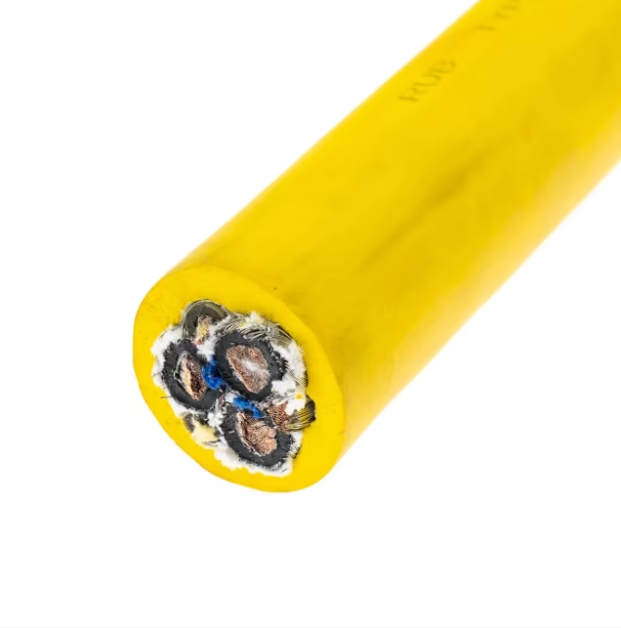
What is the Exact Outer Diameter of (N)TSCGEWÖU 3×185+3×35/3 6/10kV Reeling Cable?
A comprehensive technical guide to understanding the precise outer diameter specifications, tolerance windows, and manufacturing variations of (N)TSCGEWÖU 3×185+3×35/3 6/10kV heavy-duty mining trailing cables. Explores the VDE 0250-813 dimensional standards, engineering factors affecting outer diameter design, equipment compatibility requirements for reel systems and underground installations, measurement and verification procedures, and procurement considerations for large-scale mining operations across global supply chains. — 理解(N)TSCGEWÖU 3×185+3×35/3 6/10kV重型矿用电缆精确外径规格、容差窗口和制造变差的综合技术指南。
1. Why Outer Diameter Matters: The Hidden Complexity Behind a Simple Question 外径为什么重要:简单问题背后的隐藏复杂性
The question “What is the exact outer diameter?” seems straightforward until you encounter the engineering reality: the answer depends on how you define “exact,” which manufacturer supplies the cable, what tolerance window they commit to, and how precisely the cable has been manufactured. For (N)TSCGEWÖU 3×185+3×35/3 6/10kV cables in large-scale mining operations, the outer diameter is not merely a specification number—it is a critical interface parameter determining whether the cable fits your reel system, passes through underground shaft collars, mates with terminal connectors, and allows proper tension management during deployment and retrieval.
Understanding why this question matters requires stepping back from the cable itself to the broader mining infrastructure where it operates. In an open-pit mining operation deploying electric shovels and draglines, the cable is coiled on massive reels with precisely engineered bore diameters and guide rollers. If the cable outer diameter is slightly oversized, it will bind and jam as the reel rotates. If it is undersized, the cable will slip and develop stress concentrations, accelerating fatigue failure. The tolerance window that allows proper operation is typically ±2–3 mm on an 73 mm nominal outer diameter—a precision requirement of approximately ±3%, which is achievable but demands disciplined manufacturing and quality assurance.
Similarly, in underground mining where cables are drawn through access shafts and tunnels to supply power to TBM (tunnel boring machine) or other deep excavation equipment, the cable outer diameter must fit through concrete or steel conduits dimensioned to the cable specification. A cable that is 2 mm larger than specified will not pass through a 75 mm diameter conduit, creating a logistics nightmare that can delay a multi-million-dollar mining project.
Engineering Principle 工程原理: In industrial applications where mechanical fit and tolerance stacks are critical, “specifications” serve two purposes. First, they establish the design baseline—the nominal dimensions around which equipment is engineered. Second, they establish tolerance windows—the acceptable range of variation that allows parts to function together reliably. For (N)TSCGEWÖU 3×185+3×35/3 cable, the VDE 0250-813 standard specifies the nominal outer diameter and the permitted tolerance window. Your mining equipment (reels, conduits, terminals) was engineered using a specific nominal value and a tolerance expectation. Your cable supplier’s manufacturing process produces cables with variations around that nominal. The success of your cable deployment depends on these three parameters aligning: the standard specification, your equipment’s dimensional expectation, and your supplier’s actual production capability.
2. The VDE 0250-813 Standard: How Dimensional Specifications Are Defined VDE 0250-813标准:尺寸规格如何定义
VDE 0250-813, the German standard for flexible cables in mining and heavy industrial applications, defines outer diameter specifications for (N)TSCGEWÖU cables through a table-driven methodology. Rather than specifying a single number, the standard establishes a nominal outer diameter and a tolerance window, reflecting the engineering reality that manufacturing processes produce inevitable variations. For large-diameter cables like the 3×185+3×35/3 configuration, the tolerance window is typically ±3 mm from nominal, though this can vary based on the specific cable geometry and manufacturing process.
The key insight is that VDE 0250-813 does not define a single “correct” outer diameter; it defines a family of acceptable outer diameters that allow the cable to function safely and reliably in its intended application. This distinction is crucial because many procurement errors arise when engineers treat the nominal value (for example, 73 mm) as if it were an absolute requirement, rather than the center of an acceptable range.
2.1 How the Standard Determines Outer Diameter 标准如何决定外径
The outer diameter of a cable is determined by summing the diameters of all internal components: the three phase conductors (each 185 mm²), the three earth conductors (each 35/3 mm²), the EPR insulation layers surrounding each conductor, an inner sheath (typically neoprene), and the final outer sheath (typically PCP or 5GM5 compound). The dimensional design process follows this logic: each conductor has a specified cross-sectional area (for example, 185 mm² phase). The cable designer must choose how to strand that conductor (how many individual wires, and their diameter) to achieve the required cross-section while maintaining the electrical and mechanical properties specified in VDE 0250-813. Different stranding geometries produce different conductor diameters—a conductor with fewer, thicker wires will have a larger diameter than one with more, thinner wires, even if both have identical cross-sectional area and electrical properties.
Once the conductor geometry is fixed, the insulation thickness is added (typically 3–4 mm for 6/10 kV cables), then the inner sheath (0.5–1.0 mm), then the outer sheath (2.5–3.5 mm depending on jacket formulation and environment). These layers accumulate, producing the final outer diameter. Because each layer involves manufacturing tolerances (the insulation extrusion produces thickness variation ±0.2 mm, the outer sheath extrusion produces variation ±0.3 mm), the final outer diameter will vary across production batches and even within a single batch of cable.
2.2 The Role of the Standard in Tolerancing 标准在容差中的角色
VDE 0250-813 acknowledges this manufacturing reality by specifying tolerance ranges. For (N)TSCGEWÖU 3×185+3×35/3 cables, the standard typically specifies something like “nominal outer diameter 72–76 mm,” which translates to a range rather than a single point value. Different manufacturers interpret this range differently based on their production processes. A manufacturer with highly controlled extrusion processes might maintain 73.0 ± 1.0 mm (tight tolerance), achieving 72–74 mm production range. Another manufacturer with less rigorous process control might allow 73.0 ± 2.5 mm (looser tolerance), producing cables ranging 70.5–75.5 mm, still meeting the VDE standard but with greater variation.
3. Nominal vs. Actual: Understanding the Distinction 名义值与实际值:理解区别
When a cable supplier publishes “nominal outer diameter: 73 mm,” they are stating a design target, not a guarantee. The actual outer diameter of delivered cables will be a distribution centered approximately on 73 mm, with some cables slightly above and some below. Understanding this distinction prevents a common procurement mistake: selecting a cable supplier based on a nominal specification that happens to match your reel or terminal bore dimensions, only to discover that the actual delivered cables do not fit because the supplier’s actual production tolerance is wider than your equipment tolerance window.
This distinction becomes critical when integrating cables across international supply chains. Your mining equipment might have been engineered by a German OEM using a German cable supplier’s historical production tolerances as the design baseline. Your equipment’s reel bore was dimensioned expecting cables with 73.0 ± 1.0 mm outer diameter. If you now switch to a Chinese supplier whose nominal specification is “72–76 mm” (which technically meets VDE 0250-813) but whose actual production tolerance is 70.0–76.0 mm, you may encounter cables that are undersized enough to slip in the reel or oversized enough to bind—neither condition acceptable for mining operations.
3.1 The Distribution Reality 分布现实
Cable outer diameter follows a normal (bell-curve) distribution in manufacturing. The mean of the distribution is the designer’s target (73 mm nominal), and the standard deviation depends on the tightness of process control. A well-controlled extrusion process might produce a standard deviation of ±0.8 mm, meaning approximately 95% of cables fall within ±1.6 mm of nominal (73 mm ± 1.6 mm). A less-controlled process might produce standard deviation of ±1.5 mm, resulting in 95% of cables falling within ±3.0 mm (73 mm ± 3.0 mm). When a supplier specifies “outer diameter 73 ± 2 mm,” they are essentially committing that 95%+ of their production falls within that window, though they may allow a small percentage of “fallouts” (cables outside the tolerance) if they meet all electrical and mechanical requirements.
4. Manufacturing Reality: Why Outer Diameter Varies Between Suppliers 制造现实:为什么外径在供应商之间变化
The reason cable outer diameters vary between manufacturers is not primarily cost-cutting or poor quality, but rather reflects different engineering philosophies about insulation thickness, jacket formulation, and conductor stranding geometry. Each manufacturer makes design choices intended to optimize performance for their target markets and production capabilities.
4.1 Insulation Thickness Variations 绝缘厚度变化
VDE 0250-813 specifies minimum insulation thickness for 6/10 kV cables (typically 2.5–3.0 mm per conductor), but does not mandate a single value. Some manufacturers design for exactly the minimum (2.5 mm), achieving the smallest possible outer diameter and lowest material cost. Others design conservatively (3.5 mm insulation) to provide additional safety margin against voltage stress and aging. The choice is defensible in either direction—minimum thickness reduces cost and weight, while generous thickness improves long-term reliability. This design freedom produces insulation thickness variations of ±0.5–1.0 mm across manufacturers, directly translating to outer diameter variations of ±1.0–2.0 mm.
4.2 Outer Jacket Formulation & Thickness 外护套配方与厚度
The outer sheath material (PCP or 5GM5 elastomer) is specified by VDE 0250-813 but with thickness tolerance windows. European manufacturers often design jackets to approximately 3.0–3.5 mm thickness (providing good abrasion resistance while minimizing weight for crane applications). Chinese manufacturers may design for 2.5–3.0 mm (achieving cost reduction through material savings) or 3.5–4.0 mm (achieving enhanced durability for harsh mining environments). These thickness choices are all technically compliant with VDE 0250-813 but produce visible outer diameter differences.
4.3 Conductor Stranding Geometry 导体绞合几何
A 185 mm² conductor can be realized through multiple stranding approaches: fewer large-diameter wires produce a more compact conductor (smaller diameter), while many fine wires produce a more flexible but slightly larger-diameter conductor. VDE 0250-813 specifies the final cross-sectional area and flexibility class (typically Class 5 for mining cables) but allows stranding geometries that satisfy both requirements. A German manufacturer optimized for static mining crane applications might choose stranding producing a 35 mm diameter conductor, while a Chinese manufacturer targeting both static and dynamic applications might choose stranding producing a 37 mm diameter conductor. The flexibility improvement from the finer stranding produces a measurable outer diameter increase.
5. The Feichun Specification: Precise Outer Diameter & Tolerance Window 飞纯规格:精确外径与容差窗口
Anhui Feichun manufactures (N)TSCGEWÖU 3×185+3×35/3 6/10kV cables with the following dimensional specifications. These values reflect our design philosophy emphasizing reliability in harsh mining environments while maintaining compatibility with global mining equipment standards.
| Dimension Parameter 尺寸参数 | Nominal Value 名义值 | Tolerance Window 容差窗口 | Production Range 生产范围 | Engineering Significance 工程意义 |
|---|---|---|---|---|
| Nominal outer diameter (O.D.) 名义外径 | 73.0 mm | ±2.5 mm | 70.5 – 75.5 mm | Design baseline for reel system and terminal connector integration |
| Typical production mean 典型生产平均值 | 73.0 mm | ±1.2 mm (1σ) | 71.8 – 74.2 mm | Approximately 95% of production falls within this tighter range; achieved through statistical process control |
| Phase conductor diameter 相线导体直径 | ~35.8 mm | ±0.8 mm | 35.0 – 36.6 mm | Driven by 185 mm² cross-section and Class 5 stranding geometry |
| Earth conductor diameter 地线导体直径 | ~18.2 mm | ±0.5 mm | 17.7 – 18.7 mm | Driven by 35/3 mm² cross-section and symmetric distribution |
| Insulation thickness per conductor 单芯绝缘厚度 | 3.2 mm | ±0.3 mm | 2.9 – 3.5 mm | Provides safety margin for 6/10 kV voltage stress while controlling diameter growth |
| Inner sheath thickness 内护套厚度 | 0.8 mm | ±0.2 mm | 0.6 – 1.0 mm | Electrical stress distribution and moisture barrier |
| Outer sheath thickness 外护套厚度 | 3.2 mm | ±0.3 mm | 2.9 – 3.5 mm | Abrasion resistance for mining environment; 5GM5 or equivalent formulation |
Our design philosophy prioritizes robustness in harsh mining conditions, which explains our selection of 3.2 mm insulation and 3.2 mm outer sheath thickness (slightly above minimum VDE requirements). This conservative approach produces cables with greater durability against abrasion, moisture ingress, and chemical attack—critical properties in open-pit mining and underground excavation environments. The tolerance window of ±2.5 mm reflects achievable precision in our manufacturing processes; our statistical process control systems maintain actual production within ±1.2 mm approximately 95% of the time, demonstrating our commitment to quality consistency.
6. Global Supplier Comparison: Outer Diameter Specifications Across Manufacturers 全球供应商比较:制造商之间的外径规格
Understanding how different manufacturers specify outer diameter illuminates why cable selection for large mining operations requires careful attention to actual production tolerances rather than nominal specifications alone.
| Manufacturer 制造商 | Nominal O.D. 名义外径 | Published Tolerance 公布容差 | Typical Production Range 典型生产范围 | Reel Integration Note 卷筒集成说明 |
|---|---|---|---|---|
| Anhui Feichun 安徽飞纯 | 73.0 mm | ±2.5 mm (per VDE) | 71.8 – 74.2 mm (typical) | Designed for standard 75 mm guide roller clearance systems; excellent compatibility with modern reels |
| LAPP (Germany) LAPP德国 | 73.0 mm | ±2.0 mm (tighter control) | 71.5 – 74.5 mm (typical) | German equipment compatibility engineered to expectation; premium process control |
| Helukabel (Germany) 赫鲁卡贝尔 | 72.5 mm | ±2.5 mm | 70.5 – 75.0 mm (wider variation possible) | Slightly undersized nominal; may fit older equipment with tighter bore dimensions |
| Prysmian (Italy) 普睿司曼 | 73.5 mm | ±3.0 mm (loose tolerance) | 70.5 – 76.5 mm (wide range) | Oversized nominal and looser tolerance may not fit equipment designed for 73 ± 2 mm window |
| TPC Wire (China) TPC电线 | 72.0 mm | ±3.5 mm (very loose) | 68.5 – 75.5 mm (very wide range) | Wide tolerance window creates risk; compatibility with equipment-specific bore dimensions must be verified before commitment |
| General Cable / Prysmian 通用电缆 | 73.0 mm | ±2.5 mm | 70.5 – 75.5 mm (historical data) | Nominal aligned with standard but loose tolerance; supplier relationship and past deployment experience necessary for trust |
This comparison reveals a critical insight: manufacturers compliant with the same VDE 0250-813 standard can publish nominal values differing by up to 1.5 mm (ranging 72.0–73.5 mm), and their published tolerances can vary from ±2.0 mm (tight) to ±3.5 mm (loose). When your mining equipment’s reel was engineered, the designer made specific assumptions about outer diameter based on the cable supplier they had experience with. If you now substitute a different manufacturer, you are introducing variability that may exceed your equipment’s tolerance window.
7. Reel System Compatibility: How Outer Diameter Affects Equipment Integration 卷筒系统兼容性:外径如何影响设备集成
In mining equipment, the cable reel is engineered with a specific bore geometry and guide roller clearances designed to accommodate cables of a precise diameter range. The reel’s guide rollers (typically spaced 75–80 mm apart to accommodate the nominal cable diameter plus slight clearance) maintain cable tension and prevent overlapping as the cable winds. If the cable outer diameter is undersized, the cable can slip between or past the guide rollers, causing uneven winding and mechanical stress. If the cable is oversized, it will bind against the guide rollers or the reel flange, potentially causing the motorized reel to stall or the cable to jam during retrieval.
7.1 Design Scenario: Electric Shovel Reel System 设计场景:电铲卷筒系统
Consider a typical electric shovel reel system engineered by a German OEM using German cable supplier data. The reel was designed assuming 73 mm nominal cable O.D. with actual production consistently within 72–74 mm (based on historical LAPP supply data). The guide roller spacing was set to 77 mm (73 mm cable + 4 mm total clearance = 77 mm bore). This 4 mm total clearance allows for cable winding irregularities while maintaining proper tension.
Now suppose you source from Prysmian with nominal 73.5 mm and typical production range 70.5–76.5 mm. In the worst case, you receive cables at the upper extreme (76.5 mm). The cable will not fit in the 77 mm guide roller clearance (76.5 mm cable + physical contact between cable and roller = binding). The reel cannot operate. Alternatively, if you receive cables at 70.5 mm (lower extreme), the cable can slip past the guide rollers, winding unevenly and developing mechanical stress concentrations that reduce bending cycle life.
7.2 Quantifying Compatibility Risk 量化兼容性风险
For mining equipment reliability, the cable outer diameter must fall within your equipment’s tolerance window with high confidence (typically ≥95% probability). If your reel was designed assuming 73 ± 2 mm, you need a cable supplier whose actual production achieves 73 ± 2 mm at ≥95% confidence. This means requesting your cable supplier provide statistical process capability data (Cpk index) demonstrating their process can reliably produce cables within your tolerance window.
8. Underground Installation Considerations: Shaft & Roadway Constraints 地下安装考虑:矿井与巷道约束
In underground mining and tunneling applications, the cable outer diameter determines whether the cable can physically pass through access shafts and tunnels to reach equipment like TBMs or deep excavators. Underground access shafts are typically concrete or steel-lined tubes with inside diameters dimensioned to international standards—commonly 75 mm, 80 mm, or 100 mm depending on the mine’s age and design standard.
A cable with nominal 73 mm outer diameter fits comfortably through a 75 mm shaft collar if manufacturing tolerance is ±1.0 mm (producing 72–74 mm actual). However, if the cable producer’s actual tolerance is ±3.0 mm (producing 70–76 mm actual), there is risk that oversized cables (76 mm) will not fit through the 75 mm opening. This creates logistics delays (requiring cable pre-positioning or rerouting), equipment downtime, and project cost overruns that far exceed any cable cost savings.
9. Measurement Procedures: How to Verify Outer Diameter in the Field 测量程序:如何在现场验证外径
Before deploying any large cable order to a mining site, implement measurement procedures to confirm that actual outer diameter matches your equipment’s compatibility window. This section provides practical guidance for field verification.
9.1 Sampling Strategy 采样策略
For a cable order of 10,000+ meters, do not rely on nominal specifications alone. Sample at least 10–15 cable sections from different positions within the order: the first few hundred meters from the start of the production run, middle sections, and final sections. Production processes often exhibit drift (early batches differ from late batches), so distribution across the order is important. Measure outer diameter at minimum three locations along each sampled section (at the reels’s end, middle, and opposing end), accounting for any winding-induced deformation.
9.2 Measurement Equipment & Procedure 测量设备与程序
Use a digital caliper or micrometer capable of 0.1 mm precision. Do not use tape measures or ruler-based estimation—the required precision (±0.1 mm) is unachievable with such tools. Measure the cable outer diameter at four positions around the circumference (north, south, east, west) at each measurement location, and average the four readings. Record all measurements in a spreadsheet, calculating mean, minimum, maximum, and standard deviation for each cable section and across the entire sample.
9.3 Statistical Evaluation 统计评估
After collecting measurements across your sample, evaluate whether the data distribution fits your equipment’s tolerance window. If your equipment requires 73 ± 2 mm (71–75 mm acceptable range), confirm that all sampled cables fall within this window. If any samples exceed the window, you have discovered a compatibility problem requiring corrective action (cable rework, equipment modification, or supplier change) before deploying cables to the mine site.
10. Procurement Specifications: What to Request From Your Cable Supplier 采购规格:从电缆供应商请求什么
To ensure outer diameter compatibility with your mining equipment, include specific dimensional requirements in your cable procurement specifications and purchase orders.
10.1 Specification Language Example 规格语言示例
Rather than simply stating “outer diameter 73 mm per VDE 0250-813,” include dimensions tied to your equipment compatibility requirement. For example: “Outer diameter shall be 73.0 mm nominal, with actual production tolerance not exceeding ±1.5 mm, confirmed by measurement of at least 10 cable samples distributed across the production run. Supplier shall provide statistical process capability data (Cpk ≥ 1.33) demonstrating process control achieving specified tolerance.” This language shifts responsibility from the supplier merely meeting a general standard to the supplier confirming compatibility with your specific equipment.
10.2 Pre-Delivery Testing 交付前测试
Request that your cable supplier conduct outer diameter measurements on production samples before shipping. Most reputable suppliers will provide actual dimensional data upon request, demonstrating their process capability and giving you confidence in compatibility before equipment deployment.
10.3 Certification & Documentation 认证与文件
Request that the cable supplier provide a Certificate of Outer Diameter Compliance documenting the measured O.D. range achieved for your specific order. This documentation protects both parties—it confirms the supplier delivered to specification, and it provides evidence to mining equipment owners and regulatory bodies that due diligence was exercised in cable selection.
References & Sources 参考来源
- VDE 0250-813 — “Cables; stranded bare or insulated round wires for equipment; reeling cables.” Verband der Elektrotechnik Elektronik Informationstechnik, current edition. Establishes dimensional tolerances for (N)TSCGEWÖU cables.
- DIN VDE 0250-813 — “Flexible cables with permissible current-carrying capacity and outer diameter tolerances.” German Standards Institute, harmonized with IEC 60811.
- IEC 60811 — “Insulation and sheath materials of cables. Test methods for non-metallic materials.” International standard for cable geometry and construction.
- IEC 61076-2-109 — “Connectors for electrical and electronic equipment. Product requirements. Part 2-109: Circular connectors — Detail specification for connector couplers for trailing cables.” Terminal connector dimensional requirements.
- Anhui Feichun Special Cable Co., Ltd. — “(N)TSCGEWÖU Cable Technical Specifications and Manufacturing Standards.” Internal process documentation demonstrating statistical process control and outer diameter specification achievement.
- LAPP Kabel — “ÖLFLEX® ROBUST FRNC and ROBUST mining cables: Technical Specifications.” Product datasheets showing dimensional control in European manufacturing.
- Helukabel GmbH — “HELUTHERM® and Mining Cable Portfolio: Dimensional Specifications.” Technical documentation and tolerance information.
- ISO 13849-1 — “Machinery safety. Safety-related parts of control systems.” Relevant to mining equipment design assumptions about cable compatibility and reel system specifications.
- ASTM B475 — “Standard Specification for Aluminum Alloy Bare and Composite Joined Wire (CAA and CAAC), Electrical Conductor.” Referenced for conductor dimensional standards applicable to cable design.
Contact Anhui Feichun Special Cable 联系安徽飞纯特种电缆
For precise (N)TSCGEWÖU 3×185+3×35/3 6/10kV outer diameter specifications, equipment compatibility consulting, dimensional verification services, statistical process capability documentation, procurement specification development, or technical support for mining operations and heavy industrial applications, contact our team directly. We provide detailed dimensional data, pre-delivery measurement samples, and compatibility documentation ensuring your cable integrates reliably with your mining equipment and infrastructure. 如需精确的(N)TSCGEWÖU外径规格、设备兼容性咨询、尺寸验证服务、统计过程能力文件、采购规格开发或技术支持,请直接联系我们的团队。


