NTSCGEWOU

DS1N (also designated UNE 22513-1) represents an evolved generation of mining cable technology designed specifically for environments where electromagnetic interference (EMI) and signal integrity are as critical as mechanical durability. The standard specifies cables that combine the proven mechanical robustness of UNE 22511/22512 designs with the electromagnetic shielding technology required for control systems, signal circuits, and power distribution in complex underground installations. The defining characteristic of DS1N is the integration of a metal braid shield — typically tinned copper wire woven at high density around the cable core — combined with a symmetric earth architecture (3×S1 + 3×S2 distribution) that provides both electrical protection and mechanical balance. This combination addresses a critical operational requirement in modern mining: reducing noise and crosstalk in environments where control signals must coexist with high-power switching equipment, variable frequency drives, and long distribution runs to remote equipment.

(N)TSCGECWÖU – TBM: средневольтный reeling power supply cable для Tunnel Boring Machines и подземного тоннельного строительства

(N)TSCGECWÖU – TBM — это кабель для Tunnel Boring Machines, предназначенный для reeling power supply и применения в underground mines for tunnel constructions. По предоставленным данным он имеет гибкие лужёные медные проводники DIN VDE 0295 Class 5, 3GI3 EPR insulation, внутренний и наружный полупроводящие слои для electrical field control, PE-структуру из tinned copper / textile braiding вокруг каждой power core, контрольные жилы, overall concentric copper monitoring conductor, GM1b inner sheath и красную наружную оболочку 5GM5.
La vida útil de los cables móviles de carrete, festón y canasta depende, en gran medida, de la instalación y del diseño del sistema de enrollado. Este manual abarca radios de curvatura, guías, protección de tensión, anclaje, selección de carrete y eliminación de torsión, junto con los métodos eléctricos de capacidad de corriente, reducción (derating), caída de tensión y cortocircuito.

NTSCGEWÖU Flexible Trailing Cable: средневольтный гибкий кабель для экскаваторов, кранов, dumpers, mining и tunnelling applications

NTSCGEWÖU — это flexible trailing cable для подключения электрического оборудования и крупных material handling machines: экскаваторов, кранов и dumpers в горных и тоннельных применениях. По предоставленным данным кабель имеет лужёные медные жилы DIN VDE 0295 Class 5, EPR-изоляцию 3GI3, внутренний и наружный полупроводящие слои для electrical field control, PE-проводники с полупроводящим слоем, три контрольные жилы во внешних промежутках, GM1b внутреннюю оболочку, встроенную анти-торсионную синтетическую оплётку и красную наружную оболочку 5GM5.
Direct Answer: Standard (N)TSCGEWÖU cables based on DIN VDE 0250-813 are not compliant with AS/NZS 1802 underground coal mining standards. The non-compliance is not merely a matter of standard jurisdiction—it reflects fundamental physical and electrical differences in cable structure, particularly regarding pilot core design and semiconductive cradle technology. 直接答案:基于DIN VDE 0250-813的标准(N)TSCGEWÖU电缆不符合AS/NZS 1802井下煤矿标准。非合规性不仅仅是标准管辖权的问题——它反映了电缆结构的根本物理和电气差异,特别是关于导引线设计和半导体支架技术。 Consequence: Using (N)TSCGEWÖU cables on Australian or New Zealand underground coal mining equipment violates workplace safety regulations and mining electrical codes. It also renders the equipment's earth fault detection system non-functional, eliminating critical protection against explosion and electrical hazards.

Is (N)TSCGEWÖU Compliant with AS/NZS 1802 Coal Mining Standards? Understanding the Pilot Core Issue

Direct Answer: Standard (N)TSCGEWÖU cables based on DIN VDE 0250-813 are not compliant with AS/NZS 1802 underground coal mining standards. The non-compliance is not merely a matter of standard jurisdiction—it reflects fundamental physical and electrical differences in cable structure, particularly regarding pilot core design and semiconductive cradle technology. 直接答案:基于DIN VDE 0250-813的标准(N)TSCGEWÖU电缆不符合AS/NZS 1802井下煤矿标准。非合规性不仅仅是标准管辖权的问题——它反映了电缆结构的根本物理和电气差异,特别是关于导引线设计和半导体支架技术。 Consequence: Using (N)TSCGEWÖU cables on Australian or New Zealand underground coal mining equipment violates workplace safety regulations and mining electrical codes. It also renders the equipment’s earth fault detection system non-functional, eliminating critical protection against explosion and electrical hazards.
Yes, properly-specified generic (N)TSCGEWÖU 3x70+3x35/3 6/10kV cables can reliably replace Sandvik OEM cables on underground load-haul-dump loaders, with realistic cost savings of 20 to 40 percent over the cable's service life, provided that five critical verification steps are completed before installation. The generic cable must have an outer diameter not exceeding 59.1 millimeters (matching or staying within the original cable's drum clearance envelope), must feature verified anti-torsion braid rated for minimum ±25° per meter torsional resistance (preventing corkscrewing failures), must specify an outer jacket of either premium 5GM5 elastomer or polyurethane formulation confirmed for underground abrasion resistance (not standard CPE), must carry a maximum tensile load rating of at least 3,150 to 4,200 newtons (matching Sandvik's duty cycle), and must include complete technical documentation of insulation thickness and conductor stranding patterns (enabling proper splicing compatibility). Additionally, the cable supplier must provide type-test certification according to DIN VDE 0250-813 and ideally field-proven performance data from comparable underground mining installations. When these five criteria are met, field experience from underground mines across Scandinavia, North America, and Australia demonstrates that properly-specified generic cables achieve service lives of 3 to 5 years—matching or occasionally exceeding OEM cable longevity—while reducing procurement costs by $80,000 to $150,000 per cable depending on the specific LHD model and regional pricing. However, many suppliers offering cables under the "(N)TSCGEWÖU" designation do not actually meet these technical requirements. Low-cost variants that compromise on anti-torsion structure, use inadequate jacket material, or provide incomplete documentation will fail within 6 to 12 months of underground operation, creating safety hazards and erasing the cost savings through premium pricing for emergency replacement cables and associated downtime. Therefore, the straightforward answer "yes, generic cables can work" comes with an essential caveat: success requires rigorous verification of the specific generic cable specification before procurement, not blind assumption that any product bearing the (N)TSCGEWÖU designation meets the technical requirements of underground LHD operation.

Underground LHD Loaders: Replacing OEM Sandvik Cables with Generic (N)TSCGEWÖU 3×70+3×35/3

Yes, properly-specified generic (N)TSCGEWÖU 3×70+3×35/3 6/10kV cables can reliably replace Sandvik OEM cables on underground load-haul-dump loaders, with realistic cost savings of 20 to 40 percent over the cable’s service life, provided that five critical verification steps are completed before installation. The generic cable must have an outer diameter not exceeding 59.1 millimeters (matching or staying within the original cable’s drum clearance envelope), must feature verified anti-torsion braid rated for minimum ±25° per meter torsional resistance (preventing corkscrewing failures), must specify an outer jacket of either premium 5GM5 elastomer or polyurethane formulation confirmed for underground abrasion resistance (not standard CPE), must carry a maximum tensile load rating of at least 3,150 to 4,200 newtons (matching Sandvik’s duty cycle), and must include complete technical documentation of insulation thickness and conductor stranding patterns (enabling proper splicing compatibility). Additionally, the cable supplier must provide type-test certification according to DIN VDE 0250-813 and ideally field-proven performance data from comparable underground mining installations. When these five criteria are met, field experience from underground mines across Scandinavia, North America, and Australia demonstrates that properly-specified generic cables achieve service lives of 3 to 5 years—matching or occasionally exceeding OEM cable longevity—while reducing procurement costs by $80,000 to $150,000 per cable depending on the specific LHD model and regional pricing. However, many suppliers offering cables under the “(N)TSCGEWÖU” designation do not actually meet these technical requirements. Low-cost variants that compromise on anti-torsion structure, use inadequate jacket material, or provide incomplete documentation will fail within 6 to 12 months of underground operation, creating safety hazards and erasing the cost savings through premium pricing for emergency replacement cables and associated downtime. Therefore, the straightforward answer “yes, generic cables can work” comes with an essential caveat: success requires rigorous verification of the specific generic cable specification before procurement, not blind assumption that any product bearing the (N)TSCGEWÖU designation meets the technical requirements of underground LHD operation.
(N)TSCGEWÖU 3x120+3x70/3 12/20kV cable is the correct choice for most tunnel boring machine main cutterhead power supplies operating at medium voltage with cutterhead thrust loads in the range of 8,000 to 12,000 kilonewtons, featuring three 120 mm² phase conductors providing approximately 350 to 380 amperes current capacity in free-air installation at 30°C ambient and 90°C conductor operating temperature. The cable's nominal outer diameter is 73 to 81 millimeters, with total weight of approximately 9,800 to 10,500 kilograms per kilometer, making it manageable for most standard cable spools while still providing sufficient conductor cross-section to limit voltage drop to acceptable levels over tunnel distances extending several kilometers. The cable features Class 5 tinned copper conductors engineered for fatigue resistance in continuously flexing applications, EPR insulation maintaining exceptional thermal stability even when subjected to the 90°C conductor temperature that results from high-current excavation duty, semi-conductive shielding layers that uniformly distribute electric stress and prevent partial discharge initiation in the high-voltage environment, and a heavy-duty CPE jacket providing abrasion resistance in the confined underground spaces where the cable is routed. However, the critical distinction between simply selecting a cable model and properly sizing a cable for your specific tunnel boring installation lies in understanding the difference between the cable's theoretical free-air current capacity and its actual safe operating current when coiled on a cable drum—a difference that can reduce safe current by 30 to 50 percent depending on the spooling configuration. For tunnel boring machines operating in continental European or Asian tunneling projects with tunnel lengths of 5 to 15 kilometers and cutterhead thrust loads in the moderate to high range, the 3x120+3x70/3 12/20kV cable provides excellent balance between current capacity, voltage drop performance, mechanical durability, and cost. However, for shorter tunnels where voltage drop is not a concern, smaller conductor sizes (such as 3x95 mm²) may provide adequate performance at lower material cost, while for exceptionally long tunnels or extremely high thrust conditions, larger sizes (such as 3x150 mm² or 3x185 mm²) become necessary to maintain safe operating currents and acceptable voltage drop. Proper cable sizing requires engineering analysis specific to your tunnel length, expected cutterhead current demand, acceptable voltage drop limits, available cable drum diameters, and operational duty cycle.

Tunnel Boring Machines (TBM): Sizing (N)TSCGEWÖU 3×120+3×70/3 12/20kV for the Main Cutterhead Power Supply

(N)TSCGEWÖU 3×120+3×70/3 12/20kV cable is the correct choice for most tunnel boring machine main cutterhead power supplies operating at medium voltage with cutterhead thrust loads in the range of 8,000 to 12,000 kilonewtons, featuring three 120 mm² phase conductors providing approximately 350 to 380 amperes current capacity in free-air installation at 30°C ambient and 90°C conductor operating temperature. The cable’s nominal outer diameter is 73 to 81 millimeters, with total weight of approximately 9,800 to 10,500 kilograms per kilometer, making it manageable for most standard cable spools while still providing sufficient conductor cross-section to limit voltage drop to acceptable levels over tunnel distances extending several kilometers. The cable features Class 5 tinned copper conductors engineered for fatigue resistance in continuously flexing applications, EPR insulation maintaining exceptional thermal stability even when subjected to the 90°C conductor temperature that results from high-current excavation duty, semi-conductive shielding layers that uniformly distribute electric stress and prevent partial discharge initiation in the high-voltage environment, and a heavy-duty CPE jacket providing abrasion resistance in the confined underground spaces where the cable is routed. However, the critical distinction between simply selecting a cable model and properly sizing a cable for your specific tunnel boring installation lies in understanding the difference between the cable’s theoretical free-air current capacity and its actual safe operating current when coiled on a cable drum—a difference that can reduce safe current by 30 to 50 percent depending on the spooling configuration. For tunnel boring machines operating in continental European or Asian tunneling projects with tunnel lengths of 5 to 15 kilometers and cutterhead thrust loads in the moderate to high range, the 3×120+3×70/3 12/20kV cable provides excellent balance between current capacity, voltage drop performance, mechanical durability, and cost. However, for shorter tunnels where voltage drop is not a concern, smaller conductor sizes (such as 3×95 mm²) may provide adequate performance at lower material cost, while for exceptionally long tunnels or extremely high thrust conditions, larger sizes (such as 3×150 mm² or 3×185 mm²) become necessary to maintain safe operating currents and acceptable voltage drop. Proper cable sizing requires engineering analysis specific to your tunnel length, expected cutterhead current demand, acceptable voltage drop limits, available cable drum diameters, and operational duty cycle.
The standard (N)TSCGEWÖU 3x50+3x25/3 trailing cable is technically rated for ambient temperatures down to approximately -10°C to -15°C under normal industrial conditions according to DIN VDE 0250 Part 813, with the 5GM5 CPE (chlorinated polyethylene) rubber jacket remaining flexible and maintaining mechanical integrity within this range. However, operating this cable in Arctic mining environments at sustained -40°C temperatures requires significant engineering reevaluation and is not recommended without specialized modifications and enhanced installation protocols. While the cable does not spontaneously fail at -40°C, the rubber jacket becomes progressively more rigid and brittle, and the minimum allowable bending radius must be expanded from the standard 15D (15 times the outer diameter) to approximately 25D to 30D or greater to prevent jacket cracking during dynamic reeling operations. At -50°C, which occurs frequently in Siberia and parts of Northern Canada during winter, standard TECWATER-family cables experience material brittleness that pushes them toward structural failure risk even without bending stress. A cable suitable for -15°C temperate mining operations is fundamentally different in its application safety profile from a cable operating continuously at -40°C in an open-pit mine where the cable must flex regularly during equipment deployment and retrieval. The distinction between "technically possible" and "operationally safe" is critical to understand: equipment that operates at extreme cold requires more than just survival—it requires predictable, controlled behavior under stress. The standard (N)TSCGEWÖU can survive brief exposure to -40°C without immediate failure, but extended service in this temperature regime demands either specification of cold-hardened alternatives or acceptance of significant operational constraints.

Arctic Mining Cable Performance: Is (N)TSCGEWÖU 3×50+3×25/3 Rated for -40°C Extreme Cold Conditions in Russia and Canada?

The standard (N)TSCGEWÖU 3×50+3×25/3 trailing cable is technically rated for ambient temperatures down to approximately -10°C to -15°C under normal industrial conditions according to DIN VDE 0250 Part 813, with the 5GM5 CPE (chlorinated polyethylene) rubber jacket remaining flexible and maintaining mechanical integrity within this range. However, operating this cable in Arctic mining environments at sustained -40°C temperatures requires significant engineering reevaluation and is not recommended without specialized modifications and enhanced installation protocols. While the cable does not spontaneously fail at -40°C, the rubber jacket becomes progressively more rigid and brittle, and the minimum allowable bending radius must be expanded from the standard 15D (15 times the outer diameter) to approximately 25D to 30D or greater to prevent jacket cracking during dynamic reeling operations. At -50°C, which occurs frequently in Siberia and parts of Northern Canada during winter, standard TECWATER-family cables experience material brittleness that pushes them toward structural failure risk even without bending stress. A cable suitable for -15°C temperate mining operations is fundamentally different in its application safety profile from a cable operating continuously at -40°C in an open-pit mine where the cable must flex regularly during equipment deployment and retrieval. The distinction between “technically possible” and “operationally safe” is critical to understand: equipment that operates at extreme cold requires more than just survival—it requires predictable, controlled behavior under stress. The standard (N)TSCGEWÖU can survive brief exposure to -40°C without immediate failure, but extended service in this temperature regime demands either specification of cold-hardened alternatives or acceptance of significant operational constraints.
The (N)TSCGEWÖU 3x50+3x25/3 12/20kV reeling cable has a base ampacity of approximately 210 amperes when installed in free air with standard ambient conditions of 30°C (86°F) and conductor temperature not exceeding 90°C. However, when this same cable is wound in a 3-layer configuration on a cylindrical motorized reel drum—a typical arrangement for port cranes, ship-to-shore gantries, mining equipment, and mobile cargo handling systems—the effective ampacity is dramatically reduced through application of the DIN VDE 0298-4 thermal derating factor of 0.49. This produces a practical continuous ampacity of approximately 102.9 amperes (calculated as 210 A × 0.49), representing less than half the free-air capacity. The cable features three 50 mm² main phase conductors and three 25 mm² grounding conductors arranged in a compact helical geometry, with an outer diameter of approximately 52–58 mm and total weight of approximately 4,300–4,600 kg/km. The derating factor reflects the fundamental thermal reality that cable layers wound inside the drum cannot radiate heat to the surrounding air, trapping thermal energy and forcing the cable to operate at temperatures significantly above the ambient reference condition.

Derating Factors: Current Carrying Capacity of (N)TSCGEWÖU 3×50+3×25/3 12/20kV Wound in 3 Layers on a Reel

The (N)TSCGEWÖU 3×50+3×25/3 12/20kV reeling cable has a base ampacity of approximately 210 amperes when installed in free air with standard ambient conditions of 30°C (86°F) and conductor temperature not exceeding 90°C. However, when this same cable is wound in a 3-layer configuration on a cylindrical motorized reel drum—a typical arrangement for port cranes, ship-to-shore gantries, mining equipment, and mobile cargo handling systems—the effective ampacity is dramatically reduced through application of the DIN VDE 0298-4 thermal derating factor of 0.49. This produces a practical continuous ampacity of approximately 102.9 amperes (calculated as 210 A × 0.49), representing less than half the free-air capacity. The cable features three 50 mm² main phase conductors and three 25 mm² grounding conductors arranged in a compact helical geometry, with an outer diameter of approximately 52–58 mm and total weight of approximately 4,300–4,600 kg/km. The derating factor reflects the fundamental thermal reality that cable layers wound inside the drum cannot radiate heat to the surrounding air, trapping thermal energy and forcing the cable to operate at temperatures significantly above the ambient reference condition.
(N)TSCGEWÖU 3x185+3x35/3 6/10kV cables in large-scale mining operations, the outer diameter is not merely a specification number—it is a critical interface parameter determining whether the cable fits your reel system, passes through underground shaft collars, mates with terminal connectors, and allows proper tension management during deployment and retrieval.

What is the Exact Outer Diameter of (N)TSCGEWÖU 3×185+3×35/3 6/10kV Reeling Cable?

(N)TSCGEWÖU 3×185+3×35/3 6/10kV cables in large-scale mining operations, the outer diameter is not merely a specification number—it is a critical interface parameter determining whether the cable fits your reel system, passes through underground shaft collars, mates with terminal connectors, and allows proper tension management during deployment and retrieval.
A pervasive misconception exists among electrical engineers and procurement specialists working with reeling cables for port machinery and heavy mining equipment: the belief that Panzerflex and (N)TSCGEWÖU represent two fundamentally different technical approaches or competing product lines. In reality, this confusion stems from a misunderstanding of how industrial cable standards and branding intersect. To clarify this relationship requires understanding what each term actually represents. 在与港口机械和重型采矿设备卷筒电缆合作的电气工程师和采购专家中存在一个普遍的误解:认为 Panzerflex 和 (N)TSCGEWÖU 代表两种根本不同的技术路线或竞争产品线。事实上,这种混淆源于对工业电缆标准和品牌如何相交的误解。澄清这种关系需要理解每个术语实际代表什么。

Prysmian Panzerflex vs. (N)TSCGEWÖU: Which Reeling Cable Should You Choose for Port and Mining Equipment?

A pervasive misconception exists among electrical engineers and procurement specialists working with reeling cables for port machinery and heavy mining equipment: the belief that Panzerflex and (N)TSCGEWÖU represent two fundamentally different technical approaches or competing product lines. In reality, this confusion stems from a misunderstanding of how industrial cable standards and branding intersect. To clarify this relationship requires understanding what each term actually represents. 在与港口机械和重型采矿设备卷筒电缆合作的电气工程师和采购专家中存在一个普遍的误解:认为 Panzerflex 和 (N)TSCGEWÖU 代表两种根本不同的技术路线或竞争产品线。事实上,这种混淆源于对工业电缆标准和品牌如何相交的误解。澄清这种关系需要理解每个术语实际代表什么。
When specifying medium-voltage mining cables for international projects, engineers frequently encounter seemingly incompatible voltage ratings between European VDE standards and Commonwealth AS/NZS standards. A common point of confusion arises when comparing the 3.6/6kV rating found in DIN VDE 0250-813 flexible mining cables with the 3.3/3.3kV rating specified for AS/NZS 2802 Type 441 cables used extensively in Australian, New Zealand, and South African mining operations. 在为国际项目指定中压矿用电缆时,工程师经常遇到欧洲VDE标准与英联邦AS/NZS标准之间看似不兼容的电压等级。一个常见的困惑点是比较DIN VDE 0250-813柔性矿用电缆中的3.6/6kV额定电压与澳大利亚、新西兰和南非采矿作业广泛使用的AS/NZS 2802 Type 441电缆规定的3.3/3.3kV额定电压。

Voltage Rating Comparison: How Does the 3.6/6kV Rating in VDE 0250 Standards Compare to the 3.3/3.3kV Rating Used for Type 441 Cables in Commonwealth Mining?

When specifying medium-voltage mining cables for international projects, engineers frequently encounter seemingly incompatible voltage ratings between European VDE standards and Commonwealth AS/NZS standards. A common point of confusion arises when comparing the 3.6/6kV rating found in DIN VDE 0250-813 flexible mining cables with the 3.3/3.3kV rating specified for AS/NZS 2802 Type 441 cables used extensively in Australian, New Zealand, and South African mining operations. 在为国际项目指定中压矿用电缆时,工程师经常遇到欧洲VDE标准与英联邦AS/NZS标准之间看似不兼容的电压等级。一个常见的困惑点是比较DIN VDE 0250-813柔性矿用电缆中的3.6/6kV额定电压与澳大利亚、新西兰和南非采矿作业广泛使用的AS/NZS 2802 Type 441电缆规定的3.3/3.3kV额定电压。
(N)TSKCGEWÖU designation represents a sophisticated medium-voltage flexible mining cable engineered according to DIN VDE 0250 Part 813 standards, incorporating a distinctive feature that differentiates it from standard trailing cables: a central support element with integrated Kevlar (aramid fiber) reinforcement. The "K" in the designation specifically denotes the presence of this Kevlar-reinforced cradle separator, which serves as the structural backbone of the cable assembly. (N)TSKCGEWÖU命名代表按照DIN VDE 0250第813部分标准设计的精密中压柔性矿用电缆,其具有区别于标准拖曳电缆的独特特征:带有集成凯夫拉(芳纶纤维)加强的中心支撑元件。命名中的"K"特别表示存在这种凯夫拉加强的托架分离器,它作为电缆组件的结构骨干。

Support Element Function: The Specific Purpose of the Central “Support Element” (Dummy Core) in (N)TSKCGEWÖU Cable Designs for Mechanical Stability

(N)TSKCGEWÖU designation represents a sophisticated medium-voltage flexible mining cable engineered according to DIN VDE 0250 Part 813 standards, incorporating a distinctive feature that differentiates it from standard trailing cables: a central support element with integrated Kevlar (aramid fiber) reinforcement. The “K” in the designation specifically denotes the presence of this Kevlar-reinforced cradle separator, which serves as the structural backbone of the cable assembly. (N)TSKCGEWÖU命名代表按照DIN VDE 0250第813部分标准设计的精密中压柔性矿用电缆,其具有区别于标准拖曳电缆的独特特征:带有集成凯夫拉(芳纶纤维)加强的中心支撑元件。命名中的”K”特别表示存在这种凯夫拉加强的托架分离器,它作为电缆组件的结构骨干。
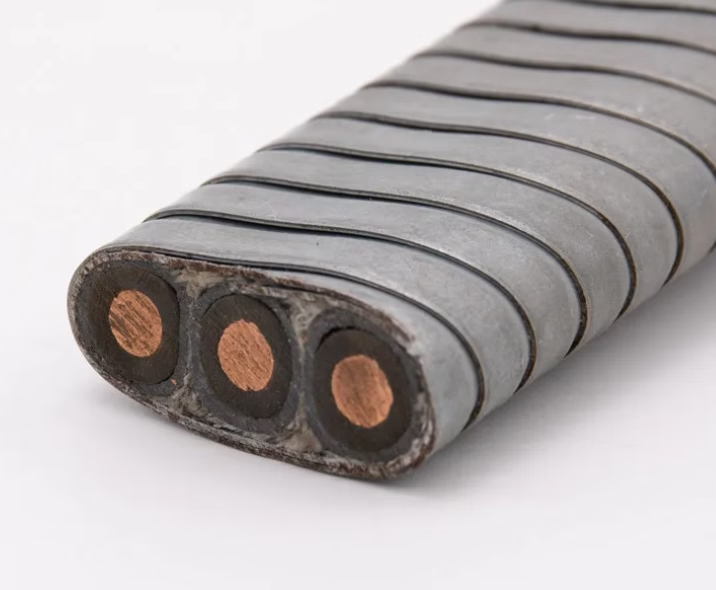
Submersible and pump cables are specialized electrical cables designed for permanent operation underwater, connecting electrical motor equipment in both process and potable water applications. According to IEC standards and VDE specifications, these cables must demonstrate exceptional water resistance, flexibility under pressure, and chemical compatibility with their operating environment. The cables support diverse industries from food processing to water treatment, mining, and aquatic installations.

What are Submersible & Pump Cables?

(N)SHÖU O/J 0.6/1kV, NSSHÖU O/J 0.6/1kV, NSSHÖU 3E 0.6/1kV, NSSHÖU 3E + ST 0.6/1kV, (N)SSCHÖU-J 0.6/1kV, (N)TSCGECEWÖU 3.6/6kV, (N)TSCGECEWÖU 6/10kV, (N)TSCGECEWÖU 8.7/15kV, (N)TSCGECEWÖU 12/20kV (N)TSCGEWÖU 3.6/6kV, (N)TSCGEWÖU 6/10kV, (N)TSCGEWÖU 8.7/15kV, (N)TSCGEWÖU 12/20kV, H07RN-8-F (10m), Pump Cable 300 (300m), Drincable 600 (600m), Drincable 600 Flat (600m), Drincable 800 (800m)