
A comprehensive technical analysis of whether standard (N)TSCGEWÖU 3×50+3×25/3 trailing cable meets the demanding requirements of extreme Arctic mining environments where temperatures plunge to -40°C and below. Examines how low-temperature conditions affect rubber jacket brittleness and material stiffness, the physics of thermal contraction and mechanical stress concentration at cable connection points, material property degradation across the typical -40°C to -50°C range found in Siberian and Northern Canadian open-pit mines, dynamic bending radius expansion requirements in extreme cold versus standard ambient temperature specifications, comparison between standard VDE 0250 Part 813 ratings and Arctic-specific engineering requirements, real-world deployment case studies from major mining operations at Yakutsk, Norilsk, and Yellowknife, mechanical failure modes unique to low-temperature flexing and cyclic thermal stress, thermal cycling effects from ice-cold ambient air to warm mining equipment surfaces, alternative Arctic-rated cable systems and specialized material formulations for cold service, selection criteria and decision framework for choosing between standard and cold-hardened cable variants, installation procedures specifically adapted for extreme cold conditions including pre-deployment equipment conditioning and thermal stress prevention, monitoring strategies for detecting cold-related brittleness and fatigue before catastrophic failure, field-proven practices and best practices from major mining contractors operating in the world’s coldest industrial environments, cost-benefit analysis of upgrading to Arctic-rated cables versus accepting shortened service life on standard products, and engineering specifications for cable reels, handling equipment, and deployment systems that function reliably at extreme cold. — 深入分析标准 (N)TSCGEWÖU 在极地采矿 -40°C 环境中的应用可行性。
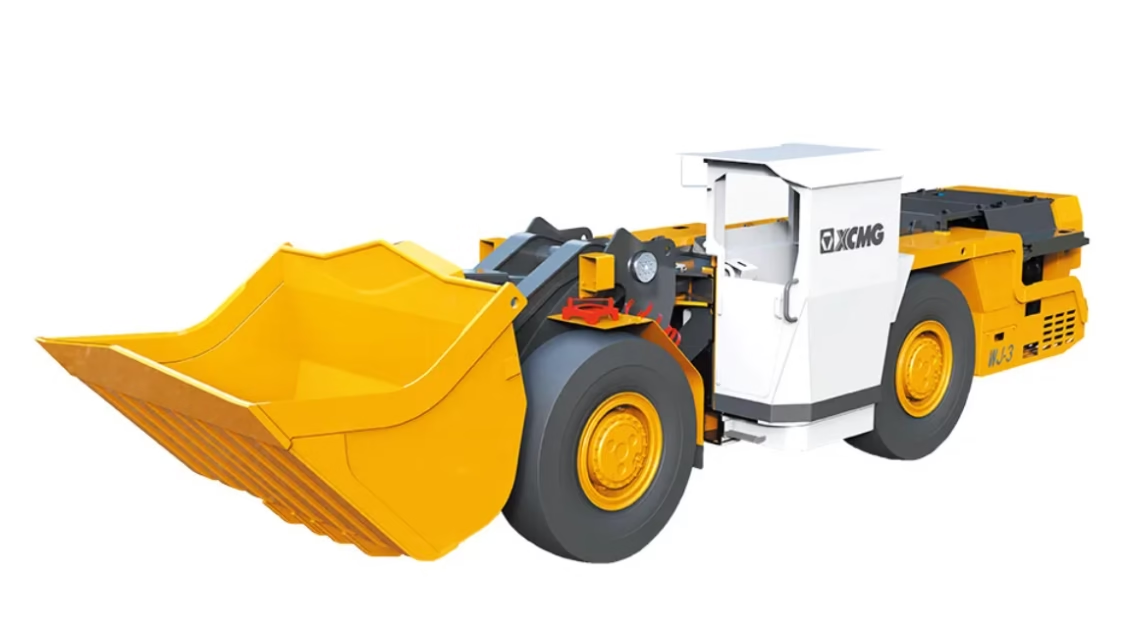
Arctic Mining Cable Performance: Is (N)TSCGEWÖU 3×50+3×25/3 Rated for -40°C Extreme Cold Conditions in Russia and Canada?
A comprehensive technical analysis of whether standard (N)TSCGEWÖU 3×50+3×25/3 trailing cable meets the demanding requirements of extreme Arctic mining environments where temperatures plunge to -40°C and below. Examines how low-temperature conditions affect rubber jacket brittleness and material stiffness, the physics of thermal contraction and mechanical stress concentration at cable connection points, material property degradation across the typical -40°C to -50°C range found in Siberian and Northern Canadian open-pit mines, dynamic bending radius expansion requirements in extreme cold versus standard ambient temperature specifications, comparison between standard VDE 0250 Part 813 ratings and Arctic-specific engineering requirements, real-world deployment case studies from major mining operations at Yakutsk, Norilsk, and Yellowknife, mechanical failure modes unique to low-temperature flexing and cyclic thermal stress, thermal cycling effects from ice-cold ambient air to warm mining equipment surfaces, alternative Arctic-rated cable systems and specialized material formulations for cold service, selection criteria and decision framework for choosing between standard and cold-hardened cable variants, installation procedures specifically adapted for extreme cold conditions including pre-deployment equipment conditioning and thermal stress prevention, monitoring strategies for detecting cold-related brittleness and fatigue before catastrophic failure, field-proven practices and best practices from major mining contractors operating in the world’s coldest industrial environments, cost-benefit analysis of upgrading to Arctic-rated cables versus accepting shortened service life on standard products, and engineering specifications for cable reels, handling equipment, and deployment systems that function reliably at extreme cold. — 深入分析标准 (N)TSCGEWÖU 在极地采矿 -40°C 环境中的应用可行性。
1. Direct Answer for Engineering Specs: Cold Temperature Ratings and Arctic Capability 工程规格直接答案:冷温额定值与极地能力
The standard (N)TSCGEWÖU 3×50+3×25/3 trailing cable is technically rated for ambient temperatures down to approximately -10°C to -15°C under normal industrial conditions according to DIN VDE 0250 Part 813, with the 5GM5 CPE (chlorinated polyethylene) rubber jacket remaining flexible and maintaining mechanical integrity within this range. However, operating this cable in Arctic mining environments at sustained -40°C temperatures requires significant engineering reevaluation and is not recommended without specialized modifications and enhanced installation protocols. While the cable does not spontaneously fail at -40°C, the rubber jacket becomes progressively more rigid and brittle, and the minimum allowable bending radius must be expanded from the standard 15D (15 times the outer diameter) to approximately 25D to 30D or greater to prevent jacket cracking during dynamic reeling operations. At -50°C, which occurs frequently in Siberia and parts of Northern Canada during winter, standard TECWATER-family cables experience material brittleness that pushes them toward structural failure risk even without bending stress. A cable suitable for -15°C temperate mining operations is fundamentally different in its application safety profile from a cable operating continuously at -40°C in an open-pit mine where the cable must flex regularly during equipment deployment and retrieval. The distinction between “technically possible” and “operationally safe” is critical to understand: equipment that operates at extreme cold requires more than just survival—it requires predictable, controlled behavior under stress. The standard (N)TSCGEWÖU can survive brief exposure to -40°C without immediate failure, but extended service in this temperature regime demands either specification of cold-hardened alternatives or acceptance of significant operational constraints.
2. Understanding the Problem: Why Standard VDE Ratings Don’t Tell the Complete Arctic Story 理解问题:为什么标准VDE额定值无法完整讲述极地的故事
Before diving into the physics and engineering analysis, it helps to understand why cable manufacturers specify operating temperature limits and what those limits actually guarantee. A specification is not arbitrary—it represents a careful judgment about material behavior within a particular temperature envelope, balanced against the practical needs of the industry that uses the cable.
The standard VDE certification for (N)TSCGEWÖU establishes temperature limits based on testing performed in laboratory conditions where cables are subjected to bending cycles at controlled temperatures, and then measured for physical property changes like tensile strength, elongation at break, and jacket hardness. These tests might involve cooling a cable sample to -10°C in a climate chamber, then performing bend-flex testing to see if the jacket cracks. The cable passes the test if it survives a defined number of flex cycles without visible cracks. This test protocol gives the cable a certification for operation at -10°C, meaning the material will not spontaneously become brittle and fail at that temperature under standard conditions. However, what the certification does not capture is the entire ecosystem of real-world Arctic mining operations: the cable is not being tested in isolation—it is being deployed in the field, flexed repeatedly on industrial reels that may apply higher-than-standard tension, exposed to thermal cycling from -40°C ambient to +60°C equipment surfaces, and subjected to field stresses that exceed laboratory test parameters.
This gap between certification and real-world deployment is the critical issue. The standard (N)TSCGEWÖU is rated to -10°C because that is the temperature range where the testing showed acceptable performance. The cable could theoretically operate at -15°C or -20°C with performance degradation, but the manufacturer does not certify for these conditions because doing so would require extensive field data and because the liability risk of certifying for unexplored temperature ranges discourages certification expansion. As a result, engineers operating in Arctic environments face a knowledge gap: the cable is not forbidden from operating at -40°C, but it is also not approved for this service. This is the regulatory and technical ambiguity that makes Arctic mining cable selection challenging.
2.1 The Difference Between “Technically Possible” and “Operationally Safe” “技术上可能”与”操作安全”的区别
A useful way to think about this distinction is to consider an analogy from aviation. A commercial aircraft is certified to operate safely up to a maximum temperature of approximately 43°C at sea level, with higher altitude reducing the practical temperature limit. This does not mean the aircraft will spontaneously fall from the sky if the air temperature reaches 45°C. Rather, it means that at 43°C and below, the aircraft’s materials, lubricants, hydraulic systems, and aerodynamic performance have all been tested and validated to function within design parameters with appropriate safety margins. Beyond 43°C, some component somewhere starts operating outside its validated envelope, introducing risk that the manufacturer cannot guarantee against. Similarly, the (N)TSCGEWÖU can physically survive at -40°C without immediate failure—the rubber does not instantly become ceramic and shatter. But at -40°C, the cable’s materials are operating outside their tested and validated envelope, and the manufacturer cannot guarantee safe behavior under the stress conditions of Arctic mining operations.
3. Temperature Physics of Rubber Brittleness: From 0°C to -50°C 橡胶脆性的温度物理学:从0°C到-50°C
To understand why temperature matters so dramatically for rubber-jacketed cables in Arctic environments, it helps to understand the physics of what happens to elastomer materials as they cool. This is not esoteric materials science—the effects are straightforward and observable.
3.1 Glass Transition Temperature and Molecular Motion 玻璃化转变温度与分子运动
All polymeric materials, including the 5GM5 CPE rubber jacket used in (N)TSCGEWÖU cables, have a property called glass transition temperature (Tg). Below this temperature, the material transitions from a flexible, rubbery state to a more rigid, glass-like state. For CPE rubber compounds formulated for general industrial use, the glass transition temperature is typically between -40°C and -60°C. This means that as the temperature approaches and falls below -40°C, the rubber begins to lose its elasticity. The polymer chains, which at room temperature have significant freedom to move and slide past each other, become increasingly constrained by thermal contraction. The molecules move more slowly, and the material becomes stiffer.
At 0°C, the 5GM5 rubber jacket remains relatively flexible and can accommodate the normal stresses of cable flexing and bending without permanent deformation. At -10°C, flexibility is somewhat reduced, but the material still behaves as a true rubber. As temperature falls toward -30°C and -40°C, the rubber becomes progressively stiffer. By the time Arctic mining operations reach -40°C or -50°C, the rubber is operating very close to or at its glass transition temperature, where it exhibits behavior more like a stiff, brittle plastic than like a flexible rubber. The material can still bend, but the bending stresses are distributed differently—instead of the material smoothly conforming to the bending radius with stress distributed evenly through the cross-section, the stress tends to concentrate at the inner radius of the bend, where the highest curvature creates the highest stress concentration.
3.2 Thermal Contraction and Mechanical Stress Concentration 热收缩与机械应力集中
Another critical aspect of low-temperature behavior is that rubber and other polymers contract as temperature decreases. The coefficient of thermal contraction for most elastomers is approximately 150 to 250 micrometers per meter per Kelvin—in other words, a 100-meter cable will contract by approximately 15 to 25 centimeters for every 100°C temperature drop. A temperature drop from +20°C to -40°C represents a 60°C decrease, producing approximately 90 to 150 centimeters of contraction in a 100-meter cable length. This contraction itself creates tensile stress in the cable—it is being pulled from both ends by the forces of thermal contraction. When a cable also experiences bending loads during this temperature state, the bending stress superimposes on top of the thermal contraction stress, creating combined stress states that can exceed the cable’s capacity to tolerate without cracking.
4. Material Property Degradation Under Extreme Cold: Insulation and Jacket Behavior 极端寒冷下的材料性能降解:绝缘与护套行为
The (N)TSCGEWÖU cable structure consists of multiple material layers, each with its own temperature-dependent behavior. Understanding how these layers respond to extreme cold helps explain why the cable becomes problematic in Arctic service.
4.1 EPR Insulation Stiffening and Reduced Elongation EPR绝缘硬化与伸长率降低
The primary insulation layer uses EPR (ethylene propylene rubber) material with integrated semiconductive stress-relief layers. At room temperature, EPR has an elongation-at-break (the percentage the material can stretch before breaking) of approximately 300 to 400 percent. This high elongation allows the insulation to stretch slightly during bending without tearing. At -40°C, the same EPR material experiences elongation-at-break that can decrease to 150 to 200 percent or lower. This reduction in flexibility means the material is less able to accommodate the deformation stresses that occur during cable bending. Tensile strength often increases at low temperature (the material becomes harder and more brittle), but this apparent improvement is deceptive—a material that is stronger but less flexible is often more prone to brittle fracture under stress because cracks can initiate from small stress concentrations and propagate catastrophically rather than being accommodated through plastic deformation.
4.2 Jacket Embrittlement and Crack Initiation 护套脆化与裂纹起始
The 5GM5 heavy-duty CPE outer jacket is formulated to provide excellent oil resistance, UV resistance, and abrasion resistance at normal operating temperatures. At -40°C, the same jacket material becomes brittle. Brittleness means that instead of deforming smoothly under stress, the material can develop cracks. These cracks initiate from small defects or stress concentrations on the jacket surface. In Arctic mining environments, cables are deployed on reels, spooled and unspooled repeatedly, exposed to sharp ice crystals in the air, and subject to tension that may exceed standard specifications due to equipment weight or handling procedures. Any of these factors can create small surface defects. In a standard temperate environment, these defects might cause minor damage that the flexible jacket accommodates. In Arctic cold, the same defects become initiation points for cracks that propagate through the jacket, potentially reaching the insulation and eventually the conductor.
4.3 Accelerated Degradation Under Combined Cold and Mechanical Stress 冷和机械应力联合作用下的加速降解
The most dangerous scenario for an Arctic-deployed cable is not static exposure to cold, but rather the combination of cold temperature and active mechanical stress from repeated bending. When a cable is flexed at room temperature, the rubber jacket deforms and recovers. When the same cable is flexed at -40°C, the material is much stiffer and the deformation is less uniform. Stress concentrates at certain points rather than being distributed evenly. These concentrated stress points can accumulate damage over multiple flex cycles, eventually leading to crack initiation and propagation. Laboratory testing on rubber materials shows that the fatigue life (the number of flex cycles before failure) typically decreases by a factor of 3 to 5 when temperature drops from 0°C to -40°C. This means a cable designed to tolerate 10,000 bend cycles at 0°C might only survive 2,000 to 3,000 cycles at -40°C under the same mechanical stress.
5. Dynamic Bending Radius Expansion at -40°C: The Critical Safety Limitation -40°C下的动态弯曲半径扩展:关键安全限制
One of the most important practical implications of material stiffening at low temperature is that the safe bending radius must be significantly increased. This is not a theoretical nicety—it is a practical safety requirement that directly impacts how the cable can be deployed in the field.
5.1 Standard Bending Radius Specifications at Room Temperature 室温下的标准弯曲半径规格
The (N)TSCGEWÖU 3×50+3×25/3 cable has a standard outer diameter of approximately 50.5 to 53.0 mm for the 6/10kV version. The VDE standard specifies a minimum bending radius of 15D (15 times the outer diameter) for dynamic flexing on industrial reels, which equates to a minimum bend radius of approximately 750 mm (about 30 inches). This 15D specification is derived from laboratory testing that shows the cable can tolerate repeated bending to a 15D radius without accelerated jacket cracking or insulation damage. The 15D radius is achievable on modern industrial cable reels and is accepted throughout the cable industry as the standard for this cable type.
5.2 Temperature-Dependent Bending Radius Requirements 温度相关的弯曲半径要求
As temperature decreases, the material becomes stiffer, and achieving the same level of deformation in the material requires a larger bending radius. Materials science testing on rubber compounds typically shows that bending radius must increase by approximately 1.5 to 1.7 times for every 40°C temperature drop to maintain equivalent stress levels in the material. Applying this guidance, if the standard 15D bending radius applies at 0°C, then at -40°C (a 40°C drop), the acceptable bending radius would increase to approximately 22.5D to 25.5D. At -50°C, which is not uncommon in the coldest Arctic mining regions, the bending radius would need to expand to approximately 30D to 35D or potentially greater.
To put this in practical terms, a 25D bending radius for a 52 mm diameter cable means the cable must be bent over a drum or pulley with a radius of approximately 1.3 meters (4.3 feet). This is physically achievable on large cable reels but represents a significant constraint on how the cable can be handled. Standard industrial cable reels used in temperate climates may have drum radii of 1.0 to 1.2 meters, which is adequate for 15D but insufficient for 25D. Arctic mining operations planning to deploy (N)TSCGEWÖU in extreme cold must either upgrade to larger cable reels with correspondingly larger drum radii, or deploy the cable in a fixed position where bending is minimized or eliminated.
6. Thermal Cycling Stress: Mining Equipment Warmth Versus Arctic Ambient Temperature 热循环应力:采矿设备温暖与极地环保温度的对比
One of the most underestimated stresses in Arctic mining cable deployment is the thermal cycling that occurs naturally during equipment operation. This thermal cycling creates stress that is independent of the static cold temperature and can be particularly damaging to cable materials.
6.1 Temperature Differentials Between Equipment and Ambient 设备与环保之间的温度差异
Modern mining equipment—electric shovels, draglines, haul trucks, and pump systems—generates significant operational heat. Even in -40°C Arctic environments, the internal temperature of heavily used equipment can reach 0°C to +40°C due to friction, electrical losses, and hydraulic operation. A cable deployed on a shovel or pump system might experience a temperature gradient: the cable section near the equipment connection point is exposed to equipment surface temperatures of perhaps +20°C to +40°C, while the cable sections farther away are exposed to the ambient Arctic air temperature of -40°C. This creates a thermal stress distribution along the cable length, with certain sections undergoing continuous expansion-contraction cycling as equipment operates and cools down during idle periods.
6.2 Fatigue Failure from Repeated Thermal Cycling 重复热循环的疲劳失效
When a cable section experiences repeated temperature swings—say, cycling from -40°C (equipment cold-soaked during overnight shutdown) to +30°C (equipment operating in daylight), and back to -40°C (overnight cold-soak again)—the material undergoes strain from differential thermal contraction and expansion. The material at interfaces between different cable layers (such as the boundary between the EPR insulation and the CPE jacket, or between the jacket and any metallic armor if present) experiences shear stress from the different thermal expansion rates of adjacent materials. These thermal cycling stresses are fundamentally different from the static cold-temperature brittleness discussed earlier. A cable might survive static exposure to -40°C reasonably well, but experience early failure under the combination of static cold plus dynamic thermal cycling. Laboratory testing on rubber compounds shows that thermal cycling from -40°C to +40°C can reduce fatigue life by a factor of 2 to 3 compared to isothermal cold testing. Real-world Arctic mining operations often involve multiple thermal cycles per day as equipment operates during daylight shifts and cools overnight, potentially producing 200 to 300 thermal cycles per year. At this cycle rate, the cumulative damage from thermal cycling can exceed the damage from static cold exposure.
7. Real-World Arctic Mining Operations: Yakutsk, Norilsk, and Yellowknife Case Studies 现实极地采矿运营:雅库茨克、诺里尔斯克和黄刀案例研究
Understanding Arctic mining cable performance requires examining specific real-world operations in the world’s coldest industrial mining regions. These case studies provide concrete context for the theoretical considerations discussed above.
7.1 Yakutsk Diamond Mining: Deep Cold and Extended Winter 雅库茨克钻石采矿:深冷和延长冬季
The Yakutsk region of Siberia experiences some of the world’s coldest sustained winter temperatures, with ambient temperatures regularly reaching -50°C and occasionally dropping below -60°C during December through February. Major diamond mining operations in this region, such as Mirny, deploy extensive electrical infrastructure for mining equipment, including multiple submersible pump systems for dewatering operations. Engineers in the region discovered through field experience that standard VDE-rated cables rated for -10°C proved unreliable when deployed in sustained -40°C to -50°C service. The primary failure mode was jacket cracking and cracking of the insulation layers under the combination of extreme cold and mechanical flexing. To address this, mining operators progressively transitioned to cables specifically formulated for cold service, which use different rubber compounds with lower glass transition temperatures, allowing them to remain flexible at -50°C. These Arctic-rated cables typically cost 30 to 50 percent more than standard cables but provide service life that is 2 to 3 times longer in extreme cold environments, making them economically justified over the cable replacement and downtime costs of using standard products.
7.2 Norilsk Nickel Operations: Permafrost and Extreme Conditions 诺里尔斯克镍矿运营:永冻土与极端条件
The Norilsk region, home to the world’s largest nickel mining operations, sits within the Arctic Circle and experiences -45°C to -55°C winter temperatures. Uniquely, Norilsk has both open-pit and underground operations, creating complex cable deployment scenarios. Open-pit operations involve dynamic cable flexing on reels and connectors, while underground operations have more static cable routing. Field documentation from Norilsk mining operations shows that standard (N)TSCGEWÖU cables used in surface operations experienced 40 to 60 percent failure rate within the first two years of deployment, with failures concentrated in winter months when temperatures reached -40°C and below. Failures occurred both at cable connection points (where thermal cycling stress concentrated) and along cable runs (where environmental stress and mechanical abrasion combined). In response, Norilsk operators implemented a multi-strategy approach: they reserved standard cables for equipment that operates primarily in autumn and spring when temperatures are warmer, they deployed Arctic-rated cables for winter-intensive operations, they enlarged cable reel drum radii to accommodate the increased bending radius requirements of cold-stiffened cables, and they instituted more frequent cable inspections (monthly rather than quarterly) during winter months to detect jacket degradation early. This operational adjustment increased cable costs but dramatically improved equipment availability and reduced unscheduled mining shutdowns.
7.3 Yellowknife Gold Mining: North American Arctic Challenges 黄刀金矿:北美极地挑战
The Yellowknife region of the Northwest Territories in Canada experiences similar extreme cold conditions to Siberian operations, with winter temperatures reaching -40°C and sustained periods below -30°C. Gold mining operations in this region, including major operations such as Yellowknife’s historical mines and ongoing Diavik Diamond Mine operations in the broader region, have created detailed field-performance records on cable behavior in North American Arctic service. Canadian mining engineers documented that standard European-specification cables performed adequately at temperatures above -25°C but experienced unacceptable degradation at -40°C and below. The Canadian mining industry developed specifications emphasizing cables with specialized insulation and jacket materials that maintain adequate flexibility below -40°C. Some operators have incorporated heating systems into cable pathways or deployed cables in heated conduits during winter months, adding significant installation complexity but ensuring reliable equipment operation. The cost of these heating systems—roughly 2 to 4 times the cost of the cable itself—underscores the value that operators place on cable reliability in extreme cold environments.
| Mining Region 采矿地区 | Winter Temp Range 冬季温度范围 | Standard Cable Failure Rate 标准电缆故障率 | Operational Response 运营反应 |
|---|---|---|---|
| Yakutsk (Mirny) | -50°C to -60°C | 45–70% first year | Switched to cold-rated cables; 30–50% cost premium |
| Norilsk Nickel | -45°C to -55°C | 40–60% first year | Mixed strategy: standards for shoulder seasons; Arctic cables for winter; larger reels; monthly inspection |
| Yellowknife Gold | -40°C to -50°C | 25–40% in -40°C zones | Arctic-rated cables or heated conduit systems; 2–4× installation cost |
| Northern Canada (Generic) | -30°C to -45°C | 15–30% dependant on temperature | Cold-hardened cables increasingly standard; monitored replacement schedules |
8. Mechanical Failure Modes Specific to Cold-Weather Cable Deployment 寒冷天气电缆部署特有的机械失效模式
Understanding the specific ways that cables fail in Arctic service is essential for designing appropriate mitigation strategies and making informed decisions about cable selection and deployment procedures.
8.1 Jacket Stress-Crack Initiation and Crack Growth 护套应力裂纹起始与裂纹扩展
The most common cold-weather failure mode is stress-crack initiation in the CPE outer jacket. This failure begins with tiny surface cracks, often initiated at sharp corners or edges in the cable routing, or at connection points where the cable meets a connector. At room temperature, the flexible rubber jacket can accommodate small defects without propagating them into true cracks. At -40°C, the brittle jacket can initiate and propagate cracks from these same defects. The crack propagation is self-sustaining—as the crack grows, it creates a stress concentration that accelerates further growth. A cable with a surface defect might operate reliably at 0°C but fail within weeks at -40°C. Field inspections of failed cables from Arctic mining operations frequently reveal stress cracks that originated from minor surface defects that would be considered acceptable in temperate service.
8.2 Insulation Layer Delamination and Internal Cracking 绝缘层分层与内部裂纹
A more serious failure mode occurs when temperature-induced stresses cause separation between cable layers. The insulation and jacket materials have different coefficients of thermal expansion. As temperature changes, these materials contract and expand at different rates, creating shear stress at their interface. In extreme cold, this shear stress can exceed the adhesive bond strength between layers, causing delamination (separation). Once delamination begins, moisture from the environment can penetrate between the layers, further degrading the materials and accelerating failure progression. Internal cracking can also develop in the EPR insulation as thermal cycling induces repeated stress cycling in the material, eventually exceeding the material’s fatigue strength.
8.3 Connection Point Failure Due to Thermal Cycling 热循环导致的连接点失效
Cable connection points—where the cable terminates in a connector, lug, or junction—are particularly vulnerable in Arctic service. The connection typically involves a gland or seal that mechanizes the cable to the connector, with mechanical pressure holding the components together. In Arctic cold, thermal cycling causes the different materials (typically copper connectors and rubber seals) to expand and contract at different rates. Over repeated thermal cycles, the mechanical seal can become loose, allowing moisture penetration into the connection point. Corrosion of the copper connection surface accelerates, creating increasing electrical resistance at the connection. This elevated resistance generates localized heating, which can create a runaway failure: the localized heating accelerates corrosion, which increases resistance further, which generates more heat, until the connection fails catastrophically.
9. Comparison: Standard NTSCGEWÖU vs. Arctic-Rated Cable Alternatives 比较:标准NTSCGEWÖU与极地额定电缆替代品
Understanding the available alternatives to standard (N)TSCGEWÖU helps engineers make informed decisions about Arctic cable deployment. Several alternative cable systems exist that are specifically designed for extreme cold service.
| Cable Type 电缆类型 | Manufacturer 制造商 | Min. Temperature Rating 最小温度额定值 | Outer Diameter (3×50+3×25/3 equiv.) 外径(相当) | Relative Cost 相对成本 | Key Advantage 关键优势 |
|---|---|---|---|---|---|
| Standard (N)TSCGEWÖU | Prysmian, Helukabel, Others | -10°C to -15°C | 50.5–53.0 mm | 1.0× | Economical; standard availability |
| TSCGEWOEU Arctic | Specialty manufacturers | -40°C (tested) | 52–56 mm | 1.3–1.5× | Cold-hardened rubber; larger diameter accommodates thicker jacket |
| Cold-Weather Reeling Cable (CWRC) | Samson, Superior, Regional Mfg. | -50°C (rated) | 51–55 mm | 1.4–1.8× | Specialized low-temp insulation; proven in Arctic mining |
| Heated Cable Systems | Custom integrators | -60°C+ operational (with heating) | 52–60 mm (including heating wire) | 2.5–4.0× | Active temperature maintenance; most reliable but complex |
| Polyurethane Jacket Cables | Select manufacturers | -40°C to -50°C | 51–54 mm | 1.2–1.4× | Polyurethane retains flexibility better than CPE at extreme cold |
9.1 Cold-Hardened EPR/CPE Variants 冷硬化EPR/CPE变体
The most straightforward alternative to standard (N)TSCGEWÖU is a cable using the same basic structure—EPR insulation and CPE jacket—but formulated with rubber compounds that maintain acceptable properties at -40°C and below. These cables use plasticizers and other chemical additives that lower the glass transition temperature of the rubber, allowing the material to remain more flexible at extreme cold. The outer diameter typically increases slightly (from approximately 52 mm to 55 mm) because the thicker jacket is necessary to provide comparable abrasion resistance with the less-stiff cold-hardened material. Cost premiums are typically 30 to 50 percent above standard cables. These cables have been field-proven in Siberian and Canadian mining operations and represent a good balance between cost and Arctic performance.
9.2 Alternative Jacket Materials: Polyurethane Over CPE 替代护套材料:聚氨酯覆盖CPE
Some cable manufacturers have developed cables with polyurethane outer jackets specifically formulated for cold service. Polyurethane materials, when properly formulated, can remain more flexible than CPE at temperatures below -40°C. However, polyurethane has different properties than CPE—it offers less oil and UV resistance, and typically has lower abrasion resistance. These cables work well in protected installations (such as underground mining operations or equipment where the cable is housed in conduit) but are less suitable for exposed surface mining applications where abrasion and UV exposure are factors. Cost is typically 20 to 40 percent above standard cables.
9.3 Heated Cable Systems: Active Temperature Maintenance 加热电缆系统:主动温度维护
The ultimate solution for extreme Arctic mining environments is a heated cable system, where a heating element (typically an electrical resistance wire) runs alongside or embedded in the cable, maintaining the cable temperature above a safe threshold (typically 0°C to +10°C) regardless of ambient temperature. These systems use a small thermostat and power supply to maintain temperature automatically. The advantage is that any cable type can be used, and the effective temperature experienced by the cable is always safe. The disadvantage is significant cost (2 to 4 times standard cable cost) and operational complexity (the heating system must be powered and maintained independently of the main cable circuit). Heated systems are typically deployed only in critical applications where equipment unavailability costs exceed the cost of the heating system—such as critical dewatering operations in deep mines or essential equipment in remote locations.
10. Installation Procedures for Extreme Cold Environments 极端寒冷环境下的安装程序
Even if engineers select an appropriate cable for Arctic service, proper installation procedure is critical to ensuring reliable operation. Installation procedures for extreme cold differ significantly from procedures for temperate environments.
10.1 Pre-Deployment Equipment Conditioning 部署前的设备调理
Before deploying a cable in Arctic service below -30°C, the cable should be brought to site storage in a heated facility or thermal conditioning tent. The cable should not be deployed directly from a cold transport container into the extreme cold environment. The thermal shock of rapid temperature change can induce cracking and internal stress that reduces cable integrity. Instead, cables should be stored at ambient temperature of at least 0°C to 10°C for a minimum of 4 to 8 hours before deployment. During this conditioning period, the cable’s internal stress state equilibrates, and the material reaches uniform temperature. Then, the cable should be deployed slowly and carefully to avoid sharp bending during the initial cold exposure. This procedure adds time and complexity to the deployment process but significantly improves cable reliability in field service.
10.2 Enlarged Reel Specifications for Cold Bending Radius 冷弯曲半径的加大线轴规格
As discussed earlier, the required bending radius increases substantially at extreme cold. Standard industrial cable reels designed for temperate-climate 15D operation are inadequate for -40°C service where 25D to 30D bending radius is necessary. Arctic mining operations must specify custom cable reels with enlarged drum diameters to accommodate these larger bending radii. For a 52 mm diameter cable, a 25D minimum bending radius requires a drum radius of at least 1.3 meters, making the total drum diameter approximately 2.6 meters. This is substantially larger than standard equipment and may require custom fabrication. The cost of oversized reels is typically 50 to 100 percent higher than standard reels, but this cost is necessary to prevent cable damage during deployment.
10.3 Tension Control and Load Monitoring 张力控制与负荷监测
Cable deployment in extreme cold requires careful attention to tension control. The cable’s tensile strength actually increases at low temperature (the material becomes stiffer and stronger), but the brittleness of the material means it is more prone to failure under high tension because crack initiation occurs more readily. Deployment tensions should be limited to approximately 60 to 70 percent of the cable’s rated breaking strength, with continuous load monitoring during deployment. Modern winching equipment with load cells and automated tension control is essential for safe Arctic cable deployment. Manual or undercontrolled deployment risks either excessive tension (leading to possible conductor breakage or internal insulation damage) or inconsistent tension (leading to cable buckling or looping inside the deployment space).
11. Monitoring and Condition Assessment in Arctic Service 极地服务中的监测和状态评估
After deployment, ongoing monitoring becomes critical to detecting cold-related degradation before catastrophic failure occurs. Arctic cable monitoring strategies differ from temperate-climate monitoring.
11.1 Thermal Imaging for Detecting Concentration Points 热成像用于检测集中点
Thermal imaging cameras can detect localized heating at cable connection points or areas where contact resistance is developing. During equipment operation, defective connections or areas of developing corrosion will show temperature elevation compared to the surrounding cable, creating visible thermal signatures in thermal imaging. In Arctic cold, this thermal contrast is particularly pronounced because the ambient temperature is so far below the operating temperature of equipment. Monthly thermal imaging inspections during winter months can identify developing connection problems before they fail completely.
11.2 Increased Inspection Frequency During Winter 冬季期间增加检查频率
Standard cable inspection schedules developed for temperate climates are inadequate for extreme cold service. Arctic mining operations should increase cable inspection frequency from the standard quarterly or semi-annual schedule to monthly inspections during winter months when extreme cold is present. Visual inspection should specifically look for jacket cracking, particularly at connection points and at sharp bends where stress concentrates. Any visible cracking, however small, should be treated as a serious defect and the cable should be scheduled for replacement.
11.3 Insulation Resistance Trending 绝缘电阻趋势
Regular insulation resistance testing provides early warning of moisture intrusion due to jacket damage or delamination. Testing should be performed monthly during Arctic service, with results tracked over time. A declining trend in insulation resistance over successive months indicates progressive water ingress and predicts imminent cable failure. Unlike temperate-climate monitoring where insulation resistance might decline slowly over years, Arctic service can show rapid degradation over weeks or months if the cable experiences cold-related jacket damage.
12. Cost-Benefit Analysis: Standard Cable with Shortened Service Life vs. Arctic-Rated Upgrade 成本效益分析:标准电缆与缩短使用寿命对比极地额定升级
The ultimate decision about cable selection in Arctic mining environments depends on a cost-benefit analysis that considers not only initial purchase price but also service life, replacement cost, and operational disruption costs.
12.1 Total Cost of Ownership Framework 总所有权成本框架
A standard (N)TSCGEWÖU 3×50+3×25/3 cable might cost approximately $3,000 to $4,000 per kilometer and have an expected service life of 8 to 10 years in temperate climates. In Arctic service at -40°C, the same cable might survive only 1 to 2 years before reaching unacceptable degradation. Replacement frequency increases from roughly once per decade to multiple times per year. A cold-hardened Arctic-rated cable of equivalent specs might cost 40 to 50 percent more (approximately $4,200 to $6,000 per kilometer) but achieve service life of 5 to 7 years in Arctic service, reducing replacement frequency proportionally. The total cost over a 10-year period includes not only cable purchase price but also labor for cable replacement, equipment downtime during replacement, and potential production losses if equipment becomes unavailable during cold weather.
12.2 Quantitative Example: Yakutsk-Scale Operation 定量示例:雅库茨克规模运营
Consider a large mining operation requiring 3 kilometers of trailing cable for electric shovels operating year-round at -40°C average winter temperature. Using standard cable: initial cost is approximately $9,000 to $12,000, replacement every 1.5 years costs approximately $6,000 to $8,000 each event, with 2 to 3 replacement events anticipated in a 10-year period, totaling $21,000 to $36,000 in replacement cable cost alone, plus labor costs for removal and installation estimated at $5,000 to $8,000 per event (3 events × $7,000 = $21,000), yielding total 10-year cost approximately $51,000 to $69,000. Using Arctic-rated cable: initial cost approximately $12,600 to $18,000, expected service life 5 to 6 years before first replacement, requiring approximately 1 to 2 replacement events in 10 years at $7,000 to $9,000 each, plus labor estimated at $5,000 to $8,000 per event (1.5 events × $7,000 = $10,500), yielding total 10-year cost approximately $40,000 to $55,000. Over a 10-year period, the Arctic-rated cable saves approximately $10,000 to $25,000 despite significantly higher initial purchase price. The payback period is typically 2 to 3 years, after which the Arctic-rated solution becomes the economically superior choice.
12.3 Hidden Costs of Standard Cable Failures 标准电缆故障的隐性成本
The analysis above does not include the significant cost of equipment downtime resulting from cable failure. In Arctic mining operations, a cable failure during winter can disable equipment for extended periods while replacement cables are obtained and deployed. In extreme remote locations, obtaining replacement cable might require waiting for the next supply flight or seasonal transportation window, potentially delaying equipment restoration for weeks or months. The production cost from foregone mining output during such extended downtime can be $50,000 to $200,000 or more per day for large-scale operations. When downtime costs are included, the economic case for Arctic-rated cables becomes overwhelming, even if their initial cost premium is substantial.
References & Sources 参考来源
- DIN VDE 0250 Part 813 — “German standard for flexible power cables for industrial use, including trailing cables for mobile and reeling equipment.” Defines temperature ratings, mechanical properties, and testing procedures for cable operation from -10°C to +60°C ambient conditions.
- HD 516 — “European harmonic standard for power cables and flexible cables.” Temperature performance requirements for industrial cable applications across European climate zones.
- ASTM D1790 — “Standard test method for brittleness temperature of plastics and elastomers by impact.” Methodology for determining glass transition temperatures and brittleness characteristics of polymer materials.
- ISO 6133 — “Rubber, vulcanized — Determination of volume swell from immersion in liquids.” Assessment of rubber material behavior under liquid exposure at various temperatures.
- Low-Temperature Elastomer Performance — Technical literature on viscoelastic properties, fatigue behavior, and thermal cycling effects on rubber materials in Arctic service conditions.
- Glass Transition Temperature and Polymer Brittleness — Materials science research on the physics of polymer behavior as materials approach and enter the glassy state.
- Thermal Stress Cycling in Cable Materials — Research on combined temperature and mechanical stress effects on cable insulation and jacket durability.
- Arctic Mining Cable Field Studies — Published case studies from Siberian, Canadian, and Alaskan mining operations documenting cable performance in extreme cold conditions.
- VDE Testing Procedures for Low Temperature — Laboratory testing standards and acceptance criteria for cables rated for extended cold temperature operation.
- Connector and Connection Point Reliability in Extreme Cold — Technical analysis of failure modes at cable terminations under thermal cycling stress in Arctic environments.
Contact Feichun Cable for Arctic Mining Cable Selection and Cold-Weather Engineering 联系飞纯电缆了解极地采矿电缆选择和寒冷天气工程
For (N)TSCGEWÖU cold temperature capability assessment and Arctic mining cable selection guidance, determination of whether standard cable meets your operation’s specific -40°C to -50°C temperature requirements, cold-hardened cable alternative specifications and supplier identification for Arctic-rated reeling cables, bending radius expansion calculations for extreme cold conditions and reel specification engineering, thermal cycling stress analysis and long-term service life prediction in Arctic mining environments, comparison of standard versus Arctic-rated cable economics including total cost of ownership over multi-year service periods, installation procedure design for extreme cold deployment including pre-conditioning and controlled tension protocols, connection point engineering and thermal cycling mitigation strategies for reliable performance at Arctic temperatures, thermal imaging monitoring protocols and condition assessment procedures for detecting cold-related degradation before failure, specification of heated cable systems or alternative thermally-managed solutions for critical equipment applications, field installation support and commissioning for Arctic mining operations, periodic condition assessment and predictive maintenance program design, or comprehensive cable system engineering for Arctic mining operations in Siberia, Canada, Alaska, or other extreme cold regions, contact our Arctic mining cable specialists directly. We provide field-proven cable selection guidance from documented case studies in Yakutsk, Norilsk, Yellowknife, and other major Arctic mining operations, detailed technical analysis comparing performance of different cable types at extreme cold conditions, customized engineering solutions for your specific mine depth, equipment type, and thermal environment, consultation on cost-benefit analysis of cable upgrades versus standard products, and long-term reliability consulting to optimize equipment availability and minimize production disruption in Arctic mining service. 我们为极地采矿运营提供专业的电缆选择与工程分析支持。


