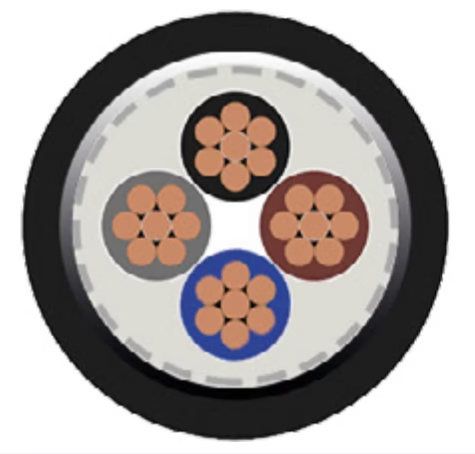
power cable

飞纯 Type 245 是基于 AS/NZS 1802:2003 卷筒与拖曳电缆 标准体系设计的矿用非常柔性长壁采煤机电缆,电压范围覆盖 1.1 至 6.6KV。根据产品资料,该电缆主要用作长壁采煤机电缆,也可用于连续采煤机和长壁外围电缆。 Type 245 的关键结构特征是 三根中央可伸长 Pilot / 控制芯线。这三根中央 Pilot 芯线可用于 接地连续性监测 和 控制回路。对于长壁采煤机来说,电缆不仅要传输动力电能,还要承担设备控制、保护联锁、接地连续性确认和移动工况下的安全监测任务。

O que é o PANZERFLEX-L 0,6/1 kV: Análise de Engenharia Aprofundada do Cabo de Carretel e Festão de Baixa Tensão para Mineração

O PANZERFLEX-L 0,6/1 kV é o membro de baixa tensão da família PANZERFLEX: o mesmo DNA mecânico dos cabos de carretel redondos — cobre estanhado classe 5, passo de cabeamento curto, trança de fios sintéticos anti-torção aderida entre as bainhas — porém despido das camadas de controle de campo que só a média tensão exige. É um cabo flexível de potência para conectar partes móveis de máquinas e equipamentos de movimentação de material, igualmente adequado a carretel e a festão, sob altos esforços mecânicos, flexão e torção frequentes e movimento rápido com forte aceleração. Dois traços o distinguem: a isolação HEPR antiesmagamento (crushproof), pensada para o cabo que é pisado e prensado na mina, e a velocidade mais alta de toda a linha, até 240 m/min.
UNE 22512 — formally titled "Cables flexibles para minería subterránea con tensiones de 1,8/3 kV y 0,6/1 kV con aislamiento de caucho, con armadura" (Flexible cables for underground mining, rubber-insulated, armoured) — exists as a parallel but fundamentally distinct standard from its unarmoured sibling UNE 22511. Where UNE 22511 is engineered as a torsion-optimized drag cable for mobile equipment, UNE 22512 is engineered as a crush-and-cut protected feeder cable for semi-fixed installations where mechanical damage from external forces (falling rock, equipment impact, floor pressure) is a documented operational risk, but the extreme torsional loading of continuously moving equipment is not. The addition of metallic armour — specifically, galvanized steel wire braid forming what the standard designates as M2 GSWB — is the defining structural choice that reshapes every downstream design decision in the cable. The armour is not merely a protective layer added to an otherwise standard cable; rather, it fundamentally alters the cable's mechanical behavior, installation requirements, cost structure, and applicable fatigue loading regimes. Understanding UNE 22512 therefore requires understanding not just what the armour is, but why its presence necessitates a completely different engineering philosophy compared to unarmoured cables. The standard was developed by AENOR (Asociación Española de Normalización y Certificación) to address a specific operational problem encountered in Spanish and Latin American underground mining installations. While drag cables experience cyclic torsional loading as the controlling mechanical stress, semi-fixed installation cables experience something categorically different: static or low-cycle crushing and cutting stresses from external impacts, combined with continuous exposure to abrasive underground surfaces and sharp rock edges. A cable optimized exclusively for torsional fatigue — such as UNE 22511 — when installed in a semi-fixed route subject to crushing and cutting, experiences mechanical failure not through fatigue mechanisms but through acute sheath penetration, insulation damage, and moisture ingress. Conversely, an armoured cable optimized for crush protection, if inappropriately installed in a drag duty application, fails not through crushing (which the armour prevents) but through torsional fatigue of the armour wires themselves — a more insidious failure mode that occurs entirely within the armour structure, invisible until complete armour failure exposes the underlying insulation.

DM2N 3×150+3×25+3×2,5 0,6/1 kV SW HD

UNE 22512 — formally titled “Cables flexibles para minería subterránea con tensiones de 1,8/3 kV y 0,6/1 kV con aislamiento de caucho, con armadura” (Flexible cables for underground mining, rubber-insulated, armoured) — exists as a parallel but fundamentally distinct standard from its unarmoured sibling UNE 22511. Where UNE 22511 is engineered as a torsion-optimized drag cable for mobile equipment, UNE 22512 is engineered as a crush-and-cut protected feeder cable for semi-fixed installations where mechanical damage from external forces (falling rock, equipment impact, floor pressure) is a documented operational risk, but the extreme torsional loading of continuously moving equipment is not. The addition of metallic armour — specifically, galvanized steel wire braid forming what the standard designates as M2 GSWB — is the defining structural choice that reshapes every downstream design decision in the cable. The armour is not merely a protective layer added to an otherwise standard cable; rather, it fundamentally alters the cable’s mechanical behavior, installation requirements, cost structure, and applicable fatigue loading regimes. Understanding UNE 22512 therefore requires understanding not just what the armour is, but why its presence necessitates a completely different engineering philosophy compared to unarmoured cables. The standard was developed by AENOR (Asociación Española de Normalización y Certificación) to address a specific operational problem encountered in Spanish and Latin American underground mining installations. While drag cables experience cyclic torsional loading as the controlling mechanical stress, semi-fixed installation cables experience something categorically different: static or low-cycle crushing and cutting stresses from external impacts, combined with continuous exposure to abrasive underground surfaces and sharp rock edges. A cable optimized exclusively for torsional fatigue — such as UNE 22511 — when installed in a semi-fixed route subject to crushing and cutting, experiences mechanical failure not through fatigue mechanisms but through acute sheath penetration, insulation damage, and moisture ingress. Conversely, an armoured cable optimized for crush protection, if inappropriately installed in a drag duty application, fails not through crushing (which the armour prevents) but through torsional fatigue of the armour wires themselves — a more insidious failure mode that occurs entirely within the armour structure, invisible until complete armour failure exposes the underlying insulation.
Multi-Purpose Industrial Cable FLEXIDRUM® SPECIAL R 702 Highly Flexible, Customizable Cable for Heavy Appliances & Vertical Use ⚡ Voltage: 0.6/1 kV OR 300/500 V 🔧 Speed: 120 m/min max 🎯 Configurations: 40+ SKUs, fully customizable 🌡️ Temperature: −50 to +90°C Nominal Voltage 0.6/1 kV OR 300/500 V (customer selection) Test Voltage 4 kV / 2 kV Depending on voltage class Max Speed 120 m/min Moderate-speed reeling applications Operating Temp −50 to +90°C Fixed & flexible laying (highest in class) Bending Radius 3×d to 7.5×D Depends on application mode & cable size Configurations 40+ Power, control, signal, fiber-optic integration

FLEXIDRUM® SPECIAL R 702

Multi-Purpose Industrial Cable FLEXIDRUM® SPECIAL R 702 Highly Flexible, Customizable Cable for Heavy Appliances & Vertical Use ⚡ Voltage: 0.6/1 kV OR 300/500 V 🔧 Speed: 120 m/min max 🎯 Configurations: 40+ SKUs, fully customizable 🌡️ Temperature: −50 to +90°C Nominal Voltage 0.6/1 kV OR 300/500 V (customer selection) Test Voltage 4 kV / 2 kV Depending on voltage class Max Speed 120 m/min Moderate-speed reeling applications Operating Temp −50 to +90°C Fixed & flexible laying (highest in class) Bending Radius 3×d to 7.5×D Depends on application mode & cable size Configurations 40+ Power, control, signal, fiber-optic integration
GAALFLEX® VFD NYCWY: 600V/1000V European Standard Power Cable with Concentric Copper Conductor Shielding, Underground Direct-Burial Installation Capability, Frequency Converter Integration, Control Impulse & Test Data Transmission, 2–4 Cores, 10–240 mm² Solid/Stranded Red Copper, PVC DIV4 Insulation, Corrugated Copper Wire + Tape Screening, Self-Extinguishing Flame-Retardant, DIN VDE 0276/IEC 60502 Compliance, Utility Substation & Subscriber Network Deployment | European Underground Utility VFD Power Cable UL-certified European standard 600V/1000V underground direct-burial power cable with unique concentric copper conductor shielding combining solid or stranded red copper with PVC DIV4 insulation, corrugated copper wire + tape concentric shielding, and professional utility-grade grounding continuity—addressing underground direct-burial specification (subscriber networks, power stations), dual-voltage power distribution (600V/1000V), frequency converter system integration, control signal and test data transmission, utility substation infrastructure, and comprehensive European underground power distribution infrastructure simultaneously.

Type NYCWY GAALFLEX® VFD

GAALFLEX® VFD NYCWY: 600V/1000V European Standard Power Cable with Concentric Copper Conductor Shielding, Underground Direct-Burial Installation Capability, Frequency Converter Integration, Control Impulse & Test Data Transmission, 2–4 Cores, 10–240 mm² Solid/Stranded Red Copper, PVC DIV4 Insulation, Corrugated Copper Wire + Tape Screening, Self-Extinguishing Flame-Retardant, DIN VDE 0276/IEC 60502 Compliance, Utility Substation & Subscriber Network Deployment | European Underground Utility VFD Power Cable UL-certified European standard 600V/1000V underground direct-burial power cable with unique concentric copper conductor shielding combining solid or stranded red copper with PVC DIV4 insulation, corrugated copper wire + tape concentric shielding, and professional utility-grade grounding continuity—addressing underground direct-burial specification (subscriber networks, power stations), dual-voltage power distribution (600V/1000V), frequency converter system integration, control signal and test data transmission, utility substation infrastructure, and comprehensive European underground power distribution infrastructure simultaneously.
The standard (N)TSCGEWÖU 3x50+3x25/3 trailing cable is technically rated for ambient temperatures down to approximately -10°C to -15°C under normal industrial conditions according to DIN VDE 0250 Part 813, with the 5GM5 CPE (chlorinated polyethylene) rubber jacket remaining flexible and maintaining mechanical integrity within this range. However, operating this cable in Arctic mining environments at sustained -40°C temperatures requires significant engineering reevaluation and is not recommended without specialized modifications and enhanced installation protocols. While the cable does not spontaneously fail at -40°C, the rubber jacket becomes progressively more rigid and brittle, and the minimum allowable bending radius must be expanded from the standard 15D (15 times the outer diameter) to approximately 25D to 30D or greater to prevent jacket cracking during dynamic reeling operations. At -50°C, which occurs frequently in Siberia and parts of Northern Canada during winter, standard TECWATER-family cables experience material brittleness that pushes them toward structural failure risk even without bending stress. A cable suitable for -15°C temperate mining operations is fundamentally different in its application safety profile from a cable operating continuously at -40°C in an open-pit mine where the cable must flex regularly during equipment deployment and retrieval. The distinction between "technically possible" and "operationally safe" is critical to understand: equipment that operates at extreme cold requires more than just survival—it requires predictable, controlled behavior under stress. The standard (N)TSCGEWÖU can survive brief exposure to -40°C without immediate failure, but extended service in this temperature regime demands either specification of cold-hardened alternatives or acceptance of significant operational constraints.

Arctic Mining Cable Performance: Is (N)TSCGEWÖU 3×50+3×25/3 Rated for -40°C Extreme Cold Conditions in Russia and Canada?

The standard (N)TSCGEWÖU 3×50+3×25/3 trailing cable is technically rated for ambient temperatures down to approximately -10°C to -15°C under normal industrial conditions according to DIN VDE 0250 Part 813, with the 5GM5 CPE (chlorinated polyethylene) rubber jacket remaining flexible and maintaining mechanical integrity within this range. However, operating this cable in Arctic mining environments at sustained -40°C temperatures requires significant engineering reevaluation and is not recommended without specialized modifications and enhanced installation protocols. While the cable does not spontaneously fail at -40°C, the rubber jacket becomes progressively more rigid and brittle, and the minimum allowable bending radius must be expanded from the standard 15D (15 times the outer diameter) to approximately 25D to 30D or greater to prevent jacket cracking during dynamic reeling operations. At -50°C, which occurs frequently in Siberia and parts of Northern Canada during winter, standard TECWATER-family cables experience material brittleness that pushes them toward structural failure risk even without bending stress. A cable suitable for -15°C temperate mining operations is fundamentally different in its application safety profile from a cable operating continuously at -40°C in an open-pit mine where the cable must flex regularly during equipment deployment and retrieval. The distinction between “technically possible” and “operationally safe” is critical to understand: equipment that operates at extreme cold requires more than just survival—it requires predictable, controlled behavior under stress. The standard (N)TSCGEWÖU can survive brief exposure to -40°C without immediate failure, but extended service in this temperature regime demands either specification of cold-hardened alternatives or acceptance of significant operational constraints.
The NSHTÖU-J 4G95 0.6/1kV heavy-duty reeling cable has a nominal 1-second short-circuit current rating of 9,000 amperes, with typical field variations ranging between 8,500 and 10,200 amperes depending on conductor material purity, cable geometry variations, and reference test conditions. This rating represents the maximum instantaneous fault current the cable can safely withstand for exactly one second of duration before the copper conductor temperature exceeds the absolute thermal limit of 250°C, at which point irreversible thermal damage to the EPR insulation and conductor structure begins. The cable features four 95 mm² conductors (including one integrated green/yellow earth core) of Class 5 tinned copper, an outer diameter of approximately 53–57.5 mm, and a total weight of approximately 7,600 kg/km. Under normal continuous operation at 30°C ambient temperature in free air, the cable safely carries 301 amperes without exceeding 90°C conductor temperature. However, when a short circuit occurs and fault current reaches 9,000 amperes, the same conductor experiences a 100-fold increase in current density, generating extreme Joule heating that raises conductor temperature from the pre-fault state (typically 50–70°C under load) to 250°C within one second. The underlying calculation governing this short-circuit rating is the adiabatic heating formula, a fundamental electrical engineering principle that engineers must understand to properly coordinate protection devices and prevent cable failure during electrical faults.

Short-Circuit Rating: What is the 1-Second Short-Circuit Current for NSHTÖU-J 4G95 0.6/1kV?

The NSHTÖU-J 4G95 0.6/1kV heavy-duty reeling cable has a nominal 1-second short-circuit current rating of 9,000 amperes, with typical field variations ranging between 8,500 and 10,200 amperes depending on conductor material purity, cable geometry variations, and reference test conditions. This rating represents the maximum instantaneous fault current the cable can safely withstand for exactly one second of duration before the copper conductor temperature exceeds the absolute thermal limit of 250°C, at which point irreversible thermal damage to the EPR insulation and conductor structure begins. The cable features four 95 mm² conductors (including one integrated green/yellow earth core) of Class 5 tinned copper, an outer diameter of approximately 53–57.5 mm, and a total weight of approximately 7,600 kg/km. Under normal continuous operation at 30°C ambient temperature in free air, the cable safely carries 301 amperes without exceeding 90°C conductor temperature. However, when a short circuit occurs and fault current reaches 9,000 amperes, the same conductor experiences a 100-fold increase in current density, generating extreme Joule heating that raises conductor temperature from the pre-fault state (typically 50–70°C under load) to 250°C within one second. The underlying calculation governing this short-circuit rating is the adiabatic heating formula, a fundamental electrical engineering principle that engineers must understand to properly coordinate protection devices and prevent cable failure during electrical faults.
The selection of industrial power cables represents one of the most critical engineering decisions in drilling operations, whether on land or offshore. Two cable types dominate this application space: the Type SHD-GC (重型屏蔽接地检查电缆), designed primarily for mobile mining and terrestrial drilling equipment, and the Type P (海洋平台电缆), engineered specifically for harsh offshore and fixed platform environments. Though both cables operate at similar voltage ratings, they embody fundamentally different design philosophies that reflect the distinct mechanical, electrical, and safety demands of their respective application domains.

Type SHD-GC vs. Type P: Selecting the Right Trailing Cable for Land and Offshore Drilling 

The selection of industrial power cables represents one of the most critical engineering decisions in drilling operations, whether on land or offshore. Two cable types dominate this application space: the Type SHD-GC (重型屏蔽接地检查电缆), designed primarily for mobile mining and terrestrial drilling equipment, and the Type P (海洋平台电缆), engineered specifically for harsh offshore and fixed platform environments. Though both cables operate at similar voltage ratings, they embody fundamentally different design philosophies that reflect the distinct mechanical, electrical, and safety demands of their respective application domains.
PE cable, polyethylene cable, XLPE cable, medium voltage cable, N2XS2Y, NA2XS2Y, N2XS(F)2Y, N2XS(FL)2Y, BS 6622 cable, MDPE cable, HDPE cable, 6/10kV cable, 12/20kV cable, 18/30kV cable, underground cable, direct burial cable, duct grade cable, IEC 60502, VDE 0276, copper conductor cable, aluminium cable, waterblock cable, UV resistant cable, Cat 6 PE cable, Cat 5E external cable, oil resistant cable, industrial power cable, railway cable, mining cable, petrochemical cable, 聚乙烯电缆, 中压电缆, PE電纜, cable de polietileno, cable XLPE, outdoor power cable, MV cable manufacturer, Anhui Feichun cable, 安徽飞纯电缆, special cable manufacturer China

What is PE Cable?

N2XS2Y cable, NA2XS2Y cable, N2XS(F)2Y cable, N2XS(FL)2Y cable, NA2XS(F)2Y cable, NA2XS(FL)2Y cable, NY2Y cable, NAY2Y cable, BS 6622 cable, A2XS(F)2Y cable, A2XS(FL)2Y cable, PE cable, polyethylenMDPE cable, HDPE cable, XLPE insulated cable, PE sheathed cable, polyethylene insulation cable, cross-linked polyethylene cable, thermoplastic cable sheathe cable, XLPE cable, medium voltage cable, power cable, outdoor cable, underground cable, MV cable specifications
Armoured cables, commonly referred to as SWA (Steel Wire Armoured) or AWA (Aluminium Wire Armoured) cables, are robust power cables designed with metallic armour protection for demanding installation environments. The armour provides mechanical protection where physical stress could damage the cable, such as direct burial underground, outdoor installations, or industrial environments. These cables are manufactured in accordance with British, European, and International standards including BS 5467, BS 6724, BS 6622, BS 7835, and IEC 60502.

What are Armoured Cables SWA & AWA?

SWA cable, AWA cable, armoured cable, steel wire armoured, aluminium wire armoured, BS 5467, BS 6724, BS 6622, BS 7835, IEC 60502, BASEC approved, XLPE cable, LSZH cable, underground cable, 0.6/1kV, 11kV cable, 33kV cable, N2XRY, NYFGBY, power cable, industrial cable, direct burial, 鎧裝電纜, 鋼絲鎧裝, cable blindado
The International Electrotechnical Commission (IEC) is the world's leading independent non-profit international standard-setting organization for electrical, electronic, and related technologies. Founded in 1906 with British Scientist Lord Kelvin as its first president, the IEC has over a century of expertise in developing international standards that form the basis for national and international standardization. All IEC standards are consensus-based and represent the needs of key stakeholders, with every member country having an equal vote.

What is IEC Cable?

IEC cable, IEC standard cable, IEC power cable, International Electrotechnical Commission cable, IEC 60228, IEC 60502, IEC 60331, IEC 60332, IEC cable standards, IEC compliant cable, international standard cable, IEC certified cable, IEC 60228, IEC 60228:2023, IEC 60228 conductor, IEC 60228 class 1, IEC 60228 class 2, IEC 60228 class 5, IEC 60228 class 6, IEC 60502, IEC 60502-1, IEC 60502-2, IEC 60502-4, IEC 60502-1:2021, IEC 60331, IEC 60331-1, IEC 60331-2, IEC 60331-21, IEC 60331-31, IEC 60332, IEC 60332-1, IEC 60332-1-2, IEC 60332-2, IEC 60332-3, IEC 60332-3-22, IEC 60332-3-23, IEC 60332-3-24, IEC 60332-3-25, IEC 61034, IEC 60754, IEC 60754-1, IEC 60754-2, IEC 60092, IEC 60702, IEC 60811, IEC 61158, IEC 60840
IEC 60502 is an international standard published by the International Electrotechnical Commission (IEC) that sets out the specification for power cables with extruded insulation. The standard covers cables with voltage ratings from 1 kV (Um = 1.2 kV) up to 30 kV (Um = 36 kV), designed for fixed installations such as distribution networks and industrial installations. This widely recognized standard serves as a primary reference for cable manufacturers worldwide and forms the basis for numerous national and regional cable standards.

What is IEC 60502 Cable?

IEC 60502 對導體類型、絕緣材料和護套化合物提供了詳細規格。絕緣材料包括 PVC(最高溫度 70°C)、XLPE、EPR 和 HEPR(均為最高 90°C)。導體類別包括第 1 類(實心)、第 2 類(絞合)和第 5 類(柔性),尺寸範圍從 1.5 mm² 到 1600 mm²。護套化合物包括 PVC、PE 和用於防火敏感區域的無鹵素材料。XLPE 絕緣的標稱厚度從 0.6/1 kV 的 1.0 mm 到 18/30 kV 的 8.0 mm 不等。