
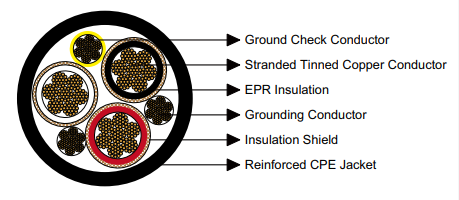
Complete SHD-GC 2kV portable power cable range with ground check conductor for underground mining. 13 conductor sizes 3×6 AWG to 3×500 kcmil, ampacity 93-536A. Continuous miners, face drill rigs, underground loaders, shotcrete machines, roadheaders. Yellow polypropylene ground check conductor, EPR insulation, CPE jacket. ICEA S-75-381 compliant.
SHD-GC Type Three-Conductor Round Portable Power Cable 2kV Complete Range with Ground Check Conductor
Comprehensive Underground Mining Cable Solution: 13 Conductor Sizes for Every Application
Industry Standards and Underground Mining Safety Compliance
- ICEA S-75-381 / NEMA WC 58: Comprehensive industry standards for portable mining power cables incorporating ground check conductor monitoring systems for underground coal and metal mining applications through 5kV voltage classification
- ASTM B 172: American Society for Testing and Materials specification establishing requirements for rope-lay-stranded copper conductors utilizing bunch-stranded or concentric-stranded construction methodologies across broad ampacity ranges
- ASTM B 33: Standard specification for tinned soft or annealed copper wire manufactured for electrical applications requiring corrosion resistance in high-humidity underground mining atmospheres approaching saturation conditions
- CAN/CSA C22.2 No. 96: Canadian Standards Association certification standard for portable power cables deployed in underground mining environments with enhanced safety requirements including ground integrity monitoring capabilities
Yellow Polypropylene Ground Check Conductor: Enhanced Identification and Durability
The SHD-GC cable series incorporates a dedicated ground check conductor with yellow polypropylene insulation specifically engineered for underground mining service. Polypropylene thermoplastic insulation delivers distinct advantages compared to conventional PVC or thermosetting elastomeric insulation materials commonly employed in other cable constructions. Polypropylene exhibits superior moisture resistance critical in high-humidity underground environments where condensation accumulation on cable surfaces proves inevitable. The material demonstrates excellent chemical resistance to mineral oils, hydraulic fluids, and cleaning solvents encountered around underground mining equipment requiring frequent maintenance.
The yellow pigmentation incorporated throughout the polypropylene insulation compound provides immediate visual identification of the ground check conductor during cable termination procedures in dimly-lit underground electrical installation environments. Unlike surface-pigmented materials where color fades through abrasion exposure, polypropylene color remains consistent throughout the insulation wall thickness ensuring sustained visual identification throughout decades of underground service. The thermoplastic nature of polypropylene provides excellent low-temperature flexibility maintaining cable handling characteristics in underground metal mines where ambient temperatures approach freezing, while the material retains dimensional stability at elevated temperatures generated by high-ampacity conductor operation.
Ground check conductor sizing in the SHD-GC series varies proportionally with cable capacity requirements. Smaller cables serving auxiliary equipment (3×6 AWG through 3×2 AWG) incorporate 10 AWG ground check conductors providing adequate mechanical strength and flexibility for compact cable constructions. Medium-capacity cables (3×1 AWG through 3×4/0 AWG) utilize 8 AWG ground check conductors balancing mechanical robustness with cable flexibility. Large-capacity cables (3×250 kcmil through 3×500 kcmil) employ 6 AWG ground check conductors ensuring proportional mechanical strength matching the overall cable construction while maintaining adequate flexibility for hydraulic cable reel winding operations on continuous miners and longwall shearers.
Detailed Construction Engineering and Underground Mining Materials
Power Conductor Assembly
Primary conductors manufactured using rope-lay stranded annealed copper with comprehensive tin plating applied to individual wire strands. Stranding configurations from 133 strands in smaller sizes through 1221 strands in largest sizes provide exceptional flexibility essential for cable reel operations in confined underground spaces. Tin plating prevents copper oxidation in humid underground atmospheres while facilitating reliable electrical connections at termination points.
Primary Insulation Material
Ethylene Propylene Rubber (EPR) compound formulated for underground mining service. EPR demonstrates excellent electrical properties including high dielectric strength, low power factor, comprehensive resistance to tracking and corona discharge, maintained flexibility across underground temperature ranges, and immunity to moisture degradation in saturated atmospheres typical in underground mining environments below water tables.
Metallic Shielding System
Individual shields constructed from tinned copper wire braided with reinforcing textile fibers encircle each power conductor. These shields provide electrostatic screening reducing electromagnetic interference in underground electrical installations, contribute supplementary grounding pathways for fault current protection, and deliver mechanical reinforcement against abrasion from rock surfaces and cable handling damage during installation in confined tunnels.
Yellow Polypropylene Ground Check Conductor
Dedicated tinned copper ground check conductor with yellow polypropylene thermoplastic insulation sized proportionally to cable capacity: 10 AWG for light-duty cables, 8 AWG for medium-capacity cables, 6 AWG for heavy-duty cables. Yellow color coding enables immediate visual identification in underground lighting conditions. Polypropylene insulation provides superior moisture resistance and chemical immunity compared to alternative insulation materials.
Equipment Grounding Conductor
Bare tinned copper grounding conductor sized proportionally to power conductor ampacity, ranging from 10 AWG in smallest cables through 4/0 AWG in largest configurations. Provides primary equipment grounding pathway for fault current return ensuring personnel protection through rapid overcurrent protective device operation during ground fault conditions. Sized according to NEC and ICEA requirements for fault current handling capacity.
Reinforced CPE Outer Jacket
Extra-heavy-duty Chlorinated Polyethylene (CPE) jacket formulated specifically for underground mining applications. CPE delivers exceptional abrasion resistance against rock surfaces during cable dragging operations, comprehensive flame propagation resistance meeting underground mining fire safety codes, resistance to mineral oil and hydraulic fluid contamination, and maintained flexibility in high-humidity underground atmospheres preventing jacket cracking during cable handling at low temperatures.
Alternative Jacketing Materials for Specialized Underground Conditions
While CPE represents the standard jacketing material for underground coal mining applications, alternative elastomeric compounds address specialized requirements in metal mining operations and unique environmental conditions. Chlorosulfonated Polyethylene (CSP) provides enhanced resistance to aggressive chemical exposure in metal mines utilizing blasting agents, dewatering chemicals, and ground support accelerators. Polychloroprene (PCP) delivers improved low-temperature flexibility for deep underground metal mines where rock temperatures remain near freezing despite ventilation heating systems.
Nitrile Butadiene Rubber (NBR) offers superior resistance to petroleum products, hydraulic fluids, and diesel fuel prevalent around underground mobile equipment requiring frequent servicing in confined maintenance areas. Polyvinyl Chloride (PVC) serves applications in well-ventilated underground installations with moderate environmental conditions where cost optimization proves important. Thermoplastic Polyurethane (TPU) provides exceptional abrasion resistance combined with excellent flexibility essential for cable reel applications on equipment operating in extremely abrasive rock conditions with sharp quartz or silica mineral particles.
For installations in particularly severe mechanical environments with repetitive cable flexing over sharp rock edges or equipment structures, a reinforced dual-layer jacket construction incorporating high-tenacity aramid textile fibers between inner and outer elastomeric layers substantially increases puncture resistance and extends cable service life. This premium construction proves beneficial for continuous miner cables in hard coal seams with significant rock intrusions and roadheader cables in hard rock metal mining excavations.
Thermal and Mechanical Performance Parameters
The 90°C continuous conductor operating temperature establishes thermal boundaries for sustained current-carrying operation in underground mining installations. Underground environments typically maintain relatively stable ambient temperatures between 15-30°C depending on depth below surface, ventilation system effectiveness, and geothermal gradients, enabling more predictable ampacity determination compared to surface mining installations experiencing extreme temperature variations. However, cable installations in sealed cable trays or multiple-layer cable reel winding configurations experience thermal derating due to restricted heat dissipation.
The minimum bending radius specification prevents mechanical damage during cable installation through confined tunnel spaces and winding onto hydraulic cable reel drums. Underground mining cable installations frequently route through sharp-angle bends around tunnel corners, over conveyor structures, and through roof support frameworks requiring careful attention to minimum bending radius compliance. Hydraulic cable reel drum diameter selection must accommodate minimum bending radius requirements while maximizing cable storage capacity for equipment travel distances in underground mining panels.
Complete Technical Specifications: Light-Duty Through Heavy-Duty Underground Applications
| Cable Size (Cores × AWG/kcmil) | Strands | Equipment Ground (AWG/kcmil) | Ground Check (AWG/kcmil) | Insulation (inch / mm) | Jacket (inch / mm) | Diameter (inch / mm) | Weight (lbs/kft / kg/km) | Ampacity (Amps) |
|---|---|---|---|---|---|---|---|---|
| 3 × 6 AWG | 133 | 10 AWG | 10 AWG (Yellow PP) | 0.07 / 1.8 | 0.155 / 3.9 | 1.29 / 32.8 | 1130 / 1682 | 93 |
| 3 × 4 AWG | 259 | 8 AWG | 10 AWG (Yellow PP) | 0.07 / 1.8 | 0.155 / 3.9 | 1.40 / 35.6 | 1460 / 2173 | 122 |
| 3 × 3 AWG | 259 | 7 AWG | 10 AWG (Yellow PP) | 0.07 / 1.8 | 0.170 / 4.3 | 1.51 / 38.3 | 1680 / 2500 | 140 |
| 3 × 2 AWG | 259 | 6 AWG | 10 AWG (Yellow PP) | 0.07 / 1.8 | 0.170 / 4.3 | 1.59 / 40.4 | 1990 / 2961 | 159 |
| 3 × 1 AWG | 259 | 5 AWG | 8 AWG (Yellow PP) | 0.08 / 2.0 | 0.190 / 4.8 | 1.76 / 44.7 | 2385 / 3549 | 184 |
| 3 × 1/0 AWG | 266 | 4 AWG | 8 AWG (Yellow PP) | 0.08 / 2.0 | 0.190 / 4.8 | 1.86 / 47.2 | 2765 / 4115 | 211 |
| 3 × 2/0 AWG | 329 | 3 AWG | 8 AWG (Yellow PP) | 0.08 / 2.0 | 0.205 / 5.2 | 2.00 / 50.8 | 3255 / 4844 | 243 |
| 3 × 3/0 AWG | 418 | 2 AWG | 8 AWG (Yellow PP) | 0.08 / 2.0 | 0.205 / 5.2 | 2.13 / 54.1 | 3890 / 5789 | 279 |
| 3 × 4/0 AWG | 532 | 1 AWG | 8 AWG (Yellow PP) | 0.08 / 2.0 | 0.220 / 5.6 | 2.31 / 58.7 | 4720 / 7024 | 321 |
| 3 × 250 kcmil | 627 | 1/0 AWG | 6 AWG (Yellow PP) | 0.095 / 2.4 | 0.220 / 5.6 | 2.51 / 63.8 | 5460 / 8125 | 355 |
| 3 × 300 kcmil | 741 | 1/0 AWG | 6 AWG (Yellow PP) | 0.095 / 2.4 | 0.235 / 6.0 | 2.68 / 68.1 | 6395 / 9517 | 398 |
| 3 × 350 kcmil | 888 | 2/0 AWG | 6 AWG (Yellow PP) | 0.095 / 2.4 | 0.235 / 6.0 | 2.81 / 71.4 | 7280 / 10834 | 435 |
| 3 × 500 kcmil | 1221 | 4/0 AWG | 6 AWG (Yellow PP) | 0.095 / 2.4 | 0.265 / 6.7 | 3.19 / 81.0 | 9820 / 14614 | 536 |
Ampacity Rating Methodology: Current-carrying capacity values represent calculations based on 90°C maximum conductor operating temperature with 40°C ambient air temperature per ICEA S-75-381 standard. Underground mining installations typically experience ambient temperatures 15-30°C enabling operation near rated ampacity. However, cables installed in sealed cable trays, wound in multiple layers on cable reels, or installed in high-temperature deep mining operations require ampacity derating. Duty cycle analysis considering equipment starting current, continuous operation periods, and idle intervals enables refined ampacity determination for specific underground mining applications.
Cable Size Selection Guide: Matching Equipment Requirements to Cable Capacity
Underground Mining Equipment Cable Sizing Framework
The comprehensive thirteen-size range in the SHD-GC cable series enables precise matching of cable electrical capacity to specific underground mining equipment power requirements. Proper cable sizing optimization balances electrical performance requirements including adequate ampacity for equipment motor ratings, acceptable voltage drop maintaining motor starting capability, sufficient conductor sizing for extended cable lengths, and thermal margin accommodating duty cycle variations against mechanical considerations including cable weight impacts on hydraulic reel motor sizing, cable diameter constraints in confined underground installations, cable flexibility requirements for reel winding operations, and economic factors balancing cable material costs against installation efficiency and operational reliability.
Light-Duty Applications (93-159A)
6 AWG – 2 AWG
- Utility vehicles and underground tractors under 75 horsepower
- Scaling equipment and cleaning machinery
- Small hydraulic drilling units for cable bolt installation
- Auxiliary ventilation fan motors 25-50 horsepower
- Dewatering pump installations under 60 horsepower
- Mobile compressor units for pneumatic tools
- Cable length recommendation: Effective for installations under 75 meters
- Reel system advantage: Lightest weight minimizes hydraulic motor requirements and cable handling complexity
- Installation benefit: Compact diameter facilitates routing through restricted tunnel spaces and around obstacles
Medium-Duty Applications (184-321A)
1 AWG – 4/0 AWG
- Standard underground LHD loaders 6-12 cubic yard capacity
- Face drill rigs (jumbos) with 2-3 boom configurations
- Roadheader machines for tunnel excavation 50-150 kW cutting head power
- Shotcrete machines for ground support application
- Roof bolting equipment with automated drilling systems
- Shuttle cars for coal haulage 10-20 ton capacity
- Belt conveyor drive systems 100-300 horsepower
- Cable length recommendation: Suitable for installations 75-200 meters with acceptable voltage drop
- Industry standard: Most frequently specified range for general underground mining mobile equipment
- Versatility advantage: Covers majority of underground mining equipment power requirements in coal and metal mining operations
Heavy-Duty Applications (355-536A)
250 kcmil – 500 kcmil
- Continuous miners for coal extraction 300-500+ horsepower total motor load
- Longwall shearer systems with dual cutting drums and ranging arm drives
- Large underground LHD loaders exceeding 15 cubic yard capacity
- Multi-boom face drill rigs with 4+ independent drill positioning systems
- High-capacity roadheaders for large-diameter tunnel boring 200+ kW cutting power
- Primary mine ventilation fans 400-600 horsepower in main intake airways
- High-capacity underground crushers and sizing equipment
- Cable length recommendation: Engineered for extended installations 200-400+ meters maintaining voltage regulation
- Maximum capability: Highest ampacity accommodates sustained heavy-load operation and frequent equipment starting cycles
- Future-proof specification: Provides capacity margin for equipment power upgrades and operational changes without cable replacement
Hydraulic Cable Reel Systems: Underground Mining Installation Architecture
Underground mining equipment relies almost exclusively on hydraulic-powered cable reel systems for portable power cable management in confined space operations. Unlike surface mining trailing cable reels powered by electric motors, underground hydraulic cable reels integrate directly with equipment hydraulic systems eliminating separate electrical power requirements for reel motor operation. Hydraulic drive systems prove inherently safer in underground environments classified as potentially explosive atmospheres, avoiding electrical motor sparking hazards near methane accumulations in coal mining or combustible dust in metal mining operations.
The comprehensive SHD-GC cable size range accommodates underground hydraulic reel capacities from compact NAMI series reels managing 3×6 AWG through 3×2 AWG cables for utility vehicles and auxiliary equipment, through medium-capacity CWR and TCR series reels handling 3×1 AWG through 3×4/0 AWG cables for standard underground loaders and drill rigs, to heavy-duty TCR series reels managing 3×250 kcmil through 3×500 kcmil cables for continuous miners and longwall shearers requiring maximum cable storage capacity for equipment travel distances approaching 400 meters in underground mining panels.
Hydraulic cable reel drum diameter selection must accommodate cable minimum bending radius requirements while maximizing cable storage capacity. Smaller diameter drums reduce overall reel assembly dimensions critical in height-restricted underground mining operations, but necessitate smaller cable sizes meeting minimum bending radius specifications at reduced drum diameters. Larger cables requiring greater minimum bending radius mandate larger-diameter reel drums potentially exceeding underground mining equipment height envelope constraints in low-seam coal operations or narrow-vein metal mining excavations.
Ground check conductor monitoring relay systems integrate into hydraulic cable reel junction box assemblies where primary power terminates from mine electrical distribution infrastructure. Yellow polypropylene insulated ground check conductors and bare equipment grounding conductors route through monitoring relay terminals before continuing through the cable reel assembly and cable to equipment termination points. This configuration enables continuous ground integrity supervision across the entire power distribution pathway from mine electrical system through the cable reel, portable power cable, and equipment internal wiring to machinery frames and structures where personnel contact creates electrocution hazards should grounding failures develop.


