
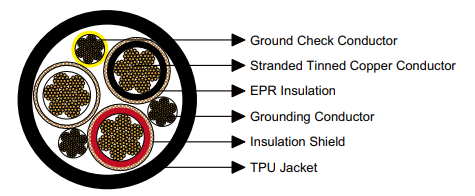
Premium SHD-GC 2kV portable power cable with TPU thermoplastic polyurethane jacket for heavy mobile equipment. Dragline excavators, electric mining shovels, dredges, drilling rigs, power feeders. Superior abrasion resistance, extreme flexibility, oil/chemical resistance. Ground check conductor, 11 sizes 3×6 AWG to 3×500 kcmil, ampacity 93-536A. ICEA S-75-381 certified.
SHD-GC Type Three-Conductor Round Portable Power Cable 2kV with Premium TPU Jacket
Thermoplastic Polyurethane Technology for Extreme-Duty Heavy Mobile Equipment Applications
Industry Standards and Premium Cable Certification
- ICEA S-75-381 / NEMA WC 58: Industry standards for premium portable mining power cables with advanced jacketing materials and ground check conductor monitoring systems for heavy mobile equipment applications
- ASTM B 172: Specification for rope-lay-stranded copper conductors with high strand counts providing exceptional flexibility for large-scale cable reel operations on draglines and electric shovels
- ASTM B 33: Standard specification for tinned copper wire preventing corrosion in outdoor surface mining, marine dredging, and high-humidity heavy equipment applications
- CAN/CSA C22.2 No. 96: Canadian certification for portable power cables deployed in extreme-duty mining and industrial environments requiring premium mechanical and chemical resistance
Comparative Performance Analysis: TPU versus CPE Jacketing Materials
While Chlorinated Polyethylene (CPE) represents the industry-standard jacketing material for general mining cable applications delivering reliable performance in typical surface and underground mining environments, Thermoplastic Polyurethane (TPU) provides superior performance characteristics justifying premium material costs for extreme-duty heavy mobile equipment applications. Understanding the comparative advantages and limitations of each material enables informed cable selection decisions optimizing long-term total cost of ownership.
| Performance Characteristic | CPE Jacket (Standard) | TPU Jacket (Premium) |
|---|---|---|
| Abrasion Resistance (Taber Test) | Good – suitable for typical mining | Excellent – 3-5× superior to CPE, ideal for severe abrasion environments |
| Low Temperature Flexibility | Adequate to -30°C with some stiffening | Superior – maintains flexibility to -40°C, critical for arctic operations |
| Oil & Hydrocarbon Resistance | Moderate – acceptable for limited exposure | Exceptional – no swelling or degradation with continuous oil/diesel contact |
| Hydrolysis Resistance | Limited – susceptible to degradation in wet conditions | Outstanding – ideal for dredging and high-moisture mining applications |
| Tear Propagation Resistance | Adequate for general service | Superior – significantly reduces catastrophic failure from localized damage |
| Ultraviolet Stability | Good with carbon black pigmentation | Excellent – extended outdoor life in high-UV environments |
| Flame Resistance | Excellent – inherent flame retardancy | Good – meets mining safety requirements with additives |
| Material Cost | Standard industry pricing | Premium – 30-50% higher material costs |
| Service Life Expectancy | 8-12 years in typical mining environments | 15-20+ years in extreme-duty applications, superior total cost of ownership |
| Optimal Applications | General surface/underground mining, standard equipment | Draglines, electric shovels, dredges, drilling rigs, severe abrasion/chemical exposure |
For heavy mobile equipment where cable replacement necessitates substantial equipment downtime, rigging complexity handling multi-ton cables, and expensive installation procedures, the extended service life delivered by TPU jacketing substantially reduces total cost of ownership despite premium material pricing. Dragline excavators and electric shovels operating continuous production schedules particularly benefit from TPU jacket reliability minimizing unplanned outages and extending maintenance intervals between cable replacements.
Premium Construction Engineering and TPU Material Technology
High-Capacity Conductor Assembly
Power conductors manufactured using rope-lay stranded annealed copper with comprehensive tin plating and strand counts from 133 through 1221 strands. High strand counts provide exceptional flexibility essential for large-diameter cable reel drums on draglines and electric shovels. Tin plating prevents corrosion during decades of outdoor surface mining exposure.
Premium EPR Insulation
Ethylene Propylene Rubber (EPR) compound formulated for heavy equipment service. EPR provides superior electrical properties including high dielectric strength, excellent resistance to tracking and corona discharge, maintained flexibility across extreme temperature ranges, and comprehensive immunity to ozone and weather aging in outdoor surface mining installations.
Metallic Shield Architecture
Individual tinned copper wire shields braided with reinforcing textile fibers encircle each power conductor. Shields provide electrostatic screening, contribute supplementary grounding pathways for fault current protection, and deliver mechanical reinforcement protecting insulation against abrasion damage from sharp rock fragments common around draglines and shovels.
Yellow Polypropylene Ground Check Conductor
Dedicated ground check conductor with yellow polypropylene insulation sized proportionally: 10 AWG for light-duty cables, 8 AWG for medium-capacity cables, 6 AWG for heavy-duty configurations. Polypropylene provides superior moisture resistance and chemical immunity compared to alternative insulation materials. Yellow color coding ensures immediate visual identification.
Equipment Grounding Conductor
Bare tinned copper grounding conductor sized from 10 AWG through 4/0 AWG proportional to power conductor ampacity. Provides primary equipment grounding pathway ensuring personnel protection through rapid fault current return during ground fault conditions. Sized according to ICEA standards for fault current handling capacity on large mobile equipment.
Premium TPU Outer Jacket
Thermoplastic Polyurethane jacket engineered specifically for extreme-duty heavy mobile equipment applications. TPU delivers exceptional abrasion resistance (3-5× superior to CPE), outstanding flexibility maintained across -40°C to +90°C temperature range, comprehensive oil and hydrocarbon resistance without swelling, superior tear propagation resistance, excellent hydrolysis resistance for wet environments, and sustained ultraviolet stability for decades of outdoor exposure.
Alternative Premium Jacketing Materials for Specialized Conditions
While TPU represents the premium jacketing material for extreme-duty heavy mobile equipment applications, alternative materials remain available addressing specialized requirements or budget constraints. CPE jacketing delivers reliable performance for general heavy equipment applications without the severe abrasion or chemical exposure justifying TPU premium costs. Chlorosulfonated Polyethylene (CSP) provides enhanced chemical resistance for equipment operating in aggressive chemical environments. Polychloroprene (PCP) offers improved flexibility at moderate temperatures with good oil resistance. Nitrile Butadiene Rubber (NBR) provides maximum oil and fuel resistance for applications with extreme hydrocarbon exposure. Polyvinyl Chloride (PVC) serves cost-sensitive applications with moderate environmental conditions.
For installations demanding absolute maximum mechanical protection beyond standard TPU jacketing, a reinforced dual-layer construction incorporating high-tenacity aramid textile fibers between inner and outer TPU jacket layers delivers unprecedented puncture resistance and service life. This ultra-premium construction proves beneficial for dragline cables in exceptionally abrasive operations with sharp silica-rich rock fragments or electric shovel cables in mining operations with severe mechanical cable abuse from equipment track contact and material spillage.
Thermal and Mechanical Performance Specifications
The 90°C continuous conductor operating temperature establishes thermal limits for sustained current-carrying operation in heavy mobile equipment applications. Surface mining operations in desert environments experiencing 50°C ambient temperatures require substantial ampacity derating, while arctic mining operations at -30°C ambient may permit modest ampacity increases. TPU jacket temperature rating from -40°C through +90°C ensures cable flexibility and mechanical integrity across global mining climates from Arctic diamond operations through Australian desert iron ore mining.
The minimum bending radius specification prevents mechanical damage during cable installation on large-diameter trailing cable reel drums typical of dragline and electric shovel applications. TPU jacket flexibility enables meeting minimum bending radius requirements on smaller-diameter reel drums compared to conventional CPE jacketing, potentially reducing overall cable reel assembly dimensions beneficial in equipment design optimization. Reel drum diameter selection must balance cable storage capacity for maximum equipment travel distances against minimum bending radius compliance and overall equipment dimensional constraints.
Complete Technical Specifications: Premium TPU Jacket Cable Range
| Cable Size (Cores × AWG/kcmil) | Conductor Strands | Equipment Ground (AWG/kcmil) | Ground Check (AWG/kcmil) | Insulation Wall (inch / mm) | TPU Jacket (inch / mm) | Overall Diameter (inch / mm) | Cable Weight (lbs/kft / kg/km) | Ampacity (Amperes) |
|---|---|---|---|---|---|---|---|---|
| 3 × 6 AWG | 133 | 10 AWG | 10 AWG (Yellow PP) | 0.07 / 1.8 | 0.155 / 3.9 | 1.29 / 32.8 | 1069 / 1590 | 93 |
| 3 × 4 AWG | 259 | 8 AWG | 10 AWG (Yellow PP) | 0.07 / 1.8 | 0.155 / 3.9 | 1.40 / 35.6 | 1295 / 1927 | 122 |
| 3 × 2 AWG | 259 | 6 AWG | 10 AWG (Yellow PP) | 0.07 / 1.8 | 0.170 / 4.3 | 1.59 / 40.4 | 1778 / 2645 | 159 |
| 3 × 1 AWG | 259 | 5 AWG | 8 AWG (Yellow PP) | 0.08 / 2.0 | 0.190 / 4.8 | 1.76 / 44.7 | 2163 / 3218 | 184 |
| 3 × 1/0 AWG | 266 | 4 AWG | 8 AWG (Yellow PP) | 0.08 / 2.0 | 0.190 / 4.8 | 1.86 / 47.2 | 2508 / 3731 | 211 |
| 3 × 2/0 AWG | 323 | 3 AWG | 8 AWG (Yellow PP) | 0.08 / 2.0 | 0.205 / 5.2 | 2.00 / 50.8 | 3001 / 4465 | 243 |
| 3 × 3/0 AWG | 418 | 2 AWG | 8 AWG (Yellow PP) | 0.08 / 2.0 | 0.205 / 5.2 | 2.13 / 54.1 | 3470 / 5163 | 279 |
| 3 × 4/0 AWG | 532 | 1 AWG | 8 AWG (Yellow PP) | 0.08 / 2.0 | 0.220 / 5.6 | 2.31 / 58.7 | 4192 / 6237 | 321 |
| 3 × 250 kcmil | 627 | 1/0 AWG | 6 AWG (Yellow PP) | 0.095 / 2.4 | 0.220 / 5.6 | 2.51 / 63.8 | 5213 / 7756 | 355 |
| 3 × 350 kcmil | 888 | 2/0 AWG | 6 AWG (Yellow PP) | 0.095 / 2.4 | 0.235 / 6.0 | 2.81 / 71.4 | 6824 / 10153 | 435 |
| 3 × 500 kcmil | 1221 | 4/0 AWG | 6 AWG (Yellow PP) | 0.095 / 2.4 | 0.265 / 6.7 | 3.19 / 81.0 | 9014 / 13411 | 536 |
Ampacity and Weight Considerations: Current-carrying capacity ratings represent calculations based on 90°C conductor temperature with 40°C ambient per ICEA S-75-381. Surface mining operations require site-specific ampacity analysis accounting for solar radiation, wind velocity, and cable installation configuration. TPU jacket weight is approximately 5-10% lower than equivalent CPE jacketed cables, beneficial for large-scale dragline and shovel cable reel systems where cable weight impacts reel motor sizing and structural loading. The weight reduction, combined with superior flexibility, facilitates cable handling during installation and replacement operations on heavy mobile equipment.
Application-Specific Engineering Selection for Heavy Mobile Equipment
Cable Sizing and TPU Jacket Optimization for Extreme-Duty Service
Specifying portable power cables for heavy mobile equipment requires comprehensive evaluation of electrical performance requirements, mechanical durability demands, environmental exposure severity, and total cost of ownership optimization. TPU jacketing delivers maximum value proposition for equipment where cable replacement proves expensive due to operational downtime, installation complexity, and material costs. The premium material investment proves particularly justified for draglines, electric shovels, and dredges operating continuous production schedules where unplanned cable failures trigger substantial economic losses.
Dragline Excavator Applications
250-536A Capacity
- Walking draglines: 80-120+ cubic yard bucket capacity, boom lengths 100-150 meters
- Crawler-mounted draglines: Moderate-capacity configurations for specialty applications
- Power transmission: Trailing cable from mine power supply to dragline electrical room, distances 400-600+ meters
- TPU advantages: Extreme abrasion resistance from sharp overburden rock contact, superior flexibility for large reel drums, extended service life 15-20 years minimizing costly cable replacements
- Recommended sizes: 3×350 kcmil (435A) for large draglines 100+ yd³, 3×500 kcmil (536A) for ultra-large draglines exceeding 120 yd³ bucket capacity
- Economic justification: Cable replacement requires dragline downtime costing $50,000-$100,000+ per day, extended TPU cable life delivers substantial ROI
Electric Mining Shovel Applications
243-435A Capacity
- Rope shovels: 40-80 cubic yard dipper capacity, primary excavation in surface mining operations
- Hydraulic shovels: Ultra-large configurations exceeding standard excavator classifications
- Power distribution: Trailing cable from pit electrical distribution to shovel, distances 200-400 meters typical
- TPU advantages: Outstanding abrasion resistance from sharp rock and equipment track contact, oil resistance preventing degradation from hydraulic fluid exposure, low-temperature flexibility for arctic mining operations
- Recommended sizes: 3×2/0 AWG (243A) to 3×3/0 AWG (279A) for moderate shovels 40-55 yd³, 3×250 kcmil (355A) to 3×350 kcmil (435A) for large shovels exceeding 60 yd³
- Service life expectation: 15-18 years with TPU jacket versus 10-12 years with CPE in severe abrasion environments
Dredging Equipment Applications
184-355A Capacity
- Cutter suction dredges: Large-scale harbor deepening and land reclamation projects
- Hydraulic dredges: Material extraction from underwater deposits
- Marine construction: Offshore platform installation and underwater excavation equipment
- TPU advantages: Exceptional hydrolysis resistance for continuous water immersion, superior flexibility in marine environments, comprehensive oil resistance for shipboard hydraulic contamination
- Recommended sizes: 3×1 AWG (184A) to 3×2/0 AWG (243A) for moderate dredging equipment, 3×3/0 AWG (279A) to 3×250 kcmil (355A) for large cutter dredges
- Critical requirement: Hydrolysis resistance proves essential as CPE jacketing degrades rapidly in continuous water immersion applications, TPU maintains integrity for decades in marine service
Drilling Rig & Power Feeder Applications
122-321A Range
- Rotary drilling rigs: Large-diameter blast hole drilling in surface mining operations
- Power feeders: Primary power distribution cables from mine electrical infrastructure to equipment load centers
- Mobile equipment distribution: Portable power supply for various heavy equipment installations
- TPU advantages: Superior abrasion resistance for cables frequently relocated across rough mining surfaces, excellent flexibility simplifying cable handling and storage, comprehensive chemical resistance to drilling fluids and lubricants
- Recommended sizes: 3×4 AWG (122A) to 3×1 AWG (184A) for auxiliary drilling systems, 3×1/0 AWG (211A) to 3×4/0 AWG (321A) for main drilling rig motors and primary power feeders
- Installation benefit: TPU flexibility reduces cable handling labor and equipment requirements during frequent relocation operations
Dragline Trailing Cable Systems: Engineering Considerations for TPU Implementation
Dragline excavators represent the most demanding portable power cable application in surface mining operations, with trailing cables managing power transmission across distances frequently exceeding 500 meters as equipment traverses mining benches extracting overburden materials. These cables experience severe mechanical abuse from sharp rock fragments continuously falling from dragline buckets, abrasion from cable contact with rough mining surfaces during equipment movement, crushing forces if equipment inadvertently positions over cable, temperature extremes from -40°C arctic conditions through +50°C desert environments, and decades of continuous ultraviolet radiation exposure during 20+ year dragline service lives.
TPU jacket technology delivers compelling performance advantages justifying premium material costs for dragline applications. The exceptional abrasion resistance of TPU (3-5× superior to CPE) substantially extends cable service life in environments where sharp rock contact proves inevitable. The superior flexibility of TPU maintained across extreme temperature ranges facilitates cable handling during installation and enables smaller-diameter trailing cable reel drums potentially reducing overall reel assembly dimensions and weight. The comprehensive oil resistance prevents jacket degradation from hydraulic fluid and lubricant contamination common around large dragline machinery requiring frequent maintenance.
Cable replacement on operating draglines necessitates extensive equipment downtime for cable removal, new cable installation, electrical termination work, and testing procedures before returning equipment to production. For large walking draglines processing thousands of tons per hour, each day of downtime for cable replacement represents $50,000-$100,000+ in lost production revenue and fixed cost continuation. Extending cable service life from typical 10-12 years with CPE jacketing to 15-20 years with premium TPU jacketing delivers substantial economic benefits offsetting higher initial cable material costs through reduced replacement frequency and associated downtime costs.
Ground check conductor monitoring proves particularly critical for dragline safety given the large equipment frames, extensive cable lengths, and harsh environmental conditions accelerating grounding conductor degradation. The yellow polypropylene insulated ground check conductor with 6 AWG sizing in large cables provides reliable monitoring circuit continuity throughout decades of dragline service. Ground monitoring relays continuously supervise ground integrity, immediately detecting grounding conductor failures and triggering protective equipment shutdown before hazardous frame voltages develop, essential for personnel safety around equipment where operators and maintenance personnel routinely contact machinery during operation and maintenance activities.
David Martinez, P.E., M.S.
Throughout twenty-eight years specializing in electrical power systems for heavy mobile mining equipment, I have designed, commissioned, and optimized trailing cable installations for dragline excavators and electric mining shovels across surface mining operations on four continents. My professional focus encompasses electrical system engineering for ultra-large mining equipment, portable power cable specification and performance optimization, trailing cable reel system design and integration, and ground fault protection system implementation for personnel safety in heavy equipment operations.
My career includes twelve years as Principal Electrical Engineer for Global Surface Mining Corporation responsible for electrical infrastructure across eight surface coal and copper mining operations with draglines ranging from 80 to 130 cubic yard bucket capacity, nine years with Heavy Equipment Manufacturing as Senior Design Engineer specializing in trailing cable reel systems and electrical power distribution for electric mining shovels, and five years with Mining Cable Testing Laboratory conducting field performance evaluations of portable power cables under actual mining operating conditions.
This technical analysis reflects practical knowledge accumulated through direct involvement specifying portable power cable jacketingmaterials for dragline and shovel applications, investigating premature cable failures determining root causes of jacket degradation and mechanical damage, conducting comparative service life studies evaluating TPU versus CPE jacketing performance in identical mining environments, and developing cable selection methodologies optimizing total cost of ownership through extended service life and reduced maintenance requirements.
My field experience spans surface coal mining operations in Wyoming and Montana with draglines operating in temperature extremes from -35°C winter conditions through +45°C summer heat, copper mining installations in Arizona and Chile with aggressive ultraviolet radiation and abrasive rock conditions, iron ore operations in Western Australia with severe mechanical cable abuse, and arctic diamond mining in Northwest Territories operating at -40°C ambient requiring cables maintaining flexibility in extreme cold. This diverse operational exposure across climates and mining conditions provides comprehensive understanding of cable performance requirements and jacketing material selection optimization for heavy mobile equipment applications.
- Professional Engineer (P.E.) License – Electrical Engineering, National Council of Examiners for Engineering and Surveying
- Master of Science (M.S.) – Electrical Power Systems Engineering, Colorado School of Mines (2003)
- Bachelor of Science (B.S.) – Electrical Engineering, State Engineering University (1996)
- Certified Heavy Equipment Electrical Systems Specialist – Mining Equipment Manufacturers Association
- Trailing Cable Systems Expert Certification – International Cable Engineering Association
- Senior Member, Institute of Electrical and Electronics Engineers (IEEE) – Mining Industry Applications Society
- Professional Member, Society for Mining, Metallurgy and Exploration (SME) – Electrical Engineering Division
- Technical Committee Member, ICEA Portable Mining Cable Standards Development
- Published Author: “TPU Jacket Performance in Dragline Cable Applications: 10-Year Field Study” – Mining Engineering Journal (2021)
- Conference Speaker: “Total Cost of Ownership Optimization for Heavy Equipment Portable Cables” – SME Annual Conference (2020)
- Field Testing Coordinator: Comparative Cable Jacket Performance Studies (2015-2024, multiple mining operations)
- International Experience: 28 years across surface coal, copper, iron ore, and diamond mining in USA, Canada, Chile, and Australia


