
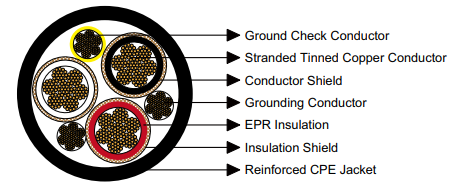
SHD-GC Type 8kV Three-Conductor Round Portable Power Cable with Ground Check Conductor
Ultra-Maximum Specification: World’s Largest Mining Equipment and Extreme-Distance Power Transmission
Industry Standards and Ultra-Maximum Specification Certification
- ICEA S-75-381 / NEMA WC 58: Comprehensive industry standards for portable mining power cables incorporating ground check conductor monitoring systems for ultra-high voltage service through maximum 8kV voltage classification representing upper limit of portable cable voltage ratings
- ASTM B 172: Specification for rope-lay-stranded copper conductors with ultra-high strand counts providing exceptional flexibility essential for large-diameter trailing cable reel drums on world’s largest draglines and electric shovels
- ASTM B 33: Standard specification for tinned copper wire preventing corrosion through decades of outdoor exposure on equipment with operational lifetimes spanning 30-40+ years of continuous surface mining service
- CAN/CSA C22.2 No. 96: Canadian certification for portable power cables deployed in extreme-duty mining environments requiring ultra-high voltage electrical service with maximum safety monitoring and enhanced mechanical protection
Enhanced Insulation Shield System: Dual-Layer Voltage Stress Control
The transition from 5kV to 8kV voltage service necessitates enhanced insulation shield architecture incorporating dual-layer stress control systems. While 5kV cables utilize metallic braid shields providing electromagnetic screening and supplementary grounding, 8kV specifications add semiconducting tape layer between primary EPR insulation and metallic braid shield. This dual-layer configuration creates graduated voltage stress distribution across insulation system interfaces, eliminating abrupt dielectric transitions where voltage stress concentrations could initiate tracking or partial discharge at elevated electric field strengths characteristic of 8kV operation.
5kV Shield System
(Standard High Voltage)
- Conductor shield: Semiconducting extruded layer
- Primary insulation: 2.8-3.0mm EPR compound
- Insulation shield: Metallic braid only
- Voltage stress control: Single-layer shielding
- Application range: Standard large surface mining equipment
8kV Enhanced Shield System
(Ultra-Maximum Voltage)
- Conductor shield: Semiconducting extruded layer over conductor
- Primary insulation: 3.8mm enhanced EPR compound (25% thicker)
- Semiconducting tape: Intermediate stress control layer
- Metallic braid: Outer electromagnetic shield plus grounding
- Voltage stress control: Dual-layer graduated stress distribution
- Application range: World’s largest draglines and shovels, extreme-distance transmission
The conducting tape layer, typically manufactured from carbon-loaded polymer materials or metalized plastic films, provides semiconductive characteristics bridging electrical properties between insulating EPR compound and fully conductive metallic braid. This graduated conductivity transition eliminates sharp dielectric interfaces where electric field concentrations develop, substantially reducing partial discharge inception probability at 8kV voltage levels. The metallic braid maintains electromagnetic screening effectiveness while the conducting tape primarily addresses voltage stress distribution, creating synergistic protection unavailable through single-layer shielding architectures.
Ultra-Maximum Construction Engineering for 8kV Service
Ultra-High Strand Count Conductors
Power conductors with maximum strand counts from 259 through 1221 strands provide exceptional flexibility essential for ultra-large trailing cable reel installations. Comprehensive tin plating on every individual wire strand prevents corrosion through decades of continuous outdoor exposure on equipment with 30-40 year operational lifetimes. High flexibility proves critical for 8kV cables where stricter bending radius requirements necessitate larger reel drum diameters.
Semiconducting Conductor Shield
Carbon-black-filled polymer conductor shield applied directly over stranded conductors eliminates air voids between conductor strands and primary insulation. At 8kV voltage levels, even microscopic air voids can initiate partial discharge activity leading to insulation degradation. Conductor shield ensures uniform electric field distribution across insulation system preventing localized voltage stress concentrations critical for long-term reliability in ultra-high voltage service.
Enhanced 3.8mm EPR Insulation
Ethylene Propylene Rubber insulation with maximum wall thickness 3.8mm provides dielectric strength essential for 8kV voltage service. This represents 27% thickness increase versus 3.0mm insulation at 5kV, reflecting quadratic relationship between voltage level and insulation stress. Premium EPR formulation delivers superior tracking resistance, excellent corona discharge immunity, and sustained performance across extreme temperature ranges encountered on world’s largest mining equipment.
Semiconducting Tape Shield Layer
Conducting tape applied over primary EPR insulation before metallic braid provides intermediate voltage stress control layer unique to 8kV specifications. Carbon-loaded polymer tape or metalized film creates semiconductive interface bridging insulation and metallic shield, eliminating abrupt dielectric transitions where voltage stress concentrations develop. Essential for preventing partial discharge inception at electric field strengths characteristic of 8kV operation.
Metallic Braid Electromagnetic Shield
Tinned copper wire braid with textile reinforcement provides outer electromagnetic shield and supplementary grounding pathway. At 8kV voltage levels, electromagnetic screening proves critical preventing interference with ground monitoring circuits and enabling partial discharge detection monitoring for predictive maintenance. Braid contributes mechanical protection while conducting tape handles primary voltage stress distribution functions.
Yellow Polypropylene Ground Check Conductor
Dedicated ground check conductor with yellow polypropylene insulation sized 8 AWG for smaller cables and 6 AWG for larger configurations. At 8kV voltage levels where electrocution hazards prove more severe, ground check monitoring assumes critical importance. Polypropylene provides exceptional moisture resistance, chemical immunity, and sustained visual identification through decades of service on ultra-large equipment.
Ultra-Large Equipment Grounding Conductor
Bare tinned copper grounding conductor sized from 8 AWG through 4/0 AWG proportional to power conductor capacity. For ultra-large equipment with multi-megawatt power requirements, grounding conductor must handle substantial fault currents. Sized according to ICEA standards ensuring adequate fault current capacity while maintaining cable flexibility for trailing reel applications on world’s largest mining equipment.
Reinforced Extra-Heavy-Duty CPE Jacket
Extra-heavy-duty Chlorinated Polyethylene jacket engineered for ultra-large equipment service. Provides exceptional abrasion resistance, comprehensive flame resistance, oil and chemical immunity, ultraviolet stability for decades of outdoor exposure, and maintained flexibility essential for 8× minimum bending radius compliance. CPE delivers reliable performance proven across decades of service on world’s largest draglines and electric shovels.
8× Minimum Bending Radius: Critical Design Constraint for Ultra-High Voltage
The stricter minimum bending radius requirement (8× overall diameter versus 6× at 5kV) reflects fundamental insulation stress mechanics at ultra-high voltages. When cables bend, insulation experiences compression on inner bend radius and tension on outer radius, creating localized stress concentrations. At 8kV voltage levels, these mechanical stress concentrations combined with electrical stress from elevated voltage can initiate insulation degradation. The 8× minimum bending radius ensures mechanical and electrical stress remain within safe limits throughout cable operational life.
For ultra-large trailing cable reel applications, the 8× minimum bending radius necessitates larger reel drum diameters compared to equivalent-ampacity lower-voltage cables. A 3×500 kcmil cable at 8kV with 90.4mm (3.56 inch) overall diameter requires minimum 723mm (28.5 inch) reel drum diameter versus 542mm (21.3 inch) for equivalent 5kV cable with 6× minimum bending radius. This reel drum sizing impacts overall cable reel assembly dimensions, weight, and motor horsepower requirements, representing engineering trade-offs accepting larger reel assemblies to achieve extreme-distance power transmission capability unavailable through lower-voltage alternatives.
Ultra-Maximum Performance Specifications
Complete Ultra-Maximum Technical Specifications
| Cable Size (Cores × AWG/kcmil) | Conductor Strands | Equipment Ground (AWG/kcmil) | Ground Check (AWG/kcmil) | Insulation (inch / mm) | CPE Jacket (inch / mm) | Overall Diameter (inch / mm) | Cable Weight (lbs/kft / kg/km) | Ampacity (Amperes) |
|---|---|---|---|---|---|---|---|---|
| 3 × 4 AWG | 259 | 8 AWG | 8 AWG (Yellow PP) | 0.150 / 3.8 | 0.205 / 5.2 | 1.94 / 49.3 | 2308 / 3594 | 122 |
| 3 × 2 AWG | 259 | 6 AWG | 8 AWG (Yellow PP) | 0.150 / 3.8 | 0.220 / 5.6 | 2.12 / 53.8 | 2920 / 4554 | 159 |
| 3 × 1 AWG | 329 | 5 AWG | 8 AWG (Yellow PP) | 0.150 / 3.8 | 0.220 / 5.6 | 2.21 / 56.1 | 3292 / 5104 | 184 |
| 3 × 1/0 AWG | 259 | 4 AWG | 8 AWG (Yellow PP) | 0.150 / 3.8 | 0.220 / 5.6 | 2.32 / 58.9 | 3675 / 5700 | 211 |
| 3 × 2/0 AWG | 329 | 3 AWG | 8 AWG (Yellow PP) | 0.150 / 3.8 | 0.235 / 6.0 | 2.46 / 62.5 | 4304 / 6593 | 243 |
| 3 × 3/0 AWG | 413 | 2 AWG | 8 AWG (Yellow PP) | 0.150 / 3.8 | 0.250 / 6.4 | 2.62 / 66.5 | 5200 / 7738 | 279 |
| 3 × 4/0 AWG | 532 | 1 AWG | 8 AWG (Yellow PP) | 0.150 / 3.8 | 0.250 / 6.4 | 2.75 / 69.8 | 5840 / 8713 | 321 |
| 3 × 250 kcmil | 608 | 1/0 AWG | 6 AWG (Yellow PP) | 0.150 / 3.8 | 0.250 / 6.4 | 2.89 / 73.4 | 6774 / 9948 | 355 |
| 3 × 300 kcmil | 741 | 1/0 AWG | 6 AWG (Yellow PP) | 0.150 / 3.8 | 0.265 / 6.7 | 3.04 / 77.2 | 7423 / 11384 | 398 |
| 3 × 350 kcmil | 888 | 2/0 AWG | 6 AWG (Yellow PP) | 0.150 / 3.8 | 0.280 / 7.1 | 3.21 / 81.3 | 8543 / 12739 | 435 |
| 3 × 500 kcmil | 1221 | 4/0 AWG | 6 AWG (Yellow PP) | 0.150 / 3.8 | 0.295 / 7.5 | 3.56 / 90.4 | 11260 / 16757 | 536 |
Critical 8kV Application Note: Ultra-high voltage cable installations require specialized engineering analysis beyond standard ampacity and voltage drop calculations. Electric field stress analysis verifying insulation adequacy, minimum approach distances for personnel safety near energized 8kV cables, high-pot testing procedures during installation commissioning, and periodic partial discharge monitoring for predictive maintenance all prove essential for 8kV service. Cable terminations require stress cone assemblies distributing voltage stress gradually from shielded cable to unshielded terminals. Only qualified high-voltage electricians with 8kV training and certification should perform installation, termination, and maintenance work on ultra-maximum voltage cables. Consult factory engineering department for application-specific design review and installation support.
Ultra-Maximum Applications: World’s Largest Mining Equipment
Equipment Engineering Justification for 8kV Specifications
The 8kV voltage classification addresses a specialized niche of ultra-large mining equipment and extreme-distance power transmission where lower voltage alternatives prove technically or economically inadequate. Understanding when 8kV specifications deliver value versus situations where 5kV or 6.6kV systems prove sufficient requires systematic evaluation of equipment power requirements, trailing cable distances, voltage drop constraints, and total system economics including cable reel infrastructure costs.
Ultra-Large Walking Draglines
150+ Cubic Yard Bucket Capacity
- Equipment examples: Bucyrus/Caterpillar 8750, Marion 8050, Big Muskie (historical reference)
- Bucket capacity: 150-220 cubic yards representing absolute largest land-based mobile equipment
- Boom length: 130-160 meters requiring extreme trailing cable distances
- Power requirements: 5-7+ megawatts continuous operation across multiple drive motors
- Trailing cable length: 700-1000+ meters from mine electrical distribution to dragline
- 8kV justification: Voltage drop with 5kV systems exceeds acceptable limits. 8kV enables 75% current reduction maintaining voltage regulation across extreme cable lengths. Equipment represents $100+ million capital investment warranting premium electrical infrastructure.
- Installation consideration: Ultra-large cable reel assemblies with 8× minimum bending radius prove acceptable trade-off versus electrical performance limitations of lower-voltage alternatives
Massive Electric Mining Shovels
100+ Cubic Yard Dipper Capacity
- Equipment examples: Bucyrus/Caterpillar RH400, Hitachi EX8000, Liebherr R9800
- Dipper capacity: 100-120 cubic yards processing 7000+ tons per hour
- Power requirements: 4-6 megawatts continuous with multiple propel, swing, hoist, and crowd motors
- Trailing cable length: 500-800 meters typical in ultra-large open pit operations
- Operational schedule: Continuous 24-hour operation across multi-year campaigns
- 8kV justification: Multi-megawatt power transmission across 500+ meters proves challenging at 5kV. 8kV delivers superior voltage regulation ensuring adequate motor starting capability and sustained performance. Premium cable cost justified by equipment criticality and installation complexity.
Extreme-Distance Power Transmission
800+ Meter Cable Runs
- Application: Large-scale surface mining operations with extensive pit dimensions requiring extreme trailing cable lengths
- Power distribution: Mine electrical infrastructure located at pit rim, equipment operating at pit floor
- Cable length: 800-1200+ meters vertical and horizontal distance from substation to equipment
- Voltage drop constraint: Maintaining motor terminal voltage within ±10% of rated requires minimizing conductor current through maximum practical voltage
- 8kV justification: At 800+ meter distances, even large conductor sizes at 5kV experience excessive voltage drop. 8kV enables practical conductor sizing maintaining voltage regulation. Alternative approaches requiring intermediate voltage transformation stations prove more complex and expensive than 8kV cable infrastructure.
Historical Context: Engineering the World’s Largest Mobile Equipment
Ultra-large draglines and electric shovels represent engineering achievements at the absolute limits of mobile equipment scale. The Bucyrus-Erie 4250-W “Big Muskie” dragline, operating from 1969-1999 in Ohio coal mining, held records as the largest land-based mobile equipment ever constructed with 220 cubic yard bucket capacity, 150-meter boom length, 13,500-ton operating weight, and 32,000 horsepower (24 megawatts) connected electrical power. While Big Muskie operated at 13.8kV distribution voltage (stepped down to 7.2kV for equipment motors), this represented custom-engineered power distribution exceeding standard portable cable voltage classifications.
Modern ultra-large equipment including the Bucyrus/Caterpillar 8750 dragline series (150+ cubic yard capacity) and massive electric shovels approaching 120 cubic yard dipper capacity continue pushing mobile equipment scale boundaries. These machines represent $100-200+ million capital investments with 30-40 year operational lifetimes processing billions of tons of material. The electrical infrastructure powering these machines—including 8kV portable cables with ground check monitoring—must deliver absolute reliability through decades of continuous service in harsh surface mining environments where unplanned equipment failures trigger substantial economic losses and operational disruptions.
The 8kV SHD-GC cable specification with enhanced dual-layer insulation shield system represents the culmination of decades of portable mining cable engineering evolution. From early 2kV cables serving modest underground mining equipment through progressive voltage increases enabling larger surface mining machinery, 8kV specifications address the absolute upper limit of portable cable applications. Beyond 8kV voltage levels, power transmission typically transitions to fixed installation cables or overhead conductor systems rather than portable cable trailing reels, defining 8kV as the practical maximum for mobile equipment electrification where operational flexibility demands portable power distribution architecture.


