TPU Mining Cable

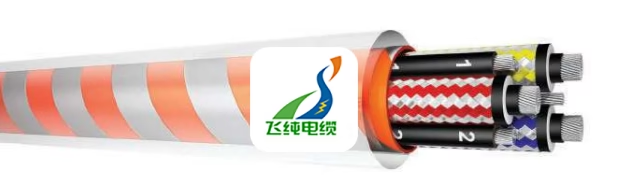
Comprehensive professional guide to the TYPE 441-LED — a world-first self-powered LED illuminated trailing and reeling cable manufactured to AS/NZS 2802:2000 — covering the complete technology behind electromagnetic induction energy harvesting (≥ 3.3 kV variants) and internal solid-state capacitive shunt (1.1 kV variants) that powers an integrated warning-red (620–630 nm) LED strip through a proprietary translucent flame-retardant thermoplastic polyurethane (FR-TPU) outer sheath, delivering continuous high-visibility cable path delineation in underground coal mines without any external DC power supply, gate end box modifications, or additional switchgear: detailed breakdown of the integrated multi-layer surge protection system (magnetic saturation pickup coil, TVS diodes, Zener/LDO regulation, PTC resettable fuses on polyimide FPC with epoxy/silicone IP68+ potting and aramid stress-isolation braid), translucent FR-TPU sheath technology (3–5× abrasion resistance vs conventional CPE/CR chloroprene rubber, halogen-free flame retardancy to AS/NZS 1802 Cl. 13.2, UV/ozone/chemical resistance), full Australian and international standards compliance (AS/NZS 2802:2000, AS/NZS 1802:2003, AS/NZS 60079.11 intrinsic safety, AS/NZS 3808 Group I methane, IEC 60502), dimensional and electrical data across 1.1 kV / 3.3 kV / 6.6 kV / 11 kV voltage classes with conductor sizes from 6 mm² to 150 mm², and the operational benefits of plug-and-play deployment for mine operators seeking to improve underground roadway visibility, personnel safety during ventilation-failure and smoke scenarios, and energisation status indication for LOTO (lock-out/tag-out) procedures — manufactured by Anhui Feichun Special Cable Co., Ltd., a dedicated mining cable specialist with proven AS/NZS 2802 manufacturing capability, in-house EPR compounding, continuous vulcanization, and dynamic flexing test infrastructure.

TYPE 441-LED Self-Powered Illuminated Mining Cable

Comprehensive professional guide to the TYPE 441-LED — a world-first self-powered LED illuminated trailing and reeling cable manufactured to AS/NZS 2802:2000 — covering the complete technology behind electromagnetic induction energy harvesting (≥ 3.3 kV variants) and internal solid-state capacitive shunt (1.1 kV variants) that powers an integrated warning-red (620–630 nm) LED strip through a proprietary translucent flame-retardant thermoplastic polyurethane (FR-TPU) outer sheath, delivering continuous high-visibility cable path delineation in underground coal mines without any external DC power supply, gate end box modifications, or additional switchgear: detailed breakdown of the integrated multi-layer surge protection system (magnetic saturation pickup coil, TVS diodes, Zener/LDO regulation, PTC resettable fuses on polyimide FPC with epoxy/silicone IP68+ potting and aramid stress-isolation braid), translucent FR-TPU sheath technology (3–5× abrasion resistance vs conventional CPE/CR chloroprene rubber, halogen-free flame retardancy to AS/NZS 1802 Cl. 13.2, UV/ozone/chemical resistance), full Australian and international standards compliance (AS/NZS 2802:2000, AS/NZS 1802:2003, AS/NZS 60079.11 intrinsic safety, AS/NZS 3808 Group I methane, IEC 60502), dimensional and electrical data across 1.1 kV / 3.3 kV / 6.6 kV / 11 kV voltage classes with conductor sizes from 6 mm² to 150 mm², and the operational benefits of plug-and-play deployment for mine operators seeking to improve underground roadway visibility, personnel safety during ventilation-failure and smoke scenarios, and energisation status indication for LOTO (lock-out/tag-out) procedures — manufactured by Anhui Feichun Special Cable Co., Ltd., a dedicated mining cable specialist with proven AS/NZS 2802 manufacturing capability, in-house EPR compounding, continuous vulcanization, and dynamic flexing test infrastructure.
IT earthing—where "I" stands for Isolated and "T" represents Terre (earth/ground)—refers to an electrical power distribution system where the transformer's neutral point is either completely isolated from ground or connected to ground through a high-impedance resistor or inductor. This design philosophy is fundamentally different from the TN earthing systems dominant in Europe and North America, where the neutral is directly grounded at low impedance (typically

IT Earthing Systems: Why Australian Mining Cables Must Be Rated for Phase-to-Phase Voltage (Uo=U)

IT earthing system, Australian mining cables, Uo=U voltage rating, phase-to-phase voltage, AS/NZS 2802, AS/NZS 1802, AS/NZS 3007, underground mining cables, surface mining cables, trailing cables, reeling cables, heavy duty flexible cables, mining electrical engineering, ungrounded power systems, single phase to earth fault, earth fault overvoltage, insulation stress, cable dielectric strength, power cable specifications, mining cable cross section, AWG to mm2, cable outer diameter, copper weight, cable weight, current carrying capacity, cable ampacity, EPR insulated cable, PCP sheathed cable, TPU mining cable, medium voltage mining, low voltage mining, mine power distribution, continuous mine operation, fault tolerant power, mine safety standards, Australian mine safety, electrical hazards mining, Type 275 trailing cable, Type 241 reeling cable, Type 441 cable, Type 209 cable, earth continuity conductor, pilot core mining, earth leakage relay, neutral point earthing, isolated neutral system, mine electrical design, flexible power transmission, heavy industrial cables, mining infrastructure
Type SHD-GC 3/C #1 AWG 8kV trailing cable has a DC resistance of approximately 0.161 ohms per kilometer measured at the reference temperature of 20°C (68°F). This DC resistance value represents the pure ohmic resistance of the copper conductor when direct current flows through it—a condition that occurs in short-circuit analysis and DC testing procedures. However, when this same cable carries the alternating current typical of mining equipment operations (at the standard operating temperature of 90°C), the AC resistance increases to approximately 0.363 ohms per kilometer due to the combined effects of temperature rise and skin effect phenomena. The substantial difference between 0.161 Ω/km (DC, 20°C) and 0.363 Ω/km (AC, 90°C)—more than a 2.25 times increase—demonstrates a critical principle that engineers must account for in real-world voltage drop calculations: laboratory DC resistance values are not directly applicable to field voltage drop analysis. The cable features three 107.2 mm² (1 AWG equivalent) phase conductors of Class 5 tinned copper, with an additional ground-check conductor for continuous monitoring of cable integrity during operation, an outer diameter of approximately 53–58 mm, and a total weight of approximately 6,200–6,800 kg/km. Understanding both the DC baseline resistance and the elevated AC resistance at operating temperature is essential for accurately predicting voltage drop over long cable runs in open-pit mining operations where power distribution distances frequently exceed 500 meters.

Voltage Drop Calculation: Resistance (Ohms/km) for Type SHD-GC 3/C #1 AWG 8kV Trailing Cable

Type SHD-GC 3/C #1 AWG 8kV trailing cable has a DC resistance of approximately 0.161 ohms per kilometer measured at the reference temperature of 20°C (68°F). This DC resistance value represents the pure ohmic resistance of the copper conductor when direct current flows through it—a condition that occurs in short-circuit analysis and DC testing procedures. However, when this same cable carries the alternating current typical of mining equipment operations (at the standard operating temperature of 90°C), the AC resistance increases to approximately 0.363 ohms per kilometer due to the combined effects of temperature rise and skin effect phenomena. The substantial difference between 0.161 Ω/km (DC, 20°C) and 0.363 Ω/km (AC, 90°C)—more than a 2.25 times increase—demonstrates a critical principle that engineers must account for in real-world voltage drop calculations: laboratory DC resistance values are not directly applicable to field voltage drop analysis. The cable features three 107.2 mm² (1 AWG equivalent) phase conductors of Class 5 tinned copper, with an additional ground-check conductor for continuous monitoring of cable integrity during operation, an outer diameter of approximately 53–58 mm, and a total weight of approximately 6,200–6,800 kg/km. Understanding both the DC baseline resistance and the elevated AC resistance at operating temperature is essential for accurately predicting voltage drop over long cable runs in open-pit mining operations where power distribution distances frequently exceed 500 meters.
Type G-GC 3/C #2 AWG cable is a three-conductor power cable with an integrated pilot ground-check conductor designed specifically for underground mine power distribution and earth fault monitoring applications. The three main conductors each measure 33.3 mm² (2 AWG) cross-sectional area and carry three-phase power distribution. The pilot ground-check conductor measures 4 mm² (12 AWG equivalent) and serves as an independent monitoring channel for earth fault detection. The overall cable outer diameter (OD) is typically 18.5 mm to 20.0 mm (0.73 to 0.79 inches) depending on the specific insulation system. The overall weight is approximately 850 kg/km (570 lbs/1000ft). The cable outer sheath is typically XLPE (cross-linked polyethylene) rated for 600 volts continuous service with a safety protocol compliant with DIN VDE 0482-335-2 and IEEE 1202 standards for mine cables. The pilot conductor resistance is approximately 5.2 ohms per kilometer, which establishes the baseline sensitivity for ground fault detection circuits. The capacitance between main conductors and the pilot conductor is typically 120–140 pF/m, a critical parameter that determines the transient response characteristics of the earth fault detection relay.

Earth Fault Monitoring: How does the pilot ground-check conductor in Type G-GC 3/C #2 AWG integrate with mine safety relays? Understanding dual-channel earth fault detection and safety-critical relay logic

Type G-GC 3/C #2 AWG cable is a three-conductor power cable with an integrated pilot ground-check conductor designed specifically for underground mine power distribution and earth fault monitoring applications. The three main conductors each measure 33.3 mm² (2 AWG) cross-sectional area and carry three-phase power distribution. The pilot ground-check conductor measures 4 mm² (12 AWG equivalent) and serves as an independent monitoring channel for earth fault detection. The overall cable outer diameter (OD) is typically 18.5 mm to 20.0 mm (0.73 to 0.79 inches) depending on the specific insulation system. The overall weight is approximately 850 kg/km (570 lbs/1000ft). The cable outer sheath is typically XLPE (cross-linked polyethylene) rated for 600 volts continuous service with a safety protocol compliant with DIN VDE 0482-335-2 and IEEE 1202 standards for mine cables. The pilot conductor resistance is approximately 5.2 ohms per kilometer, which establishes the baseline sensitivity for ground fault detection circuits. The capacitance between main conductors and the pilot conductor is typically 120–140 pF/m, a critical parameter that determines the transient response characteristics of the earth fault detection relay.
The straightforward answer to whether Type SHD-GC 3/C 250 MCM 25kV cable can handle continuous dragging on sharp granite rocks is: not completely immune—it must be combined with physical protection. The 400-ampere continuous rating at 40°C ambient represents the maximum electrical current capacity under controlled installation conditions. However, the cable's 25 kV service capability and class-leading durability of the extra-heavy-duty CPE or TPU jacket cannot overcome the fundamental physics of sharp granite edges acting like cutting blades under thousands of tons of dynamic dragging tension. When a cable is dragged repeatedly across sharp granite surfaces, the pulling tension (often 5,000–8,000 newtons for large draglines) creates extremely high localized shear stress at every point where the cable edge contacts the rock. Over hours and days of continuous operation, this shear stress gradually thins the outer sheath, cutting through the protective layers, damaging the inner copper shield, allowing moisture and conductive mud to penetrate the insulation, and inevitably leading to partial discharge, electrical tracking, and eventually cable failure or catastrophic blowout at 25 kV. No cable jacket material—no matter how premium the grade—can indefinitely withstand continuous contact with sharp, hard-rock surfaces under high mechanical tension.

Draglines & Shovels: Can Type SHD-GC 3/C 250 MCM 25kV handle continuous dragging on sharp granite rocks?

The straightforward answer to whether Type SHD-GC 3/C 250 MCM 25kV cable can handle continuous dragging on sharp granite rocks is: not completely immune—it must be combined with physical protection. The 400-ampere continuous rating at 40°C ambient represents the maximum electrical current capacity under controlled installation conditions. However, the cable’s 25 kV service capability and class-leading durability of the extra-heavy-duty CPE or TPU jacket cannot overcome the fundamental physics of sharp granite edges acting like cutting blades under thousands of tons of dynamic dragging tension. When a cable is dragged repeatedly across sharp granite surfaces, the pulling tension (often 5,000–8,000 newtons for large draglines) creates extremely high localized shear stress at every point where the cable edge contacts the rock. Over hours and days of continuous operation, this shear stress gradually thins the outer sheath, cutting through the protective layers, damaging the inner copper shield, allowing moisture and conductive mud to penetrate the insulation, and inevitably leading to partial discharge, electrical tracking, and eventually cable failure or catastrophic blowout at 25 kV. No cable jacket material—no matter how premium the grade—can indefinitely withstand continuous contact with sharp, hard-rock surfaces under high mechanical tension.
Mining Cable

What is UNE 22510:1996 Mining Cables?

UNE 22510:1996 is a Spanish national standard published by the Spanish Association for Standardization and Certification (AENOR) that specifies comprehensive requirements for electric cables designed for underground mining operations. This standard, classified under ICS categories 29.060.20 (Cables) and 73.100.99 (Other mining equipment), establishes rigorous guidelines for cable construction, performance, and safety in hazardous mining environments.
Mining Cable

Mining Cable: Comprehensive Glossary of Cable Terms

Mining cables represent one of the most demanding applications in the electrical cable industry, requiring exceptional durability, flexibility, and safety features to withstand the harsh conditions found in underground and surface mining operations. This comprehensive glossary provides essential technical terminology and specifications for mining cable professionals, engineers, and procurement specialists. According to Feichun Cable, mining operations worldwide depend on specialized cables that meet stringent international standards including MSHA (Mine Safety and Health Administration), IEC (International Electrotechnical Commission), and CSA (Canadian Standards Association) certifications to ensure worker safety and operational reliability in extreme environments.
(N)TSCGECEWÖU Mining Reeling Cable

What is a Type (N)TSCGECEWÖU MINING REELING Cable

Type (N)TSCGECEWÖU Mining Reeling Cable represents a specialized category of medium voltage flexible power cables engineered specifically for the demanding conditions found in underground mining operations and material handling equipment. This cable designation, while complex in nomenclature, follows the systematic German cable naming convention established by DIN VDE standards.
(N)TSCGEWÖU Mining Reeling Cable

What is a Type (N)TSCGEWÖU Cable?

The (N)TSCGEWÖU Mining Reeling Cable MT MIN F PLUS represents a pinnacle of engineering excellence in medium voltage power transmission for the most demanding industrial applications. Engineered specifically for mining operations and material handling equipment, this cable type is designed to withstand extreme mechanical stresses while maintaining reliable electrical performance in harsh environmental conditions.
Reeling & Trailing Cables for Cranes & Mining — Feichun Special Cable Blogs

What Are the Differences Between the Various Cable Types in International Standards?

International mining operations require specialized cables complying with diverse regional standards including European VDE, British BS, Australian AS/NZS, and International IEC specifications. This comprehensive technical guide examines the critical differences between major international standard mining cable types, covering construction specifications, material requirements, compliance frameworks, electrical characteristics, safety requirements, and optimal applications across global mining operations in Europe, Australia, Asia, Africa, and South America.
DIN-VDE-0250-812

DIN VDE 0250 Part 812 NSSHÖU Rubber Insulated Flexible Cables

DIN VDE 0250 p.812 superseded VDE 0250/03.69 §812 with a transition period ending October 31, 1985. This standard eliminated the 6kV rated voltage construction and established the current NSSHÖU specifications as an independent standard within the DIN VDE 0250 series.
SHD GC CABLE

What is SHD-GC 2/0 AWG 2 kV Cable?

SHD-GC 2/0 AWG 2 kV cable is a heavy-duty, MSHA-approved portable power cable specifically engineered for extreme mining and tunneling environments. Featuring EPR insulation and TPU jacketing, this cable delivers reliable power transmission for draglines, shovels, dredges, and mobile mining equipment in the harshest conditions.
Reeling & Trailing Cables for Cranes & Mining — Feichun Special Cable Blogs

What is FEICHUN PROTOLON (SB) NTSCGEWOEU -45C 3,6/6KV Mining Trailing Cable?

PROTOLON (SB) NTSCGEWOEU -45C 3,6/6KV is a premium medium voltage trailing cable engineered for the most demanding mining applications. The “SB” (Special Build) designation indicates this cable is specifically designed for extreme mechanical stresses encountered in trailing operations behind large excavators and draglines in open-cast mines. Featuring advanced PROTOLON insulation technology, polychloroprene double-sheath construction, polyester mesh reinforcement, and split earth conductor design, this cable delivers exceptional durability and cold flexibility down to -45°C.
What is TENAX-SAS (N)TSCGEWOEU 3,6/6KV Mining Trailing Cable for Cold Environments?

What is TENAX-SAS (N)TSCGEWOEU 3,6/6KV Mining Trailing Cable for Cold Environments?

TENAX-SAS (N)TSCGEWOEU 3,6/6KV is a specialized cold-flexible mining trailing cable engineered to maintain complete flexibility and reliable power transmission in extreme arctic conditions down to -50°C. Designed for shovels, draglines, and mobile mining equipment, this robust cable delivers exceptional performance in both trailing and reeling applications where conventional cables would fail due to cold-weather brittleness.
(N)TSCGEWOEU

25kV SHD-GC Advanced TPU Flexible Power Cable | High Voltage Dragline Mining Cable – Feichun Special Cables

Advanced SHD-GC 25kV portable power cable with premium TPU jacket combining ultra-high voltage capacity with superior flexibility. Ideal for draglines, large shovels, automated mining equipment. Lightweight construction, exceptional abrasion resistance, ICEA S-75-381 certified.
NSSHCGEOEU 0.6/1kV High Tensile Coal Cutter Cables - Complete Technical Guide & International Standards | Feichun Special Cables

Ultimate 5kV SHD-GC TPU Premium Cable with Ground Check | Dragline, Shovel, Dredge Elite Solution | 20+ Year Service Life | Feichun Cables

Ultimate SHD-GC 5kV portable power cable combining premium TPU jacket, ground check monitoring, and high-voltage efficiency. Dragline excavators, electric shovels, dredges, drilling rigs demanding maximum performance and longevity. 3-5× abrasion resistance, 20+ year service life, -40°C to +90°C operation. 11 sizes 3×6 AWG to 3×500 kcmil, 93-536A. ICEA S-75-381 certified ultimate mining cable.
Reeling & Trailing Cables for Cranes & Mining — Feichun Special Cable Blogs

5kV SHD-CGC Portable Power Cable with Ground Check Conductor | Electric Shovel Safety Cable | Dragline Ground Monitoring | High-Voltage Surface Mining | Feichun Cables

Premium 5kV SHD-CGC three-conductor portable cable integrating high-voltage power transmission with ground check monitoring for surface mining. Electric shovels, dragline excavators, mobile crushers, bucket wheel reclaimers. Yellow ground check conductor, conductor shield layer, EPR insulation. ICEA S-75-381 certified. Four sizes 3×2/0 to 3×350 kcmil, ampacity 243-435A.