What is TENAX-SAS (N)TSCGEWOEU 3,6/6KV Mining Trailing Cable for Cold Environments?
Table of Contents
Introduction to TENAX-SAS Cold-Flexible Mining Cable
In arctic and extreme cold-weather mining operations, standard electrical cables face a critical challenge: as temperatures plummet, conventional cable materials become stiff, brittle, and prone to cracking or catastrophic failure. The TENAX-SAS (N)TSCGEWOEU 3,6/6KV represents Prysmian Group’s engineering solution to this challenge, delivering a medium-voltage trailing cable that maintains full flexibility and mechanical integrity even at temperatures as low as -50°C.
This specialized cable is essential for mining operations in regions such as Siberia, Arctic Canada, Alaska, Scandinavia, and other high-latitude locations where winter temperatures regularly drop to extreme levels. Where standard cables would freeze and crack under repeated flexing, the TENAX-SAS continues to perform reliably, ensuring uninterrupted power supply to critical mobile mining equipment.
The Arctic Mining Challenge
Arctic and sub-arctic regions contain vast mineral wealth—including 22% of the world’s undiscovered recoverable resources and significant portions of global oil, gas, and mineral deposits. However, extreme temperatures cause normal cables to become stiff and brittle in intense cold, creating operational and safety hazards. The TENAX-SAS cable addresses this critical need with specialized rubber compounds that remain flexible even in the harshest conditions.
Purpose and Applications
Primary Applications
The TENAX-SAS cable serves as a critical power supply solution for demanding mining applications where cold flexibility is essential:
- Electric Shovels: Powers large excavating equipment in surface mining operations, providing reliable electrical supply through all weather conditions and seasonal temperature variations
- Draglines: Delivers high-voltage power to massive earthmoving equipment used in strip mining and open-pit operations, withstanding the mechanical stresses of trailing and reeling applications
- Mobile Equipment: Supplies energy to portable mining machinery including drills, conveyors, and material handling equipment that must operate year-round in cold climates
- Reeling Applications: Specifically designed for cable reels and festoon systems where repeated winding, unwinding, and flexing occur in sub-zero temperatures
- Arctic Mining Operations: Essential infrastructure for mines in Alaska, northern Canada, Siberia, Scandinavia, and other arctic regions where conventional cables would fail
Why Cold Flexibility Matters
At low temperatures, standard cable materials undergo physical changes that dramatically affect performance:
- Material Embrittlement: Insulation and sheath materials lose elasticity and become rigid, leading to cracking under mechanical stress
- Increased Failure Risk: Brittle cables are susceptible to insulation breakdown when bent, twisted, or subjected to impact
- Safety Hazards: Cracked insulation can expose conductors, creating electrocution risks and potential for arc flash incidents
- Operational Downtime: Cable failures in extreme cold require costly emergency repairs and halt production
- Shortened Service Life: Temperature cycling causes fatigue damage that accelerates cable deterioration
The TENAX-SAS cable’s specialized rubber compounds maintain flexibility and mechanical properties across the full temperature range from +60°C to -50°C, eliminating these failure modes.
Target Mining Environments
This cable is specifically designed for large material handling machines operating under extremely high mechanical stresses in open-cast mines, including:
- Surface coal mines in cold-climate regions
- Arctic oil sands extraction operations
- Northern iron ore and copper mining
- Siberian mineral extraction facilities
- Alaskan gold and precious metal mining
- Canadian diamond mining operations
- Scandinavian mining operations
Key Characteristics and Features
❄️ Extreme Cold Flexibility
Maintains full flexibility down to -50°C with specialized rubber compounds designed for arctic conditions
💪 Superior Mechanical Strength
Extremely robust outer sheath resistant to abrasion, tearing, crushing, and impact damage
🔄 Reeling & Trailing Capability
Optimized for both trailing and reeling applications with excellent fatigue resistance
⚡ Medium Voltage Rating
3.6/6 kV rated voltage for reliable power transmission to large mining equipment
🌡️ Wide Temperature Range
Operates from -50°C to +60°C in flexible applications, +80°C for fixed installations
🛡️ Multi-Layer Protection
EPR insulation with semiconductive layers and special rubber sheath for maximum durability
Temperature Performance Visualization
Operating Temperature Range:
■ Flexible Operation: -50°C to +60°C
■ Fixed Installation: -50°C to +80°C
Technical Performance Specifications
| Performance Parameter | Specification |
|---|---|
| Cold Flexibility Temperature | Down to -50°C (fully flexible) |
| Maximum Conductor Temperature (Continuous) | 90°C |
| Short Circuit Temperature | 250°C maximum |
| Torsional Stress Resistance | ±100°/m |
| Permanent Tensile Strength | 25 N/mm² |
| Oil Resistance | Yes – resistant to hydraulic fluids |
| Ozone Resistance | Yes – prevents atmospheric degradation |
| UV Resistance | Yes – suitable for outdoor use |
| Flame Retardancy | EN/IEC 60332-1-2 compliant |
Material Structure and Cable Design
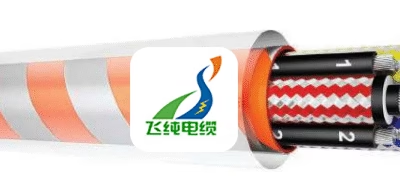
The TENAX-SAS cable employs a sophisticated multi-layer construction specifically engineered to maintain flexibility and electrical integrity in extreme cold while providing exceptional mechanical protection:
Layer-by-Layer Construction
- Conductor Core:
- Finely stranded tinned copper conductors, Class 5 per DIN EN 60228/IEC 60228
- Tinning prevents oxidation and maintains conductivity in harsh environments
- Fine stranding (Class 5) provides maximum flexibility for repeated bending and coiling
- Available in sizes from 16 mm² to 300 mm² depending on power requirements
- Conductor Shield (Inner Semiconductive Layer):
- Special semiconductive EPR (Ethylene Propylene Rubber) compound
- Ensures uniform electrical field distribution around conductor
- Prevents partial discharge and corona formation
- Maintains properties across full temperature range
- Core Insulation:
- EPR rubber with special compound 3GI3 formulation
- This specialized compound maintains flexibility at -50°C while providing excellent electrical insulation
- Resistant to ozone, oil, water, solvents, and corrosive substances
- Superior mechanical properties including tear and abrasion resistance
- Insulation Shield (Outer Semiconductive Layer):
- Semiconductive NBR (Nitrile Butadiene Rubber) with easy-strip design
- Facilitates cable termination and splicing operations
- Provides additional protection to insulation layer
- Maintains conductivity across temperature extremes
- Cable Core Assembly:
- Power cores laid up around conductive central support element
- Aramid rope in the center provides mechanical strength and prevents core deformation
- Includes pilot/control conductor: tinned copper Class 5 with EPR insulation
- Ground/earth conductors integrated for safety grounding
- Inner Sheath:
- EPR rubber with special compound 5GM3
- Provides first layer of mechanical protection
- Maintains flexibility in extreme cold
- Acts as moisture barrier
- Outer Sheath:
- Special rubber compound >5GM3 – the key to cold flexibility
- Extremely robust and tough against abrasion and tearing
- Engineered specifically to remain pliable at -50°C
- Resistant to oils, chemicals, UV radiation, and weathering
- Black color for durability and professional appearance
Material Innovation: Cold-Flexible Compounds
The breakthrough in cold-flexible cable technology lies in the specialized rubber compound formulations used for both insulation and sheathing. Standard cables become stiff and brittle in intense cold, but rubber-based cables with specially formulated EPR compounds remain highly flexible and resistant. These proprietary compounds incorporate plasticizers and polymer blends that prevent crystallization and maintain elasticity even at -50°C, while still providing excellent electrical properties and mechanical protection.
Available Cable Configurations
The TENAX-SAS cable is manufactured in a wide range of conductor sizes to match different equipment power requirements:
| Basic Construction | Conductor Diameter | Cable Diameter (Min-Max) | Weight |
|---|---|---|---|
| 3×16+2×10+1×10 | 5 mm | 41-45 mm | 2270 kg/km |
| 3×25+2×16+1×16 | 6.2 mm | 43.5-47.5 mm | 2790 kg/km |
| 3×35+2×16+1×16 | 7.5 mm | 46.5-50 mm | 3280 kg/km |
| 3×70+2×25+1×16 | 10.6 mm | 55-59.5 mm | 5020 kg/km |
| 3×95+2×25+1×16 | 12.6 mm | 58.5-63 mm | 5860 kg/km |
| 3×150+2×35+1×16 | 16 mm | 69.8-73.4 mm | 8456 kg/km |
| 3×185+2×50+1×16 | 17.7 mm | 72.7-77.2 mm | 9955 kg/km |
| 3×240+2×70+1×16 | 20.3 mm | 80.1-84.6 mm | 12618 kg/km |
| 3×300+2×95+1×16 | 31.3 mm | 84-89 mm | 15075 kg/km |
Note: The “3x” designation indicates three power conductors, the “+2x” or “+3x” indicates ground/earth conductors, and “+1x” indicates the pilot/control conductor. This configuration provides comprehensive power transmission, safety grounding, and control signal capability.
Compliance with International Standards
The TENAX-SAS cable is manufactured and tested according to stringent international and regional standards, ensuring reliability and safety for global mining operations:
Applicable Standards and Certifications
- DIN VDE 0250-813: German standard for rubber-insulated cables with rated voltages up to 450/750V. This forms the foundational design basis for the cable construction
- DIN EN 60228 / IEC 60228 / VDE 0295: International standard for conductors of insulated cables, specifying conductor construction, stranding, and electrical resistance requirements. Ensures proper conductor design for flexibility and current carrying capacity
- DIN VDE 0207-21: German standard for identification of cores in cables and flexible cords, ensuring proper color coding and marking for safety
- DIN EN 60332-1-2 / IEC 60332-1-2: Tests on electric cables under fire conditions – Part 1-2: Test for vertical flame propagation for a single insulated wire or cable. Ensures the cable is flame retardant and will not propagate fire
- DIN VDE 0298-4: Use of cables and cords in power installations – Part 4: Recommended values for current-carrying capacity. Provides guidance for safe ampacity ratings based on installation conditions
- DIN EN 60811-404 / IEC 60811-404: Insulating and sheathing materials of electric and optical cables – Common test methods – Part 404: Miscellaneous tests – Mineral oil immersion tests for sheaths. Verifies oil resistance of cable materials
- GOST-R / GOST-K / GOST-BF Fire Certificate: Russian Federation fire safety certification, essential for operations in Russia and CIS countries where significant arctic mining occurs
Global Compliance Significance
These certifications are particularly important for arctic mining operations, which often span multiple jurisdictions including Russia, Canada, United States (Alaska), and Scandinavian countries. The combination of European (DIN/EN), international (IEC), and Russian (GOST) standards ensures the cable meets requirements for:
- Electrical safety and performance
- Fire safety in confined mining spaces
- Mechanical durability under extreme conditions
- Environmental compatibility and chemical resistance
- Quality control and manufacturing consistency
Safety Thresholds and Operating Parameters
Electrical Safety Parameters
| Parameter | Value | Description |
|---|---|---|
| Rated Voltage U0/U (Um) | 3.6/6 (7.2) kV | U0 = voltage to earth; U = voltage between phases; Um = maximum system voltage |
| Test Voltage | 11 kV | Withstand voltage during type testing to verify insulation integrity |
| Nominal Voltage | 6000 V | Standard operating voltage for medium-voltage mining equipment |
| Maximum Conductor Temperature | 90°C | Continuous operating temperature limit under normal load |
| Short Circuit Temperature | 250°C | Maximum permissible temperature during short circuit (5 seconds maximum duration) |
Environmental Operating Ranges
| Installation Type | Minimum Temperature | Maximum Temperature |
|---|---|---|
| Fixed Installation | -50°C | +80°C |
| Flexible/Mobile Operation | -50°C | +60°C |
Critical Cold-Weather Performance
The -50°C minimum temperature rating is not merely a survival specification—it represents the cable’s ability to maintain full flexibility, mechanical properties, and electrical performance at this extreme. Cold bend and impact testing at -50°C verifies the cable can be handled, flexed, and subjected to mechanical stress without damage. This is essential because mining operations cannot cease during extreme weather, and cable failures in sub-zero conditions create severe safety hazards.
Mechanical Safety Thresholds
Bending Radius Requirements
According to VDE 0298-3, minimum bending radius must be observed to prevent internal damage:
- Fixed Installation: 6 × D (where D = cable outer diameter)
- Flexible Operation: 10 × D minimum during use
- S-Type Directional Changes: 20 × D minimum distance between bends when cable changes direction in different planes
Example: For a 3×95 mm² cable with outer diameter of approximately 60.8 mm:
- Fixed installation: 365 mm minimum bend radius
- Flexible operation: 608 mm minimum bend radius
- S-type changes: 1,216 mm minimum spacing
Mechanical Stress Limits
- Torsional Stress: ±100°/m – the cable can withstand up to 100 degrees of twist per meter length in either direction
- Tensile Strength: 25 N/mm² permanent rating – ensures cable integrity under pulling forces during installation and operation
- Impact Resistance: Sheath designed to absorb impacts without damage to internal conductors, even at -50°C
- Abrasion Resistance: Special rubber compounds resist wear from dragging across rough surfaces
Chemical and Environmental Resistance
| Resistance Type | Rating | Significance |
|---|---|---|
| Oil Resistance | Yes | Withstands hydraulic fluids, lubricants, and petroleum products |
| Ozone Resistance | Yes | Prevents degradation from atmospheric ozone and electrical corona |
| UV Resistance | Yes | Extended outdoor exposure without material breakdown |
| Flame Retardancy | EN/IEC 60332-1-2 | Self-extinguishing properties for fire safety |
| Water Resistance | Suitable | Can withstand exposure to moisture, rain, snow, and ice |
Installation and Usage Precautions
Critical Safety Warning
High Voltage Hazard: The TENAX-SAS cable operates at medium voltage (6 kV). Improper installation, maintenance, or operation can result in severe electrical shock, arc flash incidents, equipment damage, and fatalities. All work must be performed by qualified electricians and mining electrical personnel following established safety procedures, lockout/tagout protocols, and local regulations.
Pre-Installation Planning
- Environmental Assessment:
- Verify actual minimum operating temperatures for the installation location
- Assess exposure to wind chill, ice formation, and snow accumulation
- Evaluate terrain roughness and potential for cable abrasion
- Identify crossing points and potential hazards from mobile equipment
- Cable Route Design:
- Plan routes that minimize exposure to mechanical damage
- Avoid areas where falling rocks or material could strike the cable
- Provide adequate drainage to prevent ice formation around cable
- Design routes allowing minimum bending radius compliance
- Consider seasonal changes in mining operations and equipment positioning
- Support System Selection:
- Choose cable reels, festoon systems, or support towers appropriate for cable weight
- Ensure support equipment functions reliably at -50°C
- Verify adequate clearance for cable movement during equipment operation
- Install systems that prevent cable dragging on frozen ground
Installation Best Practices
Temperature Considerations During Installation
Important: While the TENAX-SAS maintains flexibility at -50°C, installation is ideally performed at temperatures above -20°C when practical. At extreme cold:
- Handle cable more gently to avoid impact damage
- Allow extra time for cable to flex and position naturally
- Warm termination areas before making connections
- Use cold-rated tools and equipment
- Protect exposed conductor areas from moisture that could freeze
Bending and Routing
- Minimum Bending Radius Compliance: Always maintain 10 × D minimum for flexible applications. Mark acceptable bending radius on installation drawings
- Avoid Sharp Transitions: Use cable guides, pulleys, or rounded support points at direction changes. Never allow cable to bend around sharp edges or corners
- S-Curve Spacing: When cable must change direction in different planes (forming an S-curve), maintain 20 × D minimum distance between bend points
- Strain Relief: Provide adequate cable slack and strain relief at equipment connections to prevent tensile stress on terminations
Termination and Connections
- Use Approved Components: Only use connectors, terminations, and splicing kits approved by the manufacturer and rated for -50°C operation
- Environmental Sealing: All connections must be properly sealed against moisture, snow, and ice infiltration. Water ingress followed by freezing can damage connections
- Mechanical Support: Provide robust mechanical support for all connections to prevent strain on electrical joints during cable movement
- Easy-Strip Layer: The semiconductive NBR outer layer is designed for easy stripping during termination. Follow manufacturer instructions for proper stripping techniques
Operational Precautions
Cold Weather Operations
- Pre-Operation Inspection: Before energizing equipment in extreme cold, visually inspect entire cable length for:
- Ice or snow accumulation causing weight stress
- Visible damage from freeze-thaw cycles
- Proper positioning away from traffic areas
- Secure connections and terminations
- Gradual Energization: In extreme cold conditions, consider gradual voltage application to allow any residual moisture to evaporate
- Movement in Cold: While the cable maintains flexibility, allow slightly more time for cable movement and positioning in extreme cold compared to normal temperatures
Reeling Operations
- Reel Speed: The cable is suitable for high travel speeds and dynamic tensile loads in reeling applications, but reduce speeds in extreme cold to minimize stress
- Spooling: Maintain even spooling on reels to prevent cable damage from uneven layers. This is especially important in cold weather when ice can form between layers
- Reel Maintenance: Keep cable reels and festoon systems free of ice accumulation that could interfere with operation
Maintenance Requirements
- Regular Inspection Schedule:
- Daily visual inspection by equipment operators
- Weekly detailed inspection of high-stress areas
- Monthly comprehensive inspection including connections
- Quarterly electrical testing (insulation resistance, continuity)
- Annual complete system evaluation and testing
- Inspection Focus Areas:
- Sheath condition: cracks, abrasion, cuts, or deformation
- Areas of repeated flexing for fatigue signs
- Connection integrity and environmental sealing
- Ground conductor continuity
- Signs of internal damage (bulging, discoloration)
- Support system condition and proper cable positioning
- Documentation:
- Maintain detailed records of all inspections and tests
- Document any damage found and repairs performed
- Track cable service life and environmental exposure
- Record temperature extremes experienced
Damage Response Protocol
Immediate Action Required: If cable damage is detected:
- Immediately de-energize the affected circuit using proper lockout/tagout procedures
- Mark damaged cable area clearly with high-visibility warning signs
- Barricade the area to prevent personnel exposure to damaged cable
- Contact qualified electrical maintenance personnel
- Do not attempt temporary repairs on energized cables
- Replace or professionally repair damaged sections before returning to service
Common Problems and Solutions
1. Cold-Weather Material Performance Issues
Problem: Although TENAX-SAS is designed for -50°C, improper handling, installation defects, or extreme temperature cycling can still cause problems.
Symptoms:
- Reduced flexibility in extreme cold
- Surface crazing or fine cracks in sheath
- Unusual stiffness during cable movement
- Difficulty coiling or positioning cable
Causes:
- Cable stored or installed incorrectly before use
- Damage during transport or handling
- Using cables past their design service life
- Exposure to temperatures below -50°C
- Contamination with incompatible chemicals
Solutions:
- Verify cable storage conditions meet manufacturer specifications
- Inspect cables before installation, especially after cold storage
- Replace cables showing signs of material degradation
- Monitor actual operating temperatures to ensure they remain within specification
- Implement proper cable lifecycle management and retirement criteria
2. Ice and Snow Accumulation
Problem: Snow and ice buildup on cables adds weight, creates abrasion points, and can interfere with cable movement in reeling systems.
Causes:
- Cables running on or near ground level
- Poor drainage in cable routing areas
- Inadequate support allowing cable contact with snow
- Ice formation from water spray or condensation
Solutions:
- Route cables elevated above snow accumulation level where possible
- Design cable routes with consideration for prevailing wind and drifting snow
- Implement regular snow and ice removal procedures for cable routes
- Use heated cable trays or supports in critical areas
- Ensure adequate drainage to prevent water pooling and freezing
3. Mechanical Damage from Equipment
Problem: Cable damage from mobile equipment crushing, cutting, or impact remains a leading cause of failures even with robust cold-flexible cables.
Causes:
- Equipment operators losing sight of cable position in snow or poor visibility
- Cable positioning too close to equipment travel paths
- Inadequate cable protection at crossing points
- Falling objects from equipment buckets or conveyors
Solutions:
- Install highly visible cable markers and warning signs
- Consider luminescent marking tape for improved visibility in dark conditions
- Use cable crossover systems at designated crossing points
- Implement strict protocols for equipment movement near cables
- Train all equipment operators on cable awareness and damage prevention
- Install cable detection or proximity warning systems on mobile equipment
4. Connection and Termination Failures
Problem: Connections are vulnerable points in cold environments, subject to thermal cycling, moisture ingress, and mechanical stress.
Symptoms:
- Intermittent power loss
- Arcing or burning at connection points
- Corrosion visible on connectors
- Ice formation around connection housings
Causes:
- Inadequate environmental sealing
- Water entry followed by freezing and expansion
- Mechanical stress from cable movement
- Loose connections due to thermal cycling
- Use of non-cold-rated connection components
Solutions:
- Use only cold-rated connectors and termination kits
- Apply proper environmental sealing techniques and materials
- Provide robust mechanical support and strain relief at all connections
- Implement more frequent inspection cycles for connections in extreme cold
- Consider heated connection enclosures for critical connections
- Re-torque connections after initial cold exposure and periodically thereafter
5. Reeling System Complications
Problem: Cable reel systems face unique challenges in arctic conditions including frozen reels, ice buildup between cable layers, and difficulty with cable spooling.
Causes:
- Ice and snow accumulation on reel mechanisms
- Frozen or sluggish reel drive systems
- Moisture between cable layers freezing solid
- Increased friction from cold temperatures
Solutions:
- Use reel systems specifically designed and lubricated for arctic conditions
- Implement reel heating systems for extreme conditions
- Keep reels and cable layers clear of snow and ice accumulation
- Reduce reel speed in extreme cold to minimize mechanical stress
- Regular maintenance of reel drive systems with cold-appropriate lubricants
- Consider enclosing critical reel systems in heated shelters
6. Abrasion and Chafing
Problem: Abrasion and chaffing stresses are particularly problematic in trailing operations, and frozen ground or ice-covered surfaces can increase abrasion rates.
Causes:
- Cable dragging across frozen, rough terrain
- Contact with sharp ice formations
- Repeated flexing over frozen support points
- Inadequate support allowing ground contact
Solutions:
- Use cable protection sleeves in high-abrasion areas
- Provide smooth support surfaces at all contact points
- Regular inspection and repositioning to prevent concentrated wear
- Implement cable rotation schedules to distribute wear
- Upgrade to larger cable sizes if current sizing inadequate for application stresses
7. Insulation Resistance Degradation
Problem: Over time, insulation resistance can decrease due to moisture ingress, thermal cycling, or material aging, particularly in harsh arctic environments.
Symptoms:
- Decreasing insulation resistance test results
- Nuisance tripping of ground fault protection
- Equipment leakage current increases
Causes:
- Micro-cracks from repeated freeze-thaw cycles
- Moisture migration into insulation
- Contamination with conductive materials
- Material degradation from UV, ozone, or chemical exposure
Solutions:
- Conduct regular insulation resistance testing (megger testing)
- Establish baseline values and acceptable degradation limits
- Remove cables from service when insulation resistance falls below acceptable levels
- Investigate and repair any sources of moisture ingress
- Implement predictive maintenance programs to detect gradual degradation
Conclusion
The TENAX-SAS (N)TSCGEWOEU 3,6/6KV Mining Trailing Cable represents a critical enabling technology for mining operations in arctic and extreme cold-weather environments. By maintaining full flexibility and reliable performance at temperatures down to -50°C, this specialized cable ensures uninterrupted power supply to essential mobile mining equipment where conventional cables would fail.
Key advantages of the TENAX-SAS cable include:
- Proven Cold Performance: Specialized rubber compounds maintain flexibility and mechanical properties in extreme arctic conditions
- Exceptional Durability: Multi-layer construction with robust sheathing resists abrasion, tearing, and environmental degradation
- Comprehensive Safety Compliance: Meets stringent international and regional standards including DIN VDE, IEC, and GOST certifications
- Versatile Applications: Suitable for trailing, reeling, and festoon systems serving draglines, shovels, and mobile equipment
- Chemical Resistance: Withstands oils, ozone, UV radiation, and other harsh environmental factors
Successful deployment of TENAX-SAS cables requires attention to proper installation practices, adherence to minimum bending radius requirements, use of cold-rated connection components, and implementation of rigorous maintenance programs. Temperature monitoring, regular inspection, and prompt response to any damage are essential for maximizing cable service life and maintaining operational safety.
For mining companies operating in Siberia, Arctic Canada, Alaska, Scandinavia, and other extreme-cold regions, the TENAX-SAS trailing cable provides a reliable solution backed by Prysmian Group’s expertise in specialized cable engineering. Its ability to perform consistently through arctic winters, maintain safety in hazardous conditions, and minimize costly downtime makes it an indispensable component of modern cold-climate mining operations.
As arctic resource development continues to expand, with 22% of the world’s undiscovered recoverable resources located in the Far North, technologies like the TENAX-SAS cable will become increasingly critical to safe and efficient operations in these challenging environments.