
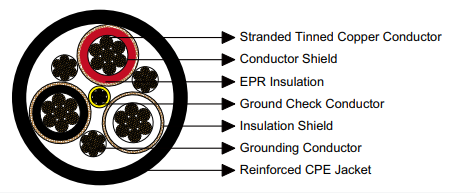
Premium 5kV SHD-CGC three-conductor portable cable integrating high-voltage power transmission with ground check monitoring for surface mining. Electric shovels, dragline excavators, mobile crushers, bucket wheel reclaimers. Yellow ground check conductor, conductor shield layer, EPR insulation. ICEA S-75-381 certified. Four sizes 3×2/0 to 3×350 kcmil, ampacity 243-435A.
SHD-CGC Type Three-Conductor Round Portable Power Cable 5kV with Integrated Ground Check Conductor
High-Voltage Power Transmission with Continuous Ground Integrity Monitoring for Large-Scale Surface Mining Operations
Regulatory Compliance and High-Voltage Safety Standards
- ICEA S-75-381 / NEMA WC 58: Joint industry standard specifications for portable mining power cables with integrated ground check conductor monitoring systems for voltage classifications through 8kV service
- ASTM B 172: American Society for Testing and Materials specification governing rope-lay-stranded copper conductors utilizing bunch-stranded or concentric-stranded construction for high-ampacity applications
- ASTM B 33: Standard specification establishing requirements for tinned soft or annealed copper wire manufactured for electrical applications requiring corrosion resistance in outdoor surface mining environments
- CAN/CSA C22.2 No. 96: Canadian Standards Association certification standard for portable power cables deployed in mining and heavy industrial environments with enhanced safety and high-voltage requirements
Synergistic Integration: High-Voltage Efficiency with Enhanced Safety Monitoring
The SHD-CGC 5kV cable series represents an advanced engineering solution addressing the apparently conflicting requirements of maximizing electrical system efficiency through elevated voltage operation while simultaneously enhancing personnel safety through continuous ground integrity supervision. This cable architecture delivers the technical and economic advantages of 5kV power distribution while implementing safety protection levels exceeding those typically available in lower-voltage mining installations.
5kV High-Voltage Advantages
- Reduced conductor current: 60% decrease versus 2kV for equivalent power transmission
- Resistive losses minimized: 64% reduction in I²R losses compared to 2kV systems
- Voltage drop optimization: Extended cable runs 300-500+ meters with acceptable regulation
- Conductor size reduction: Smaller, lighter conductors for equivalent power transmission capacity
- Motor efficiency: High-voltage motors achieve improved efficiency and power factor characteristics
- Economic advantage: Reduced copper content and cable weight lower material costs
Ground Check Safety Protection
- Continuous monitoring: Real-time ground integrity verification during equipment operation
- Instant fault detection: Immediate identification of grounding conductor failures or high-resistance connections
- Automatic disconnection: Ground monitoring relays trigger circuit breaker opening before hazardous voltages develop
- Yellow conductor identification: 16 AWG yellow-insulated conductor enables visual verification during installation
- Enhanced protection at 5kV: Critical safety monitoring for elevated voltage equipment where shock severity increases
- Regulatory alignment: Meets MSHA and international mining safety requirements for high-voltage equipment
For electric shovels with dipper capacities exceeding 40 cubic yards and dragline excavators with boom lengths surpassing 100 meters, power requirements frequently exceed 3 megawatts continuous operation. Transmitting this power at 2kV necessitates conductor currents approaching 1500 amperes, requiring impractically large conductor sizes with excessive weight complicating trailing cable reel system design. Operating at 5kV reduces conductor current to approximately 600 amperes, enabling practical cable configurations while the integrated ground check conductor ensures that the inherent safety risks of elevated voltage operation are continuously supervised and controlled.
Advanced Construction Engineering and High-Voltage Material Specifications
Power Conductor Architecture
Primary conductors manufactured using rope-lay stranded annealed copper with comprehensive tin plating applied to individual wire elements. Stranding configurations ranging from 323 to 888 strands provide exceptional flexibility for trailing cable reel applications while maintaining current-carrying capacity. Tin plating prevents copper oxidation during decades of outdoor exposure to surface mining environmental conditions.
Conductor Shield Layer
Semiconducting extruded layer applied directly over conductor stranding before primary insulation application. This conducting layer ensures uniform electric field distribution across the insulation system, eliminating voltage stress concentrations that could initiate tracking or partial discharge at 5kV voltage levels. Essential for long-term insulation reliability at elevated voltages.
Primary Insulation System
Ethylene Propylene Rubber (EPR) compound specifically formulated for 5kV voltage service with increased wall thickness (2.8-3.0mm versus 2.0mm in 2kV cables). EPR provides superior dielectric strength, excellent resistance to tracking and corona discharge, maintained flexibility across temperature extremes from -40°C to +90°C, and comprehensive immunity to outdoor environmental degradation including ultraviolet radiation and ozone exposure.
Insulation Shield System
Individual metallic shields constructed from tinned copper wire braided with reinforcing textile fibers encircle each power conductor above the primary insulation. These shields provide electrostatic screening essential for 5kV operation, reduce electromagnetic interference affecting ground monitoring circuits, and contribute mechanical reinforcement against abrasion damage from mineral particles in surface mining operations.
Yellow Ground Check Conductor
Dedicated 16 AWG tinned copper conductor with yellow thermoplastic insulation positioned at cable geometric center. Central placement ensures balanced mechanical properties during trailing cable reel winding and unwinding cycles. Yellow color coding facilitates immediate visual identification during high-voltage cable termination procedures where proper ground check conductor connection proves critical for safety monitoring functionality.
Equipment Grounding Conductor
Bare tinned copper grounding conductor sized proportional to power conductor ampacity (ranging from 5 AWG through 1 AWG) provides primary equipment grounding pathway for fault current return. Located adjacent to ground check conductor enabling monitoring relay circuits to detect grounding conductor resistance changes indicating incipient failures before complete ground circuit interruption occurs.
Reinforced Protective Jacket
Extra-heavy-duty Chlorinated Polyethylene (CPE) outer jacket formulated specifically for surface mining environmental exposure delivers comprehensive protection against ultraviolet radiation degradation, ozone aging, petroleum hydrocarbon contamination, mineral particle abrasion, and temperature cycling between -40°C and +60°C ambient conditions typical across global surface mining operations from arctic to desert environments.
Premium Jacketing Material Options for Extreme Environmental Conditions
While CPE represents the industry-standard jacketing material for general surface mining applications, alternative elastomeric compounds address specialized operational requirements encountered in particularly harsh environmental conditions. Chlorosulfonated Polyethylene (CSP) provides enhanced resistance to aggressive chemical exposure in copper and gold mining operations utilizing heap leaching or solvent extraction processes. Polychloroprene (PCP) delivers improved low-temperature flexibility critical for surface mining operations in arctic regions, high-altitude Andean mining, or Siberian mineral extraction where ambient temperatures regularly fall below -30°C.
Nitrile Butadiene Rubber (NBR) offers superior resistance to petroleum products, hydraulic fluids, and diesel fuel contamination prevalent around large mobile mining equipment requiring frequent refueling and hydraulic system maintenance. Polyvinyl Chloride (PVC) serves applications in moderate climates with controlled environmental conditions where cost optimization proves important. Thermoplastic Polyurethane (TPU) provides exceptional abrasion resistance combined with maintained flexibility across extreme temperature ranges, optimal for desert mining operations experiencing 50°C daytime temperatures and near-freezing nighttime conditions.
For installations in extremely abrasive environments with sharp rock fragments, equipment track damage risks, or repetitive crushing forces from cable routing under mobile equipment, a reinforced dual-layer jacket construction incorporating high-tenacity aramid or polyester textile fibers between inner and outer elastomeric layers substantially increases puncture resistance and extends cable service life. This premium construction proves particularly beneficial for trailing cable applications on electric shovels operating in hard rock copper, iron ore, or taconite mining where sharp mineral particles generate severe cable abrasion.
Thermal and Mechanical Performance Specifications for 5kV Operation
The 90°C continuous conductor operating temperature establishes the thermal boundary for sustained current-carrying operation at 5kV voltage levels. Maintaining conductor temperatures below this threshold through appropriate ampacity derating based on ambient temperature, solar radiation exposure, and duty cycle characteristics significantly extends EPR insulation service life by reducing thermal aging acceleration. Surface mining operations in desert environments experiencing 50°C ambient temperatures require substantial ampacity derating compared to operations in temperate or arctic climates.
The minimum bending radius specification prevents mechanical damage during cable installation around trailing cable reel drums and routing through equipment structures. For 5kV cables, maintaining proper bending radius proves particularly critical as excessive bending induces insulation stress concentrations potentially initiating tracking or partial discharge at elevated voltage levels. Trailing cable reel drum diameter selection must accommodate minimum bending radius requirements while ensuring adequate cable storage capacity for maximum equipment travel distances.
Complete Technical Specifications and Engineering Performance Data
| Cable Size (Cores × AWG/kcmil) | Conductor Strands | Equipment Ground (AWG/kcmil) | Ground Check (AWG/kcmil) | Insulation Wall (inch / mm) | Jacket Thickness (inch / mm) | Overall Diameter (inch / mm) | Linear Mass (lbs/kft / kg/km) | Ampacity (Amperes) |
|---|---|---|---|---|---|---|---|---|
| 3 × 2/0 AWG | 323 | 5 AWG | 16 AWG (Yellow) | 0.11 / 2.8 | 0.220 / 5.6 | 2.20 / 55.9 | 3716 / 5529 | 243 |
| 3 × 3/0 AWG | 418 | 4 AWG | 16 AWG (Yellow) | 0.11 / 2.8 | 0.235 / 6.0 | 2.36 / 59.9 | 4130 / 6145 | 279 |
| 3 × 4/0 AWG | 532 | 3 AWG | 16 AWG (Yellow) | 0.11 / 2.8 | 0.235 / 6.0 | 2.50 / 63.5 | 5190 / 7722 | 321 |
| 3 × 350 kcmil | 888 | 1 AWG | 16 AWG (Yellow) | 0.12 / 3.0 | 0.265 / 6.7 | 2.95 / 74.9 | 7571 / 11264 | 435 |
Ampacity Calculation Methodology for 5kV Surface Mining Applications: Current-carrying capacity ratings represent calculations performed according to ICEA S-75-381 standard procedures assuming 90°C maximum conductor operating temperature with 40°C ambient air temperature baseline. Surface mining installations experience highly variable ambient conditions requiring site-specific ampacity analysis. Desert operations with 50°C ambient temperatures and intense solar radiation require 25-30% ampacity derating. Arctic operations at -30°C ambient may permit modest ampacity increases but must account for reduced insulation flexibility during cable handling. Trailing cable reel installations with multiple cable layers experience thermal derating due to reduced heat dissipation from inner cable layers.
Trailing Cable Reel Integration and 5kV Safety Considerations
Trailing cable reel systems for large electric shovels and dragline excavators represent the primary deployment methodology for 5kV portable power cables in surface mining operations. These motorized reel assemblies manage several hundred meters of cable as equipment travels across mining benches, continuously winding and unwinding cable to maintain appropriate cable tension and prevent cable damage from equipment movement. The combination of 5kV voltage levels with mechanical stress from reeling operations demands rigorous attention to cable design, installation practices, and maintenance procedures.
The conductor shield layer and insulation shield system incorporated in SHD-CGC 5kV cables prove essential for trailing cable reel applications. Repeated cable bending cycles during winding and unwinding operations induce mechanical stress potentially creating micro-cracks in insulation systems lacking stress control layers. The semiconducting conductor shield ensures uniform voltage stress distribution preventing localized high-field regions that could initiate tracking. The metallic insulation shield provides additional mechanical reinforcement while enabling partial discharge detection monitoring for predictive maintenance programs.
Ground check conductor monitoring assumes heightened importance in 5kV trailing cable applications where equipment grounding conductor failures present severe electrocution hazards. The yellow-insulated 16 AWG ground check conductor must terminate at ground monitoring relay inputs located in the trailing cable reel junction box, enabling continuous supervision of equipment ground integrity throughout the entire cable length from power supply to equipment. Ground monitoring relays specifically rated for 5kV service incorporate higher trip sensitivity detecting incipient ground faults before equipment frame voltages reach hazardous levels.
Installation procedures for 5kV trailing cables on electric shovels require meticulous attention to cable termination quality. High-voltage cable terminations utilize stress relief cones distributing voltage stress gradually from shielded cable regions to unshielded terminal connections. Improper termination procedures creating sharp voltage stress transitions initiate corona discharge and tracking leading to catastrophic cable failures. All termination work must be performed by qualified high-voltage electricians following manufacturer specifications and verified through hi-pot testing before equipment commissioning.
Application-Specific Engineering Selection and Performance Optimization
Conductor Size Selection Framework for High-Voltage Surface Mining Equipment
Specifying the appropriate conductor size for 5kV surface mining cable installations requires comprehensive technical evaluation encompassing electrical performance requirements, equipment duty cycle characteristics, trailing cable length from power supply to equipment, acceptable voltage drop percentage at full load operation, and mechanical handling constraints imposed by trailing cable reel system design. The elevated voltage operation provides flexibility in conductor sizing compared to 2kV installations, but careful analysis ensures optimal performance balancing electrical efficiency, mechanical practicality, and economic considerations.
3 × 2/0 AWG Specification
- Ampacity rating: 243A at 40°C ambient
- Power capacity: 2.1 MW at 5kV, unity power factor
- Conductor cross-section: 67.4 mm² per phase
- Cable linear mass: 5529 kg/km (lightest option)
- Overall diameter: 55.9 mm (most compact)
- Equipment grounding: 5 AWG bare tinned copper
- Optimal applications: Medium-capacity electric shovels 25-35 cubic yard dipper capacity, crawler-mounted spreaders for overburden distribution, mobile crusher secondary systems, drilling rigs under 1500 horsepower, moderate-capacity bucket wheel reclaimers
- Trailing cable length: Effective for installations under 200 meters maintaining acceptable voltage regulation
- Reel system advantage: Lightest weight minimizes trailing cable reel motor horsepower requirements and structural loading
3 × 3/0 AWG Specification
- Ampacity rating: 279A at 40°C ambient (+15% versus 2/0)
- Power capacity: 2.4 MW at 5kV, unity power factor
- Conductor cross-section: 85.0 mm² per phase
- Cable linear mass: 6145 kg/km
- Overall diameter: 59.9 mm
- Equipment grounding: 4 AWG bare tinned copper
- Optimal applications: Standard electric mining shovels 35-45 cubic yard capacity, dragline excavators 60-80 cubic yard bucket capacity, large bucket wheel excavators with wheel diameters 12-15 meters, primary mobile crusher systems processing 2000+ ton/hour, high-capacity bridge reclaimers
- Trailing cable length: Suitable for installations 200-300 meters with acceptable efficiency
- Industry standard: Most frequently specified size for general 5kV surface mining power distribution on large equipment
3 × 4/0 AWG Specification
- Ampacity rating: 321A at 40°C ambient (+32% versus 2/0)
- Power capacity: 2.8 MW at 5kV, unity power factor
- Conductor cross-section: 107.2 mm² per phase
- Cable linear mass: 7722 kg/km
- Overall diameter: 63.5 mm
- Equipment grounding: 3 AWG bare tinned copper
- Optimal applications: Large electric shovels 45-60 cubic yard dipper capacity, dragline excavators 80-100 cubic yard bucket capacity, ultra-large bucket wheel excavators with wheel diameters exceeding 15 meters, heavy-duty mobile crushers with multiple drive motors totaling 3000+ horsepower
- Trailing cable length: Effective for installations 300-400 meters maintaining good voltage regulation
- Heavy-duty performance: Enhanced thermal margin accommodates sustained peak loads and frequent equipment starting cycles in demanding mining operations
3 × 350 kcmil Premium Specification
- Ampacity rating: 435A at 40°C ambient (+79% versus 2/0, maximum capacity)
- Power capacity: 3.8 MW at 5kV, unity power factor
- Conductor cross-section: 177.3 mm² per phase (largest available)
- Cable linear mass: 11264 kg/km (heaviest configuration)
- Overall diameter: 74.9 mm (largest diameter)
- Equipment grounding: 1 AWG bare tinned copper (largest ground conductor)
- Enhanced insulation: Thicker insulation wall (3.0mm versus 2.8mm) provides increased dielectric margin for extreme-duty applications
- Optimal applications: Maximum-capacity electric shovels exceeding 60 cubic yard dipper capacity with multiple drive motors, ultra-large dragline excavators with boom lengths exceeding 120 meters and bucket capacities 100+ cubic yards, primary power distribution for largest bucket wheel excavators in lignite mining operations, installations requiring maximum future capacity expansion capability
- Trailing cable length: Engineered for extended installations 400-500+ meters where voltage drop must be absolutely minimized
- Premium capability: Highest ampacity accommodates equipment power upgrades, provides maximum thermal safety margin for desert operations, and ensures long-term reliability in most demanding surface mining applications worldwide
Ground Check Monitoring System Implementation for 5kV Equipment Safety
Implementing ground check conductor monitoring on 5kV surface mining equipment requires integration with high-voltage ground fault detection relays specifically rated for elevated voltage service. These monitoring relays continuously inject a low-voltage DC monitoring signal (typically 24-48 VDC for 5kV applications versus 12-24 VDC for 2kV installations) through the yellow ground check conductor while simultaneously monitoring the equipment grounding conductor voltage relative to the monitoring signal reference. The higher monitoring voltage employed in 5kV systems provides enhanced noise immunity in electrically noisy surface mining environments with multiple high-power motors, variable frequency drives, and switching transients.
For trailing cable reel installations on electric shovels and dragline excavators, the ground monitoring relay typically mounts within the trailing cable reel junction box where primary power terminates from the mine power distribution system. Ground check conductor and equipment grounding conductor connections route through the monitoring relay before continuing through the trailing cable to equipment termination points. This configuration enables the monitoring relay to supervise ground integrity across the entire trailing cable length plus any equipment internal wiring, providing comprehensive protection against ground faults occurring anywhere in the power distribution pathway from mine supply to equipment frame.
High-voltage ground monitoring relays incorporate adjustable trip sensitivity settings accommodating varying cable lengths and installation configurations. Longer trailing cables exhibit higher normal ground circuit resistance requiring less sensitive trip settings to prevent nuisance alarms, while shorter cables permit more sensitive settings detecting incipient ground faults at earlier stages. Trip delay settings prevent false alarms from transient ground circuit disturbances during equipment starting or switching operations, while ensuring rapid protective response to sustained ground faults indicating genuine equipment grounding failures requiring immediate attention.
Dr. Patricia Rodriguez, Ph.D., P.E.
Throughout twenty-six years dedicated to high-voltage electrical safety engineering in surface mining operations, I have developed ground fault protection systems, investigated equipment electrocution incidents, and advanced safety technologies for mining operations across five continents. My professional specialization encompasses high-voltage power distribution system design for large-scale open-pit mining operations, ground fault protection system development and optimization, and electrical safety research addressing personnel protection in elevated voltage mining installations.
My career trajectory includes eleven years as Director of Electrical Safety Research for Global Mining Safety Institute conducting field studies on high-voltage ground fault incidents and developing advanced protection technologies, nine years as Principal High-Voltage Engineer for International Mining Corporation designing electrical systems for copper, gold, and iron ore surface mining operations with 5kV and 7.2kV distribution systems, and four years with Mining Equipment Testing Laboratory evaluating cable performance and ground monitoring system effectiveness under simulated and actual mining conditions.
This technical analysis reflects knowledge accumulated through direct involvement investigating twenty-three electrical fatalities in surface mining operations involving equipment grounding failures at elevated voltages, developing ground check monitoring specifications preventing similar incidents through early fault detection, and conducting long-term field studies evaluating ground monitoring system performance across diverse climates from Chilean Atacama Desert copper mines to Canadian arctic diamond operations and Australian tropical iron ore mines experiencing monsoon conditions.
My doctoral research at Colorado Mining Institute focused on electrical safety engineering for high-voltage mining equipment, with dissertation emphasis on ground fault detection methodologies and protection system optimization. This academic foundation combined with extensive field experience provides comprehensive technical understanding of the engineering principles, failure mechanisms, and protection strategies governing high-voltage portable cable performance and personnel safety in surface mining environments. I hold multiple patents on ground monitoring technologies currently deployed in mining operations worldwide.
My published research on 5kV cable systems and ground fault protection effectiveness appears in peer-reviewed journals including IEEE Transactions on Industry Applications, Mining Engineering Magazine, and International Journal of Mining Safety. I serve as technical consultant to international mining safety organizations developing high-voltage electrical safety standards and have provided expert testimony in legal proceedings involving mining electrical incidents. This article synthesizes twenty-six years of professional experience advancing electrical safety in large-scale surface mining operations where equipment operating voltages necessitate enhanced protection strategies ensuring personnel safety while maintaining operational efficiency.
- Doctor of Philosophy (Ph.D.) – Electrical Safety Engineering, Colorado Mining Institute (2005)
- Professional Engineer (P.E.) License – Electrical Engineering, National Council of Examiners for Engineering and Surveying
- Master of Science (M.S.) – High-Voltage Power Systems, Technical University (1999)
- Bachelor of Science (B.S.) – Electrical Engineering Technology, State Engineering University (1996)
- Certified High-Voltage Safety Specialist – International Electrical Safety Foundation
- Mining Electrical Systems Professional Certification – Society for Mining, Metallurgy and Exploration
- IEEE Fellow – Institute of Electrical and Electronics Engineers (elevated for contributions to mining electrical safety)
- Senior Member, IEEE Industry Applications Society – Mining Industry Committee Chair
- Professional Member, Society for Mining, Metallurgy and Exploration (SME) – Electrical Safety Technical Group
- Technical Committee Member, ICEA High-Voltage Mining Cable Standards Development
- Published Author: “Ground Fault Protection Optimization in 5kV Surface Mining Power Systems” – IEEE Transactions (2019)
- Patent Holder: Multiple patents on ground monitoring relay technologies and high-voltage cable designs (US Patents 2018-2023)
- International Conference Speaker: “Enhanced Personnel Protection in High-Voltage Mining Operations” – World Mining Congress (2021)
- Technical Advisor: International Mining Safety Standards Development Organization
- Expert Witness: Electrical safety incidents in mining operations (litigation consulting, 2008-present)


