
安徽飞纯特种电缆有限公司
Why Your Reeling Cable Keeps “Corkscrewing”:
Diagnosis & Solutions for Type 440
1. Introduction
Corkscrewing — also referred to as Z-kinking or the “pigtail” effect — is among the most frequently encountered failure modes in dynamic reeling applications. When a Type 440 cable repeatedly exhibits helical deformation after even modest operating hours, the root cause almost never lies in a single variable. It is instead a compounding interaction of design, installation, and operating conditions. (软电缆在卷盘运行中出现螺旋变形,通常称为”软木塞效应”或Z型褶皱,是Type 440型动态卷盘电缆最常见的失效模式之一。)
This article walks through the complete diagnostic chain for Type 440 reeling cables manufactured to AS/NZS 2802:2000, identifies the top six causes supported by industry-published research, and provides actionable corrective measures that align with both the standard’s mechanical requirements and real-world drum-reeling geometry. (本文针对符合 AS/NZS 2802:2000 标准的 Type 440 卷盘电缆,系统梳理了六大根本原因及对应的纠正措施。)
2. What Exactly Is Corkscrewing?
Cable corkscrewing occurs when conductors migrate from their manufactured stranding position toward the outer or inner radius during repeated bending cycles. Once a conductor is pulled out of its original “lay,” it can no longer distribute mechanical stress evenly across the cable cross-section. The displaced conductors then push against adjacent layers, producing the characteristic helical twist visible on the cable surface. (电缆导体在反复弯曲过程中偏离原制造螺距位置后,无法均匀分配机械应力,最终导致外表面出现螺旋形变。)
Corkscrewing (Z-Kinking): Irreversible helical deformation caused by the release of internal torsional stress after conductors exceed their elastic yield point under repeated flexing. Once copper strands are stretched beyond roughly 10 % of their yield strain, the deformation becomes permanent and progressive with each subsequent flex cycle. (一旦铜导体的伸长量超过约10%的屈服应变,螺旋变形将不可逆,且随弯曲循环逐渐加剧。)
3. Type 440 — Technical At-a-Glance
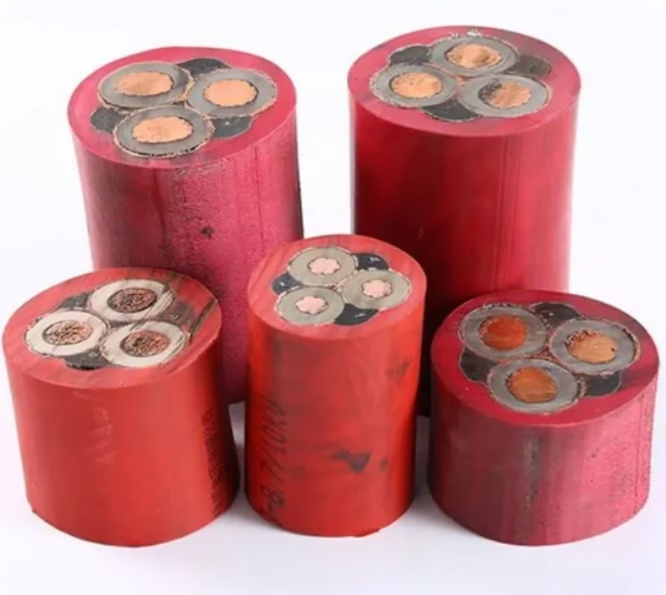
Type 440 is a Class 1, metal-screened, EPR-insulated reeling and trailing cable defined under AS/NZS 2802. Its configuration — 3 power cores + 3 earth cores + 1 pilot core — is engineered for long cable runs where pilot-core resistance limits disqualify simpler Type 409 designs. (Type 440 为 AS/NZS 2802 标准下的 Class 1 金属屏蔽 EPR 绝缘电缆,结构为3芯动力芯+3芯接地芯+1芯导pilot芯,适用于长距离卷盘场景。)
4. Root-Cause Diagnosis Matrix
The table below consolidates the six primary failure vectors observed across published cable-failure analyses. Each row maps a cause to the observable symptom, the affected component, and the minimum corrective action required. (以下诊断矩阵汇总了行业研究中报告的六大主要失效诱因,涵盖症状、受影响构件和最低限度的纠正措施。)
| # | Root Cause (根本原因) | Observable Symptom (可见症状) | Affected Component (受损构件) | Corrective Action (纠正措施) |
|---|---|---|---|---|
| 01 | Bend radius violation 弯曲半径违规 | Helical twist concentrated at one cable segment; jacket crazing | Outer conductors, jacket | Enforce minimum R ≥ 8 × cable OD (mobile); verify drum sheave diameter |
| 02 | Excess tension / improper drum load 过度张力/鼓盘装载不当 | Conductors pulled out of lay; jacket bulging at high-stress point | All conductor layers | Limit tensile load to manufacturer spec; use free-wheel drum design |
| 03 | Layered (non-bundled) conductor construction 分层导体构型(非束合设计) | Progressive twist from first flex cycle; uniform across cable length | Core stranding geometry | Specify bundled-design cables with short pitch lengths for continuous-flex duty |
| 04 | Insufficient quiet-zone length 静止段长度不足 | Corkscrewing starts exactly at drum exit point | Cable at drum egress | Maintain quiet zone ≥ 15–50 × cable OD depending on conductor count |
| 05 | Rotational / torsional loading 旋转/扭转载荷 | Twist direction opposite to cable lay; cable appears “wound” | Central core, filler | Install swivel at drum outlet; eliminate fixed-end rotation path |
| 06 | Weak or missing core element 核心构件薄弱或缺失 | Conductors collapse inward; core visibly flattened on cut section | Centre filler / strength member | Select cable with tension-proof rope-type centre core; inspect at commissioning |
5. Minimum Bending-Radius Parameters — Type 440
Respecting the minimum bend radius is the single most impactful installation variable. The figures below are drawn from AS/NZS 2802 guidance and Feichun’s engineering data for Type 440 across all rated voltage classes. (弯曲半径是影响安装最关键的单一变量。以下参数取自 AS/NZS 2802 标准与飞纯工程数据。)
| Installation Mode (安装方式) | Min. Bend Radius Formula | Example: 60 mm OD Cable | Consequence of Non-Compliance (不合规后果) |
|---|---|---|---|
| Fixed / static installation 固定安装 | 6 × cable OD | 360 mm | Insulation stress cracking over time |
| Mobile / reeling application 动态卷盘应用 | 8 × cable OD | 480 mm | Progressive corkscrewing; conductor migration |
| S-shape / reverse-bend path S形/反向弯曲路径 | 20 × cable OD | 1 200 mm | Rapid conductor failure; jacket rupture risk |
6. How Cable Construction Prevents — or Causes — Corkscrewing
Internal cable architecture is the primary design lever. The difference between a cable that survives 500,000 flex cycles and one that corkscrews after 20,000 lies largely in three construction parameters: bundling vs. layering, pitch length, and core strength. (内部结构是最重要的设计变量。耐用电缆与易损电缆之间的区别主要体现在束合/分层、螺距和芯体强度三个参数上。)
| Parameter (参数) | Layered Design (分层构型) | Bundled Design (束合构型) |
|---|---|---|
| Conductor arrangement 导体排列 | Concentric circles around core | Short-pitch bundles cabled in single layer |
| Torsional stress balance 扭转应力平衡 | Unbalanced — outer layer under tension, inner under compression | Balanced — pull & compression forces cancel within each bundle |
| Corkscrewing susceptibility 螺旋变形风险 | High | Very low |
| Manufacturing cost 制造成本 | Lower | Moderate (specialty stranders required) |
| Typical flex life 典型弯曲寿命 | 20 000 – 50 000 cycles | 200 000 – 500 000+ cycles |
7. Field Diagnostic & Corrective Checklist
Before replacing cable, run through the following installation-side checks. In the majority of returned-cable cases examined in industry whitepapers, the cable itself was performing to spec — the corkscrewing was an installation or commissioning error. (在更换电缆之前,请先逐项检查以下安装端要点。根据行业白皮书的调查,大多数退役电缆的螺旋变形根源在于安装或调试操作失误。)
- Drum sheave diameter: Confirm sheave ID ≥ 8 × cable OD for mobile reeling. Measure with a calibrated tape; do not estimate.
- Quiet zone: Measure the free-run length from drum exit to the first fixed support or bend. It must be at least 15 × cable OD; for cables with more than two cabling layers, target 30–50 × OD.
- Cable alignment & routing: Walk the entire cable path and identify any sharp edges, pinch points, or areas where the cable contacts a hard radius without a proper sheave or guide roller.
- Tension monitoring: If a tension gauge is available at the drum, log the peak tension during normal operation and compare it against the cable manufacturer’s maximum tensile rating.
- Rotation check: Fix a marker tape on the cable near the drum outlet. After one full reel cycle, check if the marker has rotated. If it has, a swivel or anti-rotation clamp is needed.
- Cross-section cut inspection: Cut a 2 cm sample from the cable end. Under good lighting (or a USB microscope), verify that all conductors sit concentrically within their designed positions and that the centre filler is intact.
8. When Type 440 Is Not the Right Cable — Application Comparison
Type 440 serves the majority of medium-voltage trailing and reeling duties, but certain operating profiles call for a different AS/NZS cable type. The matrix below helps engineers select the appropriate cable type based on voltage, dynamic duty, and conductor count requirements. (Type 440 适用于大多数中压拖尾和卷盘工况,但特定运行场景可能需要更换电缆类型。以下矩阵协助工程师根据电压、动态工况和导体数量选型。)
| Cable Type | Class | Voltage Range | Primary Duty (主要用途) | Corkscrewing Risk (螺旋变形风险) |
|---|---|---|---|---|
| Type 409 | Class 1 | 1.1 – 11 kV | Short trailing runs; low pilot-resistance demand | Medium |
| Type 440 | Class 1 | 1.1 – 11 kV | Long reeling runs; 3-pilot-core design for resistance compliance | Medium (installation-dependent) |
| Type 441 | Class 2 | 1.1 – 22 kV | Higher-voltage trailing; enhanced sheath radials | Medium-Low |
| Type 450 | Class 2 | 3.3 – 33 kV | High-stress reeling — draglines, shovels, excavators | Low (heavy-duty bundled core) |
9. Environmental Factors & Maintenance Intervals
Even a perfectly installed Type 440 cable will degrade ahead of schedule if environmental conditions exceed its rated parameters. EPR insulation (R-EP-90) provides an operating ceiling of +90 °C continuous and a cold-bend rating of −25 °C, but real-world surface temperatures around mining equipment can easily exceed these thresholds locally. (EPR绝缘的连续工作温度上限为+90°C,耐低温弯曲至−25°C,但矿场设备周围局部表面温度往往超出此范围。)
| Inspection Item (检查项目) | Frequency (频率) | Method (方法) | Pass Criterion (合格标准) |
|---|---|---|---|
| Visual twist / corkscrew check | Weekly | Walk-down with UV flashlight | No helical deformation visible on jacket surface |
| Jacket surface condition | Monthly | Tactile + visual; photograph high-wear zones | No cracks, abrasion flats, or blistering |
| Drum & sheave alignment | Monthly | Laser or straight-edge alignment check | Lateral offset < 1 % of drum width |
| Insulation resistance test | Quarterly | DC megger at 1 kV or per AS/NZS 1747 | ≥ 50 MΩ (contact manufacturer for cable-specific limits) |
| Conductor cross-section audit | Annually or after incident | Cut sample; microscope or magnified photo | All strands within original lay; no migration or buckling |
10. Summary
Corkscrewing in Type 440 reeling cable is a diagnosable and, in most cases, preventable failure mode. The evidence consistently shows that the majority of field failures originate from installation variables — particularly bend-radius violations, missing quiet zones, and absent swivels — rather than from manufacturing defects in the cable itself. When cable design is the contributing factor, switching from a layered to a bundled conductor architecture is the single most effective structural countermeasure. (Type 440 卷盘电缆的螺旋变形是一种可诊断且大多数情况下可预防的失效模式。行业数据表明,多数现场失效的根源在于安装变量——弯曲半径违规、静止段不足和缺少旋转器——而非电缆本身的制造缺陷。在电缆结构层面,从分层导体切换至束合导体是最有效的单项结构性改进。)
Authoritative Sources & References
-
Wire & Cable Tips — “What Is Cable Corkscrewing?”, 2017.
https://www.wireandcabletips.com/what-is-cable-corkscrewing/ -
igus® — “3 Ways to Avoid Corkscrewed Cables” (chainflex® engineering guide).
igus.com — Corkscrewing Prevention Guide -
igus® Blog — “What Is a Corkscrew in a Cable and How Can It Be Avoided?”, 2020.
blog.igus.eu — Corkscrew Avoidance -
TPC Wire & Cable — “Understanding Why Cable Fails”, Nov 2024.
tpcwire.com — Cable Failure Analysis -
Marmon / Belden — “Why Is My Cable Corkscrewing?” White Paper, Dec 2024.
Marmon — Corkscrewing White Paper (PDF) -
Alpha Wire / Lapp Tannehill — “Optimising the Lifetime of High-Flex Cables”, Oct 2025.
lapptannehill.com — High-Flex Cable Lifetime -
GlobalSpec / IEEE Spectrum — “Prevent Corkscrewing with the Right Cable Design”.
insights.globalspec.com — Cable Design & Corkscrewing -
Eland Cables — “Type 440 and Type 441 Flexible Rubber Mining Cables” (product & technical reference).
elandcables.com — Type 440 / 441 Datasheet -
Prysmian Australia — “Type 440” product reference; Mining Cable Guide 2018.
australia.prysmian.com — Type 440 -
Standards Australia — AS/NZS 2802:2000 (R2020) — Electric cables – Reeling and trailing.
store.standards.org.au — AS/NZS 2802:2000 -
Feichun Special Cable — “What Are the Differences Between Various Cable Types in the AS Standard?”
feichuncables.com — AS Cable Type Guide -
Cable Wholesale — “Common Causes of Cable Failure”, Mar 2021.
cablewholesale.com — Cable Failure Causes


