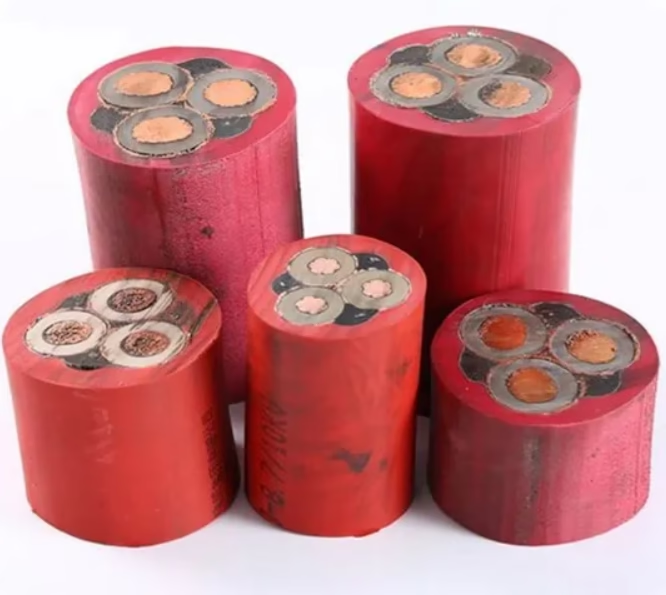
mining cable bend radius

Project Magnitude: Rio Tinto's Oyu Tolgoi underground expansion is one of the world's largest block caving mine projects. The underground mine currently extends 1,300+ meters below surface, with expansion workings reaching 1,500+ meters depth. The power distribution network includes underground substations feeding: (1) Electric load-haul-dump (LHD) fleets, (2) Continuous mining equipment and drill jumbos, (3) Conveyor systems and material handling, (4) Dewatering pumps, (5) Ventilation systems. 力拓奥尤陶勒盖地下扩建是全球最大的自然崩落法矿井项目之一。地下矿山目前已延伸地表下1300多米,扩建工作延伸到1500多米深度。配电网络包括为以下系统供电的地下变电站:(1)电动铲运机(LHD)队,(2)连续采矿设备和凿岩台车,(3)传送带系统和物料处理,(4)排水泵,(5)通风系统。 11kV Primary Distribution Role: The 11kV distribution tier is the primary feeder for underground mobile substations, which then step voltage down to 3.3kV for equipment power circuits. Multiple 11kV feeders distribute power across different mining levels (extraction level, haulage level, ventilation shafts). Each feeder may be 500–2,000 meters long, running through risky terrain where cables experience mechanical stress from falling rock, ground movement, and environmental extremes.

Oyu Tolgoi Expansion: Ampacity and Mechanical Suitability of 11kV AS/NZS Mining Cables

Project Magnitude: Rio Tinto’s Oyu Tolgoi underground expansion is one of the world’s largest block caving mine projects. The underground mine currently extends 1,300+ meters below surface, with expansion workings reaching 1,500+ meters depth. The power distribution network includes underground substations feeding: (1) Electric load-haul-dump (LHD) fleets, (2) Continuous mining equipment and drill jumbos, (3) Conveyor systems and material handling, (4) Dewatering pumps, (5) Ventilation systems. 力拓奥尤陶勒盖地下扩建是全球最大的自然崩落法矿井项目之一。地下矿山目前已延伸地表下1300多米,扩建工作延伸到1500多米深度。配电网络包括为以下系统供电的地下变电站:(1)电动铲运机(LHD)队,(2)连续采矿设备和凿岩台车,(3)传送带系统和物料处理,(4)排水泵,(5)通风系统。 11kV Primary Distribution Role: The 11kV distribution tier is the primary feeder for underground mobile substations, which then step voltage down to 3.3kV for equipment power circuits. Multiple 11kV feeders distribute power across different mining levels (extraction level, haulage level, ventilation shafts). Each feeder may be 500–2,000 meters long, running through risky terrain where cables experience mechanical stress from falling rock, ground movement, and environmental extremes.
For a Type 3S 11kV feeder cable with 82–88 mm outer diameter (typically a 3x95mm² to 3x240mm² conductor), the appropriate Ex d cable gland must be sized to accommodate the cable's full outer diameter while maintaining the flange-threaded sealing design required by ATEX EN 60079-1 for Zone 1 explosive atmospheres. A typical selection for a 3x95mm² Type 3S cable would be an M100 or M105 flange-threaded gland rated for ATEX II 2G Ex d IIB T4, with a compressive sealing ring (typically 2 mm thick polyurethane or equivalent elastomer) that creates a pressure-tight barrier against explosive gas ingress, and a separate earthing screw or braided conductor that bonds the cable's steel wire armor directly to the enclosure's earth continuity. This is not simply a matter of finding any cable gland that fits the cable diameter—it is a critical safety component that must be certified, specified, and installed with precision.

Ex d Gland Matching: Terminating Type 3S 11kV SWA Armor in Hazardous Zone 1

For a Type 3S 11kV feeder cable with 82–88 mm outer diameter (typically a 3x95mm² to 3x240mm² conductor), the appropriate Ex d cable gland must be sized to accommodate the cable’s full outer diameter while maintaining the flange-threaded sealing design required by ATEX EN 60079-1 for Zone 1 explosive atmospheres. A typical selection for a 3x95mm² Type 3S cable would be an M100 or M105 flange-threaded gland rated for ATEX II 2G Ex d IIB T4, with a compressive sealing ring (typically 2 mm thick polyurethane or equivalent elastomer) that creates a pressure-tight barrier against explosive gas ingress, and a separate earthing screw or braided conductor that bonds the cable’s steel wire armor directly to the enclosure’s earth continuity. This is not simply a matter of finding any cable gland that fits the cable diameter—it is a critical safety component that must be certified, specified, and installed with precision.
The nominal outer diameter (OD) of an AS/NZS 1972 Type 2S 11kV 3x185mm² feeder cable is 76.0 to 80.0 millimeters (3.0 to 3.15 inches). The typical design center for Feichun's Type 2S 3x185mm² product is approximately 78.6 mm. This measurement is taken across the outermost surface of the flame-retardant PVC sheath, which forms the final protective layer after the galvanized steel wire armour (SWA) and inner insulation geometry. 澳标 AS/NZS 1972 Type 2S 11kV 3x185mm² 馈电电缆的标称外径为 76.0 至 80.0 毫米(3.0 至 3.15 英寸)。 Feichun Type 2S 3x185mm² 产品的典型设计中心约为 78.6 mm。该测量是在钢丝铠装 (SWA) 和内层绝缘几何结构之后,在阻燃 PVC 外护套的最外表面进行的。 This 76–80 mm range is not arbitrary—it represents the accumulated thicknesses of multiple cable components layered concentrically around the three power conductors. To understand where this dimension comes from, an electrical engineer planning a mine installation must understand the contribution of each layer.

Outer Diameter Specs: What is the Nominal OD for AS/NZS 1972 Type 2S 11kV 3x185mm² Feeder Cable?

The nominal outer diameter (OD) of an AS/NZS 1972 Type 2S 11kV 3x185mm² feeder cable is 76.0 to 80.0 millimeters (3.0 to 3.15 inches). The typical design center for Feichun’s Type 2S 3x185mm² product is approximately 78.6 mm. This measurement is taken across the outermost surface of the flame-retardant PVC sheath, which forms the final protective layer after the galvanized steel wire armour (SWA) and inner insulation geometry. 澳标 AS/NZS 1972 Type 2S 11kV 3x185mm² 馈电电缆的标称外径为 76.0 至 80.0 毫米(3.0 至 3.15 英寸)。 Feichun Type 2S 3x185mm² 产品的典型设计中心约为 78.6 mm。该测量是在钢丝铠装 (SWA) 和内层绝缘几何结构之后,在阻燃 PVC 外护套的最外表面进行的。 This 76–80 mm range is not arbitrary—it represents the accumulated thicknesses of multiple cable components layered concentrically around the three power conductors. To understand where this dimension comes from, an electrical engineer planning a mine installation must understand the contribution of each layer.
The Single Most Important Cable Design Decision in Underground Coal Mining: Whether the cable employs collective screening (Type 2) or individual phase screening (Type 2S). This single engineering choice directly determines whether a mechanical cable failure will result in a phase-to-earth fault (detected and stopped in milliseconds) or a phase-to-phase fault with thousands of amperes of arc current (igniting methane explosions).

Type 2 vs Type 2S: Why the “S” (Individual Screen) is Mandatory for 11kV Underground Coal Mines

The Single Most Important Cable Design Decision in Underground Coal Mining: Whether the cable employs collective screening (Type 2) or individual phase screening (Type 2S). This single engineering choice directly determines whether a mechanical cable failure will result in a phase-to-earth fault (detected and stopped in milliseconds) or a phase-to-phase fault with thousands of amperes of arc current (igniting methane explosions).
Corkscrewing — also referred to as Z-kinking or the "pigtail" effect — is among the most frequently encountered failure modes in dynamic reeling applications. When a Type 440 cable repeatedly exhibits helical deformation after even modest operating hours, the root cause almost never lies in a single variable. It is instead a compounding interaction of design, installation, and operating conditions. (软电缆在卷盘运行中出现螺旋变形,通常称为"软木塞效应"或Z型褶皱,是Type 440型动态卷盘电缆最常见的失效模式之一。)

Why Your Reeling Cable Keeps “Corkscrewing”:Diagnosis & Solutions for Type 440

Corkscrewing — also referred to as Z-kinking or the “pigtail” effect — is among the most frequently encountered failure modes in dynamic reeling applications. When a Type 440 cable repeatedly exhibits helical deformation after even modest operating hours, the root cause almost never lies in a single variable. It is instead a compounding interaction of design, installation, and operating conditions. (软电缆在卷盘运行中出现螺旋变形,通常称为”软木塞效应”或Z型褶皱,是Type 440型动态卷盘电缆最常见的失效模式之一。)
Fermel is a recognized manufacturer of underground utility vehicles designed for mining, tunneling, and construction applications. Their utility vehicle lineup includes personnel carriers, material transporters, and multi-purpose service units that operate in confined underground environments where electrical power delivery via trailing cables is essential for safe and efficient operation. 费尔梅尔(Fermel)是地下多功能车的知名制造商,产品专为采矿、隧道和建筑应用设计。其多功能车系列包括人员运输车、物料运输车和多功能服务单元,在封闭的地下环境中运行,通过拖曳电缆供电对于安全高效运行至关重要。

Fermel Utility Vehicles: Type 241 Cable Flexibility for Cable Reels

Fermel is a recognized manufacturer of underground utility vehicles designed for mining, tunneling, and construction applications. Their utility vehicle lineup includes personnel carriers, material transporters, and multi-purpose service units that operate in confined underground environments where electrical power delivery via trailing cables is essential for safe and efficient operation. 费尔梅尔(Fermel)是地下多功能车的知名制造商,产品专为采矿、隧道和建筑应用设计。其多功能车系列包括人员运输车、物料运输车和多功能服务单元,在封闭的地下环境中运行,通过拖曳电缆供电对于安全高效运行至关重要。
Mining and drilling cables are among the most critical components in underground operations and oil/gas fields. According to IEEE 525 and IEC 60502-1 standards, proper installation can extend cable life by up to 40%. Statistics from the Mine Safety and Health Administration (MSHA) indicate that approximately 60-70% of cable failures result from installation errors and improper handling.

ما هي أخطاء التركيب الشائعة التي تقلل من عمر كابلات التعدين والحفر؟

mining cable, mining cable installation, mining cable failure, drilling cable, ESP cable, electric submersible pump cable, underground mining cable, trailing cable, SHD-GC mining cable, Type W portable cable, mining power cable, coal mine cable, rubber sheathed mining cable, flexible mining cable, armored mining cable, mining cable bend radius, cable installation mistakes, cable life extension, mining cable maintenance, mining electrical cable
Complete Guide to UL 1650:2025 Portable Power Cable Type G, Type G-GC, Type W, MP-GC & SHD-GC Mining Cables — Technical Specifications, Compliance Standards, Safety Guidelines and Applications

Complete Guide to UL 1650:2025 Portable Power Cable

UL 1650, UL 1650:2025, portable power cable, mining cable, Type G cable, Type G-GC cable, Type W cable, MP-GC cable, SHD-GC cable, MSHA approved cable, EPR insulation, CPE jacket, trailing cable, mining equipment cable UL 1650 is the primary safety standard for portable power cables used in industrial and mining applications across North America. The UL 1650:2025 edition, published by Underwriters Laboratories and ANSI approved in November 2025, establishes comprehensive requirements for portable power cables designed for use in accordance with the National Electrical Code (NFPA 70).[1] This standard covers various types of portable power cables including Type G, Type G-GC, Type W, MP-GC, and SHD-GC cables that are essential for powering mobile and stationary mining equipment in both surface and underground operations. The cables manufactured under UL 1650 must undergo rigorous testing per UL 2556 (Wire and Cable Test Methods) to ensure safety and reliability in demanding industrial environments.[2]
TYPE 260 Heavy-Duty Mining Cable: Comprehensive Technical Analysis

TYPE 260 Heavy-Duty Mining Cable: Comprehensive Technical Analysis

TYPE 260 mining cable represents a pinnacle of engineering excellence in the domain of heavy-duty electrical power transmission for mining operations. This pliable armoured cable, designed in strict accordance with Australian and New Zealand standards AS/NZS 1802:2003 and AS/NZS 2802:2000, serves as a critical feeder cable in demanding mining environments where exceptional impact resistance and mechanical durability are paramount operational requirements.
SANS 1520 Feichun Cable

What is SANS 1520 Cable Part 1-2-3 Mining Cable?

The South African National Standard (SANS) 1520 represents one of the most comprehensive and rigorous cable standards for mining operations globally, specifically addressing the unique challenges faced in underground and surface mining environments. Issued by the South African Bureau of Standards (SABS), this standard has become the benchmark for flexible electrical trailing cables used in mines worldwide, ensuring both operational efficiency and worker safety in some of the most demanding industrial conditions.