cable corkscrewing prevention

Joy Shuttle Car Operating Cycle: Joy Global's shuttle cars are core materials transport vehicles in underground coal mines. A typical operational cycle involves: (1) Advancing into mine face (unreeling cable under constant speed tension), (2) Loading ore/waste into bucket, (3) Sharp turns and direction changes (rapid torsional and bending stress), (4) Reversing to dump point (rapid cable reeling, highest tension conditions), (5) Return to face under load (sustained tension, speeds 50–100 m/min). A single shift can involve 80–120 complete cycles. Joy Global穿梭车是地下煤矿的核心运输工具。典型运行周期包括:(1)推进到矿面(在恒定速度张力下放线),(2)装载矿石/废料,(3)急转弯和方向改变(快速扭转和弯曲应力),(4)倒车至卸点(快速收线,最高张力条件),(5)负载返回(持续张力,速度50-100 m/min)。单班可完成80-120个完整周期。 Cable Stress Combination: Unlike stationary installations where cables experience steady-state thermal and electrical stress, shuttle car cables experience: (1) Cyclic tensile loading (alternating between low idle tension and high reeling tension), (2) Torsional twisting during turns (multiple revolutions per shift), (3) Sharp bending around reel drum edges (radius-limited deflection), (4) Thermal cycling (ambient underground temperature 15–25°C during operation, cold surface storage -5°C to -20°C).
Joy Shuttle Car Tension Ratings: Maximum Safe Pulling Load for Type 275 3.3/3.3kV 3x50mm² Cables

Joy Shuttle Car Operating Cycle: Joy Global’s shuttle cars are core materials transport vehicles in underground coal mines. A typical operational cycle involves: (1) Advancing into mine face (unreeling cable under constant speed tension), (2) Loading ore/waste into bucket, (3) Sharp turns and direction changes (rapid torsional and bending stress), (4) Reversing to dump point (rapid cable reeling, highest tension conditions), (5) Return to face under load (sustained tension, speeds 50–100 m/min). A single shift can involve 80–120 complete cycles. Joy Global穿梭车是地下煤矿的核心运输工具。典型运行周期包括:(1)推进到矿面(在恒定速度张力下放线),(2)装载矿石/废料,(3)急转弯和方向改变(快速扭转和弯曲应力),(4)倒车至卸点(快速收线,最高张力条件),(5)负载返回(持续张力,速度50-100 m/min)。单班可完成80-120个完整周期。 Cable Stress Combination: Unlike stationary installations where cables experience steady-state thermal and electrical stress, shuttle car cables experience: (1) Cyclic tensile loading (alternating between low idle tension and high reeling tension), (2) Torsional twisting during turns (multiple revolutions per shift), (3) Sharp bending around reel drum edges (radius-limited deflection), (4) Thermal cycling (ambient underground temperature 15–25°C during operation, cold surface storage -5°C to -20°C).
Corkscrewing — also referred to as Z-kinking or the "pigtail" effect — is among the most frequently encountered failure modes in dynamic reeling applications. When a Type 440 cable repeatedly exhibits helical deformation after even modest operating hours, the root cause almost never lies in a single variable. It is instead a compounding interaction of design, installation, and operating conditions. (软电缆在卷盘运行中出现螺旋变形,通常称为"软木塞效应"或Z型褶皱,是Type 440型动态卷盘电缆最常见的失效模式之一。)

Why Your Reeling Cable Keeps “Corkscrewing”:Diagnosis & Solutions for Type 440

Corkscrewing — also referred to as Z-kinking or the “pigtail” effect — is among the most frequently encountered failure modes in dynamic reeling applications. When a Type 440 cable repeatedly exhibits helical deformation after even modest operating hours, the root cause almost never lies in a single variable. It is instead a compounding interaction of design, installation, and operating conditions. (软电缆在卷盘运行中出现螺旋变形,通常称为”软木塞效应”或Z型褶皱,是Type 440型动态卷盘电缆最常见的失效模式之一。)
Type 440 reeling cables represent a critical component in mining and industrial power distribution systems, specifically designed for flexible trailing applications according to AS/NZS 2802:2000 standards. These metal-screened power cables feature three pilot cores and operate across voltage ratings from 1.1 kilovolts to 11 kilovolts, supplying reliable electrical power to mobile mining equipment such as draglines, excavators, and materials handling machinery. Despite their robust construction with EPR insulation and high abrasion resistance, these cables remain vulnerable to a particularly destructive failure mode known as corkscrewing, which can compromise both electrical performance and mechanical integrity during operation.

How does “Corkscrewing” destroy Type 440 reeling cables, and how to prevent it during installation?

Type 440 reeling cables represent a critical component in mining and industrial power distribution systems, specifically designed for flexible trailing applications according to AS/NZS 2802:2000 standards. These metal-screened power cables feature three pilot cores and operate across voltage ratings from 1.1 kilovolts to 11 kilovolts, supplying reliable electrical power to mobile mining equipment such as draglines, excavators, and materials handling machinery. Despite their robust construction with EPR insulation and high abrasion resistance, these cables remain vulnerable to a particularly destructive failure mode known as corkscrewing, which can compromise both electrical performance and mechanical integrity during operation.
TYPE 275 mining cable

TYPE 275 1.1kV AS/NZS 1802:2003, AS/NZS 2802:2000 Australian Mining Cable

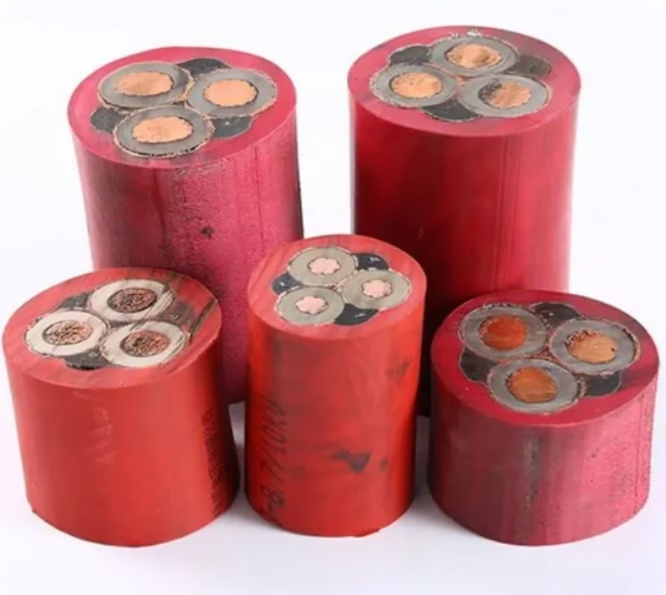
TYPE 275 mining cable represents a specialized category of flexible reeling cables engineered specifically for the demanding requirements of underground coal mining operations and surface mining applications. Manufactured in strict accordance with AS/NZS 1802:2003 and AS/NZS 2802:2000 standards, this cable is designed to deliver reliable power transmission to shuttle cars, mobile pumping equipment, and other heavy-duty mining machinery subjected to continuous mechanical stress and harsh environmental conditions.