
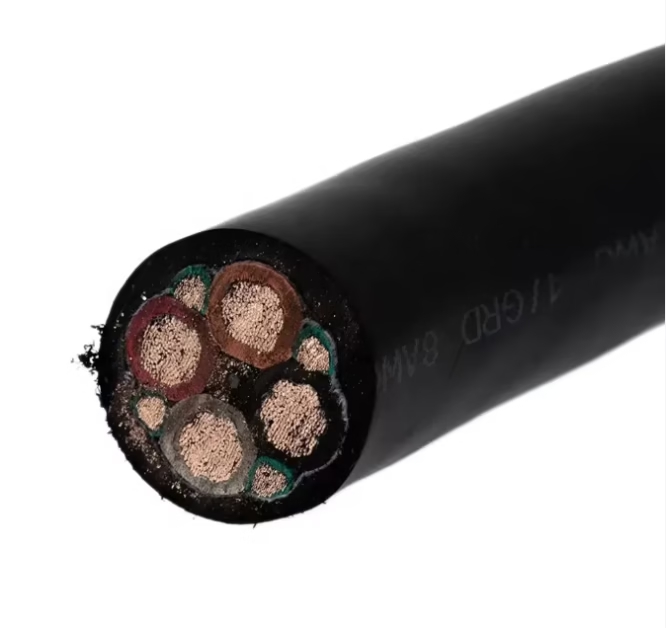
Submersible Pump Cable Failures:
Switching from H07RN-F to NSSHÖU
for Deep Mine Dewatering
1. Introduction — The Cable as the Weakest Link
In deep-mine dewatering systems, the power cable connecting the submersible pump to its surface control panel is statistically the single most failure-prone component in the entire pumping assembly.
According to repair-statistics analysis published by Tsurumi — one of the world’s largest manufacturers of dewatering pumps — a defective power cable is the most frequent cause of pump failure. Their engineering team notes that the cable is the first link in the failure chain and therefore the most important element to consider first. (根据全球最大潜水泵制造商之一Tsurumi的维修数据统计,电缆故障是潜水泵失效最常见的单一原因。电缆是故障链中的第一环节。)
Many operators in underground coal and metal mines still default to H07RN-F, a widely stocked general-purpose rubber flexible cable governed by IEC 60245. For surface or shallow-water pump connections this cable is perfectly adequate. The moment the pump drops below roughly 10 metres in a mine sump — or stays submerged for months on end in acidic, sediment-laden water — its design envelope is exceeded. This article builds a fact-based, source-backed case for when and why operators should switch to NSSHÖU, the German-standard heavy-duty mining cable governed by VDE 0250 Part 812. (许多地下矿业仍默认使用H07RN-F通用橡胶电缆。当潜水泵深度超过约10米或长期浸泡在含酸性、泥沙的矿水中时,H07RN-F的设计范围将被超越,此时应考虑转用符合VDE 0250 Part 812标准的NSSHÖU电缆。)
2. H07RN-F — What the Designation Actually Tells You
H07RN-F is a harmonised European code defined in IEC 60245 / EN 50525-2-21 and the CENELEC harmonic designation HD 22.4 S4. Decoding the letters: H = harmonised; 07 = 450/750 V rated; R = rubber (EPR) insulation; N = polychloroprene (neoprene) outer sheath; F = flexible stranded conductors. (H07RN-F 是 IEC 60245 / EN 50525-2-21 标准下的欧盟协调代码:H=协调;07=额定电压450/750V;R=EPR橡胶绝缘;N=氯丁橡胶外护套;F=软绞线导体。)
2.1 The AD6 vs AD8 Problem
The base IEC 60245 specification for H07RN-F assigns only an AD6 water-presence rating — meaning temporary immersion, not continuous submersion. Standard H07 cables are generally suitable for dry or damp conditions but may fail when submerged continuously. The insulation and sheathing materials used in standard H07 cables may degrade over time, leading to potential electrical faults and equipment failure. (标准IEC 60245对H07RN-F仅赋予AD6水接触评级——即临时浸泡。标准H07电缆在长期浸泡条件下,其绝缘和护套材料会随时间推移逐渐劣化,可能引起电气故障。)
Some manufacturers (notably Top Cable / XTREM®) upgrade their H07RN-F production line to meet AD8 (permanent submersion) by using improved polymers, effectively creating what is technically an H07RN8-F cable. The standard indicates AD6, temporary, whereas enhanced production gives AD8 (submerged). However, even AD8-rated H07RN8-F cables are rated for submersion up to a depth of 10 m, with a max. water temperature of +40 °C. (部分制造商将H07RN-F升级至AD8标准(即H07RN8-F),但即使是AD8评级的电缆,其额定浸没深度仅为10米,最高水温+40°C。)
An AD8-rated H07RN8-F cable is certified for submersion to 10 m. Deep mine dewatering sumps routinely reach 50–200+ m below ground. At those depths the hydrostatic column pressure alone can compress insulation and force moisture through sheath micro-defects far beyond what AD8 testing covers. (AD8评级仅针对10米深度。深矿排水井常达50~200米以上,静水柱压力远超AD8测试范围。)
3. NSSHÖU — The Mine-Grade Alternative
NSSHÖU is a German-national cable designation regulated by DIN VDE 0250 Part 812. This standard covers rubber insulated flexible cables designated as NSSHÖU (Neopren-Schlauchleitung Schwer Höchste Ölfestigkeit Ummantelung) for power installation applications with rated voltages up to U₀/U 0.6/1kV. (NSSHÖU 受DIN VDE 0250 Part 812标准管辖,代表”重型橡胶软管电缆,最高耐油,带护套”,额定电压0.6/1kV。)
Unlike H07RN-F, the NSSHÖU features a dual-sheath construction: an inner jacket of thermosetting rubber compound (type GM1b) and an outer jacket of compound type 5GM3. This dual barrier is engineered specifically to resist the combined mechanical, chemical, and hydrostatic stresses present in mine and quarry environments. NSSHÖU cables can be submerged in fresh water, salt water, oily water, and sewage-contaminated water up to a depth of 100 meters. (与H07RN-F不同,NSSHÖU采用双层护套构型,可在淡水、盐水、含油水和污水中浸没至100米深度。)
3.1 Construction Layer-by-Layer
The conductor is annealed flexible stranded tin-coated copper, Class 5 to IEC 60228 / HD 383. Insulation is ethylene-propylene rubber (EPR) type 3GI3 in accordance with DIN VDE 0207 Part 21. A suitable tape separator sits between conductor and insulation. The internal jacket is a synthetic thermosetting compound type GM1b; the outer jacket is compound type 5GM3, coloured yellow. (导体为IEC 60228标准下的Class 5软绞镀锡铜线;绝缘为EPR橡胶(3GI3型);内护套为GM1b型热固化合物;外护套为5GM3型,黄色。)
4. Head-to-Head: H07RN-F vs NSSHÖU — Parameter Comparison
The following matrix consolidates published specification data from IEC 60245, VDE 0250 Part 812, and manufacturer technical datasheets. Every parameter listed has a direct bearing on cable survival in a deep-mine dewatering environment. (下表汇总了IEC 60245和VDE 0250标准及制造商数据手册中的规范参数,每个参数均与深矿排水环境中电缆的耐久性直接相关。)
| Parameter参数 | H07RN-F (base IEC)基础标准 | H07RN8-F (AD8 enhanced)AD8增强版 | NSSHÖU (VDE 0250)VDE标准矿级电缆 |
|---|---|---|---|
| Governing Standard 执行标准 | IEC 60245 · HD 22.4 S4 | IEC 60245-8 · HD 22.10 | DIN VDE 0250 Part 812 |
| Rated Voltage 额定电压 | 450 / 750 V | 450 / 750 V | 600 / 1 000 V |
| Water-Presence Rating 耐水接触评级 | AD6 — Temporary | AD8 — Permanent | Submersible to 100 m |
| Max Submersion Depth 最大浸没深度 | Not rated | 10 m | 100 m |
| Conductor Temp (continuous) 导体连续工作温度 | 60 °C | 90 °C | 90 °C |
| Short-Circuit Temp 短路温度极限 | 200 °C / 5 s | 250 °C / 5 s | 250 °C / 5 s |
| Cold-Bend Rating 耐低温弯曲 | −25 °C | −40 °C | −25 °C |
| Sheath Construction 护套结构 | Single neoprene | Single neoprene | Dual sheath (inner GM1b + outer 5GM3) |
| Oil / Grease Resistance 耐油脂性能 | Good | Good | Excellent — rated Ö (Ölfest) |
| Flame Retardancy 耐火性能 | IEC 60332-1 | IEC 60332-1 | IEC 60332-1-2 |
| Min Bending Radius 最小弯曲半径 | 6× OD (static) | 6× OD (static) | 5× OD (static) · 10× OD (flex) |
| Insulation Resistance 绝缘电阻 | Per IEC 60245-2 | Per IEC 60245-2 | ≥ 20 MΩ·km (DIN VDE 0472) |
| Target Application 目标应用场景 | Surface / portable pump | Shallow submersible (≤10 m) | Underground mine / quarry / deep dewatering |
5. The Tsurumi Case Study — An Industry Benchmark
Tsurumi Manufacturing (Japan), which supplies over 500 pump models to the global mining and construction sector, provides one of the most compelling real-world data points available. Rubber hose cables, for example according to the specification H07RN-F, are common on the market. These are allowed, but only fulfil the basic requirements, according to Stefan Himmelsbach, the company’s EU technical lead. (Tsurumi是全球最大的潜水泵制造商之一,据其欧盟技术负责人Stefan Himmelsbach表示,H07RN-F市场上常见,但仅满足基本要求。)
Tsurumi switched to NSSHÖU cables 10 years ago. Since then, pump failures due to cable damage have drastically decreased. (Tsurumi约10年前转用NSSHÖU电缆后,因电缆损坏导致的泵故障急剧减少。)
The company’s assessment of the mechanical difference is direct: the NSSHÖU is more robust, more abrasion-resistant and offers greater notch and tensile strength compared to standard rubber hose cables. It is also considerably more resistant to higher temperatures — important because shear and pressure generate heat. (NSSHÖU更加坚固、耐磨、抗刻痕和抗拉强度更高,且对高温的耐受性也显著改善——这对于剪切和压力产生热量的矿井环境尤为重要。)
5.1 Why Tsurumi Also Sealed the Cable Entry
Beyond the cable itself, Tsurumi identified the cable-to-motor gland as a secondary ingress point. They encapsulate every single electrical conductor in synthetic resin, which hermetically seals the inlet. Pump failures due to penetrating creeping moisture are thus ruled out. (Tsurumi还将每根导体用合成树脂封装,密封电缆入口处,从根本上消除了蠕行水分渗入造成泵故障的风险。)
6. Why H07RN-F Fails in Deep-Mine Dewatering — Failure-Mode Matrix
Each row in the table below maps a documented failure vector to its physical mechanism, the depth or condition at which it becomes critical, and whether NSSHÖU’s construction addresses it. Sources include the peer-reviewed ESP failure review published in the Journal of Petroleum Exploration and Production Technology, Homa Pump’s field-failure catalogue, and Pumps & Systems’ ESP vulnerability analysis. (以下矩阵将每种已记录的失效类型与其物理机制、临界条件以及NSSHÖU能否解决该问题进行映射。来源包括同行评审论文及行业故障分析报告。)
| # | Failure Mode失效模式 | Physical Mechanism物理机制 | Critical Depth / Condition临界条件 | Mitigated by NSSHÖU?NSSHÖU是否解决 |
|---|---|---|---|---|
| 01 | Hydrostatic compression 静水柱压缩 | Water column pressure flattens single-sheath cable; insulation shorts between conductors | > 10 m (exceeds AD8 test envelope) | Yes — dual sheath rated to 100 m |
| 02 | Creeping moisture ingress 蠕行水分渗入 | Microscopic sheath defects allow slow water migration into insulation; insulation resistance drops progressively | Months of continuous submersion at any depth | Yes — dual barrier + Ö oil-resistant compound |
| 03 | Abrasion & crush damage 磨损与挤压损坏 | Cable dragged across stony sump floor or run over by loading equipment | Any depth — operational misuse | Yes — outer jacket 5GM3 rated for high mechanical stress |
| 04 | Thermal degradation 热力劣化 | Pump motor heat + mine ambient temperature exceed 60 °C conductor rating; insulation embrittles | Continuous loads at > 60 °C | Yes — 90 °C continuous, 250 °C short circuit |
| 05 | Chemical attack (acid water) 化学侵蚀(酸性水) | Mine water pH < 4 accelerates rubber oxidation; sheath swells or cracks | pH < 4 — common in coal-mine drainage | Partial — consult manufacturer for pH < 3.5 |
| 06 | Tensile overload 拉力过载 | Pump pulled out of sump by the cable rather than by dedicated lifting hardware | Any depth — operational error | Yes — higher notch & tensile strength (Tsurumi data) |
7. Hydrostatic Pressure vs Cable Rating — By Depth
The table below calculates the static water-column pressure at common mine-dewatering depths (assuming fresh water, ρ = 1 000 kg/m³) and maps each depth against the certified submersion envelope of H07RN8-F and NSSHÖU. For reference, deep well fluid column pressure can reach 30–50 MPa, easily flattening ordinary cables, leading to conductor contact and insulation breakdown. While that figure applies to oil-well ESP cables at 3 000+ m, even the top tier of mine dewatering (200 m) produces pressures well above the AD8 test protocol. (深井静水柱压力可达30~50 MPa,普通电缆会被压缩致导体接触、绝缘击穿。矿用200米深度处的静水压力已远超AD8测试协议。)
| Depth (m)深度 | Hydrostatic Pressure静水柱压力 | H07RN8-F StatusAD8电缆状态 | NSSHÖU StatusVDE矿级电缆状态 |
|---|---|---|---|
| 5 | 0.5 bar (0.05 MPa) | ✓ Within rating | ✓ Within rating |
| 10 | 1.0 bar (0.10 MPa) | ✓ At rated limit | ✓ Within rating |
| 20 | 2.0 bar (0.20 MPa) | ✗ Exceeds AD8 envelope | ✓ Within rating |
| 50 | 5.0 bar (0.50 MPa) | ✗ Significant risk | ✓ Within rating |
| 100 | 10.0 bar (1.0 MPa) | ✗ Failure expected | ✓ At rated limit |
| 150 | 15.0 bar (1.5 MPa) | ✗ Not applicable | ⚠ Consult manufacturer |
| 200 | 20.0 bar (2.0 MPa) | ✗ Not applicable | ⚠ Medium-voltage submersible cable required |
8. Application Decision Matrix — Which Cable for Which Scenario?
Not every dewatering scenario demands NSSHÖU. The matrix below correlates mine operating conditions with the minimum acceptable cable type, drawing on the application guidance published by VDE (DIN VDE 0298 Part 3) and Feichun’s own engineering guidelines. (不是每种排水场景都需要NSSHÖU。以下矩阵将矿业工况与最低可接受电缆类型对应,依据VDE应用指导和飞纯工程指南。)
| Operating Scenario工况描述 | Depth深度 | Duration使用周期 | Minimum Cable最低电缆要求 | Preferred Cable推荐电缆 |
|---|---|---|---|---|
| Surface sump / construction pit | < 5 m | Days – weeks | H07RN-F (AD6+) | H07RN8-F |
| Shallow open-cut dewatering | 5 – 10 m | Weeks – months | H07RN8-F | NSSHÖU |
| Underground sump — moderate depth | 10 – 50 m | Months (continuous) | NSSHÖU | NSSHÖU |
| Deep underground sump | 50 – 100 m | Permanent | NSSHÖU | NSSHÖU (verify with mfr.) |
| Ultra-deep shaft / borehole | > 100 m | Permanent | (N)TSCGEWÖU or MV submersible | Feichun NTSCGECEWÖU series |
9. Installation & Maintenance Best Practices
Selecting the correct cable type eliminates the majority of failure risk, but improper installation can still bring down even a NSSHÖU cable prematurely. The checklist below consolidates guidance from VDE application standards, Tsurumi’s installation protocol, and general ESP maintenance practice. (正确选型可消除大多数失效风险,但安装不当仍会缩短NSSHÖU电缆寿命。以下清单汇总了VDE应用标准和行业最佳安装规范。)
- Never lift the pump by the cable. Use the manufacturer-supplied handle or eyebolt. The pump is sometimes pulled out of the sump just by the cable — this is one of the most common damage patterns recorded.
- Protect cable routing from vehicle traffic. Heavy vehicles run over the cable lying on stony ground, or the cable is crushed when loading materials are stacked. Route the cable through conduit or over a raised lip whenever possible.
- Seal the cable gland hermetically. Use an epoxy-resin or heat-shrink termination rated for your depth. Even a small moisture ingress path will progressively lower insulation resistance over months.
- Verify bending radius at every bend point. For NSSHÖU: minimum 5× OD static, 10× OD if the cable flexes during operation. Tight bends around drum edges or pipe supports are a common overlooked failure source.
- Run quarterly megger tests. A DC insulation-resistance test at 1 kV will surface degradation months before a full short-circuit event. Log readings and trend them over time.
- Inspect cable entry at every pump service. The cable-to-housing gland is the second most common water-ingress point after sheath defects. Replace or re-torque glands at each annual service.
| Task检查项目 | Frequency频率 | Method方法 | Pass Criterion合格标准 |
|---|---|---|---|
| Visual sheath inspection | Weekly | Walk-down; check exposed cable sections | No cracks, abrasion flats, swelling, or discolouration |
| Gland torque & seal check | Monthly | Torque wrench; visual for weeping | No moisture visible at cable entry; torque within spec |
| Insulation resistance (megger) | Quarterly | DC 1 kV test per IEC 60502 / VDE guidance | ≥ 20 MΩ·km (or manufacturer limit) |
| Bend-radius audit | Quarterly | Measure at every guide / drum contact | Static ≥ 5× OD; Flex ≥ 10× OD |
| Full gland replacement | Annually | Strip, clean, re-seal with rated compound | New seal passes 1 atm water pressure hold for 5 min |
11. Summary
H07RN-F — even in its AD8-enhanced H07RN8-F variant — is a surface and shallow-water cable. Its 10 m submersion ceiling and single-sheath construction make it unsuitable for the sustained, high-pressure, chemically aggressive conditions that define deep-mine dewatering. NSSHÖU, governed by DIN VDE 0250 Part 812, closes every gap: it is rated to 100 m submersion, carries a dual sheath engineered for oil and acid resistance, and offers a 90 °C continuous temperature rating. The Tsurumi case study demonstrates that this is not merely a specification preference — it is an operational outcome: cable-related pump failures drop to near zero after the switch. (H07RN-F即使在AD8增强版(H07RN8-F)形态下,仍仅适用于地面和浅水场景。NSSHÖU在每个关键指标上都填补了差距:100米浸没深度、双层护套、90°C连续工作温度。Tsurumi实业经验表明,切换后电缆相关泵故障几乎降至零。)
Authoritative Sources & References
-
International Mining — “Tsurumi on solving the dewatering pump cable weak point”, Oct 2021.
im-mining.com — Tsurumi Cable Weak Point -
Top Cable (XTREM®) — “H07RN-F: The Cable for Industrial and Mobile Use”, Technical Blog.
topcable.com — XTREM H07RN-F -
Contact Cables — “Why Use AD8 Approved H07-RNF over Standard H07 for Pumps?”, Jun 2024.
contactcables.com — AD8 vs Standard H07 -
LAPP Group — H07RN8-F Product Datasheet, HAR-certified.
lappgroup.com — H07RN8-F -
LAPP Group — NSSHÖU Product Datasheet, VDE 0250 Part 812.
lappgroup.com — NSSHÖU -
Eland Cables — “NSSHÖU Cable — Technical Datasheet”.
elandcables.com — NSSHÖU -
Feichun Special Cable — “DIN VDE 0250 Technical Guide — NSSHÖU Designation”, Oct 2025.
feichuncables.com — DIN VDE 0250 -
Feichun Special Cable — “Water Treatment Cables: H07RN-F & Submersible Series”, 2025.
feichuncables.com — Water Treatment Cables -
Springer — Journal of Petroleum Exploration & Production Technology — “Rigorous Review of Electrical Submersible Pump Failure Mechanisms and Their Mitigation Measures”, Sep 2021.
springer.com — ESP Failure Mechanisms -
Homa Pump — “5 Causes of Submersible Pump Failure and How to Fix Them”, Aug 2025.
homapump.com — Pump Failure Causes -
Pumps & Systems — “Pump Failure: Causes, Modes & Prevention Strategies”, 2024.
pumpsandsystems.com — Failure Prevention -
TST Cable — “Advantages of ESP Cables in Deep Well Submersible Pump Applications Below 4000 m”, 2025.
tstcables.com — Deep Well ESP Cables -
HT Wire & Cable — NSSHÖU Construction Specification Sheet.
htwirecable.com — NSSHÖU Spec -
ZMS kV Cable — “What Is a Submersible Cable and Why Should We Use It?”, Apr 2025.
kvcable.com — Submersible Cable Guide


