NSSHÖU

What Are UNE 22560 and UNE 22561? Scope, Definitions, and Core Purpose The UNE 22560 and UNE 22561 standards represent the final and often most underestimated element of the Spanish and Latin American underground mining cable ecosystem. Where UNE 22511 and UNE 22512 govern the power distribution cables that energize mining equipment, the 22560 and 22561 standards govern the signal, control, and interlock cables that command and protect that equipment. These are the "nervous system" cables of a mine — the communication network that tells a continuous miner when to advance and when to halt, that triggers emergency stops, that monitors hoisting rope tension on shaft equipment, that controls conveyor sequencing, and that enables the protective interlocking that prevents a piece of equipment from operating unless all safety preconditions are met. UNE 22560 formally defines flexible multi-core cables for underground mining with voltage ratings up to 500 V or 0.6/1 kV, with no metallic armour protection — designed for installation within equipment enclosures, along protected cable trays in main gate roads, or in areas where mechanical damage risk is minimal. UNE 22561 is its armoured sister standard, incorporating steel wire braid or steel tape protection, specified for installation in rough terrain areas where mechanical damage from rock fall, equipment collision, or floor contact is a credible risk. Both standards mandate that the cable be designed as a multi-core concentric stranded bundle — not the parallel-laid three or four conductors common in power cables, but rather seven, twelve, nineteen, or more individually insulated cores twisted concentrically around a central axis, allowing compact packaging of numerous independent control circuits within a single cable jacket. The distinction between these standards is not merely mechanical armour presence or absence. Control cables are tested against an entirely different set of safety criteria than power cables because their failure mode is fundamentally different. A power cable failure results in loss of energy to equipment — dangerous but localized. A control cable failure can disable the interlock system that prevents a continuous miner from advancing into unsafe ground, or can disable the emergency stop circuit that should halt a conveyor if a worker falls into it. A control cable fire, burning in a tightly bundled cable tray with other control cables, must not spread flame between cables because control cables are typically routed in shared ducts and cable carriers where one cable's ignition could cascade to adjacent circuits. Therefore, control cables are tested for bundle flame propagation (EN 60332-3) rather than single-cable flame propagation tests — a more stringent requirement that demands careful attention to outer sheath formulation and cable spacing in bundle installation.

NSSHÖU для общего применения: тяжёлый эластомерный кабель 0,6/1 kV для шахт, карьеров, тоннелей и промышленности

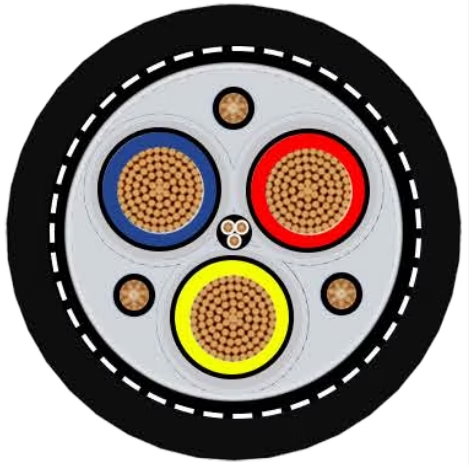
NSSHÖU — это гибкий силовой кабель тяжёлого исполнения для общего применения в горной добыче, карьерах, промышленных зонах, строительных площадках, сельскохозяйственных операциях и в качестве trailing cable. По предоставленным техническим данным он имеет лужёные медные жилы DIN VDE 0295 Class 5, изоляцию 3GI3, внутреннюю оболочку GM1b, наружную тяжёлую эластомерную оболочку 5GM5, а также специальные исполнения с индивидуальными экранами …3/E и концентрическим общим экраном …kon.
Underground LHD (Load-Haul-Dump) loaders — also called scooptrams — rely on a flexible trailing cable that is continuously reeled and unreeled as the machine travels between muck piles and ore passes. The cable must survive thousands of reeling cycles, simultaneous tensile and torsional loads, crushing from rock debris, and exposure to water, oil, and abrasive dust. Two cable families dominate this niche: the Nexans TORERO® series (type designation NSHTOEU) and the more generic NSSHÖU heavy-duty rubber cable. 井下 LHD(铲运机/Scooptram)依靠持续收放的柔性拖曳电缆供电。该电缆需承受数千次卷绕循环、拉伸与扭转同时作用的载荷、岩石碾压以及水、油与粉尘侵蚀。两大系列电缆在此领域占据主导:Nexans TORERO®(型号 NSHTOEU)与通用的 NSSHÖU 重型橡套电缆。 This article explains the structural, electrical, and mechanical differences between the two, examines why many OEMs and mine operators specify the TORERO type for LHD duty, and introduces Feichun's comparable alternative manufactured in Anhui, China. 本文将阐明二者在结构、电气与机械性能上的差异,分析 OEM 与矿方为何为 LHD 工况指定 TORERO 型,并介绍飞纯在安徽制造的同等替代方案。

Nexans TORERO® vs. NSSHÖU: Why TORERO Is Often Specified for LHD Loaders

Underground LHD (Load-Haul-Dump) loaders — also called scooptrams — rely on a flexible trailing cable that is continuously reeled and unreeled as the machine travels between muck piles and ore passes. The cable must survive thousands of reeling cycles, simultaneous tensile and torsional loads, crushing from rock debris, and exposure to water, oil, and abrasive dust. Two cable families dominate this niche: the Nexans TORERO® series (type designation NSHTOEU) and the more generic NSSHÖU heavy-duty rubber cable. 井下 LHD(铲运机/Scooptram)依靠持续收放的柔性拖曳电缆供电。该电缆需承受数千次卷绕循环、拉伸与扭转同时作用的载荷、岩石碾压以及水、油与粉尘侵蚀。两大系列电缆在此领域占据主导:Nexans TORERO®(型号 NSHTOEU)与通用的 NSSHÖU 重型橡套电缆。 This article explains the structural, electrical, and mechanical differences between the two, examines why many OEMs and mine operators specify the TORERO type for LHD duty, and introduces Feichun’s comparable alternative manufactured in Anhui, China. 本文将阐明二者在结构、电气与机械性能上的差异,分析 OEM 与矿方为何为 LHD 工况指定 TORERO 型,并介绍飞纯在安徽制造的同等替代方案。
In deep-mine dewatering systems, the power cable connecting the submersible pump to its surface control panel is statistically the single most failure-prone component in the entire pumping assembly. According to repair-statistics analysis published by Tsurumi — one of the world's largest manufacturers of dewatering pumps — a defective power cable is the most frequent cause of pump failure. Their engineering team notes that the cable is the first link in the failure chain and therefore the most important element to consider first. (根据全球最大潜水泵制造商之一Tsurumi的维修数据统计,电缆故障是潜水泵失效最常见的单一原因。电缆是故障链中的第一环节。)

Submersible Pump Cable Failures: Switching from H07RN-F to NSSHÖU for Deep Mine Dewatering

In deep-mine dewatering systems, the power cable connecting the submersible pump to its surface control panel is statistically the single most failure-prone component in the entire pumping assembly. According to repair-statistics analysis published by Tsurumi — one of the world’s largest manufacturers of dewatering pumps — a defective power cable is the most frequent cause of pump failure. Their engineering team notes that the cable is the first link in the failure chain and therefore the most important element to consider first. (根据全球最大潜水泵制造商之一Tsurumi的维修数据统计,电缆故障是潜水泵失效最常见的单一原因。电缆是故障链中的第一环节。)
The choice of conductor material in electrical cables represents a critical engineering decision that directly impacts cable longevity, performance, and safety. German VDE standards, particularly DIN VDE 0250, specify tinned copper conductors for rubber-insulated cables such as NSSHÖU, while PVC-insulated cables commonly utilize bare (plain) copper conductors. This technical distinction arises from fundamental differences in material chemistry and vulcanization processes. 电缆导体材料的选择是一项关键的工程决策,直接影响电缆的寿命、性能和安全性。德国VDE标准,特别是DIN VDE 0250,规定橡胶绝缘电缆(如NSSHÖU)必须使用镀锡铜导体,而PVC绝缘电缆通常使用裸铜导体。这一技术区别源于材料化学和硫化工艺的根本差异。

Tinned Copper: Why Do VDE Standards Typically Require Tinned Copper Conductors for Rubber Cables Like NSSHÖU, Whereas PVC Cables Often Use Bare Copper?

The choice of conductor material in electrical cables represents a critical engineering decision that directly impacts cable longevity, performance, and safety. German VDE standards, particularly DIN VDE 0250, specify tinned copper conductors for rubber-insulated cables such as NSSHÖU, while PVC-insulated cables commonly utilize bare (plain) copper conductors. This technical distinction arises from fundamental differences in material chemistry and vulcanization processes. 电缆导体材料的选择是一项关键的工程决策,直接影响电缆的寿命、性能和安全性。德国VDE标准,特别是DIN VDE 0250,规定橡胶绝缘电缆(如NSSHÖU)必须使用镀锡铜导体,而PVC绝缘电缆通常使用裸铜导体。这一技术区别源于材料化学和硫化工艺的根本差异。
How do you select conductor size for high-current tunnelling equipment and cable reels?

كيفية اختيار مقاس الموصل لمعدات الأنفاق عالية التيار وبكرات الكابلات؟

Selecting the correct conductor size for cables used in tunnel boring equipment and cable reels is critical for ensuring safety and operational efficiency. These cables are subjected to extreme conditions including high currents, mechanical stress, and elevated temperatures. According to International Electrotechnical Commission (IEC) standards, conductor selection must consider ampacity, voltage drop, short-circuit capacity, and environmental factors.
тяжелонагруженный кабель, гибкий кабель с резиновой изоляцией, резиновый гибкий кабель, горный кабель, шахтный кабель, кабель для горнодобычи, кабель для карьера, промышленный силовой кабель, кабель 0.6/1кВ, кабель 1кВ резиновый

Что такое тяжелонагруженный гибкий кабель с резиновой изоляцией NSSHOEU-O (NSSHÖU-O) и NSSHOEU-J (NSSHÖU-J)?

NSSHOEU, NSSHÖU, NSSHOEU-O, NSSHOEU-J, NSSHÖU-O, NSSHÖU-J, кабель NSSHOEU, кабель NSSHÖU, NSSHOEU 4×25, NSSHOEU 4×35, NSSHOEU 4×50, NSSHOEU 4×70, NSSHOEU 3×70/35, NSSHOEU 3×95/50, NSSHOEU 3×120/70, NSSHOEU 1×50, NSSHOEU 1×70, NSSHOEU 1×95, NSSHOEU 1×120, NSSHOEU 5×6, NSSHOEU 5×10, NSSHOEU 5×16
Mining, drilling, and tunnelling cables represent a specialized category of electrical cables engineered to withstand the extreme conditions found in extractive industry operations. Unlike standard industrial cables, these cables must endure continuous mechanical stress from reeling and unreeling operations, exposure to ultraviolet radiation in surface mining, salt-water submersion in offshore drilling, contact with oils and greases from machinery, and the abrasive conditions of underground environments. The demanding nature of these applications requires cables with exceptional durability, flexibility, and resistance to environmental factors that would rapidly degrade conventional cables.

What is Mining, Drilling & Tunnelling Cable? Solutions for Surface, Sub-Surface & Underground Operations

(N)3GHSSHCH – 3.6/6kV, 6/10kV, 8.7/15kV, 12/20kV (N)3GHSSYCY – 3.6/6kV, 6/10kV, 8.7/15kV, 12/20kV (N)SSCHÖU-J – 0.6/1kV (N)SHÖU O/J – 0.6/1kV NSSHÖU O/J – 0.6/1kV NSSHÖU 3E – 0.6/1kV NSSHÖU 3E + ST – 0.6/1kV (N)TMCGEWÖU – 3.6/6kV to 18/30kV (N)TSCGEWÖU – 3.6/6kV to 18/30kV (N)TSCGEWÖU ZH – 3.6/6kV to 12/20kV (N)TSCGEWÖU ATB – 3.6/6kV to 12/20kV (N)TSCGEWÖU FO – 3.6/6kV to 12/20kV (N)TSCGEWÖU Submersible – 3.6/6kV to 12/20kV (N)TSKCGEWÖU – 3.6/6kV to 18/30kV (N)TSCGECEWÖU – 3.6/6kV to 12/20kV (N)TSCGECEWÖU ATB – 3.6/6kV to 12/20kV (N)TSCGECEWÖU ATB GCC – 1.8/3kV to 12/20kV (N)TSCGECEWÖU Submersible – 3.6/6kV to 12/20kV (N)TSCGECECWÖU – 3.6/6kV to 12/20kV (N)TSCGECECWÖU ZH – 3.6/6kV to 12/20kV R-(N)TSCGEWÖU + FO – 3.6/6kV to 12/20kV
Mining, drilling, and tunnelling cables represent the most demanding category of industrial cables, designed to operate in some of the harshest environments on earth. These heavy-duty power, control, and instrumentation cables serve mine operators worldwide for both static infrastructure and dynamic equipment applications. Manufactured in accordance with international standards including IEC 60502, BS EN 60332, BS EN 60811, BS EN 60754, and VDE 0295, mining cables must withstand mechanical stress, oil and grease exposure, water immersion, and in underground applications, provide critical fire safety through reduced smoke and fume emissions.

What are Mining, Drilling & Tunnelling Cables?

NSSHÖU cable, NSSHOU cable, NSHÖU cable, NSHOU cable, NSSCHOU cable, NSHTÖU cable, NTSCGEWÖU cable, NTSCGEWOU cable, NTMCGEWÖU cable, N3GHSSYCY cable, N3GHSSHCH cable,Type 61 cable, Type 63 cable, Type 611 cable, Type 622 cable, Type 633 cable, Type 66 cable,Type 240 cable, Type 241 cable, Type 245 cable, Type 450 cable, Type 455 cable, Type 260 cable, Type 275 cable, Type 409 cable, Type 440 cable, Type 441 cable,