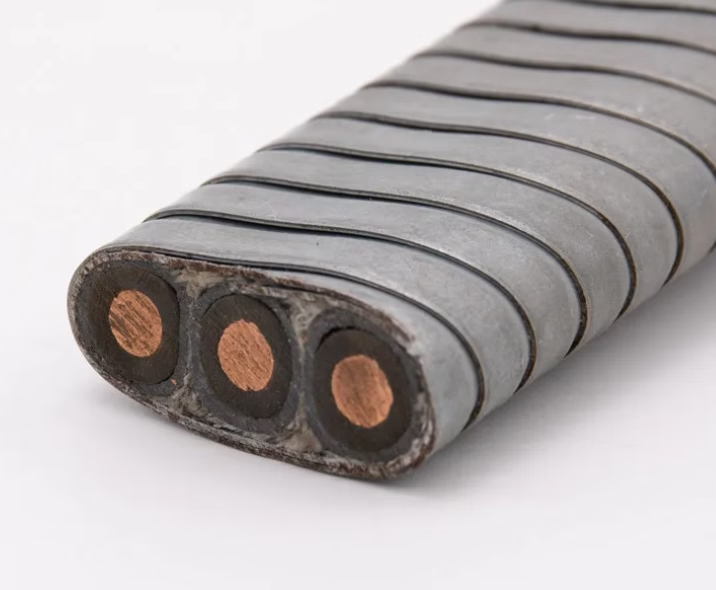
Submersible Pump Cable

飞纯 Type 209 是飞纯电缆基于 AS/NZS 1802:2003 卷筒与拖曳电缆 体系设计的矿用柔性馈电与拖曳电缆系列,电压范围覆盖 1.1 至 11KV。根据产品资料,Type 209 系列电缆主要作为矿山机械柔性馈电电缆使用,更适合作为拖曳电缆而不是高频卷筒电缆。较小规格适用于钻机、手持工具和移动设备。 这一定义是理解 Type 209 的关键。Type 209 不是普通工业橡套软电缆,也不只是单纯的矿山供电线。它的核心定位是 矿山机械柔性馈电电缆,也就是为矿山机械提供可移动、可拖曳、可适应复杂作业路径的供电系统。同时,它更适合作为 拖曳电缆,即跟随设备移动的电缆,而不是长期高频卷绕使用的卷筒电缆。

什么是 H07RN8-F 450/750V Harmonized Rubber Cables

H07RN8-F 450/750V Harmonized Rubber Cables 是一种用于潜水泵和类似工业水下应用的重型柔性橡套电缆。根据资料说明,该电缆可用于工业用水环境,适用水深最高可达 10 m,水温范围最高可达 40℃,同时也适用于干燥、潮湿和湿润应用。Feichun 将其定位于矿山排水、地下工程排涝、港口泵站、码头检修排水、工业水池和移动潜水泵供电等场景。它的工程价值不是单纯“能进水”,而是在水压、潮湿、移动、拉拽、磨损和低压动力传输同时存在时,仍能通过 Class 5 多股铜导体、EI4 橡胶绝缘、EM2/EM3 内护套与 EM2 外护套形成稳定的电气与机械防护系统。
Marine & Port Drag Cable — High-Flexibility Saltwater-Resistant System A comprehensive engineering dissection of heavy-duty marine drag cables for port equipment, container terminals, and offshore platforms — from conductor architecture and EPR insulation to steel wire armour (M2) design rationale, galvanic corrosion protection mechanisms, environmental compliance, and validated performance benchmarking against Nexans Eproneo Port and Prysmian marine systems.

Mining Cable Families at a Glance: An Engineering Guide to PROTOMONT, PROTOLON, TENAX, CORDAFLEX, NSSHOEU, TUNNELFLEX, MINEMASTER, SHD-GC, G-GC, MT 818 and Fibre Optic Cables

In mining, tunnelling and bulk material handling, the term mining cable does not describe one universal product. It describes an engineering map: reeling cables, trailing cables, feeder cables, fixed installation cables, tunnel cables, dredger and submersible pump cables, ground-check cables, fibre optic cables and custom OEM cable systems. A single mine may use low-voltage 0.6/1 kV reeling cables for LHD machines, medium-voltage trailing cables for excavators, TBM reeling cables from 6/10 to 18/30 kV, fixed feeder cables in tunnels and optical fibre networks for monitoring and automation. The correct selection starts not with a brand name, but with the application: how the cable moves, how it bends, how it is grounded, what voltage it carries, what regional standard applies and how the surrounding mine environment attacks the sheath.
AquaGlow® LED-illuminated trailing cable is engineered specifically for the practical realities of dredging operations, floating platform power systems, and submersible pump installation. Unlike theoretical self-powered LED solutions, AquaGlow is designed around real-world operational features: cables are dragged across gravel and rocky bottoms, bent repeatedly around pulleys and drums, exposed to saltwater spray and corrosive sewage chemicals, and must remain functional after years of intense mechanical stress.

AquaGlow® LED-Illuminated Trailing Cable

AquaGlow® LED-illuminated trailing cable is engineered specifically for the practical realities of dredging operations, floating platform power systems, and submersible pump installation. Unlike theoretical self-powered LED solutions, AquaGlow is designed around real-world operational features: cables are dragged across gravel and rocky bottoms, bent repeatedly around pulleys and drums, exposed to saltwater spray and corrosive sewage chemicals, and must remain functional after years of intense mechanical stress.
TML® submersible pump cable is the professional-grade electrical solution designed specifically for permanent submersion in drinking water systems, deep well applications, underwater pump installations, and saltwater coastal environments. Unlike general-purpose control cables that degrade when exposed to continuous moisture, the TML cable family features tinned copper conductors, AD8 water-resistant rubber insulation, and robust rubber sheathing engineered to maintain electrical integrity even after months or years of 24/7 submersion.

TML® Submersible Pump Cable

TML® submersible pump cable is the professional-grade electrical solution designed specifically for permanent submersion in drinking water systems, deep well applications, underwater pump installations, and saltwater coastal environments. Unlike general-purpose control cables that degrade when exposed to continuous moisture, the TML cable family features tinned copper conductors, AD8 water-resistant rubber insulation, and robust rubber sheathing engineered to maintain electrical integrity even after months or years of 24/7 submersion.
Annual Precipitation Extreme: Ok Tedi (Ok Tedi Mining Limited) operates in the Star Mountains of Papua New Guinea, a region that ranks among Earth's wettest mining zones. Annual rainfall exceeds 10,000 mm (10 meters)—more than 15× the global average. This extreme precipitation creates: (1) Continuous pit inflow of precipitation + groundwater, (2) Constant mud and sediment transport through dewatering systems, (3) Year-round 100% relative humidity in pit and underground areas, (4) Sediment concentration in pit sumps up to 15–20% solids by volume (vs typical 5–10% for other operations). Ok Tedi(奥克泰迪矿业有限公司)运营于PNG星山区,该地区是地球上降雨最多的矿区之一。年降水量超过10,000毫米(10米)—全球平均水平的15倍以上。这种极端降水造成:(1)持续降水+地下水补给坑道,(2)持续通过排水系统的泥浆和沉积物运输,(3)全年100%相对湿度在坑道和地下区域,(4)坑道集水池的沉积物浓度高达15-20%固体体积分数(vs其他运营的典型5-10%)。

Ok Tedi Dewatering Pump Cable: Type 209 1.1/1.1kV 3x25mm² for PNG Extreme Rainfall Mining

Annual Precipitation Extreme: Ok Tedi (Ok Tedi Mining Limited) operates in the Star Mountains of Papua New Guinea, a region that ranks among Earth’s wettest mining zones. Annual rainfall exceeds 10,000 mm (10 meters)—more than 15× the global average. This extreme precipitation creates: (1) Continuous pit inflow of precipitation + groundwater, (2) Constant mud and sediment transport through dewatering systems, (3) Year-round 100% relative humidity in pit and underground areas, (4) Sediment concentration in pit sumps up to 15–20% solids by volume (vs typical 5–10% for other operations). Ok Tedi(奥克泰迪矿业有限公司)运营于PNG星山区,该地区是地球上降雨最多的矿区之一。年降水量超过10,000毫米(10米)—全球平均水平的15倍以上。这种极端降水造成:(1)持续降水+地下水补给坑道,(2)持续通过排水系统的泥浆和沉积物运输,(3)全年100%相对湿度在坑道和地下区域,(4)坑道集水池的沉积物浓度高达15-20%固体体积分数(vs其他运营的典型5-10%)。
Dewatering System Scale: Indonesian mining operations (coal, copper, gold) contend with abundant tropical rainfall (3,000–5,000 mm annually) and complex hydrogeology. A typical open-pit mine encounters two water sources: (1) Direct precipitation, (2) Rising groundwater from aquifers. Combined inflow can exceed 10,000–50,000 cubic meters per day. Multiple submersible pumps, each rated 75–500 kW, operate continuously to prevent pit flooding. 印尼矿业运营(煤炭、铜矿、金矿)面临丰富的热带降雨(3000-5000毫米/年)和复杂的水文地质。典型露天矿遇到两个水源:(1)直接降水,(2)含水层上升地下水。联合流入量可超过10,000-50,000立方米/天。多台额定功率75-500千瓦的潜水泵连续运行,以防止坑道泛滥。 Water Quality Challenge: Unlike temperate mining regions where water is relatively neutral, Indonesian pit water often exhibits: (1) Low pH (3–5) due to pyrite oxidation (acid mine drainage—AMD), (2) High iron and sulfate concentration (leachate chemistry), (3) Abrasive suspended solids (clay, silt, ore fragments). This corrosive environment degrades standard cables rapidly—typical lifespan drops from 7–10 years to 2–4 years unless special formulations are used.

Type 209 Submersible Pump Cable: 1.1/1.1kV 3x25mm² for Indonesian Mine Dewatering Systems

Dewatering System Scale: Indonesian mining operations (coal, copper, gold) contend with abundant tropical rainfall (3,000–5,000 mm annually) and complex hydrogeology. A typical open-pit mine encounters two water sources: (1) Direct precipitation, (2) Rising groundwater from aquifers. Combined inflow can exceed 10,000–50,000 cubic meters per day. Multiple submersible pumps, each rated 75–500 kW, operate continuously to prevent pit flooding. 印尼矿业运营(煤炭、铜矿、金矿)面临丰富的热带降雨(3000-5000毫米/年)和复杂的水文地质。典型露天矿遇到两个水源:(1)直接降水,(2)含水层上升地下水。联合流入量可超过10,000-50,000立方米/天。多台额定功率75-500千瓦的潜水泵连续运行,以防止坑道泛滥。 Water Quality Challenge: Unlike temperate mining regions where water is relatively neutral, Indonesian pit water often exhibits: (1) Low pH (3–5) due to pyrite oxidation (acid mine drainage—AMD), (2) High iron and sulfate concentration (leachate chemistry), (3) Abrasive suspended solids (clay, silt, ore fragments). This corrosive environment degrades standard cables rapidly—typical lifespan drops from 7–10 years to 2–4 years unless special formulations are used.
The AS/NZS 1802 Type 275 3.3/3.3kV 3×50+3×16+1×16 is a heavy-duty medium-voltage reeling cable designed for mobile underground mining equipment—continuous miners, shuttle cars, and load-haul-dump machines—operating under Australian and New Zealand electrical standards. The designation "3.3/3.3kV" means the cable insulation is rated for 3.3kV phase-to-earth and 3.3kV phase-to-phase simultaneously, a requirement of the IT (isolated neutral) earthing systems mandated in AS/NZS-compliant mining operations. Feichun Cable manufactures a tropicalized variant of this cable with fully tinned copper conductors, hydrolysis-resistant EPR insulation, anti-capillary water-blocking fill, and ultra-low-absorption CPE sheath—purpose-engineered for Indonesia's high-humidity coal and metal mines where relative humidity exceeds 85% year-round and ambient temperatures reach 40–50°C.

AS/NZS 1802 Type 275 3.3/3.3kV 3×50mm² Reeling Cable for High-Humidity Mining in Indonesia: Complete Manufacturing & Sourcing Guide

The AS/NZS 1802 Type 275 3.3/3.3kV 3×50+3×16+1×16 is a heavy-duty medium-voltage reeling cable designed for mobile underground mining equipment—continuous miners, shuttle cars, and load-haul-dump machines—operating under Australian and New Zealand electrical standards. The designation “3.3/3.3kV” means the cable insulation is rated for 3.3kV phase-to-earth and 3.3kV phase-to-phase simultaneously, a requirement of the IT (isolated neutral) earthing systems mandated in AS/NZS-compliant mining operations. Feichun Cable manufactures a tropicalized variant of this cable with fully tinned copper conductors, hydrolysis-resistant EPR insulation, anti-capillary water-blocking fill, and ultra-low-absorption CPE sheath—purpose-engineered for Indonesia’s high-humidity coal and metal mines where relative humidity exceeds 85% year-round and ambient temperatures reach 40–50°C.
Type 7S cables are specifically engineered for mining applications where equipment must operate in wet, chemically hostile, and mechanically demanding underground environments. The designation "7S" indicates a cable designed for high mechanical stress combined with submersion protection—the perfect specification for permanent dewatering pump installations in deep mine shafts. Type 7S电缆专门为必须在潮湿、化学腐蚀性和机械要求苛刻的地下环境中运行的采矿应用而设计。术语"7S"表示一种为高机械应力结合浸没保护而设计的电缆——是深矿井永久降水泵安装的完美规范。

Dewatering Pumps: Is Type 7S 1.1kV 3x50mm² Suitable for Permanent Submerged Connections?

Type 7S cables are specifically engineered for mining applications where equipment must operate in wet, chemically hostile, and mechanically demanding underground environments. The designation “7S” indicates a cable designed for high mechanical stress combined with submersion protection—the perfect specification for permanent dewatering pump installations in deep mine shafts. Type 7S电缆专门为必须在潮湿、化学腐蚀性和机械要求苛刻的地下环境中运行的采矿应用而设计。术语”7S”表示一种为高机械应力结合浸没保护而设计的电缆——是深矿井永久降水泵安装的完美规范。
Deep well dewatering represents a critical infrastructure operation across Australian mining, civil construction, and agriculture. Whether managing groundwater in coal mining operations, controlling water in tunnel boring, or extracting water from agricultural boreholes, submersible pump systems must operate reliably in extreme conditions: complete water immersion, elevated hydrostatic pressures (depths of 50–200 meters), temperature variations, and potential contamination with minerals or abrasive particulates. 深井降水代表澳洲采矿、土木施工和农业的关键基础设施运营。无论是管理煤矿地下水、隧道掘进中的水控制,还是从农业水井中提取水,潜水泵系统必须在极端条件下可靠运行:完全浸水、升高的静水压力(50-200米深度)、温度变化和矿物或磨料污染的可能性。 Submersible Pump Power Demand: Modern submersible pumps for dewatering typically operate at 380–400V three-phase systems (standard Australian industrial voltage) with power ratings of 5–100 kW for typical deep well applications. The pump motor, submerged at depth, requires continuous reliable power delivered through an electrical cable that must withstand constant water contact, hydraulic pressure, and mechanical stress from pump vibration. Cable Deployment Challenge: The cable is lowered into the well and left in place—sometimes for years during extended dewatering operations. The cable cannot be easily inspected or replaced during operation, requiring specification at extreme safety margins for both electrical and mechanical properties. Cable failure mid-operation creates immediate emergency because the pump cannot be operated without power.

Submersible Pumps in AU: Specifying H07RN-F (Upgraded to 1.1/1.1kV) for Deep Well Dewatering

Deep well dewatering represents a critical infrastructure operation across Australian mining, civil construction, and agriculture. Whether managing groundwater in coal mining operations, controlling water in tunnel boring, or extracting water from agricultural boreholes, submersible pump systems must operate reliably in extreme conditions: complete water immersion, elevated hydrostatic pressures (depths of 50–200 meters), temperature variations, and potential contamination with minerals or abrasive particulates. 深井降水代表澳洲采矿、土木施工和农业的关键基础设施运营。无论是管理煤矿地下水、隧道掘进中的水控制,还是从农业水井中提取水,潜水泵系统必须在极端条件下可靠运行:完全浸水、升高的静水压力(50-200米深度)、温度变化和矿物或磨料污染的可能性。 Submersible Pump Power Demand: Modern submersible pumps for dewatering typically operate at 380–400V three-phase systems (standard Australian industrial voltage) with power ratings of 5–100 kW for typical deep well applications. The pump motor, submerged at depth, requires continuous reliable power delivered through an electrical cable that must withstand constant water contact, hydraulic pressure, and mechanical stress from pump vibration. Cable Deployment Challenge: The cable is lowered into the well and left in place—sometimes for years during extended dewatering operations. The cable cannot be easily inspected or replaced during operation, requiring specification at extreme safety margins for both electrical and mechanical properties. Cable failure mid-operation creates immediate emergency because the pump cannot be operated without power.
RHEYFIRM® is Nexans' premium line of flexible medium-voltage reeling cables specifically engineered for the extreme mechanical and environmental stresses of port machinery (STS cranes, automated stacker-reclaimers) and mining equipment (continuous dragline cables, mobile crusher power systems). Unlike fixed installation cables that remain stationary throughout their service life, reeling cables experience constant dynamic stress—deploying and retracting hundreds to thousands of times over their operational life. This continuous reeling duty subjects the cable to millions of bending cycles, sustained tensile loads, electromagnetic stress, salt spray corrosion, intense ultraviolet radiation, and temperature extremes far exceeding what conventional industrial cables are designed to tolerate. The physical diameter of a reeling cable is not simply a matter of aesthetics or standardization—it directly affects how much cable can fit on a physical drum of fixed dimensions. Consider a stacker-reclaimer with an existing cable drum that has a fixed flange width (say, 1,200 millimeters) and a fixed core diameter (say, 400 millimeters). The amount of cable that can be wound onto this drum depends on how tightly the cable packs around the core. A cable with a 59-millimeter outer diameter will create a larger spiral as it is wound layer by layer, limiting the total cable length to perhaps 600 meters. That same physical drum, if fitted with a 55.8-millimeter diameter cable, creates a tighter spiral and accommodates perhaps 750 meters of cable—a 25 percent increase in usable length with zero change to the physical equipment. For equipment where travel distance requirements have increased due to terminal expansion or operational upgrades, this diameter optimization can mean the difference between being able to extend operations and being forced into an expensive drum replacement project costing hundreds of thousands of dollars.

RHEYFIRM® (RS) vs. RHEYFIRM® (RTS): When to Choose the “Reduced Diameter” Version for Space-Constrained Reels

RHEYFIRM® is Nexans’ premium line of flexible medium-voltage reeling cables specifically engineered for the extreme mechanical and environmental stresses of port machinery (STS cranes, automated stacker-reclaimers) and mining equipment (continuous dragline cables, mobile crusher power systems). Unlike fixed installation cables that remain stationary throughout their service life, reeling cables experience constant dynamic stress—deploying and retracting hundreds to thousands of times over their operational life. This continuous reeling duty subjects the cable to millions of bending cycles, sustained tensile loads, electromagnetic stress, salt spray corrosion, intense ultraviolet radiation, and temperature extremes far exceeding what conventional industrial cables are designed to tolerate. The physical diameter of a reeling cable is not simply a matter of aesthetics or standardization—it directly affects how much cable can fit on a physical drum of fixed dimensions. Consider a stacker-reclaimer with an existing cable drum that has a fixed flange width (say, 1,200 millimeters) and a fixed core diameter (say, 400 millimeters). The amount of cable that can be wound onto this drum depends on how tightly the cable packs around the core. A cable with a 59-millimeter outer diameter will create a larger spiral as it is wound layer by layer, limiting the total cable length to perhaps 600 meters. That same physical drum, if fitted with a 55.8-millimeter diameter cable, creates a tighter spiral and accommodates perhaps 750 meters of cable—a 25 percent increase in usable length with zero change to the physical equipment. For equipment where travel distance requirements have increased due to terminal expansion or operational upgrades, this diameter optimization can mean the difference between being able to extend operations and being forced into an expensive drum replacement project costing hundreds of thousands of dollars.
The Type W 4/C 2/0 AWG 2000V cable features a heavy-duty thermoset CPE (chlorinated polyethylene) jacket that is specifically formulated with UV stabilizers and ozone-resistant additives, providing robust protection against continuous direct sunlight and high ozone concentrations found in desert port environments. The cable is rated to withstand prolonged outdoor exposure in desert conditions, typically maintaining 80 to 90 percent of its physical properties after 5 to 10 years of continuous unshaded sunlight exposure, compared to standard elastomeric jackets that degrade to 50 to 70 percent property retention under identical conditions. The nominal outer diameter of this cable is 46.8 to 49.1 mm (1.845 to 1.935 inches), with approximate weight of 4,390 to 5,133 kg per kilometer. The cable features 259-strand rope-lay copper conductors (2/0 AWG per core), four 67.4 mm² cores, EPDM insulation rated for 90°C conductor temperature, and current carrying capacity of 237 amperes (based on 30°C ambient, 90°C conductor temperature). However, the critical distinction that separates viable long-term desert service from premature field failures lies in understanding the difference between a cable jacket that merely resists UV degradation and a comprehensively designed system where all exposed components—including terminal connections, stripped insulation, and mechanical attachment points—receive appropriate protection from direct sunlight. In actual desert port applications, failures are as frequently caused by UV damage at unprotected termination points as by jacket degradation itself, making installation and maintenance procedures as important as material selection. For typical desert port power systems, RTG (rubber-tired gantry) crane power leads, shore-to-ship power cables, and fixed deck-mounted power distribution systems operating in Middle Eastern, North African, and Australian port environments, the Type W 4/C 2/0 AWG cable with standard CPE jacket provides reliable field-proven performance when properly installed and maintained, but premium UV-resistant cable variants should be considered for applications where service life extension beyond 7 to 10 years is critical or where inspection and maintenance infrastructure is limited.

UV & Ozone Resistance of Type W 4/C 2/0 AWG 2000V: Is the CPE Jacket Durable Enough for Constant Direct Sunlight in Desert Ports?

The Type W 4/C 2/0 AWG 2000V cable features a heavy-duty thermoset CPE (chlorinated polyethylene) jacket that is specifically formulated with UV stabilizers and ozone-resistant additives, providing robust protection against continuous direct sunlight and high ozone concentrations found in desert port environments. The cable is rated to withstand prolonged outdoor exposure in desert conditions, typically maintaining 80 to 90 percent of its physical properties after 5 to 10 years of continuous unshaded sunlight exposure, compared to standard elastomeric jackets that degrade to 50 to 70 percent property retention under identical conditions. The nominal outer diameter of this cable is 46.8 to 49.1 mm (1.845 to 1.935 inches), with approximate weight of 4,390 to 5,133 kg per kilometer. The cable features 259-strand rope-lay copper conductors (2/0 AWG per core), four 67.4 mm² cores, EPDM insulation rated for 90°C conductor temperature, and current carrying capacity of 237 amperes (based on 30°C ambient, 90°C conductor temperature). However, the critical distinction that separates viable long-term desert service from premature field failures lies in understanding the difference between a cable jacket that merely resists UV degradation and a comprehensively designed system where all exposed components—including terminal connections, stripped insulation, and mechanical attachment points—receive appropriate protection from direct sunlight. In actual desert port applications, failures are as frequently caused by UV damage at unprotected termination points as by jacket degradation itself, making installation and maintenance procedures as important as material selection. For typical desert port power systems, RTG (rubber-tired gantry) crane power leads, shore-to-ship power cables, and fixed deck-mounted power distribution systems operating in Middle Eastern, North African, and Australian port environments, the Type W 4/C 2/0 AWG cable with standard CPE jacket provides reliable field-proven performance when properly installed and maintained, but premium UV-resistant cable variants should be considered for applications where service life extension beyond 7 to 10 years is critical or where inspection and maintenance infrastructure is limited.
Prysmian TECWATER 3x120 mm² submersible pump cable has a standardized maximum operating depth of approximately 10 meters under the VDE certification standard (DIN VDE 0298-300) in typical industrial environments. This 10-meter specification assumes normal freshwater conditions, moderate water quality without unusual corrosive properties, and water temperature not exceeding 40°C. However, in extended applications involving less corrosive water sources (such as industrial cooling water circuits, mining surface drainage, or rainwater collection systems) where inspection and maintenance requirements are relaxed, the cable can operate at depths up to 500 meters, provided all mechanical stresses are carefully managed and the cable is protected from snapping or mechanical damage during deployment. The relationship between depth and service life is non-linear and governed by hydrostatic pressure physics, material science principles regarding polymer behavior under sustained compression, and the synergistic effects of pressure and temperature on insulation degradation. Understanding the distinction between the standardized 10-meter specification and the extended 500-meter capability requires appreciation for how hydrostatic pressure actually affects cable materials, what additional engineering controls are necessary at greater depths, and what real-world scenarios justify each depth rating. A cable suitable for a 10-meter municipal wastewater pumping station is fundamentally different in its application requirements from a cable operating at 500 meters in a deep mining shaft, yet both use the same basic material formulation because the cable itself is equally capable—the difference lies in system design, installation procedures, and operational monitoring protocols.

Water Submersion Depth: Maximum Continuous Operating Depth for Prysmian TECWATER 3×120 mm² Submersible Pump Cable

Prysmian TECWATER 3×120 mm² submersible pump cable has a standardized maximum operating depth of approximately 10 meters under the VDE certification standard (DIN VDE 0298-300) in typical industrial environments. This 10-meter specification assumes normal freshwater conditions, moderate water quality without unusual corrosive properties, and water temperature not exceeding 40°C. However, in extended applications involving less corrosive water sources (such as industrial cooling water circuits, mining surface drainage, or rainwater collection systems) where inspection and maintenance requirements are relaxed, the cable can operate at depths up to 500 meters, provided all mechanical stresses are carefully managed and the cable is protected from snapping or mechanical damage during deployment. The relationship between depth and service life is non-linear and governed by hydrostatic pressure physics, material science principles regarding polymer behavior under sustained compression, and the synergistic effects of pressure and temperature on insulation degradation. Understanding the distinction between the standardized 10-meter specification and the extended 500-meter capability requires appreciation for how hydrostatic pressure actually affects cable materials, what additional engineering controls are necessary at greater depths, and what real-world scenarios justify each depth rating. A cable suitable for a 10-meter municipal wastewater pumping station is fundamentally different in its application requirements from a cable operating at 500 meters in a deep mining shaft, yet both use the same basic material formulation because the cable itself is equally capable—the difference lies in system design, installation procedures, and operational monitoring protocols.
In mining pump and dewatering operations, cable selection directly impacts system reliability and operational safety. While H07RN-F Titanex (manufactured by Nexans) represents a high-quality general industrial rubber cable compliant with EN 50525-2-21/IEC 60245-4, the NSSHÖU cable manufactured per DIN VDE 0250 Part 812 offers critical advantages specifically engineered for mining environments. 在矿井泵和排水作业中,电缆选择直接影响系统可靠性和操作安全。虽然H07RN-F Titanex(Nexans生产)是符合EN 50525-2-21/IEC 60245-4标准的高品质通用工业橡胶电缆,但按DIN VDE 0250第812部分制造的NSSHÖU电缆专为矿业环境设计,具有关键优势。

H07RN-F Titanex vs. NSSHÖU: Why NSSHÖU is Superior for Mining Pump Applications

In mining pump and dewatering operations, cable selection directly impacts system reliability and operational safety. While H07RN-F Titanex (manufactured by Nexans) represents a high-quality general industrial rubber cable compliant with EN 50525-2-21/IEC 60245-4, the NSSHÖU cable manufactured per DIN VDE 0250 Part 812 offers critical advantages specifically engineered for mining environments. 在矿井泵和排水作业中,电缆选择直接影响系统可靠性和操作安全。虽然H07RN-F Titanex(Nexans生产)是符合EN 50525-2-21/IEC 60245-4标准的高品质通用工业橡胶电缆,但按DIN VDE 0250第812部分制造的NSSHÖU电缆专为矿业环境设计,具有关键优势。
In deep-mine dewatering systems, the power cable connecting the submersible pump to its surface control panel is statistically the single most failure-prone component in the entire pumping assembly. According to repair-statistics analysis published by Tsurumi — one of the world's largest manufacturers of dewatering pumps — a defective power cable is the most frequent cause of pump failure. Their engineering team notes that the cable is the first link in the failure chain and therefore the most important element to consider first. (根据全球最大潜水泵制造商之一Tsurumi的维修数据统计,电缆故障是潜水泵失效最常见的单一原因。电缆是故障链中的第一环节。)

Submersible Pump Cable Failures: Switching from H07RN-F to NSSHÖU for Deep Mine Dewatering

In deep-mine dewatering systems, the power cable connecting the submersible pump to its surface control panel is statistically the single most failure-prone component in the entire pumping assembly. According to repair-statistics analysis published by Tsurumi — one of the world’s largest manufacturers of dewatering pumps — a defective power cable is the most frequent cause of pump failure. Their engineering team notes that the cable is the first link in the failure chain and therefore the most important element to consider first. (根据全球最大潜水泵制造商之一Tsurumi的维修数据统计,电缆故障是潜水泵失效最常见的单一原因。电缆是故障链中的第一环节。)
The selection of appropriate submersible pump cables for acidic mine water dewatering applications represents a critical engineering decision that directly impacts operational safety, equipment longevity, and maintenance costs. While Type 441 cables may appear suitable for general submersible pump applications, the harsh chemical environment of acidic mine water typically necessitates the use of specialized EPR (Ethylene Propylene Rubber) or CSP (Chlorosulfonated Polyethylene) insulated cables specifically engineered for corrosive conditions. 为酸性矿井水脱水应用选择合适的潜水泵电缆是一项关键的工程决策,直接影响运行安全、设备寿命和维护成本。虽然441型电缆可能适用于一般潜水泵应用,但酸性矿井水的恶劣化学环境通常需要使用专门设计用于腐蚀性条件的EPR(乙丙橡胶)或CSP(氯磺化聚乙烯)绝缘电缆。

Submersible Pumps: Can Type 441 Cables Be Used for Dewatering Pumps in Acidic Mine Water, or Is a Specialized EPR/CSP Cable Required?

The selection of appropriate submersible pump cables for acidic mine water dewatering applications represents a critical engineering decision that directly impacts operational safety, equipment longevity, and maintenance costs. While Type 441 cables may appear suitable for general submersible pump applications, the harsh chemical environment of acidic mine water typically necessitates the use of specialized EPR (Ethylene Propylene Rubber) or CSP (Chlorosulfonated Polyethylene) insulated cables specifically engineered for corrosive conditions. 为酸性矿井水脱水应用选择合适的潜水泵电缆是一项关键的工程决策,直接影响运行安全、设备寿命和维护成本。虽然441型电缆可能适用于一般潜水泵应用,但酸性矿井水的恶劣化学环境通常需要使用专门设计用于腐蚀性条件的EPR(乙丙橡胶)或CSP(氯磺化聚乙烯)绝缘电缆。
In the hierarchy of German VDE standards, while high-voltage reeling cables like (N)TSCGEWÖU handle the massive power distribution, the NSSHÖU series (defined by DIN VDE 0250 Part 812) performs the grueling, daily operational tasks. It is termed the "workhorse" because it bridges the gap between standard rubber cables (like H07RN-F) and specialized mining cables. It offers superior mechanical strength, robust abrasion resistance, and chemical stability for dynamic applications in mines, drilling rigs, and heavy industry. 在德国 VDE 标准的体系中,虽然像 (N)TSCGEWÖU 这样的高压卷盘电缆负责大规模的配电,但 NSSHÖU 系列(由 DIN VDE 0250 第 812 部分定义)承担着繁重、日常的操作任务。它被称为“主力军(workhorse)”,因为它填补了普通橡胶电缆(如 H07RN-F)与专用矿用电缆之间的空白。它为矿山、钻井平台和重工业中的动态应用提供了卓越的机械强度、强大的耐磨性和化学稳定性。

Why is NSSHÖU considered the “workhorse” of VDE 0250 cables for low-voltage heavy-duty connections?

In the hierarchy of German VDE standards, while high-voltage reeling cables like (N)TSCGEWÖU handle the massive power distribution, the NSSHÖU series (defined by DIN VDE 0250 Part 812) performs the grueling, daily operational tasks. It is termed the “workhorse” because it bridges the gap between standard rubber cables (like H07RN-F) and specialized mining cables. It offers superior mechanical strength, robust abrasion resistance, and chemical stability for dynamic applications in mines, drilling rigs, and heavy industry. 在德国 VDE 标准的体系中,虽然像 (N)TSCGEWÖU 这样的高压卷盘电缆负责大规模的配电,但 NSSHÖU 系列(由 DIN VDE 0250 第 812 部分定义)承担着繁重、日常的操作任务。它被称为“主力军(workhorse)”,因为它填补了普通橡胶电缆(如 H07RN-F)与专用矿用电缆之间的空白。它为矿山、钻井平台和重工业中的动态应用提供了卓越的机械强度、强大的耐磨性和化学稳定性。
Mining, drilling, and tunnelling cables are specialized heavy-duty electrical cables engineered specifically for the harsh conditions found in underground mining operations, drilling sites, and tunnel construction facilities. These industrial-grade cables are designed to withstand extreme mechanical stress, chemical exposure, moisture, and temperature variations while maintaining reliable power transmission and ensuring safety in demanding underground environments. According to international standards including IEC 60502 and MSHA regulations, these cables form the electrical backbone of modern mining and underground construction operations.

ما هي كابلات التعدين والحفر والأنفاق؟ وأين تُستخدم تحت الأرض؟

Mining, drilling, and tunnelling cables are specialized heavy-duty electrical cables engineered specifically for the harsh conditions found in underground mining operations, drilling sites, and tunnel construction facilities. These industrial-grade cables are designed to withstand extreme mechanical stress, chemical exposure, moisture, and temperature variations while maintaining reliable power transmission and ensuring safety in demanding underground environments. According to international standards including IEC 60502 and MSHA regulations, these cables form the electrical backbone of modern mining and underground construction operations.
The global water treatment industry represents one of the most critical infrastructure sectors, serving both municipal drinking water systems and industrial wastewater processing facilities. According to the World Bank, approximately 2.2 billion people worldwide lack access to safely managed drinking water services, driving unprecedented investment in water treatment infrastructure. The U.S. Environmental Protection Agency (EPA) estimates that water utilities in the United States alone require over $470 billion in infrastructure investment over the next two decades.

Water Treatment Cables

H07RN-F rubber flexible cable, H07RN-8-F submersible pump cable, H05RR-F light duty cable, 318-TRS rubber cable, NTSCGECEWOU 3.6/6kV submersible cable, NTSCGECEWOU 6/10kV screened cable, NTSCGECEWOU 8.7/15kV medium voltage cable, NTSCGECEWOU 12/20kV deep well cable, NTSCGEWOU 3.6/6kV unscreened cable, NTSCGEWOU 6/10kV armoured cable, NTSCGEWOU 8.7/15kV submersible, NTSCGEWOU 12/20kV pump cable, Drincable 600 WRAS approved, Drincable 800 potable water cable, Drincable 600 Flat borehole cable
Mining, drilling, and tunnelling cables represent a specialized category of electrical cables engineered to withstand the extreme conditions found in extractive industry operations. Unlike standard industrial cables, these cables must endure continuous mechanical stress from reeling and unreeling operations, exposure to ultraviolet radiation in surface mining, salt-water submersion in offshore drilling, contact with oils and greases from machinery, and the abrasive conditions of underground environments. The demanding nature of these applications requires cables with exceptional durability, flexibility, and resistance to environmental factors that would rapidly degrade conventional cables.

What is Mining, Drilling & Tunnelling Cable? Solutions for Surface, Sub-Surface & Underground Operations

(N)3GHSSHCH – 3.6/6kV, 6/10kV, 8.7/15kV, 12/20kV (N)3GHSSYCY – 3.6/6kV, 6/10kV, 8.7/15kV, 12/20kV (N)SSCHÖU-J – 0.6/1kV (N)SHÖU O/J – 0.6/1kV NSSHÖU O/J – 0.6/1kV NSSHÖU 3E – 0.6/1kV NSSHÖU 3E + ST – 0.6/1kV (N)TMCGEWÖU – 3.6/6kV to 18/30kV (N)TSCGEWÖU – 3.6/6kV to 18/30kV (N)TSCGEWÖU ZH – 3.6/6kV to 12/20kV (N)TSCGEWÖU ATB – 3.6/6kV to 12/20kV (N)TSCGEWÖU FO – 3.6/6kV to 12/20kV (N)TSCGEWÖU Submersible – 3.6/6kV to 12/20kV (N)TSKCGEWÖU – 3.6/6kV to 18/30kV (N)TSCGECEWÖU – 3.6/6kV to 12/20kV (N)TSCGECEWÖU ATB – 3.6/6kV to 12/20kV (N)TSCGECEWÖU ATB GCC – 1.8/3kV to 12/20kV (N)TSCGECEWÖU Submersible – 3.6/6kV to 12/20kV (N)TSCGECECWÖU – 3.6/6kV to 12/20kV (N)TSCGECECWÖU ZH – 3.6/6kV to 12/20kV R-(N)TSCGEWÖU + FO – 3.6/6kV to 12/20kV
Submersible and pump cables are specialized electrical cables designed for permanent operation underwater, connecting electrical motor equipment in both process and potable water applications. According to IEC standards and VDE specifications, these cables must demonstrate exceptional water resistance, flexibility under pressure, and chemical compatibility with their operating environment. The cables support diverse industries from food processing to water treatment, mining, and aquatic installations.

What are Submersible & Pump Cables?

(N)SHÖU O/J 0.6/1kV, NSSHÖU O/J 0.6/1kV, NSSHÖU 3E 0.6/1kV, NSSHÖU 3E + ST 0.6/1kV, (N)SSCHÖU-J 0.6/1kV, (N)TSCGECEWÖU 3.6/6kV, (N)TSCGECEWÖU 6/10kV, (N)TSCGECEWÖU 8.7/15kV, (N)TSCGECEWÖU 12/20kV (N)TSCGEWÖU 3.6/6kV, (N)TSCGEWÖU 6/10kV, (N)TSCGEWÖU 8.7/15kV, (N)TSCGEWÖU 12/20kV, H07RN-8-F (10m), Pump Cable 300 (300m), Drincable 600 (600m), Drincable 600 Flat (600m), Drincable 800 (800m)
H07RN-F cable, H05RR-F cable, H07ZZ-F cable, H07BN4-F cable, H07RN8-F cable, H05BB-F cable, H05BQ-F cable, H07BB-F cable, H07BQ-F cable, H05GG-F cable, H05SS-F cable

What is BS7919 Cable?

BS7919 cable, BS7919 flexible cable, BS EN 50525 cable, industrial flexible cable, rubber flexible cable, heavy duty cable 450/750V,H07RN-F cable, H05RR-F cable, H07ZZ-F cable, H07BN4-F cable, H07RN8-F cable, H05BB-F cable, H05BQ-F cable, H07BB-F cable, H07BQ-F cable, H05GG-F cable, H05SS-F cable,BS7919電纜, 柔性橡膠電纜, 工業柔性電纜, 重型橡膠電纜, 耐油電纜, 阻燃柔性電纜, 港口機械電纜, 起重機電纜, 移動電源電纜, H07RN-F橡膠電纜, 450/750V柔性電纜, 氯丁橡膠護套電纜, EPR絕緣電纜, 多芯柔性電纜, 拖曳電纜, 卷筒電纜
PROTOLON (M) F-(N)TSCGEWOEU 6/10KV is a medium voltage flexible cable engineered for semi-flexible installation in demanding mining and tunneling applications. This cable represents the pinnacle of German engineering excellence, designed specifically for environments where mechanical stress, chemical exposure, and continuous operation are standard operating conditions.

What is PROTOLON (M) F-(N)TSCGEWOEU 6/10KV Mining & Tunneling Semi-flexible Cable?

PROTOLON (M) F-(N)TSCGEWOEU 6/10KV is a medium voltage flexible cable engineered for semi-flexible installation in demanding mining and tunneling applications. This cable represents the pinnacle of German engineering excellence, designed specifically for environments where mechanical stress, chemical exposure, and continuous operation are standard operating conditions.
(N)SSHOEU PUR 0.6/1KV is a halogen-free low voltage flexible cable designed for semi-flexible use and fixed installation in demanding environments. The polyurethane (PUR) sheath provides superior abrasion resistance compared to standard rubber cables. (N)SSHOEU PUR 0.6/1KV 是一款無鹵素低壓柔性電纜,專為惡劣環境中的半柔性使用和固定安裝而設計。聚氨酯(PUR)護套比標準橡膠電纜具有更優越的耐磨性。

(N)SSHOEU PUR 0.6/1KV Semi-Flexible Installation Cable

(N)SSHOEU PUR 0.6/1KV is a halogen-free low voltage flexible cable designed for semi-flexible use and fixed installation in demanding environments. The polyurethane (PUR) sheath provides superior abrasion resistance compared to standard rubber cables. (N)SSHOEU PUR 0.6/1KV 是一款無鹵素低壓柔性電纜,專為惡劣環境中的半柔性使用和固定安裝而設計。聚氨酯(PUR)護套比標準橡膠電纜具有更優越的耐磨性。
DLO TORSIONFLEX RHH/RHW-2 represents an advanced category of portable power cables specifically engineered for demanding industrial applications, including wind turbine installations where torsional flexibility and multi-environment performance are critical requirements. This cable type combines the proven durability of Diesel Locomotive (DLO) construction with enhanced torsion resistance, making it uniquely suited for wind energy systems where cables must accommodate continuous nacelle rotation while maintaining electrical integrity.

What is DLO TORSIONFLEX RHH/RHW-2 2000V Wind Turbine Cable?

DLO TORSIONFLEX RHH/RHW-2 represents an advanced category of portable power cables specifically engineered for demanding industrial applications, including wind turbine installations where torsional flexibility and multi-environment performance are critical requirements. This cable type combines the proven durability of Diesel Locomotive (DLO) construction with enhanced torsion resistance, making it uniquely suited for wind energy systems where cables must accommodate continuous nacelle rotation while maintaining electrical integrity.
heavy-duty rubber cables represent a critical category for applications requiring exceptional mechanical strength, flexibility, and environmental resistance. This comprehensive technical guide examines three closely related cable types that dominate international markets for portable power transmission: the Chinese standard GB/T 5013 YC (Heavy-Duty General Rubber Cable) rated at 450/750V, the enhanced YCW variant with oil and weather resistance, and the European harmonized H07RN-F cable that serves as the international equivalent.

GB/T 5013 YC & YCW Heavy-Duty Rubber Cables and H07RN-F: Comprehensive Technical Analysis

heavy-duty rubber cables represent a critical category for applications requiring exceptional mechanical strength, flexibility, and environmental resistance. This comprehensive technical guide examines three closely related cable types that dominate international markets for portable power transmission: the Chinese standard GB/T 5013 YC (Heavy-Duty General Rubber Cable) rated at 450/750V, the enhanced YCW variant with oil and weather resistance, and the European harmonized H07RN-F cable that serves as the international equivalent.
PROTOMONT(MT) (N)SHOEU

PROTOMONT(MT) (N)SHOEU 1 kV Light & Flexible Rubber Cable

The designation (N)SHOEU within the German VDE cable nomenclature system identifies a specific cable construction optimized for applications requiring exceptional flexibility and reduced weight while maintaining robust environmental protection characteristics essential for industrial and mining applications. The single “S” designation, distinguishing (N)SHOEU from the double “SS” in NSSHOEU variants, signifies Strapazierfähig (heavy-duty) rather than Spezial Strapazierfähig (special heavy-duty), indicating an optimized balance between mechanical strength and flexibility. This optimization enables (N)SHOEU cables to achieve approximately fifteen to twenty-five percent weight reduction compared to NSSHOEU equivalents while maintaining adequate mechanical properties for applications not subjected to the most extreme stress conditions characteristic of coal cutter cable chain operations or heavy continuous miner trailing cable applications.
What is PROTOMONT NSSHOEU 1 kV Low Voltage Flexible Rubber Cable? A Comprehensive Technical Guide to Heavy-Duty Mining and Industrial Flexible Cables with EPR Insulation for Extreme Environments

What is PROTOMONT NSSHOEU 1 kV Low Voltage Flexible Rubber Cable?

PROTOMONT NSSHOEU series represents a category of heavy-duty, low voltage flexible rubber cables engineered specifically for demanding industrial environments. These cables are designed to provide reliable power transmission in applications where conventional cables would fail due to extreme mechanical stress, environmental exposure, or chemical contact. The designation NSSHOEU follows German cable nomenclature standards where each letter indicates specific construction characteristics. The cables are manufactured according to DIN VDE 0250-812 specifications, which define requirements for rubber-insulated flexible cables used in power installations. According to industry standards, these cables are engineered for environments where high levels of mechanical stress and abrasion are expected, making them essential for modern mining, construction, and industrial operations.
PROTOLON(M) F (N)TSCGEWOEU 3 kV – 30 kV

What is PROTOLON(M) F (N)TSCGEWOEU 3 kV – 30 kV Medium Voltage Reeling Cable?

PROTOLON(M) F (N)TSCGEWOEU represents an advanced class of medium voltage flexible power cables engineered specifically for demanding industrial environments. Manufactured by Anhui Feichun Special Cable Co., Ltd., this cable series delivers reliable power transmission across voltage ratings from 3.6/6 kV to 18/30 kV, making it indispensable for large-scale mining operations, conveyor systems, and heavy material handling equipment. Unlike standard reeling cables designed for high-speed dynamic applications, the “F” designation in PROTOLON(M) F indicates this series is optimized for fixed and semi-flexible installations. This makes it particularly suited for permanent laying alongside conveyor belts, shiftable mining units, connections between upper and lower machinery sections (such as excavator car bodies), and continuous submersible pump operations.