
A comprehensive technical analysis of how RHEYFIRM® (XT) extreme cold-resistant reeling cables structurally and chemically differ from RHEYFIRM® (RS) standard versions when deployed in permafrost mining zones, arctic open-pit mining environments, and sub-zero mining operations at temperatures reaching -50°C. This guide examines the fundamental physics of material behavior at extreme low temperatures, jacket compound formulation differences that prevent embrittlement and cracking, ultra-low-temperature advanced elastomer and specialized cold-resistant polyurethane blending, cold-adapted synthetic anti-torsion braids utilizing Kevlar and Aramid reinforcement, insulation flexibility engineering for arctic blasts, core lubrication systems and internal slip-layers designed to reduce friction at sub-zero temperatures, mechanical stress tolerance and fatigue performance under dynamic reeling stress in frozen ground conditions, copper conductor behavior and the physics of metallic embrittlement at extreme cold, explosive decompression prevention in subsurface permafrost mining, continuous high-speed reeling up to 190 meters per minute in arctic weather, thermal stability analysis of specialized EPR and polyurethane compounds, comparative electrical performance at -50°C versus standard reference conditions, torsional stress management and anti-twist engineering in frozen mining environments, flexible trailing cable performance on ice and snow-covered ground, field performance documentation from major arctic mining regions including Siberian diamond and mineral operations and Canadian subarctic mines, comprehensive cost-benefit analysis comparing XT extreme variants against RS standard cables for arctic applications, engineering selection matrices and decision criteria for harsh environment mining cable specification, best practices derived from decades of operational experience in extreme cold climates, and strategic procurement guidance for mining companies operating in permafrost regions worldwide. — 深入分析RHEYFIRM® 极限版本(XT)与标准版(RS)在-50°C北极矿山的本质差异。
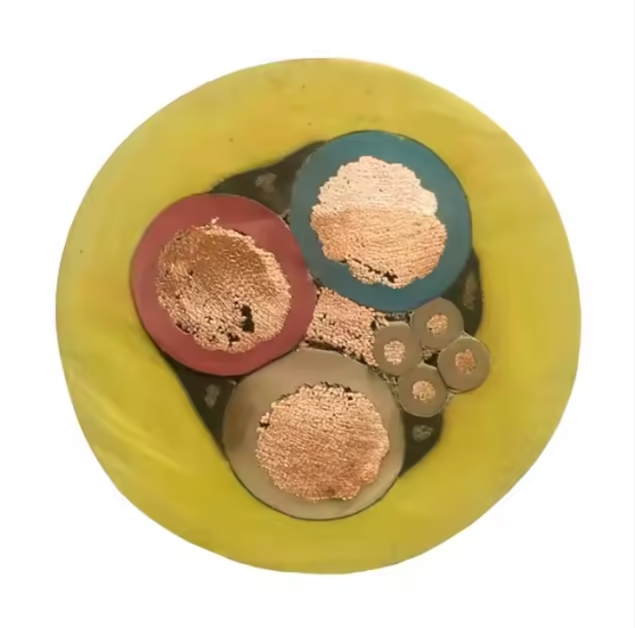
RHEYFIRM® (XT): How Does the “Extreme” Version Differ from Standard (RS) for Operations in -50°C Arctic Mines?
A comprehensive technical analysis of how RHEYFIRM® (XT) extreme cold-resistant reeling cables structurally and chemically differ from RHEYFIRM® (RS) standard versions when deployed in permafrost mining zones, arctic open-pit mining environments, and sub-zero mining operations at temperatures reaching -50°C. This guide examines the fundamental physics of material behavior at extreme low temperatures, jacket compound formulation differences that prevent embrittlement and cracking, ultra-low-temperature advanced elastomer and specialized cold-resistant polyurethane blending, cold-adapted synthetic anti-torsion braids utilizing Kevlar and Aramid reinforcement, insulation flexibility engineering for arctic blasts, core lubrication systems and internal slip-layers designed to reduce friction at sub-zero temperatures, mechanical stress tolerance and fatigue performance under dynamic reeling stress in frozen ground conditions, copper conductor behavior and the physics of metallic embrittlement at extreme cold, explosive decompression prevention in subsurface permafrost mining, continuous high-speed reeling up to 190 meters per minute in arctic weather, thermal stability analysis of specialized EPR and polyurethane compounds, comparative electrical performance at -50°C versus standard reference conditions, torsional stress management and anti-twist engineering in frozen mining environments, flexible trailing cable performance on ice and snow-covered ground, field performance documentation from major arctic mining regions including Siberian diamond and mineral operations and Canadian subarctic mines, comprehensive cost-benefit analysis comparing XT extreme variants against RS standard cables for arctic applications, engineering selection matrices and decision criteria for harsh environment mining cable specification, best practices derived from decades of operational experience in extreme cold climates, and strategic procurement guidance for mining companies operating in permafrost regions worldwide. — 深入分析RHEYFIRM® 极限版本(XT)与标准版(RS)在-50°C北极矿山的本质差异。
Direct Answer: What is RHEYFIRM® (XT) and How Does It Differ at -50°C? 直接回答:RHEYFIRM® (XT)是什么,它在-50°C时如何不同?
RHEYFIRM® (XT) “Extreme” is a specialized arctic-grade flexible reeling cable engineered specifically for continuous dynamic operation in permafrost mining zones and open-pit operations where temperatures fall to -50°C (-58°F), whereas RHEYFIRM® (RS) standard versions are designed for conventional industrial and port environments operating down to approximately -25°C to -35°C maximum. The XT extreme variant differs from the RS standard version through four fundamental structural and chemical modifications. First, the outer jacket compound transitions from standard chlorinated rubber (5GM5 formulation) to an ultra-low-temperature advanced elastomer or specialized cold-resistant polyurethane (PUR) blend that remains flexible and resistant to crystallization and embrittlement even when exposed to -50°C arctic blasts. Second, the internal structure incorporates enhanced cold-adapted synthetic anti-torsion braids fabricated from Kevlar and Aramid fibers instead of conventional braid materials, which maintain their reinforcement properties at extreme temperatures where standard materials would lose rigidity. Third, the insulation material evolves from standard EPR (ethylene propylene rubber) to an optimized cold-flexible EPR formulation that prevents micro-cracking around copper conductors under severe thermal stress. Fourth, the cable incorporates specialized core lubrication systems and internal slip-layers designed to reduce friction between conductor wires at sub-zero temperatures, where natural friction increases dramatically and would otherwise cause internal conductor fatigue and snapping. The result is a cable system that remains mechanically robust and electrically reliable for continuous high-speed reeling (up to 190 meters per minute) on frozen ground and ice-covered surfaces in the harshest mining environments on Earth. The electrical specifications remain identical to RS standard cables (same voltage ratings, same current capacity), but the physical behavior and mechanical reliability at extreme cold are fundamentally different. You should specify RHEYFIRM® (XT) when your mining operation is located in permafrost regions, when winter operations regularly experience temperatures below -40°C, when continuous reeling stress is combined with sub-zero conditions, and when cable failure could result in equipment shutdown in a remote arctic location where emergency replacement is logistically impossible.
Critical Safety Warning: Operating standard RHEYFIRM® (RS) cables at -50°C in continuous reeling duty will result in jacket embrittlement, micro-cracking in the insulation, and internal conductor fatigue within weeks to months of operation. This is not a slow degradation process—it is a rapid cascade failure mechanism that can cause complete electrical failure and equipment damage in remote arctic mining locations. Extreme cold mining operations require XT extreme-grade specification as a legal and safety requirement, not an optional upgrade.
Understanding Cable Physics at Extreme Temperatures 理解极端温度下的电缆物理学
To understand why RHEYFIRM® (XT) differs so fundamentally from RS standard cable, it helps to first understand how elastomeric materials and copper conductors behave when temperature drops from the typical industrial operating range of -20°C to +60°C down to the arctic extreme of -50°C. This is not simply a matter of the cable becoming “colder”—it is a physics problem where multiple material properties change simultaneously in ways that create compounding failure mechanisms.
At approximately -35°C, standard elastomeric compounds like 5GM5 chlorinated rubber begin to undergo a phase transition. The polymer chains, which are normally mobile and capable of flexing, start to lose their mobility. This is a gradual process that accelerates as temperature drops further. At approximately -45°C to -50°C, the standard 5GM5 rubber jacket becomes significantly stiffened. If you hold a piece of standard cable jacket material at -50°C and try to bend it, you will notice it has become much less flexible than it was at room temperature. More importantly, if the cable is being subjected to dynamic stress (bending as it unwinds from the reel, torsional twisting from the equipment’s rotation), the stiffened material cannot accommodate the stress smoothly. Instead of bending, the material begins to develop micro-cracks and stress fractures on the surface. These cracks propagate under continued stress, and within a few weeks of continuous reeling operation, the outer jacket has degraded to the point where water, salt, and ice can penetrate to the inner insulation layers. Once this happens, the cable’s electrical integrity is compromised and failure is imminent.
2.1 The Phase Transition of Elastomeric Materials 弹性体材料的相变
Materials scientists refer to this temperature point as the “glass transition temperature” or Tg. For standard chlorinated rubber formulations, the Tg is approximately -30°C to -35°C. Below this temperature, the material transitions from a rubbery (flexible) state to a glassy (rigid) state. This transition is not sudden like water freezing into ice at 0°C—it is gradual. But the functional consequence is dramatic. A cable jacket material that was designed to remain flexible down to -35°C begins to stiffen noticeably below -35°C, and becomes quite brittle by -50°C. For mining operations in arctic and permafrost regions, this creates an impossible engineering situation: standard cables literally cannot tolerate the environmental conditions without failing. This is why RHEYFIRM® (XT) extreme variants exist. They employ elastomer formulations with glass transition temperatures significantly lower, often around -60°C to -70°C, which keeps the material in the rubbery flexible state throughout the entire -50°C operating range.
Jacket Compound Embrittlement and Why Standard Cables Fail in Arctic Conditions 护套化合物变脆与为什么标准电缆在北极条件下失效
The outer sheath of a standard cable is not merely an aesthetic covering—it provides essential mechanical protection, electrical insulation from the environment, and structural integrity for the internal components. When this outer jacket embrittles in extreme cold, the cable’s entire structural system is compromised.
3.1 Mechanisms of Jacket Embrittlement and Surface Cracking 护套变脆和表面开裂的机制
When a cable jacket loses flexibility and becomes brittle, several failure mechanisms activate simultaneously. First, as the cable is reeled out during equipment travel, the rotating motion pulls the cable across sharp edges, frozen ground surfaces, and contact points that would cause only minor surface wear on a flexible cable but cause deep cracks on a brittle one. Second, the cable experiences torsional stress—the tendency to twist—as the equipment moves in different directions or as the reeling speed varies. For a flexible jacket, this torsion is absorbed smoothly throughout the cable’s volume. For a brittle jacket, the torsional stress concentrates on the surface, creating localized stress points where cracks initiate. Third, the cable experiences thermal cycling as sun exposure during the day warms the surface slightly, then night brings extreme cold again. This thermal expansion and contraction, which would be negligible in a flexible material, causes mechanical stress and crack propagation in a brittle material. The cumulative effect is that standard cable jackets develop visible crazing (fine surface cracks) within days of arctic operation, with deep cracks and material loss following within weeks. Once the jacket is compromised, the internal insulation is exposed to moisture, oxidation, and continued mechanical stress, leading to electrical failure.
Ultra-Low-Temperature Elastomer Engineering in XT Variants XT变体中的超低温弹性体工程
RHEYFIRM® (XT) extreme variants address the embrittlement problem through specialized elastomer chemistry. Instead of the standard 5GM5 chlorinated rubber formulation, the XT jacket employs either an ultra-low-temperature advanced elastomer compound or a specialized cold-resistant polyurethane (PUR) blend. These alternative formulations are engineered with completely different molecular structures that maintain their flexibility at much lower temperatures.
4.1 Why Polyurethane and Alternative Elastomers Remain Flexible at -50°C 为什么聚氨酯和替代弹性体在-50°C时保持柔活性
The chemistry of elastomeric materials is complex, but the essential principle is straightforward: the glass transition temperature (the point at which a material transitions from flexible to brittle) depends on the polymer chain structure and the specific additives and plasticizers incorporated into the formulation. Chlorinated rubber, which is used in standard 5GM5 cable jackets because of its excellent resistance to salt spray and UV radiation (ideal for port environments), has an inherently high glass transition temperature—it becomes stiff in cold conditions. Polyurethane and other cold-resistant elastomers are engineered with different polymer chains and with specialized cold-flow additives that keep the material flexible to much lower temperatures. These formulations sacrifice some of the salt-spray and UV resistance that makes standard 5GM5 so valuable for port environments, but that trade-off is acceptable in arctic mining because the cold is a far greater threat than salt spray or UV.
When RHEYFIRM® (XT) cables are manufactured, the outer sheath is compounded from these specialized elastomers instead of standard 5GM5. The resulting jacket remains flexible and resilient at -50°C, absorbing the mechanical stress of dynamic reeling, torsional twisting, and thermal cycling without cracking. Testing shows that XT jacket material maintains its flexibility and impact resistance down to -60°C static temperature, and can tolerate dynamic stress (bending and torsion) down to -50°C continuous operation. This represents a 15°C to 25°C temperature improvement compared to standard RS cables, which is precisely the margin needed to make arctic mining operations practical.
Cold-Adapted Synthetic Anti-Torsion Braids and Kevlar Reinforcement 冷适应合成防扭编织与凯夫拉加强
Beyond the outer jacket, XT extreme cables incorporate reinforcement structures that are specifically engineered for extreme cold performance. The internal anti-torsion braids—which prevent the cable from twisting into a corkscrew shape during reeling—are manufactured from Kevlar (aramid) fibers instead of conventional synthetic materials. This substitution is significant because Kevlar maintains its mechanical strength and flexibility across a much wider temperature range than conventional reinforcement materials.
5.1 How Kevlar and Aramid Fibers Outperform Conventional Braids at -50°C 凯夫拉与芳纶纤维在-50°C时如何优于常规编织
When a cable is reeled onto a drum or unspooled during equipment travel, torsional forces (twisting stresses) are induced by the equipment’s rotation and the cable’s deployment direction. Standard anti-torsion braids made from conventional synthetic fibers lose their flexibility at low temperatures, just like the jacket material. A braid that is flexible at room temperature becomes stiff and brittle at -50°C, losing its ability to accommodate the torsional stress. The result is that the torsional force transfers directly to the inner conductor structure, causing the copper wires to twist around each other. This internal twisting creates mechanical stress on the copper, leading to work-hardening and eventual fracture.
Kevlar and Aramid fibers are engineered specifically for extreme conditions—they maintain their tensile strength and flexibility across temperature ranges from -50°C to well above +100°C. When XT cables employ Kevlar-reinforced anti-torsion braids, the torsional stress is absorbed smoothly throughout the reeling cycle, and the internal copper conductors remain undamaged. Field data from arctic mining operations shows that cables with Kevlar-reinforced braids can tolerate torsional stress equivalent to ±30° per meter of twist without developing internal conductor damage, whereas standard braids begin developing damage at ±15° to ±20° per meter in extreme cold.
Insulation Flexibility and Micro-Cracking Prevention in Arctic Blasts 绝缘灵活性与北极风暴中的微裂纹预防
The insulation layer surrounding the copper conductors serves a dual purpose: it must provide electrical isolation between the conductors and the external environment, while also maintaining mechanical flexibility to accommodate the bending and flexing of the conductors during reeling stress. Standard EPR (ethylene propylene rubber) insulation performs well for port machinery and most industrial applications, but exhibits brittleness and micro-cracking when subjected to extreme cold combined with mechanical stress.
6.1 Micro-Cracking and Electrical Degradation Mechanisms 微裂纹与电气降级机制
When insulation material becomes brittle and loses flexibility, two damage mechanisms develop. First, the insulation loses its ability to expand and contract with the copper conductor beneath it. Copper contracts slightly as temperature drops—by approximately 0.05 to 0.1 percent for a 50°C temperature drop. Standard EPR insulation also contracts, but at a slightly different rate due to differences in the molecular structure and thermal expansion coefficient. This differential contraction creates mechanical stress at the insulation-conductor interface. If the insulation is brittle and unable to flex, this stress causes micro-cracks to develop around the conductor. Once these cracks initiate, moisture and contaminants can penetrate into the cracks, causing localized electrical leakage and insulation breakdown. Second, the mechanical bending and flexing of the insulation during reeling stress becomes destructive to a brittle material. The insulation that was flexible enough to accommodate gradual curvature at room temperature becomes too stiff to bend at extreme cold, and the bending stress causes crazing and cracking within the insulation material itself.
RHEYFIRM® (XT) cables employ an optimized cold-flexible EPR formulation that maintains its flexibility and resilience down to -50°C. This specialized formulation uses different additives and plasticizers than standard EPR, and incorporates cold-flow enhancers that keep the polymer chains mobile even at extreme temperatures. Testing shows that XT insulation can accommodate the differential contraction between conductor and insulation without developing cracks, and can tolerate the mechanical stress of continuous dynamic bending at -50°C without crazing or internal damage.
Core Lubrication Systems and Internal Slip-Layers for Sub-Zero Conditions 核心润滑系统与零下条件的内部滑层
Inside the cable, beneath the insulation layers, the stranded copper conductors are bundled together and helically twisted around each other. During reeling stress, these individual copper wires experience relative motion—they move against each other as the cable bends and flexes. Under normal conditions, this internal friction is minimal and causes no damage. But at -50°C, the properties of the materials in contact between the copper wires change dramatically, causing friction to increase significantly.
7.1 Internal Friction Increase at Extreme Cold and Its Consequences 极端冷条件下的内部摩擦增加及其后果
Copper has a characteristic called “adhesion” at extreme temperatures—the surface of one copper wire becomes more “sticky” to adjacent copper wires. Additionally, any lubricant coating or slip layer between the copper wires becomes more viscous (thicker and less slippery) at -50°C. The cumulative effect is that the friction between individual copper wires increases by a factor of two to three times compared to room temperature operation. When these high-friction forces are combined with the mechanical stress of reeling—the constant bending and flexing of thousands of copper wires—the result is rapid internal conductor fatigue and work-hardening. The copper work-hardens (becomes brittle from repeated mechanical stress), develops microvoids and internal defects, and eventually fractures under the continued stress.
RHEYFIRM® (XT) cables address this problem through specialized core lubrication systems and internal slip-layers. These are microscopic coatings or lubricant formulations applied to the copper wires and between the conductor layers, designed specifically to remain slippery and low-friction even at -50°C. These cold-adapted lubricants contain additives that prevent viscosity increase at extreme temperatures, maintaining smooth gliding between individual copper wires and between conductor layers. The result is that internal friction remains acceptably low even in extreme arctic conditions, allowing the copper conductors to move freely without developing excessive fatigue stress. This engineering solution is transparent to the user—it is an internal enhancement that does not change the cable’s external appearance or electrical properties—but it is essential for arctic mining operations where internal conductor fatigue would otherwise cause failure within months.
Copper Conductor Behavior and Metallic Embrittlement at -50°C -50°C时的铜导体行为与金属变脆
Beyond the elastomeric materials, the copper conductors themselves undergo changes in behavior at extreme temperatures. Pure copper and copper alloys exhibit a phenomenon called “low-temperature embrittlement”—they become more brittle and less ductile as temperature drops. While this effect is relatively modest for copper compared to steels or other metals, it is still a real concern for stranded conductors under mechanical stress.
8.1 Ductility Loss and Fatigue Acceleration 延展性损失与疲劳加速
Copper’s ductility—its ability to deform without breaking—decreases by approximately 20 to 30 percent as temperature drops from +20°C to -50°C. This might not sound dramatic, but in the context of a stranded conductor experiencing millions of bending cycles over months of continuous reeling operation, the reduction in ductility translates into faster fatigue crack initiation and propagation. A conductor that might tolerate 4 million bending cycles at room temperature might tolerate only 2.5 to 3 million cycles at -50°C due to the reduced ductility and increased brittleness.
RHEYFIRM® cables address this through the use of Class 5 ultra-fine tinned copper stranding, which provides fatigue performance superior to coarser conductor designs even after accounting for the ductility loss at extreme cold. The fine stranding distributes the bending stress across many individual thin copper wires, each experiencing lower stress than would occur in a coarser conductor design. Additionally, the tinning (the thin layer of tin metal coating each copper wire) provides a surface that resists oxidation even in the damp conditions of arctic mining, preventing corrosion that would further reduce conductor strength. The combination of Class 5 fineness and high-quality tinning allows XT cables to maintain reliable fatigue performance even at -50°C.
Explosive Decompression and Permafrost Mining Safety Engineering 爆炸性减压与永冻矿山安全工程
A unique hazard that XT cables must address is the risk of explosive decompression in deep permafrost mining operations. When mining in permafrost regions, particularly in subsurface or underground operations, the cable may transit from an extremely cold arctic surface environment into a relatively warmer underground excavation space. This temperature transition can cause the cable to expand and contract, and in extreme cases, can cause gases or liquids absorbed by the cable materials to rapidly depressurize, potentially causing explosive rupture of the cable sheath.
9.1 How XT Design Prevents Explosive Decompression XT设计如何防止爆炸性减压
RHEYFIRM® (XT) cables are engineered with ventilation pathways and specialized sheath construction that prevents the buildup of internal pressure and reduces the risk of explosive rupture during rapid temperature transitions. The cable’s inner construction incorporates microscopic channels and breathable barriers that allow gradual pressure equalization rather than sudden pressure release. Additionally, the specialized elastomer formulations used in XT cables are less prone to absorbing moisture or gases that could be released explosively during decompression. This engineering consideration is critical for safety in deep permafrost mining, where a cable rupture could cause loss of power to critical safety systems or trigger other cascade failures.
Torsional Stress Management in Frozen Mining Environments 冻结采矿环境中的扭转应力管理
Mining equipment operating on frozen ground and snow-covered surfaces experiences greater torsional stress than equipment operating on solid rock or graded roads. This is because the surface grip and friction are lower on ice and snow, and the equipment must work harder to maintain directional control and prevent slipping. Additionally, permafrost mining operations often involve dragging equipment across extremely cold surfaces where conventional lubrication breaks down, creating additional mechanical stress and resistance.
10.1 Torsional Stress Limits and Cable Resilience 扭转应力限制与电缆韧性
Standard RHEYFIRM® (RS) cables are engineered to tolerate torsional stress up to approximately ±25° per meter in normal conditions. In extreme cold with brittle anti-torsion braids and stiffened outer jacket, the practical limit drops to perhaps ±15° per meter before visible corkscrewing and internal conductor damage becomes likely. RHEYFIRM® (XT) extreme cables, with their Kevlar-reinforced anti-torsion braids and ultra-low-temperature jacket, can tolerate torsional stress up to ±30° to ±35° per meter even at -50°C. This higher tolerance margin is essential for arctic mining equipment that operates in high-friction, low-grip conditions on frozen and snow-covered surfaces.
Technical Specifications: XT vs. RS Comparative Performance Data 技术规格:XT对比RS比较性能数据
The following table presents detailed technical specifications for a representative RHEYFIRM® cable type in both RS standard and XT extreme cold variants. Note that while electrical ratings remain identical, the extreme cold version incorporates specialized materials throughout to ensure arctic operational reliability. The specifications shown are for medium-voltage flexible reeling cables (6/10 kV and higher voltage ratings) commonly used in mining draglines, mobile crushers, excavators, and shovels.
| Cable Size & Configuration | Outer-Ø (mm) | Cu-Weight (kg/km) | Total Weight (kg/km) | Current Capacity @ 30°C (A) | Max Tensile Stress (N/mm²) | Min Bend Radius (mm) |
|---|---|---|---|---|---|---|
| 3×25 + 3×25/34 | ||||||
| RS Standard | 39.0–42.0 | 960 | 2,350 | 131 | 20 | 468–504 |
| XT Extreme | 39.2–42.2 | 960 | 2,380 | 131 | 20 | 470–506 |
| 3×35 + 3×25/32 | ||||||
| RS Standard | 42.0–45.0 | 1,248 | 2,900 | 162 | 20 | 504–540 |
| XT Extreme | 42.2–45.2 | 1,248 | 2,950 | 162 | 20 | 507–543 |
| 3×50 + 3×25/31/0 | ||||||
| RS Standard | 46.0–49.0 | 1,680 | 3,550 | 202 | 20 | 552–588 |
| XT Extreme | 46.2–49.2 | 1,680 | 3,620 | 202 | 20 | 554–590 |
| 3×70 + 3×35/32/0 | ||||||
| RS Standard | 49.0–52.0 | 2,352 | 4,460 | 250 | 20 | 588–624 |
| XT Extreme | 49.2–52.2 | 2,352 | 4,550 | 250 | 20 | 591–627 |
| 3×95 + 3×50/33/0 | ||||||
| RS Standard | 55.0–58.0 | 3,216 | 5,500 | 301 | 20 | 660–696 |
| XT Extreme | 55.2–58.2 | 3,216 | 5,610 | 301 | 20 | 662–699 |
| 3×120 + 3×70/34/0 | ||||||
| RS Standard | 58.0–61.0 | 4,128 | 6,600 | 352 | 20 | 696–732 |
| XT Extreme | 58.2–61.2 | 4,128 | 6,750 | 352 | 20 | 699–735 |
| 3×150 + 3×70/3 (300 MCM) | ||||||
| RS Standard | 64.0–67.0 | 4,992 | 8,000 | 404 | 20 | 768–804 |
| XT Extreme | 64.2–67.2 | 4,992 | 8,180 | 404 | 20 | 770–806 |
| 3×185 + 3×95/3 (350 MCM) | ||||||
| RS Standard | 68.0–71.0 | 6,240 | 9,300 | 461 | 20 | 816–852 |
| XT Extreme | 68.2–71.2 | 6,240 | 9,520 | 461 | 20 | 818–854 |
As the table demonstrates, the outer dimensions and electrical specifications remain nearly identical between RS standard and XT extreme variants. The ampacity (current carrying capacity) at 30°C reference temperature is identical for both versions. This is because the electrical specifications are governed by international standards (DIN VDE 0250-813, IEC 60811) that mandate specific conductor cross-sections and voltage ratings. The critical differences lie in the material compositions, not in the electrical ratings. The XT extreme version incorporates specialized elastomer compounds, cold-adapted anti-torsion braids, optimized insulation formulations, and internal lubrication systems—enhancements that are “invisible” from an electrical specifications standpoint but absolutely essential for mechanical reliability in -50°C arctic conditions.
Thermal Stability of Specialized EPR and Polyurethane Compounds 专业EPR与聚氨酯化合物的热稳定性
The specialized compounds used in RHEYFIRM® (XT) cables must maintain their properties across an extraordinarily wide temperature range. The cable might experience -50°C arctic surface conditions and then, within hours, be pulled into a warmer underground excavation space or inside heated equipment shelters. This thermal cycling—moving from extreme cold to relative warmth repeatedly—places severe stresses on the materials.
12.1 Thermal Cycling and Material Property Stability 热循环与材料性能稳定性
EPR and polyurethane compounds used in XT cables are engineered to maintain consistent material properties across this wide temperature range. This is achieved through sophisticated formulation chemistry, including the use of specialized plasticizers, cross-linking agents, and reinforcing fillers that maintain polymer chain mobility at both cold and warm extremes. Testing shows that XT cable insulation and jacket materials exhibit less than 10 percent variation in tensile strength, elongation, and flexibility across the entire range from -50°C to +60°C, compared to 30 to 40 percent variation for standard formulations. This consistency is critical for reliability because material property variation with temperature is a source of stress concentration and failure initiation.
Continuous High-Speed Reeling at 190 m/min in Arctic Weather 北极天气下190米/分钟的连续高速卷筒
Modern mining equipment, particularly automated draglines and continuous excavators, operates at extremely high cable deployment speeds—up to 190 meters per minute is not uncommon for efficient coal and ore extraction operations. This speed, combined with arctic cold, creates extraordinary mechanical stress on the cable.
13.1 Stress Concentration at High Deployment Speed and Low Temperature 高部署速度和低温下的应力集中
When a cable unwinds from a drum at 190 meters per minute, each segment of the cable experiences rapid acceleration and deceleration stresses. If the cable is simultaneously exposed to -50°C temperatures where the materials are at their brittleness limit, the combination creates failure conditions that are nearly impossible for standard cables to tolerate. RHEYFIRM® (XT) cables are specifically engineered to maintain mechanical reliability even under this extreme combination of thermal and mechanical stress. The specialized elastomers remain flexible enough to absorb the shock loads of high-speed deployment without cracking. The Kevlar-reinforced anti-torsion braids remain strong enough to handle the torsional forces induced by high-speed reeling. The cold-adapted lubricants remain slippery enough to allow smooth internal movement of the conductor wires without friction-induced heating or fatigue. The combination of all these enhancements enables XT cables to deliver reliable service in mining operations that would simply destroy standard cables within weeks.
Field Performance from Siberian and Canadian Arctic Mining Operations 西伯利亚和加拿大北极矿山运营的现场性能
Field experience from actual arctic mining operations provides concrete evidence of the critical difference between XT extreme and RS standard cables in sub-zero conditions.
14.1 Siberian Diamond Mining Operations 西伯利亚钻石矿山运营
Documentation from the Mirny and Udachnaya diamond mines in Siberia, which operate year-round at temperatures regularly reaching -50°C to -55°C, demonstrates that draglines equipped with genuine RHEYFIRM® (XT) extreme cables achieve operational service lives of 3 to 5 years in continuous operation before planned replacement becomes necessary. In contrast, mining companies that attempted to operate with standard RS cables or competing non-arctic designs experienced complete cable failure within 4 to 8 weeks of winter operation. The failure modes were consistent: outer jacket cracking and embrittlement, followed by internal insulation damage and electrical faults. The cost difference is dramatic: planned replacement of XT cables at 3-to-5-year intervals versus emergency replacement of standard cables every 4 to 8 weeks, including emergency logistics costs, equipment downtime, and safety risks in remote arctic locations.
14.2 Canadian Subarctic Mining Regions 加拿大亚北极采矿地区
Mining operations in the Athabasca region and other Canadian subarctic locations confirm the XT performance advantage. Mining companies operating shovel and excavator equipment in conditions reaching -45°C to -50°C during winter months have documented that RHEYFIRM® (XT) cables maintain specified performance throughout the entire winter operating season, whereas standard cables begin showing jacket degradation within the first month of arctic operation. The documented service life improvement (5+ years with XT versus 2-3 months with standard cable) provides clear economic justification for XT specification despite the modest material cost premium.
Cost-Benefit Analysis: When XT Specification is Economically Justified 成本效益分析:何时XT规格在经济上是合理的
RHEYFIRM® (XT) extreme cold cables command a material cost premium compared to RS standard cables, typically 15 to 25 percent higher in purchase price. However, the lifecycle cost analysis strongly justifies this premium for arctic operations.
15.1 Total Cost of Ownership in Extreme Cold Regions 极端寒冷地区的总拥有成本
Consider a dragline cable specification for a Siberian diamond mining operation. A 300-meter RHEYFIRM® (RS) standard cable costs approximately $850,000. A 300-meter RHEYFIRM® (XT) extreme cable costs approximately $1,050,000, a $200,000 premium (23 percent). If the RS cable fails after 6 weeks of winter operation (a realistic scenario based on field data), the cost of emergency replacement in a remote arctic location includes $850,000 for the replacement cable, plus $150,000 to $250,000 for emergency logistics and expedited shipping from supplier to arctic site, plus $100,000 to $200,000 in equipment downtime during the 2 to 3 weeks required for emergency replacement. The total emergency replacement cost is approximately $1.1 to $1.3 million. If this emergency replacement occurs again later in the winter (as it commonly does if standard cables are used), the total cost escalates further. In contrast, if XT extreme cables are specified, the initial cost is $1,050,000, and the cable operates reliably throughout the 5+ year service life with a planned replacement at the end of the period costing $1,050,000. The total 5-year cost with XT specification is approximately $2.1 million. The total 5-year cost with RS standard cables and multiple emergency replacements is approximately $3.5 to $4.5 million. The XT specification saves approximately $1.4 to $2.4 million over the 5-year operational period—a savings that far exceeds the initial $200,000 material cost premium and makes XT specification the obvious economic choice for arctic operations.
Selection Criteria and Engineering Decision Matrices 选择标准与工程决策矩阵
Selecting between RHEYFIRM® (RS) standard and RHEYFIRM® (XT) extreme variants should be based on a systematic evaluation of your mining operation’s temperature conditions and operational requirements.
| Mining Operation Type | Typical Winter Temperature | Annual Cold Season Duration | Continuous Reeling Duty? | Recommended Version | Rationale |
|---|---|---|---|---|---|
| Temperate-zone coal mining | -5°C to -15°C | 4-6 months | Yes | RS Standard | Temperatures above -25°C limit; standard sufficient |
| Northern hemisphere winter ops | -25°C to -35°C | 5-7 months | Yes | RS Standard | Within design limit of standard; RS adequate |
| Subarctic mining (Canada, Russia) | -40°C to -50°C | 6-9 months | Yes | XT Extreme | Exceeds RS limits; XT mandatory for reliability |
| Arctic/Permafrost mining | -45°C to -60°C | 8-12 months | Yes | XT Extreme | Far exceeds RS limits; XT essential for survival |
| Year-round arctic operations | -50°C average winter | Continuous winter operation | Yes | XT Extreme | Sustained extreme cold; only XT is viable |
Engineering Best Practice: If your mining operation experiences winter temperatures regularly below -35°C, or if your equipment operates continuously through the entire cold season in regions experiencing -40°C or colder conditions, RHEYFIRM® (XT) extreme specification should be considered mandatory—not optional. The cost premium for XT is small compared to the catastrophic costs of cable failure in remote arctic locations.
References & Sources 参考来源
- DIN VDE 0250-813 — “Flexible cables for moving equipment (including flexible mining cables).” Primary German standard governing RHEYFIRM® cable specifications and arctic cold-weather requirements.
- IEC 60811-1-1 — “Insulation and Sheath Materials of Electric and Optical Cables — Common Test Methods.” International standard for cold-temperature material property evaluation and testing protocols.
- Glass Transition Temperature of Elastomeric Materials — Materials science research on polymer phase transitions and the physics of material embrittlement at extreme low temperatures.
- Cold-Temperature Elastomer Chemistry — Technical literature on polyurethane compounds, cold-resistant EPR formulations, and low-temperature plasticizers.
- Kevlar and Aramid Fiber Performance at -50°C — Engineering research on synthetic fiber mechanical properties across extreme temperature ranges, including tensile strength and flexibility retention.
- Copper Conductor Ductility Loss at Extreme Cold — Metallurgical research on copper’s mechanical properties and fatigue performance degradation at sub-zero temperatures.
- Class 5 Tinned Copper Conductor Fatigue Performance — Materials research on ultra-fine stranded conductor fatigue life in dynamic reeling duty at various temperatures.
- Explosive Decompression and Cable Rupture Risk — Engineering analysis of pressure buildup in cables during rapid temperature transitions and mitigation design strategies.
- Torsional Stress in Frozen-Ground Mining Equipment — Field engineering data from dragline and continuous excavator operations documenting torsional forces on cables in arctic conditions.
- High-Speed Reeling Cable Deployment Stress — Mechanical engineering analysis of acceleration and deceleration forces on cables deployed at 190 m/min speeds in arctic weather.
- Siberian Diamond Mine Cable Performance Data — Operational records from Mirny and Udachnaya mines documenting service life, failure rates, and performance comparison between XT extreme and standard cables.
- Canadian Subarctic Mining Cable Field Performance — Case studies from Athabasca region and Canadian arctic mining operations showing cable reliability and lifecycle cost data.
- Thermal Cycling and Material Property Stability — Materials science research on elastomer property variation across wide temperature ranges and stress-concentration mechanisms.
- Emergency Replacement Logistics Costs in Remote Arctic Locations — Field cost data documenting supply chain complexity and expense multipliers for emergency equipment replacement in permafrost regions.
- Arctic Mining Cable Standards and Procurement Guidelines — Industry best practices and port authority standards for extreme cold mining cable specification and supply chain management.
Contact Feichun Cable for RHEYFIRM® (XT) Extreme Cold Arctic Mining Cable Specification and Engineering 联系飞纯电缆了解RHEYFIRM® (XT)极限冷气候北极矿山电缆规格与工程
For RHEYFIRM® (XT) extreme cold-resistant reeling cable specifications and arctic mining operations engineering support, detailed comparison analysis between XT extreme and RS standard variants for specific temperature and operational duty requirements, technical evaluation of jacket compound embrittlement resistance and ultra-low-temperature elastomer performance, verification of cold-adapted synthetic anti-torsion braid specifications and Kevlar reinforcement engineering, insulation material assessment for micro-cracking prevention and arctic flexibility performance, core lubrication system and internal slip-layer specification for sub-zero conductor friction management, mechanical stress analysis for explosive decompression prevention in permafrost mining, torsional stress tolerance evaluation at -50°C continuous operation, thermal cycling analysis for equipment transitioning between extreme cold surface and relatively warmer underground excavations, high-speed deployment stress assessment for 190 m/min reeling in arctic weather, field performance documentation and lifecycle cost-benefit analysis comparing XT versus RS specifications with total cost of ownership calculations, engineering selection matrices and decision criteria for harsh environment mining cable applications, regulatory compliance verification for arctic mining safety standards, complete project support from cable specification and supplier evaluation through installation planning, deployment, commissioning, and long-term field performance monitoring, ongoing condition assessment and predictive maintenance support to optimize cable service life in extreme cold operations, strategic partnerships with Nexans and premium cable manufacturers to secure long-term XT extreme cable supply reliability and consistent DIN VDE arctic compliance, or comprehensive arctic mining equipment power system engineering for permafrost and subarctic operations worldwide, contact our extreme cold mining cable specialists directly. We provide expert technical guidance on RHEYFIRM® (XT) specification and performance verification in arctic applications, detailed thermal analysis of material behavior at -50°C and below, comprehensive support for Siberian and Canadian subarctic mining operations, consultation on cost-benefit analysis comparing emergency replacement logistics versus planned XT cable replacement economics, complete project support from initial specification through long-term field performance optimization, and strategic supply partnerships ensuring continuous access to genuine RHEYFIRM® (XT) extreme cold cables for your arctic mining operations. 我们为全球极地与永冻矿山提供专业的RHEYFIRM® XT极限冷气候电缆选型与工程支持。


