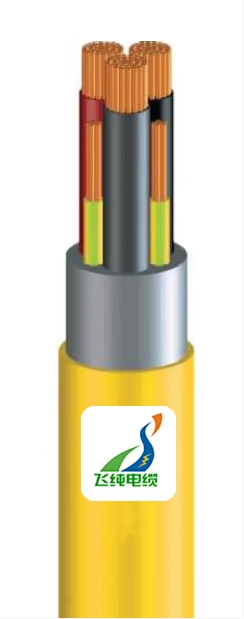
low temperature mining cable

The safest way to write this page is not to pretend that Rio Tinto has publicly released a project call-off for this exact cable. The stronger and more credible angle is this: under Oyu Tolgoi Underground-style conditions, Arctic-grade Type 241 11/11kV 3x50mm² is a rational engineering specification direction. That distinction matters. A serious mining page should never fake project-specific approval language that has not been published. What it should do is explain the logic clearly. Oyu Tolgoi Underground is a world-class block-caving copper-gold project in Mongolia’s South Gobi. The site sees a harsh thermal range, with hot summers and deep winter exposure. Standard Type 241 mining cable is designed to AS/NZS 1802 and is publicly described for applications such as continuous miners, pump feeders, monorails supplying DCBs and longwalls. Electrically and structurally, that makes it a very credible candidate architecture for underground mining distribution circuits. But when winter ambient moves below the standard low-temperature threshold, the correct engineering response is not to abandon Type 241 altogether. The correct response is to specify an Arctic-grade low-temperature sheath and insulation system built on the Type 241 platform.

Oyu Tolgoi Underground: Specifying Arctic-Grade Type 241 11/11kV 3x50mm² for Mongolian Winters

The safest way to write this page is not to pretend that Rio Tinto has publicly released a project call-off for this exact cable. The stronger and more credible angle is this: under Oyu Tolgoi Underground-style conditions, Arctic-grade Type 241 11/11kV 3x50mm² is a rational engineering specification direction. That distinction matters. A serious mining page should never fake project-specific approval language that has not been published. What it should do is explain the logic clearly. Oyu Tolgoi Underground is a world-class block-caving copper-gold project in Mongolia’s South Gobi. The site sees a harsh thermal range, with hot summers and deep winter exposure. Standard Type 241 mining cable is designed to AS/NZS 1802 and is publicly described for applications such as continuous miners, pump feeders, monorails supplying DCBs and longwalls. Electrically and structurally, that makes it a very credible candidate architecture for underground mining distribution circuits. But when winter ambient moves below the standard low-temperature threshold, the correct engineering response is not to abandon Type 241 altogether. The correct response is to specify an Arctic-grade low-temperature sheath and insulation system built on the Type 241 platform.
If your Central Asian underground coal mining project operates within an engineering and procurement ecosystem dominated by Australian consulting firms, English-language design specifications, AS/NZS standards documentation, and requires compatibility with continuous mining equipment protected by pilot-core-dependent relays, then Type 241 (AS/NZS 1802) is your correct choice. Type 241 provides the electrical architecture, pilot conductor continuity, and protective logic integration that Australian mining engineers expect. If your project operates in Kazakhstan, Mongolia, Uzbekistan, or Kyrgyzstan with Russian or Russian-influenced technical standards, local certification bodies that recognize GOST compliance, local maintenance teams trained on GOST equipment, Russian-language technical documentation, and primary focus on cost-effective 6kV power delivery in extreme cold environments, then КГЭ-ХЛ (GOST 31945-2012) is likely the more practical choice. КГЭ-ХЛ integrates seamlessly into Russian-standard electrical systems and is purpose-engineered for the minus forty to minus sixty degree Celsius temperatures endemic to Central Asian winters. 如果您的中亚地下煤矿项目由澳洲咨询公司主导、英文设计规范、AS/NZS标准文件和对连续采煤机保护逻辑兼容性有特殊要求,那么 Type 241(AS/NZS 1802)是正确选择。如果您的项目在哈萨克斯坦、蒙古、乌兹别克斯坦或吉尔吉斯斯坦,采用俄标或俄标影响的技术体系,本地认证机构认可GOST合规,本地维护团队熟悉GOST设备,主要关注极寒下的成本有效6kV供电,那么КГЭ-ХЛ(ГОСТ 31945-2012)是更实用的选择。

AS/NZS Type 241 vs. GOST КГЭ-ХЛ: Choosing the Right Standard for Underground Coal Mines in Central Asia

If your Central Asian underground coal mining project operates within an engineering and procurement ecosystem dominated by Australian consulting firms, English-language design specifications, AS/NZS standards documentation, and requires compatibility with continuous mining equipment protected by pilot-core-dependent relays, then Type 241 (AS/NZS 1802) is your correct choice. Type 241 provides the electrical architecture, pilot conductor continuity, and protective logic integration that Australian mining engineers expect. If your project operates in Kazakhstan, Mongolia, Uzbekistan, or Kyrgyzstan with Russian or Russian-influenced technical standards, local certification bodies that recognize GOST compliance, local maintenance teams trained on GOST equipment, Russian-language technical documentation, and primary focus on cost-effective 6kV power delivery in extreme cold environments, then КГЭ-ХЛ (GOST 31945-2012) is likely the more practical choice. КГЭ-ХЛ integrates seamlessly into Russian-standard electrical systems and is purpose-engineered for the minus forty to minus sixty degree Celsius temperatures endemic to Central Asian winters. 如果您的中亚地下煤矿项目由澳洲咨询公司主导、英文设计规范、AS/NZS标准文件和对连续采煤机保护逻辑兼容性有特殊要求,那么 Type 241(AS/NZS 1802)是正确选择。如果您的项目在哈萨克斯坦、蒙古、乌兹别克斯坦或吉尔吉斯斯坦,采用俄标或俄标影响的技术体系,本地认证机构认可GOST合规,本地维护团队熟悉GOST设备,主要关注极寒下的成本有效6kV供电,那么КГЭ-ХЛ(ГОСТ 31945-2012)是更实用的选择。
To understand why the Oyu Tolgoi copper mining project—operated by Rio Tinto in the Gobi Desert of southern Mongolia—demands a specialized Arctic Grade version of AS/NZS 1802 Type 241 cable, you must first grasp the fundamental reality of extreme cold mining: the same materials that remain pliable and safe at temperate conditions can transform into brittle, dangerous substances when subjected to temperatures dropping to minus forty degrees Celsius. A standard Type 241 trailing cable, engineered for operational environments of minus twenty or minus twenty-five degrees, becomes not merely less effective but actively hazardous when deployed in Oyu Tolgoi's winter conditions. 要理解为什么力拓在蒙古戈壁南部运营的奥尤陶勒盖铜矿项目需要专门的极地级版本AS/NZS 1802 Type 241电缆,您必须首先掌握极端严寒采矿的基本现实:在温和条件下保持柔韧和安全的相同材料,当温度下降到负四十摄氏度时,可能转变为脆性、危险的物质。标准的Type 241拖曳电缆在负二十或负二十五度的运行环境中设计,但当在奥尤陶勒盖的冬季条件下使用时,不仅效能下降,而且变得主动危险。

Oyu Tolgoi Standard: Sourcing -40°C Arctic Grade AS/NZS 1802 Type 241 11kV for Mongolian Copper Mines

To understand why the Oyu Tolgoi copper mining project—operated by Rio Tinto in the Gobi Desert of southern Mongolia—demands a specialized Arctic Grade version of AS/NZS 1802 Type 241 cable, you must first grasp the fundamental reality of extreme cold mining: the same materials that remain pliable and safe at temperate conditions can transform into brittle, dangerous substances when subjected to temperatures dropping to minus forty degrees Celsius. A standard Type 241 trailing cable, engineered for operational environments of minus twenty or minus twenty-five degrees, becomes not merely less effective but actively hazardous when deployed in Oyu Tolgoi’s winter conditions. 要理解为什么力拓在蒙古戈壁南部运营的奥尤陶勒盖铜矿项目需要专门的极地级版本AS/NZS 1802 Type 241电缆,您必须首先掌握极端严寒采矿的基本现实:在温和条件下保持柔韧和安全的相同材料,当温度下降到负四十摄氏度时,可能转变为脆性、危险的物质。标准的Type 241拖曳电缆在负二十或负二十五度的运行环境中设计,但当在奥尤陶勒盖的冬季条件下使用时,不仅效能下降,而且变得主动危险。
RHEYFIRM® (XT) "Extreme" is a specialized arctic-grade flexible reeling cable engineered specifically for continuous dynamic operation in permafrost mining zones and open-pit operations where temperatures fall to -50°C (-58°F), whereas RHEYFIRM® (RS) standard versions are designed for conventional industrial and port environments operating down to approximately -25°C to -35°C maximum. The XT extreme variant differs from the RS standard version through four fundamental structural and chemical modifications. First, the outer jacket compound transitions from standard chlorinated rubber (5GM5 formulation) to an ultra-low-temperature advanced elastomer or specialized cold-resistant polyurethane (PUR) blend that remains flexible and resistant to crystallization and embrittlement even when exposed to -50°C arctic blasts. Second, the internal structure incorporates enhanced cold-adapted synthetic anti-torsion braids fabricated from Kevlar and Aramid fibers instead of conventional braid materials, which maintain their reinforcement properties at extreme temperatures where standard materials would lose rigidity. Third, the insulation material evolves from standard EPR (ethylene propylene rubber) to an optimized cold-flexible EPR formulation that prevents micro-cracking around copper conductors under severe thermal stress. Fourth, the cable incorporates specialized core lubrication systems and internal slip-layers designed to reduce friction between conductor wires at sub-zero temperatures, where natural friction increases dramatically and would otherwise cause internal conductor fatigue and snapping. The result is a cable system that remains mechanically robust and electrically reliable for continuous high-speed reeling (up to 190 meters per minute) on frozen ground and ice-covered surfaces in the harshest mining environments on Earth. The electrical specifications remain identical to RS standard cables (same voltage ratings, same current capacity), but the physical behavior and mechanical reliability at extreme cold are fundamentally different. You should specify RHEYFIRM® (XT) when your mining operation is located in permafrost regions, when winter operations regularly experience temperatures below -40°C, when continuous reeling stress is combined with sub-zero conditions, and when cable failure could result in equipment shutdown in a remote arctic location where emergency replacement is logistically impossible.

RHEYFIRM® (XT): How Does the “Extreme” Version Differ from Standard (RS) for Operations in -50°C Arctic Mines?

RHEYFIRM® (XT) “Extreme” is a specialized arctic-grade flexible reeling cable engineered specifically for continuous dynamic operation in permafrost mining zones and open-pit operations where temperatures fall to -50°C (-58°F), whereas RHEYFIRM® (RS) standard versions are designed for conventional industrial and port environments operating down to approximately -25°C to -35°C maximum. The XT extreme variant differs from the RS standard version through four fundamental structural and chemical modifications. First, the outer jacket compound transitions from standard chlorinated rubber (5GM5 formulation) to an ultra-low-temperature advanced elastomer or specialized cold-resistant polyurethane (PUR) blend that remains flexible and resistant to crystallization and embrittlement even when exposed to -50°C arctic blasts. Second, the internal structure incorporates enhanced cold-adapted synthetic anti-torsion braids fabricated from Kevlar and Aramid fibers instead of conventional braid materials, which maintain their reinforcement properties at extreme temperatures where standard materials would lose rigidity. Third, the insulation material evolves from standard EPR (ethylene propylene rubber) to an optimized cold-flexible EPR formulation that prevents micro-cracking around copper conductors under severe thermal stress. Fourth, the cable incorporates specialized core lubrication systems and internal slip-layers designed to reduce friction between conductor wires at sub-zero temperatures, where natural friction increases dramatically and would otherwise cause internal conductor fatigue and snapping. The result is a cable system that remains mechanically robust and electrically reliable for continuous high-speed reeling (up to 190 meters per minute) on frozen ground and ice-covered surfaces in the harshest mining environments on Earth. The electrical specifications remain identical to RS standard cables (same voltage ratings, same current capacity), but the physical behavior and mechanical reliability at extreme cold are fundamentally different. You should specify RHEYFIRM® (XT) when your mining operation is located in permafrost regions, when winter operations regularly experience temperatures below -40°C, when continuous reeling stress is combined with sub-zero conditions, and when cable failure could result in equipment shutdown in a remote arctic location where emergency replacement is logistically impossible.
FG7ORPu-TUNNELFLEX is a specialized 0.6/1kV flexible power cable engineered specifically for mining and tunneling applications. This cable provides reliable power supply to mobile equipment operating in harsh underground environments where there is a high risk of mechanical damage. The TUNNELFLEX cable is suitable for applications where it is deflected in one plane only, with a maximum operating speed of 60 m/min.

What is FG7ORPu-TUNNELFLEX 0.6/1kV Cable?

FG7ORPu-TUNNELFLEX is a specialized 0.6/1kV flexible power cable engineered specifically for mining and tunneling applications. This cable provides reliable power supply to mobile equipment operating in harsh underground environments where there is a high risk of mechanical damage. The TUNNELFLEX cable is suitable for applications where it is deflected in one plane only, with a maximum operating speed of 60 m/min.
PROTOLON (M) R-(N)TSCGEWOEU Arctic -50°C 6/10KV is an advanced medium voltage reeling cable specifically engineered for extreme cold climate mining operations. This cable maintains full flexibility and mechanical performance down to -50°C, making it ideal for Arctic regions, Siberian mines, Canadian northern territories, and other extreme cold environments where conventional cables become brittle and fail.

What is PROTOLON (M) R-(N)TSCGEWOEU Arctic -50°C 6/10KV Mining MV Reeling Cable?

PROTOLON (M) R-(N)TSCGEWOEU Arctic -50°C 6/10KV is an advanced medium voltage reeling cable specifically engineered for extreme cold climate mining operations. This cable maintains full flexibility and mechanical performance down to -50°C, making it ideal for Arctic regions, Siberian mines, Canadian northern territories, and other extreme cold environments where conventional cables become brittle and fail.
TENAX-LUMEN (N)TSCGEH3S 6 kV – 10 kV for Trailing Application

What is Luminescent Power Cable TENAX-LUMEN (N)TSCGEH3S 6 kV – 10 kV for Trailing Application?

TENAX-LUMEN (N)TSCGEH3S represents a significant advancement in mining cable technology, combining robust electrical performance with innovative safety features. This medium-voltage trailing cable is specifically engineered for the demanding environments of open-pit mining operations, where large mobile equipment such as draglines and electric rope shovels require reliable power supply combined with enhanced visibility for personnel safety.
ANSI/NEMA WC 58 / ICEA S-75-381: Portable and Power Feeder Cables for Mining Applications

ANSI/NEMA WC 58 / ICEA S-75-381: Portable and Power Feeder Cables for Mining Applications

ANSI/NEMA WC 58 / ICEA S-75-381 standard represents one of the most comprehensive specifications for portable and power feeder cables used in mining environments. According to industry analysis, this standard represents one of the most rigorous cable specifications ever developed, specifically addressing the unique challenges encountered in both surface and underground mining operations where equipment reliability directly impacts production efficiency and worker safety.