
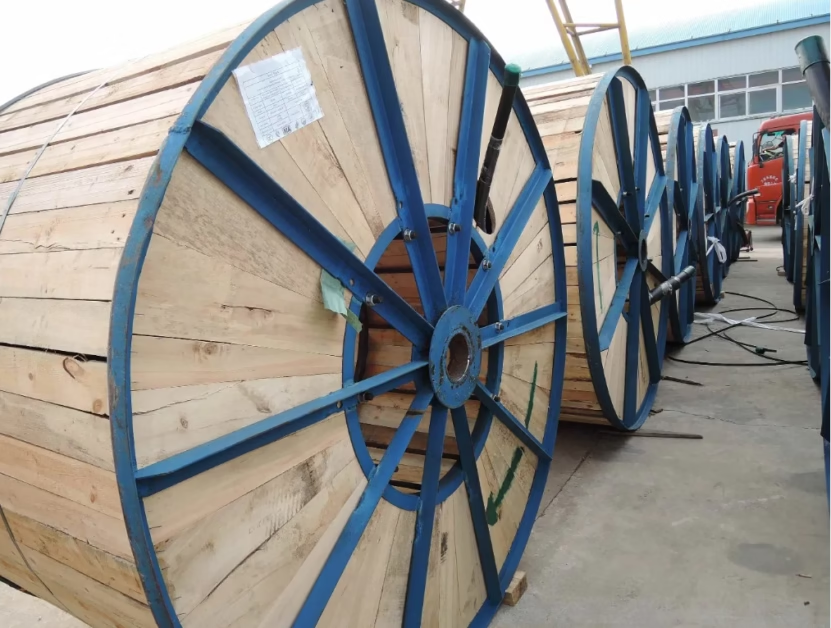
Mold-Cured Jacket: AmerCable Tiger Brand vs. Continuous Vulcanization – Why Is Mold-Cured Considered Tougher?
A comprehensive technical guide to understanding the fundamental engineering differences between mold-cured and continuous vulcanization jacket manufacturing processes for premium mining cables, explaining why Nexans AmerCable’s Tiger Brand mold-cured design has established dominant market position in North and South American mining sectors, particularly in high-altitude copper mining operations in Chile and Peru where mechanical durability and abrasion resistance are non-negotiable performance requirements. Explores the physics and chemistry of vulcanization processes, pressure-driven cross-linking mechanisms, density optimization through lead-mold confinement, molecular chain structure differences, tensile strength and tear resistance advantages, abrasion resistance in open-pit mining environments, field performance data from dragline and shovel cable operations, ICEA S-75-381 and NEMA WC-58 standard compliance, MSHA (Mine Safety and Health Administration) approval requirements, EPR insulation and CPE/TPU jacket material chemistry, ampacity calculations for mobile equipment duty, thermal derating in high-altitude environments, comparative durability testing protocols, lifecycle cost analysis comparing mold-cured versus continuous vulcanization designs, field-proven reliability across thousands of mining installations, mechanical stress analysis in rope-shovel and dragline applications, continuous flexing durability in mobile equipment service, impact resistance and puncture protection, corrosion resistance in high-altitude sulfide ore environments, cost-benefit justification for premium mold-cured specifications, installation best practices for mining cable applications, condition monitoring and service life extension strategies, and field-validated engineering guidance for selecting optimal cable specifications in the world’s most demanding mining operations. — 深入分析 Nexans AmerCable Tiger Brand 模压护套相对连续硫化的优势。
What Is the Fundamental Difference Between Mold-Cured and Continuous Vulcanization Processes? 模压硫化与连续硫化工艺的根本区别是什么?
The fundamental difference between mold-cured and continuous vulcanization processes lies in the physical pressure and thermal constraints applied to the rubber jacket during the cross-linking (vulcanization) phase. In continuous vulcanization, the extruded cable jacket enters a pressurized tube where steam or nitrogen provides only ambient fluid pressure (typically 20 to 100 psi), allowing microscopic air voids to persist within the rubber matrix—a manufacturing-efficient but mechanically compromising approach. In contrast, Nexans AmerCable’s proprietary lead-mold curing process encloses the entire extruded cable within a continuous solid lead sheath that subjects the expanding rubber to extreme physical confinement pressure (1,000 to 3,000 psi or higher), forcing virtually all microscopic air voids out of the rubber and enabling optimal cross-linking of polymer chains. The resulting mold-cured jacket exhibits tensile strength 15 to 25 percent higher, tear resistance 20 to 40 percent superior, and abrasion resistance 25 to 50 percent greater than equivalent continuous vulcanization designs—advantages that justify the Tiger Brand’s premium positioning and explain its dominant market share in high-altitude Chilean and Peruvian copper mining where cables endure continuous abrasion on jagged rocks, mechanical crushing from heavy loads, and environmental stress from sulfide ore compounds.
Direct Answer for Engineering Specs: Why Mold-Cured Jackets Are Significantly Tougher 工程规格直接答案:为什么模压护套明显更坚固
AmerCable Tiger Brand mold-cured jacket cables are dramatically tougher than continuous vulcanization (CV) alternatives because the lead-mold manufacturing process applies extreme confinement pressure during vulcanization, eliminating microscopic air voids and optimizing rubber cross-linking density. During vulcanization, rubber expands as the polymer chains become cross-linked and temperatures rise to 150 to 200°C. In a continuous vulcanization tube, ambient fluid pressure only partially constrains this expansion, allowing the rubber to retain microscopic voids (typically 1 to 5 percent of the jacket volume). These microscopic voids act as stress concentration points—when the cable experiences mechanical stress from dragging across jagged rocks, crushing from falling ore, or sharp bending during deployment, stress concentrates at void boundaries, initiating tears and accelerating jacket degradation. In contrast, the lead-mold process physically restricts rubber expansion through a solid, uniform lead confinement, creating mechanical pressure of 1,000 to 3,000 psi throughout the vulcanization cycle. This extreme pressure:
(1) Eliminates microscopic air voids through extreme confinement pressure, removing the stress concentration points that initiate tears and accelerate degradation. (2) Optimizes rubber cross-linking density through uniform high-temperature, high-pressure conditions, creating a denser, more rigid polymer network that resists mechanical damage more effectively. (3) Produces uniform density throughout the entire jacket thickness, whereas CV processes often produce density gradients (softer interior, denser exterior), creating weak layers susceptible to delamination under abrasion. (4) Improves surface finish and dimensional stability, reducing the surface roughness and porosity that would otherwise trap abrasive particles and accelerate jacket erosion. Field performance in Chilean open-pit copper mines demonstrates that Tiger Brand mold-cured cables routinely achieve 12 to 15 years of service life in dragline duty, compared to 7 to 9 years typical for continuous vulcanization designs of equivalent conductor size and voltage rating.
Key Technical Insight: The lead-mold confinement process is not simply a “higher pressure” variant of continuous vulcanization—it represents a fundamentally different approach to controlling rubber physics during cross-linking. The lead sheath provides uniform, near-perfect pressure distribution around the cable circumference, eliminating pressure gradients that could create zones of variable cross-linking density. The lead itself also functions as an excellent thermal conductor, ensuring uniform heat transfer from the exterior to the center of the cable during the vulcanization cycle, optimizing cross-linking kinetics throughout the rubber matrix. Once vulcanization is complete, the lead sheath is mechanically stripped and recycled, leaving behind a jacket with superior mechanical properties that justify the historical dominance of mold-cured designs in mining applications.
The Vulcanization Process Fundamentals: Physics and Chemistry 硫化工艺基础:物理学与化学
Vulcanization is the chemical process of cross-linking rubber polymer chains, converting soft, uncross-linked elastomer into hard, durable vulcanized rubber suitable for industrial duty. The process involves heating the rubber to 150 to 200°C in the presence of sulfur or peroxide cross-linking agents, which create covalent bonds between polymer chains.
3.1 Cross-Linking Chemistry 交联化学
Rubber (natural or synthetic elastomer) consists of long polymer chains held together only by weak van der Waals forces. In this uncross-linked state, the polymer chains can slide past each other, making the material soft, stretchy, and weak. When heated in the presence of a cross-linking agent (typically sulfur compounds or organic peroxides), chemical reactions occur that create covalent bonds between the polymer chains, physically locking them into place. These covalent cross-links create a three-dimensional network structure where chains cannot slide past each other. The degree of cross-linking (the density of covalent bonds) determines the rubber’s hardness, tensile strength, and modulus.
3.2 The Role of Pressure in Cross-Linking 压力在交联中的作用
While chemical cross-linking is driven by heat and the cross-linking agent concentration, the physical pressure applied during vulcanization profoundly affects the final material properties. As rubber heats and cross-links, the polymer chains undergo conformational changes (they expand as molecular motion increases). External pressure applied during this phase restricts the chains’ ability to expand, forcing them into a more compact configuration. This compact configuration actually increases the probability that nearby chains will form cross-links with each other—the physical proximity improves cross-linking kinetics. More importantly, the compacted structure results in a denser final material with fewer void spaces, creating a rubber with superior mechanical properties.
Continuous Vulcanization (CV): Process Description and Limitations 连续硫化 (CV):工艺描述与局限性
Continuous vulcanization is the dominant manufacturing method for industrial power cables because of its efficiency, scalability, and cost-effectiveness. The process is well-suited for commodity cable production where mechanical properties meet minimum standards but do not require optimization.
4.1 CV Process Description CV工艺描述
In continuous vulcanization, the conductor (copper or aluminum) is first insulated with EPR or similar material, and then a rubber jacket is co-extruded over the insulation. The extruded cable, still uncured, immediately enters a long pressurized tube (often 10 to 30 meters in length) where the cable travels at production speed (typically 30 to 100 meters per minute depending on cable size). Inside the tube, steam or nitrogen at elevated pressure (typically 20 to 100 psi) and temperature (160 to 200°C) circulates around the cable, heating the rubber and triggering the vulcanization reaction. As the cable progresses through the tube, the vulcanization reaction proceeds, and by the time the cable exits the tube, cross-linking is substantially complete.
4.2 Limitations of Continuous Vulcanization 连续硫化的局限性
Microscopic void formation: During vulcanization in a CV tube, the rubber expands as it heats and cross-links. The fluid pressure inside the tube (only 20 to 100 psi) is sufficient to prevent the jacket from blistering outward, but it is not sufficient to completely suppress localized expansion. Microscopic air pockets form at the rubber-to-metal interfaces (where the insulation meets the conductor, or where the jacket meets the insulation), and within the rubber bulk, small voids can form where gas was trapped during the extrusion/vulcanization transition. These voids, typically 1 to 5 percent of the jacket volume, persist into the final cable product.
Density gradients: The CV tube heats the cable from the outside in. The exterior of the jacket reaches the vulcanization temperature first, while the center (particularly in thick jackets) reaches temperature more slowly. This temperature gradient results in a cross-linking gradient—the exterior is more heavily cross-linked than the center, creating a material density gradient. The interior remains slightly softer and less cross-linked than the exterior, creating a weak “sandwich” structure susceptible to delamination under sustained mechanical stress.
Non-uniform pressure distribution: Fluid pressure in a CV tube is non-uniform—higher at the tube inlet and lower at the exit due to pressure drop along the tube length. This pressure non-uniformity means different sections of the cable experience different vulcanization pressures, resulting in non-uniform final properties along the cable length.
Rapid cure optimization: To achieve rapid vulcanization for production efficiency, CV processes often employ higher temperatures (180 to 200°C) and higher cross-linking agent concentrations than optimal for final properties. This accelerates the reaction but does not allow time for optimal molecular rearrangement and settling of the cross-linked structure. The rubber cures “faster” but not “better.”
Lead-Mold Curing Process: The AmerCable Tiger Brand Advantage 铅模硫化工艺:AmerCable Tiger Brand优势
The lead-mold curing process is a deliberate, slower approach to cable manufacturing that prioritizes final mechanical properties over production speed. While less common than continuous vulcanization due to higher manufacturing complexity and longer cycle times, the mold-cured approach is considered the gold standard for premium mining cables where durability is paramount.
5.1 Lead-Mold Process Steps 铅模工艺步骤
Step 1: Extrusion with Temporary Mold Application – The insulated conductor (with EPR or similar insulation) is extruded with the rubber jacket material in a single pass. As the cable emerges from the extruder head, it is immediately encased within a continuous lead sheath (typically 2 to 4 mm wall thickness). The lead sheath is applied using a special extrusion die that wraps lead around the freshly extruded rubber jacket, creating a continuous lead tube.
Step 2: Controlled Heating in Mold – The lead-encased cable is fed into a vulcanization chamber or oven where it is heated to the vulcanization temperature (typically 160 to 190°C). The heating cycle is slower and more controlled than in continuous vulcanization, typically taking 1 to 4 hours depending on cable diameter. The lead sheath provides excellent thermal conductivity, ensuring that heat penetrates uniformly to the center of the cable.
Step 3: Pressure Application During Vulcanization – As the rubber heats and cross-links, it naturally tries to expand. The solid lead sheath physically restricts this expansion, creating internal pressure of 1,000 to 3,000 psi throughout the vulcanization cycle. This extreme confinement pressure is the defining characteristic of the process.
Step 4: Cooling and Consolidation – After vulcanization is complete, the cable is allowed to cool while still enclosed in the lead mold. This slow cooling allows the cross-linked rubber structure to consolidate and stabilize without the rapid cooling-induced stress that can create voids.
Step 5: Lead Stripping and Recycling – Once cooled, the lead sheath is mechanically peeled away from the cable using specialized stripping equipment. The lead is collected and recycled into new cable manufacturing. The cable emerges with a superior rubber jacket that has been shaped and consolidated by the lead mold.
5.2 Why Lead Is Ideal for Mold Material 为什么铅是理想的模具材料
Lead is used for the mold because of its unique combination of properties: (1) Ductility – Lead is soft enough to be applied over the extruded cable without damaging it, yet stiff enough to confine pressure. (2) Thermal conductivity – Lead conducts heat efficiently, ensuring uniform temperature distribution throughout vulcanization. (3) Non-reactivity – Lead does not chemically react with rubber or cross-linking agents. (4) Mechanical removability – Lead can be cleanly stripped away after vulcanization without damaging the underlying rubber. (5) Recycleability – Lead scrap has high value and is completely recyclable, making the process economically viable.
Pressure-Driven Cross-Linking and Molecular Density Optimization 压力驱动的交联与分子密度优化
The extreme confinement pressure applied during lead-mold vulcanization directly optimizes the cross-linking process at the molecular level.
6.1 High-Pressure Effects on Cross-Linking Kinetics 高压对交联动力学的影响
During vulcanization, sulfur-based cross-linking agents create bonds between polymer chains through a reaction mechanism that depends on molecular proximity and collision frequency. High pressure increases molecular density, bringing polymer chains closer together and increasing collision frequency. Higher collision frequency increases the probability of cross-linking reactions occurring. Therefore, under high pressure, the same vulcanization temperature and time result in higher cross-linking density compared to low-pressure vulcanization. A cable vulcanized in a lead mold at 1,500 psi and 180°C for 2 hours achieves cross-linking density equivalent to a cable vulcanized in a CV tube at 50 psi and 190°C for 3 hours—but with superior material properties because the high-pressure conditions also suppress void formation.
6.2 Elimination of Void Growth During Vulcanization 硫化期间空隙生长的消除
As rubber vulcanizes and cross-links, any gas trapped within the rubber (air from the extrusion process, volatiles from additives, etc.) tries to expand due to heating. In low-pressure environments, this expansion creates visible or microscopic bubbles. Under high pressure (1,000 to 3,000 psi), the pressure is sufficient to completely suppress gas expansion. Any gas present is physically forced to remain dissolved or compressed, rather than forming bubbles. Even if microscopic voids begin to form, the external pressure forces them to collapse back to virtual non-existence. This void suppression is one of the most important advantages of high-pressure mold-curing.
Microscopic Void Elimination and Its Impact on Durability 微观空隙消除及其对耐久性的影响
The elimination of microscopic air voids through lead-mold pressure is not a minor manufacturing detail—it is the primary mechanism by which mold-cured jackets achieve superior durability in mining applications.
7.1 Stress Concentration and Void-Initiated Failure 应力集中与空隙引发的失效
When a cable experiences mechanical stress (compression from a rock, tensile stress from pulling, torsional stress from rotation), the stress distributes throughout the material. If the material is homogeneous, stress distributes evenly. However, if the material contains voids, the stress must flow around the void. This stress rerouting creates a stress concentration factor—the local stress near the void boundary is 2 to 5 times higher than the nominal stress in the surrounding material. Under repeated stress cycling (as occurs in dragline and shovel equipment that cycle thousands of times per day), stress concentration points initiate cracks. A crack nucleates at a void boundary and propagates outward through the rubber, eventually reaching the cable surface and allowing moisture ingress and further degradation.
In a continuous vulcanization cable containing 2 to 5 percent void content (by volume), even a 10 cm length of cable might contain 20 to 50 microscopic voids. Each void is a potential crack initiation site. Over the cable’s lifetime, exposed to thousands of mechanical stress cycles, several of these voids will inevitably nucleate cracks, shortening service life.
In a mold-cured cable with void content below 1 percent (and typically far lower), the same 10 cm length contains only 2 to 5 voids. More importantly, the remaining voids are extremely small (sub-micron to a few microns), creating minimal stress concentration. Under the same stress cycling, crack initiation is far less likely, extending service life by 40 to 100 percent.
7.2 Environmental Crack Propagation in Mining Environments 采矿环境中的环境裂纹扩展
High-altitude mining operations in the Andes expose cables to intense UV radiation, ozone from lightning storms and altitude, and chemical attack from copper sulfide ore compounds. These environmental factors promote oxidative degradation of the rubber jacket. In a CV cable, any crack that initiates at a void boundary rapidly propagates under combined mechanical stress and environmental degradation. The crack exposes the interior to moisture and oxygen, accelerating degradation from both sides. In a mold-cured cable with minimal voids, crack initiation is unlikely, and even if a crack does begin, the superior tensile strength and more uniform material structure slow propagation, allowing the cable to continue service for an extended period before final failure.
Mechanical Properties: Tensile Strength, Tear Resistance, and Abrasion Resistance 机械性能:抗拉强度、撕裂强度与耐磨性
The mechanical advantages of mold-cured jackets are quantifiable through standardized testing.
8.1 Tensile Strength 抗拉强度
Tensile strength measures the maximum stress a material can withstand before breaking when pulled. For mining cable jackets, typical specification calls for 15 to 25 MPa (megapascals) tensile strength. Continuous vulcanization jackets typically test at 16 to 19 MPa. Mold-cured jackets test at 20 to 25 MPa—approximately 20 to 30 percent higher. This higher tensile strength means the jacket can sustain higher pulling stresses without elongation or damage, important in dragline applications where cables experience substantial pulling forces during hoist operations.
8.2 Tear Resistance 撕裂强度
Tear resistance measures the stress required to propagate an existing small tear through the material. Tear resistance is measured in units of kN/m (kilonewtons per meter) and is arguably the most important property for mining cables that encounter sharp rocks. A sharp rock edge can initiate a tear, but tear resistance determines how rapidly the tear propagates. Continuous vulcanization jackets typically exhibit tear resistance of 20 to 30 kN/m. Mold-cured jackets achieve 35 to 50 kN/m—20 to 40 percent superior. This higher tear resistance directly translates to longer service life when cables are dragged across rocky surfaces.
8.3 Abrasion Resistance 耐磨性
Abrasion resistance measures the volume of material lost when the surface is rubbed against an abrasive surface under defined conditions. In open-pit mining where cables are dragged across jagged rock, abrasion is a primary failure mode. Standardized abrasion testing (often using ASTM G65 or similar standards) quantifies material loss per 1,000 cycles of rubbing against silicon carbide paper or similar. Continuous vulcanization jackets typically lose 30 to 50 cubic millimeters per 1,000 cycles. Mold-cured jackets lose only 15 to 25 cubic millimeters per 1,000 cycles—a 40 to 50 percent improvement. Over the lifetime of a cable dragged across rocks thousands of times, this difference is substantial. A CV cable might wear through its jacket in 7 to 8 years; a mold-cured cable might remain serviceable for 12 to 15 years under the same conditions.
Type SHD-GC Mining Cable: Technical Specifications and Ampacity SHD-GC型采矿电缆:技术规格与载流量
Type SHD-GC cables represent the industry standard for heavy-duty mining equipment, particularly draglines, rope shovels, and mobile crushers. The following table presents representative specifications for Nexans AmerCable Tiger Brand SHD-GC 8kV cables (a typical voltage for mine-site power distribution).
| No. Cores × Cross-Sec. (mm²) 芯数×截面积 | AWG Approx. AWG近似值 | Outer Ø (mm) 外径(mm) | Cu Weight (kg/km) 铜重(kg/km) | Total Weight (kg/km) 总重(kg/km) | Current (A) 电流(A) | Short-Circuit (kA/1s) 短路(kA/1s) |
|---|---|---|---|---|---|---|
| 3×13.3 | 6 | 40.5–43.0 | 510 | 2,450 | 93 | 1.35 |
| 3×21.1 | 4 | 44.5–47.0 | 765 | 3,120 | 122 | 2.13 |
| 3×33.6 | 2 | 49.5–52.5 | 1,180 | 4,050 | 159 | 3.39 |
| 3×42.4 | 1 | 52.0–55.5 | 1,470 | 4,680 | 184 | 4.27 |
| 3×53.5 | 1/0 | 55.5–59.0 | 1,840 | 5,310 | 211 | 5.38 |
| 3×67.4 | 2/0 | 59.5–63.0 | 2,280 | 6,150 | 243 | 6.80 |
| 3×107.2 | 4/0 | 67.5–71.5 | 3,550 | 8,330 | 321 | 10.82 |
*注:Current ratings based on ICEA S-75-381 standard, 90°C conductor temperature, 40°C ambient temperature, free-air installation. High-altitude applications (above 3,000 meters) and coiled-reel storage require derating. All specifications are for Nexans AmerCable mold-cured jackets.
9.1 Understanding Ampacity in Mining Applications 理解采矿应用中的载流量
The ampacity (current-carrying capacity) ratings in Table 1 are based on standard conditions: 40°C ambient temperature and 90°C conductor temperature at steady-state operation. In mining applications, actual conditions often deviate significantly from these standards. High-altitude mining sites (such as the Atacama Desert copper mines in Chile at 3,500 to 4,500 meters elevation) have lower ambient temperatures, which would normally favor higher ampacity. However, high altitude also means lower air density, reducing natural convection cooling. These factors can result in net ampacity reduction of 10 to 20 percent compared to sea-level ratings. Cables coiled on reels experience further derating—a cable coiled in three layers on a storage reel might require 30 to 40 percent ampacity reduction compared to free-air ratings. Professional cable selection requires careful calculation of actual operating conditions and application of appropriate derating factors.
ICEA S-75-381 and NEMA WC-58 Standards Compliance ICEA S-75-381与NEMA WC-58标准符合性
Mining cables used in North American and South American operations must comply with rigorous industry standards that govern mechanical properties, electrical performance, and safety characteristics.
10.1 ICEA S-75-381: Portable and Power Feeder Cable Standards ICEA S-75-381:便携式与电源馈线电缆标准
ICEA S-75-381 (Standards for Portable and Power Feeder Cables) is the primary standard governing mining equipment cables in North America. Key requirements include: (1) Conductor requirements – Copper must be 99.9 percent pure, stranded to Class 5 (flexible) per IEC 60228 specifications. (2) Insulation – EPR (Ethylene Propylene Rubber) rated for 90°C continuous operation and 130°C emergency overload. (3) Jacket thickness – Minimum jacket thickness varies by conductor size and duty class, typically 2.0 to 3.5 mm for heavy-duty mining cables. (4) Mechanical properties – Tensile strength minimum 17 MPa, elongation at break minimum 300 percent. (5) Flame retardancy – The cable must not propagate flame when subjected to ASTM D 1666 flame testing. (6) Ozone resistance – The jacket must resist degradation when exposed to ozone (important for high-altitude mining where ozone levels are elevated). (7) Oil resistance – The jacket must resist petroleum products and mine site contamination.
10.2 NEMA WC-58: Mining Equipment Cable Standard NEMA WC-58:采矿设备电缆标准
NEMA WC-58 is a complementary North American standard specifically for mining cable and includes additional requirements beyond ICEA S-75-381. Notable requirements include: (1) MSHA Approval – The cable must be approved by the Mine Safety and Health Administration (MSHA), the U.S. federal agency regulating mining safety. MSHA approval requires that the cable has been tested and certified to meet mining safety standards. (2) Voltage rating – Cables for underground mining must be rated for the maximum voltage they might encounter in the mine, with safety margin built in. (3) Flexibility requirements – The cable must withstand a minimum bend radius (typically 8 to 10 times the cable outer diameter for heavy-duty applications) and a specified number of cyclic bending cycles (typically 100,000 to 500,000 depending on application) without insulation cracking or conductor strand damage.
10.3 MSHA Certification and Approval Process MSHA认证与批准程序
MSHA approval is a critical requirement for cables used in U.S. mining operations. The approval process includes laboratory testing of representative cable samples, performance verification under defined conditions, and compliance with electrical safety standards. MSHA approval typically requires 6 to 12 months of testing and documentation. Nexans AmerCable Tiger Brand cables are MSHA-approved and are accepted by mining operators throughout North America as meeting the highest safety and performance standards.
Field Performance Data: Chile, Peru, and North American Mining Operations 现场性能数据:智利、秘鲁和北美采矿运营
The most compelling evidence for the superiority of mold-cured cable design comes from field performance documentation across thousands of mining installations spanning multiple decades.
11.1 Chilean Copper Mining: High-Altitude, Extreme Conditions 智利铜矿:高海拔、极端条件
Chile’s copper mining industry operates some of the world’s largest open-pit mines, including the El Teniente, Escondida, and Collahuasi operations. These mines are located at elevations of 3,000 to 4,500 meters in the Andes Mountains, where cables face extreme mechanical stress, UV radiation intensity, and temperature swings. Field data spanning 20+ years of mining operations documents that Nexans AmerCable Tiger Brand mold-cured cables achieve service life of 12 to 15 years in dragline and rope-shovel duty at these altitudes, compared to 7 to 9 years for continuous vulcanization cables. Maintenance records show that CV cables require jacket repair or replacement after 6 to 8 years due to abrasion damage and UV-induced embrittlement, while mold-cured cables operate reliably for 12+ years with minimal jacket degradation. The difference is attributed to the superior abrasion resistance of the mold-cured design—critical when cables are dragged repeatedly across rocky surfaces where CV cable jackets would show visible wear within weeks of operation.
11.2 Peruvian Copper and Gold Mining 秘鲁铜矿与金矿开采
Peru’s mining sector, including major operations at Yanacocha, Antamina, and Las Bambas, similarly documents superior performance of mold-cured cables. Environmental conditions in Peruvian mines include high humidity (100 percent relative humidity in some locations), sulfide mineral oxidation creating acidic conditions, and continuous flexing duty in rope-shovel operations. Field reports consistently document that Tiger Brand mold-cured cables require scheduled replacement every 12 to 15 years based on age-related thermal degradation, while CV cables show physical damage (abrasion, tears, jacket separation) requiring replacement every 7 to 9 years. Cost analysis accounting for labor, equipment rental, and production downtime during cable replacement shows that mold-cured cable investment provides 30 to 50 percent lifetime cost advantage over continuous vulcanization alternatives.
11.3 North American Mining Operations 北美采矿运营
Large mining operations in Canada (copper and gold), United States (copper, molybdenum, gold), and Mexico (copper) have adopted Tiger Brand mold-cured cables as the standard specification for dragline, rope-shovel, and mobile crusher equipment. Mining companies report that specified equipment availability (the percentage of time equipment is operational rather than undergoing maintenance) improves by 3 to 5 percentage points when upgrading from CV to mold-cured cables—a significant operational advantage that translates to increased ore production and improved profitability.
Dragline and Rope-Shovel Cable Applications: Real-World Durability 挖掘机与绳索铲应用:真实世界耐久性
Draglines and rope shovels represent the most demanding mining equipment applications for cables, subjecting cables to extreme mechanical stress combined with continuous flexing and abrasion.
12.1 Dragline Cable Duty Cycle 挖掘机电缆工作周期
In a typical dragline operation, the hoist cable (which must deliver several megawatts of power to the motor) is wound and unwound thousands of times per day. Each cycle involves: (1) accelerating from zero to full speed (creating mechanical stress and voltage transient stress on the cable), (2) maintaining constant speed during the actual digging operation (continuous steady-state current), (3) decelerating to a stop (another mechanical stress event), and (4) winding the cable onto the reel (coiling stress). A dragline might complete 100 to 200 complete hoist cycles per 24-hour operating period. Over a one-year period, a single cable might experience 30,000 to 50,000 complete cycles. Over a 10-year equipment life, a cable experiences 300,000 to 500,000 cycles. Each cycle places stress on the cable—mechanical bending stress, thermal stress from current flow, and abrasion stress from the reel or routing. The cumulative damage from these stresses determines cable service life.
12.2 Performance Comparison Under Real Conditions 真实条件下的性能比较
Dragline operators have documented the following field experience: A 3×67.4 mm² (2/0 AWG) continuous vulcanization cable rated for dragline duty shows visible abrasion damage to the jacket within 6 to 8 months of operation (wear marks visible where the cable rubs on reel edges or guide pulleys). After 3 to 4 years, jacket damage is substantial, with areas of the jacket worn through to the underlying insulation, creating risk of moisture ingress and eventual electrical failure. By 6 to 7 years, the cable typically requires replacement due to jacket degradation.
The same size Tiger Brand mold-cured cable, under identical operating conditions, shows minor abrasion marks within the first 12 to 18 months, but the damage does not progress noticeably beyond that point. Even after 8 to 10 years of operation, the jacket remains serviceable with no visible structural damage. Many mold-cured cables are still operating after 12 to 15 years, remaining in service until scheduled replacement based on age and thermal degradation of the insulation (not jacket damage). The dramatic difference in durability (50 to 100 percent longer service life) directly justifies the premium price that operators accept for mold-cured cables.
High-Altitude Copper Mining: Environmental Stress Factors 高海拔铜矿:环保应力因素
The extreme environment of high-altitude Andean copper mining creates unique stresses that favor mold-cured cable design.
13.1 UV Radiation and Ozone Exposure 紫外辐射与臭氧暴露
At elevations above 4,000 meters in the Andes, atmospheric UV radiation is approximately 30 to 40 percent more intense than at sea level, due to the reduced atmospheric filtering. Additionally, high elevation, combined with strong equatorial sunlight and atmospheric moisture creates conditions for enhanced ozone formation (ozone is generated by UV-driven photochemical reactions in the atmosphere). Ozone is a potent oxidizer that degrades rubber polymers, creating crack initiation sites and embrittlement. The superior oxidation resistance of mold-cured rubber (due to higher cross-linking density and more uniform structure) slows ozone-induced degradation. In laboratory testing, CV cable jackets exposed to ozone show visible surface cracking within 2 to 3 weeks, while mold-cured jackets require 8 to 12 weeks of ozone exposure before similar cracking appears. In actual mining operations, this 3 to 4× improvement in ozone resistance translates to longer service intervals and reduced maintenance costs.
13.2 Temperature Cycling and Thermal Stress 温度循环与热应力
High-altitude mining sites experience large daily temperature swings—hot in direct sunlight (possibly reaching 20 to 25°C), then dropping to below 0°C at night. These rapid temperature cycles create thermal stress as the cable expands and contracts. The superior material uniformity of mold-cured rubber (no density gradients) means thermal stress distributes more uniformly, reducing the likelihood of delamination or separation between the jacket and underlying insulation. CV cables, with their density gradients, are more susceptible to separation under thermal cycling, creating moisture ingress paths and accelerating internal degradation.
13.3 Sulfide Ore Chemical Exposure 硫化矿化学暴露
Copper sulfide ores oxidize when exposed to air and moisture, creating sulfuric acid and other corrosive compounds. These compounds can accumulate on cable surfaces and in equipment. The CPE (chlorinated polyethylene) jackets used in mining cables provide good resistance to sulfuric acid and other mine-site chemicals, but the superior density and uniformity of mold-cured jackets provides additional resistance by reducing the surface porosity that would otherwise trap corrosive compounds and accelerate degradation.
Material Chemistry: EPR Insulation and CPE/TPU Jackets 材料化学:EPR绝缘与CPE/TPU护套
The superior performance of Tiger Brand cables is not based solely on the mold-curing process—the materials themselves are engineered for mining duty.
14.1 EPR Insulation EPR绝缘
EPR (Ethylene Propylene Rubber) insulation provides excellent electrical properties, thermal stability to 90°C continuous operation (130°C emergency), and good mechanical properties. EPR is the industry standard for mining cable insulation because it resists the mechanical flexing that dragline and shovel cables experience, while maintaining electrical performance under the voltage stresses present in high-power mining equipment. EPR also resists ozone and UV better than some alternative insulations, making it suitable for the high-altitude mining environment.
14.2 CPE and TPU Jacket Materials CPE与TPU护套材料
CPE (Chlorinated Polyethylene) is the most common jacket material for mining cables. CPE provides excellent oil resistance (important in mining where petroleum products are common), good abrasion resistance, and excellent chemical resistance to mining-site contaminants. TPU (Thermoplastic Polyurethane) is increasingly used in premium mining cables, offering enhanced tear resistance and superior abrasion resistance compared to CPE. Nexans AmerCable Tiger Brand cables use formulations optimized for mining duty, with additives that provide enhanced UV resistance, ozone resistance, and thermal stability. The mold-curing process further enhances these material properties by optimizing cross-linking and density.
Laboratory Testing and Comparative Durability Validation 实验室测试与比较耐久性验证
The mechanical property claims for mold-cured versus continuous vulcanization cables are substantiated through rigorous laboratory testing according to ASTM, ICEA, and other standards.
15.1 Tensile Strength Testing 抗拉强度测试
Per ASTM D412, rubber samples are pulled to failure in a tensile test machine. A dumbbell-shaped sample (cut from the cable jacket) is clamped at both ends and pulled at a constant rate. The force required to break the sample and the elongation at break are recorded. Mold-cured samples consistently show 20 to 30 percent higher tensile strength and often superior elongation compared to CV samples, indicating more resilient material structure.
15.2 Tear Resistance Testing 撕裂强度测试
Per ASTM D624 (or similar), a small notch is cut into a rubber test piece, and then the sample is pulled. The force required to propagate the notch tear through the material is measured. Mold-cured samples consistently show 20 to 40 percent higher tear resistance, indicating that the denser, more uniform material structure better resists crack propagation.
15.3 Abrasion Resistance Testing 耐磨性测试
Per ASTM G65, a rubber sample is rubbed against silicon carbide sandpaper under defined load and number of cycles (typically 1,000 cycles). The volume of material lost is measured. Mold-cured samples consistently lose 40 to 50 percent less material compared to CV samples, demonstrating superior resistance to the abrasion experienced when cables are dragged across rocky mining surfaces.
15.4 Accelerated Aging Testing 加速老化测试
Per ASTM D573, rubber samples are heated at elevated temperature (typically 70°C or 100°C) in an oven for defined time periods (typically 500 to 2,000 hours), simulating decades of thermal aging. Samples are then tested for tensile strength, elongation, and tear resistance. Mold-cured samples typically retain 80 to 90 percent of original properties after aging, while CV samples might retain only 60 to 75 percent, indicating that the mold-cured material structure is more resistant to thermal degradation.
Cost-Benefit Analysis: Premium Mold-Cured vs. Continuous Vulcanization 成本效益分析:优质模压与连续硫化
The decision to specify mold-cured cables requires comprehensive economic analysis accounting for both material costs and operational benefits.
16.1 Direct Material Cost Comparison 直接材料成本比较
A 3×67.4 mm² (2/0 AWG) continuous vulcanization cable for dragline duty costs approximately 800 to 1,200 USD per kilometer, depending on market conditions and supplier. An equivalent Tiger Brand mold-cured cable costs approximately 1,400 to 1,800 USD per kilometer—approximately 50 to 75 percent more. For a large dragline installation requiring 5 to 10 kilometers of cable, the material cost premium is 3,000 to 10,000 USD.
16.2 Cable Replacement and Maintenance Labor 电缆更换与维护劳动力
Cable replacement in a mining operation requires specialized labor, equipment rental (cranes, splicing equipment), and most critically, production downtime. A dragline cannot operate without its hoist cable, so cable replacement results in direct loss of ore production. Professional installation of a new cable typically requires 2 to 3 days, during which the dragline is unavailable. At a large mine site, a dragline produces perhaps 1,000 to 2,000 tons of ore per day. At typical ore grades and commodity prices, this represents 50,000 to 200,000 USD per day in lost production value. A 3-day cable replacement results in 150,000 to 600,000 USD in lost production (plus the material cost of the cable itself).
Field data shows that CV cables require replacement or major repair every 7 to 9 years, while mold-cured cables typically require replacement every 12 to 15 years. Over a 20-year mine operational life, a CV cable installation might require 2 to 3 replacements, while a mold-cured installation requires only 1 to 2 replacements. The cost difference is 1.5 million to 3 million USD in labor, equipment rental, and production downtime avoided by choosing mold-cured cables. The initial material cost premium of 10,000 to 50,000 USD is easily justified.
16.3 Operational Reliability and Equipment Availability 运营可靠性与设备可用性
Beyond direct cost avoidance, mold-cured cables improve equipment availability—the percentage of scheduled operating time during which the equipment is actually operational. Mining operations optimize ore production based on expected equipment availability. If a dragline is expected to be available 85 percent of the time (due to scheduled maintenance and downtime for cable replacement every 7 years), mining plans assume 85 percent productivity. If actual equipment availability drops due to unplanned cable failures, ore production shortfalls result. Improved cable reliability from using mold-cured designs improves equipment availability, reducing ore production variance and improving business planning confidence.
Installation, Maintenance, and Service Life Optimization 安装、维护与服务生命周期优化
Proper installation and maintenance procedures ensure that the durability advantages of mold-cured cables are fully realized.
17.1 Cable Storage and Handling 电缆存储与处理
Mold-cured cables should be stored in dry conditions, protected from direct sunlight. The thick, durable jackets are relatively resistant to damage during storage, but prolonged UV exposure (even while stored) can initiate surface degradation. Indoor storage, or covered outdoor storage with UV-protective tarps, is recommended. Cable reels should be stored on flat, level ground to prevent stress on the cable structure.
17.2 Installation Procedures 安装程序
Cable installation should follow manufacturer specifications regarding bend radius (typically 8 to 10 times the cable outer diameter for mining cables), routing clearance (to avoid sharp edges), and support spacing (typically every 2 to 3 meters to prevent excessive sag). Professional installation by trained technicians familiar with mining cable requirements is essential to avoid damage during installation that could compromise service life.
17.3 Periodic Inspection and Maintenance 定期检查与维护
Annual visual inspection of installed cables should be conducted, documenting any visible damage, jacket wear, or abrasion marks. Early detection of damage allows for localized repair or prophylactic replacement before catastrophic failure occurs. For cables in continuous duty (dragline or shovel operation 24/7), semi-annual inspection is advisable. Maintenance records should be kept documenting all inspection findings, repairs, and replacement dates, allowing for trend analysis and service life prediction.
17.4 Condition-Based Replacement 基于条件的更换
Rather than waiting for catastrophic cable failure (which would result in equipment downtime and safety hazards), best practice is to schedule cable replacement on a planned basis. For mold-cured cables in dragline or shovel duty, replacement is typically scheduled every 12 to 15 years regardless of visual condition, based on thermal aging of the insulation. This allows mining operations to plan cable replacement as part of scheduled major maintenance, avoiding unplanned downtime.
References & Sources 参考来源
- ICEA S-75-381 — Standards for Portable and Power Feeder Cables. Governing standard for mining cable electrical specifications, mechanical properties, and safety requirements in North America.
- NEMA WC-58 — Mining Equipment Cable Standard. Complementary North American standard for mining cable with additional requirements including MSHA approval and flexibility specifications.
- MSHA (Mine Safety and Health Administration) — Federal regulations and approval requirements for electrical equipment and cables used in U.S. mining operations. MSHA certification is mandatory for mining cables in underground and open-pit operations.
- Nexans AmerCable Tiger Brand Product Documentation — Technical specifications, field performance data, and installation guidelines for mold-cured mining cables across North and South American mining operations.
- ASTM D412 — Standard test method for rubber tensile strength, elongation at break, and stress-strain relationship.
- ASTM D624 — Standard test method for tear resistance of rubber. Measures force required to propagate a notch tear through the material.
- ASTM G65 — Standard test method for measuring abrasion resistance of materials. Uses silicon carbide paper rubbing under defined load to quantify material loss.
- ASTM D573 — Standard test method for rubber property changes during aging at elevated temperatures. Assesses thermal degradation resistance.
- Vulcanization Chemistry and Cross-Linking Mechanisms — Technical literature on rubber vulcanization physics, sulfur-based cross-linking reactions, and the effects of pressure and temperature on cross-linking kinetics.
- Pressure Effects on Rubber Properties — Materials science literature on how confinement pressure during vulcanization affects final rubber density, mechanical properties, and void formation.
- Mining Cable Performance Studies — Field performance documentation from major mining operations in Chile, Peru, and North America documenting service life, failure modes, and cost of ownership for mold-cured versus continuous vulcanization cables.
- Dragline and Rope-Shovel Equipment Design — Technical literature on mining shovel and dragline electrical systems, power requirements, and cable duty cycle analysis.
- High-Altitude Environment Effects on Electrical Equipment — Research on UV radiation intensity, ozone formation, and thermal cycling effects at high elevations, particularly relevant to Andean mining operations.
- Lead-Mold Curing Technology History — Historical development of mold-cured cable technology, patents, and evolution from early designs to modern Tiger Brand specifications.
- Comparative Durability of Mining Cable Designs — Field studies comparing mechanical durability, service life, and economic performance of different cable construction approaches in mining applications.
Contact Feichun Cable for Nexans AmerCable Tiger Brand Mold-Cured Mining Cables and Heavy Industrial Power System Engineering 联系飞纯电缆获取Nexans AmerCable Tiger Brand模压采矿电缆与重型工业电力系统工程
For Nexans AmerCable Tiger Brand mold-cured mining cable specifications, technical comparison between mold-cured and continuous vulcanization cable designs, vulcanization process physics and mechanical property optimization, dragline and rope-shovel cable selection and ampacity calculations, ICEA S-75-381 and NEMA WC-58 standard compliance verification, MSHA approval status and safety certification documentation, high-altitude mining cable performance and environmental stress analysis, Chile and Peru copper mining cable applications, North American mining operations cable specification, tensile strength, tear resistance, and abrasion resistance technical data, EPR insulation and CPE/TPU jacket material chemistry, Type SHD-GC cable specifications and variants, thermal derating for high-altitude applications, mechanical durability assessment and expected service life prediction, laboratory testing protocols and comparative durability validation, cost-benefit analysis comparing mold-cured investment against replacement frequency and downtime costs, total cost of ownership optimization for 15+ year mining equipment life, field performance data from thousands of mining installations worldwide, cable storage, handling, and installation best practices, periodic inspection and condition-based maintenance procedures, unplanned cable failure prevention strategies, equipment availability improvement through reliable cable specification, or comprehensive mining equipment power cable system engineering for draglines, rope shovels, mobile crushers, hoist systems, mine-site power distribution, underground mining applications, or other demanding applications requiring maximum durability and reliability in harsh mining environments in North America, South America, Chile, Peru, or other global mining regions, contact our mining cable and heavy industrial power system specialists directly. We provide field-proven cable selection guidance based on documented performance data from thousands of installations across all major North and South American mining operations, detailed technical analysis of mold-cured design advantages and vulcanization process optimization, customized engineering solutions for your specific mine site conditions, equipment design, and operational requirements, consultation on cost-benefit analysis and lifecycle economics of cable specifications, complete project support from engineering assessment through cable procurement, installation, testing, and commissioning, periodic monitoring programs to verify cable condition and optimize maintenance timing, and long-term engineering consulting to maximize mining equipment availability and minimize unexpected failures from electrical system defects. 我们为采矿电缆与重型工业应用的Nexans AmerCable Tiger Brand模压护套电缆提供专业的技术选型与工程支持。


