industrial flexible cable

H07BN4-F HAR Nomenclature Breakdown (per CEI 20-20/20-19): H = Harmonized standard designation (IEC 60227 compliance) Indicates cable meets international safety standards Full compatibility with European electrical regulations 07 = Voltage designation (Uo/U = 450/750V) 07 = 450/750V nominal voltage class (other classes: 03 = 300/500V, 04 = 400/690V) Testing: 3 kV test voltage (10 times nominal) B = Special feature (Flexible/Benign environment) B typically indicates bare or flexible conductor design (Standard = no letter designation) N = Rubber type designation N = Normally-proportioned sheath thickness (S = Slim/reduced, T = Thick/reinforced) For H07BN4-F: N = Standard thickness for 450/750V industrial use Insulation thickness: 1.2 mm per DIN VDE 0282 Sheath thickness: 1.0–1.5 mm per DIN VDE 0293 4 = Number of principal tests/features Typically indicates: (1) Temperature range, (2) Insulation type, (3) Sheath composition, (4) Mechanical properties certification F = Flexibility designation F = Fully flexible (can be wound on reels) (Other: S = Service-cord, C = Cable) H07BN4-F can be: Coiled on reel: Yes (reelable) Bent radius: Down to 4×D (normal use) to 2×D (close to terminal) Repeated winding: Yes (drum rating available) Continuous flexing: Yes (up to 50+ million cycles per EN 50266) HAR = Harmonics-compatible technology designation HAR = High-frequency harmonic and transient rated Specifically designed for: - VFD (variable frequency drive) motor circuits (up to 20 kHz switching) - Welding equipment (high current transients, multi-frequency content) - Industrial power electronics environments (distorted waveforms) HAR testing per EN 50334: Transient overvoltage withstand: 3× nominal voltage, sustained Harmonic content up to 50th harmonic: Fully rated Dv/dt immunity: >3 kV/µs (fast switching events) Comparison: Standard vs. HAR designation Standard H07BN4-F (without HAR): Frequency: Single 50/60 Hz only Total harmonic distortion (THD) limit: 20% acceptable (VFD typical) Transient immunity: Enhanced (3+ kV nominal test) Suitable for: VFD motors, welding, power electronics Cost: +8–12% premium over standard Application advantage: Single cable type serves both conventional and VFD circuits

FLEXIFESTOON® H07BN4-F

H07BN4-F HAR Nomenclature Breakdown (per CEI 20-20/20-19): H = Harmonized standard designation (IEC 60227 compliance) Indicates cable meets international safety standards Full compatibility with European electrical regulations 07 = Voltage designation (Uo/U = 450/750V) 07 = 450/750V nominal voltage class (other classes: 03 = 300/500V, 04 = 400/690V) Testing: 3 kV test voltage (10 times nominal) B = Special feature (Flexible/Benign environment) B typically indicates bare or flexible conductor design (Standard = no letter designation) N = Rubber type designation N = Normally-proportioned sheath thickness (S = Slim/reduced, T = Thick/reinforced) For H07BN4-F: N = Standard thickness for 450/750V industrial use Insulation thickness: 1.2 mm per DIN VDE 0282 Sheath thickness: 1.0–1.5 mm per DIN VDE 0293 4 = Number of principal tests/features Typically indicates: (1) Temperature range, (2) Insulation type, (3) Sheath composition, (4) Mechanical properties certification F = Flexibility designation F = Fully flexible (can be wound on reels) (Other: S = Service-cord, C = Cable) H07BN4-F can be: Coiled on reel: Yes (reelable) Bent radius: Down to 4×D (normal use) to 2×D (close to terminal) Repeated winding: Yes (drum rating available) Continuous flexing: Yes (up to 50+ million cycles per EN 50266) HAR = Harmonics-compatible technology designation HAR = High-frequency harmonic and transient rated Specifically designed for: – VFD (variable frequency drive) motor circuits (up to 20 kHz switching) – Welding equipment (high current transients, multi-frequency content) – Industrial power electronics environments (distorted waveforms) HAR testing per EN 50334: Transient overvoltage withstand: 3× nominal voltage, sustained Harmonic content up to 50th harmonic: Fully rated Dv/dt immunity: >3 kV/µs (fast switching events) Comparison: Standard vs. HAR designation Standard H07BN4-F (without HAR): Frequency: Single 50/60 Hz only Total harmonic distortion (THD) limit: 20% acceptable (VFD typical) Transient immunity: Enhanced (3+ kV nominal test) Suitable for: VFD motors, welding, power electronics Cost: +8–12% premium over standard Application advantage: Single cable type serves both conventional and VFD circuits
FLEXIDRUM® MEDIUM SHD GC: Advanced Flexible Power Cable for Mobile Mining and Industrial Equipment Comprehensive technical engineering guide to FLEXIDRUM® MEDIUM SHD GC (2 kV to 25 kV AC power distribution cable), purpose-engineered for flexible installation on cable-reel systems, mobile mining equipment, longwall miners, loaders, drills, shovels, conveyors, pumps, and industrial machinery requiring simultaneous power delivery, ground conductor functionality, and ground-check monitoring across demanding extraction and materials-handling environments.

SHD GC Cable ICEA S-75-381 or CSA C22.2 No. 96-17

FLEXIDRUM® MEDIUM SHD GC: Advanced Flexible Power Cable for Mobile Mining and Industrial Equipment Comprehensive technical engineering guide to FLEXIDRUM® MEDIUM SHD GC (2 kV to 25 kV AC power distribution cable), purpose-engineered for flexible installation on cable-reel systems, mobile mining equipment, longwall miners, loaders, drills, shovels, conveyors, pumps, and industrial machinery requiring simultaneous power delivery, ground conductor functionality, and ground-check monitoring across demanding extraction and materials-handling environments.
Feichun FLEXIFESTOON® H07BN4-F HAR: Advanced EPR Rubber Industrial Flexible Control Cables for European Heavy-Duty Crane, Festoon, and Mobile Equipment Applications (450/750V Rated, −45 to +90°C Continuous Service, Extreme Short-Circuit Temperature Resistance +250°C Thermal Shock, EPR Rubber Insulation with Elastomer Outer Sheath, Specialized Multi-Scenario Bending Radius Engineering 4×D to 8×D Application-Dependent, Exceptional Torsion Resistance ±150°/m for Sling Applications, Crane-Sling Festoon-Rated, CEI 20-19/20-20, DIN VDE 0282-part-1, CENELEC HD 22.2 Full Compliance, Self-Extinguishing Flame-Retardant Per EN 50265-2-1/IEC 60332-1-2, RoHS/CE Approved, Complete 1.5–630 mm² Conductor Range with 45 SKU Configurations): Comprehensive Rubber Materials Science and Thermal-Shock Engineering Analysis Integrating Advanced EPR Polymer Architecture, Short-Circuit Temperature Tolerance Mechanisms, Flame-Retardant Chemical Systems, Multi-Application Bending-Radius Optimization, Torsion-Fatigue Resistance Engineering, and European Heavy-Duty Industrial Integration European heavy-duty industrial automation—overhead traveling cranes in manufacturing plants, ship-deck crane systems, festoon cable reeling systems for mobile equipment, traction-powered work platforms, automated handling systems in factories, mining conveyor supports, and construction site hoisting equipment—demands electrical control cabling engineered to withstand the combined mechanical and thermal stresses found nowhere else in industrial service: extreme short-circuit current thermal shock (+250°C instantaneous temperature rise, lasting milliseconds during fault conditions, requiring polymer thermal stability and rapid thermal recovery without degradation or mechanical property loss), continuous mechanical flexure from repeated coiling/uncoiling on festoon reels and bending around pulleys (millions of flex cycles annually), torsional stress from cable twist and rotational equipment motion (±150°/meter maximum torsion specifications for sling applications), multi-scenario bending-radius requirements varying from 4×D (fixed installation) to 8×D (high-speed festoon reeling, pulley systems) depending on mechanical context), and stringent flame-retardancy mandates for enclosed factory environments with combustible materials nearby. Conventional industrial cables fail catastrophically under short-circuit thermal shock: PVC insulation softens and loses dimensional stability; standard EPDM undergoes permanent cross-link degradation and reversion loss. FLEXIFESTOON® H07BN4-F HAR represents a specialized European industrial cable engineered through advanced EPR (ethylene-propylene rubber) polymer chemistry combined with sophisticated flame-retardant additives, delivering simultaneous optimization across all five performance domains: extreme short-circuit temperature tolerance (+250°C thermal recovery without property loss), exceptional mechanical flexure endurance (millions of bend cycles), superior torsion resistance (±150°/m continuous), application-adaptive bending-radius engineering (4–8×D scenario-specific design), and comprehensive flame-retardancy compliance per European standards—enabling European industrial engineers, heavy-equipment manufacturers, and factory automation integrators to deploy a unified advanced cable solution across the complete spectrum of demanding crane, festoon, and mobile equipment applications with proven durability and safety across extreme-stress scenarios.

FLEXIFESTOON® H07BN4-F

Feichun FLEXIFESTOON® H07BN4-F HAR: Advanced EPR Rubber Industrial Flexible Control Cables for European Heavy-Duty Crane, Festoon, and Mobile Equipment Applications (450/750V Rated, −45 to +90°C Continuous Service, Extreme Short-Circuit Temperature Resistance +250°C Thermal Shock, EPR Rubber Insulation with Elastomer Outer Sheath, Specialized Multi-Scenario Bending Radius Engineering 4×D to 8×D Application-Dependent, Exceptional Torsion Resistance ±150°/m for Sling Applications, Crane-Sling Festoon-Rated, CEI 20-19/20-20, DIN VDE 0282-part-1, CENELEC HD 22.2 Full Compliance, Self-Extinguishing Flame-Retardant Per EN 50265-2-1/IEC 60332-1-2, RoHS/CE Approved, Complete 1.5–630 mm² Conductor Range with 45 SKU Configurations): Comprehensive Rubber Materials Science and Thermal-Shock Engineering Analysis Integrating Advanced EPR Polymer Architecture, Short-Circuit Temperature Tolerance Mechanisms, Flame-Retardant Chemical Systems, Multi-Application Bending-Radius Optimization, Torsion-Fatigue Resistance Engineering, and European Heavy-Duty Industrial Integration European heavy-duty industrial automation—overhead traveling cranes in manufacturing plants, ship-deck crane systems, festoon cable reeling systems for mobile equipment, traction-powered work platforms, automated handling systems in factories, mining conveyor supports, and construction site hoisting equipment—demands electrical control cabling engineered to withstand the combined mechanical and thermal stresses found nowhere else in industrial service: extreme short-circuit current thermal shock (+250°C instantaneous temperature rise, lasting milliseconds during fault conditions, requiring polymer thermal stability and rapid thermal recovery without degradation or mechanical property loss), continuous mechanical flexure from repeated coiling/uncoiling on festoon reels and bending around pulleys (millions of flex cycles annually), torsional stress from cable twist and rotational equipment motion (±150°/meter maximum torsion specifications for sling applications), multi-scenario bending-radius requirements varying from 4×D (fixed installation) to 8×D (high-speed festoon reeling, pulley systems) depending on mechanical context), and stringent flame-retardancy mandates for enclosed factory environments with combustible materials nearby. Conventional industrial cables fail catastrophically under short-circuit thermal shock: PVC insulation softens and loses dimensional stability; standard EPDM undergoes permanent cross-link degradation and reversion loss. FLEXIFESTOON® H07BN4-F HAR represents a specialized European industrial cable engineered through advanced EPR (ethylene-propylene rubber) polymer chemistry combined with sophisticated flame-retardant additives, delivering simultaneous optimization across all five performance domains: extreme short-circuit temperature tolerance (+250°C thermal recovery without property loss), exceptional mechanical flexure endurance (millions of bend cycles), superior torsion resistance (±150°/m continuous), application-adaptive bending-radius engineering (4–8×D scenario-specific design), and comprehensive flame-retardancy compliance per European standards—enabling European industrial engineers, heavy-equipment manufacturers, and factory automation integrators to deploy a unified advanced cable solution across the complete spectrum of demanding crane, festoon, and mobile equipment applications with proven durability and safety across extreme-stress scenarios.
Feichun AS/NZS 1972 Type 2S 3.3kV cables can serve as direct drop-in replacements for Olex Nexans Versolex Type 2S mining cables, provided that the specifications are matched cross-section for cross-section and that the installation environment confirms compliance with AS/NZS 1972 requirements. However, this replacement is not automatic or universal. It requires careful verification of your existing Olex cable specifications, comparison against Feichun's equivalent product line, validation of termination compatibility, and confirmation that your mining site's electrical protection systems (earth leakage relays, neutral earthing resistors, and protection settings) are appropriately configured for the replacement cable's impedance characteristics.

Drop-in SWA Replacement for Olex Versolex Type 2S 3.3kV Underground Power Cable

Feichun AS/NZS 1972 Type 2S 3.3kV cables can serve as direct drop-in replacements for Olex Nexans Versolex Type 2S mining cables, provided that the specifications are matched cross-section for cross-section and that the installation environment confirms compliance with AS/NZS 1972 requirements. However, this replacement is not automatic or universal. It requires careful verification of your existing Olex cable specifications, comparison against Feichun’s equivalent product line, validation of termination compatibility, and confirmation that your mining site’s electrical protection systems (earth leakage relays, neutral earthing resistors, and protection settings) are appropriately configured for the replacement cable’s impedance characteristics.
Sandvik Load-Haul-Dump (LHD) underground loaders represent the workhorse of modern Australian coal mining operations. Models including the LH514E, LH621E, and larger variants operate 24/7 in underground environments, continuously loading ore or coal into fixed haulage systems. These electrically powered machines (increasingly replacing diesel engines) require reliable power delivery through trailing cables that can withstand continuous reeling, mechanical shock from ore impact, and the harsh underground environment. 山特维克装运卸(LHD)井下铲运机代表现代澳洲煤矿运营的主力军。包括LH514E、LH621E和更大型号的车型在地下环境中24/7运行,持续将矿石或煤炭装入固定运输系统。这些电动机械(越来越多地替代柴油发动机)需要可靠的电力传输,通过能够承受连续卷筒、矿石冲击机械冲击和恶劣地下环境的拖曳电缆。

Sandvik Underground Loaders: Sourcing 3.3/3.3kV European Trailing Cables for Australian Coal Mines

Sandvik Load-Haul-Dump (LHD) underground loaders represent the workhorse of modern Australian coal mining operations. Models including the LH514E, LH621E, and larger variants operate 24/7 in underground environments, continuously loading ore or coal into fixed haulage systems. These electrically powered machines (increasingly replacing diesel engines) require reliable power delivery through trailing cables that can withstand continuous reeling, mechanical shock from ore impact, and the harsh underground environment. 山特维克装运卸(LHD)井下铲运机代表现代澳洲煤矿运营的主力军。包括LH514E、LH621E和更大型号的车型在地下环境中24/7运行,持续将矿石或煤炭装入固定运输系统。这些电动机械(越来越多地替代柴油发动机)需要可靠的电力传输,通过能够承受连续卷筒、矿石冲击机械冲击和恶劣地下环境的拖曳电缆。
Why European 0.6/1kV cables must be upgraded to 1.1/1.1kV in Australian and New Zealand markets. IT earthing system insulation requirements, 4G95 conductor specification, 5600–6470 kg/km total weight, 3648 kg/km copper content, 260–295A ampacity, 50.8–58.0mm outer diameter, port crane and mining reeling applications, VDE 0250 and AS/NZS standard compliance, procurement verification guide.

NSHTÖU-J 4G95 1.1/1.1kV 卷筒电缆:澳洲/新西兰标准完整规格指南与采购实践

Why European 0.6/1kV cables must be upgraded to 1.1/1.1kV in Australian and New Zealand markets. IT earthing system insulation requirements, 4G95 conductor specification, 5600–6470 kg/km total weight, 3648 kg/km copper content, 260–295A ampacity, 50.8–58.0mm outer diameter, port crane and mining reeling applications, VDE 0250 and AS/NZS standard compliance, procurement verification guide.
The fundamental difference between mold-cured and continuous vulcanization processes lies in the physical pressure and thermal constraints applied to the rubber jacket during the cross-linking (vulcanization) phase. In continuous vulcanization, the extruded cable jacket enters a pressurized tube where steam or nitrogen provides only ambient fluid pressure (typically 20 to 100 psi), allowing microscopic air voids to persist within the rubber matrix—a manufacturing-efficient but mechanically compromising approach. In contrast, Nexans AmerCable's proprietary lead-mold curing process encloses the entire extruded cable within a continuous solid lead sheath that subjects the expanding rubber to extreme physical confinement pressure (1,000 to 3,000 psi or higher), forcing virtually all microscopic air voids out of the rubber and enabling optimal cross-linking of polymer chains. The resulting mold-cured jacket exhibits tensile strength 15 to 25 percent higher, tear resistance 20 to 40 percent superior, and abrasion resistance 25 to 50 percent greater than equivalent continuous vulcanization designs—advantages that justify the Tiger Brand's premium positioning and explain its dominant market share in high-altitude Chilean and Peruvian copper mining where cables endure continuous abrasion on jagged rocks, mechanical crushing from heavy loads, and environmental stress from sulfide ore compounds.

Mold-Cured Jacket: AmerCable Tiger Brand vs. Continuous Vulcanization – Why Is Mold-Cured Considered Tougher?

The fundamental difference between mold-cured and continuous vulcanization processes lies in the physical pressure and thermal constraints applied to the rubber jacket during the cross-linking (vulcanization) phase. In continuous vulcanization, the extruded cable jacket enters a pressurized tube where steam or nitrogen provides only ambient fluid pressure (typically 20 to 100 psi), allowing microscopic air voids to persist within the rubber matrix—a manufacturing-efficient but mechanically compromising approach. In contrast, Nexans AmerCable’s proprietary lead-mold curing process encloses the entire extruded cable within a continuous solid lead sheath that subjects the expanding rubber to extreme physical confinement pressure (1,000 to 3,000 psi or higher), forcing virtually all microscopic air voids out of the rubber and enabling optimal cross-linking of polymer chains. The resulting mold-cured jacket exhibits tensile strength 15 to 25 percent higher, tear resistance 20 to 40 percent superior, and abrasion resistance 25 to 50 percent greater than equivalent continuous vulcanization designs—advantages that justify the Tiger Brand’s premium positioning and explain its dominant market share in high-altitude Chilean and Peruvian copper mining where cables endure continuous abrasion on jagged rocks, mechanical crushing from heavy loads, and environmental stress from sulfide ore compounds.
(N)TSCGEWÖU 3x120+3x70/3 12/20kV cable is the correct choice for most tunnel boring machine main cutterhead power supplies operating at medium voltage with cutterhead thrust loads in the range of 8,000 to 12,000 kilonewtons, featuring three 120 mm² phase conductors providing approximately 350 to 380 amperes current capacity in free-air installation at 30°C ambient and 90°C conductor operating temperature. The cable's nominal outer diameter is 73 to 81 millimeters, with total weight of approximately 9,800 to 10,500 kilograms per kilometer, making it manageable for most standard cable spools while still providing sufficient conductor cross-section to limit voltage drop to acceptable levels over tunnel distances extending several kilometers. The cable features Class 5 tinned copper conductors engineered for fatigue resistance in continuously flexing applications, EPR insulation maintaining exceptional thermal stability even when subjected to the 90°C conductor temperature that results from high-current excavation duty, semi-conductive shielding layers that uniformly distribute electric stress and prevent partial discharge initiation in the high-voltage environment, and a heavy-duty CPE jacket providing abrasion resistance in the confined underground spaces where the cable is routed. However, the critical distinction between simply selecting a cable model and properly sizing a cable for your specific tunnel boring installation lies in understanding the difference between the cable's theoretical free-air current capacity and its actual safe operating current when coiled on a cable drum—a difference that can reduce safe current by 30 to 50 percent depending on the spooling configuration. For tunnel boring machines operating in continental European or Asian tunneling projects with tunnel lengths of 5 to 15 kilometers and cutterhead thrust loads in the moderate to high range, the 3x120+3x70/3 12/20kV cable provides excellent balance between current capacity, voltage drop performance, mechanical durability, and cost. However, for shorter tunnels where voltage drop is not a concern, smaller conductor sizes (such as 3x95 mm²) may provide adequate performance at lower material cost, while for exceptionally long tunnels or extremely high thrust conditions, larger sizes (such as 3x150 mm² or 3x185 mm²) become necessary to maintain safe operating currents and acceptable voltage drop. Proper cable sizing requires engineering analysis specific to your tunnel length, expected cutterhead current demand, acceptable voltage drop limits, available cable drum diameters, and operational duty cycle.

Tunnel Boring Machines (TBM): Sizing (N)TSCGEWÖU 3×120+3×70/3 12/20kV for the Main Cutterhead Power Supply

(N)TSCGEWÖU 3×120+3×70/3 12/20kV cable is the correct choice for most tunnel boring machine main cutterhead power supplies operating at medium voltage with cutterhead thrust loads in the range of 8,000 to 12,000 kilonewtons, featuring three 120 mm² phase conductors providing approximately 350 to 380 amperes current capacity in free-air installation at 30°C ambient and 90°C conductor operating temperature. The cable’s nominal outer diameter is 73 to 81 millimeters, with total weight of approximately 9,800 to 10,500 kilograms per kilometer, making it manageable for most standard cable spools while still providing sufficient conductor cross-section to limit voltage drop to acceptable levels over tunnel distances extending several kilometers. The cable features Class 5 tinned copper conductors engineered for fatigue resistance in continuously flexing applications, EPR insulation maintaining exceptional thermal stability even when subjected to the 90°C conductor temperature that results from high-current excavation duty, semi-conductive shielding layers that uniformly distribute electric stress and prevent partial discharge initiation in the high-voltage environment, and a heavy-duty CPE jacket providing abrasion resistance in the confined underground spaces where the cable is routed. However, the critical distinction between simply selecting a cable model and properly sizing a cable for your specific tunnel boring installation lies in understanding the difference between the cable’s theoretical free-air current capacity and its actual safe operating current when coiled on a cable drum—a difference that can reduce safe current by 30 to 50 percent depending on the spooling configuration. For tunnel boring machines operating in continental European or Asian tunneling projects with tunnel lengths of 5 to 15 kilometers and cutterhead thrust loads in the moderate to high range, the 3×120+3×70/3 12/20kV cable provides excellent balance between current capacity, voltage drop performance, mechanical durability, and cost. However, for shorter tunnels where voltage drop is not a concern, smaller conductor sizes (such as 3×95 mm²) may provide adequate performance at lower material cost, while for exceptionally long tunnels or extremely high thrust conditions, larger sizes (such as 3×150 mm² or 3×185 mm²) become necessary to maintain safe operating currents and acceptable voltage drop. Proper cable sizing requires engineering analysis specific to your tunnel length, expected cutterhead current demand, acceptable voltage drop limits, available cable drum diameters, and operational duty cycle.
The 1-second short-circuit current rating for an NSHTÖU-J 4G95 0.6/1kV low-voltage heavy-duty reeling cable is approximately 8,500 to 10,200 amperes when the cable is new and at reference condition (20°C conductor temperature, single conductor in free air, no mechanical stress or aging degradation).

Short-Circuit Rating: What is the 1-second short-circuit current for NSHTÖU-J 4G95 0.6/1kV heavy-duty reeling cable? 

The 1-second short-circuit current rating for an NSHTÖU-J 4G95 0.6/1kV low-voltage heavy-duty reeling cable is approximately 8,500 to 10,200 amperes when the cable is new and at reference condition (20°C conductor temperature, single conductor in free air, no mechanical stress or aging degradation).
In demanding industrial environments such as ports, steel plants, mining facilities, and automated material handling systems, reeling cables must withstand extreme mechanical stress. Tensile strength—the maximum load a cable can bear before failure—is a critical specification when selecting cables for crane systems, spreaders, and mobile machinery. 在港口、钢铁厂、矿山及自动化物流系统等苛刻工业环境中,卷筒电缆必须承受极端机械应力。抗拉强度——电缆断裂前所能承受的最大载荷——是选择起重机、吊具及移动设备用电缆时的关键技术指标。 This technical comparison examines two industry-leading reeling cable types: the (N)TSCGEWÖU (a German-standard flexible reeling cable conforming to DIN VDE specifications) and the Nexans RHEYFIRM-RS (a premium heavy-duty cable from Nexans Germany). Both are engineered for motor-driven cable reels, but differ in construction philosophy and performance characteristics. 本文深入对比两种行业领先的卷筒电缆:符合DIN VDE规范的德国标准柔性卷筒电缆(N)TSCGEWÖU,以及来自Nexans德国的高端重载电缆RHEYFIRM-RS。两者均专为电动卷筒设计,但在结构理念和性能特性上各有差异。

Comparison: (N)TSCGEWÖU vs. Nexans RHEYFIRM-RS

In demanding industrial environments such as ports, steel plants, mining facilities, and automated material handling systems, reeling cables must withstand extreme mechanical stress. Tensile strength—the maximum load a cable can bear before failure—is a critical specification when selecting cables for crane systems, spreaders, and mobile machinery. 在港口、钢铁厂、矿山及自动化物流系统等苛刻工业环境中,卷筒电缆必须承受极端机械应力。抗拉强度——电缆断裂前所能承受的最大载荷——是选择起重机、吊具及移动设备用电缆时的关键技术指标。 This technical comparison examines two industry-leading reeling cable types: the (N)TSCGEWÖU (a German-standard flexible reeling cable conforming to DIN VDE specifications) and the Nexans RHEYFIRM-RS (a premium heavy-duty cable from Nexans Germany). Both are engineered for motor-driven cable reels, but differ in construction philosophy and performance characteristics. 本文深入对比两种行业领先的卷筒电缆:符合DIN VDE规范的德国标准柔性卷筒电缆(N)TSCGEWÖU,以及来自Nexans德国的高端重载电缆RHEYFIRM-RS。两者均专为电动卷筒设计,但在结构理念和性能特性上各有差异。
Before we dive deeply into techniques for removing the bonded semiconductive layer from (N)TSCGEWÖU cables, I need to address something important about the question itself. The title asks about comparing shaving tool methods versus heat methods. This comparison suggests that both approaches might be viable alternatives that professionals choose between based on preference or circumstances. However, after extensive review of industry practices, manufacturer guidelines, and professional standards from organizations including utility companies, cable accessory manufacturers, and electrical standards bodies, I must be clear: heat is not a standard or recommended method for removing bonded semiconductive screens from medium voltage cables.

How to strip the bonded semi-con layer on (N)TSCGEWÖU cables without damaging the insulation (Shaving Tool vs. Heat)?

Before we dive deeply into techniques for removing the bonded semiconductive layer from (N)TSCGEWÖU cables, I need to address something important about the question itself. The title asks about comparing shaving tool methods versus heat methods. This comparison suggests that both approaches might be viable alternatives that professionals choose between based on preference or circumstances. However, after extensive review of industry practices, manufacturer guidelines, and professional standards from organizations including utility companies, cable accessory manufacturers, and electrical standards bodies, I must be clear: heat is not a standard or recommended method for removing bonded semiconductive screens from medium voltage cables.
Before we can properly discuss earthing techniques, we need to build a solid understanding of what (N)TSCGECEWÖU cables are and why their semiconductive screens require such careful attention. These cables represent one of the most sophisticated designs in medium voltage flexible power transmission, and understanding their construction will help you see why proper earthing is not just important but absolutely critical for safe operation.

How to properly earth the semiconductive screen of an (N)TSCGECEWÖU cable to prevent arcing?

Before we can properly discuss earthing techniques, we need to build a solid understanding of what (N)TSCGECEWÖU cables are and why their semiconductive screens require such careful attention. These cables represent one of the most sophisticated designs in medium voltage flexible power transmission, and understanding their construction will help you see why proper earthing is not just important but absolutely critical for safe operation.
тяжелонагруженный кабель, гибкий кабель с резиновой изоляцией, резиновый гибкий кабель, горный кабель, шахтный кабель, кабель для горнодобычи, кабель для карьера, промышленный силовой кабель, кабель 0.6/1кВ, кабель 1кВ резиновый

Что такое тяжелонагруженный гибкий кабель с резиновой изоляцией NSSHOEU-O (NSSHÖU-O) и NSSHOEU-J (NSSHÖU-J)?

NSSHOEU, NSSHÖU, NSSHOEU-O, NSSHOEU-J, NSSHÖU-O, NSSHÖU-J, кабель NSSHOEU, кабель NSSHÖU, NSSHOEU 4×25, NSSHOEU 4×35, NSSHOEU 4×50, NSSHOEU 4×70, NSSHOEU 3×70/35, NSSHOEU 3×95/50, NSSHOEU 3×120/70, NSSHOEU 1×50, NSSHOEU 1×70, NSSHOEU 1×95, NSSHOEU 1×120, NSSHOEU 5×6, NSSHOEU 5×10, NSSHOEU 5×16
Кабель H07RN-F / A07RN-F имеет сложную многослойную конструкцию, разработанную для максимальной долговечности и электрических характеристик. Проводник состоит из тонкоскрученных медных проволок (лужёных для сечений до 10мм²), соответствующих требованиям гибкости класса 5 по IEC 60228. Изоляционный слой выполнен из этиленпропиленовой резиновой смеси класса EI4 — в частности, наша запатентованная формула TENAX®-O — обеспечивает исключительную озоностойкость, УФ-стабильность и устраняет необходимость дополнительной защиты жил в точках подключения.

Что такое гибкий кабель с резиновой изоляцией гармонизированной конструкции TENAX®-O H07RN-F A07RN-F?

Кабель H07RN-F / A07RN-F имеет сложную многослойную конструкцию, разработанную для максимальной долговечности и электрических характеристик. Проводник состоит из тонкоскрученных медных проволок (лужёных для сечений до 10мм²), соответствующих требованиям гибкости класса 5 по IEC 60228. Изоляционный слой выполнен из этиленпропиленовой резиновой смеси класса EI4 — в частности, наша запатентованная формула TENAX®-O — обеспечивает исключительную озоностойкость, УФ-стабильность и устраняет необходимость дополнительной защиты жил в точках подключения.
EN 50525 cable, H07V-K cable, H07RN-F cable, H05VV-F cable, 6491X cable, 6491B cable, tri-rated cable, H07V2-K, H05V2-K, 318Y cable, 2491X cable, 2192Y cable, H07Z1-K LSZH cable, H03VV-F cable, H05RR-F cable, H07BN4-F 6381TQ, H01N2-D welding cable, H05S-K silicone cable, EN 50525-2-11, EN 50525-2-21, EN 50525-2-31, EN 50525-3-31, BS6500 replacement, CENELEC harmonized cable, low voltage cable 450/750V, European cable standard, PVC insulated cable, LSZH cable specification, elastomeric cable industrial, flexible thermoplastic cable, cable para instalación fija, cable libre de halógenos, cable de silicona alta temperatura, cable soldadura EN 50525, norma europea cables, cable armonizado CENELEC, cable baja tensión 750V, especificación cable EN 50525, cable industrial pesado H07RN-F, cable doméstico H05VV-F, cable tri-rated automotriz, EN 50525電纜, 歐洲統一電纜標準, 低壓電纜450/750V, LSZH無鹵電纜, 矽膠高溫電纜, 工業用橡膠電纜

¿Qué es el Cable EN 50525?

EN 50525 cable, H07V-K cable, H07RN-F cable, H05VV-F cable, 6491X cable, 6491B cable, tri-rated cable, H07V2-K, H05V2-K, 318Y cable, 2491X cable, 2192Y cable, H07Z1-K LSZH cable, H03VV-F cable, H05RR-F cable, H07BN4-F 6381TQ, H01N2-D welding cable, H05S-K silicone cable, EN 50525-2-11, EN 50525-2-21, EN 50525-2-31, EN 50525-3-31, BS6500 replacement, CENELEC harmonized cable, low voltage cable 450/750V, European cable standard, PVC insulated cable, LSZH cable specification, elastomeric cable industrial, flexible thermoplastic cable, cable para instalación fija, cable libre de halógenos, cable de silicona alta temperatura, cable soldadura EN 50525, norma europea cables, cable armonizado CENELEC, cable baja tensión 750V, especificación cable EN 50525, cable industrial pesado H07RN-F, cable doméstico H05VV-F, cable tri-rated automotriz, EN 50525電纜, 歐洲統一電纜標準, 低壓電纜450/750V, LSZH無鹵電纜, 矽膠高溫電纜, 工業用橡膠電纜
H07RN-F cable, H05RR-F cable, H07ZZ-F cable, H07BN4-F cable, H07RN8-F cable, H05BB-F cable, H05BQ-F cable, H07BB-F cable, H07BQ-F cable, H05GG-F cable, H05SS-F cable

What is BS7919 Cable?

BS7919 cable, BS7919 flexible cable, BS EN 50525 cable, industrial flexible cable, rubber flexible cable, heavy duty cable 450/750V,H07RN-F cable, H05RR-F cable, H07ZZ-F cable, H07BN4-F cable, H07RN8-F cable, H05BB-F cable, H05BQ-F cable, H07BB-F cable, H07BQ-F cable, H05GG-F cable, H05SS-F cable,BS7919電纜, 柔性橡膠電纜, 工業柔性電纜, 重型橡膠電纜, 耐油電纜, 阻燃柔性電纜, 港口機械電纜, 起重機電纜, 移動電源電纜, H07RN-F橡膠電纜, 450/750V柔性電纜, 氯丁橡膠護套電纜, EPR絕緣電纜, 多芯柔性電纜, 拖曳電纜, 卷筒電纜
BS6195 Standard covers the requirements for insulated flexible cables and cords typically known as coil end leads. These specialized cables are engineered for permanent and direct connection to coil windings or other electrical equipment, providing the essential flexibility and durability required in demanding industrial environments where motors, generators, transformers, and circuit breakers operate.

What is BS6195 Cable?

BS6195 Standard covers the requirements for insulated flexible cables and cords typically known as coil end leads. These specialized cables are engineered for permanent and direct connection to coil windings or other electrical equipment such as motors, generators, transformers, and circuit breakers.
NSHXAFÖ represents a specialized category of single conductor halogen-free flexible power cables engineered for demanding industrial applications, including wind turbine installations where exceptional flexibility, fire safety, and multi-voltage capability are critical requirements. This cable series spans three voltage classes from 0.6/1 kV through 3.6/6 kV, providing comprehensive solutions for both low and medium voltage power distribution within wind energy systems.

What is NSHXAFÖ 0.6/1 to 3.6/6 kV Wind Turbine Cable?

NSHXAFÖ represents a specialized category of single conductor halogen-free flexible power cables engineered for demanding industrial applications, including wind turbine installations where exceptional flexibility, fire safety, and multi-voltage capability are critical requirements. This cable series spans three voltage classes from 0.6/1 kV through 3.6/6 kV, providing comprehensive solutions for both low and medium voltage power distribution within wind energy systems.
Comprehensive Technical Guide to Halogen-Free Rubber Cables for Wind Energy Applications — Standards, Parameters, and Engineering Specifications

What is H07ZZ-F WIND 450/750V Wind Turbine Cable?

H07ZZ-F WIND represents a specialized category of flexible power cables engineered explicitly for wind turbine installations and renewable energy infrastructure. This cable type combines cross-linked halogen-free compound technology with enhanced torsion resistance, making it indispensable for modern wind energy systems where both electrical performance and fire safety are paramount considerations.
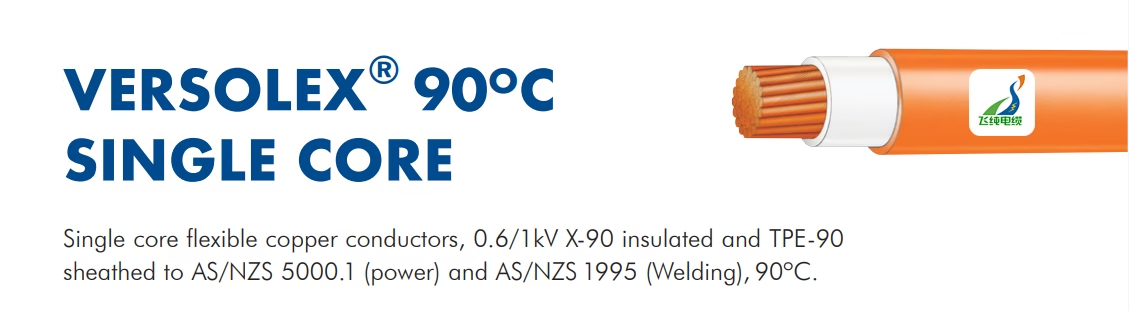
VERSOLEX 90OC, single core flexible cable, AS/NZS 5000.1, AS/NZS 1995, X-90 insulation, TPE-90 sheath, welding cable, 0.6/1kV cable, industrial power cable, flexible copper conductor, 90°C rated cable

What is VERSOLEX® 90°C Single Core Cable?

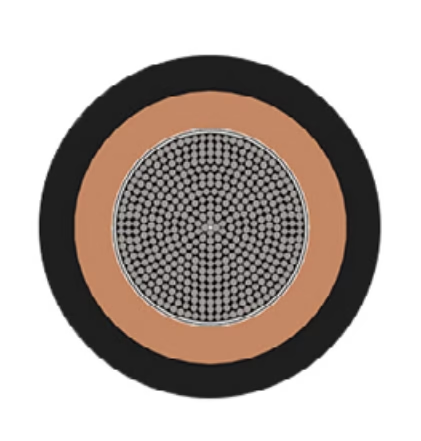
The VERSOLEX® 90OC Single Core cable represents a premium-grade flexible power cable engineered specifically for demanding industrial applications where exceptional flexibility, thermal endurance, and electrical performance are critical requirements. This specialized cable features single core flexible copper conductors rated at 0.6/1kV, utilizing X-90 (XLPE) insulation combined with TPE-90 (Thermoplastic Elastomer) sheathing to achieve superior performance characteristics across a broad range of operating conditions.
What is PROTOMONT(MT) (N)SSHOEU 1 kV? Complete Technical Guide Comprehensive specifications, applications, safety standards, and technical parameters for heavy-duty rubber-sheathed flexible mining and tunneling cables | Anhui Feichun Special Cable Co., Ltd. (安徽飞纯特种电缆有限公司)

What is PROTOMONT(MT) (N)SSHOEU 1 kV? Complete Technical Guide

PROTOMONT(MT) (N)SSHOEU represents a specialized category of rubber-sheathed flexible cables engineered specifically for mining and tunneling applications where heavy mechanical stress is a constant operational challenge. These cables serve as essential power transmission components in some of the world’s most demanding industrial environments, from underground coal mines to surface excavation operations. Mining environments present unique challenges that standard industrial cables cannot withstand. As noted in industry research, mining cables must endure severe physical punishment including constant abrasion against rock surfaces, crushing forces from equipment, impacts from falling debris, and frequent flexing as mobile equipment moves. The PROTOMONT(MT) (N)SSHOEU cable line addresses these challenges through sophisticated engineering and advanced material selection. Manufactured in accordance with DIN VDE 0250 part 812 standards and carrying VDE-REG F546 certification, this cable represents the pinnacle of German engineering excellence applied to mining cable technology. The designation “(N)SSHOEU” provides valuable information about the cable’s construction characteristics, indicating compliance with national and international standards, special sheathing for severe service conditions, and European standard compliance.
What is PROTOMONT NSSHOEU 1 kV Low Voltage Flexible Rubber Cable? A Comprehensive Technical Guide to Heavy-Duty Mining and Industrial Flexible Cables with EPR Insulation for Extreme Environments

What is PROTOMONT NSSHOEU 1 kV Low Voltage Flexible Rubber Cable?

PROTOMONT NSHXOEU series represents an advanced category of low voltage flexible rubber cables specifically engineered for demanding mining and industrial environments. These cables feature a specialized EVA-based outer sheath compound (5GM3) combined with EPR (Ethylene Propylene Rubber) insulation, providing an optimal balance of flexibility, durability, and environmental resistance for medium mechanical stress applications. The designation NSHXOEU follows the German cable nomenclature system established by DIN VDE standards, where each letter indicates specific construction characteristics. The “X” in the designation indicates the halogen-reduced EVA sheath compound, while “H” denotes the heavy-duty rubber construction suitable for harsh environments. According to Eland Cables, DIN VDE 0250 has achieved global recognition as the ultimate standard for tough rubber sheathed flexible cables, particularly for mining and material handling equipment.
What is PROTOMONT NSSHOEU 1 kV Low Voltage Flexible Rubber Cable? A Comprehensive Technical Guide to Heavy-Duty Mining and Industrial Flexible Cables with EPR Insulation for Extreme Environments

What is PROTOMONT NSSHOEU 1 kV Low Voltage Flexible Rubber Cable?

PROTOMONT NSSHOEU series represents a category of heavy-duty, low voltage flexible rubber cables engineered specifically for demanding industrial environments. These cables are designed to provide reliable power transmission in applications where conventional cables would fail due to extreme mechanical stress, environmental exposure, or chemical contact. The designation NSSHOEU follows German cable nomenclature standards where each letter indicates specific construction characteristics. The cables are manufactured according to DIN VDE 0250-812 specifications, which define requirements for rubber-insulated flexible cables used in power installations. According to industry standards, these cables are engineered for environments where high levels of mechanical stress and abrasion are expected, making them essential for modern mining, construction, and industrial operations.