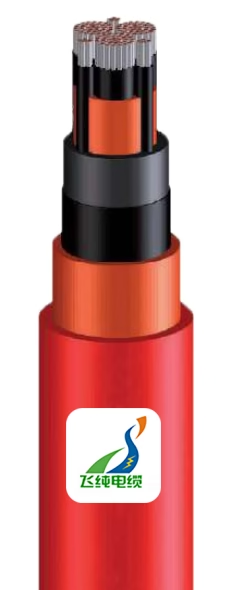
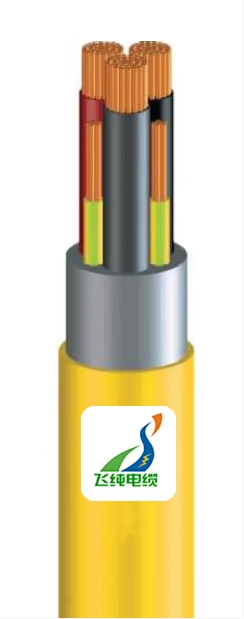
polyurethane mining cable

The Design Temperature Assumption: AS/NZS 1802 mining cable standards were developed for Australian and New Zealand mining conditions, where minimum ambient temperatures rarely drop below -10°C to -15°C. The standard's base material specifications (PCP chloroprene jacket, standard EPR insulation) were formulated for this relatively temperate range. A cable certified to AS/NZS 1802 specifications is guaranteed to function correctly from 0°C to 60°C (typical service range), with an operating floor around -20°C at absolute minimum. AS/NZS 1802矿用电缆标准是为澳大利亚和新西兰矿业条件而开发的,最低环境温度很少低于-10°C至-15°C。该标准的基础材料规范(PCP氯丁橡胶护套、标准EPR绝缘)针对这个相对温暖的范围而配制。根据AS/NZS 1802规范认证的电缆保证在0°C至60°C范围内正确工作,绝对最低工作温度约为-20°C。

Cold Bend Performance: Modifying AS/NZS Mining Cables for -40°C Operation in Mongolia

The Design Temperature Assumption: AS/NZS 1802 mining cable standards were developed for Australian and New Zealand mining conditions, where minimum ambient temperatures rarely drop below -10°C to -15°C. The standard’s base material specifications (PCP chloroprene jacket, standard EPR insulation) were formulated for this relatively temperate range. A cable certified to AS/NZS 1802 specifications is guaranteed to function correctly from 0°C to 60°C (typical service range), with an operating floor around -20°C at absolute minimum. AS/NZS 1802矿用电缆标准是为澳大利亚和新西兰矿业条件而开发的,最低环境温度很少低于-10°C至-15°C。该标准的基础材料规范(PCP氯丁橡胶护套、标准EPR绝缘)针对这个相对温暖的范围而配制。根据AS/NZS 1802规范认证的电缆保证在0°C至60°C范围内正确工作,绝对最低工作温度约为-20°C。
The Gobi Desert in southern Mongolia, where Oyu Tolgoi and other mining operations are located, experiences one of the most thermally extreme climates on Earth. Winter temperatures regularly drop to -35°C to -45°C, with recorded extremes approaching -50°C. Conversely, summer surface temperatures exceed +45°C, and cables exposed to direct solar radiation can reach +55°C to +65°C. This represents a temperature differential of 95–115°C between winter lows and summer highs—far exceeding the thermal cycling experienced in most mining regions globally. 蒙古南部戈壁沙漠,奥尤陶勒盖等矿区所在地,经历全球最极端的热气候之一。冬季温度经常降至-35°C至-45°C,记录低温接近-50°C。反之,夏季地表温度超过+45°C,直接暴露在太阳辐射下的电缆可达+55°C至+65°C。这代表冬季低温和夏季高温之间温度差异95-115°C,远远超过全球大多数矿区经历的热循环。 The Cable Deployment Context: Rio Tinto's 6.6kV trailing cables at Oyu Tolgoi power large electric shovels, electric drill jumbos, and load-haul-dump (LHD) equipment. These cables experience: (1) Winter deployment at -40°C where equipment must operate continuously despite extreme cold, (2) Coiling on equipment reels in -40°C conditions with high mechanical tension, (3) Summer storage in surface conditions where cables experience +50°C+ heat exposure, (4) Repeated thermal cycling as equipment moves between underground (warmer) and surface (colder or hotter) locations.

Rio Tinto Mongolia Cable Specs: Preventing Jacket Cracking on 6.6kV Mining Cables in Gobi Desert Extreme Climate

The Gobi Desert in southern Mongolia, where Oyu Tolgoi and other mining operations are located, experiences one of the most thermally extreme climates on Earth. Winter temperatures regularly drop to -35°C to -45°C, with recorded extremes approaching -50°C. Conversely, summer surface temperatures exceed +45°C, and cables exposed to direct solar radiation can reach +55°C to +65°C. This represents a temperature differential of 95–115°C between winter lows and summer highs—far exceeding the thermal cycling experienced in most mining regions globally. 蒙古南部戈壁沙漠,奥尤陶勒盖等矿区所在地,经历全球最极端的热气候之一。冬季温度经常降至-35°C至-45°C,记录低温接近-50°C。反之,夏季地表温度超过+45°C,直接暴露在太阳辐射下的电缆可达+55°C至+65°C。这代表冬季低温和夏季高温之间温度差异95-115°C,远远超过全球大多数矿区经历的热循环。 The Cable Deployment Context: Rio Tinto’s 6.6kV trailing cables at Oyu Tolgoi power large electric shovels, electric drill jumbos, and load-haul-dump (LHD) equipment. These cables experience: (1) Winter deployment at -40°C where equipment must operate continuously despite extreme cold, (2) Coiling on equipment reels in -40°C conditions with high mechanical tension, (3) Summer storage in surface conditions where cables experience +50°C+ heat exposure, (4) Repeated thermal cycling as equipment moves between underground (warmer) and surface (colder or hotter) locations.
If you are procuring Type 275 3.3kV 3x95mm² mining cables for Mongolian operations and relying on standard AS/NZS 1802 formulations without Arctic Grade modification, you will experience outer sheath cracking within days to weeks of deployment during Mongolian winter. The answer to your question is unambiguous: yes, standard cables will fail, and the failure is not marginal—it is catastrophic. The cracking will progress from hairline fissures to complete jacket failure within a timeframe measured in operational shifts, not months. This is not a theoretical risk or a worst-case scenario. It is an engineering certainty rooted in fundamental material science physics. 如果您正在为蒙古国运营采购 Type 275 3.3kV 3x95mm² 矿用电缆,并依赖于标准 AS/NZS 1802 配方而没有极地级修改,您将在蒙古冬季部署后的几天到几周内经历外护套开裂。答案是明确的:是的,标准电缆会失效,且失效不是边际的—这是灾难性的。开裂将在以运营班次而不是月份衡量的时间框架内从细微裂纹发展为完全护套失效。这不是理论风险或最坏情况场景。它是根植于基本材料科学物理的工程必然。

Cold Weather Reeling: Does Type 275 3.3kV 3x95mm² Outer Sheath Crack in Mongolian Winters?

If you are procuring Type 275 3.3kV 3x95mm² mining cables for Mongolian operations and relying on standard AS/NZS 1802 formulations without Arctic Grade modification, you will experience outer sheath cracking within days to weeks of deployment during Mongolian winter. The answer to your question is unambiguous: yes, standard cables will fail, and the failure is not marginal—it is catastrophic. The cracking will progress from hairline fissures to complete jacket failure within a timeframe measured in operational shifts, not months. This is not a theoretical risk or a worst-case scenario. It is an engineering certainty rooted in fundamental material science physics. 如果您正在为蒙古国运营采购 Type 275 3.3kV 3x95mm² 矿用电缆,并依赖于标准 AS/NZS 1802 配方而没有极地级修改,您将在蒙古冬季部署后的几天到几周内经历外护套开裂。答案是明确的:是的,标准电缆会失效,且失效不是边际的—这是灾难性的。开裂将在以运营班次而不是月份衡量的时间框架内从细微裂纹发展为完全护套失效。这不是理论风险或最坏情况场景。它是根植于基本材料科学物理的工程必然。
3.3kV mining cable, 3.6/6kV trailing cable, (N)TSCGEWOU cable, AS/NZS 1802, AS/NZS 2802, Type 241 cable, Type 275 mining cable, Type 409 cable, Australian mining cable standards, flexible rubber cable, ECM pilot core, earth continuity monitoring, underground coal mining cable, VDE 0250-813, DIN VDE mining cable, reeling and trailing cable, 3.3/3.3kV vs 3.6/6kV, mining equipment cable, SHD-GC alternative, European vs Australian cable standards, heavy duty PCP sheath, EPR insulation mining cable, Cu-weight mining cable, current carrying capacity mining cable, high voltage flexible cable, mining cable specifications, electrical engineer mining standard, AS/NZS certification, Simtars approved cable, MDA approval cable, phase-to-earth fault protection, symmetrical earth mining cable, central extensible pilot, semiconductive elastomer screen, dragline cable, longwall mining cable, continuous miner cable, shuttle car cable, mining feeder cable, robust trailing cable, AS1125 tinned copper conductor, mining cable outer diameter, cable AWG to mm2 cross-section, CPE sheath mining cable, polyurethane mining cable, mining machinery power supply, IEC to AS/NZS cable comparison, mining cable Australia import, trailing cable failure analysis, industrial heavy duty cable

3.3/3.3kV vs 3.6/6kV: Why Australian Mines Reject European (N)TSCGEWÖU Cables

When international mining equipment manufacturers—such as Liebherr for draglines, Caterpillar for longwall systems, or Sandvik for continuous miners—design equipment with power cable specifications, they typically reference European standards. The de facto standard for heavy-duty mining cables across Europe is the 3.6/6kV (U0/U) specification, which appears on virtually every major mining equipment nameplate manufactured in Germany, Switzerland, or Scandinavia. Equipment arrives in Australian ports with factory-supplied 3.6/6kV cables or with rigid specifications demanding 3.6/6kV replacement cables. Yet when Australian mining engineers and electrical inspectors evaluate these specifications against local regulatory requirements, they universally reject them. The cables must be replaced with 3.3/3.3kV hybrid specifications, creating costly project delays, adding unexpected procurement cycles, and forcing equipment owners to source custom cables.
RHEYFIRM® (XT) "Extreme" is a specialized arctic-grade flexible reeling cable engineered specifically for continuous dynamic operation in permafrost mining zones and open-pit operations where temperatures fall to -50°C (-58°F), whereas RHEYFIRM® (RS) standard versions are designed for conventional industrial and port environments operating down to approximately -25°C to -35°C maximum. The XT extreme variant differs from the RS standard version through four fundamental structural and chemical modifications. First, the outer jacket compound transitions from standard chlorinated rubber (5GM5 formulation) to an ultra-low-temperature advanced elastomer or specialized cold-resistant polyurethane (PUR) blend that remains flexible and resistant to crystallization and embrittlement even when exposed to -50°C arctic blasts. Second, the internal structure incorporates enhanced cold-adapted synthetic anti-torsion braids fabricated from Kevlar and Aramid fibers instead of conventional braid materials, which maintain their reinforcement properties at extreme temperatures where standard materials would lose rigidity. Third, the insulation material evolves from standard EPR (ethylene propylene rubber) to an optimized cold-flexible EPR formulation that prevents micro-cracking around copper conductors under severe thermal stress. Fourth, the cable incorporates specialized core lubrication systems and internal slip-layers designed to reduce friction between conductor wires at sub-zero temperatures, where natural friction increases dramatically and would otherwise cause internal conductor fatigue and snapping. The result is a cable system that remains mechanically robust and electrically reliable for continuous high-speed reeling (up to 190 meters per minute) on frozen ground and ice-covered surfaces in the harshest mining environments on Earth. The electrical specifications remain identical to RS standard cables (same voltage ratings, same current capacity), but the physical behavior and mechanical reliability at extreme cold are fundamentally different. You should specify RHEYFIRM® (XT) when your mining operation is located in permafrost regions, when winter operations regularly experience temperatures below -40°C, when continuous reeling stress is combined with sub-zero conditions, and when cable failure could result in equipment shutdown in a remote arctic location where emergency replacement is logistically impossible.

RHEYFIRM® (XT): How Does the “Extreme” Version Differ from Standard (RS) for Operations in -50°C Arctic Mines?

RHEYFIRM® (XT) “Extreme” is a specialized arctic-grade flexible reeling cable engineered specifically for continuous dynamic operation in permafrost mining zones and open-pit operations where temperatures fall to -50°C (-58°F), whereas RHEYFIRM® (RS) standard versions are designed for conventional industrial and port environments operating down to approximately -25°C to -35°C maximum. The XT extreme variant differs from the RS standard version through four fundamental structural and chemical modifications. First, the outer jacket compound transitions from standard chlorinated rubber (5GM5 formulation) to an ultra-low-temperature advanced elastomer or specialized cold-resistant polyurethane (PUR) blend that remains flexible and resistant to crystallization and embrittlement even when exposed to -50°C arctic blasts. Second, the internal structure incorporates enhanced cold-adapted synthetic anti-torsion braids fabricated from Kevlar and Aramid fibers instead of conventional braid materials, which maintain their reinforcement properties at extreme temperatures where standard materials would lose rigidity. Third, the insulation material evolves from standard EPR (ethylene propylene rubber) to an optimized cold-flexible EPR formulation that prevents micro-cracking around copper conductors under severe thermal stress. Fourth, the cable incorporates specialized core lubrication systems and internal slip-layers designed to reduce friction between conductor wires at sub-zero temperatures, where natural friction increases dramatically and would otherwise cause internal conductor fatigue and snapping. The result is a cable system that remains mechanically robust and electrically reliable for continuous high-speed reeling (up to 190 meters per minute) on frozen ground and ice-covered surfaces in the harshest mining environments on Earth. The electrical specifications remain identical to RS standard cables (same voltage ratings, same current capacity), but the physical behavior and mechanical reliability at extreme cold are fundamentally different. You should specify RHEYFIRM® (XT) when your mining operation is located in permafrost regions, when winter operations regularly experience temperatures below -40°C, when continuous reeling stress is combined with sub-zero conditions, and when cable failure could result in equipment shutdown in a remote arctic location where emergency replacement is logistically impossible.
Type 409 cables represent a specialized category of flexible mining cables designed specifically for demanding applications in material handling equipment, surface mining operations, and industrial environments. These cables are manufactured according to the Australian and New Zealand Standard AS/NZS 2802:2000, which establishes rigorous requirements for reeling and trailing cables used in mining and general industrial applications outside underground coal mining environments. (409型电缆是专为物料搬运设备、露天采矿作业和工业环境中的高要求应用而设计的一类特种柔性矿用电缆。这些电缆按照澳大利亚和新西兰标准AS/NZS 2802:2000制造,该标准对用于煤矿井下以外的采矿和一般工业应用的卷筒电缆和拖曳电缆制定了严格要求。)

TENAX-PUR (N)TSCGEH3S I 6 – 10 KV

TENAX-PUR is a premium medium voltage trailing cable engineered specifically for power supply to large mobile mining equipment such as shovels and draglines. The cable features an extremely robust polyurethane (PUR) outer sheath that delivers exceptional performance against abrasion and tearing, maintaining full flexibility even in extreme cold conditions down to -50°C. Available in orange, yellow, or custom colors to meet specific operational requirements. TENAX-PUR 是一种专为大型移动采矿设备(如电铲和拉斗铲)供电而设计的优质中压拖曳电缆。该电缆采用极其坚固的聚氨酯(PUR)外护套,在磨损和撕裂方面提供卓越的性能,即使在低至-50°C的极端寒冷条件下也能保持充分的柔韧性。可提供橙色、黄色或定制颜色以满足特定操作要求。
The selection of appropriate submersible pump cables for acidic mine water dewatering applications represents a critical engineering decision that directly impacts operational safety, equipment longevity, and maintenance costs. While Type 441 cables may appear suitable for general submersible pump applications, the harsh chemical environment of acidic mine water typically necessitates the use of specialized EPR (Ethylene Propylene Rubber) or CSP (Chlorosulfonated Polyethylene) insulated cables specifically engineered for corrosive conditions. 为酸性矿井水脱水应用选择合适的潜水泵电缆是一项关键的工程决策,直接影响运行安全、设备寿命和维护成本。虽然441型电缆可能适用于一般潜水泵应用,但酸性矿井水的恶劣化学环境通常需要使用专门设计用于腐蚀性条件的EPR(乙丙橡胶)或CSP(氯磺化聚乙烯)绝缘电缆。

TUNNELFLEX-R-PUR HF with Antitwisting Protection 1 KV

TUNNELFLEX-R-PUR HF represents a specialized category of halogen-free, flame-retardant flexible power cables engineered specifically for the demanding requirements of underground mining and tunneling operations. This cable combines advanced polyurethane (PUR) sheathing technology with integrated antitwisting protection to deliver exceptional mechanical durability, environmental resistance, and most importantly, enhanced safety through its halogen-free construction that significantly reduces toxic gas emissions during fire incidents. TUNNELFLEX-R-PUR HF电缆是专为地下采矿和隧道作业的苛刻要求而设计的无卤阻燃柔性电力电缆。该电缆结合了先进的聚氨酯护套技术和集成的防扭转保护,提供卓越的机械耐久性、环境抵抗力,以及通过无卤结构在火灾事故中显著减少有毒气体排放的增强安全性。
High-performance polyurethane sheathed flexible power cables for mining and tunneling applications. Available in two variants: standard version without anti-twisting protection (TUNNELFLEX-PUR) and enhanced version with synthetic mesh anti-twisting protection (TUNNELFLEX-R/PUR).

What is TUNNELFLEX-PUR&TUNNELFLEX-R/PUR 0.6/1kV Cable?

TUNNELFLEX-PUR and TUNNELFLEX-R/PUR are specialized 0.6/1kV flexible power cables engineered for mining and tunneling applications. These cables provide reliable power supply to mobile equipment operating in harsh underground environments where there is a high risk of mechanical damage. The TUNNELFLEX cable series is suitable for applications where it is deflected in one plane only, with a maximum operating speed of 60 m/min.
FG7ORPu-TUNNELFLEX is a specialized 0.6/1kV flexible power cable engineered specifically for mining and tunneling applications. This cable provides reliable power supply to mobile equipment operating in harsh underground environments where there is a high risk of mechanical damage. The TUNNELFLEX cable is suitable for applications where it is deflected in one plane only, with a maximum operating speed of 60 m/min.

What is FG7ORPu-TUNNELFLEX 0.6/1kV Cable?

FG7ORPu-TUNNELFLEX is a specialized 0.6/1kV flexible power cable engineered specifically for mining and tunneling applications. This cable provides reliable power supply to mobile equipment operating in harsh underground environments where there is a high risk of mechanical damage. The TUNNELFLEX cable is suitable for applications where it is deflected in one plane only, with a maximum operating speed of 60 m/min.