
经济型 Type P 海工电源电缆:为全球钻井和平台应用优化的预算设计
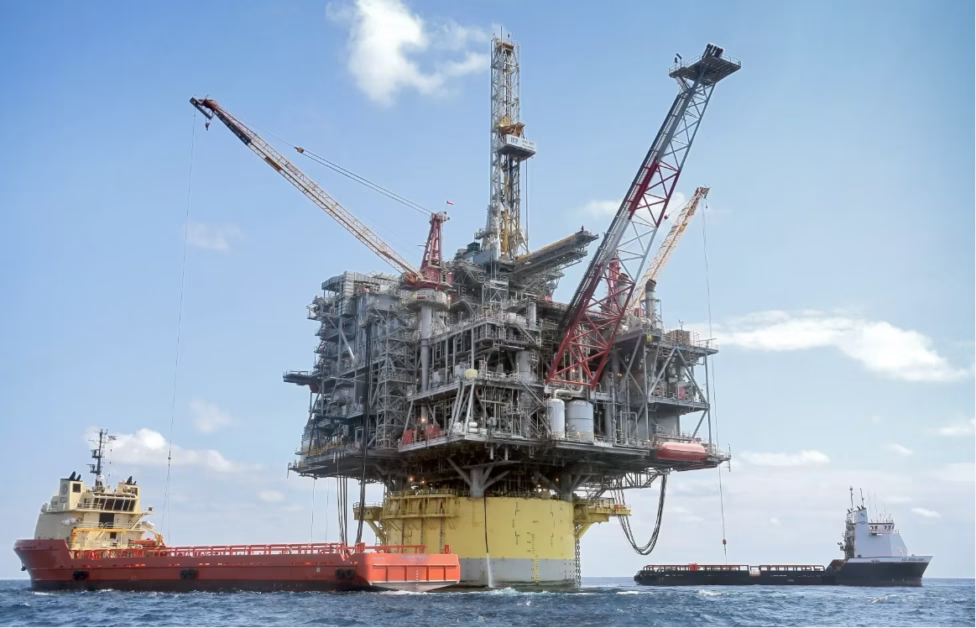
Type P Cost-Effective Offshore Power Cables: Budget-Optimized Design for Global Drilling and Platform Applications 经济型 Type P 海工电源电缆:为全球钻井和平台应用优化的预算设计
In the competitive landscape of international offshore project bidding, electrical engineers and procurement managers face a fundamental tension: delivering mission-critical power distribution systems while simultaneously optimizing capital expenditure. The emergence of cost-effective Type P cable designs (经济型 Type P 电缆设计) addresses this tension directly. These unarmored marine power cables, fully compliant with IEEE 1580 offshore cable specifications (IEEE 1580 海上电缆标准), deliver measurable cost reductions across material procurement, logistics, and installation phases while maintaining rigorous electrical and safety performance standards.
This installation guide addresses the engineering rationale behind cost-effective, unarmored Type P cable specifications and provides procurement teams with objective decision criteria for determining when these configurations are appropriate for their specific offshore applications.
Understanding the Cost-Effective Type P Cable Architecture
The designation “cost-effective Type P” does not signify a compromised or reduced-specification product. Rather, it refers to IEEE 1580 compliant multi-conductor power cables manufactured without the bronze or tinned copper wire braid armor layer (无青铜丝或镀锡铜丝编织铠装层). This architectural simplification eliminates one of the most expensive and labor-intensive manufacturing steps while preserving all essential electrical and thermal characteristics mandated by IEEE 1580 and UL 1309 standards.
The foundational technology remains identical to armored Type P cables: soft annealed tinned copper conductors, cross-linked polyolefin insulation rated for 110°C continuous operation, semi-conductive shielding layers, and thermosetting neoprene (Type N) jackets engineered for oil, mud, and petrochemical resistance (软退火镀锡铜导体、110°C交联聚烯烃绝缘、热固性氯丁橡胶护套). The critical difference is architectural simplicity: by eliminating the armor layer, manufacturers avoid the specialized machinery required for wire braid application, the labor costs associated with armor wrapping and tensioning, the material costs for thousands of meters of phosphor bronze wire, and the inspection and testing complexity that armoring introduces.
Three Strategic Advantages Driving Cost-Effective Adoption
Material and Manufacturing Cost Reduction
Armor wire represents a substantial material cost in traditional Type P specifications. A single 3-conductor 1/0 AWG cable fully armored might incorporate 400–600 meters of phosphor bronze braid wire per kilometer of cable length, with material costs frequently exceeding USD $0.80–1.20 per meter for high-quality marine-grade wire. Current market analysis indicates that elimination of armor materials reduces per-kilometer cable cost by approximately 12–18% for typical medium-voltage marine power cables (去除铠装材料可降低12-18%的单公里成本).
Manufacturing complexity reduction compounds this advantage. Armoring operations require specialized equipment capable of maintaining consistent wire tension, braid angle geometry, and coverage uniformity—machinery that demands significant capital investment and skilled operator expertise. Unarmored cables bypass this entire manufacturing stage, reducing factory production time per unit and enabling more efficient production scheduling across multiple cable gauges and configurations.
Logistics Weight Optimization and International Transportation Efficiency
The physical weight differential between armored and unarmored Type P cables becomes the dominant cost factor when procuring for international offshore projects. International ocean freight pricing for project materials to offshore platforms typically ranges from USD $150–300 per metric ton for equipment shipped via container vessel (国际海运费用通常为每吨150-300美元), with additional handling and inland transportation frequently doubling effective freight costs.
Consider a practical example: a 3-conductor 1/0 AWG armored Type P cable weighs approximately 2,550 kg/km, while the identical cable without armor weighs approximately 1,950 kg/km—a 23 percent weight reduction. For a 50-kilometer subsea or platform cable installation requiring 50 metric tons of total cable weight, the weight difference translates to approximately 12.5 metric tons of material that would otherwise require dedicated cargo space, specialized handling, and associated freight charges. At current international freight rates, this weight optimization can yield savings of USD $3,750–7,500 per project, before considering the secondary logistics benefits of reduced platform load displacement and simplified material handling procedures.
Container vessel load optimization (集装箱装载优化) provides additional leverage. Procurement teams loading cables destined for offshore platforms must account for strict weight distribution requirements and specialized racking systems designed for standard cable diameters. Unarmored cables, being approximately 15–20 percent smaller in outer diameter than their armored equivalents, permit higher-density packing within standard 20-foot and 40-foot shipping containers. This density improvement frequently eliminates the need for partial-container shipments, consolidating several smaller cable orders into single full-container loads and capturing significant volume discounts that accumulate to 8–12 percent additional cost reduction.
Installation Speed Enhancement and Reduced Labor Hours
The installation cost advantage, though less obvious than material savings, often exceeds both material and logistics benefits. Offshore cable installation typically involves multiple phases: cable laying, burial or tray installation, pull-in to equipment terminals, and final electrical testing (电缆敷设、埋设、牵引和测试). Installation speed directly correlates to vessel utilization costs. Most offshore cable installation contracts are charged on a time-and-materials basis, with the cable installation vessel being the highest-cost asset involved—frequently USD $300,000–500,000 per day for medium-sized dynamically positioned vessels.
The smaller outer diameter and reduced weight of unarmored cables permits tighter bending radii during installation (更紧的弯曲半径). Standard IEEE 1580 guidance specifies that minimum bend radius during installation should not exceed 6–8 times the cable outer diameter for armored cables, whereas unarmored cables can typically accommodate 4 times their outer diameter during pulling operations. This flexibility permits smoother cable routing through congested platform areas, eliminates the need for expensive protective conduit and secondary guarding systems, and enables higher pulling speeds without risk of insulation damage from excessive tensioning.
Electrical contractors report that unarmored cable installations proceed approximately 25–35 percent faster than equivalent armored installations when routing cables through crowded platform electrical rooms, living quarters, and control station areas (安装速度提升25-35%). For a typical platform electrical installation requiring 3–5 kilometers of distributed cable routing, this speed improvement translates to reduced vessel hire time of 1–2 days, yielding cost reductions of USD $300,000–1,000,000 per project.
Technical Parameter Table: 3-Conductor Unarmored Type P Power Cables (600V/1000V Rating)
The following specifications provide industry-standard parameters for three-conductor unarmored Type P power cables rated 600V/1000V, operating at 110°C conductor temperature with 45°C ambient temperature rating per IEEE 45 and IEEE 1580 marine cable standards (基于IEEE 45和IEEE 1580标准的110°C导体温度). Outer diameters, weights, and ampacity values reflect typical manufacturing specifications accounting for standard industry tolerances (反映标准制造公差的行业典型值).
| Conductor Configuration 导体配置 | AWG Equivalent AWG规格 | Outer Diameter 外径 (mm) | Theoretical Copper 理论铜重 (kg/km) | Total Cable Weight 总重量 (kg/km) | Ampacity @ 110°C @ 110°C (A) |
|---|---|---|---|---|---|
| 3 × 2.5 mm² | 14 AWG | 10.5 – 11.5 | ~72 | ~185 | 35 |
| 3 × 4.0 mm² | 12 AWG | 11.5 – 12.8 | ~115 | ~230 | 43 |
| 3 × 6.0 mm² | 10 AWG | 13.0 – 14.5 | ~173 | ~315 | 55 |
| 3 × 10.0 mm² | 8 AWG | 16.0 – 17.5 | ~288 | ~480 | 74 |
| 3 × 16.0 mm² | 6 AWG | 18.5 – 20.0 | ~461 | ~690 | 99 |
| 3 × 25.0 mm² | 4 AWG | 22.5 – 24.5 | ~720 | ~1050 | 130 |
| 3 × 35.0 mm² | 2 AWG | 25.5 – 27.5 | ~1008 | ~1380 | 171 |
| 3 × 50.0 mm² | 1/0 AWG | 31.0 – 33.5 | ~1440 | ~1950 | 231 |
Sources: IEEE 1580 Type P Unarmored Cable Specifications (Nassau National Cable); Prysmian Offshore Cable Technologies and Type P Design Documentation; Marine Unarmored Cable Market Analysis and Cost Structure (2024)
Critical Applications Where Cost-Effective Unarmored Type P Cables Are Appropriate
Electrical Distribution Rooms and Control Stations
Modern offshore drilling platforms and FPSOs feature centralized electrical distribution rooms where ambient conditions are controlled and physical hazards are minimized through design. Cables routed within these protected enclosures, distributed through cable trays with secondary protection systems, do not require the mechanical robustness of armored designs (在保护的电气室内,电缆不需要铠装的机械强度). The electrical environment remains stable, with controlled temperature and humidity, no exposure to direct mechanical abuse, and established secondary safeguards against rodent damage or abrasion.
Cost-effective unarmored Type P cables are fully specified for these applications. The IEEE 1580 standard recognizes that electrical performance and environmental resistance—not mechanical impact protection—are the relevant design criteria for these protected spaces. By specifying unarmored designs in electrical distribution rooms while reserving armored designs for topside and exposed deck applications, procurement teams effectively optimize specifications without compromising safety or reliability.
Subsea and Internal Platform Riser Applications
Subsea cable installations benefit substantially from unarmored designs when the cables are installed within rigid conduit systems or buried protective systems. Professional offshore cable installation contractors routinely employ protective armoring, burial methods, or rigid conduit systems for subsea cables (专业海上电缆安装采用保护铠装或埋设系统). When the cable itself is located within external mechanical protection, the cable’s internal unarmored construction provides no compromise to system reliability. The external protection layer fulfills the mechanical safeguarding function.
This approach permits significant specification optimization: instead of procuring expensive armored cables that will themselves be installed inside protective conduit, procurement teams can specify cost-effective unarmored designs and rely on the external protection system. The result is equivalent mechanical protection, identical electrical performance, and measurably lower total system cost.
Specialized Platform Areas Without Mechanical Hazard Exposure
Living quarters, administrative areas, emergency response centers, and other non-industrial platform spaces frequently house critical control and power distribution systems that do not justify the cost of armored cabling. These areas, by operational definition, limit personnel traffic to essential staff, restrict heavy equipment and machinery, and maintain organized cable management systems. Cost-effective unarmored Type P cables are fully appropriate for these applications (经济型非铠装Type P电缆完全适用) because the mechanical threat environment does not warrant the expense of armor materials and installation labor.
Critical Applications Where Armored Designs Remain Mandatory
Exposed Deck and Topside Installations
Cable systems routed across open decks or through areas subject to mechanical equipment traffic, foot traffic, vehicle passage, or weather exposure require armored protection. These applications demand bronze or tinned copper armor without compromise (这些应用必须采用青铜或镀锡铜铠装). The mechanical threat environment—including crushing from dropped equipment, cutting from sharp deck edges, abrasion from repeated foot traffic, and impact from heavy machinery—exceeds what unarmored cable jackets can reasonably withstand during a 20–30 year service life.
Direct Mud and Petrochemical Exposure in Drilling Operations
While unarmored Type P cables do provide exceptional chemical resistance through their thermosetting neoprene jackets, drilling platform applications involving direct mud circulation systems, shale shaker discharge areas, or continuous slurry contact may justify armored designs because the armor provides secondary mechanical containment. Armored cables, in these scenarios, provide defense-in-depth: if the outer jacket sustains puncture or chemical penetration, the underlying armor braid provides mechanical integrity and prevents complete cable separation.
Procurement Strategy: When to Specify Cost-Effective Versus Armored Type P Cables
The decision to specify cost-effective unarmored cables versus armored designs should be guided by systematic evaluation of application risk factors rather than reflexive acceptance of standard platform-wide armoring specifications.
Step 1: Environmental Hazard Assessment 环境危害评估. Obtain the cable routing drawings for your specific project and identify which cable segments traverse protected spaces (electrical rooms, cable trays with guarding, conduit systems) versus exposed areas (open decks, equipment rooms with machinery, mudline areas). This segregation directly informs specification decisions.
Step 2: Cost-Benefit Analysis by Cable Route Segment 按电缆路段成本-效益分析. For each major cable segment, calculate the cost differential between armored and unarmored designs at the specified conductor size. Multiply this differential by the total length of cable required for that route segment. Sum these segment costs to determine total project cost impact. If armoring adds 18–25 percent cost premium across 50 kilometers of cable, you are potentially evaluating USD $750,000–1,500,000 in additional expenditure.
Step 3: Risk Verification with Electrical Engineering and Operations Teams 与电气和运维团队风险验证. Present your proposed unarmored cable specifications to the platform’s electrical engineering department and operations staff. Ask them directly: given the cable routing and intended service area, what is the realistic probability of mechanical cable damage during the anticipated 25-year service life? Professional offshore operations teams routinely provide frank risk assessments that distinguish genuine mechanical hazard areas from theoretical concerns.
Step 4: Standardize Within Your Supply Chain 在供应链中标准化. Once you have established a risk-based framework for cable specification, document it internally and apply it consistently across your portfolio of offshore projects. This consistency permits volume-based procurement strategies with cable manufacturers, yielding additional quantity discounts for standardized unarmored designs across multiple platforms (基于数量的采购策略可获得额外折扣).
Common Objections and Technical Responses
Objection: “Our standard platform specification requires armored cables throughout. Using unarmored cables creates a non-standard system that will cause future maintenance confusion.” 异议:我们的标准规范要求全部使用铠装电缆
Response: This represents a legitimate operational concern. The solution involves updating your standard specification to explicitly differentiate between protected-space and exposed-area cable requirements. Modern platform-wide cable specifications from major oil and gas operators include risk-based cable selection matrices that reference application type, mechanical hazard level, and corresponding approved cable designs. This approach maintains systematic specification discipline while capturing cost optimization opportunities. The cable documentation and component labeling systems should clearly indicate which cable sections employ unarmored designs and why—this facilitates future maintenance and modification work.
Objection: “Cost-effective unarmored cables must be lower quality than armored equivalents.” 异议:经济型非铠装电缆质量必然较低
Response: This reflects a fundamental misunderstanding of cost-effective design philosophy. Unarmored Type P cables manufactured to IEEE 1580 standards employ identical insulation systems, conductor materials, and shielding architectures as armored equivalents (采用相同的绝缘系统、导体材料和屏蔽结构). The only difference is the absence of an external protective armor layer—a deliberate design choice, not a quality compromise. The cable’s electrical performance, thermal rating, and chemical resistance are indistinguishable from armored designs. The cost reduction comes from elimination of expensive manufacturing operations and materials, not from substitution of inferior components.
Conclusion: Engineering-Driven Specification Discipline
Cost-effective, unarmored Type P offshore power cables represent a legitimate engineering solution appropriate for specific application contexts where mechanical protection requirements do not justify the cost premium of armored designs. The IEEE 1580 standard recognizes both armored and unarmored configurations as valid design approaches, with the selection decision appropriately delegated to the engineer conducting application analysis.
The procurement advantage of cost-effective designs is measurable and material: 12–18 percent per-kilometer cable cost reduction, 20–30 percent weight optimization yielding significant logistics savings, and 25–35 percent installation speed improvement on cable routing tasks. For international offshore projects where project cost control represents a competitive advantage, systematic application of risk-based specification discipline can yield total project savings exceeding 10 percent of electrical installation costs.
The critical success factor is engineering discipline: cost-effective specifications should be based on documented hazard assessment and risk analysis, not on reflexive cost reduction. When applied appropriately—in protected spaces, subsea applications with external protection, and non-hazard platform areas—these designs deliver equivalent reliability with significant economic advantage.
All ampacity values in this guide are based on IEEE 45 and IEEE 1580 standard assumptions: 110°C continuous conductor temperature, 45°C ambient temperature, and single-cable installation without grouping derating. For applications operating at different temperature conditions, with cable grouping or bundling, or with unusual duty cycles (such as prolonged high-current operation), consult the cable manufacturer’s application engineering team for detailed ampacity derating and verification calculations. 所有载流量值基于110°C导体温度和45°C环境温度的假设。对于不同条件,请咨询制造商的应用工程团队。
Authoritative References and Standards 权威参考文献和标准
Technical Consultation & Sales Inquiries 技术咨询与销售咨询:
📧 Email: [email protected]
📞 WhatsApp/Phone: +86 13855123218 (经济型Type P电缆技术支持)
Authorized supplier of cost-effective IEEE 1580 Type P unarmored marine power cables for offshore drilling platforms, FPSO installations, subsea applications, and international oil and gas projects. Full compliance with IEEE 1580, UL 1309, and DNV certification standards. (IEEE 1580 经济型非铠装海工电源电缆认证供应商)


