marine power cable

NEK 606 RFOU 0.6/1kV P1/P8 cable is specifically designed with mud-resistant SHF2 MUD heat-set thermoset outer sheath and is rated to withstand prolonged exposure to ester-based drilling mud, making it suitable for continuous mud-zone service typically lasting 5 to 7 years before material property degradation requires cable replacement or service assessment. The cable's heat-set thermoset formulation provides superior resistance to synthetic ester drilling fluids compared to standard elastomeric jackets, as the cross-linked polymer structure exhibits swelling rates of approximately 20 to 35 percent in typical ester-based drilling muds, compared to 50 to 80 percent swelling in non-resistant elastomers. However, the term "mud resistant" represents a carefully defined performance envelope, not unlimited exposure—the cable is qualified for service in drilling mud zones where the cable may be splashed, partially immersed, or in periodic contact with mud over operational periods measured in years, but not for continuous full immersion in mud-filled drilling riser pipes or mud tanks where exposure conditions exceed the design assumptions underlying the material formulation. In such extreme immersion scenarios, service life may be reduced to 2 to 4 years depending on temperature, pressure, and the specific chemical composition of the drilling mud system. Understanding the distinction between standard mud-zone service (where the cable experiences periodic mud contact in the operational envelope for which P1/P8 is certified) and extreme continuous immersion scenarios (where cable selection must be upgraded or enhanced) is critical to avoiding premature field failures. For typical offshore drilling platforms, FPSO systems, and subsea support vessel applications operating in the North Sea, Southeast Asia, or West African waters, the NEK 606 RFOU P1/P8 provides reliable, field-proven performance that meets or exceeds the mud-zone cable specifications of major offshore operators including DNV GL, Lloyds Register, and the American Petroleum Institute.

Mud Resistance of NEK 606 RFOU 0.6/1kV P1/P8: Can This Offshore Cable Withstand Prolonged Exposure to Ester-Based Drilling Mud?

NEK 606 RFOU 0.6/1kV P1/P8 cable is specifically designed with mud-resistant SHF2 MUD heat-set thermoset outer sheath and is rated to withstand prolonged exposure to ester-based drilling mud, making it suitable for continuous mud-zone service typically lasting 5 to 7 years before material property degradation requires cable replacement or service assessment. The cable’s heat-set thermoset formulation provides superior resistance to synthetic ester drilling fluids compared to standard elastomeric jackets, as the cross-linked polymer structure exhibits swelling rates of approximately 20 to 35 percent in typical ester-based drilling muds, compared to 50 to 80 percent swelling in non-resistant elastomers. However, the term “mud resistant” represents a carefully defined performance envelope, not unlimited exposure—the cable is qualified for service in drilling mud zones where the cable may be splashed, partially immersed, or in periodic contact with mud over operational periods measured in years, but not for continuous full immersion in mud-filled drilling riser pipes or mud tanks where exposure conditions exceed the design assumptions underlying the material formulation. In such extreme immersion scenarios, service life may be reduced to 2 to 4 years depending on temperature, pressure, and the specific chemical composition of the drilling mud system. Understanding the distinction between standard mud-zone service (where the cable experiences periodic mud contact in the operational envelope for which P1/P8 is certified) and extreme continuous immersion scenarios (where cable selection must be upgraded or enhanced) is critical to avoiding premature field failures. For typical offshore drilling platforms, FPSO systems, and subsea support vessel applications operating in the North Sea, Southeast Asia, or West African waters, the NEK 606 RFOU P1/P8 provides reliable, field-proven performance that meets or exceeds the mud-zone cable specifications of major offshore operators including DNV GL, Lloyds Register, and the American Petroleum Institute.
Type MMV 8kV 3/C #2 AWG marine and mining medium voltage cable is designed to withstand brief exposure to 250°C (482°F) emergency fault temperatures, specifically for fault durations not exceeding 5 seconds as defined in IEEE 45 and IEC 60092-502 international standards. This 250°C specification represents the absolute maximum temperature that the EPR (ethylene propylene rubber) insulation can tolerate without experiencing irreversible chemical degradation, mechanical property loss, or immediate failure. The cable will remain mechanically and electrically intact during this emergency thermal exposure provided the fault is cleared by protective devices (circuit breakers, fuses, or automatic shutdown systems) before the five-second threshold is exceeded. However, this specification does not mean the cable is unaffected by this thermal stress—even brief exposure to 250°C causes permanent changes to the EPR insulation chemistry, partial annealing of the tinned copper conductors, and measurable loss of mechanical properties. A cable that has experienced a 250°C fault event and survived instantaneous rupture is not necessarily suitable for continued service at full ampacity without comprehensive testing and damage assessment. Understanding what the 250°C specification guarantees and what it does not guarantee is essential for engineers making repair versus replacement decisions following fault events in mining and offshore applications.

Short-Circuit Temperature Limit: Can Type MMV 8kV 3/C #2 AWG Withstand a 250°C Fault?

Type MMV 8kV 3/C #2 AWG marine and mining medium voltage cable is designed to withstand brief exposure to 250°C (482°F) emergency fault temperatures, specifically for fault durations not exceeding 5 seconds as defined in IEEE 45 and IEC 60092-502 international standards. This 250°C specification represents the absolute maximum temperature that the EPR (ethylene propylene rubber) insulation can tolerate without experiencing irreversible chemical degradation, mechanical property loss, or immediate failure. The cable will remain mechanically and electrically intact during this emergency thermal exposure provided the fault is cleared by protective devices (circuit breakers, fuses, or automatic shutdown systems) before the five-second threshold is exceeded. However, this specification does not mean the cable is unaffected by this thermal stress—even brief exposure to 250°C causes permanent changes to the EPR insulation chemistry, partial annealing of the tinned copper conductors, and measurable loss of mechanical properties. A cable that has experienced a 250°C fault event and survived instantaneous rupture is not necessarily suitable for continued service at full ampacity without comprehensive testing and damage assessment. Understanding what the 250°C specification guarantees and what it does not guarantee is essential for engineers making repair versus replacement decisions following fault events in mining and offshore applications.
Type MMV 15kV 3/C 4/0 AWG marine medium voltage cable has a base continuous ampacity of 270 amperes when the conductor temperature reaches 90°C under standard ambient conditions of 45°C (113°F) in free air. This rating follows IEEE 45-2002 and IEEE 1580 marine standards and represents the maximum sustained current the cable can safely carry without exceeding the EPR insulation thermal limit. The cable features three 4/0 AWG (107.2 mm²) main power conductors of Class 5 highly flexible tinned copper stranding, supplemented by symmetrical grounding and shielding geometry optimized for maritime power distribution in offshore drilling units (MODUs), floating production storage offloading (FPSO) vessels, and port machinery applications. Approximate copper weight is 3,345 kg/km, and total cable weight is approximately 5,950 kg/km (unarmored) or 6,400 kg/km (bronze-braided armored variant).

Ampacity Chart: How Much Current Can Type MMV 15kV 3/C 4/0 AWG Marine Cable Carry at 90°C?

Understanding ampacity for marine cables differs fundamentally from standard industrial land-based cables because marine environments present unique thermal challenges. Shipboard cable routing often passes through engine rooms, boiler compartments, and tropical climates where ambient air temperatures routinely exceed the standard reference condition of 45°C. Additionally, marine cables must account for the physical constraints of vessel design—cables are bundled in trays, enclosed in cable trunking, and subjected to continuous vibration from engine operation and heavy sea state conditions. These factors necessitate precise ampacity derating calculations to ensure the cable operates safely throughout its design life without insulation degradation.
The nominal overall diameter (O.D.) of a Nexans AmerCable 37-102594BS 2/C #4 AWG 600/1000V bronze armored and sheathed marine power cable is approximately 28.45 mm (1.120 inches), with a standard tolerance window of ±1.0–1.5 mm producing a permissible range of 26.95–29.95 mm. The cable features two parallel Class 5 tinned copper main power conductors each rated for 4 AWG (approximately 21.2 mm² cross-section), with a Gexol® XLPO (cross-linked polyolefin) insulation system providing superior low-frequency and high-frequency electrical integrity for 600/1000V marine applications. The outer protective architecture comprises a high-density bronze wire braid armor layer (approximately 1.5–2.0 mm thickness) specifically engineered to resist saltwater corrosion and mechanical abuse, overlaid with an arctic-grade halogen-free thermosetting rubber jacket (approximately 2.0–2.5 mm thickness) providing extreme durability in harsh offshore, subsea, and deep-freeze industrial environments. The approximate total weight is ~1,380 kg/km (927 lbs/1000 ft), with pure copper content approximately 380 kg/km. This cable achieves IEEE 1580 Type P certification, meeting or exceeding all critical flame-retardance, electrical stress distribution, and mechanical protection requirements for offshore drilling platforms, large vessel power systems, subsea equipment power distribution, and Class I Division 1 hazardous zone installations where conventional industrial cables cannot operate safely.

What is the Overall Diameter (O.D.) of AmerCable 37-102594BS 2/C #4 AWG Bronze Armored Cable?

The nominal overall diameter (O.D.) of a Nexans AmerCable 37-102594BS 2/C #4 AWG 600/1000V bronze armored and sheathed marine power cable is approximately 28.45 mm (1.120 inches), with a standard tolerance window of ±1.0–1.5 mm producing a permissible range of 26.95–29.95 mm. The cable features two parallel Class 5 tinned copper main power conductors each rated for 4 AWG (approximately 21.2 mm² cross-section), with a Gexol® XLPO (cross-linked polyolefin) insulation system providing superior low-frequency and high-frequency electrical integrity for 600/1000V marine applications. The outer protective architecture comprises a high-density bronze wire braid armor layer (approximately 1.5–2.0 mm thickness) specifically engineered to resist saltwater corrosion and mechanical abuse, overlaid with an arctic-grade halogen-free thermosetting rubber jacket (approximately 2.0–2.5 mm thickness) providing extreme durability in harsh offshore, subsea, and deep-freeze industrial environments. The approximate total weight is ~1,380 kg/km (927 lbs/1000 ft), with pure copper content approximately 380 kg/km. This cable achieves IEEE 1580 Type P certification, meeting or exceeding all critical flame-retardance, electrical stress distribution, and mechanical protection requirements for offshore drilling platforms, large vessel power systems, subsea equipment power distribution, and Class I Division 1 hazardous zone installations where conventional industrial cables cannot operate safely.
Comprehensive technical guide to Prysmian Bostrig Type P (600V-1000V) armored power cables: conductor flexibility, cross-linked polyolefin insulation, tinned copper braided armor, flame retardance testing, and ampacity calculations for offshore drilling, subsea, and marine power applications.

Prysmian Bostrig Type P Cross-Reference: Equivalent Marine Cables with Faster Lead Times and Superior Flexibility for Offshore Power Distribution

Comprehensive technical guide to Prysmian Bostrig Type P (600V-1000V) armored power cables: conductor flexibility, cross-linked polyolefin insulation, tinned copper braided armor, flame retardance testing, and ampacity calculations for offshore drilling, subsea, and marine power applications.
Technical deep-dive into MPRXCX and MGCH medium-voltage marine cables for floating production storage and offloading vessels: XLPE vs. EPR insulation systems, DNV type-approval, ampacity calculations, EMI shielding design, and flame-retardant jacket specifications for FPSO electrical systems.

MPRXCX / MGCH Equivalents: Finding DNV Approved Medium Voltage Cables for FPSOs with Optimized XLPE and EPR Insulation Systems

Technical deep-dive into MPRXCX and MGCH medium-voltage marine cables for floating production storage and offloading vessels: XLPE vs. EPR insulation systems, DNV type-approval, ampacity calculations, EMI shielding design, and flame-retardant jacket specifications for FPSO electrical systems.
In the competitive landscape of international offshore project bidding, electrical engineers and procurement managers face a fundamental tension: delivering mission-critical power distribution systems while simultaneously optimizing capital expenditure. The emergence of cost-effective Type P cable designs (经济型 Type P 电缆设计) addresses this tension directly. These unarmored marine power cables, fully compliant with IEEE 1580 offshore cable specifications (IEEE 1580 海上电缆标准), deliver measurable cost reductions across material procurement, logistics, and installation phases while maintaining rigorous electrical and safety performance standards. This installation guide addresses the engineering rationale behind cost-effective, unarmored Type P cable specifications and provides procurement teams with objective decision criteria for determining when these configurations are appropriate for their specific offshore applications.

Type P Cost-Effective Offshore Power Cables: Budget-Optimized Design for Global Drilling and Platform Applications

In the competitive landscape of international offshore project bidding, electrical engineers and procurement managers face a fundamental tension: delivering mission-critical power distribution systems while simultaneously optimizing capital expenditure. The emergence of cost-effective Type P cable designs (经济型 Type P 电缆设计) addresses this tension directly. These unarmored marine power cables, fully compliant with IEEE 1580 offshore cable specifications (IEEE 1580 海上电缆标准), deliver measurable cost reductions across material procurement, logistics, and installation phases while maintaining rigorous electrical and safety performance standards. This installation guide addresses the engineering rationale behind cost-effective, unarmored Type P cable specifications and provides procurement teams with objective decision criteria for determining when these configurations are appropriate for their specific offshore applications.
Variable frequency drives represent critical components in modern industrial automation systems, enabling precise control of AC motor speed and torque through pulse width modulation technology. According to research from Nexans, VFD systems inherently create challenging operating conditions including high voltage spikes, electromagnetic interference, and radio frequency noise that standard power cables cannot adequately manage.[1] The selection of appropriate VFD-rated cables becomes essential for system reliability and longevity. 变频驱动器是现代工业自动化系统中的关键部件,通过脉宽调制技术实现对交流电机转速和扭矩的精确控制。根据耐克森公司的研究,变频系统固有地产生具有挑战性的运行条件,包括高电压尖峰、电磁干扰和射频噪声,标准电力电缆无法充分管理。选择合适的变频额定电缆对系统可靠性和使用寿命至关重要。

VFD Cable Compatibility Analysis

Variable frequency drives represent critical components in modern industrial automation systems, enabling precise control of AC motor speed and torque through pulse width modulation technology. According to research from Nexans, VFD systems inherently create challenging operating conditions including high voltage spikes, electromagnetic interference, and radio frequency noise that standard power cables cannot adequately manage.[1] The selection of appropriate VFD-rated cables becomes essential for system reliability and longevity. 变频驱动器是现代工业自动化系统中的关键部件,通过脉宽调制技术实现对交流电机转速和扭矩的精确控制。根据耐克森公司的研究,变频系统固有地产生具有挑战性的运行条件,包括高电压尖峰、电磁干扰和射频噪声,标准电力电缆无法充分管理。选择合适的变频额定电缆对系统可靠性和使用寿命至关重要。
Shipwiring and offshore platform cables represent a specialized category of marine cables designed to perform reliably in the most demanding environments on earth—at sea. These cables must withstand extreme temperature variations (from Arctic cold to engine room heat), constant exposure to humidity, salt water, oils, acids, and drilling muds, while maintaining electrical integrity for power, control, signal, instrumentation, and communication applications. The primary international standards governing these cables include NEK 606 (Norwegian standard for offshore floating platforms), IEC 60092 (electrical installations in ships), BS 6883 (fixed wiring in offshore units), and BS 7917 (fire resistant cables for offshore applications).

What are Shipwiring & Offshore Platform Cables?

NEK 606 cable, BFOU cable, RFOU cable, NEK 606 BFOU, NEK 606 RFOU, offshore platform cable, MUD resistant cable, Norwegian offshore cable, floating platform cable, FPSO cable, marine cable, offshore cable, shipwiring cable, ship cable, offshore platform cable, marine power cable, ship electrical cable, naval cable, maritime cable, at-sea cable,RFOU P101, BFOU P105, RFOU S101, RFOU S102, BFOU S103, BFOU S104, UX P108, RFOU P102, RFOU P103, RFOU P104, RFOU P112, RFOU P113
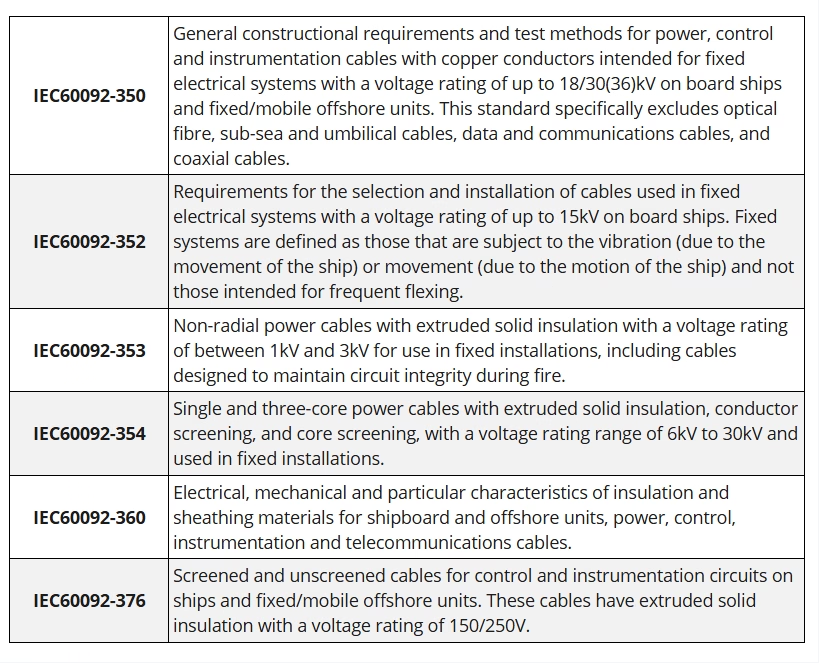
IEC 60092 is the international standard for electrical installations in ships and fixed/mobile marine applications. Ship wiring is covered by various national standards such as BS 6883 (British) and NEK 606 (Norwegian), and subject to third-party accreditations including Lloyd's Register, DNV (Det Norske Veritas), and ABS (American Bureau of Shipping). As an international standard, IEC 60092 covers power and instrumentation cables for use on ships and in mobile marine environments.

What is IEC 60092 Cable?

IEC 60092 cable, marine cable, shipboard cable, offshore cable, BS 6883 cable, NEK 606 cable, BFOU cable, RFOU cable, 657TQ cable, 658TQ cable, fire resistant marine cable, flame retardant cable, ship wiring, offshore platform cable, Lloyd’s Register approved, DNV certified, halogen free cable, LSZH marine cable, MUD resistant cable, IEC 60092-353, IEC 60092-354, IEC 60092-376, SW4 cable, EPR insulated, TCWB armoured, instrumentation cable, control cable, emergency power cable, oil rig cable, Feichun cable
The International Electrotechnical Commission (IEC) is the world's leading independent non-profit international standard-setting organization for electrical, electronic, and related technologies. Founded in 1906 with British Scientist Lord Kelvin as its first president, the IEC has over a century of expertise in developing international standards that form the basis for national and international standardization. All IEC standards are consensus-based and represent the needs of key stakeholders, with every member country having an equal vote.

What is IEC Cable?

IEC cable, IEC standard cable, IEC power cable, International Electrotechnical Commission cable, IEC 60228, IEC 60502, IEC 60331, IEC 60332, IEC cable standards, IEC compliant cable, international standard cable, IEC certified cable, IEC 60228, IEC 60228:2023, IEC 60228 conductor, IEC 60228 class 1, IEC 60228 class 2, IEC 60228 class 5, IEC 60228 class 6, IEC 60502, IEC 60502-1, IEC 60502-2, IEC 60502-4, IEC 60502-1:2021, IEC 60331, IEC 60331-1, IEC 60331-2, IEC 60331-21, IEC 60331-31, IEC 60332, IEC 60332-1, IEC 60332-1-2, IEC 60332-2, IEC 60332-3, IEC 60332-3-22, IEC 60332-3-23, IEC 60332-3-24, IEC 60332-3-25, IEC 61034, IEC 60754, IEC 60754-1, IEC 60754-2, IEC 60092, IEC 60702, IEC 60811, IEC 61158, IEC 60840
DNV (Det Norske Veritas) is an international accredited registrar and classification society headquartered in Høvik, Norway. As one of the world's leading classification societies, DNV provides certification, verification, and risk management services for the maritime, oil & gas, renewable energy, and other industries. DNV approved cables are electrical cables that have been tested, verified, and certified by DNV to meet stringent safety, quality, and performance standards for use in marine and offshore applications.

What is DNV Approved Cable?

offshore platform cable, drilling platform cable, oil rig cable, FPSO cable, jackup rig cable, semi-submersible cable, drillship cable, offshore wind farm cable, wind turbine cable, subsea cable, underwater cable, shipboard wiring cable, ship electrical cable, naval vessel cable, cruise ship cable, ferry cable, offshore substation cable, offshore power distribution, marine electrical installation
DLO TORSIONFLEX RHH/RHW-2 represents an advanced category of portable power cables specifically engineered for demanding industrial applications, including wind turbine installations where torsional flexibility and multi-environment performance are critical requirements. This cable type combines the proven durability of Diesel Locomotive (DLO) construction with enhanced torsion resistance, making it uniquely suited for wind energy systems where cables must accommodate continuous nacelle rotation while maintaining electrical integrity.

What is DLO TORSIONFLEX RHH/RHW-2 2000V Wind Turbine Cable?

DLO TORSIONFLEX RHH/RHW-2 represents an advanced category of portable power cables specifically engineered for demanding industrial applications, including wind turbine installations where torsional flexibility and multi-environment performance are critical requirements. This cable type combines the proven durability of Diesel Locomotive (DLO) construction with enhanced torsion resistance, making it uniquely suited for wind energy systems where cables must accommodate continuous nacelle rotation while maintaining electrical integrity.
PROTOLON(ST) NTSCGEWOEU 3 kV – 30 kV

What is Medium Voltage Flexible Cables for Use in Water with Copper Core Shield PROTOLON(ST) NTSCGEWOEU 3 kV – 30 kV?

PROTOLON(ST) NTSCGEWOEU represents a specialized category of medium-voltage flexible power cables engineered specifically for submersible and underwater applications. Originally developed by Prysmian Group, a global leader in cable technology, this cable series addresses the unique challenges of power distribution in aquatic environments where conventional cables would fail due to water ingress, pressure, and corrosive conditions. Anhui Feichun Special Cable Co., Ltd manufactures cables based on this proven technology, bringing advanced underwater cable solutions to mining, dredging, and marine industries worldwide.