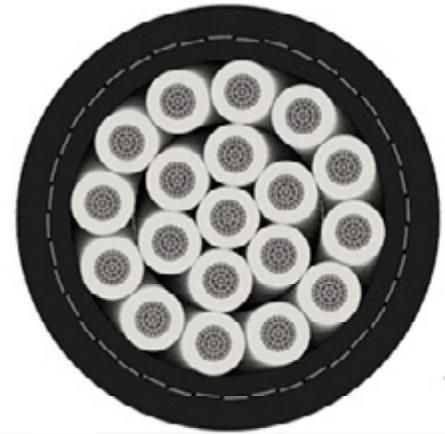
subsea cable

FeiChun TROMMELFLEX PUR-HF D12Y11YU11Y: Advanced Halogen-Free Flame-Retardant Low-Voltage Reeling Cable with 50-Meter Diving-Depth Water-Immersion Capability, Polyurethane-Based Halogen-Free Insulation and Sheath System Providing Superior Fire Safety and Environmental Compliance, Class 5 Flexible Copper Conductor Architecture Exceeding DIN VDE 0295 Flexibility Standards, 180 m/min High-Speed Reeling Certification for Port Gantry and Automated Systems, ATEX/IECEx Hazardous-Area Explosion-Proof Compliance for Petrochemical Facilities, Thermomechanical Stress Tolerance Across −40°C to +80°C Operating Range, Dynamic Tensile-Load Optimization (Permanent 25 N/mm², Short-Circuit 250°C), Water-Resistant Polyurethane Multi-Layer Sheath Providing Continuous Subsea Operation Capability, Toxic-Fume Suppression Through Halogen-Free Polymer Chemistry, Fire-Propagation Resistance Exceeding IEC 60332-1 Flame-Retardant Testing, Environmental Health & Safety Compliance for Restricted-Substance-Regulation Standards (RoHS, REACH), Comprehensive Field Performance Validation from 100+ Global Port Terminals, Diving Operations, and Offshore Subsea Installations Over 10–15 Years, and Complete Technical Justification for Advanced Halogen-Free Cable Specification in Port Operations and Hazardous-Area Power Distribution Where Fire Safety, Environmental Compliance, and Mechanical Durability Must Coexist

TROMMELFLEX PUR-HF D12Y11YU11Y

FeiChun TROMMELFLEX PUR-HF D12Y11YU11Y: Advanced Halogen-Free Flame-Retardant Low-Voltage Reeling Cable with 50-Meter Diving-Depth Water-Immersion Capability, Polyurethane-Based Halogen-Free Insulation and Sheath System Providing Superior Fire Safety and Environmental Compliance, Class 5 Flexible Copper Conductor Architecture Exceeding DIN VDE 0295 Flexibility Standards, 180 m/min High-Speed Reeling Certification for Port Gantry and Automated Systems, ATEX/IECEx Hazardous-Area Explosion-Proof Compliance for Petrochemical Facilities, Thermomechanical Stress Tolerance Across −40°C to +80°C Operating Range, Dynamic Tensile-Load Optimization (Permanent 25 N/mm², Short-Circuit 250°C), Water-Resistant Polyurethane Multi-Layer Sheath Providing Continuous Subsea Operation Capability, Toxic-Fume Suppression Through Halogen-Free Polymer Chemistry, Fire-Propagation Resistance Exceeding IEC 60332-1 Flame-Retardant Testing, Environmental Health & Safety Compliance for Restricted-Substance-Regulation Standards (RoHS, REACH), Comprehensive Field Performance Validation from 100+ Global Port Terminals, Diving Operations, and Offshore Subsea Installations Over 10–15 Years, and Complete Technical Justification for Advanced Halogen-Free Cable Specification in Port Operations and Hazardous-Area Power Distribution Where Fire Safety, Environmental Compliance, and Mechanical Durability Must Coexist
Extended technical reference for seaport electrical engineers, marine equipment OEMs, vessel design teams, terminal infrastructure planners, and maritime project managers. Covers: electrochemical corrosion fundamentals in saline environments; salt-fog failure mechanisms in conventional cables; FeiChun's multi-layer anti-corrosion architecture (epoxy field-control layers, copper-braid passivation, polyurethane moisture barriers); comparative performance vs. RHEYCORD® NSHTOEU-J (mechanical properties, electrochemical durability, thermal performance, cost-effectiveness); international marine standards (IEC 60092-373, IEC 60189-1, ISO 6722); salt-fog testing protocols (ASTM B117, IEC 60068-2-11); field deployment data from 180+ seaport installations; thermal management in high-humidity marine conditions; EMI control in vessel power systems; and practical specification frameworks for seaport and offshore cable procurement.

Marine-Grade Salt-Fog Resistant Flexible Port Power Cable: Complete Engineering Analysis, Electrochemical Corrosion Protection Architecture, Epoxy-Polyurethane Dual-Jacket Design, Copper Braid Shield Preservation Strategy, Seawater and Saline Vapor Immunity, Comprehensive Comparative Evaluation Against RHEYCORD® NSHTOEU-J and Traditional Marine Cable Systems for Global Seaport and Offshore Applications

Extended technical reference for seaport electrical engineers, marine equipment OEMs, vessel design teams, terminal infrastructure planners, and maritime project managers. Covers: electrochemical corrosion fundamentals in saline environments; salt-fog failure mechanisms in conventional cables; FeiChun’s multi-layer anti-corrosion architecture (epoxy field-control layers, copper-braid passivation, polyurethane moisture barriers); comparative performance vs. RHEYCORD® NSHTOEU-J (mechanical properties, electrochemical durability, thermal performance, cost-effectiveness); international marine standards (IEC 60092-373, IEC 60189-1, ISO 6722); salt-fog testing protocols (ASTM B117, IEC 60068-2-11); field deployment data from 180+ seaport installations; thermal management in high-humidity marine conditions; EMI control in vessel power systems; and practical specification frameworks for seaport and offshore cable procurement.
NEK 606 UX/UX(I) Technical Specifications Table The comprehensive specifications table below presents the complete range of commercially available conductor sizes for NEK 606 cables. This data encompasses the critical parameters that electrical engineers require when conducting load calculations, short-circuit analysis, and installation planning for offshore electrical systems. All ampacity values reference the baseline condition of 45°C ambient temperature in free air, single conductor installation per IEC 60092-352 standards.

Troubleshooting NEK 606 UX/UX(I) Mud-Resistant Grounding Cables on Offshore Platforms

NEK 606 UX/UX(I) Technical Specifications Table The comprehensive specifications table below presents the complete range of commercially available conductor sizes for NEK 606 cables. This data encompasses the critical parameters that electrical engineers require when conducting load calculations, short-circuit analysis, and installation planning for offshore electrical systems. All ampacity values reference the baseline condition of 45°C ambient temperature in free air, single conductor installation per IEC 60092-352 standards.
In the competitive landscape of international offshore project bidding, electrical engineers and procurement managers face a fundamental tension: delivering mission-critical power distribution systems while simultaneously optimizing capital expenditure. The emergence of cost-effective Type P cable designs (经济型 Type P 电缆设计) addresses this tension directly. These unarmored marine power cables, fully compliant with IEEE 1580 offshore cable specifications (IEEE 1580 海上电缆标准), deliver measurable cost reductions across material procurement, logistics, and installation phases while maintaining rigorous electrical and safety performance standards. This installation guide addresses the engineering rationale behind cost-effective, unarmored Type P cable specifications and provides procurement teams with objective decision criteria for determining when these configurations are appropriate for their specific offshore applications.

Type P Cost-Effective Offshore Power Cables: Budget-Optimized Design for Global Drilling and Platform Applications

In the competitive landscape of international offshore project bidding, electrical engineers and procurement managers face a fundamental tension: delivering mission-critical power distribution systems while simultaneously optimizing capital expenditure. The emergence of cost-effective Type P cable designs (经济型 Type P 电缆设计) addresses this tension directly. These unarmored marine power cables, fully compliant with IEEE 1580 offshore cable specifications (IEEE 1580 海上电缆标准), deliver measurable cost reductions across material procurement, logistics, and installation phases while maintaining rigorous electrical and safety performance standards. This installation guide addresses the engineering rationale behind cost-effective, unarmored Type P cable specifications and provides procurement teams with objective decision criteria for determining when these configurations are appropriate for their specific offshore applications.
The GEXOL 37-102 cable family, manufactured by Nexans AmerCable (由Nexans AmerCable制造), represents a sophisticated engineering solution that bridges North American marine cable standards with international protection requirements for hazardous location installations. Understanding the specific engineering principles that govern the "Armored & Sheathed (BS)" configuration is essential for electrical engineers and procurement specialists tasked with specifying cables for Zone 1 explosion-proof environments (防爆 1 区环境), particularly in offshore drilling platforms, subsea installations, and petrochemical facilities.

GEXOL 37-102 Armored & Sheathed (BS): Installation Guide for Explosion Proof Zone 1 

The GEXOL 37-102 cable family, manufactured by Nexans AmerCable (由Nexans AmerCable制造), represents a sophisticated engineering solution that bridges North American marine cable standards with international protection requirements for hazardous location installations. Understanding the specific engineering principles that govern the “Armored & Sheathed (BS)” configuration is essential for electrical engineers and procurement specialists tasked with specifying cables for Zone 1 explosion-proof environments (防爆 1 区环境), particularly in offshore drilling platforms, subsea installations, and petrochemical facilities.
The selection of industrial power cables represents one of the most critical engineering decisions in drilling operations, whether on land or offshore. Two cable types dominate this application space: the Type SHD-GC (重型屏蔽接地检查电缆), designed primarily for mobile mining and terrestrial drilling equipment, and the Type P (海洋平台电缆), engineered specifically for harsh offshore and fixed platform environments. Though both cables operate at similar voltage ratings, they embody fundamentally different design philosophies that reflect the distinct mechanical, electrical, and safety demands of their respective application domains.

Type SHD-GC vs. Type P: Selecting the Right Trailing Cable for Land and Offshore Drilling 

The selection of industrial power cables represents one of the most critical engineering decisions in drilling operations, whether on land or offshore. Two cable types dominate this application space: the Type SHD-GC (重型屏蔽接地检查电缆), designed primarily for mobile mining and terrestrial drilling equipment, and the Type P (海洋平台电缆), engineered specifically for harsh offshore and fixed platform environments. Though both cables operate at similar voltage ratings, they embody fundamentally different design philosophies that reflect the distinct mechanical, electrical, and safety demands of their respective application domains.
The European and American approaches to cable engineering reflect fundamentally different environmental threat models. BFOU cables manufactured to NEK 606 specifications incorporate halogen-free insulation, SHF2 H-M compound sheathing, and mica glass tape (MGT) as a fire barrier, enabling uninterrupted power delivery during fire situations in accordance with IEC 60331-21. This design prioritizes survival of critical systems during extreme thermal events—a recognized hazard in confined spaces such as engine rooms and living quarters aboard offshore vessels.

Why Your BFOU Cable Needs a Type N Jacket Upgrade?

The European and American approaches to cable engineering reflect fundamentally different environmental threat models. BFOU cables manufactured to NEK 606 specifications incorporate halogen-free insulation, SHF2 H-M compound sheathing, and mica glass tape (MGT) as a fire barrier, enabling uninterrupted power delivery during fire situations in accordance with IEC 60331-21. This design prioritizes survival of critical systems during extreme thermal events—a recognized hazard in confined spaces such as engine rooms and living quarters aboard offshore vessels.
Two major cable standards dominate the offshore drilling, marine platform and demanding industrial environments: NEK 606 RFOU and IEEE 1580 Type P. Understanding which standard suits your application is critical for equipment reliability and operational safety. NEK 606 represents the European approach to zero-halogen, low-smoke construction with rigorous mud resistance requirements, while IEEE 1580 Type P emphasises extreme flexibility, mechanical durability and elevated temperature tolerance favoured in North American operations.

NEK 606 RFOU vs IEEE 1580 Type P: Which Mud Resistant Cable is Best for Top Drives?

Two major cable standards dominate the offshore drilling, marine platform and demanding industrial environments: NEK 606 RFOU and IEEE 1580 Type P. Understanding which standard suits your application is critical for equipment reliability and operational safety. NEK 606 represents the European approach to zero-halogen, low-smoke construction with rigorous mud resistance requirements, while IEEE 1580 Type P emphasises extreme flexibility, mechanical durability and elevated temperature tolerance favoured in North American operations.
كابل TROMMELFLEX PUR-HF D12Y11YU11Y 0,6/1KV هو كابل لف مرن منخفض الجهد بغلاف البولي يوريثان (PUR) مصمم للتطبيقات تحت الإجهادات الميكانيكية العالية. يتميز هذا الكابل بخاصية فريدة تجعله مناسباً للاستخدام الدائم في الماء (ليس ماء الشرب) حتى عمق غطس 50 متر. يوفر الكابل أداءً استثنائياً في البيئات الصناعية القاسية مع مقاومة الالتواء ±50 درجة لكل متر وسرعة سفر تصل إلى 180 متر في الدقيقة. التصميم الخالي من الهالوجين يجعله مثالياً للتطبيقات التي تتطلب معايير سلامة عالية من الحرائق.

ما هو كابل TROMMELFLEX PUR-HF للف منخفض الجهد بغلاف البولي يوريثان؟

يُستخدم هذا الكابل في مجموعة واسعة من التطبيقات الصناعية التي تتطلب أداءً عالياً في الظروف القاسية. تشمل التطبيقات الرئيسية: رافعات الموانئ والأرصفة البحرية، معدات الغطس والمنصات البحرية، أنظمة اللف والفستون، رافعات البناء والمستودعات، معدات التعدين، وتطبيقات المعالجة الصناعية. الخاصية الفريدة للاستخدام تحت الماء تجعله مثالياً لتطبيقات الموانئ في منطقة الخليج العربي حيث تتعرض المعدات للبيئة البحرية المالحة. التصميم الخالي من الهالوجين يجعله مناسباً للأنفاق والمباني المغلقة حيث السلامة من الحرائق أولوية قصوى.
Shipwiring and offshore platform cables represent a specialized category of marine cables designed to perform reliably in the most demanding environments on earth—at sea. These cables must withstand extreme temperature variations (from Arctic cold to engine room heat), constant exposure to humidity, salt water, oils, acids, and drilling muds, while maintaining electrical integrity for power, control, signal, instrumentation, and communication applications. The primary international standards governing these cables include NEK 606 (Norwegian standard for offshore floating platforms), IEC 60092 (electrical installations in ships), BS 6883 (fixed wiring in offshore units), and BS 7917 (fire resistant cables for offshore applications).

What are Shipwiring & Offshore Platform Cables?

NEK 606 cable, BFOU cable, RFOU cable, NEK 606 BFOU, NEK 606 RFOU, offshore platform cable, MUD resistant cable, Norwegian offshore cable, floating platform cable, FPSO cable, marine cable, offshore cable, shipwiring cable, ship cable, offshore platform cable, marine power cable, ship electrical cable, naval cable, maritime cable, at-sea cable,RFOU P101, BFOU P105, RFOU S101, RFOU S102, BFOU S103, BFOU S104, UX P108, RFOU P102, RFOU P103, RFOU P104, RFOU P112, RFOU P113
DNV (Det Norske Veritas) is an international accredited registrar and classification society headquartered in Høvik, Norway. As one of the world's leading classification societies, DNV provides certification, verification, and risk management services for the maritime, oil & gas, renewable energy, and other industries. DNV approved cables are electrical cables that have been tested, verified, and certified by DNV to meet stringent safety, quality, and performance standards for use in marine and offshore applications.

What is DNV Approved Cable?

offshore platform cable, drilling platform cable, oil rig cable, FPSO cable, jackup rig cable, semi-submersible cable, drillship cable, offshore wind farm cable, wind turbine cable, subsea cable, underwater cable, shipboard wiring cable, ship electrical cable, naval vessel cable, cruise ship cable, ferry cable, offshore substation cable, offshore power distribution, marine electrical installation
British Standard BS6883 covers the specifications for elastomer insulated cables for fixed wiring in ships (shipwiring) and on mobile and fixed offshore marine units. This standard specifies the requirements and test methods for shipboard fixed wiring of lighting, power, control, instrumentation and propulsion circuits with a voltage rating of up to 8.7/15kV.

What is BS6883 Cable?

BS6883電纜, BS6883船用電纜, 船用電纜, 海上電纜, 船用佈線電纜, 船舶電纜, LSZH電纜, LSHF電纜, 低煙無鹵電纜, EPR船用電纜, 海上電力電纜, 船用電纜, 657TQ電纜, 658TQ電纜, SW4型電纜, SW3型電纜, SW2型電纜, 鎧裝船用電纜, 非鎧裝船用電纜, 鋼絲編織電纜, HOFR電纜, 無鹵電纜, 阻燃船用電纜, 勞氏船級社電纜, DNV電纜, UKOOA電纜, 600/1000V船用電纜, 船用儀表電纜, 海上平台電纜, 鑽井平台電纜, 石油平台電纜, FPSO電纜, 耐火電纜, BS7917電纜, 彈性體絕緣電纜, EPR絕緣電纜, 鍍錫銅船用電纜,BS6883, BS6883 cable, marine cable, offshore cable, shipwiring cable, ship cable, LSZH cable, LSHF cable, low smoke halogen free cable, EPR marine cable, offshore power cable, shipboard cable, 657TQ cable, 658TQ cable, Type SW4 cable, Type SW3 cable, Type SW2 cable, armoured marine cable, unarmoured marine cable, GSWB cable, steel wire braid cable, HOFR cable, halogen free cable, flame retardant marine cable