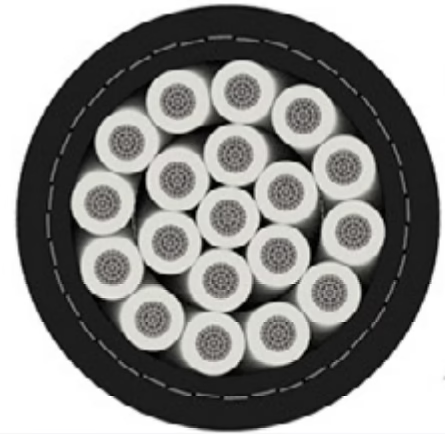
jack-up rig cable

BFOU 0.6/1kV P5/P12 fire-resistant offshore power cable with 3 × 95 mm² tinned copper conductors is approximately 45 mm (1.77 inches), with a standard tolerance window of ±2.0 mm producing a permissible range of 43.0–47.0 mm. This specification is critical for cable gland selection because offshore and marine cable glands are manufactured with specific bore diameters engineered to accommodate this dimensional range. The approximate total weight of this cable is 4,950 kg/km (3,330 lbs/1000 ft), with copper content approximately 3,350 kg/km. It features three 95 mm² Class 2 tinned copper main power conductors, a halogen-free EPR insulation system, a critical mica tape fire-resistance layer rated for 830°C continuous operation (IEC 60331 certified), tinned copper wire braid armor providing mechanical protection and electromagnetic shielding, and an SHF2 halogen-free thermosetting outer sheath rated for extreme marine and subsea conditions.

Cable Gland Sizing: Finding the OD Tolerance for BFOU 0.6/1kV P5/P12 3×95 mm² Offshore Power Cable

BFOU 0.6/1kV P5/P12 fire-resistant offshore power cable with 3 × 95 mm² tinned copper conductors is approximately 45 mm (1.77 inches), with a standard tolerance window of ±2.0 mm producing a permissible range of 43.0–47.0 mm. This specification is critical for cable gland selection because offshore and marine cable glands are manufactured with specific bore diameters engineered to accommodate this dimensional range. The approximate total weight of this cable is 4,950 kg/km (3,330 lbs/1000 ft), with copper content approximately 3,350 kg/km. It features three 95 mm² Class 2 tinned copper main power conductors, a halogen-free EPR insulation system, a critical mica tape fire-resistance layer rated for 830°C continuous operation (IEC 60331 certified), tinned copper wire braid armor providing mechanical protection and electromagnetic shielding, and an SHF2 halogen-free thermosetting outer sheath rated for extreme marine and subsea conditions.
在海上石油与天然气开采环境中,电缆系统必须承受极端的机械应力、化学腐蚀与温度波动。MOR® Polyrad® XT-125 系列的设计理念便是从这一现实需求出发,通过多层次的材料创新与严格的标准认证体系,为海上平台提供可靠的动力与控制方案。当电气工程师审核技术规格书(Datasheet)时,通常会严格核对以下几个维度以确保系统的安全性、合规性与长期稳定性。

MOR® Polyrad® XT-125: 600V Non-Armored Flexible Marine Power Cables with Superior Mud Oil Resistance and 125°C Continuous Rating for Offshore Drilling Platforms, Mud Motor Drive Systems, and Subsea Power Distribution

Comprehensive technical guide to MOR® Polyrad® XT-125 non-armored flexible marine power cables: Mud Oil-Resistant insulation, 125°C continuous rating, XLPO cross-linked polyolefin, tinned copper braided armor, platform power distribution, and mud motor drive systems for offshore drilling platforms and subsea intervention.
Comprehensive technical guide to Prysmian Bostrig Type P (600V-1000V) armored power cables: conductor flexibility, cross-linked polyolefin insulation, tinned copper braided armor, flame retardance testing, and ampacity calculations for offshore drilling, subsea, and marine power applications.

Prysmian Bostrig Type P Cross-Reference: Equivalent Marine Cables with Faster Lead Times and Superior Flexibility for Offshore Power Distribution

Comprehensive technical guide to Prysmian Bostrig Type P (600V-1000V) armored power cables: conductor flexibility, cross-linked polyolefin insulation, tinned copper braided armor, flame retardance testing, and ampacity calculations for offshore drilling, subsea, and marine power applications.
An offshore wind farm's electrical heart lies at its platform-mounted substation, often called an Offshore Substation (OSS) or offshore switching station. This facility sits 80 to 300 kilometers from shore, atop a jacket or floating foundation, constantly exposed to salt spray, extreme vibration from wind turbines, temperature swings, and corrosive humidity. The OSS's role is to gather power from dozens of wind turbines—each feeding in 10 to 15 megawatts—and consolidate that energy through a series of transformers and medium-voltage (MV) switchgear before feeding it via subsea cable to the onshore grid connection point. 海上风电场的电气心脏位于平台安装的变电站,通常称为海上变电站(OSS)或海上开关站。该设施位于离岸 80 至 300 公里处,坐落在导管架或浮式基础上,持续暴露于盐雾、风力发电机极端振动、温度波动和腐蚀性湿度。OSS 的作用是汇集来自数十台风力发电机的电力——每台 10 至 15 兆瓦——通过一系列变压器和中压(MV)开关柜进行整合,然后通过海底电缆输送到陆上并网点。

Type MMV 37-105 Cables (5kV–15kV): Powering Offshore Wind Electrical Substations with Flexible, High-Voltage Marine Integrity

An offshore wind farm’s electrical heart lies at its platform-mounted substation, often called an Offshore Substation (OSS) or offshore switching station. This facility sits 80 to 300 kilometers from shore, atop a jacket or floating foundation, constantly exposed to salt spray, extreme vibration from wind turbines, temperature swings, and corrosive humidity. The OSS’s role is to gather power from dozens of wind turbines—each feeding in 10 to 15 megawatts—and consolidate that energy through a series of transformers and medium-voltage (MV) switchgear before feeding it via subsea cable to the onshore grid connection point. 海上风电场的电气心脏位于平台安装的变电站,通常称为海上变电站(OSS)或海上开关站。该设施位于离岸 80 至 300 公里处,坐落在导管架或浮式基础上,持续暴露于盐雾、风力发电机极端振动、温度波动和腐蚀性湿度。OSS 的作用是汇集来自数十台风力发电机的电力——每台 10 至 15 兆瓦——通过一系列变压器和中压(MV)开关柜进行整合,然后通过海底电缆输送到陆上并网点。
In the competitive landscape of international offshore project bidding, electrical engineers and procurement managers face a fundamental tension: delivering mission-critical power distribution systems while simultaneously optimizing capital expenditure. The emergence of cost-effective Type P cable designs (经济型 Type P 电缆设计) addresses this tension directly. These unarmored marine power cables, fully compliant with IEEE 1580 offshore cable specifications (IEEE 1580 海上电缆标准), deliver measurable cost reductions across material procurement, logistics, and installation phases while maintaining rigorous electrical and safety performance standards. This installation guide addresses the engineering rationale behind cost-effective, unarmored Type P cable specifications and provides procurement teams with objective decision criteria for determining when these configurations are appropriate for their specific offshore applications.

Type P Cost-Effective Offshore Power Cables: Budget-Optimized Design for Global Drilling and Platform Applications

In the competitive landscape of international offshore project bidding, electrical engineers and procurement managers face a fundamental tension: delivering mission-critical power distribution systems while simultaneously optimizing capital expenditure. The emergence of cost-effective Type P cable designs (经济型 Type P 电缆设计) addresses this tension directly. These unarmored marine power cables, fully compliant with IEEE 1580 offshore cable specifications (IEEE 1580 海上电缆标准), deliver measurable cost reductions across material procurement, logistics, and installation phases while maintaining rigorous electrical and safety performance standards. This installation guide addresses the engineering rationale behind cost-effective, unarmored Type P cable specifications and provides procurement teams with objective decision criteria for determining when these configurations are appropriate for their specific offshore applications.
When electrical engineers and procurement managers specify cables for self-elevating drilling rigs—commonly known as jack-up rigs (自升式钻井平台)—they frequently encounter AmerCable 37-102 designations in technical specifications. The primary concern when evaluating equivalent cable solutions centers on whether alternative suppliers can deliver the same IEEE 1580 Type P core standard and extreme high-flexibility characteristics while offering improved lead times and cost optimization.

AmerCable 37-102 Equivalent: Sourcing High-Flexibility Type P Cables for Jack-Up Rigs

When electrical engineers and procurement managers specify cables for self-elevating drilling rigs—commonly known as jack-up rigs (自升式钻井平台)—they frequently encounter AmerCable 37-102 designations in technical specifications. The primary concern when evaluating equivalent cable solutions centers on whether alternative suppliers can deliver the same IEEE 1580 Type P core standard and extreme high-flexibility characteristics while offering improved lead times and cost optimization.
British Standard BS6883 covers the specifications for elastomer insulated cables for fixed wiring in ships (shipwiring) and on mobile and fixed offshore marine units. This standard specifies the requirements and test methods for shipboard fixed wiring of lighting, power, control, instrumentation and propulsion circuits with a voltage rating of up to 8.7/15kV.

What is BS6883 Cable?

BS6883電纜, BS6883船用電纜, 船用電纜, 海上電纜, 船用佈線電纜, 船舶電纜, LSZH電纜, LSHF電纜, 低煙無鹵電纜, EPR船用電纜, 海上電力電纜, 船用電纜, 657TQ電纜, 658TQ電纜, SW4型電纜, SW3型電纜, SW2型電纜, 鎧裝船用電纜, 非鎧裝船用電纜, 鋼絲編織電纜, HOFR電纜, 無鹵電纜, 阻燃船用電纜, 勞氏船級社電纜, DNV電纜, UKOOA電纜, 600/1000V船用電纜, 船用儀表電纜, 海上平台電纜, 鑽井平台電纜, 石油平台電纜, FPSO電纜, 耐火電纜, BS7917電纜, 彈性體絕緣電纜, EPR絕緣電纜, 鍍錫銅船用電纜,BS6883, BS6883 cable, marine cable, offshore cable, shipwiring cable, ship cable, LSZH cable, LSHF cable, low smoke halogen free cable, EPR marine cable, offshore power cable, shipboard cable, 657TQ cable, 658TQ cable, Type SW4 cable, Type SW3 cable, Type SW2 cable, armoured marine cable, unarmoured marine cable, GSWB cable, steel wire braid cable, HOFR cable, halogen free cable, flame retardant marine cable