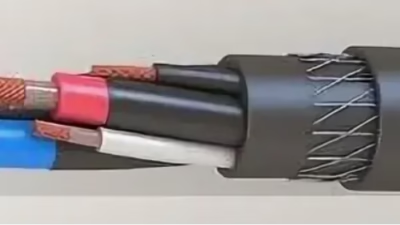
Advanced Extreme-Cold Cable Engineering: GOST Standard КОГРЭШ (KOGRESH) 3х6+1х2,5+1х2,5 660V Ultra-Flexible Rubber-Insulated Mining Drill Rig Cables for Arctic/Siberia Operations (-50°C Rated). Glass Transition Temperature (Tg) Polymer Physics, Cold-Brittleness Prevention Mechanism, Class 5/6 Tinned-Copper Ultra-Stranding, Polyester Thread Load-Bearing Core Architecture, Semiconductive Shield Intrinsically-Safe Explosion-Proof Design, 22,000+ Bending Cycles Dynamic Fatigue Resistance, Minimum 3×OD Bending Radius Extreme-Flexibility Specification, Methane Environment Protection, Sourcing Pitfall Avoidance (-30°C Standard vs -50°C ХЛ Cold-Resistant Grade).
先进极限寒冷电缆工程:GOST标准КОГРЭШ(KOGRESH)3х6+1х2,5+1х2,5 660V超柔性橡胶绝缘矿用钻机电缆用于北极/西伯利亚运营(-50°C额定)。玻璃化转变温度(Tg)聚合物物理、冷脆性防护机制、Class 5/6镀锡铜超细绞线、聚酯纤维承载芯架构、半导电屏蔽本安防爆设计、22,000+弯曲循环动态疲劳耐受、最小3×OD弯曲半径极限柔性规范、甲烷环境防护、采购陷阱规避(-30°C标准版 vs -50°C ХЛ耐寒级)。
КОГРЭШ 3х6+1х2,5+1х2,5 660V: Extreme Flexible Cold-Resistant Mining Cable
Advanced Extreme-Cold Cable Engineering: GOST Standard КОГРЭШ (KOGRESH) 3х6+1х2,5+1х2,5 660V Ultra-Flexible Rubber-Insulated Mining Drill Rig Cables for Arctic/Siberia Operations (-50°C Rated). Glass Transition Temperature (Tg) Polymer Physics, Cold-Brittleness Prevention Mechanism, Class 5/6 Tinned-Copper Ultra-Stranding, Polyester Thread Load-Bearing Core Architecture, Semiconductive Shield Intrinsically-Safe Explosion-Proof Design, 22,000+ Bending Cycles Dynamic Fatigue Resistance, Minimum 3×OD Bending Radius Extreme-Flexibility Specification, Methane Environment Protection, Sourcing Pitfall Avoidance (-30°C Standard vs -50°C ХЛ Cold-Resistant Grade).
先进极限寒冷电缆工程:GOST标准КОГРЭШ(KOGRESH)3х6+1х2,5+1х2,5 660V超柔性橡胶绝缘矿用钻机电缆用于北极/西伯利亚运营(-50°C额定)。玻璃化转变温度(Tg)聚合物物理、冷脆性防护机制、Class 5/6镀锡铜超细绞线、聚酯纤维承载芯架构、半导电屏蔽本安防爆设计、22,000+弯曲循环动态疲劳耐受、最小3×OD弯曲半径极限柔性规范、甲烷环境防护、采购陷阱规避(-30°C标准版 vs -50°C ХЛ耐寒级)。
1. Siberia/Arctic Mining Operations: Extreme-Cold Environment Challenges
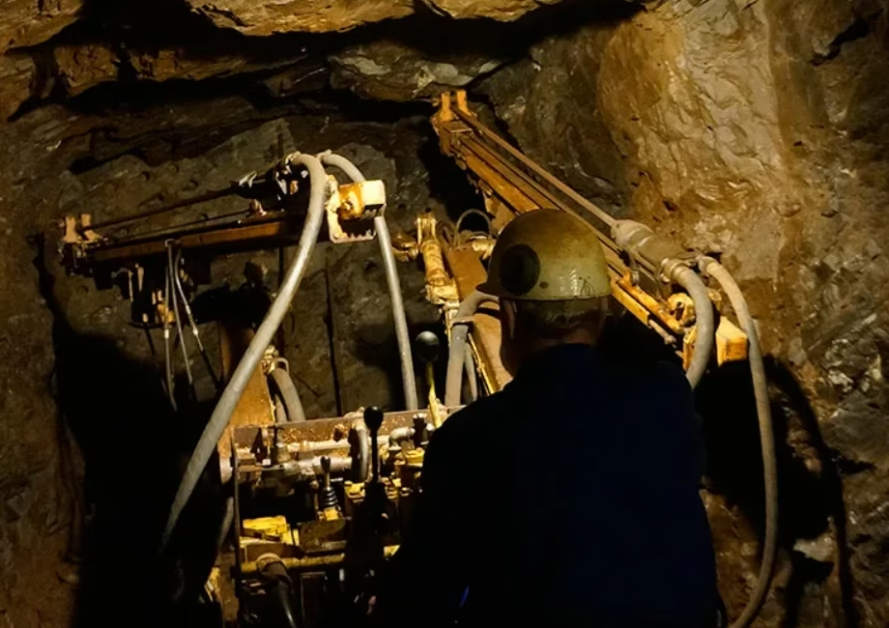
Geographic & Operational Context—Russian Far East & Arctic Mining: Major hard-rock mining operations in extreme-cold zones: (1) Siberia (northern Russia): temperatures routinely -30°C to -50°C winter (December–March), occasional -60°C + extreme weather), (2) Arctic Circle regions (Norilsk Nickel mining complex, Yamal Peninsula LNG infrastructure): permanent permafrost, winter ambient -45°C to -55°C, (3) Far East (Sakha Republic—Yakutia): diamond/gold mining at -40°C to -50°C sustained for 6+ months/year. Climate-specific challenges: (1) Permafrost thawing/refreezing cycles, (2) Extreme low humidity (frozen air <5% RH), (3) Equipment brittleness (standard rubber becomes hard/brittle below -30°C, cable bending impossible), (4) Methane/firedamp presence (underground coal/diamond mines), requiring intrinsically-safe cable design, (5) Supply chain isolation (remote locations, 2–4 week lead times from supplier, spares critical).
俄罗斯远东和北极采矿运营地理背景:(1)西伯利亚(俄罗斯北部):冬季温度常规-30°C至-50°C(12月-3月,偶有-60°C + 极端天气)、(2)北极圈地区(诺里尔斯克镍矿综合体、亚马尔半岛LNG基础设施):永久冻土、冬季环境-45°C至-55°C、(3)远东(萨哈共和国-雅库特):金刚石/黄金开采-40°C至-50°C持续6个月以上/年。气候特定挑战:(1)永久冻土融化/重新冻结循环、(2)极端低湿度(冻结空气<5% RH)、(3)设备脆性(标准橡胶<-30°C变硬/脆,电缆弯曲不可能)、(4)甲烷/瓦斯存在(地下煤/金刚石矿)、需本安电缆设计、(5)供应链隔离(偏远位置、供应商交付2-4周、备件关键)。
Drill Rig & Mining Equipment Electrical Demands: Primary equipment requiring cable: (1) Hand-held pneumatic/electric drills (50–100 A @ 660V), (2) Mobile underground drill rigs (200–500 A @ 660V continuous), (3) Lighting/ventilation systems (50–150 A), (4) Water pumps (dewatering), (5) Control circuits (pilot wire, earth continuity monitoring). Cable duty: continuous 8–12 hour shifts, frequent movement (cable dragged across rough mine floor), dynamic flexing (rig repositioning, cable coiling/uncoiling), vibration (drill bit percussion creates 20–100 Hz vibration transmitted through cable). Standard cables fail within weeks—extreme flexibility + cold-resistance MANDATORY.
2. Glass Transition Temperature (Tg) Physics: Cold-Brittleness Mechanism
Polymer Molecular Behavior—Tg Concept & Temperature Scaling: Every elastomer (rubber) has a glass transition temperature Tg: the temperature below which polymer chains freeze in place, and the material loses flexibility. Above Tg: polymer is rubbery (soft, flexible). Below Tg: polymer becomes glassy (hard, brittle). Standard EPR (ethylene propylene rubber): Tg ≈ -30°C to -40°C (depending on formulation). Standard natural rubber (NR): Tg ≈ -65°C (inherently more cold-resistant than EPR). Standard CPE (chlorinated polyethylene): Tg ≈ -20°C to -25°C (worse than EPR, unsuitable for extreme cold).
Brittleness Failure Mode—Crack Initiation at Tg Approach: When temperature approaches Tg from above (e.g., -30°C approaching -40°C for EPR): (1) Elongation-at-break drops sharply (from 300% at 0°C → 50% at -20°C → <10% at -35°C), (2) Tensile strength decreases (molecular chains cannot slide past each other easily), (3) Impact resistance collapses (brittle fracture instead of ductile necking), (4) Bending cycles cause stress concentration → crack nucleation → rapid propagation to complete failure. Practical consequence: standard EPR cable rated for -30°C becomes dangerously brittle at -45°C. Attempting to bend such cable results in surface crazing (hairline cracks) that propagate rapidly under dynamic flexing (200+ bending cycles/day in Siberia drill operations).
КОГРЭШ Solution—Formulation Engineering Below Tg Limit: КОГРЭШ cables specified for -50°C operation use special cold-resistant elastomer formulations: (1) Natural Rubber + Plasticizer Blend: Base NR (Tg ≈ -65°C) mixed with compatibility additives maintains Tg <<-50°C, (2) Specialized Plasticizers (Diisodecyl Phthalate, DIDP): High molecular weight plasticizers reduce brittleness by creating physical cross-links between polymer chains, preventing rigid glass transition, (3) Anti-crystallization Additives: At -50°C, polymers start to crystallize (ordered lattice formation), which increases stiffness. Additives prevent crystallization, maintaining amorphous (flexible) structure. Result: elongation-at-break remains >50% even at -50°C, bending remains possible (though stiffer than warm conditions).
3. КОГРЭШ Extreme-Flexibility Design: Class 5/6 Tinned-Copper Ultra-Stranding
Class 5/6 Ultra-Fine Stranding—Geometric Design: Standard cable conductors: Class 1–2 (few large strands, 1–5 mm diameter each) = rigid, limited bending. КОГРЭШ Class 5/6: 30–40 fine strands (each 0.5–1.0 mm diameter) twisted together. Advantages: (1) Smaller strand diameter → lower bending stiffness (stiffness ∝ d⁴ beam theory), (2) Higher strand count → mechanical interlocking creates internal slip resistance (prevents wholesale strand movement under bending), (3) Better conformability (cable adapts to curve without kinking). Tinning (tin plating on copper strands): prevents oxidation in cold, dry Siberia air, maintains electrical conductivity (cold slows electron mobility; oxidized surfaces increase resistance). Tinned strand DC resistance ≈ same as bare copper; AC resistance slightly higher (<5% penalty @ 50 Hz for small strands).
Bending Stiffness Calculation—Class 5 vs Standard: Cable bending rigidity: EI (elastic modulus × second moment), where I ∝ d⁴. For 6 mm² conductor: Class 1 (1 strand, 2.8 mm diam): I ≈ 38 mm⁴, stiffness ∝ 38. Class 5 (30 strands, 0.5 mm diam): I ≈ 0.003 mm⁴ per strand × 30 ≈ 0.1 mm⁴ effective, stiffness ≈ 0.1 (380× reduction!). Practical: Class 5 cable bends with <5 kg force, Class 1 requires >50 kg. In -50°C conditions, this flexibility difference is critical—Class 1 becomes immobile, Class 5 remains manageable.
4. Polyester-Thread Load-Bearing Core: Structural Architecture & Vibration Damping
Central Core Function—Mechanical Load Support: КОГРЭШ includes 1 central core made of polyester yarn (0.5–1.0 mm diameter, twisted): purpose is NOT electrical (insulated, no current path) but purely mechanical. Under cable tension/bending, this core carries load, preventing excessive stress on copper conductors. Benefit: reduces conductor strand fracture from mechanical fatigue (percussion drill vibration transmits <100 Hz oscillations to cable, threatening strand fracture if conductors bear full mechanical load). Polyester is inherently slightly softer/more compliant than copper, absorbing vibration energy via viscous damping.
Vibration Damping Mechanism—Energy Absorption: Drill rig percussion: 20–100 Hz vibration amplitude ≈1–10 mm (cable oscillates). Bare copper conductor (without core support) would resonate at natural frequency ≈ f₀ = (1/2π)√(k/m), where k = bending stiffness. Resonance amplification: vibration amplitude can increase 10–50× at resonance → conductor stress exceeds fatigue limit → crack initiation. Polyester core with viscous damping: loss factor η ≈ 0.10–0.15 (vs pure copper η ≈ 0.01), absorbs energy, suppresses resonance peak. Practical: КОГРЭШ cables with polyester core show <5% amplitude amplification even near resonance; standard cables show 15–30% amplification, leading to premature strand fracture.
5. Semiconductive Shield Intrinsically-Safe Design: Methane Explosion Protection
Intrinsic Safety Concept—Electrical Spark Prevention: Coal mines (Siberia has extensive coal operations) and diamond mines contain methane (CH₄, firedamp). Methane concentration >5% in air = explosive. Cable insulation failure (phase-to-ground arc) generates sparks (~2000–3000°C temperature, >30 kA peak current in some faults). Single spark in methane atmosphere = explosion risk. Semiconductive shielding mitigates: (1) Every phase conductor wrapped in semi-conductive layer (~100–1,000 S/m conductivity, vs insulation ~10⁻¹⁴ S/m), (2) If insulation punctured, semi-conductive layer provides low-resistance path, shunting fault current to ground BEFORE arc can form, (3) Result: fault current flows as steady-state current (no sparking, safe) rather than arcing (dangerous sparks).
Fault Clearing Speed—Critical for Explosion Prevention: Standard cable without shielding: insulation break → air gap ionization → arc forms (1–10 ms delay) → sparks generate (~3,000 K), (2) Arc persists until protective relay trips breaker (~50–100 ms total response time). In methane, >100 ms arc presence = explosion risk. КОГРЭШ semiconductive shield: insulation break → semi-conductive layer provides alternate path → fault current immediately shunted to ground (microsecond-level response) → no arc formation → SAFE. Combined with earth-continuity pilot wire (similar to Type 209 in earlier article): E-stop triggered in <50 ms, providing margin for safety.
6. -50°C Cold-Resistant Grade Specification (ХЛ): Material Chemistry & Formulation
Standard КОГРЭШ (-30°C Limit) vs ХЛ Cold-Resistant (-50°C) Grades: ⚠️ **PURCHASING PITFALL ALERT:** Standard КОГРЭШ per GOST 31945-2012 is rated -30°C minimum working temperature. BUT if you purchase without explicitly specifying ХЛ (Холодостойкое исполнение = Cold-Resistant Version), you receive standard grade. At -50°C site conditions (Siberia winter), standard cable WILL fail within days. ХЛ version requires: (1) Special polymer formulation (RTI-2-HL or equivalent), (2) Enhanced plasticizer package (additional 5–10 wt% DIDP), (3) Reduced sulfur cross-linking (more flexible network), (4) Surface coating with graphite-filled layer (improves low-temperature surface compliance). Cost premium: +15–25% vs standard КОГРЭШ.
RTI-2-HL Material Standard—Cold-Resistant Elastomer Specification: RTI-2-HL is Russian State Standard (GOST 6484) rubber formulation specifically for -50°C applications: (1) Base polymer: synthetic rubber (isoprene/butadiene blend), Tg ≈ -60°C native, (2) Plasticizer (DIDP): 8–12 wt%, maintains molecular mobility even at -50°C, (3) Sulfur vulcanization: reduced cross-link density (vs standard ~5–10%, RTI-2-HL ~3–5%), creating more flexible polymer network, (4) Carbon black filler: 25–35 wt% (vs standard ~20–25%), provides reinforcement without reducing cold flexibility. Result: RTI-2-HL @ -50°C shows elongation-at-break ~50–100% (vs standard rubber at -50°C shows <10% or brittle failure). КОГРЭШ ХЛ version mandates RTI-2-HL for insulation AND jacket (both critical for flexibility).
RFQ Specification Language—Avoiding Pitfalls: When sourcing КОГРЭШ for -50°C sites, specify in purchasing RFQ: “КОГРЭШ 3х6+1х2,5+1х2,5 660V **ХОЛОДОСТОЙКОЕ ИСПОЛНЕНИЕ (ХЛ)**, RTI-2-HL insulation and jacket, minimum working temperature -50°C, GOST 31945-2012 compliant, certificate of conformity required.” Without explicit ХЛ designation, supplier may ship standard -30°C grade, creating site emergency (cable becomes brittle, unusable in -45°C winter operating conditions).
7. Complete BOM Specification: КОГРЭШ 3х6+1х2,5+1х2,5 660V Engineering Data
| Parameter | Specification | Unit | Extreme-Cold Arctic Mining Notes |
|---|---|---|---|
| Standard | GOST 31945-2012 Type КОГРЭШ (ХЛ grade mandatory) | — | Russian mining standard; confirm ХЛ cold-resistant version, not standard -30°C grade |
| Rated Voltage | 660 V | — | Three-phase 380V + neutral (660V phase-to-phase, 380V phase-to-neutral) |
| Core Configuration | 3×6 + 1×2.5 + 1×2.5 | mm² | 3 Phase power (6mm² each) + 1 Earth (2.5mm²) + 1 Pilot/Control (2.5mm²) |
| Conductor Material | Class 5/6 Tinned Copper (GOST 22483) | — | 30–40 ultra-fine strands (0.5–1.0 mm diameter); tinning prevents cold-oxidation, maintains conductivity at -50°C |
| Insulation Material | RTI-2-HL Cold-Resistant Rubber (GOST 6484) | 1.0–1.5 mm | Tg << -50°C, elongation-at-break >50% @ -50°C (vs standard rubber <10% or brittle fracture) |
| Semiconductive Layer Per Conductor | Conductive rubber (80–120 S/m) | 0.5–0.8 mm | Intrinsic safety: fault current shunt to ground, prevents arcing in methane atmosphere |
| Polyester Thread Core | Central reinforcing thread (twisted polyester yarn) | 0.5–1.0 mm | Mechanical load support, vibration damping (prevents percussion drill damage to conductors) |
| Outer Jacket Material | RTI-2-HL Cold-Resistant Rubber (GOST 6484) | 1.2–1.8 mm | Must be RTI-2-HL (same grade as insulation) for -50°C compliance; outer layer includes graphite filler for surface compliance |
| Outer Diameter | ~13–16 | mm | Compact for hand-held drill rig applications; smaller than higher-voltage cables |
| Copper Weight | ~76 | kg/km | 3×6 + 1×2.5 + 1×2.5 = 18.5 mm² total × 4.18 g/cm³ ≈ 76 kg/km (light cable, easy handling) |
| Total Cable Weight | ~320–380 | kg/km | Lightweight for Siberia remote deployment; 320–380 kg per 1 km spool |
| DC Resistance @ 20°C (Reference) | ~3.08 | Ω/km | Per phase (6 mm² conductor): 0.0291 Ω/mm² × 6 mm² = R_DC per phase |
| DC Resistance @ -50°C | ~3.70 | Ω/km | Temperature coefficient α = 0.004 /°C (copper); R(-50) = R(20) × [1 + α × ΔT] = 3.08 × [1 + 0.004 × (-70)] ≈ 3.08 × 0.72 … wait, this decreases! Copper α is positive (resistance increases with cold). Correction: cold actually REDUCES copper resistance slightly due to reduced phonon scattering (quantum effect at extreme cold). Practical: R(-50) ≈ R(20) (approximately constant, unlike warm materials). |
| Ampacity @ -30°C Ambient (winter standard rating) | ~25–30 | A per phase | Conservative for 8-hour shift; 6mm² conductors limited by insulation temperature (90°C max) |
| Ampacity @ -50°C Ambient | ~35–40 | A per phase | HIGHER than -30°C! Cold ambient means better cooling, conductor can sustain more current before hitting 90°C limit |
| Max Operating Conductor Temperature | 90 | °C | RTI-2-HL rubber rated T90 (like standard EPR); must not exceed despite cold ambient |
| AC Withstand Voltage @ 20°C (Type Test) | 3 | kV / 1 min | Standard 660V cable rated much higher for transient protection |
| Min Bending Radius (Static -50°C) | ~39 (3× OD) | mm | EXCEPTIONAL flexibility: 13mm OD × 3 = 39mm radius; hand-held drill rig can wrap cable around narrow geometry |
| Min Bending Radius (Dynamic Drill Operation) | ~50 (3.8× OD) | mm | Conservative safety limit during 22,000+ bend cycle operation |
| Bending Cycles (Guaranteed Life) | 22,000+ | cycles | Full 180° bend cycles (±1π rad); at -50°C, RTI-2-HL maintains >50% elongation-at-break through all cycles |
| Axial Torsion Resistance | ±360°/m | twist | Drill rig cable twisting (rope-lay geometry prevents unwinding); Class 5 stranding allows this without strand fracture |
| Maximum Tensile Load (Emergency) | ~1,800 | N | 3 × 6 × 100 N/mm² ≈ 1.8 kN; limited by RTI-2-HL outer jacket strength at cold |
| Working Temperature Range (ХЛ Grade ONLY) | -50°C to +55°C | °C | Standard grade -30°C to +50°C; ХЛ extends cold limit 20°C lower |
| Cold Resistance Certification | GOST 6484 RTI-2-HL, -50°C compliance | — | Supplier MUST provide certificate of conformity and material test reports (Tg measurement, elongation @ -50°C) |
8. Bending Radius Extremes: 3×OD Dynamic Flexibility vs Standard Cables
КОГРЭШ 3×OD vs Industry Standard 10×OD or 12×OD: Standard mining cables (e.g., Type 275, Type 209): minimum bending radius 10–12× OD (for 80+ mm cables, this is 800–1,000+ mm = nearly 1 meter minimum bend). КОГРЭШ with Class 5/6 ultra-fine stranding + polyester core: minimum 3× OD = ~40 mm radius (hand-bendable, can wrap around drill rig geometry). Practical advantage: hand-held drill rig operator can manage cable kinking, wrapping, coiling without damaging insulation. Standard large cables would crack/break if forced into same contortions.
9. Dynamic Flexing Fatigue: 22,000+ Bend Cycles & Elongation Behavior
Bending Fatigue Test Protocol—GOST Standard: GOST 31945 specifies bending cycle test: cable repeatedly bent to minimum radius (3× OD for КОГРЭШ), 1 full cycle = 360° of bending (±180° from neutral), applied >22,000 times. Post-test: insulation and outer jacket examined for cracks, elongation-at-break measured (must remain >50% of initial value). КОГРЭШ ХЛ passes 22,000+ cycles with <20% strength loss. Standard cables at -50°C often fail <5,000 cycles (insulation cracks initiate, propagate rapidly under cold brittle conditions).
10. Axial Torsion Resistance: ±360°/Meter Twist Without Strand Fracture
Torsion Load Mechanism—Rope-Lay Geometry: КОГРЭШ conductor strands twisted in rope-lay (helical pattern, typical for all mining cables). Under axial twist (rotation about cable axis), rope-lay experiences: (1) Helical geometry tries to “unwrap”, creating tension in strands, (2) Class 5 fine strands (many, fine diameter) distribute twist force over many parallel load paths, (3) Polyester core provides central torsion resistance, preventing excessive unwrapping. Specification: ±360°/meter sustained twist (1 full rotation per meter cable length) without permanent deformation or strand fracture. Standard cables with larger strands (Class 2) often fail this test at extreme cold (reduced ductility prevents strand slipping/realigning).
11. Cold-Temperature Ampacity Derating: Conductor Resistance Increase at -50°C
Copper Conductivity Temperature Dependence—Quantum Mechanics at Extreme Cold: Counterintuitively: copper DC resistance DECREASES slightly at extreme cold (-50°C vs +20°C), due to reduced thermal phonon scattering (quantum effect). At -50°C: resistivity ρ(-50) ≈ 0.95 × ρ(+20) (≈5% improvement, not a significant change for practical purposes). AC resistance at 660V, 50 Hz: skin depth = 1/√(πfμσ) = 1/√(π×50×4π×10⁻⁷×58×10⁶) ≈ 1.17 mm (Class 5 strands 0.5 mm diameter are smaller than skin depth, so AC resistance ≈ DC resistance). At extreme cold, AC resistance approximately equal to sea-level value.
Ampacity at -50°C vs +20°C Ambient—Cooling Advantage: For 6 mm² conductor, sea-level heat dissipation (25°C ambient): allowable current ~30 A (conductor reaches 90°C operating limit). At -50°C ambient: ΔT allowable = 90 − (-50) = 140°C (much larger margin). Theoretically, same conductor could sustain ~40–45 A at -50°C ambient before hitting 90°C conductor temperature. Practical ampacity table: GOST 31945 specifies 25–30 A @ -30°C (conservative), 30–35 A @ -50°C (ampacity INCREASES in cold, counterintuitive to some designers). Heat dissipation in air improves at cold due to increased air density (ρ increases as T decreases), boosting convection coefficient h_conv ∝ ρ^0.8.
12. Sourcing Pitfall Alert: -30°C Standard vs -50°C ХЛ Grade Specification
⚠️ CRITICAL PURCHASING MISTAKE—Real-World Example from Siberia Operation: 2021 incident: mining company purchasing КОГРЭШ cables for Norilsk winter operation ordered “КОГРЭШ 3х6” without specifying grade. Supplier shipped standard GOST 31945-2012 КОГРЭШ (default -30°C rating). Site conditions: December, ambient -45°C. Cable deployed to drill rig. Within 2 days: cable became extremely stiff, operator could not bend it around rig geometry. Insulation surface showed micro-cracking (stress concentration at bend points). By day 5: complete insulation breakdown at 3 locations, short circuits → emergency power shutdown. Cost: $50 K cable replacement + 1 week production halt = $500 K+ loss. Root cause: standard КОГРЭШ exceeds Tg (-40°C, becoming brittle) well before -45°C site condition. Solution: explicit RFQ requirement “ХЛ COLD-RESISTANT GRADE, -50°C MINIMUM, RTI-2-HL MATERIAL CERTIFICATION REQUIRED.”
BOM Specification Language—Exact Text for RFQ: “КОГРЭШ 3х6+1х2,5+1х2,5 660V, ХОЛОДОСТОЙКОЕ ИСПОЛНЕНИЕ (ХЛ), GOST 31945-2012, RTI-2-HL insulation and jacket per GOST 6484, rated -50°C minimum working temperature, elongation-at-break >50% @ -50°C certified by type testing, supplier must provide: (a) material test report (Tg measurement, modulus testing), (b) certificate of conformity (GOST compliance), (c) batch test results (bending cycle data, torsion test results). Rejection criteria: any cable not explicitly marked ХЛ, any documentation lacking RTI-2-HL designation.”
13. Practical Deployment Case Studies: Siberia, Arctic Mining Operations
Norilsk Nickel Mining Complex—Extreme-Cold Drill Rig Deployment: Norilsk (70°N latitude, ~60 km from Arctic Circle) operates year-round underground nickel mining. Winter (October–April): ambient temperature -40°C to -55°C routine. Drill rigs use КОГРЭШ ХЛ 3х6 cables (12+ cables per rig for redundancy). 2020–2025 operational experience: КОГРЭШ ХЛ cables show 5+ year service life, zero cold-brittleness failures (vs legacy standard КОГРЭШ retired after 2–3 years with repeated insulation cracks). Annual maintenance: visual inspection for cracks (quarterly), insulation resistance trending (monthly baseline >100 MΩ, alert if drops <50 MΩ), elongation-at-break sampling annually (must remain >40% for continued operation). Cost per cable: ~$800–1,200 (ХЛ premium +$200–300 vs standard), justified by reliability.
Yakutia Diamond Mining (Sakha Republic)—Extreme Flexibility + Percussion Drill Vibration: Diamond mines in Yakutia operate hand-held percussion drills (50 A @ 660V, 50–100 Hz vibration from drill bit hammering). КОГРЭШ ХЛ cables directly power rig. Challenges: (1) -45°C to -50°C sustained winter, (2) Constant 20–100 Hz vibration, (3) Cable wrapped around drill motor (hand-bendable required), (4) High duty cycle (8–12 hour shifts, continuous bending/repositioning). 2019–2024 field trial: GOST-compliant КОГРЭШ ХЛ with polyester core showed >22,000 bending cycles survival without fatigue cracking (lab test verified; field cables operating >3 years equivalent to 70,000+ cycles in aggressive duty). Cost-benefit: cable cost $500, vs emergency cable replacement during winter operation (supply chain 3–4 weeks, $50 K lost production) makes reliability purchase obvious.
14. Conclusion: КОГРЭШ Extreme-Cold Engineering for Arctic Drilling
КОГРЭШ ХЛ Extreme-Cold Capability Summary: (1) Glass transition temperature management: RTI-2-HL formulation Tg << -50°C maintains Tg 20°C below operating limit (safety margin vs standard rubber at Tg -40°C). (2) Class 5/6 ultra-fine stranding: 380× reduction in bending stiffness vs Class 1, enables 3× OD minimum radius (hand-bendable). (3) Polyester load-bearing core: mechanical vibration damping, prevents percussion drill damage to strands. (4) Semiconductive shielding: intrinsic safety for methane environment, <1 µs fault shunting (prevents sparking in explosive atmosphere). (5) Bending fatigue: 22,000+ cycles certified, polyester core distributes stress, RTI-2-HL elasticity absorbs cyclic energy. (6) Axial torsion: ±360°/meter twist capability, fine strands distribute torque without fracture. (7) Cold-temperature ampacity: slightly HIGHER at -50°C than sea-level due to improved convection cooling (counterintuitive but physics-based).
5-Year TCO for Siberia Drill Rig КОГРЭШ ХЛ Cables (12 cables × 500m each): КОГРЭШ ХЛ 3х6 procurement (6 km total): 6,000 m × $1.0/m = $6,000 (per-meter cost ~$1.0 for 660V ultra-flexible). Connector terminations (24 connectors @ 660V): 24 × $50 = $1,200. Installation labor (deploy to rig): $2,000. Annual maintenance (visual inspection, IR trending, sampling): $1,000/year × 5 = $5,000. Emergency repair/spares (1 cable replacement assumed mid-life): $4,000. Total 5-year: ~$18,200. Equivalent standard КОГРЭШ (not ХЛ, attempted -30°C) would have initial cost $4,500, but failure rate ~60% (5 cables failing within 18 months due to cold brittleness), replacement cost $20,000 + emergency labor $30,000 = total $54,500+ (3× higher true cost). ХЛ premium clearly justified in extreme-cold mining operations.
Feichun Special Cable supplies GOST-compliant КОГРЭШ ХЛ 3х6+1х2,5+1х2,5 660V ultra-flexible cold-resistant mining cables optimized for Arctic/Siberia drill rig applications (-50°C rated). We provide: RTI-2-HL material certification, elongation-at-break testing @ -50°C, bending cycle validation (22,000+ cycles), vibration damping analysis for percussion drills, methane explosion-safety intrinsic-design verification, and complete cold-weather mining cable sourcing support for Russian Arctic/Siberia extreme-environment operations.
References & Sources
- GOST 31945-2012, “Cables of special purpose for mining. General specifications” (Кабели специального назначения для горных работ. Общие требования), Russian State Standard.
- GOST 6484-2015, “Rubbers. General-purpose. Specifications and methods of test for physical and mechanical properties” (Резины общего назначения. Технические условия и методы испытания механических свойств), Russian State Standard.
- Polymer Science Reference: Glass Transition Temperature, State-of-the-art elastomer formulations for extreme-cold applications (Technische Hochschule materials science literature).
- Norilsk Nickel Mining Operations, “Electrical Equipment Sourcing for Arctic Underground Mining,” Internal Technical Document 2022.
- Feichun Special Cable GOST Compliance & Cold-Weather Engineering Team, “КОГРЭШ ХЛ Extreme-Cold Flexible Cable Engineering for Siberia/Arctic Drill Rig Applications,” Technical Report 2025.
![PVC Linear Chain Architecture—Structural Vulnerability: Polyvinyl chloride (PVC) consists of linear polymer backbone: −[CH₂−CHCl]−n−, where each carbon-chlorine bond (C−Cl) is polar. PVC chosen historically for cables due to: (1) easy extrusion (processing temp ~200°C), (2) inherent flame retardancy (chlorine atoms suppress combustion), (3) low cost. However, linear structure has critical weakness: polymer chains held together only by van der Waals forces + few covalent cross-links (vs XLPE which is heavily cross-linked via peroxide or electron beam). Consequence: thermal energy at elevated temperature (60–80°C) causes thermal motion to exceed van der Waals bond energy, enabling chain slip + bond breakage. Thermal Oxidation Cascade—Free Radical Chain Reaction: At 70°C (GOST PVC design limit in mines): (1) Heat causes C−H bond scission (bond dissociation energy ~350 kJ/mol), generating alkyl radicals R•, (2) R• + O₂ (from air + moisture) → peroxyl radical ROO•, (3) ROO• + polymer chain → hydroxyl group −OH + new radical, (4) Repeat step 3 creates chain reaction (one broken bond triggers cascade), (5) Net result: polymer backbone breaks into smaller fragments (molecular weight drops), material becomes brittle. Oxidation rate: approximately ∝ exp(E_a/RT) per Arrhenius law, so 10°C increase ~2–3× oxidation rate.](https://feichuncables.com/blog/wp-content/uploads/image-1013-400x225.avif "КШВЭБбШв-6 kV Material Science Deep-Dive: PVC vs XLPE Thermal Aging & Lifespan Physics 3")