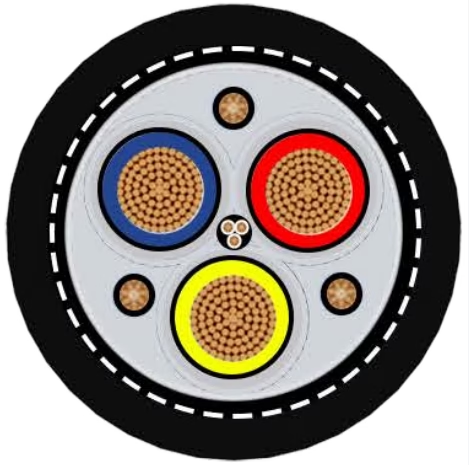
drill rig cable

Geographic & Operational Context—Russian Far East & Arctic Mining: Major hard-rock mining operations in extreme-cold zones: (1) Siberia (northern Russia): temperatures routinely -30°C to -50°C winter (December–March), occasional -60°C + extreme weather), (2) Arctic Circle regions (Norilsk Nickel mining complex, Yamal Peninsula LNG infrastructure): permanent permafrost, winter ambient -45°C to -55°C, (3) Far East (Sakha Republic—Yakutia): diamond/gold mining at -40°C to -50°C sustained for 6+ months/year. Climate-specific challenges: (1) Permafrost thawing/refreezing cycles, (2) Extreme low humidity (frozen air

КОГРЭШ 3х6+1х2,5+1х2,5 660V: Extreme Flexible Cold-Resistant Mining Cable

Geographic & Operational Context—Russian Far East & Arctic Mining: Major hard-rock mining operations in extreme-cold zones: (1) Siberia (northern Russia): temperatures routinely -30°C to -50°C winter (December–March), occasional -60°C + extreme weather), (2) Arctic Circle regions (Norilsk Nickel mining complex, Yamal Peninsula LNG infrastructure): permanent permafrost, winter ambient -45°C to -55°C, (3) Far East (Sakha Republic—Yakutia): diamond/gold mining at -40°C to -50°C sustained for 6+ months/year. Climate-specific challenges: (1) Permafrost thawing/refreezing cycles, (2) Extreme low humidity (frozen air
The КГЭ-ХЛ 3×95+1×25+1×10 6kV is a cold-resistant heavy-duty flexible trailing cable designed for electric mining excavators and draglines operating in climates where ambient temperature drops below −20°C. The Russian designation КГЭ stands for Кабель Гибкий Экскаваторный (Flexible Excavator Cable), and the suffix ХЛ stands for Холодостойкий (Cold-Resistant), indicating that all polymer materials—insulation, bedding, and outer sheath—are formulated to retain dynamic flexibility at temperatures down to −40°C (or −50°C in extreme-grade variants). The configuration "3×95+1×25+1×10" specifies three 95mm² power conductors, one 25mm² earth conductor, and one 10mm² pilot/monitoring conductor—the standard architecture for 6kV electric mining excavators of the ЭКГ series that dominate Kazakhstan's open-pit copper and coal mines. Feichun Cable manufactures a direct drop-in equivalent that matches the ГОСТ conductor configuration, voltage rating, outer diameter, cold-flex performance, and reel compatibility, enabling Kazakhstan mines to procure this cable without modifying existing excavator cable-handling equipment.

Cold Cracking: Why Standard КГЭ (KGE) Fails Below −20°C and КГЭ-ХЛ (KGE-HL) Is Required. Drop-In Equivalent for Kazakhstan Copper Mines — 3×95+1×25+1×10 6kV

The КГЭ-ХЛ 3×95+1×25+1×10 6kV is a cold-resistant heavy-duty flexible trailing cable designed for electric mining excavators and draglines operating in climates where ambient temperature drops below −20°C. The Russian designation КГЭ stands for Кабель Гибкий Экскаваторный (Flexible Excavator Cable), and the suffix ХЛ stands for Холодостойкий (Cold-Resistant), indicating that all polymer materials—insulation, bedding, and outer sheath—are formulated to retain dynamic flexibility at temperatures down to −40°C (or −50°C in extreme-grade variants). The configuration “3×95+1×25+1×10” specifies three 95mm² power conductors, one 25mm² earth conductor, and one 10mm² pilot/monitoring conductor—the standard architecture for 6kV electric mining excavators of the ЭКГ series that dominate Kazakhstan’s open-pit copper and coal mines. Feichun Cable manufactures a direct drop-in equivalent that matches the ГОСТ conductor configuration, voltage rating, outer diameter, cold-flex performance, and reel compatibility, enabling Kazakhstan mines to procure this cable without modifying existing excavator cable-handling equipment.
The straightforward answer to whether quality generic (N)TMCGEWÖU 3x70+3x35/3 cables can safely replace expensive Sandvik OEM cables on underground LHD loaders is: yes, absolutely—provided that proper specification, compatibility verification, and installation procedures are carefully implemented. The continuous ampacity rating of 246 amperes at 30°C ambient temperature represents the maximum electrical current capacity for the cable under controlled installation conditions. In realistic underground mining duty cycles where the cable is subjected to frequent reeling stress, confined-space temperature conditions, and vibration from underground machinery, the effective design ampacity reduces through cumulative derating to approximately 195–215 amperes depending on specific mine conditions. These ratings demonstrate that a quality generic cable engineered to VDE 0250-813 and DIN VDE 0298-4 standards provides equivalent electrical performance to expensive OEM cables, often at 40–60% lower acquisition cost. The key distinction between OEM cables and quality generic cables is not electrical performance—it is supply chain, brand markup, and proprietary connector systems. A well-engineered generic cable provides the same copper conductors, similar insulation quality, and equivalent current-carrying capacity as the OEM equivalent. The cost savings from generic cable selection are real and substantial, but they must be paired with careful attention to mechanical compatibility, proper termination procedures, and quality field installation to realize the full cost advantage without reliability penalties.

Underground LHD Loaders: Can you reliably replace OEM Sandvik cables with quality generic (N)TMCGEWÖU 3×70+3×35/3 cables? 

The straightforward answer to whether quality generic (N)TMCGEWÖU 3×70+3×35/3 cables can safely replace expensive Sandvik OEM cables on underground LHD loaders is: yes, absolutely—provided that proper specification, compatibility verification, and installation procedures are carefully implemented. The continuous ampacity rating of 246 amperes at 30°C ambient temperature represents the maximum electrical current capacity for the cable under controlled installation conditions. In realistic underground mining duty cycles where the cable is subjected to frequent reeling stress, confined-space temperature conditions, and vibration from underground machinery, the effective design ampacity reduces through cumulative derating to approximately 195–215 amperes depending on specific mine conditions. These ratings demonstrate that a quality generic cable engineered to VDE 0250-813 and DIN VDE 0298-4 standards provides equivalent electrical performance to expensive OEM cables, often at 40–60% lower acquisition cost. The key distinction between OEM cables and quality generic cables is not electrical performance—it is supply chain, brand markup, and proprietary connector systems. A well-engineered generic cable provides the same copper conductors, similar insulation quality, and equivalent current-carrying capacity as the OEM equivalent. The cost savings from generic cable selection are real and substantial, but they must be paired with careful attention to mechanical compatibility, proper termination procedures, and quality field installation to realize the full cost advantage without reliability penalties.
NSSHÖU cables are designed for power supply applications in mining, quarrying, tunneling, and heavy industrial equipment where extreme mechanical stress and abrasion are expected. These cables can be installed in dry, damp, wet, and hazardous environments but are NOT suitable for drumming applications under tensile loads or for continuous robotic movement in energy chains where highly flexible cables with specific bend cycle ratings are required. NSSHÖU电缆设计用于采矿、采石、隧道和重型工业设备中的供电应用,其中预期会有极端的机械应力和磨损。这些电缆可以安装在干燥、潮湿、湿润和危险环境中,但不适合在拉力负载下的卷筒应用或需要具有特定弯曲周期额定值的高度柔性电缆的连续机器人运动的能量链中。

NSSHÖU Cable Ampacity Table: Current Rating & Correction Factors at 50°C Ambient Temperature

NSSHÖU cables are designed for power supply applications in mining, quarrying, tunneling, and heavy industrial equipment where extreme mechanical stress and abrasion are expected. These cables can be installed in dry, damp, wet, and hazardous environments but are NOT suitable for drumming applications under tensile loads or for continuous robotic movement in energy chains where highly flexible cables with specific bend cycle ratings are required. NSSHÖU电缆设计用于采矿、采石、隧道和重型工业设备中的供电应用,其中预期会有极端的机械应力和磨损。这些电缆可以安装在干燥、潮湿、湿润和危险环境中,但不适合在拉力负载下的卷筒应用或需要具有特定弯曲周期额定值的高度柔性电缆的连续机器人运动的能量链中。
Proper cable gland selection for Type W mining cables requires precise understanding of outer diameter tolerances and dimensional specifications. The outer diameter of a cable is subject to manufacturing variations that must be accounted for when selecting cable glands to ensure proper sealing, strain relief, and mechanical protection. For Type W 4/0 AWG cables, which are commonly used in mining and heavy industrial applications, understanding these tolerances is critical for reliable installation and long-term performance. Type W矿用电缆的正确电缆接头选型需要精确了解外径公差和尺寸规格。电缆的外径受制造变化的影响,在选择电缆接头时必须考虑这些因素,以确保正确的密封、应变释放和机械保护。对于Type W 4/0 AWG电缆(通常用于采矿和重工业应用),了解这些公差对于可靠安装和长期性能至关重要。

Type W 4/0 AWG Cable: Diameter Tolerance & Gland Selection Technical Guide

Proper cable gland selection for Type W mining cables requires precise understanding of outer diameter tolerances and dimensional specifications. The outer diameter of a cable is subject to manufacturing variations that must be accounted for when selecting cable glands to ensure proper sealing, strain relief, and mechanical protection. For Type W 4/0 AWG cables, which are commonly used in mining and heavy industrial applications, understanding these tolerances is critical for reliable installation and long-term performance. Type W矿用电缆的正确电缆接头选型需要精确了解外径公差和尺寸规格。电缆的外径受制造变化的影响,在选择电缆接头时必须考虑这些因素,以确保正确的密封、应变释放和机械保护。对于Type W 4/0 AWG电缆(通常用于采矿和重工业应用),了解这些公差对于可靠安装和长期性能至关重要。
Primary HS Code for Rubber Mining Cables | 主要海关编码 HS Code: 8544.49 / 8544.60 Rubber-insulated mining cables typically fall under Chapter 85 of the Harmonized System, specifically within heading 8544, which covers insulated wire, cable, and other insulated electric conductors. The exact subheading depends on voltage specifications and whether connectors are fitted. 橡胶绝缘矿用电缆通常属于协调制度第85章,特别是8544项下,涵盖绝缘线、电缆和其他绝缘电导体。具体的子目取决于额定电压和是否配有连接器。

HS Code Classification Guide: Exporting Rubber Mining Cables to Peru & Chile

Primary HS Code for Rubber Mining Cables | 主要海关编码 HS Code: 8544.49 / 8544.60 Rubber-insulated mining cables typically fall under Chapter 85 of the Harmonized System, specifically within heading 8544, which covers insulated wire, cable, and other insulated electric conductors. The exact subheading depends on voltage specifications and whether connectors are fitted. 橡胶绝缘矿用电缆通常属于协调制度第85章,特别是8544项下,涵盖绝缘线、电缆和其他绝缘电导体。具体的子目取决于额定电压和是否配有连接器。
The short answer is yes, damaged Type 441 reeling cables can be spliced underground using resin joint kits that comply with AS/NZS 1747 standards, provided specific conditions are met and proper procedures are followed. However, understanding when, why, and how such repairs should be performed requires examining the cable construction, applicable standards, and field repair methodologies that govern mining cable maintenance practices across Australia, New Zealand, and similar international mining operations.

Can you splice a damaged Type 441 reeling cable underground using a Resin Joint Kit (AS/NZS 1747)?

The short answer is yes, damaged Type 441 reeling cables can be spliced underground using resin joint kits that comply with AS/NZS 1747 standards, provided specific conditions are met and proper procedures are followed. However, understanding when, why, and how such repairs should be performed requires examining the cable construction, applicable standards, and field repair methodologies that govern mining cable maintenance practices across Australia, New Zealand, and similar international mining operations.
Mining, drilling, and tunnelling cables represent the most demanding category of industrial cables, designed to operate in some of the harshest environments on earth. These heavy-duty power, control, and instrumentation cables serve mine operators worldwide for both static infrastructure and dynamic equipment applications. Manufactured in accordance with international standards including IEC 60502, BS EN 60332, BS EN 60811, BS EN 60754, and VDE 0295, mining cables must withstand mechanical stress, oil and grease exposure, water immersion, and in underground applications, provide critical fire safety through reduced smoke and fume emissions.

What are Mining, Drilling & Tunnelling Cables?

NSSHÖU cable, NSSHOU cable, NSHÖU cable, NSHOU cable, NSSCHOU cable, NSHTÖU cable, NTSCGEWÖU cable, NTSCGEWOU cable, NTMCGEWÖU cable, N3GHSSYCY cable, N3GHSSHCH cable,Type 61 cable, Type 63 cable, Type 611 cable, Type 622 cable, Type 633 cable, Type 66 cable,Type 240 cable, Type 241 cable, Type 245 cable, Type 450 cable, Type 455 cable, Type 260 cable, Type 275 cable, Type 409 cable, Type 440 cable, Type 441 cable,
What is TYPE 440 1.1 to 11KV Mining Cable to AS/NZS 2802:2000?

What is TYPE 440 1.1 to 11KV Mining Cable to AS/NZS 2802:2000?

TYPE 440 mining cables represent a specialized category of heavy-duty flexible trailing cables designed specifically for power distribution in mining operations. These cables serve as the electrical lifelines of mining operations, delivering power to mobile machinery and equipment across voltage ranges from 1.1kV to 22kV.
CEI 20-27 CENELEC HD361 Cable

What is CEI 20-27 CENELEC HD361 Cable?

CEI 20-27 CENELEC HD361 represents a standardized cable designation system developed by the European Committee for Electrotechnical Standardisation (CENELEC) to provide uniform identification and classification of harmonized power cables and cords across European markets. This systematic coding methodology enables engineers, procurement specialists, and electrical contractors to precisely identify cable specifications including voltage ratings, insulation materials, conductor types, and sheathing compounds through a structured alphanumeric designation format.