rubber insulated cable

Feichun FLEXIFESTOON® NE-FLAT Marine-Grade High-Flexibility Anti-Salt-Mist Control Cables: Integrated Electrochemical Corrosion Resistance & Harbor-Optimized Polymer Engineering (0.6/1 kV, EPR Type 3GI3 Insulation, PCP 5GM3 Rubber Sheath, Class 6 Flexible Copper, Seawater-Resistant, Oil-Resistant, 180+ m/min Speed, Port Crane & Offshore Festoon Systems): Comprehensive Technical Analysis Integrating Polymer Chemistry, Electrochemical Degradation Mechanisms, Marine Environmental Stress & Mechanical Fatigue Engineering Harbor and offshore equipment subjected to continuous salt-mist exposure faces a unique material degradation challenge: simultaneous electrochemical corrosion of copper conductors, chloride-accelerated polymer matrix embrittlement, and UV-photooxidative surface degradation occurring in parallel across cable service life. Conventional PVC-jacketed cables suffer chloride-induced copper verde (basic copper sulfate formation, reducing conductivity by 15–45% within 3–5 years in salt-spray environments per ASTM B117); conventional XLPE compounds exhibit modulus increase > 80% and elongation loss > 60% under combined salt-fog / UV exposure, eliminating festoon flexibility. FLEXIFESTOON® NE-FLAT marine-grade control cables resolve this dual-degradation profile through integrated engineering combining ethylene propylene rubber (EPR) type 3GI3 insulation with cross-linked intermediate matrix stability, polyolefin-based PCP 5GM3 rubber sheath formulation containing UV-stabilizer packages and chloride-sequestering additives (2–4 wt% zinc-oxide plus hindered-amine light stabilizers, HALS), Class 6 ultra-flexible bare annealed copper conductors engineered for 180+ m/min festoon trolley speed, and proprietary mineral-filled surface passivation layers—delivering simultaneous electrochemical corrosion immunity exceeding ASTM G85-A5 salt-fog protocol (2000 h without copper surface discoloration), oil-resistance per DIN VDE 0473, modulus retention ≥ 75% under combined accelerated environmental stress (salt-fog + 1000 h UV exposure at 150 W/m² spectral irradiance), and festoon fatigue life ≥ 5 × 10⁶ cycles at 7.5× outer diameter bend radius in corrosive marine atmosphere.

FLEXIFESTOON® NE-FLAT (N)GFLGÖU-J

Feichun FLEXIFESTOON® NE-FLAT Marine-Grade High-Flexibility Anti-Salt-Mist Control Cables: Integrated Electrochemical Corrosion Resistance & Harbor-Optimized Polymer Engineering (0.6/1 kV, EPR Type 3GI3 Insulation, PCP 5GM3 Rubber Sheath, Class 6 Flexible Copper, Seawater-Resistant, Oil-Resistant, 180+ m/min Speed, Port Crane & Offshore Festoon Systems): Comprehensive Technical Analysis Integrating Polymer Chemistry, Electrochemical Degradation Mechanisms, Marine Environmental Stress & Mechanical Fatigue Engineering Harbor and offshore equipment subjected to continuous salt-mist exposure faces a unique material degradation challenge: simultaneous electrochemical corrosion of copper conductors, chloride-accelerated polymer matrix embrittlement, and UV-photooxidative surface degradation occurring in parallel across cable service life. Conventional PVC-jacketed cables suffer chloride-induced copper verde (basic copper sulfate formation, reducing conductivity by 15–45% within 3–5 years in salt-spray environments per ASTM B117); conventional XLPE compounds exhibit modulus increase > 80% and elongation loss > 60% under combined salt-fog / UV exposure, eliminating festoon flexibility. FLEXIFESTOON® NE-FLAT marine-grade control cables resolve this dual-degradation profile through integrated engineering combining ethylene propylene rubber (EPR) type 3GI3 insulation with cross-linked intermediate matrix stability, polyolefin-based PCP 5GM3 rubber sheath formulation containing UV-stabilizer packages and chloride-sequestering additives (2–4 wt% zinc-oxide plus hindered-amine light stabilizers, HALS), Class 6 ultra-flexible bare annealed copper conductors engineered for 180+ m/min festoon trolley speed, and proprietary mineral-filled surface passivation layers—delivering simultaneous electrochemical corrosion immunity exceeding ASTM G85-A5 salt-fog protocol (2000 h without copper surface discoloration), oil-resistance per DIN VDE 0473, modulus retention ≥ 75% under combined accelerated environmental stress (salt-fog + 1000 h UV exposure at 150 W/m² spectral irradiance), and festoon fatigue life ≥ 5 × 10⁶ cycles at 7.5× outer diameter bend radius in corrosive marine atmosphere.
FeiChun vs CORDAFLEX: Comprehensive Specification Comparison, Performance Analysis, and Procurement Guidance for Industrial Reeling Cable Selection in Port, Manufacturing, Wastewater, and Underwater Applications CORDAFLEX (SMK) (N)SHTOEU represents the established industry standard for high-performance flexible reeling cables, earning its position through 30+ years of proven field deployment across global port operations, manufacturing automation, and demanding industrial applications. Yet FeiChun's specialized product line—engineered through 15+ years of competitive analysis and emerging-market focus—challenges the one-size-fits-all CORDAFLEX approach by offering differentiated solutions optimized for specific application needs: extreme salt-fog coastal environments (port marine cables), hazardous-area fire safety requirements (PUR-HF), standard industrial cost-optimization (NSHTOEU), and municipal budget constraints (EASYFLEX). This comprehensive analysis deconstructs the mechanical, thermal, electrical, and economic characteristics distinguishing these two cable manufacturers, enabling equipment engineers and procurement specialists with complete technical justification for specification decisions across diverse application scenarios where CORDAFLEX's premium general-purpose positioning may not deliver optimal value vs. FeiChun's specialized, application-focused engineering.

CORDAFLEX(SMK) (N)SHTOEU-J / -O

FeiChun vs CORDAFLEX: Comprehensive Specification Comparison, Performance Analysis, and Procurement Guidance for Industrial Reeling Cable Selection in Port, Manufacturing, Wastewater, and Underwater Applications CORDAFLEX (SMK) (N)SHTOEU represents the established industry standard for high-performance flexible reeling cables, earning its position through 30+ years of proven field deployment across global port operations, manufacturing automation, and demanding industrial applications. Yet FeiChun’s specialized product line—engineered through 15+ years of competitive analysis and emerging-market focus—challenges the one-size-fits-all CORDAFLEX approach by offering differentiated solutions optimized for specific application needs: extreme salt-fog coastal environments (port marine cables), hazardous-area fire safety requirements (PUR-HF), standard industrial cost-optimization (NSHTOEU), and municipal budget constraints (EASYFLEX). This comprehensive analysis deconstructs the mechanical, thermal, electrical, and economic characteristics distinguishing these two cable manufacturers, enabling equipment engineers and procurement specialists with complete technical justification for specification decisions across diverse application scenarios where CORDAFLEX’s premium general-purpose positioning may not deliver optimal value vs. FeiChun’s specialized, application-focused engineering.
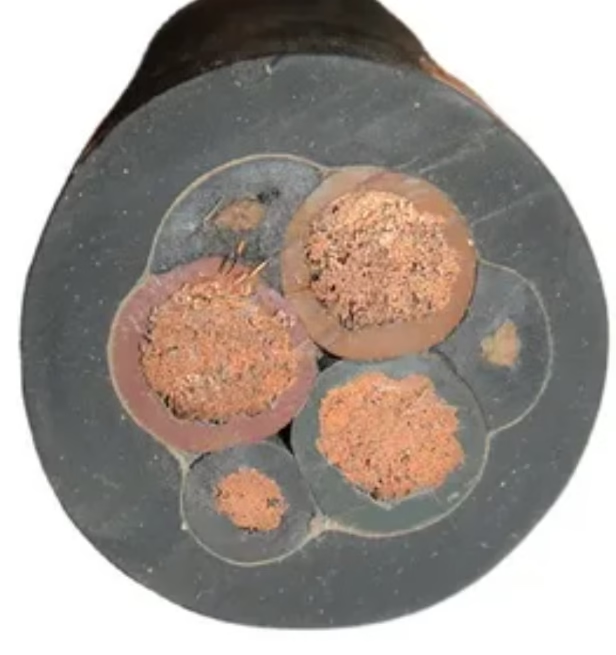
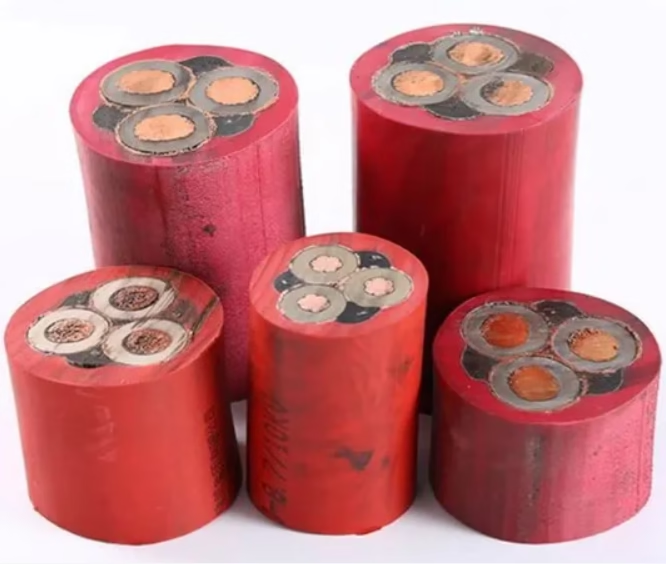
Ethylene Propylene Rubber (EPR) insulated cables represent the professional approach to flexible electrical distribution—cables engineered to accommodate dynamic deployment, repetitive coiling/uncoiling, temperature variation, and mechanical stress inherent in portable and industrial equipment applications. Unlike fixed-installation cables optimized for stationary performance, EPR cables balance electrical performance, mechanical flexibility, environmental durability, and cost-effectiveness required for equipment requiring frequent relocation or deployment flexibility. Fundamental Design Philosophy: EPR cables employ elastomeric insulation material (ethylene propylene rubber) selected specifically for flexibility maintenance across wide temperature range. This material provides sustained flexibility even at cold temperatures (−40°C minimum), maintains electrical properties across elevated temperature range (continuous operation to +100°C), and demonstrates superior resistance to ozone, UV radiation, and environmental contamination characteristic of portable equipment deployment. Conductor Architecture for Flexibility: Rather than single-strand conductors (rigid, prone to breaking under flex stress), EPR cables employ multi-strand conductor design—typically 7, 19, 37, or 61 individual wires woven together. This multi-strand architecture enables smooth bending without conductor fracture, distributes mechanical stress across multiple strands preventing single-point failure, and maintains consistent electrical performance through tens of thousands of flex cycles. Voltage Rating & Safety Margin: Standard 0.6/1KV rating provides nominal 600V operating margin with 1000V safety ceiling—appropriate for most industrial equipment, portable power systems, and temporary installations. The dual rating nomenclature indicates 0.6KV continuous operating voltage with 1KV maximum transient voltage tolerance, providing balanced safety margin against impulse transients and surge events.

Ethylene Propylene Rubber (EPR) Insulated Cable Family

Ethylene Propylene Rubber (EPR) insulated cables represent the professional approach to flexible electrical distribution—cables engineered to accommodate dynamic deployment, repetitive coiling/uncoiling, temperature variation, and mechanical stress inherent in portable and industrial equipment applications. Unlike fixed-installation cables optimized for stationary performance, EPR cables balance electrical performance, mechanical flexibility, environmental durability, and cost-effectiveness required for equipment requiring frequent relocation or deployment flexibility. Fundamental Design Philosophy: EPR cables employ elastomeric insulation material (ethylene propylene rubber) selected specifically for flexibility maintenance across wide temperature range. This material provides sustained flexibility even at cold temperatures (−40°C minimum), maintains electrical properties across elevated temperature range (continuous operation to +100°C), and demonstrates superior resistance to ozone, UV radiation, and environmental contamination characteristic of portable equipment deployment. Conductor Architecture for Flexibility: Rather than single-strand conductors (rigid, prone to breaking under flex stress), EPR cables employ multi-strand conductor design—typically 7, 19, 37, or 61 individual wires woven together. This multi-strand architecture enables smooth bending without conductor fracture, distributes mechanical stress across multiple strands preventing single-point failure, and maintains consistent electrical performance through tens of thousands of flex cycles. Voltage Rating & Safety Margin: Standard 0.6/1KV rating provides nominal 600V operating margin with 1000V safety ceiling—appropriate for most industrial equipment, portable power systems, and temporary installations. The dual rating nomenclature indicates 0.6KV continuous operating voltage with 1KV maximum transient voltage tolerance, providing balanced safety margin against impulse transients and surge events.
KSC 3317 Standard (Korean Industrial Standard C 3317: "Rubber Insulated Flexible Cables — 0.6/1kV") is the authoritative technical specification for cabtyre and flexible power cables used throughout industrial Korea and the international markets where Korean engineering standards are recognized. Adopted as a modification of IEC 60502-1, the KSC 3317 standard defines comprehensive requirements for: Conductor materials and stranding patterns • Insulation thickness and composition • Sheath material and durability requirements • Electrical performance at rated voltage • Mechanical properties including tensile strength and elongation • Temperature operating ranges and chemical resistance • Test methods for verification and certification For port crane and ship unloader applications, cables manufactured to KSC 3317 represent the consensus engineering standard across Asia-Pacific maritime terminals. Korean container terminal operators in Busan, Incheon, and Gwangyang port complexes universally specify KSC 3317-compliant cables for all festoon, cableveyor, and hoist systems. The standard's adoption by major STS crane manufacturers (including Liebherr, Konecranes, and Kalmar) has made KSC 3317 the de facto global specification for Japanese-compatible port crane cables.

KSC 3317 Port Crane & Ship Unloader Cables

KSC 3317 Standard (Korean Industrial Standard C 3317: “Rubber Insulated Flexible Cables — 0.6/1kV”) is the authoritative technical specification for cabtyre and flexible power cables used throughout industrial Korea and the international markets where Korean engineering standards are recognized. Adopted as a modification of IEC 60502-1, the KSC 3317 standard defines comprehensive requirements for: Conductor materials and stranding patterns • Insulation thickness and composition • Sheath material and durability requirements • Electrical performance at rated voltage • Mechanical properties including tensile strength and elongation • Temperature operating ranges and chemical resistance • Test methods for verification and certification For port crane and ship unloader applications, cables manufactured to KSC 3317 represent the consensus engineering standard across Asia-Pacific maritime terminals. Korean container terminal operators in Busan, Incheon, and Gwangyang port complexes universally specify KSC 3317-compliant cables for all festoon, cableveyor, and hoist systems. The standard’s adoption by major STS crane manufacturers (including Liebherr, Konecranes, and Kalmar) has made KSC 3317 the de facto global specification for Japanese-compatible port crane cables.
Geographic & Operational Context—Russian Far East & Arctic Mining: Major hard-rock mining operations in extreme-cold zones: (1) Siberia (northern Russia): temperatures routinely -30°C to -50°C winter (December–March), occasional -60°C + extreme weather), (2) Arctic Circle regions (Norilsk Nickel mining complex, Yamal Peninsula LNG infrastructure): permanent permafrost, winter ambient -45°C to -55°C, (3) Far East (Sakha Republic—Yakutia): diamond/gold mining at -40°C to -50°C sustained for 6+ months/year. Climate-specific challenges: (1) Permafrost thawing/refreezing cycles, (2) Extreme low humidity (frozen air

КОГРЭШ 3х6+1х2,5+1х2,5 660V: Extreme Flexible Cold-Resistant Mining Cable

Geographic & Operational Context—Russian Far East & Arctic Mining: Major hard-rock mining operations in extreme-cold zones: (1) Siberia (northern Russia): temperatures routinely -30°C to -50°C winter (December–March), occasional -60°C + extreme weather), (2) Arctic Circle regions (Norilsk Nickel mining complex, Yamal Peninsula LNG infrastructure): permanent permafrost, winter ambient -45°C to -55°C, (3) Far East (Sakha Republic—Yakutia): diamond/gold mining at -40°C to -50°C sustained for 6+ months/year. Climate-specific challenges: (1) Permafrost thawing/refreezing cycles, (2) Extreme low humidity (frozen air
NSHTÖU-J 4G16 0.6/1kV flexible rubber cable weighs approximately 1.17 to 1.30 kilograms per meter, depending on the specific manufacturing tolerance and the composition of the outer sheath material used by your cable supplier. This means that a 100-meter length of cable would weigh roughly 117 to 130 kilograms — about the weight of a fully grown man for every 100 meters of cable. Understanding what this weight represents, where it comes from, and how it affects your equipment design and installation planning is far more valuable than simply knowing the number. NSHTÖU-J 4G16 电缆的每米重量约为 1.17 至 1.30 千克,具体取决于制造公差和外护套材料。

Weight Calculator: What is the Weight per Meter of NSHTÖU-J 4G16 0.6/1kV Flexible Rubber Cable?

NSHTÖU-J 4G16 0.6/1kV flexible rubber cable weighs approximately 1.17 to 1.30 kilograms per meter, depending on the specific manufacturing tolerance and the composition of the outer sheath material used by your cable supplier. This means that a 100-meter length of cable would weigh roughly 117 to 130 kilograms — about the weight of a fully grown man for every 100 meters of cable. Understanding what this weight represents, where it comes from, and how it affects your equipment design and installation planning is far more valuable than simply knowing the number. NSHTÖU-J 4G16 电缆的每米重量约为 1.17 至 1.30 千克,具体取决于制造公差和外护套材料。
In port machinery, material handling equipment, stacker-reclaimers, festoon systems, and industrial cranes operating at speeds up to 240 meters per minute, trailing cables experience a distinctive and punishing stress pattern called reverse S-bending. The cable is not simply bent in one direction — it repeatedly curves left, then right, then left again, following the path of the equipment as it traverses an S-shaped trajectory or as cable spools alternately bend the cable in opposite directions during reeling and unreeling cycles. This reverse bending motion is fundamentally different from the static or single-direction bending challenges faced by underground mining cables or fixed installations. The cable experiences rapid alternation between tensile and compressive stress on its individual conductors, combined with torsional (twisting) forces that attempt to unwind the cable's spiral structure. For a standard cable, this combination of stresses creates a perfect recipe for premature fatigue failure, conductor breakage, and insulation degradation.

S-Bend Fatigue: Why (N)TSKCGEWÖU Lasts Longer in High-Speed Applications

In port machinery, material handling equipment, stacker-reclaimers, festoon systems, and industrial cranes operating at speeds up to 240 meters per minute, trailing cables experience a distinctive and punishing stress pattern called reverse S-bending. The cable is not simply bent in one direction — it repeatedly curves left, then right, then left again, following the path of the equipment as it traverses an S-shaped trajectory or as cable spools alternately bend the cable in opposite directions during reeling and unreeling cycles. This reverse bending motion is fundamentally different from the static or single-direction bending challenges faced by underground mining cables or fixed installations. The cable experiences rapid alternation between tensile and compressive stress on its individual conductors, combined with torsional (twisting) forces that attempt to unwind the cable’s spiral structure. For a standard cable, this combination of stresses creates a perfect recipe for premature fatigue failure, conductor breakage, and insulation degradation.
(N)TSFLCGEWÖU cable designation follows German DIN VDE standards and represents a specific type of flat flexible cable designed for festoon applications. Understanding the nomenclature and specifications is essential for selecting cables that will perform optimally within Conductix-Wampfler festoon systems.

Conductix-Wampfler Festoon Systems: Choosing the Right (N)TSFLCGEWÖU Flat Cable

(N)TSFLCGEWÖU cable designation follows German DIN VDE standards and represents a specific type of flat flexible cable designed for festoon applications. Understanding the nomenclature and specifications is essential for selecting cables that will perform optimally within Conductix-Wampfler festoon systems.
Primary HS Code for Rubber Mining Cables | 主要海关编码 HS Code: 8544.49 / 8544.60 Rubber-insulated mining cables typically fall under Chapter 85 of the Harmonized System, specifically within heading 8544, which covers insulated wire, cable, and other insulated electric conductors. The exact subheading depends on voltage specifications and whether connectors are fitted. 橡胶绝缘矿用电缆通常属于协调制度第85章,特别是8544项下,涵盖绝缘线、电缆和其他绝缘电导体。具体的子目取决于额定电压和是否配有连接器。

HS Code Classification Guide: Exporting Rubber Mining Cables to Peru & Chile

Primary HS Code for Rubber Mining Cables | 主要海关编码 HS Code: 8544.49 / 8544.60 Rubber-insulated mining cables typically fall under Chapter 85 of the Harmonized System, specifically within heading 8544, which covers insulated wire, cable, and other insulated electric conductors. The exact subheading depends on voltage specifications and whether connectors are fitted. 橡胶绝缘矿用电缆通常属于协调制度第85章,特别是8544项下,涵盖绝缘线、电缆和其他绝缘电导体。具体的子目取决于额定电压和是否配有连接器。
The choice of conductor material in electrical cables represents a critical engineering decision that directly impacts cable longevity, performance, and safety. German VDE standards, particularly DIN VDE 0250, specify tinned copper conductors for rubber-insulated cables such as NSSHÖU, while PVC-insulated cables commonly utilize bare (plain) copper conductors. This technical distinction arises from fundamental differences in material chemistry and vulcanization processes. 电缆导体材料的选择是一项关键的工程决策,直接影响电缆的寿命、性能和安全性。德国VDE标准,特别是DIN VDE 0250,规定橡胶绝缘电缆(如NSSHÖU)必须使用镀锡铜导体,而PVC绝缘电缆通常使用裸铜导体。这一技术区别源于材料化学和硫化工艺的根本差异。

Tinned Copper: Why Do VDE Standards Typically Require Tinned Copper Conductors for Rubber Cables Like NSSHÖU, Whereas PVC Cables Often Use Bare Copper?

The choice of conductor material in electrical cables represents a critical engineering decision that directly impacts cable longevity, performance, and safety. German VDE standards, particularly DIN VDE 0250, specify tinned copper conductors for rubber-insulated cables such as NSSHÖU, while PVC-insulated cables commonly utilize bare (plain) copper conductors. This technical distinction arises from fundamental differences in material chemistry and vulcanization processes. 电缆导体材料的选择是一项关键的工程决策,直接影响电缆的寿命、性能和安全性。德国VDE标准,特别是DIN VDE 0250,规定橡胶绝缘电缆(如NSSHÖU)必须使用镀锡铜导体,而PVC绝缘电缆通常使用裸铜导体。这一技术区别源于材料化学和硫化工艺的根本差异。
How do you select conductor size for high-current tunnelling equipment and cable reels?

كيفية اختيار مقاس الموصل لمعدات الأنفاق عالية التيار وبكرات الكابلات؟

Selecting the correct conductor size for cables used in tunnel boring equipment and cable reels is critical for ensuring safety and operational efficiency. These cables are subjected to extreme conditions including high currents, mechanical stress, and elevated temperatures. According to International Electrotechnical Commission (IEC) standards, conductor selection must consider ampacity, voltage drop, short-circuit capacity, and environmental factors.
N3GHSSYCY — это экранированный высоковольтный гибкий кабель промышленного класса, специально разработанный для подключения мобильного оборудования в шахтах и подземных выработках со взрывоопасной средой. Кабель соответствует международному стандарту DIN VDE 0250, часть 605 и выпускается в двух номинальных напряжениях: 3.6/6 кВ и 6/10 кВ. Особенностью конструкции является наличие фазоконцентрического заземляющего проводника и общего концентрического экрана мониторинга, которые в сочетании со схемой высоковольтной защиты позволяют контролировать кабель на наличие дефектов изоляции и повреждений от внешних воздействий.

N3GHSSYCY — Экранированный Высоковольтный Кабель с Резиновой Изоляцией и ПВХ Оболочкой

N3GHSSYCY кабель, высоковольтный кабель, экранированный кабель, кабель с резиновой изоляцией, кабель с ПВХ оболочкой, кабель DIN VDE 0250-605, кабель 3.6/6 кВ, кабель 6/10 кВ, горнодобывающий кабель высокого напряжения, кабель для шахт, кабель для подземных выработок, кабель для взрывоопасных зон, кабель EPR изоляция, кабель с экраном мониторинга, кабель с заземляющим экраном, кабель со стальной бронёй, кабель с контрольными жилами, кабель с литыми терминациями, гибкий высоковольтный кабель, кабель для тоннелестроения, кабель для трансформаторов, кабель низкой ёмкости, кабель для сетей 10 кВ, кабель для сетей 5 кВ, кабель тройной экструзии, кабель с медной оплёткой, кабель с оцинкованной стальной бронёй, красный кабель ПВХ YM5, кабель 3×25 N3GHSSYCY, кабель 3×35 N3GHSSYCY, кабель 3×50 N3GHSSYCY, кабель 3×70 N3GHSSYCY, кабель 3×95 N3GHSSYCY, кабель с фазоконцентрическим заземлением, кабель для мобильного оборудования, кабель для контейнерной укладки, высоковольтный кабель для горнодобычи, кабель для подземных работ СНГ, экранированный силовой кабель, кабель с двойным экраном, кабель мониторинга изоляции, высоковольтный резиновый кабель, кабель для опасных сред, промышленный высоковольтный кабель, кабель для передвижных установок, кабель Россия, кабель Казахстан, кабель Беларусь, китайский производитель высоковольтного кабеля, Anhui Feichun кабель, кабель ГОСТ 16442, кабель IEC 60502
Сварочные кабели серии TENAX®-SL H01N2-D и H01N2-E производятся в соответствии с международным стандартом DIN VDE 0282, часть 6. Данный стандарт определяет требования к конструкции, материалам и электрическим характеристикам гибких кабелей для сварочного оборудования.

Сварочные кабели TENAX®-SL H01N2-D H01N2-E

сварочный кабель H01N2-D, сварочный кабель TENAX, гибкий сварочный кабель, кабель для дуговой сварки, кабель для сварочного аппарата, кабель сварочный медный, кабель сварочный резиновый, токовая нагрузка сварочного кабеля, сечение сварочного кабеля, кабель КГ сварочный, кабель для электродной сварки, кабель сварочный маслостойкий, кабель сварочный морозостойкий
Кабели марки КОГРВЭШ предназначены для присоединения шахтного бурильного электроинструмента на номинальное переменное напряжение 660В частоты 50 Гц с изолированной нейтралью. Кабели могут эксплуатироваться в подземных помещениях и шахтах с повышенной влажностью воздуха, в которых возможно длительное наличие воды или частая конденсация влаги. Электропроводящие экраны по изоляции жил обеспечивают опережающее отключение системы электроснабжения при повреждении кабеля, предупреждая возможный взрыв метана в шахтах.

КОГРВЭШ & КОГРВЭШ-Т

КОГРВЭШ, КОГРВЭШ-Т, KOGRVESH, KOGRVESH-T, кабель КОГРВЭШ, кабель КОГРВЭШ-Т, шахтный буровой кабель, mining drill cable, drilling equipment cable, гибкий шахтный кабель КОГРВЭШ, экранированный буровой кабель, шахтный электроинструмент кабель, 矿用钻机电缆, 礦用鑽機電纜, КОГРВЭШ 3×1.5, КОГРВЭШ 3×2.5, КОГРВЭШ 3×4, КОГРВЭШ 3×6
Кабель силовой шахтный и экскаваторный необходим для подключения горнодобывающего оборудования, экскаваторов и другого землеройного оборудования, электроинструментов, а также для проведения горных взрывных работ. Шахтные кабели используют для всех типов шахт: угольные, соляные, сланцевые, а также подходят для открытых карьерных разработок. Кабели эксплуатируются на напряжении переменного тока 660, 1140, 6000 В.

What is Кабель для шахт?

КГЭШ, КГЭШ-1140, КГЭ, КГЭ-6, КГЭ-Т, КГЭ-ХЛ, КГЭ-ХЛ-6, КГЭС, КГЭТ, КГВШ, КГРШ, КШВГТ, ЭВБВ, ЭВБВ-6, ЭВТ-1140, ЭВТ-6000, кабель КГЭШ, кабель КГЭ, кабель ЭВБВ, шахтный кабель КГЭШ, экскаваторный кабель, mining cable KGESH, excavator cable KGE, KGESH cable, KGE cable, EVBV cable
Кабели марки КГЭШ предназначены для присоединения угольных комбайнов, передвижных машин и механизмов при подземных горных работах к электрическим сетям на номинальное напряжение переменного тока до 1140 В частотой 50 Гц на основных жилах и до 220 В на вспомогательной жиле. Кабели могут эксплуатироваться в подземных помещениях и шахтах с повышенной влажностью воздуха, в которых возможно длительное наличие воды или частая конденсация влаги.

Кабель КГЭШ 3х4+1х2,5+3х1,5, 1 кВ

КГЭШ, КГЭШ 3х4+1х2.5+3х1.5, КГЭШ 1кВ, кабель КГЭШ, КГЭШ cable, mining cable КГЭШ, KGESH cable, KGESH 3×4, flexible mining cable КГЭШ, shielded mining cable, экранированный кабель КГЭШ, гибкий шахтный кабель, 矿用电缆КГЭШ, 礦用電纜КГЭШ, КГЭШ 3х4 цена, КГЭШ характеристики
DIN VDE cable, VDE standard cable, German cable standard, VDE certified cable, VDE approved cable, DIN cable, VDE certification, German electrical standard, DKE standard, VDE mark, VDE testing, German power cable

What is DIN VDE Standard Cable?

VDE 0100, VDE 0105, VDE 0207, VDE 0245, VDE 0250, VDE 0253, VDE 0262, VDE 0265, VDE 0266, VDE 0267, VDE 0271, VDE 0276, VDE 0277, VDE 0281, VDE 0282, VDE 0284, VDE 0289, VDE 0292, VDE 0293, VDE 0295, VDE 0298, VDE 0472, VDE 0473, VDE 0482, VDE 0800, VDE 0811, VDE 0812, VDE 0815, VDE 0816, VDE 0839, VDE 0881, VDE 0891, VDE 0899, NYY cable, NYY-J cable, NYY-O cable, NYM cable, NYM-J cable, NYCY cable, NYCWY cable, NAYY cable, N2XY cable, NA2XY cable, N2XSY cable, N2XSEY cable, NA2XSY cable, NA2XS2Y cable, N2XH cable, N2XCH cable, NSHTOU cable, NSHTÖU cable, NSSHÖU cable, NSGAFÖU cable, NHXMH cable, NHMH cable, H03VV-F cable, H05VV-F cable, H07VV-F cable, H05V-K cable, H07V-K cable, H05V-U cable, H07V-U cable, H05V-R cable, H07V-R cable, H05RN-F cable, H07RN-F cable, H05RR-F cable, H07BN4-F cable, H05BN4-F cable, H07ZZ-F cable, H05Z-K cable, H07Z-K cable, H07Z-R cable, H05Z1Z1-F cable, H05VVH2-F cable, H05VVH6-F cable, H07V2-K cable, H05V2-K cable, H01N2-D cable, H01N2-E cable,300/500V cable, 450/750V cable, 0.6/1kV cable, 600/1000V cable, 3.6/6kV cable, 6/10kV cable, 12/20kV cable, 18/30kV cable, low voltage cable, medium voltage cable, high voltage cable,
H07RN-F cable, H05RR-F cable, H07ZZ-F cable, H07BN4-F cable, H07RN8-F cable, H05BB-F cable, H05BQ-F cable, H07BB-F cable, H07BQ-F cable, H05GG-F cable, H05SS-F cable

What is BS7919 Cable?

BS7919 cable, BS7919 flexible cable, BS EN 50525 cable, industrial flexible cable, rubber flexible cable, heavy duty cable 450/750V,H07RN-F cable, H05RR-F cable, H07ZZ-F cable, H07BN4-F cable, H07RN8-F cable, H05BB-F cable, H05BQ-F cable, H07BB-F cable, H07BQ-F cable, H05GG-F cable, H05SS-F cable,BS7919電纜, 柔性橡膠電纜, 工業柔性電纜, 重型橡膠電纜, 耐油電纜, 阻燃柔性電纜, 港口機械電纜, 起重機電纜, 移動電源電纜, H07RN-F橡膠電纜, 450/750V柔性電纜, 氯丁橡膠護套電纜, EPR絕緣電纜, 多芯柔性電纜, 拖曳電纜, 卷筒電纜
BS6195 Standard covers the requirements for insulated flexible cables and cords typically known as coil end leads. These specialized cables are engineered for permanent and direct connection to coil windings or other electrical equipment, providing the essential flexibility and durability required in demanding industrial environments where motors, generators, transformers, and circuit breakers operate.

What is BS6195 Cable?

BS6195 Standard covers the requirements for insulated flexible cables and cords typically known as coil end leads. These specialized cables are engineered for permanent and direct connection to coil windings or other electrical equipment such as motors, generators, transformers, and circuit breakers.
NSHXAFÖ represents a specialized category of single conductor halogen-free flexible power cables engineered for demanding industrial applications, including wind turbine installations where exceptional flexibility, fire safety, and multi-voltage capability are critical requirements. This cable series spans three voltage classes from 0.6/1 kV through 3.6/6 kV, providing comprehensive solutions for both low and medium voltage power distribution within wind energy systems.

What is NSHXAFÖ 0.6/1 to 3.6/6 kV Wind Turbine Cable?

NSHXAFÖ represents a specialized category of single conductor halogen-free flexible power cables engineered for demanding industrial applications, including wind turbine installations where exceptional flexibility, fire safety, and multi-voltage capability are critical requirements. This cable series spans three voltage classes from 0.6/1 kV through 3.6/6 kV, providing comprehensive solutions for both low and medium voltage power distribution within wind energy systems.
heavy-duty rubber cables represent a critical category for applications requiring exceptional mechanical strength, flexibility, and environmental resistance. This comprehensive technical guide examines three closely related cable types that dominate international markets for portable power transmission: the Chinese standard GB/T 5013 YC (Heavy-Duty General Rubber Cable) rated at 450/750V, the enhanced YCW variant with oil and weather resistance, and the European harmonized H07RN-F cable that serves as the international equivalent.

GB/T 5013 YC & YCW Heavy-Duty Rubber Cables and H07RN-F: Comprehensive Technical Analysis

heavy-duty rubber cables represent a critical category for applications requiring exceptional mechanical strength, flexibility, and environmental resistance. This comprehensive technical guide examines three closely related cable types that dominate international markets for portable power transmission: the Chinese standard GB/T 5013 YC (Heavy-Duty General Rubber Cable) rated at 450/750V, the enhanced YCW variant with oil and weather resistance, and the European harmonized H07RN-F cable that serves as the international equivalent.
What is PROTOMONT NSSHOEU 1 kV Low Voltage Flexible Rubber Cable? A Comprehensive Technical Guide to Heavy-Duty Mining and Industrial Flexible Cables with EPR Insulation for Extreme Environments

What is PROTOMONT NSSHOEU 1 kV Low Voltage Flexible Rubber Cable?

PROTOMONT NSHXOEU series represents an advanced category of low voltage flexible rubber cables specifically engineered for demanding mining and industrial environments. These cables feature a specialized EVA-based outer sheath compound (5GM3) combined with EPR (Ethylene Propylene Rubber) insulation, providing an optimal balance of flexibility, durability, and environmental resistance for medium mechanical stress applications. The designation NSHXOEU follows the German cable nomenclature system established by DIN VDE standards, where each letter indicates specific construction characteristics. The “X” in the designation indicates the halogen-reduced EVA sheath compound, while “H” denotes the heavy-duty rubber construction suitable for harsh environments. According to Eland Cables, DIN VDE 0250 has achieved global recognition as the ultimate standard for tough rubber sheathed flexible cables, particularly for mining and material handling equipment.
What is PROTOMONT NSSHOEU 1 kV Low Voltage Flexible Rubber Cable? A Comprehensive Technical Guide to Heavy-Duty Mining and Industrial Flexible Cables with EPR Insulation for Extreme Environments

What is PROTOMONT NSSHOEU 1 kV Low Voltage Flexible Rubber Cable?

PROTOMONT NSSHOEU series represents a category of heavy-duty, low voltage flexible rubber cables engineered specifically for demanding industrial environments. These cables are designed to provide reliable power transmission in applications where conventional cables would fail due to extreme mechanical stress, environmental exposure, or chemical contact. The designation NSSHOEU follows German cable nomenclature standards where each letter indicates specific construction characteristics. The cables are manufactured according to DIN VDE 0250-812 specifications, which define requirements for rubber-insulated flexible cables used in power installations. According to industry standards, these cables are engineered for environments where high levels of mechanical stress and abrasion are expected, making them essential for modern mining, construction, and industrial operations.
PROTOLON(M) F(N)TSCGEWOEU Cable

What is PROTOLON(M) F(N)TSCGEWOEU Cable?

PROTOLON(M) F(N)TSCGEWOEU represents a premium series of medium voltage trailing cables specifically engineered for demanding industrial applications. These cables feature advanced EPR (Ethylene Propylene Rubber) insulation technology, delivering exceptional performance in voltage ranges from 3.6/6 kV to 20/35 kV. The PROTOLON compound provides superior electrical insulation properties and mechanical resilience compared to standard EPR formulations.
What is 600V 2TC Light (600V 2PNCT) Crane Cable? Comprehensive Technical Analysis of 600V Ethylene Propylene Rubber Insulated Polychloroprene Rubber Sheath Cable

What is 600V 2TC Light (600V 2PNCT) Crane Cable?

The 600V 2TC Light (600V 2PNCT) crane cable represents a specialized category of flexible power cables designed specifically for low-voltage mobile equipment applications operating at rated voltages up to 600V. This cable features ethylene propylene rubber (EPR) insulation and polychloroprene rubber (CR) sheath, combining superior electrical performance with exceptional mechanical durability. Manufactured in accordance with JIS C 3327 Japanese Industrial Standard, this cable classification has established itself as the preferred solution for crane systems, reeling applications, and material handling equipment throughout industrial facilities worldwide.
CARCT (Carrier Drum Cable Type) and FFCT/FFCTB (Heat Resistant Flexible Cable) represent two specialized classifications of industrial cables designed for demanding crane and material handling applications where conventional cables prove inadequate.

What is JIS C CARCT Carrier Drum Cable & FFCT/FFCTB Heat Resistant Flexible Cable (200°C)?

CARCT (Carrier Drum Cable Type) and FFCT/FFCTB (Heat Resistant Flexible Cable) represent two specialized classifications of industrial cables designed for demanding crane and material handling applications where conventional cables prove inadequate.
Feichun Spreader Cable

What is JIS C 3327 SPDCT Spreader Cable for Container Cranes?

SPDCT (Spreader Cable) represents a specialized category of reeling cables designed specifically for vertical hoisting applications in container handling equipment. These cables operate under extreme mechanical stresses, including simultaneous tensile loading and torsional forces during rapid container lifting operations. Reeling cables are engineered for continuous movement under extreme conditions, particularly in maritime infrastructure where they serve as critical power transmission components for mobile machinery.
CEI 20-27 CENELEC HD361 Cable

What is CEI 20-27 CENELEC HD361 Cable?

CEI 20-27 CENELEC HD361 represents a standardized cable designation system developed by the European Committee for Electrotechnical Standardisation (CENELEC) to provide uniform identification and classification of harmonized power cables and cords across European markets. This systematic coding methodology enables engineers, procurement specialists, and electrical contractors to precisely identify cable specifications including voltage ratings, insulation materials, conductor types, and sheathing compounds through a structured alphanumeric designation format.