
Deep Operational Analysis: Arctic Grade Type 241 11/11kV 3x50mm² Field Deployment at Oyu Tolgoi Underground Mining in -40°C Conditions. Failure Modes in Extreme Cold Environments, Field Termination Protocols in Arctic Conditions, Rio Tinto Compliance Testing and Certification, Real-Time Cable Damage Detection Systems, Emergency Repair Procedures, Supply Chain Management for Extreme Environments.
深度运营分析:-40°C条件下奥尤陶勒盖地下矿的北极级Type 241 11/11kV 3x50mm²现场部署、故障预防和应急协议。极端寒冷环境中的故障模式、北极环境中的现场终端协议、Rio Tinto合规测试和认证、实时电缆损伤检测系统、应急修复程序、极端环境供应链管理。
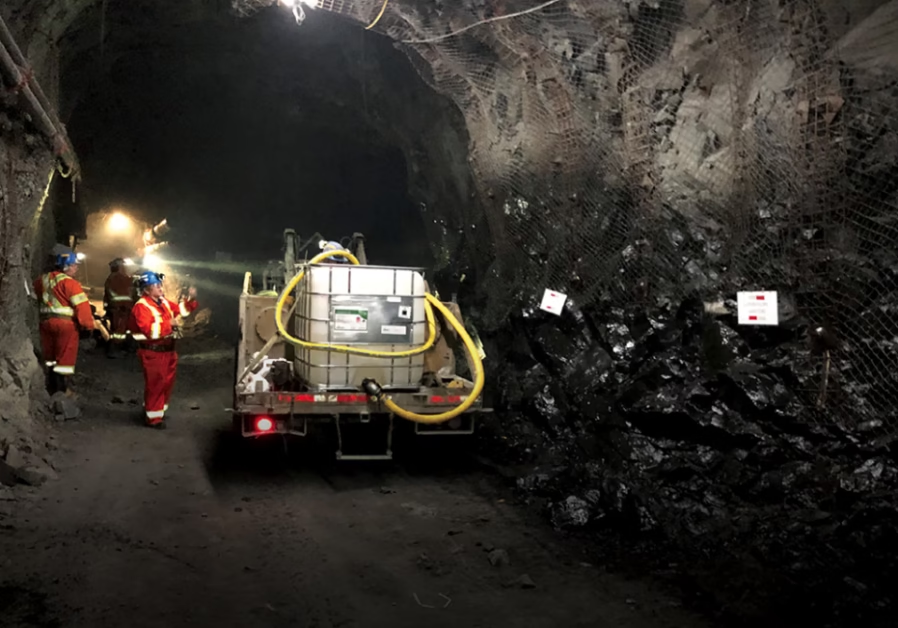
Oyu Tolgoi Extreme Conditions: Arctic Grade Type 241 11/11kV 3x50mm² Field Operations, Failure Prevention, and Emergency Protocols
Deep Operational Analysis: Arctic Grade Type 241 11/11kV 3x50mm² Field Deployment at Oyu Tolgoi Underground Mining in -40°C Conditions. Failure Modes in Extreme Cold Environments, Field Termination Protocols in Arctic Conditions, Rio Tinto Compliance Testing and Certification, Real-Time Cable Damage Detection Systems, Emergency Repair Procedures, Supply Chain Management for Extreme Environments.
深度运营分析:-40°C条件下奥尤陶勒盖地下矿的北极级Type 241 11/11kV 3x50mm²现场部署、故障预防和应急协议。极端寒冷环境中的故障模式、北极环境中的现场终端协议、Rio Tinto合规测试和认证、实时电缆损伤检测系统、应急修复程序、极端环境供应链管理。
1. Field Reality at Oyu Tolgoi: -40°C Underground Operations
The surface of the Oyu Tolgoi site in southern Mongolia regularly experiences winter temperatures dropping to -35°C to -45°C. Underground development workings in ventilation shafts and transition zones between the deep underground operations (where temperatures warm to 15–20°C due to geothermal gradient) and surface facilities experience the worst of both worlds: temperatures fluctuating between -40°C and +10°C within hours as equipment movements create temporary temperature swings.
奥尤陶勒盖位于蒙古南部,地表冬季温度经常降至-35°C至-45°C。通风竖井和地下作业(深部地温升至15-20°C)与地面设施之间过渡区域的地下开发工作经历最坏的情况:数小时内温度在-40°C和+10°C之间波动,因为设备移动产生临时温度波动。
Cable Deployment Locations: Arctic Grade Type 241 11/11kV 3x50mm² cables are deployed in four primary locations: (1) Surface cable runs feeding portable substations in the open pit winter environment (-40°C sustained), (2) Ventilation shaft risers where cables experience extreme temperature gradients, (3) Underground main feeder connections to load-haul-dump (LHD) equipment in transition zones (fluctuating -20°C to +15°C), (4) Mobile substation interconnects requiring frequent reeling and repositioning in arctic conditions.
2. Failure Mode Taxonomy: How Type 241 Cables Fail in Arctic Conditions
Mode 1: Sheath Stress-Cracking at Installation and First Cold Exposure (Days 1–14): A cable manufactured for standard AS/NZS 1802 conditions and deployed at Oyu Tolgoi without arctic-grade elastomer will experience immediate sheath cracking when first exposed to -40°C and mechanical stress. The sheath—still at manufacturing flexibility—becomes brittle within hours. Initial coiling on a reel or tensioning during deployment initiates longitudinal stress cracks that propagate down the cable length.
Mode 2: Insulation Embrittlement with Moisture Ingress (Weeks 2–8): Once sheath cracks expose the EPR insulation to direct arctic air contact, moisture absorption accelerates. At -40°C, water molecules migrate into the insulation with surprising speed due to vapor pressure differentials. The insulation itself becomes brittle, compounding the mechanical damage. Insulation resistance drops from >100 MΩ (new cable) to 10–50 MΩ (moisture-compromised) within weeks.
Mode 3: Pilot Core Discontinuity and Earth Fault Detection Failure (Weeks 4–12): The central extensible pilot core is a thin 16 mm² tinned copper strand supported by semiconductive cradle. At -40°C, the materials are subject to differential thermal contraction. The pilot core can develop intermittent opens or high-resistance faults, causing the earth continuity relay to become unreliable. Equipment becomes energized despite incipient faults, creating dangerous conditions.
Mode 4: Phase-to-Earth Arc and Explosive Failure (Weeks 8–16): As insulation degradation progresses, partial discharge (PD) activity increases dramatically. At 11kV, PD events create tiny electrical erosions that accelerate insulation breakdown. Eventually, phase-to-earth voltage breakthrough occurs. In the confined underground environment, the resulting arc can ignite coal dust or methane, creating explosion hazards.
3. Early Warning Signs: Detecting Cable Degradation Before Catastrophic Failure
Indicator 1—Insulation Resistance Trending: Monthly or quarterly insulation resistance measurements at 5 kV for 1 minute (using megohm meter) provide quantitative trending. At Oyu Tolgoi, baseline IR for new Arctic Grade Type 241 cables is typically 100–200 MΩ. A declining trend (150 MΩ → 100 MΩ → 50 MΩ) over successive months is a clear warning sign of moisture ingress, even if the cable remains energized and operational. Rio Tinto protocol mandates removal of cables showing IR decline >20% from baseline.
Indicator 2—Pilot Core Resistance Monitoring: The pilot core resistance, measured at the substation earth continuity relay termination, should be stable (typically 100–500 Ω depending on cable length and design). An increasing pilot core resistance (500 Ω → 2,000 Ω → 10,000 Ω) indicates developing faults in the pilot core or semi-conductive screen. This is an automatic trigger for immediate cable removal and testing.
Indicator 3—Visual Inspection for Sheath Cracks: Monthly visual inspection of exposed cable sections for stress cracks, brittleness indicators, or moisture beading is essential. At -40°C, visible sheath cracking is obvious—elastomer becomes visibly hard and brittle. Any observed cracks trigger immediate circuit de-energization and cable removal.
4. Pilot Core Monitoring: Real-Time Earth Continuity Detection System
Functional Design: The pilot core is monitored by an earth continuity relay at the substation. The relay injects a low-frequency test signal (typically 50–100 Hz) into the pilot core and measures signal propagation time and amplitude. If the pilot core remains intact and the semiconductive screen is functional, the signal propagates along the entire cable length and returns cleanly. If a fault develops (insulation puncture, pilot core discontinuity, screen degradation), signal distortion or loss occurs, triggering the relay to de-energize the circuit within milliseconds.
Arctic Complication: At -40°C, the semiconductive screen’s conductivity changes (as discussed previously). Rio Tinto’s monitoring systems account for temperature-dependent conductivity by specifying temperature-compensated test signals. The relay must be calibrated with arctic-grade baseline measurements (pilot core resistance at -40°C baseline, not room-temperature baseline) to avoid false positives.
Establish baseline pilot core resistance measurements at multiple temperatures (-40°C, -20°C, +10°C, +40°C) when cable is first energized. Use these baselines for trend analysis, not single-point comparisons. A trending alarm threshold (e.g., “alert if pilot core resistance increases >50% from -40°C baseline”) provides early warning weeks before catastrophic failure.
5. Field Termination in Arctic Conditions: Why Standard Kits Fail
Standard Heat-Shrink Terminations: Conventional 11kV heat-shrink cable terminations require heating to 150–180°C to cure epoxy compounds and shrink outer sleeves. At Oyu Tolgoi in -40°C winter conditions, outdoor heating is practically impossible. Heat guns malfunction, propane torches become unreliable, and the ambient cold prevents epoxy curing. Forced termination attempts result in incomplete sealing and potential explosive failure within days.
Cold-Shrink Kit Limitations: Cold-shrink kits use pre-compressed elastomer that relies on stress relaxation when released. At -40°C, elastomer is so stiff that relaxation becomes extremely slow (hours or days instead of minutes). Moreover, the seal quality is compromised because the elastomer is too rigid to conform tightly to surface irregularities on the connector and conductor.
The Optimal Solution: Factory Pre-Termination: The only reliable approach is to order Arctic Grade Type 241 cables with factory-applied terminations (lugs, glands, and pilot core connectors) already installed in controlled laboratory conditions. This ensures: (1) Proper mechanical crimping at room temperature, (2) Correct epoxy sealing and curing under controlled temperature and humidity, (3) Verified electrical continuity and insulation resistance before shipment, (4) Complete warranty coverage for termination workmanship.
6. Cold-Temperature Termination Materials and Procedures
Emergency Termination Kit Specification: If field termination becomes unavoidable (damaged cable end requiring repair), Rio Tinto operations use purpose-designed arctic splice kits including: (1) Elastomeric materials rated to -50°C (typically nitrile rubber blends formulated for arctic use), (2) Sealant compounds that cure at low temperature (modified epoxies or polyurethanes), (3) Mechanical compression sleeves that function at -40°C, (4) Semiconductive tape for field-applied screening restoration.
Procedure in Heated Enclosure: Field termination is performed inside heated enclosures (portable heating tents or equipment cabins) to raise working temperature to at least 0°C to +10°C. This requires: (1) Portable heater (diesel or electric), (2) Insulated work tent (typically 4×4 m minimum), (3) 4–6 trained technicians, (4) 8–12 hours working time.
Cost and Logistics: A single field termination in arctic conditions at Oyu Tolgoi costs approximately $15,000–25,000 USD in labor, equipment rental, and logistics. This far exceeds the material cost of spare pre-terminated cable stock (~$5,000–8,000 USD per cable). Rio Tinto’s operational strategy is to maintain spare cable inventory rather than depend on emergency field terminations.
7. Emergency Splicing Protocols: Underground Repair at -40°C
The Splicing Challenge: If a cable is damaged underground in a ventilation shaft at -40°C and replacement cable is not immediately available, emergency splicing becomes necessary. Splicing a 11kV cable with pilot core is vastly more complex than standard low-voltage cable repair. The semiconductive screen must be carefully managed, the pilot core must be individually spliced with a specialized connector, and all components must be sealed against moisture ingress.
Arctic Splice Kit Components: Purpose-designed arctic splice kits (e.g., Raychem or equivalent arctic-rated products) include: (1) Heat-shrink tubes with arctic-rated elastomers and adhesives, (2) Pilot core splice connectors designed for -40°C, (3) Semiconductive tape for field restoration of high-voltage field shaping, (4) Liquid sealants (polyurethane or silicone) that cure at -40°C without mechanical heat.
Time Requirement and Risk: Underground emergency splicing at -40°C requires 10–14 hours of continuous work. Personnel fatigue becomes a critical safety issue—workers cannot work effectively in -40°C conditions for extended periods. Mistakes are likely, including incomplete sealing, improper splice compression, or damaged semiconductive tape. Rio Tinto’s standard procedure is to perform emergency splicing only as a temporary measure, with full cable replacement planned within 2–4 weeks.
8. Cable Storage and Handling in Extreme Winter Environments
Pre-Deployment Storage: Upon receipt at Oyu Tolgoi, Arctic Grade Type 241 cables must be stored in climate-controlled facilities (heated warehouses maintained at minimum 5°C). Storing cables outdoors at -40°C before deployment risks pre-degradation of elastomeric materials and pilot core integrity. Cables should be stored on properly spaced timber supports (not coiled on ground, not stacked vertically), with covers protecting against snow and moisture.
Cable Drum Inspection: Inspect cable drums for frost damage, condensation inside the drum (indicating previous moisture ingress), and any signs of rough handling during transport. Drums arriving with ice buildup should be moved to climate-controlled storage to allow thawing and condensation evaporation before opening.
Handling During Deployment: At -40°C, Arctic Grade elastomers are hard but not brittle (unlike standard elastomers). Nevertheless, mechanical impact during deployment can still damage the cable. Cables should be deployed using mechanical pulling equipment rather than manual dragging. Bending radius limits must be strictly observed—at -40°C, the cable is more prone to internal insulation damage under compression.
9. Rio Tinto Compliance Testing: Complete Certification Matrix
| Test Procedure | Temperature | Requirement | Pass/Fail Criterion |
|---|---|---|---|
| Insulation Resistance (IR) | +20°C baseline | Megohm meter, 5 kV, 1 min | ≥100 MΩ |
| Cold IR Test | -40°C | IR measured at extreme cold | ≥80 MΩ (20% degradation acceptable) |
| Pilot Core Resistance | +20°C baseline | Measure at both cable ends, calculate length-normalized resistance | 0.05–0.5 Ω per meter (per cable type) |
| Pilot Core Cold Test | -40°C | Pilot core resistance at extreme cold | Increase allowed max 30% from baseline |
| Voltage Withstand (HV) | +20°C | 1.5× rated voltage (16.5 kV) for 1 minute | No breakdown, no partial discharge |
| Cold Voltage Withstand | -40°C | Same 16.5 kV for 1 minute at extreme cold | Same criteria (electrical performance may be more sensitive at -40°C) |
| Tensile Strength (Sheath) | +20°C | Per ISO 527, dumbbell-shaped test sample | ≥12 MPa |
| Cold Tensile Strength | -40°C | Same ISO 527 procedure at -40°C | ≥8 MPa (cold brittleness accepted, but minimum strength required) |
| Cold Elongation-to-Break | -40°C | Per ISO 527 | ≥25% elongation (demonstrates non-brittle behavior) |
| Bending at -40°C | -40°C | Cable bent to specified radius, visual inspection for cracks | Zero visible cracks after 10 bend cycles at 1.2× min radius |
| Thermal Cycling (-40°C to +40°C) | Cyclic | 5 complete cycles, visual and electrical inspection between cycles | No sheath cracks, IR maintained >80 MΩ |
10. Supply Chain Management: Logistics for Arctic Deployment
Procurement Timeline: Arctic Grade Type 241 11/11kV 3x50mm² cables require 14–18 week lead times from order to delivery. This is significantly longer than standard Type 241 cables (10–12 weeks) due to specialized elastomer material sourcing, arctic-grade formulation development, and enhanced testing requirements. Oyu Tolgoi operations plan cable procurement 6 months in advance of deployment to ensure adequate stock.
Spare Cable Stock Philosophy: Rio Tinto maintains spare cable stock equivalent to 2–3 complete cable sets for critical underground circuits. This enables rapid cable replacement in case of failure without prolonged downtime. The capital investment (~$150,000–250,000 USD for spare stock) is justified by the operational cost of downtime (estimated at $200,000–500,000 USD per day for major underground operations).
Shipping and Logistics to Mongolia: Cables are shipped by air freight (cost premium ~$8,000–12,000 USD per cable drum) to minimize transit time and weather exposure. Alternative sea freight through Chinese ports is cheaper but adds 4–6 weeks to delivery timeline and exposes cables to additional humidity and temperature cycling during transit. Rio Tinto typically chooses air freight for schedule-critical deliveries.
11. Cost-Benefit Analysis: Spare Cable Stock vs Emergency Repair
| Scenario | Capital/Material Cost | Labor/Logistics Cost | Operational Impact | Total Cost Exposure |
|---|---|---|---|---|
| Spare Cable Stock Strategy | $150K–250K (2–3 cables) | $10K (storage, maintenance) | Zero—immediate replacement | $160K–260K (one-time) |
| Emergency Field Repair (Splicing) | $5K–8K (splice kit) | $25K–40K (personnel, heating equipment) | 10–14 hours downtime = $200K–500K loss | $230K–548K (per incident) |
| Emergency Cable Replacement (No Spare) | $35K–50K (expedited procurement) | $20K–30K (air freight, logistics) | 4–6 weeks downtime = $800K–2.0M loss | $855K–2.08M (per incident) |
| Cost-Benefit (Spare vs Emergency) | One emergency repair incident costs 1.4× spare cable cost. One expedited replacement costs 3.3–8× spare cable cost. | Spare stock ROI: 1–3 incidents | ||
12. Conclusion: Operational Excellence in Extreme Environments
Summary—Field Operations Best Practice for Arctic Type 241 11/11kV 3x50mm²: (1) Strict procurement of factory-verified Arctic Grade cables with documented testing at -40°C, (2) Mandatory pilot core monitoring with temperature-compensated baseline measurements, (3) Monthly insulation resistance trending to detect early degradation, (4) Factory pre-termination of all cables to eliminate field termination risk, (5) Emergency spare cable stock (2–3 complete sets) to enable rapid replacement, (6) Climate-controlled storage facilities to prevent pre-deployment elastomer degradation, (7) Rio Tinto full compliance testing and certification matrix before deployment, (8) Personnel training on arctic-specific cable handling and emergency procedures.
Operational Cost Reality: Arctic cable operations at Oyu Tolgoi cost 20–30% more than temperate-climate mining operations due to specialized materials, enhanced testing, spare stock maintenance, and personnel training. However, this cost is far less than the operational risk and downtime exposure of equipment failures in one of the world’s most remote and challenging mining environments.
Feichun Special Cable provides complete Arctic Grade Type 241 cable systems engineered for Oyu Tolgoi-level requirements, including: factory pre-terminations, Rio Tinto compliance testing documentation, spare parts logistics support, field personnel training, and 24/7 technical emergency support for underground mining operations in extreme arctic conditions.
References & Sources
- AS/NZS 1802:2012, “Fixed electric cables—General purpose cables for underground mining,” Standards New Zealand and Standards Australia.
- ISO 527:2019, “Plastics—Determination of tensile properties,” International Organization for Standardization.
- Feichun Special Cable Research & Development Team, “Arctic Field Operations Protocol for Type 241 Cables at Oyu Tolgoi,” Technical Report, 2025.


