
Complete Technical Guide to Sourcing 22/22kV Medium Voltage Cables for Bucket Wheel Excavators in Pilbara Iron Ore Mining. Extreme Environment Durability Requirements, 45–50°C Ambient Temperature Performance, Symmetrical Earth Design for EMI Reduction, Anti-Torsion Aramid Reinforcement, UV and Abrasion Resistance, Mechanical Stress Analysis, Supplier Qualification for BHP/Rio Tinto/Fortescue Standards.
皮尔巴拉铁矿采购22/22kV中压电缆用于斗轮挖掘机的完整技术指南。极端环境耐久性要求、45-50°C环境温度性能、对称地线EMI抗扰设计、芳纶防扭转加强、紫外线和磨损阻力、机械应力分析、BHP/Rio Tinto/Fortescue标准供应商资质。
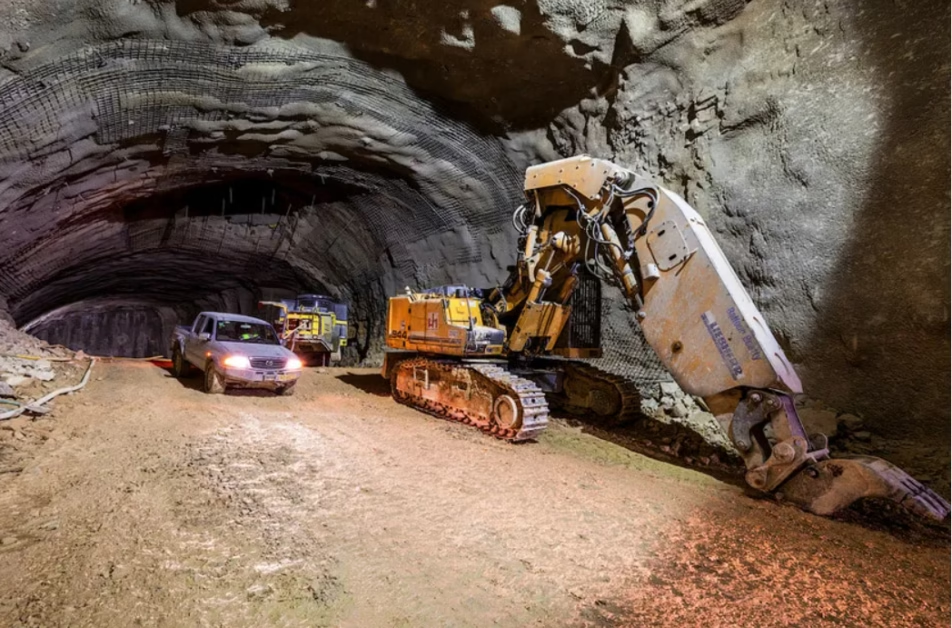
Pilbara Iron Ore Standard: Sourcing (N)TSKCGEWÖU 3×240+3×120/3 22/22kV for Bucket Wheel Excavators
Complete Technical Guide to Sourcing 22/22kV Medium Voltage Cables for Bucket Wheel Excavators in Pilbara Iron Ore Mining. Extreme Environment Durability Requirements, 45–50°C Ambient Temperature Performance, Symmetrical Earth Design for EMI Reduction, Anti-Torsion Aramid Reinforcement, UV and Abrasion Resistance, Mechanical Stress Analysis, Supplier Qualification for BHP/Rio Tinto/Fortescue Standards.
皮尔巴拉铁矿采购22/22kV中压电缆用于斗轮挖掘机的完整技术指南。极端环境耐久性要求、45-50°C环境温度性能、对称地线EMI抗扰设计、芳纶防扭转加强、紫外线和磨损阻力、机械应力分析、BHP/Rio Tinto/Fortescue标准供应商资质。
1. Pilbara Iron Ore Mining: Extreme Environment Baseline and BWE Power Requirements
The Pilbara region of Western Australia hosts some of the world’s largest iron ore mines operated by BHP, Rio Tinto, and Fortescue. The mining environment is defined by extremes: surface temperatures regularly exceed 45–50°C during summer months, UV radiation intensity is among the highest in Australia, iron ore is extraordinarily hard and sharp-edged (causing accelerated cable abrasion), and equipment operates in remote locations with minimal maintenance infrastructure.
澳洲西部皮尔巴拉地区拥有世界上一些最大的铁矿,由必和必拓、力拓和富瑞斯经营。采矿环境由极端条件定义:夏季地表温度常超45–50°C,紫外线强度是澳洲最高的,铁矿石异常坚硬且边缘锋利(导致电缆加速磨损),设备在维护基础设施最少的偏远位置运行。
Bucket Wheel Excavator Operations: A bucket wheel excavator (BWE) is a massive rotating machine that mines iron ore by continuous removal of overburden and ore. A typical Pilbara BWE operates 24/7 during mine production, with bucket wheel rotation speeds creating enormous dynamic electrical loads. A single large BWE power demand can reach 5–8 megawatts, requiring 22kV or higher voltage transmission from the main mine substation to the mobile machine.
Cable Deployment Requirements: BWE power cables are deployed as trailing cables—the cable unrolls from a reeling drum as the BWE advances through the mine pit, accumulating 500+ meters of cable length during extended operation. When the excavator repositions, the cable must be rapidly re-wound under high tension. This extreme dynamic flexing (20,000–50,000 cycles per year) combined with harsh environmental exposure (temperature, UV, abrasion) creates unprecedented cable engineering challenges.
2. Bucket Wheel Excavator Electrical Demands: Why 22/22kV Specification
The choice of 22/22kV voltage rating for Pilbara BWE cables reflects not only the high power demand but also system reliability requirements and economic optimization.
Power Transmission Efficiency: A 5 MW electrical load at 1.1kV requires conductor cross-sections exceeding 1000+ mm² (prohibitively large and heavy). The same 5 MW power at 22kV requires only 240 mm² conductors—a 4–5× reduction in conductor mass while maintaining acceptable voltage drop. This efficiency advantage justifies the higher voltage specification.
Reliability and Fault Tolerance: Pilbara mines operate in remote locations where cable failure causes complete production shutdown. Multiple large excavators operating on the same electrical system require voltage levels sufficient to provide good voltage regulation across distributed loads. 22kV provides better voltage margin across long cable runs than lower-voltage alternatives.
Equipment Compatibility: Major mining equipment manufacturers (specifically BWE builders) design their electrical systems for 22kV operation to match mine infrastructure standards. Using lower voltage would require voltage transformation equipment and create additional failure points.
3. 22/22kV Uo=U Rating: Isolated Neutral System Requirement for Pilbara Operations
Pilbara mines typically operate 22kV systems with isolated neutral (IT earthing) design—the same philosophy as underground mining but extended to the much larger voltage. During single-phase earth faults, healthy phases experience voltage rise to approximately 87% of line voltage. For a 22kV system, this is approximately 19 kV phase-to-earth sustained stress.
Standard 18/30kV Inadequacy: European standard 18/30kV cables (where Uo = 18/√3 ≈ 10.4 kV) cannot withstand 19 kV sustained stress and fail within minutes. The 22/22kV rating (Uo=U philosophy) provides insulation designed for 22 kV phase-to-earth continuous stress, offering safe operation with margin during fault conditions.
Operational Continuity Requirement: A sudden shutdown of a 5 MW excavator mid-excavation creates operational chaos. Mine personnel must be able to recognize fault conditions, execute controlled shutdown procedures, and arrange maintenance without emergency power loss. The 22/22kV cable specification enables this controlled response.
4. Complete Technical Specification: (N)TSKCGEWÖU 3×240+3×120/3 22/22kV Cable
| Parameter | 参数 | Value | 数值 | Unit | 单位 | Notes | 说明 |
|---|---|---|---|
| Voltage Rating (Uo/U) | 22 / 22 | kV | Isolated neutral system (IT) |
| Main Conductors | 3 × 240 | mm² | Phase power cores, tinned Cu |
| Earth Conductors | 3 × 120/3 | mm² | Symmetrical arrangement (3 strands × 40 mm² each) |
| AWG / MCM Equivalent | Phase: ~500 MCM | Earth: ~3 × 2/0 AWG | — | Approximate US equivalent |
| Outer Diameter | 92.0 – 98.0 | mm | Thick insulation layer impact |
| Copper Weight | 8,064 | kg/km | Conductor copper content |
| Total Cable Weight | 13,500 – 14,200 | kg/km | With EPR insulation + 5GM5 sheath |
| Ampacity (30°C) | 534 | A | Free air, 90°C conductor temp |
| Ampacity (45–50°C Pilbara) | ~438 | A | Derating factor ~0.82 for extreme heat |
| Max Tensile Load (Dynamic) | 10,800 | N | Standard rubber; higher with Kevlar reinforcement |
| Min Bending Radius | ~950 | mm | 10× outer diameter (dynamic reeling) |
5. Environmental Durability: Heat, UV, and Abrasion in Pilbara Conditions
The Pilbara represents extreme environmental stress that distinguishes BWE cables from all other mining applications. The combination of heat, UV, and abrasion creates accelerated degradation compared to temperate climate mining.
Temperature Stress (45–50°C): Pilbara summer surface temperatures reach 45–50°C. The outer sheath temperature of a cable carrying 534 amperes under 45°C ambient will reach approximately 80–90°C, approaching the cable conductor’s 90°C design limit. Ampacity derating is critical: a cable rated 534A at 30°C ambient is rated only ~438A at 45°C ambient—an 18% capacity reduction that must be accounted for in system design.
UV Degradation (Extreme Intensity): Pilbara receives approximately 2.5–3.0 times the UV radiation intensity of London or Berlin. Standard industrial cable PCP sheath (designed for European climates) degrades visibly within 3–4 years. Pilbara-spec cables require enhanced UV absorber additives (3–4% loading) in the 5GM5 outer sheath to maintain flexibility and prevent brittleness over 5–6 year service life.
Abrasion and Tearing (Iron Ore Contact): Pilbara iron ore is exceptionally hard and has sharp crystalline edges. Cable in contact with ore surface abrades at accelerated rate compared to other mining environments. The 5GM5 outer sheath thickness must be 3.2–3.5 mm (versus 2.5–2.8 mm for standard mining cables) to provide adequate abrasion resistance.
6. Symmetrical Earth Design: EMI Reduction and Field Distribution
The 3 × 120/3 earth conductor arrangement (three conductors of 40 mm² each, distributed symmetrically around the three power cores) is not arbitrary—it represents optimized electrical and mechanical design.
Symmetrical Field Distribution: Three separate earth conductors placed in the gaps between the three power cores create a symmetrical electromagnetic field around the cable. This symmetry reduces magnetic field radiation outside the cable, minimizing EMI (electromagnetic interference) with nearby communication systems and instrumentation in the mine pit. A single large earth core would create asymmetrical field that radiates EMI.
Reduced Cable Diameter: Three 40 mm² earth cores (total 120 mm²) in the interstices occupy less space than a single 120+ mm² earth core placed outside or alongside the power cores. The symmetrical arrangement keeps cable outer diameter more compact (92–98 mm) compared to alternative designs that might reach 105–110 mm.
Structural Stability: The symmetrical arrangement provides mechanical stability—the three earth conductors act as spacing elements that maintain consistent spacing between power cores during flexing, reducing the risk of conductor contact and short-circuit during extreme bending.
7. Mechanical Stress and Torsion Resistance: Aramid-Reinforced Design
BWE cables experience extreme dynamic stresses during reeling and deployment. Cables must withstand not only high tensile loads but also rotational (torsional) stresses that would destroy standard cable designs.
Torsional Stress During Reeling: When a 500-meter cable is wound onto a reeling drum, tension creates rotational stress. If the cable rotates (twists) excessively during winding, the conductor insulation can compress and crack (“bird-caging” effect where the insulation sheath separates from the conductor). Premium (N)TSKCGEWÖU cables include aramid fiber (Kevlar®) or special high-strength synthetic reinforcement layers between the insulation and outer sheath to resist torsional failure.
Tensile Load Capacity: The standard 10,800 N (maximum 1080 kg-force) tensile load limit must be respected during deployment. Cables with aramid reinforcement can tolerate higher dynamic loads (up to 13,000–14,000 N peak) without conductor breakage. For Pilbara BWE operations with aggressive reeling schedules, aramid-reinforced cables are strongly recommended.
Reeling Cycle Durability: A typical Pilbara BWE undergoes 20,000–50,000 reeling cycles per year (approximately 50–150 per operating day over 300–330 operating days annually). Standard cables degraded by this cycle count within 3–4 years. Aramid-reinforced designs maintain integrity through complete 5–6 year service life.
8. Extreme Temperature Ampacity Derating: 45–50°C Summer Operations
Ampacity derating is non-negotiable for Pilbara operations. Cable rating tables are based on standard 30°C ambient temperature assumptions. Pilbara summer ambient of 45–50°C requires significant ampacity reduction.
Derating Calculation: Standard derating factors for EPR cables operating at 45°C ambient temperature are approximately 0.82–0.85 (an 15–18% reduction from 30°C ampacity). For this 3×240 cable: 534 A × 0.82 ≈ 438 A at 45°C ambient.
System Design Implication: A 5 MW excavator requiring approximately 130–150 A per phase at full load cannot operate at full power during peak summer temperatures if a single cable at 438 A capacity is the power source. Either: (1) dual cables must be provided for full summer capacity, or (2) excavator output must be de-rated during peak temperature hours (10 AM–4 PM typical), or (3) mine infrastructure must include cooling systems for cable or forced ventilation of the reeling drum area.
Practical Solution: Most Pilbara mines specify dual-cable systems for critical BWE power, with automatic switching between cables for maintenance and derating protection. Cost premium is significant but essential for operational continuity.
9. Short-Circuit Performance and Thermal Limits at 22kV
22kV system short-circuit capacity is extremely high—typical Pilbara substation 22kV bus is rated 15–25 kA short-circuit capacity. Cable short-circuit thermal rating becomes critical.
Short-Circuit Current Magnitude: A 25 kA three-phase short circuit at 22kV creates phase current of approximately 14.4 kA per phase. For a 3×240 cable with three equal conductors, this represents 4,800 A per conductor. The thermal energy during 1-second short circuit: I²t = (4,800)² × 1 = 23,040,000 A²·s. The conductor temperature rise at this energy level exceeds 300°C, destroying cable insulation.
Protection Requirement: High-voltage (22kV) circuit breakers protecting BWE cables must clear faults within 300–500 milliseconds (0.3–0.5 seconds), not the 1-second assumption for low-voltage cables. This extremely fast clearing requirement mandates: (1) high-sensitivity current transformers, (2) instantaneous or near-instantaneous trip relays, and (3) rapid breaker operation mechanisms. Procurement must verify that substation protection is properly designed for 22kV cable protection.
10. BHP, Rio Tinto, Fortescue Standards: Industry-Specific Compliance Requirements
Each major Pilbara iron ore operator (BHP, Rio Tinto, Fortescue) maintains internal specifications that exceed standard VDE and AS/NZS requirements.
BHP Billiton Specifications: BHP specifies (N)TSKCGEWÖU cables with additional requirements: (1) aramid torsion reinforcement mandatory, (2) minimum insulation thickness 5.0 mm (standard specification often 4.5 mm), (3) 22/22kV Uo=U rating non-negotiable, (4) full documentation of UV absorber formulation and testing, (5) type testing including 5,000+ reeling cycle endurance (versus 1,000 cycles for standard), and (6) heat aging test at 95°C for 7 days simulating Pilbara summer conditions.
Rio Tinto Specifications: Rio Tinto emphasizes environmental testing: (1) salt-spray corrosion testing per ASTM B117 (500 hours minimum), (2) ozone exposure per ASTM G154 (1000+ hours), (3) UV aging per ISO 4892 (simulating 2–3 years Pilbara exposure), (4) tensile strength testing after environmental conditioning (no more than 10% reduction after thermal/UV aging), and (5) insulation resistance maintenance above 100 megohms throughout service life.
Fortescue Specifications: Fortescue requires: (1) complete supply chain traceability (all suppliers audited and approved), (2) factory acceptance testing witnessed by Fortescue engineer for all large orders, (3) yearly compliance testing during service life (insulation resistance, dielectric strength), (4) documented replacement of any cable approaching end of thermal or mechanical life, and (5) certified training for installation and maintenance crews.
11. Supplier Qualification and Procurement Strategy
Procuring 22/22kV cables for Pilbara BWE operations requires careful supplier selection and qualification.
Minimum Supplier Requirements: (1) ISO 9001 quality management certification, (2) type testing to VDE 0250-813 or equivalent, (3) experience with 22kV+ mining applications, (4) ability to provide full documentation (material certs, test reports, environmental conditioning results), (5) technical support for installation and commissioning, and (6) willingness to undergo mine-specific auditing by BHP/Rio Tinto/Fortescue.
Procurement Timeline: Typical cable procurement for Pilbara BWE applications requires 12–16 weeks: 2–3 weeks for quotation and supplier qualification, 4–6 weeks for cable manufacturing, 2–3 weeks for type testing and environmental conditioning, 2–3 weeks for shipping and customs, and 1–2 weeks for receiving inspection and final testing before installation.
Cost Considerations: 22/22kV cables with aramid reinforcement and Pilbara environmental specifications cost approximately $150–250 per meter (depending on quantity and complexity). A typical BWE installation requires 500–800 meters of cable per machine, representing $75,000–200,000 cable cost per installation. Dual-cable systems double this investment. These costs are justified by 5–6 year service life and mining productivity value.
12. Conclusion: Engineering for Pilbara Extremes
The Pilbara iron ore region represents one of the harshest electrical cable operating environments on Earth. 22/22kV bucket wheel excavator cables must simultaneously withstand extreme heat (45–50°C), intense UV radiation, sharp-edged mineral abrasion, dynamic mechanical stress from 20,000–50,000 reeling cycles annually, and sustained electrical stress during single-phase earth faults. The (N)TSKCGEWÖU 3×240+3×120/3 22/22kV specification—including aramid reinforcement, enhanced UV/heat formulations, and symmetrical earth design—represents a purpose-engineered solution for these extremes.
Procurement requires engagement with qualified suppliers experienced in Pilbara mine standards (BHP, Rio Tinto, Fortescue requirements), comprehensive environmental and mechanical testing, and disciplined installation/maintenance procedures. The investment in properly specified cables—though substantial—delivers 5–6 year service life and reliability essential to continuous mine operations in one of the world’s most challenging industrial environments.
Feichun Special Cable manufactures (N)TSKCGEWÖU 22/22kV cables engineered to Pilbara specifications including full BHP, Rio Tinto, and Fortescue compliance documentation. Our technical team has extensive experience with extreme-environment mining cable design and procurement coordination with Australia’s major iron ore operators.
References & Sources
- VDE 0250-813:2016, “Flexible cables – Part 813: Flexible cables for use with mining equipment,” Verband der Elektrotechnik Elektronik Informationstechnik.
- AS/NZS 1802:2012, “Rubber cables for underground mining applications,” Standards New Zealand and Standards Australia.
- AS/NZS 2802:2009, “Electrical installations – Portable electrical equipment,” Standards New Zealand and Standards Australia.
- ISO 4892:2021, “Plastics – Methods of exposure to laboratory light sources,” International Organization for Standardization.
- ASTM B117:2023, “Standard practice for operating salt spray (fog) apparatus,” ASTM International.
- Feichun Special Cable Research & Development Team, “(N)TSKCGEWÖU 22/22kV Cable Engineering for Pilbara Mining Operations,” Technical Report, 2024.


