Kevlar reinforced cable

Japanese Standard High Tension (HT) cables with Kevlar® reinforcement represent the pinnacle of specialized power distribution technology for demanding marine port applications. Engineered to conform to Japanese Industrial Standards (JIS C 3317, JIS C 3350), these cables incorporate integrated aramid reinforced layers that dramatically enhance tensile strength while maintaining the flexibility required for reel-mounted equipment operation. The term "high tension" in Japanese maritime engineering refers specifically to the mechanical tension and longitudinal stress experienced by cables subjected to extreme operational demands—including extended unsupported spans, repetitive reel cycling, heavy dynamic loading, and sustained exposure to marine environments. Unlike standard port cables, Japanese Standard HT cables with Kevlar® reinforcement are engineered for applications where: • Unsupported cable spans exceed 40–60 meters between ship and shore equipment or between reel stations • Combined electrical load and mechanical tension create dual stress conditions requiring advanced material science • Long service life expectancy (7–10+ years) justifies premium reinforcement material investment • Environmental exposure to saltwater aerosol, UV radiation, and thermal cycling demands superior polymer formulation • High-availability terminal operations cannot tolerate premature cable failure and operational downtime The integration of Kevlar® aramid reinforcement layers represents a fundamental departure from conventional cable design. Rather than relying solely on rubber insulation and polymer sheathing to provide mechanical strength, Kevlar-reinforced cables employ a specialized tension layer that carries a portion of the cable's weight and operational stress, thereby reducing stress on the insulation and extending overall cable service life by 40–60% compared to unreinforced designs.

Japanese Standard High Tension Cables with Kevlar® Reinforcement

Japanese Standard High Tension (HT) cables with Kevlar® reinforcement represent the pinnacle of specialized power distribution technology for demanding marine port applications. Engineered to conform to Japanese Industrial Standards (JIS C 3317, JIS C 3350), these cables incorporate integrated aramid reinforced layers that dramatically enhance tensile strength while maintaining the flexibility required for reel-mounted equipment operation. The term “high tension” in Japanese maritime engineering refers specifically to the mechanical tension and longitudinal stress experienced by cables subjected to extreme operational demands—including extended unsupported spans, repetitive reel cycling, heavy dynamic loading, and sustained exposure to marine environments. Unlike standard port cables, Japanese Standard HT cables with Kevlar® reinforcement are engineered for applications where: • Unsupported cable spans exceed 40–60 meters between ship and shore equipment or between reel stations • Combined electrical load and mechanical tension create dual stress conditions requiring advanced material science • Long service life expectancy (7–10+ years) justifies premium reinforcement material investment • Environmental exposure to saltwater aerosol, UV radiation, and thermal cycling demands superior polymer formulation • High-availability terminal operations cannot tolerate premature cable failure and operational downtime The integration of Kevlar® aramid reinforcement layers represents a fundamental departure from conventional cable design. Rather than relying solely on rubber insulation and polymer sheathing to provide mechanical strength, Kevlar-reinforced cables employ a specialized tension layer that carries a portion of the cable’s weight and operational stress, thereby reducing stress on the insulation and extending overall cable service life by 40–60% compared to unreinforced designs.
KSC 3317 Standard (Korean Industrial Standard C 3317: "Rubber Insulated Flexible Cables — 0.6/1kV") is the authoritative technical specification for cabtyre and flexible power cables used throughout industrial Korea and the international markets where Korean engineering standards are recognized. Adopted as a modification of IEC 60502-1, the KSC 3317 standard defines comprehensive requirements for: Conductor materials and stranding patterns • Insulation thickness and composition • Sheath material and durability requirements • Electrical performance at rated voltage • Mechanical properties including tensile strength and elongation • Temperature operating ranges and chemical resistance • Test methods for verification and certification For port crane and ship unloader applications, cables manufactured to KSC 3317 represent the consensus engineering standard across Asia-Pacific maritime terminals. Korean container terminal operators in Busan, Incheon, and Gwangyang port complexes universally specify KSC 3317-compliant cables for all festoon, cableveyor, and hoist systems. The standard's adoption by major STS crane manufacturers (including Liebherr, Konecranes, and Kalmar) has made KSC 3317 the de facto global specification for Japanese-compatible port crane cables.

KSC 3317 Port Crane & Ship Unloader Cables

KSC 3317 Standard (Korean Industrial Standard C 3317: “Rubber Insulated Flexible Cables — 0.6/1kV”) is the authoritative technical specification for cabtyre and flexible power cables used throughout industrial Korea and the international markets where Korean engineering standards are recognized. Adopted as a modification of IEC 60502-1, the KSC 3317 standard defines comprehensive requirements for: Conductor materials and stranding patterns • Insulation thickness and composition • Sheath material and durability requirements • Electrical performance at rated voltage • Mechanical properties including tensile strength and elongation • Temperature operating ranges and chemical resistance • Test methods for verification and certification For port crane and ship unloader applications, cables manufactured to KSC 3317 represent the consensus engineering standard across Asia-Pacific maritime terminals. Korean container terminal operators in Busan, Incheon, and Gwangyang port complexes universally specify KSC 3317-compliant cables for all festoon, cableveyor, and hoist systems. The standard’s adoption by major STS crane manufacturers (including Liebherr, Konecranes, and Kalmar) has made KSC 3317 the de facto global specification for Japanese-compatible port crane cables.
crane cable range is a complete family of six specialised cable types engineered to cover every electrical and data connection on modern port cranes — from the simplest yard crane spreader circuit to the most complex automated STS crane with integrated fibre optic networking. The family is divided into two series: the WS-RLIN series for motorised cable reel systems, and the WS-SPRD series for gravity collector basket (festoon basket) systems. Every cable in the range shares a common engineering foundation: JIS C 3327 compliance for rubber-insulated machinery cables, chloroprene rubber (CR) sheathing for oil/ozone/UV resistance, EPR insulation rated to 90°C, and an ambient temperature range of −40°C to +90°C that covers every port environment on earth from arctic to tropical. Within this shared foundation, each cable type is differentiated by its reinforcement system, voltage class, conductor range, and application-specific optimisations.

WALSREEN® Complete Port Crane Cable Range

crane cable range is a complete family of six specialised cable types engineered to cover every electrical and data connection on modern port cranes — from the simplest yard crane spreader circuit to the most complex automated STS crane with integrated fibre optic networking. The family is divided into two series: the WS-RLIN series for motorised cable reel systems, and the WS-SPRD series for gravity collector basket (festoon basket) systems. Every cable in the range shares a common engineering foundation: JIS C 3327 compliance for rubber-insulated machinery cables, chloroprene rubber (CR) sheathing for oil/ozone/UV resistance, EPR insulation rated to 90°C, and an ambient temperature range of −40°C to +90°C that covers every port environment on earth from arctic to tropical. Within this shared foundation, each cable type is differentiated by its reinforcement system, voltage class, conductor range, and application-specific optimisations.
WS-SPRD-HEXNCT was engineered specifically for this extreme duty class. Its defining characteristic is the HEXNCT enhanced chloroprene rubber sheath — a heavy-duty outer layer with thickness ranging from 4.5 mm to 5.1 mm, representing a 36–38% increase over the standard WS-SPRD-2PNCT's 3.3–3.7 mm sheath. This enhanced sheath provides a dramatically larger abrasion wear allowance at basket carrier contact points, greater resistance to mechanical impact from falling debris, and a more robust barrier against the chemical and environmental hazards of the container crane operating environment.

WALSREEN® WS-SPRD-HEXNCT Spreader Basket System Flexible Cable

WS-SPRD-HEXNCT was engineered specifically for this extreme duty class. Its defining characteristic is the HEXNCT enhanced chloroprene rubber sheath — a heavy-duty outer layer with thickness ranging from 4.5 mm to 5.1 mm, representing a 36–38% increase over the standard WS-SPRD-2PNCT’s 3.3–3.7 mm sheath. This enhanced sheath provides a dramatically larger abrasion wear allowance at basket carrier contact points, greater resistance to mechanical impact from falling debris, and a more robust barrier against the chemical and environmental hazards of the container crane operating environment.
WS-SPRD-2PNCT was engineered specifically for this unforgiving application. It combines high-core-count construction (30, 36, or 42 cores at 3.5 mm²) to carry the full complement of spreader control and signal circuits in a single cable, steel-wire-stranded conductors for tension resistance under self-weight suspension, chloroprene rubber sheathing for oil, ozone, and UV resistance in coastal port environments, and a cable geometry specifically optimised for the continuous lateral bending and catenary formation cycles unique to gravity collector basket systems. Manufactured to dual standards — JIS C 3327 (rubber-insulated machinery cables) and VDE 0250-813 (flexible cables) — the WS-SPRD-2PNCT represents dedicated engineering for a niche but mission-critical application. A failed spreader basket cable means a stopped crane, a grounded spreader, and halted container operations. There is no redundancy — the cable is the sole electrical lifeline between the crane's trolley and the spreader that grips the containers.

WALSREEN® WS-SPRD-2PNCT Spreader Basket System Flexible Cable

WS-SPRD-2PNCT was engineered specifically for this unforgiving application. It combines high-core-count construction (30, 36, or 42 cores at 3.5 mm²) to carry the full complement of spreader control and signal circuits in a single cable, steel-wire-stranded conductors for tension resistance under self-weight suspension, chloroprene rubber sheathing for oil, ozone, and UV resistance in coastal port environments, and a cable geometry specifically optimised for the continuous lateral bending and catenary formation cycles unique to gravity collector basket systems. Manufactured to dual standards — JIS C 3327 (rubber-insulated machinery cables) and VDE 0250-813 (flexible cables) — the WS-SPRD-2PNCT represents dedicated engineering for a niche but mission-critical application. A failed spreader basket cable means a stopped crane, a grounded spreader, and halted container operations. There is no redundancy — the cable is the sole electrical lifeline between the crane’s trolley and the spreader that grips the containers.
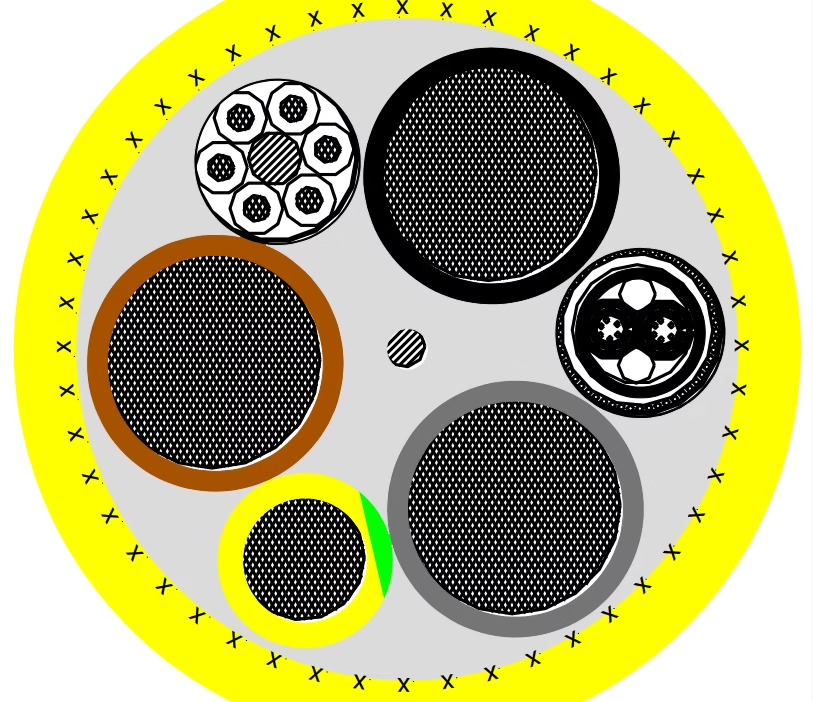
WS-RLIN-3PNCT-OF is the engineering answer to this convergence challenge. It integrates three-phase medium-voltage power conductors (3 × 38–60 mm² at AC 6,600 V) with a dedicated neutral/earth return conductor and six optical fibres housed in individually colour-coded ETFE protective tubes — all within a single Kevlar®-reinforced, chloroprene-sheathed cable construction. This hybrid design eliminates the need for separate power and fibre optic cables on the reel system, reducing reel complexity, installation time, maintenance burden, and total cable weight, while ensuring perfect synchronisation between power and data paths — because both travel through the same physical cable at all times.

WALSREEN® WS-RLIN-3PNCT-OF Hybrid Power & Fibre Optic Reel System Flexible Cable

WS-RLIN-3PNCT-OF is the engineering answer to this convergence challenge. It integrates three-phase medium-voltage power conductors (3 × 38–60 mm² at AC 6,600 V) with a dedicated neutral/earth return conductor and six optical fibres housed in individually colour-coded ETFE protective tubes — all within a single Kevlar®-reinforced, chloroprene-sheathed cable construction. This hybrid design eliminates the need for separate power and fibre optic cables on the reel system, reducing reel complexity, installation time, maintenance burden, and total cable weight, while ensuring perfect synchronisation between power and data paths — because both travel through the same physical cable at all times.
Modern port logistics infrastructure demands electrical cables that can withstand punishing mechanical conditions no ordinary flexible cable is designed to endure. A travelling cable reel system on a ship-to-shore container crane, bulk ship unloader, or harbour gantry crane repeatedly spools and unspools the cable as the trolley, grab, or spreader traverses its operating range — subjecting the cable to continuous tensile loading, cyclical bending around the reel drum, torsional forces from crane slew motion, and environmental assault from coastal salt spray, UV radiation, hydraulic oil contamination, and extreme temperature swings. The cable must survive hundreds of thousands of these combined loading cycles across a service life measured in years, not months.

WALSREEN® WS-RLIN-2PNCT / WS-RLIN-3PNCT Reel System Flexible Cable

Modern port logistics infrastructure demands electrical cables that can withstand punishing mechanical conditions no ordinary flexible cable is designed to endure. A travelling cable reel system on a ship-to-shore container crane, bulk ship unloader, or harbour gantry crane repeatedly spools and unspools the cable as the trolley, grab, or spreader traverses its operating range — subjecting the cable to continuous tensile loading, cyclical bending around the reel drum, torsional forces from crane slew motion, and environmental assault from coastal salt spray, UV radiation, hydraulic oil contamination, and extreme temperature swings. The cable must survive hundreds of thousands of these combined loading cycles across a service life measured in years, not months.
WS-RLIN-2PNCT-KB was engineered specifically to solve this challenge. Its defining innovation is a Kevlar® aramid fibre reinforcing layer — the same poly-paraphenylene terephthalamide material used in military-grade ballistic body armour — woven into a proprietary helical braid pattern that distributes tensile load uniformly across the cable's cross-section. This Kevlar reinforcement delivers tensile strength comparable to steel braid at a fraction of the weight, eliminates the fatigue-induced wire breakage that plagues conventional steel-armoured reeling cables, and maintains exceptional flexibility throughout the cable's operational life.

WALSREEN® WS-RLIN-2PNCT-KB Reel System Flexible Cable

WS-RLIN-2PNCT-KB was engineered specifically to solve this challenge. Its defining innovation is a Kevlar® aramid fibre reinforcing layer — the same poly-paraphenylene terephthalamide material used in military-grade ballistic body armour — woven into a proprietary helical braid pattern that distributes tensile load uniformly across the cable’s cross-section. This Kevlar reinforcement delivers tensile strength comparable to steel braid at a fraction of the weight, eliminates the fatigue-induced wire breakage that plagues conventional steel-armoured reeling cables, and maintains exceptional flexibility throughout the cable’s operational life.
FSTN-OFNCT is a high-performance optical fiber flexible cable designed specifically for signal and data transmission on port cranes, ship unloaders, container gantry cranes, and heavy-duty material handling equipment. Unlike conventional industrial fibre optic cables that rely on standard polymer or steel-wire tensile members, the WS-FSTN-OFNCT incorporates a Kevlar® (para-aramid) fibre reinforcement layer—the same ballistic-grade material used in bulletproof vests and military-grade protective equipment—braided in a proprietary pattern that delivers exceptional tensile strength while preserving the cable's full flexibility under continuous reeling and festoon operation.

Kevlar® Aramid Fibre Reinforced Optical Fiber Flexible Cable with Specially Braided Tensile Layer for Signal and Data Transmission on Port Cranes, Ship Unloaders, Container Gantry Cranes, and Heavy-Duty Material Handling Equipment — Engineered for Cable Reel Systems, Festoon Systems, and Continuous Flexing Applications with Graded Index 50/125, 62.5/125, and Singlemode E9/125 Fibre Options

FSTN-OFNCT is a high-performance optical fiber flexible cable designed specifically for signal and data transmission on port cranes, ship unloaders, container gantry cranes, and heavy-duty material handling equipment. Unlike conventional industrial fibre optic cables that rely on standard polymer or steel-wire tensile members, the WS-FSTN-OFNCT incorporates a Kevlar® (para-aramid) fibre reinforcement layer—the same ballistic-grade material used in bulletproof vests and military-grade protective equipment—braided in a proprietary pattern that delivers exceptional tensile strength while preserving the cable’s full flexibility under continuous reeling and festoon operation.
WS-FSTN-3PNCT fills a critical gap in the festoon cable product range: it provides the mechanical reinforcement of 3PNCT construction — the dedicated textile reinforcing layer that protects against impact, crush, and abrasion — without the weight and cost of a metallic shield braid. This makes it the optimal choice for power distribution and discrete control circuits in harsh mechanical environments where EMI shielding is not required but standard 2PNCT cables cannot survive.

WALSTOON® WS-FSTN-3PNCT Festoon System Flexible Cable

WS-FSTN-3PNCT fills a critical gap in the festoon cable product range: it provides the mechanical reinforcement of 3PNCT construction — the dedicated textile reinforcing layer that protects against impact, crush, and abrasion — without the weight and cost of a metallic shield braid. This makes it the optimal choice for power distribution and discrete control circuits in harsh mechanical environments where EMI shielding is not required but standard 2PNCT cables cannot survive.
WS-FSTN-3PNCT-SB represents the premium tier of the WALSTOON festoon cable family — a cable engineered for applications where standard 2PNCT construction does not provide sufficient mechanical protection. The critical difference is in the designation: 3PNCT versus 2PNCT. The "3" indicates a three-layer sheathing system that includes a dedicated textile reinforcing layer between the core bundle and the outer sheath — a layer that the standard 2PNCT construction does not have. In practice, this reinforcing layer transforms the cable from a flexible electrical conductor into a mechanically reinforced structure that resists impact damage, crushing forces, abrasion penetration, and tensile stress far beyond the capability of standard 2PNCT cables. When a festoon cable runs through a harsh environment — exposed to falling debris from bulk cargo operations, crushed between moving crane structures, subjected to extreme tensile loading during emergency stops, or dragged across abrasive steel surfaces — the reinforcing layer provides the mechanical margin of safety that prevents cable failure. Combined with the tinned copper shield braid for EMI protection, the WS-FSTN-3PNCT-SB delivers dual-layer protection: electromagnetic shielding for signal integrity, and mechanical reinforcement for physical survivability. This combination makes it the cable of choice for the most demanding festoon system positions — particularly on grab-type ship unloaders, heavy-duty overhead cranes in steel mills and foundries, and any application where the cable is exposed to significant mechanical abuse beyond normal festoon system operation.

WALSTOON® WS-FSTN-3PNCT-SB Festoon System Flexible Cable

WS-FSTN-3PNCT-SB represents the premium tier of the WALSTOON festoon cable family — a cable engineered for applications where standard 2PNCT construction does not provide sufficient mechanical protection. The critical difference is in the designation: 3PNCT versus 2PNCT. The “3” indicates a three-layer sheathing system that includes a dedicated textile reinforcing layer between the core bundle and the outer sheath — a layer that the standard 2PNCT construction does not have. In practice, this reinforcing layer transforms the cable from a flexible electrical conductor into a mechanically reinforced structure that resists impact damage, crushing forces, abrasion penetration, and tensile stress far beyond the capability of standard 2PNCT cables. When a festoon cable runs through a harsh environment — exposed to falling debris from bulk cargo operations, crushed between moving crane structures, subjected to extreme tensile loading during emergency stops, or dragged across abrasive steel surfaces — the reinforcing layer provides the mechanical margin of safety that prevents cable failure. Combined with the tinned copper shield braid for EMI protection, the WS-FSTN-3PNCT-SB delivers dual-layer protection: electromagnetic shielding for signal integrity, and mechanical reinforcement for physical survivability. This combination makes it the cable of choice for the most demanding festoon system positions — particularly on grab-type ship unloaders, heavy-duty overhead cranes in steel mills and foundries, and any application where the cable is exposed to significant mechanical abuse beyond normal festoon system operation.
WS-FSTN-2PNCT is the foundation cable of the WALSTOON festoon system product family — a high-performance, unshielded, rubber-insulated flexible cable engineered for the demanding mechanical and environmental conditions of port gantry cranes, ship unloaders, cable chain systems, and industrial overhead cranes. With the widest configuration range in the WALSTOON product line — from single-conductor 250 mm² power cables capable of carrying hundreds of amperes to compact 30-core × 0.75 mm² multi-circuit control cables — the WS-FSTN-2PNCT addresses every power distribution and discrete control requirement on a crane festoon system.

WALSTOON® WS-FSTN-2PNCT Festoon System Flexible Cable

WS-FSTN-2PNCT is the foundation cable of the WALSTOON festoon system product family — a high-performance, unshielded, rubber-insulated flexible cable engineered for the demanding mechanical and environmental conditions of port gantry cranes, ship unloaders, cable chain systems, and industrial overhead cranes. With the widest configuration range in the WALSTOON product line — from single-conductor 250 mm² power cables capable of carrying hundreds of amperes to compact 30-core × 0.75 mm² multi-circuit control cables — the WS-FSTN-2PNCT addresses every power distribution and discrete control requirement on a crane festoon system.
WS-FSTN-2PNCT-SB is a comprehensive-range festoon system flexible cable designed to meet the diverse wiring requirements of port gantry cranes, ship unloaders, cable chain systems, and industrial overhead crane applications. While its sibling product — the WS-FSTN-2PNCT-PSB — features Kevlar® para-aramid fibre reinforcement for extreme tensile applications, the WS-FSTN-2PNCT-SB focuses on delivering the widest possible range of core configurations with reliable tinned copper shield braiding, covering everything from compact 2-core signal cables to high-density 30-core multi-circuit cables and paired-core variants for balanced signal transmission.

WALSTOON® WS-FSTN-2PNCT-SB Festoon System Flexible Cable

WS-FSTN-2PNCT-SB is a comprehensive-range festoon system flexible cable designed to meet the diverse wiring requirements of port gantry cranes, ship unloaders, cable chain systems, and industrial overhead crane applications. While its sibling product — the WS-FSTN-2PNCT-PSB — features Kevlar® para-aramid fibre reinforcement for extreme tensile applications, the WS-FSTN-2PNCT-SB focuses on delivering the widest possible range of core configurations with reliable tinned copper shield braiding, covering everything from compact 2-core signal cables to high-density 30-core multi-circuit cables and paired-core variants for balanced signal transmission.
Festoon cables on port gantry cranes and ship unloaders endure some of the most punishing operating conditions in industrial cable engineering. Every time the crane trolley travels along its rail, the festoon cable is dragged, flexed, accelerated, and decelerated across spans of 100–300 metres. The cable must support its own suspended weight between trolley hangers, absorb dynamic shock loads during emergency stops, withstand continuous wind-induced vibration in exposed coastal environments, and resist the corrosive effects of saltwater spray, UV radiation, and airborne industrial contaminants — all while maintaining electrical continuity and signal integrity for safety-critical crane control systems.

WALSTOON® WS-FSTN-2PNCT-PSB Festoon System Flexible Cable

AC 600V Festoon System Flexible Cable with Kevlar® Para-Aramid Fibre Braided Tensile Reinforcement Layer, JIS C 3327 Compliant, −40°C to +90°C Operating Range, Oil-Resistant, Flame-Retardant — Engineered for Port Gantry Cranes, Ship-to-Shore Unloaders, Container Handling Equipment, and Heavy-Duty Cable Chain Applications
Complete Technical Guide to Specialized Vertical Reeling Cable Systems for Container Spreaders on Ship-to-Shore (STS) and Rubber-Tired Gantry (RTG) Cranes. Deep Analysis of Aramid (Kevlar) Core Strain-Relief Engineering, Gravity Suspension Load Physics, Dynamic Tension Management, Multi-Core Control Cable Architecture (24G2.5 through 48G2.5), Twist-Lock Sensor Integration, Flipper Control Circuits, High-Definition Camera Feed Transmission. VDE 0250-814 Standards, Vertical Reeling System Physics, Acceleration/Deceleration Shock Analysis, Material Selection (Rubber vs. Polyurethane), Real-World Deployment Scenarios, and Factory-Direct Procurement Strategy for Spreader Cable Replacement in High-Utilization Port Terminals.

Spreader Cable Reel Engineering Guide: Vertical Reeling Systems, Aramid Core Strain Relief, and Gravity Stress Management for Modern STS and RTG Container Cranes

Complete Technical Guide to Specialized Vertical Reeling Cable Systems for Container Spreaders on Ship-to-Shore (STS) and Rubber-Tired Gantry (RTG) Cranes. Deep Analysis of Aramid (Kevlar) Core Strain-Relief Engineering, Gravity Suspension Load Physics, Dynamic Tension Management, Multi-Core Control Cable Architecture (24G2.5 through 48G2.5), Twist-Lock Sensor Integration, Flipper Control Circuits, High-Definition Camera Feed Transmission. VDE 0250-814 Standards, Vertical Reeling System Physics, Acceleration/Deceleration Shock Analysis, Material Selection (Rubber vs. Polyurethane), Real-World Deployment Scenarios, and Factory-Direct Procurement Strategy for Spreader Cable Replacement in High-Utilization Port Terminals.
Full technical breakdown Aristoncavi PANZERLITE 0.6/1 kV: revolutionary lightweight polyurethane cable for Ship-to-Shore basket operation. "LITE" (Lightweight) reflects core philosophy: every kg of weight saved directly reduces kinetic energy of 50–80 m free fall, cuts impact shock on basket, prevents tangling in rings, radically lowers peak tension in central Kevlar strength element. Configuration 44G2.5 or 54G2.5: multiple thin cores (44–54 cores) × 2.5 mm² each, powering spreader motors + control signals. Mass 25–35% lower than standard spreader cables of same section (thin-wall insulation, light PUR sheath). Unique anti-twist wrap between cores and sheath acts as mechanical damper: during unwinding, actively returns cable to natural straight state, prevents spiral deformation and overtwist. Central Kevlar (aramid) strength element, 18–22 kN tensile, carries full suspended cable weight (80 m). EPR insulation, halogen-free yellow PUR sheath, flame retardant IEC 60332-3 + low smoke ISO 1182. OD ~16–20 mm, weight ~0.65–0.85 kg/m (30% lighter than CORDAFLEX K). FeiChun Lightweight Basket Cable — drop-in equivalent with anti-twist innovation and perfect weight-strength balance.

PANZERLITE Облегченный кабель для крановых корзин STS: инновационная конструкция против скручивания — FeiChun Lightweight Basket Cable, аналог Aristoncavi

Full technical breakdown Aristoncavi PANZERLITE 0.6/1 kV: revolutionary lightweight polyurethane cable for Ship-to-Shore basket operation. “LITE” (Lightweight) reflects core philosophy: every kg of weight saved directly reduces kinetic energy of 50–80 m free fall, cuts impact shock on basket, prevents tangling in rings, radically lowers peak tension in central Kevlar strength element. Configuration 44G2.5 or 54G2.5: multiple thin cores (44–54 cores) × 2.5 mm² each, powering spreader motors + control signals. Mass 25–35% lower than standard spreader cables of same section (thin-wall insulation, light PUR sheath). Unique anti-twist wrap between cores and sheath acts as mechanical damper: during unwinding, actively returns cable to natural straight state, prevents spiral deformation and overtwist. Central Kevlar (aramid) strength element, 18–22 kN tensile, carries full suspended cable weight (80 m). EPR insulation, halogen-free yellow PUR sheath, flame retardant IEC 60332-3 + low smoke ISO 1182. OD ~16–20 mm, weight ~0.65–0.85 kg/m (30% lighter than CORDAFLEX K). FeiChun Lightweight Basket Cable — drop-in equivalent with anti-twist innovation and perfect weight-strength balance.
The Pilbara region of Western Australia hosts some of the world's largest iron ore mines operated by BHP, Rio Tinto, and Fortescue. The mining environment is defined by extremes: surface temperatures regularly exceed 45–50°C during summer months, UV radiation intensity is among the highest in Australia, iron ore is extraordinarily hard and sharp-edged (causing accelerated cable abrasion), and equipment operates in remote locations with minimal maintenance infrastructure. 澳洲西部皮尔巴拉地区拥有世界上一些最大的铁矿,由必和必拓、力拓和富瑞斯经营。采矿环境由极端条件定义:夏季地表温度常超45–50°C,紫外线强度是澳洲最高的,铁矿石异常坚硬且边缘锋利(导致电缆加速磨损),设备在维护基础设施最少的偏远位置运行。 Bucket Wheel Excavator Operations: A bucket wheel excavator (BWE) is a massive rotating machine that mines iron ore by continuous removal of overburden and ore. A typical Pilbara BWE operates 24/7 during mine production, with bucket wheel rotation speeds creating enormous dynamic electrical loads. A single large BWE power demand can reach 5–8 megawatts, requiring 22kV or higher voltage transmission from the main mine substation to the mobile machine. Cable Deployment Requirements: BWE power cables are deployed as trailing cables—the cable unrolls from a reeling drum as the BWE advances through the mine pit, accumulating 500+ meters of cable length during extended operation. When the excavator repositions, the cable must be rapidly re-wound under high tension. This extreme dynamic flexing (20,000–50,000 cycles per year) combined with harsh environmental exposure (temperature, UV, abrasion) creates unprecedented cable engineering challenges.

Pilbara Iron Ore Standard: Sourcing (N)TSKCGEWÖU 3×240+3×120/3 22/22kV for Bucket Wheel Excavators

The Pilbara region of Western Australia hosts some of the world’s largest iron ore mines operated by BHP, Rio Tinto, and Fortescue. The mining environment is defined by extremes: surface temperatures regularly exceed 45–50°C during summer months, UV radiation intensity is among the highest in Australia, iron ore is extraordinarily hard and sharp-edged (causing accelerated cable abrasion), and equipment operates in remote locations with minimal maintenance infrastructure. 澳洲西部皮尔巴拉地区拥有世界上一些最大的铁矿,由必和必拓、力拓和富瑞斯经营。采矿环境由极端条件定义:夏季地表温度常超45–50°C,紫外线强度是澳洲最高的,铁矿石异常坚硬且边缘锋利(导致电缆加速磨损),设备在维护基础设施最少的偏远位置运行。 Bucket Wheel Excavator Operations: A bucket wheel excavator (BWE) is a massive rotating machine that mines iron ore by continuous removal of overburden and ore. A typical Pilbara BWE operates 24/7 during mine production, with bucket wheel rotation speeds creating enormous dynamic electrical loads. A single large BWE power demand can reach 5–8 megawatts, requiring 22kV or higher voltage transmission from the main mine substation to the mobile machine. Cable Deployment Requirements: BWE power cables are deployed as trailing cables—the cable unrolls from a reeling drum as the BWE advances through the mine pit, accumulating 500+ meters of cable length during extended operation. When the excavator repositions, the cable must be rapidly re-wound under high tension. This extreme dynamic flexing (20,000–50,000 cycles per year) combined with harsh environmental exposure (temperature, UV, abrasion) creates unprecedented cable engineering challenges.
Why European 0.6/1kV cables must be upgraded to 1.1/1.1kV in Australian and New Zealand markets. IT earthing system insulation requirements, 4G95 conductor specification, 5600–6470 kg/km total weight, 3648 kg/km copper content, 260–295A ampacity, 50.8–58.0mm outer diameter, port crane and mining reeling applications, VDE 0250 and AS/NZS standard compliance, procurement verification guide.

NSHTÖU-J 4G95 1.1/1.1kV 卷筒电缆:澳洲/新西兰标准完整规格指南与采购实践

Why European 0.6/1kV cables must be upgraded to 1.1/1.1kV in Australian and New Zealand markets. IT earthing system insulation requirements, 4G95 conductor specification, 5600–6470 kg/km total weight, 3648 kg/km copper content, 260–295A ampacity, 50.8–58.0mm outer diameter, port crane and mining reeling applications, VDE 0250 and AS/NZS standard compliance, procurement verification guide.
Walk into the procurement office of any major container port or container handling facility, and you will almost certainly encounter discussions about reeling cables for cranes. The conversation often centers around one particular product family: Draka's Buflex XTREME series. Since its introduction in the early 2000s, Buflex XTREME has become the de facto standard for high-speed, space-constrained applications across port machinery—rubber tyred gantry cranes (RTG), ship-to-shore cranes (STS), and mobile harbor equipment. The cable family has earned this reputation through genuine technical excellence: an exceptionally compact outer diameter, remarkable flexibility, and proven durability under continuous flexing stress. Yet despite—or perhaps because of—this market dominance, Buflex XTREME presents a formidable procurement challenge for port operators, especially those managing budgets across multiple facilities in different regions.

Draka Buflex XTREME Replacement Guide: High-Performance Reeling Cables for Port Cranes with Superior Cost-Effectiveness and Fast Delivery

Walk into the procurement office of any major container port or container handling facility, and you will almost certainly encounter discussions about reeling cables for cranes. The conversation often centers around one particular product family: Draka’s Buflex XTREME series. Since its introduction in the early 2000s, Buflex XTREME has become the de facto standard for high-speed, space-constrained applications across port machinery—rubber tyred gantry cranes (RTG), ship-to-shore cranes (STS), and mobile harbor equipment. The cable family has earned this reputation through genuine technical excellence: an exceptionally compact outer diameter, remarkable flexibility, and proven durability under continuous flexing stress. Yet despite—or perhaps because of—this market dominance, Buflex XTREME presents a formidable procurement challenge for port operators, especially those managing budgets across multiple facilities in different regions.
RHEYFIRM cable, RHEYFIRM RTS, RHEYFIRM RS, NTSCGEWTOEUS, NTSKCGECWÖU, Kevlar reinforced cable, aramid fiber cable, DIN VDE 0250-813, medium voltage reeling cable, ultra-long vertical travel cable, deep shaft mining cable, mine hoist cable, STS crane cable, ship-to-shore crane cable, RMG crane cable, trailing cable, EPR insulated cable, rubber sheathed flexible cable, 高压卷筒电缆, 凯夫拉加强电缆, 矿用电缆, 起重机电缆, Nexans equivalent cable, Prysmian alternative cable, coal cutter cable, tunnel boring machine cable, TBM cable, elevator traveling cable, high-rise elevator cable, steel core vs Kevlar cable, aramid strength member cable, DIN VDE 0250 Part 813 compliant, VDE mining cable, 6/10kV reeling cable, 12/20kV trailing cable, 18/30kV power cable, open-pit mining cable, underground mining cable, flexible power cable for cranes, material handling cable, tinned copper conductor cable, flame retardant mining cable, oil resistant reeling cable, ozone resistant cable, Feichun special cable, 安徽飞纯电缆, 飞纯特种电缆, NSSHCGEWÖU cable, continuous miner cable, dragline cable, stacker reclaimer cable, excavator power cable

RHEYFIRM® (RS) vs. RHEYFIRM® (RTS): When to Choose RHEYFIRM® KE Kevlar (N)TSKCGECWÖU for Ultra-Long Vertical Travel

RHEYFIRM cable, RHEYFIRM RTS, RHEYFIRM RS, NTSCGEWTOEUS, NTSKCGECWÖU, Kevlar reinforced cable, aramid fiber cable, DIN VDE 0250-813, medium voltage reeling cable, ultra-long vertical travel cable, deep shaft mining cable, mine hoist cable, STS crane cable, ship-to-shore crane cable, RMG crane cable, trailing cable, EPR insulated cable, rubber sheathed flexible cable, 高压卷筒电缆, 凯夫拉加强电缆, 矿用电缆, 起重机电缆, Nexans equivalent cable, Prysmian alternative cable, coal cutter cable, tunnel boring machine cable, TBM cable, elevator traveling cable, high-rise elevator cable, steel core vs Kevlar cable, aramid strength member cable, DIN VDE 0250 Part 813 compliant, VDE mining cable, 6/10kV reeling cable, 12/20kV trailing cable, 18/30kV power cable, open-pit mining cable, underground mining cable, flexible power cable for cranes, material handling cable, tinned copper conductor cable, flame retardant mining cable, oil resistant reeling cable, ozone resistant cable, Feichun special cable, 安徽飞纯电缆, 飞纯特种电缆, NSSHCGEWÖU cable, continuous miner cable, dragline cable, stacker reclaimer cable, excavator power cable
The cable selection debate between premium branded products like Nexans Olex Versolex and generic alternatives such as Type 441 cables represents a critical decision point for electrical contractors, mining operators, and industrial facility managers. This technical analysis examines whether the higher initial investment in Versolex flexible cables delivers measurable value through extended service life, reduced maintenance costs, and superior operational reliability. Both cable types serve different primary markets—Versolex targets commercial and industrial flexible power applications compliant with AS/NZS 5000.1, while Type 441 cables are specifically engineered for harsh mining environments under AS/NZS 2802 standards. 在Nexans Olex Versolex等高端品牌产品与Type 441等通用电缆之间的选择,对电气承包商、矿业运营商和工业设施管理人员来说是一个关键决策点。本技术分析探讨了对Versolex柔性电缆的更高初始投资是否通过延长使用寿命、降低维护成本和卓越的运行可靠性提供可衡量的价值。两种电缆类型服务于不同的主要市场——Versolex针对符合AS/NZS 5000.1标准的商业和工业柔性电力应用,而Type 441电缆专门为AS/NZS 2802标准下的恶劣矿业环境设计。

Nexans Olex Versolex vs. Generic Type 441: Is the Premium Price Justified by Longer Service Life?

The cable selection debate between premium branded products like Nexans Olex Versolex and generic alternatives such as Type 441 cables represents a critical decision point for electrical contractors, mining operators, and industrial facility managers. This technical analysis examines whether the higher initial investment in Versolex flexible cables delivers measurable value through extended service life, reduced maintenance costs, and superior operational reliability. Both cable types serve different primary markets—Versolex targets commercial and industrial flexible power applications compliant with AS/NZS 5000.1, while Type 441 cables are specifically engineered for harsh mining environments under AS/NZS 2802 standards. 在Nexans Olex Versolex等高端品牌产品与Type 441等通用电缆之间的选择,对电气承包商、矿业运营商和工业设施管理人员来说是一个关键决策点。本技术分析探讨了对Versolex柔性电缆的更高初始投资是否通过延长使用寿命、降低维护成本和卓越的运行可靠性提供可衡量的价值。两种电缆类型服务于不同的主要市场——Versolex针对符合AS/NZS 5000.1标准的商业和工业柔性电力应用,而Type 441电缆专门为AS/NZS 2802标准下的恶劣矿业环境设计。
(N)TSKCGEWÖU designation represents a sophisticated medium-voltage flexible mining cable engineered according to DIN VDE 0250 Part 813 standards, incorporating a distinctive feature that differentiates it from standard trailing cables: a central support element with integrated Kevlar (aramid fiber) reinforcement. The "K" in the designation specifically denotes the presence of this Kevlar-reinforced cradle separator, which serves as the structural backbone of the cable assembly. (N)TSKCGEWÖU命名代表按照DIN VDE 0250第813部分标准设计的精密中压柔性矿用电缆,其具有区别于标准拖曳电缆的独特特征:带有集成凯夫拉(芳纶纤维)加强的中心支撑元件。命名中的"K"特别表示存在这种凯夫拉加强的托架分离器,它作为电缆组件的结构骨干。

Support Element Function: The Specific Purpose of the Central “Support Element” (Dummy Core) in (N)TSKCGEWÖU Cable Designs for Mechanical Stability

(N)TSKCGEWÖU designation represents a sophisticated medium-voltage flexible mining cable engineered according to DIN VDE 0250 Part 813 standards, incorporating a distinctive feature that differentiates it from standard trailing cables: a central support element with integrated Kevlar (aramid fiber) reinforcement. The “K” in the designation specifically denotes the presence of this Kevlar-reinforced cradle separator, which serves as the structural backbone of the cable assembly. (N)TSKCGEWÖU命名代表按照DIN VDE 0250第813部分标准设计的精密中压柔性矿用电缆,其具有区别于标准拖曳电缆的独特特征:带有集成凯夫拉(芳纶纤维)加强的中心支撑元件。命名中的”K”特别表示存在这种凯夫拉加强的托架分离器,它作为电缆组件的结构骨干。
Medium voltage reeling cables conforming to DIN VDE 0250-813 employ a systematic letter coding system that communicates precise information about cable construction, materials, and performance characteristics. Within this nomenclature, each letter position corresponds to a specific structural element or material property, enabling engineers to identify critical design features at a glance.[1][2] 符合DIN VDE 0250-813标准的中压卷筒电缆采用系统性的字母编码系统,传达电缆结构、材料和性能特性的精确信息。在该命名法中,每个字母位置对应特定的结构元素或材料属性,使工程师能够一目了然地识别关键设计特征。

What Does the Letter “C” Indicate in (N)TSCGEWÖU Versus “K” in (N)TSKCGEWÖU?

Medium voltage reeling cables conforming to DIN VDE 0250-813 employ a systematic letter coding system that communicates precise information about cable construction, materials, and performance characteristics. Within this nomenclature, each letter position corresponds to a specific structural element or material property, enabling engineers to identify critical design features at a glance.[1][2] 符合DIN VDE 0250-813标准的中压卷筒电缆采用系统性的字母编码系统,传达电缆结构、材料和性能特性的精确信息。在该命名法中,每个字母位置对应特定的结构元素或材料属性,使工程师能够一目了然地识别关键设计特征。
The German national standard DIN VDE 0250 covers cables, wires, and flexible cords for power installations. This standard has achieved global recognition as the definitive benchmark for tough rubber-sheathed flexible cables. Germany remains the only country to have issued specialized design regulations for flexible electrical cables covering cranes, material handling equipment, and mining machinery, which explains why DIN VDE 0250 is widely accepted internationally for demanding industrial applications. (德国国家标准DIN VDE 0250涵盖电力设施用电缆、电线和软线。该标准已成为坚固橡胶护套柔性电缆的全球公认基准。德国是唯一一个为起重机、物料搬运设备和采矿机械的柔性电缆发布专门设计规范的国家,这解释了为什么DIN VDE 0250在要求苛刻的工业应用中被国际广泛接受。)

DIN VDE 0250: Part 812 (Mobile Equipment) vs Part 813 (Mining & Industry)

The German national standard DIN VDE 0250 covers cables, wires, and flexible cords for power installations. This standard has achieved global recognition as the definitive benchmark for tough rubber-sheathed flexible cables. Germany remains the only country to have issued specialized design regulations for flexible electrical cables covering cranes, material handling equipment, and mining machinery, which explains why DIN VDE 0250 is widely accepted internationally for demanding industrial applications. (德国国家标准DIN VDE 0250涵盖电力设施用电缆、电线和软线。该标准已成为坚固橡胶护套柔性电缆的全球公认基准。德国是唯一一个为起重机、物料搬运设备和采矿机械的柔性电缆发布专门设计规范的国家,这解释了为什么DIN VDE 0250在要求苛刻的工业应用中被国际广泛接受。)
N2XCEYRRGY cable, N2XCEHRRGH mining cable, N2XCEYFFGY shaft cable, N2XCEHFFGH 35kV cable, N3GSEYRRGY EPR cable, N3GSEHRRGH rubber sheath cable, N3GSEYFFGY mine cable, N3GSEHFFGH underground cable, N3GHSSHCH gallery cable, DM2N mining cable, NSHOEU trailing cable, SSHOEU flexible cable, POWERMINE XP cable, NSSHCGEOEU-Z reeling cable, BUFLEX-M mining cable, TSKCGECWOEUSS cable, SHT trailing cable

What is Mining Shaft, Gallery, Trailing and Reeling Cable?

N2XCEYRRGY cable, N2XCEHRRGH mining cable, N2XCEYFFGY shaft cable, N2XCEHFFGH 35kV cable, N3GSEYRRGY EPR cable, N3GSEHRRGH rubber sheath cable, N3GSEYFFGY mine cable, N3GSEHFFGH underground cable, N3GHSSHCH gallery cable, DM2N mining cable, NSHOEU trailing cable, SSHOEU flexible cable, POWERMINE XP cable, NSSHCGEOEU-Z reeling cable, BUFLEX-M mining cable, TSKCGECWOEUSS cable, SHT trailing cable