
AC 600 V Heavy-Duty Spreader Basket System Flexible Cable with Enhanced HEXNCT Chloroprene Rubber Sheath (4.5–5.1 mm) for Maximum Abrasion and Mechanical Protection, −40°C to +90°C Ambient Temperature Rating, High-Core-Count Configurations of 30, 36, and 42 Cores at 3.5 mm², Colour Coding and Tracing Methods for Core Identification — Purpose-Built for Spreader Cables Used on Gravity Collector Basket Systems for Container Crane Operation at Harbours and High-Throughput Container Terminals
The Heavy-Duty Tier of Spreader Basket Cable Engineering: HEXNCT Construction Delivers 36–38% Thicker Sheathing Than the Standard WS-SPRD-2PNCT, Providing Significantly Greater Abrasion Wear Allowance at Basket Carrier Contact Points, Enhanced Mechanical Impact Protection for Quayside Container Cranes Where Dropped Twist-Lock Debris, Falling Hardware, and Aggressive Spreader Cycling Impose the Most Punishing Mechanical Demands on the Trolley-to-Spreader Cable in the Entire Port Crane Industry
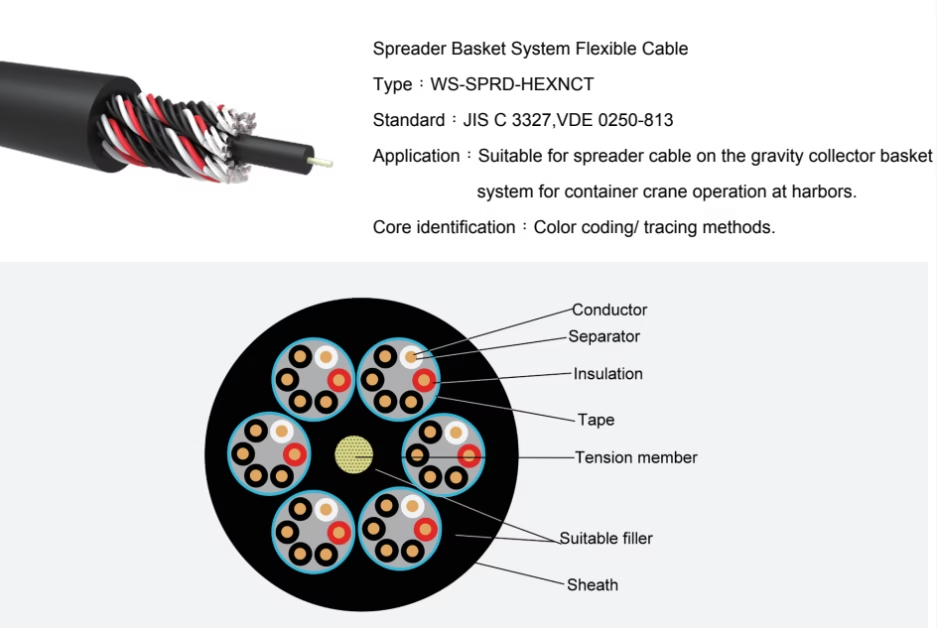
WALSREEN® WS-SPRD-HEXNCT Spreader Basket System Flexible Cable
AC 600 V Heavy-Duty Spreader Basket System Flexible Cable with Enhanced HEXNCT Chloroprene Rubber Sheath (4.5–5.1 mm) for Maximum Abrasion and Mechanical Protection, −40°C to +90°C Ambient Temperature Rating, High-Core-Count Configurations of 30, 36, and 42 Cores at 3.5 mm², Colour Coding and Tracing Methods for Core Identification — Purpose-Built for Spreader Cables Used on Gravity Collector Basket Systems for Container Crane Operation at Harbours and High-Throughput Container Terminals
The Heavy-Duty Tier of Spreader Basket Cable Engineering: HEXNCT Construction Delivers 36–38% Thicker Sheathing Than the Standard WS-SPRD-2PNCT, Providing Significantly Greater Abrasion Wear Allowance at Basket Carrier Contact Points, Enhanced Mechanical Impact Protection for Quayside Container Cranes Where Dropped Twist-Lock Debris, Falling Hardware, and Aggressive Spreader Cycling Impose the Most Punishing Mechanical Demands on the Trolley-to-Spreader Cable in the Entire Port Crane Industry
Introduction: The Armoured Spreader Cable for Container Cranes
Container crane spreader basket cables occupy a unique and brutal position in the hierarchy of port cable applications. The cable hangs in free-forming catenary loops between basket carrier trolleys, exposed to the full violence of a high-throughput container crane’s operating environment — aggressive spreader cycling at 25–40 lifts per hour, lateral wind loading from coastal gales, direct exposure to falling twist-lock fragments and debris from containers above, constant abrasion against carrier saddle surfaces, and the corrosive assault of salt spray, hydraulic oil, UV radiation, and extreme temperatures. Of all the cables on a container crane, the spreader basket cable is the most physically punished and the most operationally critical — because when it fails, the spreader goes dead and the crane stops.
The WALSREEN® WS-SPRD-HEXNCT was engineered specifically for this extreme duty class. Its defining characteristic is the HEXNCT enhanced chloroprene rubber sheath — a heavy-duty outer layer with thickness ranging from 4.5 mm to 5.1 mm, representing a 36–38% increase over the standard WS-SPRD-2PNCT’s 3.3–3.7 mm sheath. This enhanced sheath provides a dramatically larger abrasion wear allowance at basket carrier contact points, greater resistance to mechanical impact from falling debris, and a more robust barrier against the chemical and environmental hazards of the container crane operating environment.
The HEXNCT designation indicates the cable’s enhanced cross-linked chloroprene rubber compound — a formulation engineered specifically for the abrasion, impact, and flexural demands of container crane spreader basket applications. Manufactured to dual standards — JIS C 3327 and VDE 0250-813 — the WS-SPRD-HEXNCT represents the highest protection tier in the WALSREEN spreader basket cable family, specified by terminal operators who refuse to compromise on cable durability for their most critical container handling assets.
The WS-SPRD-HEXNCT is specifically designed for container crane (STS quayside crane) spreader basket applications, where the combination of high cycle frequency, long spreader drop height, heavy spreader weight, and exposure to twist-lock debris imposes significantly greater mechanical demands than yard crane (RTG/RMG) spreader systems. For yard crane applications with lower mechanical severity, the standard WS-SPRD-2PNCT provides adequate protection at lower cost and diameter. Using the HEXNCT on a yard crane is technically acceptable but economically unnecessary; using the 2PNCT on a high-throughput container crane risks premature failure due to insufficient sheath wear allowance.
Technical Specifications: Complete Dual-Standard Breakdown
| Parameter | Specification |
|---|---|
| Product Designation | WALSREEN® WS-SPRD-HEXNCT Spreader Basket System Flexible Cable |
| Standard Compliance | JIS C 3327 (rubber-insulated cables for machinery), VDE 0250-813 (flexible cables) |
| Application | Spreader cables on gravity collector basket systems for container crane operation at harbours |
| Rated Voltage | AC 600 V |
| Test Voltage | AC 3,000 V / 1 minute |
| Rated Temperature | 90°C (maximum continuous conductor temperature) |
| Ambient Temperature Range | −40°C to +90°C |
| Conductor Size | 3.5 mm² (all cores, all configurations) |
| Core Configurations | 30, 36, or 42 cores |
| Core Identification | Colour coding and tracing methods — multi-colour base with contrasting tracer stripes for positive identification of all cores |
| Insulation Material | Ethylene Propylene Rubber (EPR) — high-temperature, high-flexibility elastomer |
| Sheath Construction | HEXNCT enhanced chloroprene rubber (CR) — heavy-duty cross-linked compound with enhanced abrasion, impact, and mechanical protection |
| Sheath Thickness | 4.5–5.1 mm (36–38% thicker than standard 2PNCT) |
| Flame Retardancy | Per JIS C 3005. Self-extinguishing. |
| Oil Resistance | Per JIS C 3005. Resistant to hydraulic oil, lubricants, and diesel fuel. |
| Abrasion Resistance | Per JIS C 3327, Table 6 |
| Weather Resistance | Resistant to ozone, UV radiation, and moisture. Rated for permanent outdoor installation. |
HEXNCT Construction: Why the Heavy Sheath Matters
The defining engineering feature of the WS-SPRD-HEXNCT is its enhanced HEXNCT chloroprene rubber sheath — a purpose-formulated heavy-duty outer layer that addresses the three most common causes of spreader basket cable failure on container cranes.
Cause 1: Carrier Saddle Abrasion
Every time the crane trolley moves, the cable slides across the saddle surfaces of each basket carrier as the catenary loops form and collapse. On a container crane operating 25–40 lifts per hour, 20+ hours per day, this sliding contact generates over 500,000 abrasion cycles per year at each carrier contact point. The standard 2PNCT sheath (3.3–3.7 mm) provides adequate wear allowance for moderate-duty yard crane applications, but it can be worn to minimum safe thickness within 4–6 years on a high-throughput container crane. The HEXNCT sheath (4.5–5.1 mm) provides 36–38% additional abrasion depth — extending the cable’s useful life to 8–12 years in the same application, effectively eliminating one complete cable replacement cycle over the crane’s operational life.
Cause 2: Mechanical Impact Damage
Container crane spreader cables operate directly below the hoist area where twist-locks, corner castings, lashing hardware, and other container-related debris can fall onto the cable during handling operations. A twist-lock falling from a container at 30+ metres height impacts the cable with sufficient force to cut through a standard-thickness sheath and damage the insulation beneath. The HEXNCT’s enhanced sheath thickness provides a substantially greater protective barrier against these impact events — the additional 1.2–1.4 mm of cross-linked rubber absorbs and distributes the impact energy across a wider area, reducing the depth of damage penetration and preserving the cable’s electrical integrity after an impact that would compromise a thinner-sheathed cable.
Cause 3: Accelerated Environmental Degradation
Container cranes at busy terminals are exposed to a concentrated cocktail of environmental aggressors: heavy hydraulic oil contamination from the spreader and hoist mechanism above, diesel exhaust from ship operations alongside, salt spray accelerated by the crane’s elevated position directly over the water, and continuous UV exposure on the sun-facing side of the catenary loops. The HEXNCT sheath’s greater thickness means that even when the outer surface degrades under this combined environmental assault, the cable retains a thicker intact sheath layer protecting the conductor insulation — maintaining the cable’s electrical safety margin throughout its extended service life.
For the 42-core configuration: the HEXNCT sheath at 5.1 mm vs. the 2PNCT sheath at 3.7 mm provides 1.4 mm additional wear depth before reaching the insulation layer. Assuming a typical abrasion wear rate of 0.15–0.25 mm per year at the highest-wear carrier contact point (based on field measurement data from operating STS cranes), the additional 1.4 mm extends the cable’s service life by approximately 5.6–9.3 additional years beyond the standard variant — a dramatic return on the modest investment in enhanced sheath thickness.
HEXNCT vs. 2PNCT: Choosing the Right Spreader Basket Cable
The WALSREEN spreader basket cable family offers two distinct protection tiers — the standard WS-SPRD-2PNCT and the heavy-duty WS-SPRD-HEXNCT — for two fundamentally different mechanical severity levels in port crane operations.
Choose WS-SPRD-2PNCT (Standard) when the cable operates on yard cranes (RTG, RMG) where: spreader cycling frequency is moderate (under 20 lifts per hour), the spreader drop height is limited (typically under 20 metres in a container stack), the risk of falling debris is low (no hoist mechanism directly above the basket), and the terminal’s cable replacement budget allows for shorter replacement intervals (5–8 years). The 2PNCT’s thinner sheath produces a lighter cable (2,130–2,930 kg/km) that is better suited to the smaller basket carriers used on yard cranes.
Choose WS-SPRD-HEXNCT (Heavy-Duty) when the cable operates on container cranes (STS quayside cranes) where: spreader cycling frequency is aggressive (25–40 lifts per hour, 20+ hours per day), the spreader drop height is significant (30–50 metres from trolley to ship hold), falling twist-lock debris and hardware create a continuous impact hazard, the terminal demands extended cable replacement intervals (8–12+ years), or the cost of unplanned crane downtime makes any premature cable failure economically unacceptable. The HEXNCT’s heavier construction (2,740–3,950 kg/km) is appropriate for the robust basket carrier systems used on STS cranes.
The HEXNCT costs approximately 20–30% more per metre than the equivalent 2PNCT configuration — but delivers 60–100% longer service life in container crane applications. For a typical STS crane requiring 250–400 metres of spreader basket cable, the HEXNCT price premium is US$5,000–15,000 per crane. A single unplanned cable replacement on an STS crane (cable material + crane downtime + labour + vessel delay charges) typically costs US$80,000–150,000. The HEXNCT pays for its premium many times over by eliminating one complete replacement cycle and reducing the probability of unplanned mid-service failure.
Core Identification: Colour Coding & Tracing Methods
The WS-SPRD-HEXNCT uses a colour coding and tracing system to uniquely identify all 30, 36, or 42 cores within the cable’s cross-section. This identification system is essential for the reliable and error-free termination of a high-core-count cable at the trolley and spreader junction boxes.
Colour coding: Individual cores are manufactured with base insulation colours selected from a standardised palette that maximises visual contrast between adjacent cores. The primary colour set typically includes Brown, Red, Orange, Yellow, Green, Blue, Violet, Grey, White, and Black — providing 10 unique base colours.
Tracing methods: For cable configurations exceeding 10 cores, unique identification is achieved by applying contrasting tracer stripes (thin coloured lines printed or extruded onto the insulation surface) to cores that share the same base colour. A core with a Brown base and a White tracer is distinct from a core with a Brown base and a Red tracer, and both are distinct from a core with a plain Brown base (no tracer). This colour-plus-tracer system generates the number of unique identifications needed for 30, 36, and 42-core configurations without requiring exotic or hard-to-distinguish colours.
The specific colour code and tracer arrangement for each configuration is documented in the arrangement figure supplied with every cable delivery. This figure shows the position and identification of every core in the cable’s cross-section and must be referenced during termination at both the trolley and spreader ends. Feichun recommends laminating the arrangement figure and storing a copy inside each termination enclosure for reference during future maintenance and re-termination.
Cable Construction: Layer-by-Layer Engineering
The WS-SPRD-HEXNCT shares the same internal conductor and insulation architecture as the WS-SPRD-2PNCT, with the critical difference in its enhanced outer sheath layer.
Layer 1 — Conductors: 30, 36, or 42 copper conductors at 3.5 mm² (2.5 mm approximate diameter each). The conductors are arranged in concentric counter-stranded layers for omnidirectional bending flexibility and torsion resistance — essential for the variable-direction catenary bending of basket system operation. Each core is individually identified by colour coding with tracer stripes.
Layer 2 — Insulation: 0.8 mm EPR (ethylene propylene rubber) insulation on each conductor, rated for 90°C continuous operation with a 3,000 V / 1-minute withstand test margin. The EPR formulation maintains flexibility across the full −40°C to +90°C ambient range, preventing the insulation cracking and brittleness that would occur with standard PVC insulation at low temperatures.
Layer 3 — Internal Structure: Filling compound and binding layer that bundles the insulated cores into a circular, mechanically stable cross-section. This layer prevents core-on-core abrasion during catenary bending, resists core migration under wind-induced torsion, and provides mechanical cushioning between the conductor bundle and the heavy outer sheath.
Layer 4 — HEXNCT Enhanced Outer Sheath: The defining feature of the HEXNCT construction. 4.5–5.1 mm of cross-linked chloroprene rubber (CR) in an enhanced-hardness, enhanced-abrasion-resistance formulation. The HEXNCT compound achieves a higher Shore A hardness than the standard 2PNCT sheath while maintaining adequate flexibility for catenary loop formation — a carefully engineered trade-off between wear resistance (which favours harder rubber) and bending flexibility (which favours softer rubber). The compound is oil-resistant per JIS C 3005, flame-retardant per JIS C 3005, and resistant to ozone, UV radiation, and salt spray.
The HEXNCT sheath formulation uses a cross-linked chloroprene elastomer with enhanced carbon black loading and co-polymer content compared to the standard 2PNCT compound. The increased carbon black loading improves abrasion resistance and UV stability. The co-polymer modification improves oil resistance without sacrificing low-temperature flexibility. The result is a sheath compound that is measurably harder and more wear-resistant than standard chloroprene rubber while remaining flexible enough to form smooth catenary loops without cracking at −40°C. This balance is the core engineering challenge of the HEXNCT formulation — and the reason it requires specialised compounding expertise that most cable manufacturers do not possess.
Configuration Options & Dimensional Data
The WS-SPRD-HEXNCT is available in three standard configurations, all using 3.5 mm² conductors with the enhanced HEXNCT sheath. Note the significantly larger overall diameters and higher mass values compared to the equivalent WS-SPRD-2PNCT configurations — reflecting the enhanced sheath thickness.
| No. of Cores | Conductor Size (mm²) | Conductor Ø (mm) | Insulation Thickness (mm) | Sheath Thickness (mm) | Approx. OD (mm) | Approx. Mass (kg/km) | Max. Conductor Resistance 20°C (Ω/km) | Min. Insulation Resistance 20°C (MΩ·km) |
|---|---|---|---|---|---|---|---|---|
| 30 | 3.5 | 2.5 | 0.8 | 4.5 | 44.3 | 2,740 | 5.54 | 400 |
| 36 | 3.5 | 2.5 | 0.8 | 4.8 | 48.8 | 3,300 | 5.54 | 400 |
| 42 | 3.5 | 2.5 | 0.8 | 5.1 | 54.3 | 3,950 | 5.54 | 400 |
| No. of Cores | Sheath — HEXNCT (mm) | Sheath — 2PNCT (mm) | Increase | OD — HEXNCT (mm) | OD — 2PNCT (mm) | Mass — HEXNCT (kg/km) | Mass — 2PNCT (kg/km) |
|---|---|---|---|---|---|---|---|
| 30 | 4.5 | 3.3 | +36% | 44.3 | 37.0 | 2,740 | 2,130 |
| 36 | 4.8 | 3.5 | +37% | 48.8 | 40.0 | 3,300 | 2,520 |
| 42 | 5.1 | 3.7 | +38% | 54.3 | 43.0 | 3,950 | 2,930 |
The HEXNCT’s larger overall diameter (44.3–54.3 mm vs. 37.0–43.0 mm for 2PNCT) and greater mass (29–35% heavier) require verification against the basket carrier system’s rated capacity. STS container crane basket systems are typically designed with carrier and rail ratings that accommodate the HEXNCT’s full weight and diameter range. However, when retrofitting an existing 2PNCT installation with the HEXNCT variant, verify that the carrier saddle width accommodates the larger diameter, the carrier wheel bearings are rated for the increased cable weight, and the cable entry glands at the trolley and spreader junction boxes accept the larger OD. Contact the basket system manufacturer or Feichun’s application engineering team for compatibility verification.
Application Guide: Container Cranes & High-Throughput Terminals
Ship-to-Shore (STS) Container Gantry Cranes
STS container cranes are the primary and defining application for the WS-SPRD-HEXNCT. These cranes feature the most demanding spreader basket cable environment in the port industry: trolley travel distances of 70–120 metres with basket carrier counts of 15–25, spreader drop heights of 30–50 metres into the ship’s hold, aggressive lift cycles of 25–40 containers per hour, and continuous exposure to falling twist-lock hardware and container debris. The HEXNCT’s enhanced sheath provides the wear allowance and impact resistance to achieve 8–12 year service life in this extreme application — matching the crane’s major maintenance interval and avoiding costly mid-cycle cable replacements.
Twin-Lift & Tandem-Lift STS Cranes
The latest generation of ultra-large STS cranes with twin-lift (two 20-foot containers simultaneously) or tandem-lift (one 40-foot plus one 20-foot container) capability require the 42-core HEXNCT configuration. These spreaders incorporate additional motor drives, sensors, and control circuits for the dual-box handling mechanism, and the higher-throughput operation (effectively doubling container moves per hour) accelerates abrasion wear proportionally. The 42-core HEXNCT at 5.1 mm sheath thickness is the specification of choice for the world’s highest-throughput container terminals.
Automated STS Cranes
Remotely operated and fully automated STS cranes place additional demands on the spreader cable’s signal integrity. The 42-core HEXNCT configuration provides capacity for the expanded sensor and communication circuits required by automated spreader systems (anti-sway, machine vision, RFID), while the enhanced sheath’s greater mechanical protection reduces the risk of sheath damage that could compromise the electromagnetic environment of sensitive signal cores.
High-Throughput Hub Terminals
Transshipment hub terminals (Singapore, Shanghai, Rotterdam, Busan, Tanjung Pelepas) operate STS cranes at the highest sustained cycle rates in the industry — 35–40+ lifts per hour, 22+ hours per day, 360+ days per year. At these cycle rates, abrasion wear at carrier contact points accumulates 30–50% faster than at typical gateway terminals. The HEXNCT’s enhanced sheath thickness provides the additional wear margin to maintain adequate service life even at these extreme utilisation rates.
Environmental Resistance & Coastal Durability
The WS-SPRD-HEXNCT’s environmental resistance profile is identical in specification to the standard 2PNCT — oil resistance per JIS C 3005, flame retardancy per JIS C 3005, ozone and UV resistance, moisture resistance, and −40°C to +90°C ambient temperature operation — but the heavier sheath delivers these protections with greater depth and duration.
Oil resistance: Container crane spreader cables are continuously exposed to hydraulic oil leaking from the spreader’s hydraulic power pack, twist-lock cylinders, and flipper actuators above. The HEXNCT’s thicker chloroprene sheath provides a greater volume of oil-resistant material between the external oil contamination and the conductor insulation — ensuring that even when the outer surface layer absorbs oil and softens slightly, the inner sheath layers remain intact and mechanically sound.
UV and ozone resistance: The enhanced carbon black loading in the HEXNCT compound provides measurably better UV absorption and ozone resistance compared to standard chloroprene formulations. Carbon black is the most effective UV stabiliser for rubber compounds, and the HEXNCT’s higher loading provides additional protection against the photo-degradation and ozone cracking that are primary surface degradation mechanisms in permanently sun-exposed outdoor cable applications.
Salt spray and moisture: The thicker sheath provides a longer moisture diffusion path — the distance that salt water must penetrate through the rubber matrix before reaching the conductor insulation. This longer path delays the onset of moisture-induced insulation degradation, particularly at sheath surface micro-cracks that develop at carrier contact wear points over the cable’s service life.
Temperature performance: The cross-linked HEXNCT compound maintains flexibility at −40°C (critical for catenary loop formation in arctic port environments) and dimensional stability at +90°C (critical for cables on sun-heated steel crane structures in Middle Eastern and tropical ports). The cross-linking chemistry used in the HEXNCT formulation provides superior thermal stability compared to non-cross-linked chloroprene, reducing the rate of age-related rubber hardening that would otherwise degrade the cable’s bending performance over its extended service life.
Installation & Basket System Best Practices
Carrier Saddle Compatibility
The HEXNCT’s larger diameter (up to 54.3 mm for 42-core) requires basket carriers with saddle widths and depths designed for heavy-duty cables. Most STS crane basket systems are supplied with carriers rated for cables up to 60 mm OD, comfortably accommodating the full HEXNCT range. Verify saddle dimensions before installation — a saddle that is too narrow for the cable diameter will concentrate contact pressure on a small area, accelerating wear rather than distributing it across the full saddle contact zone.
Carrier Spacing for Heavier Cable
The HEXNCT’s 29–35% greater mass per metre produces heavier catenary loops that increase the gravitational load at each carrier contact point. For the 42-core HEXNCT at 3,950 kg/km (3.95 kg/m), a 3.5-metre carrier spacing produces loop weights of approximately 28 kg — versus approximately 21 kg for the equivalent 2PNCT loop. Verify that carrier wheel bearings and the supporting rail are rated for this increased weight, particularly when retrofitting an existing basket system with the heavier HEXNCT cable.
Installation Without Twist
The cable must be threaded through each carrier saddle sequentially without introducing any twist. With the HEXNCT’s heavier weight, twists are more difficult to remove after installation than with lighter cables — the cable’s greater stiffness and mass resist manual rotation. Take particular care during installation to maintain consistent cable orientation throughout the entire run. If a twist is detected after installation, it must be removed before the crane enters service — a twist concentrates bending stress at a single point and causes accelerated wear and eventual fatigue failure.
Termination
The HEXNCT’s thicker sheath requires cable glands and strain-relief fittings sized for the 44.3–54.3 mm OD range. Standard glands designed for the 2PNCT’s 37.0–43.0 mm OD range will not fit the HEXNCT. Ensure that all termination hardware — glands, strain-relief cones, weatherproof enclosures, and cable tray entry points — is specified for the HEXNCT’s actual OD before procurement. Core identification during termination follows the colour coding and tracing arrangement figure supplied with each cable delivery.
Inspection & Wear Monitoring
Although the HEXNCT’s enhanced sheath provides greater wear allowance, regular inspection remains essential. Measure sheath thickness at the highest-wear carrier contact points at every annual maintenance interval using a calliper or ultrasonic thickness gauge. The cable’s minimum safe sheath thickness (below which replacement should be planned) is 2.0 mm — representing approximately 50–60% wear through the HEXNCT sheath depth. This measurement-based approach enables proactive replacement scheduling based on actual wear rate data rather than time-based estimates.
Comparison: HEXNCT vs. 2PNCT vs. General-Purpose Festoon
| Feature | WS-SPRD-HEXNCT | WS-SPRD-2PNCT | General-Purpose Festoon |
|---|---|---|---|
| Target Application | Container cranes (STS) | Yard cranes (RTG/RMG) | General industrial festoon |
| Sheath Thickness (42-core) | 5.1 mm | 3.7 mm | 2.0–2.5 mm (typical PVC/PUR) |
| Sheath Material | HEXNCT cross-linked CR | Standard CR | PVC or PUR |
| Overall Diameter (42-core) | 54.3 mm | 43.0 mm | ~35–40 mm |
| Mass (42-core) | 3,950 kg/km | 2,930 kg/km | ~1,800–2,200 kg/km |
| Abrasion Resistance | JIS C 3327 Table 6 + enhanced | JIS C 3327 Table 6 | Standard (not optimised) |
| Impact Resistance | High (heavy sheath) | Moderate | Low |
| Oil Resistance | JIS C 3005 | JIS C 3005 | Moderate (PVC) to Good (PUR) |
| Temperature Range | −40°C to +90°C | −40°C to +90°C | −20°C to +70°C (typical) |
| UV / Ozone Resistance | Excellent (enhanced CR) | Excellent (standard CR) | Poor to Moderate |
| Service Life (STS crane) | 8–12 years | 4–6 years | 2–3 years |
| Service Life (yard crane) | 12–18 years (over-specified) | 8–15 years | 3–6 years |
| Relative Cable Cost | ~150% | ~130% | 100% (baseline) |
| Total Cost of Ownership (STS) | Lowest | Moderate | Highest |
Choose WS-SPRD-HEXNCT for STS container cranes, high-throughput terminals, twin-lift/tandem-lift cranes, and any application where the cost of unplanned cable failure exceeds the HEXNCT’s modest price premium. Choose WS-SPRD-2PNCT for yard cranes (RTG/RMG), moderate-throughput terminals, and applications where the lighter cable weight benefits the basket carrier system. Avoid general-purpose festoon cables on any port crane spreader basket application — their inadequate sheath construction, poor environmental resistance, and short service life make them economically wasteful despite their lower initial purchase price.
Cost-Effective Feichun Equivalent
Feichun Lead Times: 4–6 weeks for standard WS-SPRD-HEXNCT configurations. Japanese OEM suppliers: 14–18 weeks.
Feichun Pricing: Japanese OEM WS-SPRD-HEXNCT 42-core quoted at ¥9,500–14,000/metre; Feichun FC-SPRD-HX™ equivalent: ¥4,800–7,500/metre. Per 350-metre order (typical STS crane requirement): savings of ¥1,645,000–¥2,275,000.
Case Study: East African Container Terminal New-Build: A new container terminal in East Africa commissioning 6 STS cranes specified WS-SPRD-HEXNCT 42-core for all quayside crane spreader basket systems — total requirement 2,100 metres (350 metres per crane). The Japanese OEM quoted US$1.47 million with an 18-week lead time. Feichun quoted US$735,000 with a 5-week lead time, delivered in a single shipment. All cables passed comprehensive testing: 3,000 V/1-minute withstand on all 42 cores, conductor resistance verification on all cores, sheath abrasion testing per JIS C 3327 Table 6 confirming enhanced abrasion performance, Shore A hardness verification of HEXNCT sheath compound, and 10,000-cycle alternating-bend fatigue test. Total savings: US$735,000 with 13 weeks faster delivery. All 6 cranes were commissioned with full spreader functionality 3 months ahead of the terminal’s opening date.
Feichun manufactures WS-SPRD-HEXNCT equivalents in extended configurations: higher core counts (up to 61 cores for complex twin-lift and tandem-lift spreader systems with full automation), mixed conductor sizes (combining 3.5 mm² control cores with 8 mm² or larger motor power cores in a single HEXNCT-sheathed cable), individually screened pairs (for fieldbus communication, encoder signals, or EMC-sensitive circuits), integrated fibre optic elements (HEXNCT-sheathed hybrid power + fibre for automated spreader camera and sensor systems), and even thicker sheath options (up to 6.5 mm for the most extreme-duty applications). Contact the engineering department for specifications.
Technical FAQ
What does “HEXNCT” stand for?
The HEXNCT designation indicates the cable’s enhanced cross-linked chloroprene rubber sheath compound and construction. The HEX prefix denotes the enhanced-hardness, enhanced-abrasion compound formulation with optimised cross-linking chemistry and increased carbon black loading. The NCT suffix identifies the base chloroprene (Neoprene-type) sheath material. Together, the HEXNCT designation distinguishes this heavy-duty sheath construction from the standard 2PNCT construction used in the WS-SPRD-2PNCT family.
Can I use the HEXNCT on a yard crane (RTG/RMG)?
Technically yes, but it is economically unnecessary. Yard cranes operate at lower cycle frequencies and shorter spreader drop heights than STS container cranes, generating substantially less abrasion wear and impact loading on the spreader cable. The standard WS-SPRD-2PNCT provides adequate service life (8–15 years) on yard cranes at lower cost and lighter weight. The HEXNCT’s heavier construction would also increase the load on the yard crane’s basket carrier system — potentially requiring carrier reinforcement that adds further unnecessary cost. Reserve the HEXNCT for STS container cranes and other high-severity applications where its enhanced protection is justified.
How does the heavier cable affect basket carrier life?
The HEXNCT’s 29–35% greater mass per metre increases the gravitational load on each basket carrier proportionally. Carrier wheel bearings, axle pins, and the supporting rail experience increased contact pressure and will wear slightly faster than with the lighter 2PNCT cable. However, STS crane basket carrier systems are designed with substantial load margins — the HEXNCT’s weight falls comfortably within the design envelope of modern STS crane basket systems. For older crane installations with original-specification basket carriers, verify the carrier’s rated cable weight capacity before installing the HEXNCT variant.
What is the minimum safe sheath thickness for continued operation?
Feichun recommends planning cable replacement when the sheath thickness at any carrier contact point drops below 2.0 mm. At this thickness, the remaining sheath provides adequate electrical safety and moisture protection for continued short-term operation, but the wear margin is insufficient to guarantee reaching the next planned maintenance interval without risk of insulation exposure. The HEXNCT’s starting thickness of 4.5–5.1 mm provides 2.5–3.1 mm of usable wear depth before reaching the 2.0 mm replacement threshold — compared to only 1.3–1.7 mm for the 2PNCT variant.
Does the thicker sheath affect catenary loop formation?
Minimally. The HEXNCT’s increased sheath thickness adds approximately 7–11 mm to the cable’s overall diameter compared to the 2PNCT, which slightly increases the cable’s bending stiffness. In practice, this results in catenary loops with marginally larger natural curvature radii — meaning the loops hang slightly wider and shallower than 2PNCT loops at the same carrier spacing. This effect is accounted for in the basket system design of modern STS cranes. The HEXNCT compound is specifically formulated to maintain adequate flexibility despite its greater thickness — it will not form kinks, flat spots, or permanent set during normal basket system operation.
Is the core identification the same as the 2PNCT?
The core identification system is conceptually the same (colour coding with tracing methods), but the specific colour-and-tracer assignments may differ between HEXNCT and 2PNCT cables, and may also differ between manufacturers. Always reference the arrangement figure supplied with each specific cable delivery — not a generic colour code table — when terminating the cable. Feichun supplies a detailed arrangement figure with every cable reel, showing the exact colour, tracer, and position of every core in the cable’s cross-section.
References & Standards
- JIS C 3327, Rubber insulated cables for machinery — Requirements and test methods.
- VDE 0250-813, Flexible cables and cords — Particular types.
- JIS C 3005, Test methods for rubber or plastic insulated cables and cords (flame retardancy testing).
- JIS C 3005, Test methods for rubber or plastic insulated cables and cords (oil resistance testing).
- IEC 60228, Conductors of insulated cables — Classes and construction.
- ISO 4649, Rubber, vulcanized or thermoplastic — Determination of abrasion resistance.
- ISO 868, Plastics and ebonite — Determination of indentation hardness by means of a durometer (Shore hardness).
- FEM 1.001, Rules for the Design of Hoisting Appliances — Classification and Loading on Structures and Mechanisms.
- IEC 60332-1-2, Vertical flame propagation test on single insulated wires or cables.


