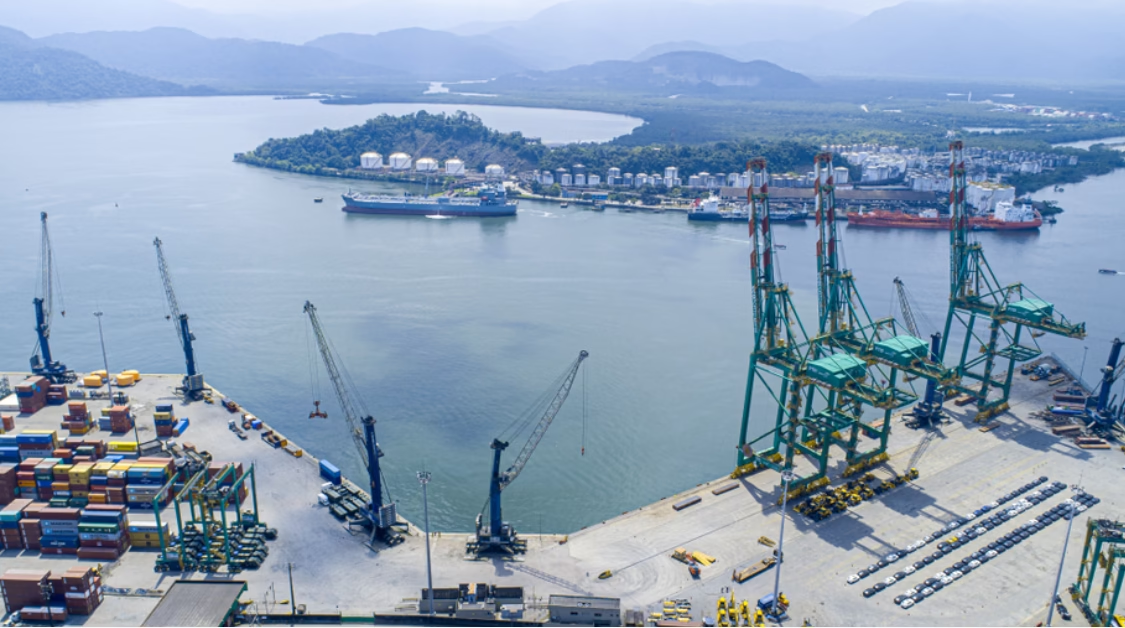
harbor crane cable

UNE 22511 Design Philosophy: Ultimate Flexibility for Underground Mobile Equipment Within the taxonomy of mining cables, the distinction between the UNE 22511 and UNE 22512 standards represents a fundamental divergence in design philosophy — not merely a difference in specification parameters. Understanding this divergence is essential for engineers procuring replacement cables for underground coal mines in Spain, Chile, Colombia, and other markets operating under the AENOR (Asociación Española de Normalización y Certificación) regulatory framework. The UNE 22511 standard governs cables for flexible connection of mobile underground mining machinery — the specific class of heavy-duty cable designed for equipment that moves continuously during operation: continuous miners, longwall shearers, shuttle cars, and cable reel systems. The engineering DNA of a UNE 22511 cable can be summarized in a single phrase: engineered for mechanical endurance, not for static installation security. This philosophy manifests in every structural element of the cable: the conductor class, the insulation compound, the earth core arrangement, the absence of metallic armor, and the sheath compound selection. Each element is chosen not to maximize any single parameter but to achieve an optimal balance of torsional resilience, bending flexibility, and sheath durability under the combined mechanical loading of continuous dragging, occasional running-over by shuttle car wheels, and periodic full-tension pulling by cable reel drum systems.

UNE 22511

UNE 22511 Design Philosophy: Ultimate Flexibility for Underground Mobile Equipment Within the taxonomy of mining cables, the distinction between the UNE 22511 and UNE 22512 standards represents a fundamental divergence in design philosophy — not merely a difference in specification parameters. Understanding this divergence is essential for engineers procuring replacement cables for underground coal mines in Spain, Chile, Colombia, and other markets operating under the AENOR (Asociación Española de Normalización y Certificación) regulatory framework. The UNE 22511 standard governs cables for flexible connection of mobile underground mining machinery — the specific class of heavy-duty cable designed for equipment that moves continuously during operation: continuous miners, longwall shearers, shuttle cars, and cable reel systems. The engineering DNA of a UNE 22511 cable can be summarized in a single phrase: engineered for mechanical endurance, not for static installation security. This philosophy manifests in every structural element of the cable: the conductor class, the insulation compound, the earth core arrangement, the absence of metallic armor, and the sheath compound selection. Each element is chosen not to maximize any single parameter but to achieve an optimal balance of torsional resilience, bending flexibility, and sheath durability under the combined mechanical loading of continuous dragging, occasional running-over by shuttle car wheels, and periodic full-tension pulling by cable reel drum systems.
Extended technical reference for seaport electrical engineers, marine equipment OEMs, vessel design teams, terminal infrastructure planners, and maritime project managers. Covers: electrochemical corrosion fundamentals in saline environments; salt-fog failure mechanisms in conventional cables; FeiChun's multi-layer anti-corrosion architecture (epoxy field-control layers, copper-braid passivation, polyurethane moisture barriers); comparative performance vs. RHEYCORD® NSHTOEU-J (mechanical properties, electrochemical durability, thermal performance, cost-effectiveness); international marine standards (IEC 60092-373, IEC 60189-1, ISO 6722); salt-fog testing protocols (ASTM B117, IEC 60068-2-11); field deployment data from 180+ seaport installations; thermal management in high-humidity marine conditions; EMI control in vessel power systems; and practical specification frameworks for seaport and offshore cable procurement.

Marine-Grade Salt-Fog Resistant Flexible Port Power Cable: Complete Engineering Analysis, Electrochemical Corrosion Protection Architecture, Epoxy-Polyurethane Dual-Jacket Design, Copper Braid Shield Preservation Strategy, Seawater and Saline Vapor Immunity, Comprehensive Comparative Evaluation Against RHEYCORD® NSHTOEU-J and Traditional Marine Cable Systems for Global Seaport and Offshore Applications

Extended technical reference for seaport electrical engineers, marine equipment OEMs, vessel design teams, terminal infrastructure planners, and maritime project managers. Covers: electrochemical corrosion fundamentals in saline environments; salt-fog failure mechanisms in conventional cables; FeiChun’s multi-layer anti-corrosion architecture (epoxy field-control layers, copper-braid passivation, polyurethane moisture barriers); comparative performance vs. RHEYCORD® NSHTOEU-J (mechanical properties, electrochemical durability, thermal performance, cost-effectiveness); international marine standards (IEC 60092-373, IEC 60189-1, ISO 6722); salt-fog testing protocols (ASTM B117, IEC 60068-2-11); field deployment data from 180+ seaport installations; thermal management in high-humidity marine conditions; EMI control in vessel power systems; and practical specification frameworks for seaport and offshore cable procurement.
crane cable range is a complete family of six specialised cable types engineered to cover every electrical and data connection on modern port cranes — from the simplest yard crane spreader circuit to the most complex automated STS crane with integrated fibre optic networking. The family is divided into two series: the WS-RLIN series for motorised cable reel systems, and the WS-SPRD series for gravity collector basket (festoon basket) systems. Every cable in the range shares a common engineering foundation: JIS C 3327 compliance for rubber-insulated machinery cables, chloroprene rubber (CR) sheathing for oil/ozone/UV resistance, EPR insulation rated to 90°C, and an ambient temperature range of −40°C to +90°C that covers every port environment on earth from arctic to tropical. Within this shared foundation, each cable type is differentiated by its reinforcement system, voltage class, conductor range, and application-specific optimisations.

WALSREEN® Complete Port Crane Cable Range

crane cable range is a complete family of six specialised cable types engineered to cover every electrical and data connection on modern port cranes — from the simplest yard crane spreader circuit to the most complex automated STS crane with integrated fibre optic networking. The family is divided into two series: the WS-RLIN series for motorised cable reel systems, and the WS-SPRD series for gravity collector basket (festoon basket) systems. Every cable in the range shares a common engineering foundation: JIS C 3327 compliance for rubber-insulated machinery cables, chloroprene rubber (CR) sheathing for oil/ozone/UV resistance, EPR insulation rated to 90°C, and an ambient temperature range of −40°C to +90°C that covers every port environment on earth from arctic to tropical. Within this shared foundation, each cable type is differentiated by its reinforcement system, voltage class, conductor range, and application-specific optimisations.
WS-SPRD-HEXNCT was engineered specifically for this extreme duty class. Its defining characteristic is the HEXNCT enhanced chloroprene rubber sheath — a heavy-duty outer layer with thickness ranging from 4.5 mm to 5.1 mm, representing a 36–38% increase over the standard WS-SPRD-2PNCT's 3.3–3.7 mm sheath. This enhanced sheath provides a dramatically larger abrasion wear allowance at basket carrier contact points, greater resistance to mechanical impact from falling debris, and a more robust barrier against the chemical and environmental hazards of the container crane operating environment.

WALSREEN® WS-SPRD-HEXNCT Spreader Basket System Flexible Cable

WS-SPRD-HEXNCT was engineered specifically for this extreme duty class. Its defining characteristic is the HEXNCT enhanced chloroprene rubber sheath — a heavy-duty outer layer with thickness ranging from 4.5 mm to 5.1 mm, representing a 36–38% increase over the standard WS-SPRD-2PNCT’s 3.3–3.7 mm sheath. This enhanced sheath provides a dramatically larger abrasion wear allowance at basket carrier contact points, greater resistance to mechanical impact from falling debris, and a more robust barrier against the chemical and environmental hazards of the container crane operating environment.
WS-SPRD-2PNCT was engineered specifically for this unforgiving application. It combines high-core-count construction (30, 36, or 42 cores at 3.5 mm²) to carry the full complement of spreader control and signal circuits in a single cable, steel-wire-stranded conductors for tension resistance under self-weight suspension, chloroprene rubber sheathing for oil, ozone, and UV resistance in coastal port environments, and a cable geometry specifically optimised for the continuous lateral bending and catenary formation cycles unique to gravity collector basket systems. Manufactured to dual standards — JIS C 3327 (rubber-insulated machinery cables) and VDE 0250-813 (flexible cables) — the WS-SPRD-2PNCT represents dedicated engineering for a niche but mission-critical application. A failed spreader basket cable means a stopped crane, a grounded spreader, and halted container operations. There is no redundancy — the cable is the sole electrical lifeline between the crane's trolley and the spreader that grips the containers.

WALSREEN® WS-SPRD-2PNCT Spreader Basket System Flexible Cable

WS-SPRD-2PNCT was engineered specifically for this unforgiving application. It combines high-core-count construction (30, 36, or 42 cores at 3.5 mm²) to carry the full complement of spreader control and signal circuits in a single cable, steel-wire-stranded conductors for tension resistance under self-weight suspension, chloroprene rubber sheathing for oil, ozone, and UV resistance in coastal port environments, and a cable geometry specifically optimised for the continuous lateral bending and catenary formation cycles unique to gravity collector basket systems. Manufactured to dual standards — JIS C 3327 (rubber-insulated machinery cables) and VDE 0250-813 (flexible cables) — the WS-SPRD-2PNCT represents dedicated engineering for a niche but mission-critical application. A failed spreader basket cable means a stopped crane, a grounded spreader, and halted container operations. There is no redundancy — the cable is the sole electrical lifeline between the crane’s trolley and the spreader that grips the containers.
WS-RLIN-3PNCT-OF is the engineering answer to this convergence challenge. It integrates three-phase medium-voltage power conductors (3 × 38–60 mm² at AC 6,600 V) with a dedicated neutral/earth return conductor and six optical fibres housed in individually colour-coded ETFE protective tubes — all within a single Kevlar®-reinforced, chloroprene-sheathed cable construction. This hybrid design eliminates the need for separate power and fibre optic cables on the reel system, reducing reel complexity, installation time, maintenance burden, and total cable weight, while ensuring perfect synchronisation between power and data paths — because both travel through the same physical cable at all times.

WALSREEN® WS-RLIN-3PNCT-OF Hybrid Power & Fibre Optic Reel System Flexible Cable

WS-RLIN-3PNCT-OF is the engineering answer to this convergence challenge. It integrates three-phase medium-voltage power conductors (3 × 38–60 mm² at AC 6,600 V) with a dedicated neutral/earth return conductor and six optical fibres housed in individually colour-coded ETFE protective tubes — all within a single Kevlar®-reinforced, chloroprene-sheathed cable construction. This hybrid design eliminates the need for separate power and fibre optic cables on the reel system, reducing reel complexity, installation time, maintenance burden, and total cable weight, while ensuring perfect synchronisation between power and data paths — because both travel through the same physical cable at all times.
WS-RLIN-2PNCT-KB was engineered specifically to solve this challenge. Its defining innovation is a Kevlar® aramid fibre reinforcing layer — the same poly-paraphenylene terephthalamide material used in military-grade ballistic body armour — woven into a proprietary helical braid pattern that distributes tensile load uniformly across the cable's cross-section. This Kevlar reinforcement delivers tensile strength comparable to steel braid at a fraction of the weight, eliminates the fatigue-induced wire breakage that plagues conventional steel-armoured reeling cables, and maintains exceptional flexibility throughout the cable's operational life.

WALSREEN® WS-RLIN-2PNCT-KB Reel System Flexible Cable

WS-RLIN-2PNCT-KB was engineered specifically to solve this challenge. Its defining innovation is a Kevlar® aramid fibre reinforcing layer — the same poly-paraphenylene terephthalamide material used in military-grade ballistic body armour — woven into a proprietary helical braid pattern that distributes tensile load uniformly across the cable’s cross-section. This Kevlar reinforcement delivers tensile strength comparable to steel braid at a fraction of the weight, eliminates the fatigue-induced wire breakage that plagues conventional steel-armoured reeling cables, and maintains exceptional flexibility throughout the cable’s operational life.
FSTN-OFNCT is a high-performance optical fiber flexible cable designed specifically for signal and data transmission on port cranes, ship unloaders, container gantry cranes, and heavy-duty material handling equipment. Unlike conventional industrial fibre optic cables that rely on standard polymer or steel-wire tensile members, the WS-FSTN-OFNCT incorporates a Kevlar® (para-aramid) fibre reinforcement layer—the same ballistic-grade material used in bulletproof vests and military-grade protective equipment—braided in a proprietary pattern that delivers exceptional tensile strength while preserving the cable's full flexibility under continuous reeling and festoon operation.

Kevlar® Aramid Fibre Reinforced Optical Fiber Flexible Cable with Specially Braided Tensile Layer for Signal and Data Transmission on Port Cranes, Ship Unloaders, Container Gantry Cranes, and Heavy-Duty Material Handling Equipment — Engineered for Cable Reel Systems, Festoon Systems, and Continuous Flexing Applications with Graded Index 50/125, 62.5/125, and Singlemode E9/125 Fibre Options

FSTN-OFNCT is a high-performance optical fiber flexible cable designed specifically for signal and data transmission on port cranes, ship unloaders, container gantry cranes, and heavy-duty material handling equipment. Unlike conventional industrial fibre optic cables that rely on standard polymer or steel-wire tensile members, the WS-FSTN-OFNCT incorporates a Kevlar® (para-aramid) fibre reinforcement layer—the same ballistic-grade material used in bulletproof vests and military-grade protective equipment—braided in a proprietary pattern that delivers exceptional tensile strength while preserving the cable’s full flexibility under continuous reeling and festoon operation.
WS-FSTN-3PNCT fills a critical gap in the festoon cable product range: it provides the mechanical reinforcement of 3PNCT construction — the dedicated textile reinforcing layer that protects against impact, crush, and abrasion — without the weight and cost of a metallic shield braid. This makes it the optimal choice for power distribution and discrete control circuits in harsh mechanical environments where EMI shielding is not required but standard 2PNCT cables cannot survive.

WALSTOON® WS-FSTN-3PNCT Festoon System Flexible Cable

WS-FSTN-3PNCT fills a critical gap in the festoon cable product range: it provides the mechanical reinforcement of 3PNCT construction — the dedicated textile reinforcing layer that protects against impact, crush, and abrasion — without the weight and cost of a metallic shield braid. This makes it the optimal choice for power distribution and discrete control circuits in harsh mechanical environments where EMI shielding is not required but standard 2PNCT cables cannot survive.
WS-FSTN-3PNCT-SB represents the premium tier of the WALSTOON festoon cable family — a cable engineered for applications where standard 2PNCT construction does not provide sufficient mechanical protection. The critical difference is in the designation: 3PNCT versus 2PNCT. The "3" indicates a three-layer sheathing system that includes a dedicated textile reinforcing layer between the core bundle and the outer sheath — a layer that the standard 2PNCT construction does not have. In practice, this reinforcing layer transforms the cable from a flexible electrical conductor into a mechanically reinforced structure that resists impact damage, crushing forces, abrasion penetration, and tensile stress far beyond the capability of standard 2PNCT cables. When a festoon cable runs through a harsh environment — exposed to falling debris from bulk cargo operations, crushed between moving crane structures, subjected to extreme tensile loading during emergency stops, or dragged across abrasive steel surfaces — the reinforcing layer provides the mechanical margin of safety that prevents cable failure. Combined with the tinned copper shield braid for EMI protection, the WS-FSTN-3PNCT-SB delivers dual-layer protection: electromagnetic shielding for signal integrity, and mechanical reinforcement for physical survivability. This combination makes it the cable of choice for the most demanding festoon system positions — particularly on grab-type ship unloaders, heavy-duty overhead cranes in steel mills and foundries, and any application where the cable is exposed to significant mechanical abuse beyond normal festoon system operation.

WALSTOON® WS-FSTN-3PNCT-SB Festoon System Flexible Cable

WS-FSTN-3PNCT-SB represents the premium tier of the WALSTOON festoon cable family — a cable engineered for applications where standard 2PNCT construction does not provide sufficient mechanical protection. The critical difference is in the designation: 3PNCT versus 2PNCT. The “3” indicates a three-layer sheathing system that includes a dedicated textile reinforcing layer between the core bundle and the outer sheath — a layer that the standard 2PNCT construction does not have. In practice, this reinforcing layer transforms the cable from a flexible electrical conductor into a mechanically reinforced structure that resists impact damage, crushing forces, abrasion penetration, and tensile stress far beyond the capability of standard 2PNCT cables. When a festoon cable runs through a harsh environment — exposed to falling debris from bulk cargo operations, crushed between moving crane structures, subjected to extreme tensile loading during emergency stops, or dragged across abrasive steel surfaces — the reinforcing layer provides the mechanical margin of safety that prevents cable failure. Combined with the tinned copper shield braid for EMI protection, the WS-FSTN-3PNCT-SB delivers dual-layer protection: electromagnetic shielding for signal integrity, and mechanical reinforcement for physical survivability. This combination makes it the cable of choice for the most demanding festoon system positions — particularly on grab-type ship unloaders, heavy-duty overhead cranes in steel mills and foundries, and any application where the cable is exposed to significant mechanical abuse beyond normal festoon system operation.
WS-FSTN-2PNCT is the foundation cable of the WALSTOON festoon system product family — a high-performance, unshielded, rubber-insulated flexible cable engineered for the demanding mechanical and environmental conditions of port gantry cranes, ship unloaders, cable chain systems, and industrial overhead cranes. With the widest configuration range in the WALSTOON product line — from single-conductor 250 mm² power cables capable of carrying hundreds of amperes to compact 30-core × 0.75 mm² multi-circuit control cables — the WS-FSTN-2PNCT addresses every power distribution and discrete control requirement on a crane festoon system.

WALSTOON® WS-FSTN-2PNCT Festoon System Flexible Cable

WS-FSTN-2PNCT is the foundation cable of the WALSTOON festoon system product family — a high-performance, unshielded, rubber-insulated flexible cable engineered for the demanding mechanical and environmental conditions of port gantry cranes, ship unloaders, cable chain systems, and industrial overhead cranes. With the widest configuration range in the WALSTOON product line — from single-conductor 250 mm² power cables capable of carrying hundreds of amperes to compact 30-core × 0.75 mm² multi-circuit control cables — the WS-FSTN-2PNCT addresses every power distribution and discrete control requirement on a crane festoon system.
WS-FSTN-2PNCT-SB is a comprehensive-range festoon system flexible cable designed to meet the diverse wiring requirements of port gantry cranes, ship unloaders, cable chain systems, and industrial overhead crane applications. While its sibling product — the WS-FSTN-2PNCT-PSB — features Kevlar® para-aramid fibre reinforcement for extreme tensile applications, the WS-FSTN-2PNCT-SB focuses on delivering the widest possible range of core configurations with reliable tinned copper shield braiding, covering everything from compact 2-core signal cables to high-density 30-core multi-circuit cables and paired-core variants for balanced signal transmission.

WALSTOON® WS-FSTN-2PNCT-SB Festoon System Flexible Cable

WS-FSTN-2PNCT-SB is a comprehensive-range festoon system flexible cable designed to meet the diverse wiring requirements of port gantry cranes, ship unloaders, cable chain systems, and industrial overhead crane applications. While its sibling product — the WS-FSTN-2PNCT-PSB — features Kevlar® para-aramid fibre reinforcement for extreme tensile applications, the WS-FSTN-2PNCT-SB focuses on delivering the widest possible range of core configurations with reliable tinned copper shield braiding, covering everything from compact 2-core signal cables to high-density 30-core multi-circuit cables and paired-core variants for balanced signal transmission.
Festoon cables on port gantry cranes and ship unloaders endure some of the most punishing operating conditions in industrial cable engineering. Every time the crane trolley travels along its rail, the festoon cable is dragged, flexed, accelerated, and decelerated across spans of 100–300 metres. The cable must support its own suspended weight between trolley hangers, absorb dynamic shock loads during emergency stops, withstand continuous wind-induced vibration in exposed coastal environments, and resist the corrosive effects of saltwater spray, UV radiation, and airborne industrial contaminants — all while maintaining electrical continuity and signal integrity for safety-critical crane control systems.

WALSTOON® WS-FSTN-2PNCT-PSB Festoon System Flexible Cable

AC 600V Festoon System Flexible Cable with Kevlar® Para-Aramid Fibre Braided Tensile Reinforcement Layer, JIS C 3327 Compliant, −40°C to +90°C Operating Range, Oil-Resistant, Flame-Retardant — Engineered for Port Gantry Cranes, Ship-to-Shore Unloaders, Container Handling Equipment, and Heavy-Duty Cable Chain Applications
The (N)TSCGEWÖU cable designation is not a casual product name — it is a highly standardized engineering specification that contains critical information about the cable's construction, materials, voltage rating, and intended application. Each letter and number in this alphanumeric code tells a specific story about what this cable is designed to do and under what conditions it will perform safely and reliably. (N)TSCGEWÖU 电缆代号不是随意的产品名称,而是高度标准化的工程规格。

What is the Outer Diameter (OD) of (N)TSCGEWÖU 3×185+3×35/3 6/10kV Reeling Cable?

The (N)TSCGEWÖU cable designation is not a casual product name — it is a highly standardized engineering specification that contains critical information about the cable’s construction, materials, voltage rating, and intended application. Each letter and number in this alphanumeric code tells a specific story about what this cable is designed to do and under what conditions it will perform safely and reliably. (N)TSCGEWÖU 电缆代号不是随意的产品名称,而是高度标准化的工程规格。
Cable crushing represents one of the most insidious and costly failure modes in reeling cable systems for container handling cranes, mobile equipment, and industrial material handling applications. When we speak of cable crushing in the context of drum winding systems, we are describing a progressive mechanical failure that occurs when cables wound onto a drum at high tension are later compressed by additional cable layers wound at even higher tension. This creates a compound crushing effect where the inner layers experience compressive forces far exceeding what the cable construction was designed to withstand. Understanding how to prevent this failure mode through proper tension management is essential for ensuring reliable, long-term operation of (N)TSKCGEWÖU cables in demanding crane applications. 电缆挤压代表了集装箱处理起重机、移动设备和工业物料搬运应用中卷筒电缆系统最隐蔽且代价最高的故障模式之一。

What is the Correct Tension Formulation to Prevent “Cable Crushing” on a Monospiral Drum for (N)TSKCGEWÖU?

Cable crushing represents one of the most insidious and costly failure modes in reeling cable systems for container handling cranes, mobile equipment, and industrial material handling applications. When we speak of cable crushing in the context of drum winding systems, we are describing a progressive mechanical failure that occurs when cables wound onto a drum at high tension are later compressed by additional cable layers wound at even higher tension. This creates a compound crushing effect where the inner layers experience compressive forces far exceeding what the cable construction was designed to withstand. Understanding how to prevent this failure mode through proper tension management is essential for ensuring reliable, long-term operation of (N)TSKCGEWÖU cables in demanding crane applications. 电缆挤压代表了集装箱处理起重机、移动设备和工业物料搬运应用中卷筒电缆系统最隐蔽且代价最高的故障模式之一。
The proper selection and installation of cable grips, particularly Kellem grips (also known as mesh grips or wire mesh grips), is critical for ensuring safe vertical suspension of heavy-duty cables in industrial environments. This is especially important for (N)SHTÖU cables, which are specifically designed for reeling applications in demanding conditions such as mining operations, port container handling equipment, and mobile industrial machinery. 正确选择和安装电缆夹具,特别是Kellem网套(也称为网状夹具或金属丝网夹具),对于确保工业环境中重型电缆的安全垂直悬挂至关重要。这对于(N)SHTÖU电缆尤其重要,这些电缆专为采矿作业、港口集装箱处理设备和移动工业机械等苛刻条件下的卷筒应用而设计。

Cable Grips: How to Select the Right Kellem Grip (Mesh Grip) for Vertical Suspension of (N)SHTÖU Cables

The proper selection and installation of cable grips, particularly Kellem grips (also known as mesh grips or wire mesh grips), is critical for ensuring safe vertical suspension of heavy-duty cables in industrial environments. This is especially important for (N)SHTÖU cables, which are specifically designed for reeling applications in demanding conditions such as mining operations, port container handling equipment, and mobile industrial machinery. 正确选择和安装电缆夹具,特别是Kellem网套(也称为网状夹具或金属丝网夹具),对于确保工业环境中重型电缆的安全垂直悬挂至关重要。这对于(N)SHTÖU电缆尤其重要,这些电缆专为采矿作业、港口集装箱处理设备和移动工业机械等苛刻条件下的卷筒应用而设计。
(N)TSCGEWÖU cable designation follows VDE naming conventions, where each letter represents specific cable characteristics. These medium-voltage cables are specifically engineered for power distribution to heavy-duty equipment in mining and industrial applications, available in voltage ratings of 3.6/6kV, 6/10kV, 8.7/15kV, and 12/20kV. The cable features tinned copper conductors (Class 5 according to DIN VDE 0295), rubber insulation (3GI3 compound per DIN VDE 0207 Part 20), and a heavy-duty elastomer outer sheath (5GM5 compound per DIN VDE 0207 Part 21).

Cold Impact Test: How (N)TSCGEWÖU Cables Are Certified as “Cold Resistant” at -40°C Under VDE Guidelines

(N)TSCGEWÖU cable designation follows VDE naming conventions, where each letter represents specific cable characteristics. These medium-voltage cables are specifically engineered for power distribution to heavy-duty equipment in mining and industrial applications, available in voltage ratings of 3.6/6kV, 6/10kV, 8.7/15kV, and 12/20kV. The cable features tinned copper conductors (Class 5 according to DIN VDE 0295), rubber insulation (3GI3 compound per DIN VDE 0207 Part 20), and a heavy-duty elastomer outer sheath (5GM5 compound per DIN VDE 0207 Part 21).
(N)TSCGEWÖU cable type represents a specialized category of medium-voltage power cables designed for demanding applications in mining, tunneling, harbor cranes, and heavy-duty industrial environments. These cables feature 3GI3 grade Ethylene-Propylene Rubber (EPR) insulation, which must maintain dielectric integrity under extreme mechanical stress, moisture exposure, and electrical field conditions. Understanding the aging behavior of the dielectric loss factor (tan delta, tan δ) is critical for predictive maintenance and ensuring operational safety in these mission-critical applications.

Tan Delta Aging: How does the dielectric loss factor (Tan Delta) of 3GI3 insulation in (N)TSCGEWÖU cables change with long-term aging?

(N)TSCGEWÖU cable type represents a specialized category of medium-voltage power cables designed for demanding applications in mining, tunneling, harbor cranes, and heavy-duty industrial environments. These cables feature 3GI3 grade Ethylene-Propylene Rubber (EPR) insulation, which must maintain dielectric integrity under extreme mechanical stress, moisture exposure, and electrical field conditions. Understanding the aging behavior of the dielectric loss factor (tan delta, tan δ) is critical for predictive maintenance and ensuring operational safety in these mission-critical applications.
NTSCGEWÖU and NTMCGEWÖU cables represent critical technical solutions for powering mobile machinery in mining, heavy industry, and material handling environments. Both cable types are manufactured according to the German DIN VDE 0250 standard, which is globally recognized as the definitive benchmark for tough rubber-sheathed flexible cables designed for cranes and material handling equipment. The fundamental distinction lies in their sheath construction: the "S" in NTSCGEWÖU indicates a double rubber sheath (Schwer = heavy-duty) providing enhanced mechanical protection for reeling applications, while "M" in NTMCGEWÖU denotes a single sheath with single-core design optimized for short-length medium voltage connections. According to industry specifications, Germany remains the only country to have issued special design regulations for flexible electrical cables covering cranes and material handling equipment, making DIN VDE 0250 the ultimate international standard for these demanding applications.

كيف تختار بين NTSCGEWÖU و NTMCGEWÖU للآلات المتحركة؟

NTSCGEWÖU and NTMCGEWÖU cables represent critical technical solutions for powering mobile machinery in mining, heavy industry, and material handling environments. Both cable types are manufactured according to the German DIN VDE 0250 standard, which is globally recognized as the definitive benchmark for tough rubber-sheathed flexible cables designed for cranes and material handling equipment. The fundamental distinction lies in their sheath construction: the “S” in NTSCGEWÖU indicates a double rubber sheath (Schwer = heavy-duty) providing enhanced mechanical protection for reeling applications, while “M” in NTMCGEWÖU denotes a single sheath with single-core design optimized for short-length medium voltage connections. According to industry specifications, Germany remains the only country to have issued special design regulations for flexible electrical cables covering cranes and material handling equipment, making DIN VDE 0250 the ultimate international standard for these demanding applications.
ما هو كابل PROTOLON XPRT-LWL متوسط الجهد للف مع الألياف البصرية؟ كابل لف مرن متوسط الجهد مع ألياف بصرية مدمجة للنقل المشترك للطاقة والبيانات

ما هو كابل PROTOLON XPRT-LWL متوسط الجهد للف مع الألياف البصرية؟

كابل متوسط الجهد, كابل الألياف البصرية, كابل لف الرافعات, كابل رافعة الحاويات, كابل صناعي, كابل مقاوم للالتواء, كابل مقاوم لمياه البحر, كابل موانئ, كابل مرن, كابل EPR, كابل 6/10 كيلو فولت, كابل PROTOLON
كابل PROTOLON (FL)-LWL(N)TSFLCGEWOEU 8,7/15KV هو كابل لف مسطح مرن متوسط الجهد مع ألياف بصرية مدمجة للنقل المشترك للطاقة والبيانات. صُمم هذا الكابل للتطبيقات التي تتعرض لإجهادات ميكانيكية عالية مثل أحمال الشد الديناميكية، والتغييرات المتعددة في الاتجاه ضمن مستوى واحد، والمرور فوق البكرات. يُستخدم بشكل رئيسي للمعدات المتحركة مثل رافعات الحاويات سريعة الحركة والمعدات المتحركة الكبيرة.

ما هو كابل PROTOLON (FL)-LWL المسطح متوسط الجهد مع الألياف البصرية؟

PROTOLON FL-LWL cable, PROTOLON (FL)-LWL(N)TSFLCGEWOEU 8.7/15KV, medium voltage flat reeling cable, fiber optic reeling cable, 15KV cable with fiber optics, DIN VDE 0250-813 cable, IEC 60228 conductor, container crane cable, STS crane cable, RTG crane power cable, gantry crane cable, port equipment cable, harbor crane cable, rail mounted gantry cable, EPR insulated cable, PROTOLON HS insulation, polychloroprene cable, PCP sheath cable, Class 5 copper conductor, oil resistant MV cable, ozone resistant cable, UV resistant industrial cable, flame retardant cable IEC 60332-1-2, multimode fiber cable, single-mode fiber cable, G62.5/125 optical fiber, G50/125 fiber optic, E9/125 single mode, hybrid power data cable, 3x35mm2 cable, 3x50mm2 cable, 3x70mm2 cable, Anhui Feichun cable, China cable manufacturer, special cable supplier, reeling drum cable, cable reel system, high tensile strength cable, dynamic load cable, roller operation cable, extreme temperature cable -50°C to +80°C, كابل متوسط الجهد مع الألياف البصرية, كابل رافعة الحاويات, كابل صناعي مقاوم للحرارة, 中壓扁平卷繞電纜, 光纖複合電力電纜, 起重機專用電纜, 港口自動化電纜, Industry 4.0 cable, smart port automation, automated storage retrieval cable, mining equipment cable, mobile equipment power cable, VDE 0298-4 current rating, CENELEC HD 22.16, ITU-T fiber standard, CIGRE cable guidelines, professional cable installation, factory assembled fiber optic cable
Reeling Drum Cables for Port Cranes and Material Handling: Complete Engineering Guide Understanding NSHTÖU, TSCGEWÖU, and PUR Polyurethane Cables - Technical Specifications, Standards Compliance, Selection Criteria, and GB/T 5013 Limitations

Reeling Drum Cables for Port Cranes and Material Handling: Complete Engineering Guide

Reeling Drum Cables for Port Cranes and Material Handling: Complete Engineering Guide Understanding NSHTÖU, TSCGEWÖU, and PUR Polyurethane Cables – Technical Specifications, Standards Compliance, Selection Criteria, and GB/T 5013 Limitations
600V 3TC-RB (600V 3PNCT) Crane Cable Class 3 600V Ethylene Propylene Rubber-Insulated Polychloroprene Rubber Sheath Cable

600V 3TC-RB (600V 3PNCT) Crane Cable

The 600V 3TC-RB cable, also known as 600V 3PNCT, represents a specialized class of flexible power cables engineered specifically for demanding industrial applications. This cable system is designed for mobile machinery operations where continuous flexing, environmental resistance, and electrical reliability are paramount. The designation “3TC-RB” indicates a Class 3 stranded conductor configuration with ethylene propylene rubber insulation and polychloroprene rubber sheath construction.
The 600V 2TC-RB crane cable represents a specialized category of rubber-insulated flexible cables engineered specifically for mobile machinery applications in demanding industrial environments. The designation "2TC-RB" identifies this as a Class 2 conductor construction featuring tin-coated copper strands, ethylene propylene rubber (EPR) insulation, and a robust polychloroprene rubber (also known as neoprene) outer sheath.

What is 600V 2TC-RB Crane Cable?

The 600V 2TC-RB crane cable represents a specialized category of rubber-insulated flexible cables engineered specifically for mobile machinery applications in demanding industrial environments. The designation “2TC-RB” identifies this as a Class 2 conductor construction featuring tin-coated copper strands, ethylene propylene rubber (EPR) insulation, and a robust polychloroprene rubber (also known as neoprene) outer sheath.
What is 600V 2TC Light (600V 2PNCT) Crane Cable? Comprehensive Technical Analysis of 600V Ethylene Propylene Rubber Insulated Polychloroprene Rubber Sheath Cable

What is 600V 2TC Light (600V 2PNCT) Crane Cable?

The 600V 2TC Light (600V 2PNCT) crane cable represents a specialized category of flexible power cables designed specifically for low-voltage mobile equipment applications operating at rated voltages up to 600V. This cable features ethylene propylene rubber (EPR) insulation and polychloroprene rubber (CR) sheath, combining superior electrical performance with exceptional mechanical durability. Manufactured in accordance with JIS C 3327 Japanese Industrial Standard, this cable classification has established itself as the preferred solution for crane systems, reeling applications, and material handling equipment throughout industrial facilities worldwide.
CARCT (Carrier Drum Cable Type) and FFCT/FFCTB (Heat Resistant Flexible Cable) represent two specialized classifications of industrial cables designed for demanding crane and material handling applications where conventional cables prove inadequate.

What is JIS C CARCT Carrier Drum Cable & FFCT/FFCTB Heat Resistant Flexible Cable (200°C)?

CARCT (Carrier Drum Cable Type) and FFCT/FFCTB (Heat Resistant Flexible Cable) represent two specialized classifications of industrial cables designed for demanding crane and material handling applications where conventional cables prove inadequate.
FTNCT (Festoon and Chain Cable) represents a specialized classification of flexible electrical cables engineered specifically for festoon systems and chain-supported applications in material handling equipment.

What is JIS C 3327 FTNCT Festoon/Chain Cable for Container Cranes?

FTNCT (Festoon and Chain Cable) represents a specialized classification of flexible electrical cables engineered specifically for festoon systems and chain-supported applications in material handling equipment.