
An accessible technical explanation of how Faraday’s law of electromagnetic induction enables energy harvesting from the alternating magnetic field surrounding AC power conductors — and how that harvested energy can illuminate LEDs embedded in a mining cable’s sheath, with no galvanic connection to the power circuit.
一篇通俗的技术解析:法拉第电磁感应定律如何使交流电力导体周围的交变磁场实现能量收集——以及该收集的能量如何在无任何电气连接的情况下点亮嵌入矿用电缆护套中的LED灯。
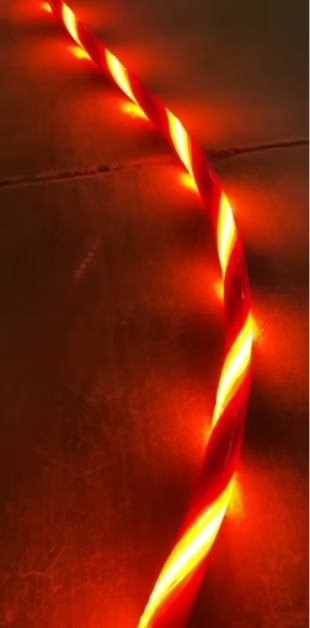
Inductive Harvesting: How Does the Magnetic Field of the Power Cores Induce Current to Light Up LEDs Without Physical Electrical Connection?
An accessible technical explanation of how Faraday’s law of electromagnetic induction enables energy harvesting from the alternating magnetic field surrounding AC power conductors — and how that harvested energy can illuminate LEDs embedded in a mining cable’s sheath, with no galvanic connection to the power circuit.
一篇通俗的技术解析:法拉第电磁感应定律如何使交流电力导体周围的交变磁场实现能量收集——以及该收集的能量如何在无任何电气连接的情况下点亮嵌入矿用电缆护套中的LED灯。
1. The Core Question核心问题
Consider a medium-voltage mining trailing cable — for instance, an (N)TMCGEH3S rated 6/10 kV — carrying hundreds of amperes of alternating current through its three power cores to an electric rope shovel in an open-pit mine. Somewhere inside the same cable, a tiny LED glows steadily, making the cable visible to operators in darkness. Yet that LED has no wire, no contact, no physical electrical connection to the power cores. How is this possible? 设想一根中压矿用拖拽电缆——例如额定 6/10 kV 的 (N)TMCGEH3S——通过三根动力线芯向露天矿的电铲输送数百安培的交流电。在同一根电缆内部某处,一颗微小的 LED 稳定发光,使电缆在黑暗中对操作人员可见。但该 LED 与动力线芯之间没有导线、没有触点、没有任何物理电气连接。这是如何做到的?
The answer lies in one of the most fundamental and elegant principles in all of physics: electromagnetic induction, first discovered by Michael Faraday in 1831. Every AC power conductor generates a time-varying magnetic field in the space around it. If a small coil of wire — a “receiver” — is placed within that field, a voltage is induced across the coil, and if the coil is connected to an LED, current flows and the LED illuminates. No physical contact is needed. The energy is transferred through the magnetic field itself, across empty space, through insulation and rubber, as silently and invisibly as gravity. 答案在于物理学中最基本、最优美的原理之一:电磁感应,由迈克尔·法拉第于1831年首次发现。每根交流电力导体都会在其周围空间产生时变磁场。如果将一个小线圈——即”接收器”——放置在该磁场中,线圈两端将感应出电压;如果线圈连接 LED,电流流过,LED 即被点亮。无需任何物理接触。能量通过磁场本身传递,穿越空气、绝缘层和橡胶,如同引力一般无声无形。
2. First Principles: Ampère’s Law — The Magnetic Field Around a Conductor第一性原理:安培定律——导体周围的磁场
To understand inductive harvesting, we must begin at the very beginning: every current-carrying conductor produces a magnetic field. This is not an engineering approximation — it is a law of nature formalized by André-Marie Ampère in 1826 and incorporated into Maxwell’s equations. For a long, straight conductor carrying current I, the magnetic flux density B at a perpendicular distance r from the conductor is given by the following well-known relation. 要理解感应能量收集,必须从最基本的原理开始:每一根载流导体都会产生磁场。这不是工程近似——而是安德烈-玛丽·安培于1826年形式化的自然法则,并被纳入麦克斯韦方程组。对于载有电流 I 的长直导体,距导体垂直距离 r 处的磁通密度 B 由以下著名关系式给出。
Where:
B = magnetic flux density (Tesla, T)
μ₀ = permeability of free space = 4π × 10⁻⁷ H/m
I = current in the conductor (Amperes, A)
r = radial distance from conductor center (meters, m)
This equation tells us several important things. First, the field is directly proportional to the current: the higher the current flowing in a mining cable’s power core (and mining cables routinely carry 200–500 A), the stronger the surrounding magnetic field. Second, the field decreases inversely with distance — but crucially, it does not vanish. Even at a distance of several centimeters (the typical spacing between a power core and the cable’s outer sheath), a measurable magnetic field persists. For example, at a current of 300 A and a radial distance of 30 mm (0.03 m), the flux density is approximately 2 mT — small by the standards of an MRI machine, but more than sufficient for energy harvesting. 这个方程告诉我们几个重要信息。首先,磁场与电流成正比:矿用电缆动力芯线中流过的电流越大(矿用电缆通常载有 200–500 A),周围磁场就越强。其次,磁场与距离成反比递减——但关键的是,它并不消失。即使在几厘米的距离处(动力芯线与电缆外护套之间的典型间距),仍然存在可测量的磁场。例如,在 300 A 电流和 30 mm(0.03 m)径向距离时,磁通密度约为 2 mT——以 MRI 设备的标准来看很小,但对能量收集而言已绰绰有余。
| Distance r (mm) | Distance r (m) | B (mT) | B (μT) | Context | |
|---|---|---|---|---|---|
| 10 | 0.010 | 6.00 | 6,000 | Inside cable, adjacent to core insulation | 电缆内部,紧邻芯线绝缘 |
| 20 | 0.020 | 3.00 | 3,000 | Within cable fill area | |
| 30 | 0.030 | 2.00 | 2,000 | Near outer sheath interior surface | 接近外护套内表面 |
| 50 | 0.050 | 1.20 | 1,200 | At outer sheath surface (typical cable OD ~100 mm) | |
| 100 | 0.100 | 0.60 | 600 | Near cable surface, air gap | |
| 500 | 0.500 | 0.12 | 120 | Half-meter from cable | |
| 1,000 | 1.000 | 0.06 | 60 | One meter from cable | 距电缆1米 |
Note: The values above assume a single isolated conductor. In a real three-phase cable, the magnetic fields from three cores partially cancel each other outside the cable (because the three phase currents sum to zero in a balanced system). However, within the cable’s interior — where the receiver coil is positioned — the local field from the nearest core dominates, and significant net flux density remains available for harvesting. 注意:以上数值假设为单根隔离导体。在实际三相电缆中,三根芯线的磁场在电缆外部会部分相互抵消(因为平衡系统中三相电流之和为零)。然而,在电缆内部——即接收线圈所在位置——最近芯线的局部磁场占主导地位,仍有显著的净磁通密度可供收集。
3. Faraday’s Law of Induction — From Magnetic Field to Voltage法拉第感应定律——从磁场到电压
Having established that a strong, time-varying magnetic field exists around the power cores, the next step is to convert that field into electrical energy. This is precisely the function of Faraday’s law of electromagnetic induction, which states that a changing magnetic flux through a closed loop of wire induces an electromotive force (EMF) — effectively, a voltage — in that loop. Mathematically, for a coil of N turns with a changing magnetic flux Φ through each turn, the induced EMF is expressed as follows. 已经确定了动力芯线周围存在强时变磁场后,下一步是将该磁场转换为电能。这正是法拉第电磁感应定律的功能,该定律指出:穿过闭合线圈的变化磁通会在该线圈中感应出电动势(EMF)——即电压。对于具有 N 匝且每匝磁通 Φ 变化的线圈,感应电动势的数学表达如下。
Where:
EMF = induced electromotive force (Volts, V)
N = number of turns in the receiver coil
Φ = magnetic flux through each turn (Weber, Wb) = B · A · cos(θ)
dΦ/dt = rate of change of magnetic flux with time
A = cross-sectional area of each coil turn (m²)
θ = angle between the magnetic field and the coil’s normal axis
The negative sign reflects Lenz’s law: the induced current flows in a direction that opposes the change in flux that produced it — a direct consequence of the conservation of energy. The critical insight here is the rate of change requirement. A static (DC) magnetic field produces zero induced EMF. But in an AC power cable operating at 50 Hz (or 60 Hz), the current — and therefore the magnetic field — reverses direction 100 times per second (120 times at 60 Hz), ensuring a continuously changing flux and a continuously induced voltage in the receiver coil. 负号反映了楞次定律:感应电流的方向总是反对产生它的磁通变化——这是能量守恒的直接结果。这里的关键洞察是变化率的要求。静态(直流)磁场产生的感应电动势为零。但在工作频率为 50 Hz(或 60 Hz)的交流电力电缆中,电流——因而磁场——每秒反转 100 次(60 Hz 时为 120 次),确保接收线圈中持续变化的磁通和持续感应的电压。
The entire mechanism is identical in principle to how a transformer works. In a transformer, the primary winding generates a time-varying magnetic flux in a shared iron core, and the secondary winding picks up that flux to produce an output voltage. In inductive harvesting within a cable, the power core acts as a single-turn “primary,” the space inside the cable serves as an air-core flux path, and the small receiver coil serves as a “secondary.” There is no iron core — coupling is weaker, so only milliwatts of power are harvested — but the underlying physics is exactly the same: Faraday’s law. 整个机制在原理上与变压器完全相同。在变压器中,初级绕组在共享铁芯中产生时变磁通,次级绕组拾取该磁通以产生输出电压。在电缆内部的感应能量收集中,动力芯线充当单匝”初级”,电缆内部空间充当空心磁通路径,小接收线圈充当”次级”。没有铁芯——耦合较弱,因此仅收集毫瓦级功率——但基本物理原理完全相同:法拉第定律。
4. The Receiver Coil — A Miniature Energy Harvester接收线圈——微型能量收集器
To capture enough energy from the ambient magnetic field to illuminate an LED, a small receiver coil is designed with several parameters tuned for maximum energy extraction. The key design variables are the number of turns (N), the coil area (A), the coil’s orientation relative to the magnetic field, and whether a ferrite core is used to concentrate flux. The table below summarizes how each parameter affects the harvested voltage. 为了从环境磁场中捕获足够的能量来点亮 LED,需要设计一个小型接收线圈,其多个参数经过调优以实现最大能量提取。关键设计变量包括匝数(N)、线圈面积(A)、线圈相对于磁场的方向,以及是否使用铁氧体磁芯来集中磁通。下表总结了各参数对收集电压的影响。
| Parameter | Symbol | Effect on Induced EMF | Practical Consideration | |
|---|---|---|---|---|
| Number of turns | 匝数 | N | EMF ∝ N (linear increase) | More turns = higher voltage but increased coil resistance, size, and weight |
| Coil cross-sectional area | 线圈截面积 | A | EMF ∝ A (linear increase) | Larger area captures more flux, but must fit within cable geometry — typically limited to a few cm² |
| Magnetic flux density | 磁通密度 | B | EMF ∝ B (linear increase) | Determined by load current in power cores and distance — not a designer’s free variable |
| Frequency of AC field | 交流磁场频率 | f | EMF ∝ f (linear increase) | Fixed by power-system frequency: 50 Hz (most of world) or 60 Hz (Americas, parts of Asia) |
| Coil orientation angle | 线圈方向角 | θ | EMF ∝ cos(θ); maximum at θ = 0° | Coil axis should align with magnetic field direction (perpendicular to power core) for maximum coupling |
| Ferrite core | 铁氧体磁芯 | μr | EMF ∝ μeff (effective permeability); can multiply flux by 10×–100× | A small ferrite rod or toroid dramatically concentrates flux lines, boosting harvested power |
For a sinusoidal AC current at frequency f, the magnetic flux varies as Φ(t) = Bpeak · A · sin(2πft), and the peak induced EMF simplifies to the following expression. 对于频率为 f 的正弦交流电流,磁通按 Φ(t) = Bpeak · A · sin(2πft) 变化,感应电动势的峰值简化为以下表达式。
Numerical example (50 Hz, mining cable):
N = 200 turns, Bpeak = 2 mT = 2 × 10⁻³ T,
A = 3 cm² = 3 × 10⁻⁴ m², f = 50 Hz
EMFpeak = 200 × 2×10⁻³ × 3×10⁻⁴ × 2π × 50
EMFpeak ≈ 200 × 2×10⁻³ × 3×10⁻⁴ × 314.16
EMFpeak ≈ 37.7 mV
At first glance, 37.7 mV seems too low — a typical red LED requires a forward voltage of about 1.8 V. But this is where circuit engineering comes in. With a ferrite core concentrating flux by a factor of 50–100×, and with additional turns or a resonant LC circuit tuned to 50 Hz to boost the voltage, the induced EMF can readily be elevated to several volts — more than sufficient to forward-bias an LED. 乍一看,37.7 mV 似乎太低——典型红色 LED 需要约 1.8 V 的正向电压。但这正是电路工程的用武之地。利用铁氧体磁芯将磁通集中 50–100 倍,加上增加匝数或采用谐振于 50 Hz 的 LC 电路来提升电压,感应电动势可轻松提升至数伏特——足以使 LED 正向导通。
5. The Complete Energy Harvesting Circuit完整的能量收集电路
Between the receiver coil and the LED, a small conditioning circuit converts the raw AC induced voltage into a usable DC supply. The circuit is simple, robust, and requires no active power supply of its own — it runs entirely on harvested energy. The typical topology consists of three stages arranged in a chain. 在接收线圈和 LED 之间,一个小型调理电路将原始交流感应电压转换为可用的直流电源。该电路简单、可靠,不需要自身的有源电源——完全依靠收集的能量运行。典型拓扑由三个依次排列的级组成。
| Stage | Function | Typical Components | 功能说明 |
|---|---|---|---|
| 1. Resonant Tuning | A capacitor C is connected in parallel (or series) with the receiver coil’s inductance L to form an LC resonant circuit tuned to 50/60 Hz. At resonance, the impedance is minimized and the voltage across the coil is amplified by the quality factor Q. | Capacitor (typically 1–100 μF film cap) | 电容 C 与接收线圈电感 L 并联(或串联)形成谐振于 50/60 Hz 的 LC 电路。在谐振时阻抗最小,线圈电压被品质因数 Q 放大。 |
| 2. Rectification | The amplified AC voltage is converted to pulsating DC using a diode bridge or a voltage-doubler rectifier. Low-forward-voltage Schottky or germanium diodes are preferred to minimize voltage loss across the diode junction. | Schottky diode bridge (e.g., BAT54S) or 1N5817 | 放大后的交流电压通过二极管桥式或倍压整流电路转换为脉动直流。优选低正向压降的肖特基或锗二极管以减少结压降损耗。 |
| 3. Smoothing & LED Drive | A small reservoir capacitor smooths the pulsating DC. A current-limiting resistor (or a simple LDO if power budget permits) feeds the LED at the correct forward current, typically 1–20 mA. | Electrolytic cap (10–100 μF), series resistor, LED | 小型储能电容平滑脉动直流。限流电阻(或低压差稳压器)以正确的正向电流(通常 1–20 mA)驱动 LED。 |
The resonant LC circuit is the single most important element in making inductive harvesting practical at power-line frequencies. At resonance, the voltage across the coil can be amplified by a factor of Q (the quality factor), where Q = (1/R)·√(L/C). For a well-wound coil on a ferrite core, Q values of 20–60 are achievable at 50 Hz, meaning the effective voltage is multiplied 20–60× compared to the un-tuned case. This is how a raw induced EMF of tens of millivolts becomes several volts — enough to drive one or more LEDs. 谐振 LC 电路是使感应能量收集在工频下变得可行的最关键元件。在谐振时,线圈上的电压可被品质因数 Q 放大,其中 Q = (1/R)·√(L/C)。对于铁氧体磁芯上精心绑扎的线圈,在 50 Hz 下 Q 值可达 20–60,即有效电压比未调谐情况放大 20–60 倍。这就是原始感应电动势从数十毫伏变为数伏特的原因——足以驱动一个或多个 LED。
6. Why AC Makes This Possible — And DC Does Not为什么交流电使这成为可能——而直流电不行
A frequently asked question is: would this work with a DC cable? The short answer is no. Faraday’s law requires a changing magnetic flux — dΦ/dt must be non-zero. A DC current produces a constant, static magnetic field. A static field passing through a coil produces zero rate of change and therefore zero induced EMF. The coil would simply sit in a steady magnetic field and generate nothing. 一个常被问到的问题是:直流电缆可以吗?简短的回答是不行。法拉第定律要求变化的磁通——dΦ/dt 必须非零。直流电流产生恒定不变的静态磁场。静态磁场穿过线圈时变化率为零,因此感应电动势为零。线圈只会处于稳态磁场中,什么也不会产生。
This is why the technology is inherently tied to AC power systems — and conveniently, virtually all mining electrical distribution operates on AC at 50 or 60 Hz. The frequency also matters: higher frequency means faster flux change and therefore higher induced EMF (EMF ∝ f). This is why some advanced energy-harvesting research explores higher harmonic components present in real-world power cables, which can contribute additional harvestable energy beyond the fundamental 50/60 Hz component. 这就是为什么该技术与交流电力系统天然绑定——而方便的是,几乎所有矿山配电系统都以 50 或 60 Hz 的交流运行。频率也很重要:更高的频率意味着更快的磁通变化,因此感应电动势更高(EMF ∝ f)。这就是为什么一些先进的能量收集研究探索实际电力电缆中存在的高次谐波分量,这些分量可以在基波 50/60 Hz 分量之外贡献额外的可收集能量。
| Characteristic | AC Power Cable | DC Power Cable | |
|---|---|---|---|
| Magnetic field type | 磁场类型 | Time-varying (sinusoidal at 50/60 Hz) | Static (constant in time) |
| dΦ/dt | Non-zero, continuously oscillating | Zero (no change) | |
| Induced EMF in receiver coil | 接收线圈中的感应EMF | Continuously generated (AC voltage) | None — zero voltage |
| Energy harvesting possible? | 能否进行能量收集? | Yes | No |
| Transformer analogy | Functions as air-core transformer | No transformer action possible |
7. Three-Phase Cables: Magnetic Field Behavior三相电缆:磁场行为
Real mining trailing cables carry three-phase AC power, with currents in the three cores phase-shifted by 120°. In a perfectly balanced system, the vector sum of the three currents is zero at every instant, which means their magnetic fields partially cancel when observed at points well outside the cable. This is desirable for electromagnetic compatibility and human exposure limits (the ICNIRP recommends a general-public exposure limit of 100 μT at 50 Hz). However, inside the cable, the geometry is different. 真实的矿用拖拽电缆承载三相交流电力,三根芯线中的电流相位差为 120°。在完全平衡的系统中,三个电流的矢量和在每一时刻均为零,这意味着在电缆外部远处观测时,其磁场会部分抵消。这对电磁兼容性和人体暴露限值有利(ICNIRP 建议50 Hz时一般公众暴露限值为 100 μT)。然而在电缆内部,几何关系不同。
When a small receiver coil is placed in the interstice (filler space) between the power cores, it is close enough to one core that the field from that core dominates. The partial cancellation from the other two cores — located farther away — only marginally reduces the local flux. Research using COMSOL Multiphysics finite-element simulation for a typical 12/20 kV three-phase underground cable has confirmed that the magnetic flux density within a cable’s cross-section, near individual cores, can range from 1 to 10 mT depending on load current and geometry — values well within the practical range for inductive harvesting. 当小型接收线圈放置在动力芯线之间的间隙(填充空间)中时,它距离一根芯线足够近,使得该芯线的磁场占主导地位。来自其他两根较远芯线的部分抵消仅略微降低了局部磁通。使用 COMSOL Multiphysics 有限元仿真对典型 12/20 kV 三相地下电缆的研究已确认,电缆截面内靠近各芯线处的磁通密度可在 1 至 10 mT 之间,取决于负载电流和几何结构——这些数值完全在感应能量收集的实用范围内。
8. Practical Implementation in Mining Cables在矿用电缆中的实际应用
The concept of inductive harvesting to power visibility LEDs in mining cables has been realized in commercial products. Prysmian Group’s TENAX-LUMEN cable incorporates an electroluminescent (EL) string embedded within a transparent polyurethane (PUR) outer sheath. While the EL mechanism differs from discrete LEDs (using phosphor excitation rather than a semiconductor junction), the principle of drawing energy from the cable’s own magnetic environment remains relevant. Chinese patent CN202473291U describes a mining luminous cable using photoelectric recurrence luminescent material (ZnS-based long-afterglow phosphors) applied to conductor surfaces, glowing under both energized and de-energized conditions. 利用感应能量收集为矿用电缆中的可见性 LED 供电的概念已在商业产品中得到实现。普睿司曼集团的 TENAX-LUMEN 电缆在透明聚氨酯(PUR)外护套中嵌入了电致发光(EL)线。虽然 EL 机制与分立 LED 不同(使用荧光粉激发而非半导体结),但从电缆自身磁环境中提取能量的原理依然相关。中国专利 CN202473291U 描述了一种矿用发光电缆,使用涂覆在导体表面的光电复合发光材料(基于 ZnS 的长余辉荧光粉),在通电和断电条件下均可发光。
For discrete LED implementations, the receiver coil and conditioning circuit can be integrated as a small, potted module positioned in the filler space of the cable during manufacturing. The module is entirely self-powered — it draws milliwatts from the magnetic field whenever current flows in the power cores. When the cable is de-energized (no current), the magnetic field vanishes, and the LEDs extinguish unless a backup mechanism (such as phosphorescent afterglow material or a small supercapacitor charged during operation) is included. The table below compares the three main approaches to cable visibility illumination. 对于分立 LED 实现方案,接收线圈和调理电路可以集成为一个小型灌封模块,在制造过程中放置在电缆的填充空间内。该模块完全自供电——每当动力芯线中有电流流过时,它从磁场中提取毫瓦级功率。当电缆断电(无电流)时,磁场消失,LED 熄灭,除非包含备用机制(如磷光余辉材料或在运行期间充电的小型超级电容器)。下表比较了三种主要的电缆可见性照明方案。
| Method | Energy Source | Active When De-energized? | Advantages | Limitations | |
|---|---|---|---|---|---|
| Inductively-harvested LED | 感应收集LED | Magnetic field of power cores (Faraday induction) | No (unless supercap backup) | No battery, no external power, self-powered, long life, can be bright | Only works when cable carries load current; requires circuit design space |
| Electroluminescent (EL) string | 电致发光线 | AC driver circuit (which may itself be inductively powered or use a dedicated pilot wire) | Possible with battery/supercap | 360° uniform glow, slim form factor, integrates into PUR sheath | EL phosphor degrades over time (5,000–10,000 hrs); requires AC driver |
| Phosphorescent / photoluminescent coating | 磷光/光致发光涂层 | Stored photon energy (charged by ambient light) | Yes (afterglow decays over hours) | Fully passive, no circuit, zero power consumption | Afterglow brightness limited; needs periodic light “charging”; dim in prolonged darkness |
9. Energy Budget: How Much Power Can Be Harvested?能量预算:能收集多少功率?
Research published in Applied Sciences (MDPI) on energy harvesting from the stray electromagnetic field around power cables has demonstrated that inductive harvesters with optimized ferrite cores can produce RMS voltages exceeding 900 mV at cable currents of 155 A. At higher mining-cable currents of 300–500 A, and with resonant tuning, the harvested power can reach tens of milliwatts — far more than needed for a few LEDs. 发表在 Applied Sciences(MDPI)上的关于电力电缆周围杂散电磁场能量收集的研究表明,经过铁氧体磁芯优化的感应收集器在电缆电流 155 A 时可产生超过 900 mV 的有效值电压。在矿用电缆更高的 300–500 A 电流下,配合谐振调谐,收集功率可达数十毫瓦——远超几颗 LED 所需。
| Item | Voltage | Current | Power | |
|---|---|---|---|---|
| Standard red LED (visible indicator) | 标准红色LED | 1.8–2.0 V | 2–20 mA | 4–40 mW |
| High-efficiency green LED | 2.0–2.2 V | 1–5 mA | 2–11 mW | |
| White LED (standard 5mm) | 3.0–3.3 V | 5–20 mA | 15–66 mW | |
| Ultra-low-power LED (0402 SMD) | 1.8 V | 0.5 mA | ~1 mW | |
| Harvestable Power (estimated, 300 A, 50 Hz, optimized ferrite-core coil at 25 mm from power core) | ||||
| Estimated available power | 估计可用功率 | 2–5 V (rectified) | 5–30 mA | 10–150 mW |
The harvested power budget of 10–150 mW is comfortably above the requirement for several ultra-low-power LEDs distributed along the cable’s length. In practice, a harvester module might be embedded every 5–10 meters, each powering one or more LEDs visible through a translucent or transparent PUR sheath section. The total power drawn from the magnetic field is negligible compared to the kilowatts flowing through the power cores — typically less than 0.001% of the transmitted power. 10–150 mW 的收集功率预算明显高于沿电缆长度分布的数颗超低功耗 LED 的需求。在实际应用中,可每隔 5–10 米嵌入一个收集器模块,每个模块驱动一颗或多颗通过半透明或透明 PUR 护套段可见的 LED。从磁场中提取的总功率与流过动力芯线的千瓦级功率相比可忽略不计——通常不到传输功率的 0.001%。
The inductive harvesting system is inherently isolated from the high-voltage power circuit. There is no galvanic (metallic) connection between the power cores and the LED circuit. The receiver coil is magnetically coupled only. This means the LED circuit operates at extra-low voltage (typically under 5 V DC), fully compliant with safety requirements for touch-safe circuits. A failure of the LED module cannot cause a fault on the high-voltage system, and a fault on the high-voltage system cannot send dangerous voltage to the LED circuit. 感应能量收集系统与高压电力回路天然隔离。动力芯线与 LED 电路之间没有电气(金属)连接。接收线圈仅通过磁耦合。这意味着 LED 电路工作在特低电压(通常低于 5 V 直流),完全符合安全触碰电路的要求。LED 模块的故障不会导致高压系统故障,高压系统的故障也不会向 LED 电路传送危险电压。
10. Summary: The Physics Chain from Power Core to LED总结:从动力芯线到LED的物理链
The complete chain of physics that allows an LED to illuminate inside a mining cable without any physical electrical connection to the power circuit can be summarized in five steps, each grounded in established electromagnetic theory. 使 LED 在矿用电缆内部无需与电力回路有任何物理电气连接即可点亮的完整物理链可以归纳为五个步骤,每一步都基于成熟的电磁理论。
| Step | Physical Phenomenon | Governing Law | What Happens | 物理过程 |
|---|---|---|---|---|
| 1 | Current flows in power core | Ohm’s law / circuit theory | AC current (50/60 Hz, 200–500 A) flows through tinned copper Class 5 conductors | 交流电流通过镀锡铜5类导体 |
| 2 | Magnetic field is generated | Ampère’s law: B = μ₀I/(2πr) | A time-varying magnetic field (1–10 mT range) surrounds each power core | 时变磁场(1–10 mT 范围)环绕每根动力芯线 |
| 3 | Magnetic flux passes through receiver coil | Φ = B · A · cos(θ) | The oscillating magnetic flux threads through the N-turn receiver coil positioned nearby | 振荡磁通穿过附近的N匝接收线圈 |
| 4 | EMF is induced in receiver coil | Faraday’s law: EMF = −N·dΦ/dt | A voltage (AC) is induced in the coil; amplified by LC resonance and ferrite core | 线圈中感应出交流电压;经LC谐振和铁氧体磁芯放大 |
| 5 | LED illuminates | Semiconductor junction physics | Rectified DC forward-biases the LED; photons are emitted — the cable glows | 整流后的直流使LED正向导通,发射光子——电缆发光 |
This elegant chain — from Ampère to Faraday to semiconductor physics — represents one of the most practical and safety-enhancing applications of fundamental electromagnetic theory in modern mining cable engineering. It is a technology that converts an unavoidable by-product of power transmission (the stray magnetic field) into a life-saving visibility feature, with zero additional wiring, zero external power, and zero compromise to the cable’s primary electrical function. 这一优美的链条——从安培到法拉第再到半导体物理——代表了基础电磁理论在现代矿用电缆工程中最实用、最能增强安全性的应用之一。这项技术将电力传输不可避免的副产品(杂散磁场)转化为拯救生命的可见性功能,无需额外布线、无需外部电源,且不影响电缆的主要电气功能。
11. About Anhui Feichun Special Cable Co., Ltd.关于安徽飞纯特种电缆有限公司
Anhui Feichun Special Cable Co., Ltd. (安徽飞纯特种电缆有限公司) designs and manufactures high-performance flexible cables for mining, crane, port, and industrial-automation applications. With products aligned to DIN VDE 0250, IEC 60228, IEC 60502, ICEA S-75-381, and AS/NZS 1802/2802, Feichun delivers engineering-grade cable solutions worldwide. Our R&D team is actively developing next-generation visibility technologies for mining trailing cables, including inductively-powered LED systems and advanced high-contrast PUR sheath formulations. 安徽飞纯特种电缆有限公司专注于矿山、起重机、港口和工业自动化领域高性能柔性电缆的设计和制造。产品系列符合 DIN VDE 0250、IEC 60228、IEC 60502、ICEA S-75-381 和 AS/NZS 1802/2802 标准,面向全球提供工程级电缆解决方案。我们的研发团队正在积极开发矿用拖拽电缆的下一代可见性技术,包括感应供电 LED 系统和先进的高对比度 PUR 护套配方。
Contact Feichun Technical Sales 联系飞纯技术销售
References & Sources 参考来源
- Faraday, M. (1831). “Experimental Researches in Electricity.” Philosophical Transactions of the Royal Society of London. — Wikipedia overview: en.wikipedia.org
- Wikipedia, “Electromagnetic induction.” en.wikipedia.org
- Physics LibreTexts, “22.1: Magnetic Flux, Induction, and Faraday’s Law.” phys.libretexts.org
- Physics LibreTexts, “12.6: Ampère’s Law.” phys.libretexts.org
- Khan, F. et al. (2016). “Energy Harvesting from the Stray Electromagnetic Field around the Electrical Power Cable for Smart Grid Applications.” PMC / Sensors. pmc.ncbi.nlm.nih.gov
- Moghe, R. et al. (2011). “Energy Harvesting from Electromagnetic Energy Radiating from AC Power Lines.” CMU. users.ece.cmu.edu
- Prysmian Group, “TENAX-LUMEN — Self-Luminous Power Cable for Mining.” prysmian.com
- Prysmian Group, “Cable Solutions for Mining Industry.” prysmian.com/mining
- CN202473291U — “Mining luminous cable” (Chinese patent). patents.google.com
- Arrow Electronics, “Faraday’s Law & Electromagnetic Induction — How Transformers Work.” arrow.com
- Electronics Tutorials, “Electromagnetic Induction and Faraday’s Law of Induction.” electronics-tutorials.ws
- Electrical4U, “Faraday’s Laws of Electromagnetic Induction.” electrical4u.com
- MDPI Applied Sciences (2023), “Numerical and Analytical Analysis of Low-Frequency Magnetic Fields Generated by Three-Phase Underground Power Cables with Solid Bonding.” mdpi.com
- ELEK Software, “Magnetic Fields from High Voltage Power Cables.” elek.com
- SimScale, “What is Electromagnetic Induction?” simscale.com
- Nexans Deutschland GmbH, “POWERMINE® (N)TMCGEH3S 6/10 kV.” nexans.de
- Feichun Special Cable, “What is DIN VDE 0250 Cable?” feichuncables.com


