DIN VDE 0250-813 trailing cable

When engineers first encounter the concept of a self-illuminating mining cable — such as the (N)TSCGEH3S / TENAX-LUMEN type — one of the most natural questions that arises is about the transparent outer sheath. Traditional mining trailing cables use opaque black polychloroprene (PCP, also known as neoprene or CR) or chlorinated polyethylene (CPE) outer jackets. These materials have decades of proven thermal performance data. Replacing them with a crystal-clear thermoplastic polyurethane (TPU) immediately raises the concern: does the change in sheath material and color affect how much current the cable can safely carry? This is not a trivial question. The ampacity (current-carrying capacity) of a power cable is fundamentally a thermal problem. Every ampere of current flowing through the conductor generates I²R heat losses. That heat must travel outward through every layer of the cable — insulation, screens, inner sheath, monitoring shield, and finally the outer sheath — before being dissipated to the surrounding environment by convection and radiation. If any layer in this thermal chain acts as a better or worse insulator, or if the cable surface radiates heat more or less efficiently, the maximum allowable current changes. 载流量本质上是一个热学问题:导体中的I²R热量必须穿过每一层传导到外部环境——如果任何层的热性能改变,最大允许电流就会变化。When engineers first encounter the concept of a self-illuminating mining cable — such as the (N)TSCGEH3S / TENAX-LUMEN type — one of the most natural questions that arises is about the transparent outer sheath. Traditional mining trailing cables use opaque black polychloroprene (PCP, also known as neoprene or CR) or chlorinated polyethylene (CPE) outer jackets. These materials have decades of proven thermal performance data. Replacing them with a crystal-clear thermoplastic polyurethane (TPU) immediately raises the concern: does the change in sheath material and color affect how much current the cable can safely carry? This is not a trivial question. The ampacity (current-carrying capacity) of a power cable is fundamentally a thermal problem. Every ampere of current flowing through the conductor generates I²R heat losses. That heat must travel outward through every layer of the cable — insulation, screens, inner sheath, monitoring shield, and finally the outer sheath — before being dissipated to the surrounding environment by convection and radiation. If any layer in this thermal chain acts as a better or worse insulator, or if the cable surface radiates heat more or less efficiently, the maximum allowable current changes. 载流量本质上是一个热学问题:导体中的I²R热量必须穿过每一层传导到外部环境——如果任何层的热性能改变,最大允许电流就会变化。
Heat Dissipation: Does the TPU Transparent Sheath Affect the Ampacity of the Cable Compared to Black Rubber?

When engineers first encounter the concept of a self-illuminating mining cable — such as the (N)TSCGEH3S / TENAX-LUMEN type — one of the most natural questions that arises is about the transparent outer sheath. Traditional mining trailing cables use opaque black polychloroprene (PCP, also known as neoprene or CR) or chlorinated polyethylene (CPE) outer jackets. These materials have decades of proven thermal performance data. Replacing them with a crystal-clear thermoplastic polyurethane (TPU) immediately raises the concern: does the change in sheath material and color affect how much current the cable can safely carry? This is not a trivial question. The ampacity (current-carrying capacity) of a power cable is fundamentally a thermal problem. Every ampere of current flowing through the conductor generates I²R heat losses. That heat must travel outward through every layer of the cable — insulation, screens, inner sheath, monitoring shield, and finally the outer sheath — before being dissipated to the surrounding environment by convection and radiation. If any layer in this thermal chain acts as a better or worse insulator, or if the cable surface radiates heat more or less efficiently, the maximum allowable current changes. 载流量本质上是一个热学问题:导体中的I²R热量必须穿过每一层传导到外部环境——如果任何层的热性能改变,最大允许电流就会变化。
Consider a medium-voltage mining trailing cable — for instance, an (N)TMCGEH3S rated 6/10 kV — carrying hundreds of amperes of alternating current through its three power cores to an electric rope shovel in an open-pit mine. Somewhere inside the same cable, a tiny LED glows steadily, making the cable visible to operators in darkness. Yet that LED has no wire, no contact, no physical electrical connection to the power cores. How is this possible? 设想一根中压矿用拖拽电缆——例如额定 6/10 kV 的 (N)TMCGEH3S——通过三根动力线芯向露天矿的电铲输送数百安培的交流电。在同一根电缆内部某处,一颗微小的 LED 稳定发光,使电缆在黑暗中对操作人员可见。但该 LED 与动力线芯之间没有导线、没有触点、没有任何物理电气连接。这是如何做到的?

Inductive Harvesting: How Does the Magnetic Field of the Power Cores Induce Current to Light Up LEDs Without Physical Electrical Connection?

Consider a medium-voltage mining trailing cable — for instance, an (N)TMCGEH3S rated 6/10 kV — carrying hundreds of amperes of alternating current through its three power cores to an electric rope shovel in an open-pit mine. Somewhere inside the same cable, a tiny LED glows steadily, making the cable visible to operators in darkness. Yet that LED has no wire, no contact, no physical electrical connection to the power cores. How is this possible? 设想一根中压矿用拖拽电缆——例如额定 6/10 kV 的 (N)TMCGEH3S——通过三根动力线芯向露天矿的电铲输送数百安培的交流电。在同一根电缆内部某处,一颗微小的 LED 稳定发光,使电缆在黑暗中对操作人员可见。但该 LED 与动力线芯之间没有导线、没有触点、没有任何物理电气连接。这是如何做到的?
In large-scale open-pit mines and underground operations, heavy mobile equipment — electric rope shovels, walking draglines, blast-hole drill rigs, and haul trucks — operates around the clock, including night shifts and in environments with zero natural light. Trailing power cables that supply electricity to this equipment lie across haul roads and bench floors, often spanning hundreds or even thousands of meters. When operators cannot see these cables, the result is crushover damage, unplanned downtime, and in the worst cases, life-threatening electrical faults. Cable damage from equipment runover is one of the most persistent operational challenges in surface mining. Each crush event can take a mine's primary production asset offline for hours or even days while the cable is repaired or replaced, and a damaged medium-voltage cable carrying 6 kV to 25 kV poses a serious arc-flash and electrocution hazard to any personnel nearby. According to Prysmian Group, the origin of many unplanned mining interruptions is related to power cable damage caused by equipment crushing during movement, particularly due to visibility restrictions. 据普睿司曼集团介绍,许多矿山非计划停机的根源是设备移动过程中因能见度受限导致的电力电缆压损。

Safety in the Dark: Why Active LED Mining Cables Are Replacing Reflective Tape

In large-scale open-pit mines and underground operations, heavy mobile equipment — electric rope shovels, walking draglines, blast-hole drill rigs, and haul trucks — operates around the clock, including night shifts and in environments with zero natural light. Trailing power cables that supply electricity to this equipment lie across haul roads and bench floors, often spanning hundreds or even thousands of meters. When operators cannot see these cables, the result is crushover damage, unplanned downtime, and in the worst cases, life-threatening electrical faults. Cable damage from equipment runover is one of the most persistent operational challenges in surface mining. Each crush event can take a mine’s primary production asset offline for hours or even days while the cable is repaired or replaced, and a damaged medium-voltage cable carrying 6 kV to 25 kV poses a serious arc-flash and electrocution hazard to any personnel nearby. According to Prysmian Group, the origin of many unplanned mining interruptions is related to power cable damage caused by equipment crushing during movement, particularly due to visibility restrictions. 据普睿司曼集团介绍,许多矿山非计划停机的根源是设备移动过程中因能见度受限导致的电力电缆压损。
Open-pit mining operations run around the clock, often in low-light conditions where trailing cables — the lifelines of mobile equipment — become nearly invisible on the ground. When heavy machinery such as draglines, shovels, or belt-wagon systems traverse active pit areas, undetected cables are at risk of being crushed or severed. The consequences extend beyond costly cable replacement: unplanned downtime, arc-flash hazards, and direct threats to personnel safety all stem from a single visibility failure. 露天矿山全天候运营,常在低光照条件下作业。此时拖拽电缆——移动设备的生命线——几乎不可见。重型机械(如拉铲、电铲或皮带车系统)经过作业区域时,未被发现的电缆面临被碾压或切断的风险。后果不仅是高昂的电缆更换费用,还包括计划外停机、电弧闪光危险以及对人员安全的直接威胁。

TENAX-LUMEN Alternative: High-Visibility (N)TMCGEH3S Cables for Safer Mines

Open-pit mining operations run around the clock, often in low-light conditions where trailing cables — the lifelines of mobile equipment — become nearly invisible on the ground. When heavy machinery such as draglines, shovels, or belt-wagon systems traverse active pit areas, undetected cables are at risk of being crushed or severed. The consequences extend beyond costly cable replacement: unplanned downtime, arc-flash hazards, and direct threats to personnel safety all stem from a single visibility failure. 露天矿山全天候运营,常在低光照条件下作业。此时拖拽电缆——移动设备的生命线——几乎不可见。重型机械(如拉铲、电铲或皮带车系统)经过作业区域时,未被发现的电缆面临被碾压或切断的风险。后果不仅是高昂的电缆更换费用,还包括计划外停机、电弧闪光危险以及对人员安全的直接威胁。
Load-Haul-Dump (LHD) loaders are the backbone of underground ore movement—more than 75% of the world's underground metal mines rely on LHDs for material handling. Electric-motor LHD units typically operate at medium voltages of 380–550 V (and up to 3.3/6.6 kV for larger units), drawing power through flexible trailing cables that must reel and unreel as the machine moves through narrow, irregular headings. In the permanent darkness of underground drifts, these cables face an acute visibility problem: personnel and equipment cannot easily see trailing cables on the ground, leading to run-over damage, unplanned outages, and serious safety hazards.

FeiChun (N)TMCGEH3S: Specifications for Active LED Medium Voltage Trailing Cables for Underground LHDs

Load-Haul-Dump (LHD) loaders are the backbone of underground ore movement—more than 75% of the world’s underground metal mines rely on LHDs for material handling. Electric-motor LHD units typically operate at medium voltages of 380–550 V (and up to 3.3/6.6 kV for larger units), drawing power through flexible trailing cables that must reel and unreel as the machine moves through narrow, irregular headings. In the permanent darkness of underground drifts, these cables face an acute visibility problem: personnel and equipment cannot easily see trailing cables on the ground, leading to run-over damage, unplanned outages, and serious safety hazards.
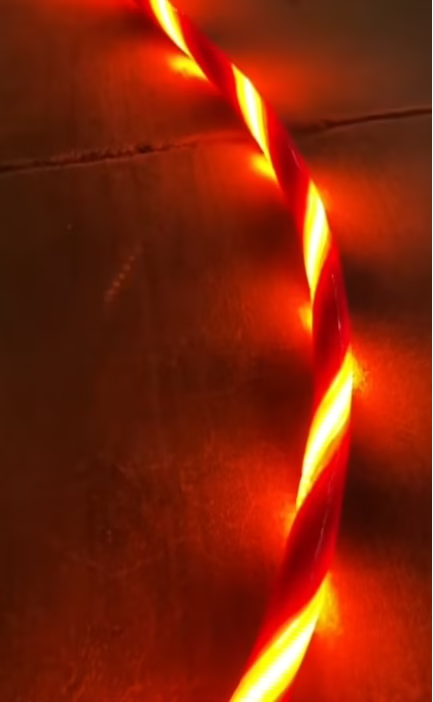
In large-scale open-pit mining, unplanned cable damage caused by low-visibility equipment movement is a leading source of operational downtime and safety incidents. The TENAX-LUMEN self-illuminating trailing cable—designated (N)TSCGEH3S—was developed by Prysmian Group precisely to address this problem. It embeds active electroluminescent (EL) lighting elements under a transparent polyurethane (TPU) outer sheath, making the cable visible in complete darkness even when it is not energized. But an essential question arises for mine electrical engineers: does adding self-illumination change the cable's core mechanical and electrical characteristics compared to the well-established (N)TSCGEWÖU standard rubber trailing cable?

TENAX-LUMEN vs. Standard (N)TSCGEWÖU: Is the (N)TSCGEH3S Self-Illuminating Cable Mechanically Identical to Standard Rubber Reeling Cables?

In large-scale open-pit mining, unplanned cable damage caused by low-visibility equipment movement is a leading source of operational downtime and safety incidents. The TENAX-LUMEN self-illuminating trailing cable—designated (N)TSCGEH3S—was developed by Prysmian Group precisely to address this problem. It embeds active electroluminescent (EL) lighting elements under a transparent polyurethane (TPU) outer sheath, making the cable visible in complete darkness even when it is not energized. But an essential question arises for mine electrical engineers: does adding self-illumination change the cable’s core mechanical and electrical characteristics compared to the well-established (N)TSCGEWÖU standard rubber trailing cable?
Load-Haul-Dump (LHD) machines are critical assets in underground mining operations, with more than 75% of the world's underground metal mines utilizing LHD equipment for material handling. The Epiroc Scooptram ST14 (14-tonne capacity) and ST18 (17.5–18 tonne capacity) represent industry-leading underground loaders engineered for demanding mining environments, featuring robust construction, ISO ROPS/FOPS certified cabins, and automation-ready configurations. 铲运机(LHD)是地下采矿作业的关键设备,全球超过75%的地下金属矿山使用LHD设备进行物料搬运。Epiroc Scooptram ST14(14吨容量)和ST18(17.5-18吨容量)代表了行业领先的地下装载机,专为严苛采矿环境设计。

Replacement Cables for Epiroc Scooptram ST14 & ST18: Enhancing LHD Availability

Load-Haul-Dump (LHD) machines are critical assets in underground mining operations, with more than 75% of the world’s underground metal mines utilizing LHD equipment for material handling. The Epiroc Scooptram ST14 (14-tonne capacity) and ST18 (17.5–18 tonne capacity) represent industry-leading underground loaders engineered for demanding mining environments, featuring robust construction, ISO ROPS/FOPS certified cabins, and automation-ready configurations. 铲运机(LHD)是地下采矿作业的关键设备,全球超过75%的地下金属矿山使用LHD设备进行物料搬运。Epiroc Scooptram ST14(14吨容量)和ST18(17.5-18吨容量)代表了行业领先的地下装载机,专为严苛采矿环境设计。
MYP cables must obtain MA (煤安) certification before they can be legally used in Chinese coal mines. The MA mark, administered by the National Coal Mine Safety Mark Office (煤矿安全标志办公室), represents mandatory safety certification for all underground coal mining equipment and materials. MYP cables, as mobile power supply cables for coal mining machinery, fall under the strictly regulated product categories defined in the Mining Product Safety Sign Management Catalog and must comply with Chinese national standards MT 818 series and GB 12972.[1][2] 是的,MYP电缆在中国煤矿使用前必须获得MA(煤安)认证。由国家煤矿安全标志办公室管理的MA标志,代表了所有井下煤矿设备和材料的强制性安全认证。MYP电缆作为煤矿机械的移动电源电缆,属于《矿用产品安全标志管理目录》中严格管制的产品类别,必须符合中国国家标准MT 818系列和GB 12972。

PROTOLON (SB-SAM) (N)TSCGEWOEU I 6 – 20 KV

NTSCGEWOEU cable, (N)TSCGEWOEU specifications, PROTOLON mining cable, SB-SAM cable, DIN VDE 0250-813 trailing cable, EN 50525-2-21 flexible cable, opencast mining cable 6kV, opencast mining cable 10kV, opencast mining cable 20kV, medium voltage trailing cable, excavator power cable, bucket wheel excavator cable, EPR rubber mining cable, polychloroprene sheath cable, IEC 60332-1-2 flame retardant, mining equipment cable 6/10kV, mining equipment cable 12/20kV, dragline cable specifications, material handling cable, heavy duty mining cable, abrasion resistant mining cable, UV resistant mining cable, oil resistant power cable, trailing cable for excavators, reeling cable mining, flexible mining cable specifications, crosslinked elastomeric insulation, semi-conductive EPR cable, DIN VDE 0298-3 mechanical parameters, GOST certificate mining cable, Russian mining cable certification, tinned copper conductor cable, split earth conductor cable, polyester braiding cable, PCP outer sheath cable, mining cable 3×25 mm2, mining cable 3×240 mm2, torsional stress cable, cable for opencast mines, cable for surface mining, Anhui Feichun cable, Feichun mining cable, China mining cable manufacturer, special cable manufacturer, cable for crushing machines, cable for coal cutters, cable for conveyor systems
TENAX-LUMEN (N)TSCGEH3S 6 kV – 10 kV for Trailing Application

What is Luminescent Power Cable TENAX-LUMEN (N)TSCGEH3S 6 kV – 10 kV for Trailing Application?

TENAX-LUMEN (N)TSCGEH3S represents a significant advancement in mining cable technology, combining robust electrical performance with innovative safety features. This medium-voltage trailing cable is specifically engineered for the demanding environments of open-pit mining operations, where large mobile equipment such as draglines and electric rope shovels require reliable power supply combined with enhanced visibility for personnel safety.