
A data-driven technical analysis of how self-illuminating trailing cables with integrated electroluminescent (EL) / LED technology outperform traditional passive reflective solutions in open-pit and underground mining operations. — 数据驱动的技术分析:自发光拖曳电缆如何在露天及地下矿山作业中优于传统被动反光方案。
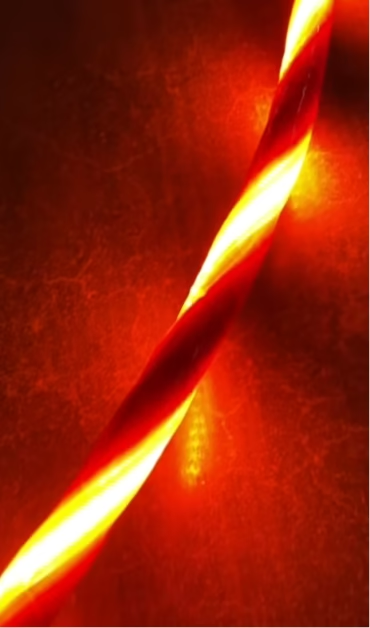
Safety in the Dark: Why Active LED Mining Cables Are Replacing Reflective Tape
A data-driven technical analysis of how self-illuminating trailing cables with integrated electroluminescent (EL) / LED technology outperform traditional passive reflective solutions in open-pit and underground mining operations. — 数据驱动的技术分析:自发光拖曳电缆如何在露天及地下矿山作业中优于传统被动反光方案。
1. The Visibility Crisis in Mining Operations 矿山作业中的可见性危机
In large-scale open-pit mines and underground operations, heavy mobile equipment — electric rope shovels, walking draglines, blast-hole drill rigs, and haul trucks — operates around the clock, including night shifts and in environments with zero natural light. Trailing power cables that supply electricity to this equipment lie across haul roads and bench floors, often spanning hundreds or even thousands of meters. When operators cannot see these cables, the result is crushover damage, unplanned downtime, and in the worst cases, life-threatening electrical faults.
Cable damage from equipment runover is one of the most persistent operational challenges in surface mining. Each crush event can take a mine’s primary production asset offline for hours or even days while the cable is repaired or replaced, and a damaged medium-voltage cable carrying 6 kV to 25 kV poses a serious arc-flash and electrocution hazard to any personnel nearby. According to Prysmian Group, the origin of many unplanned mining interruptions is related to power cable damage caused by equipment crushing during movement, particularly due to visibility restrictions. 据普睿司曼集团介绍,许多矿山非计划停机的根源是设备移动过程中因能见度受限导致的电力电缆压损。
Safety Alert 安全警示: MSHA (Mine Safety and Health Administration) fatality reports document multiple incidents where miners were fatally injured in connection with trailing cable operations — including cases where cables were not adequately visible, cable signage or markings were absent, or where equipment operators could not detect cable positions in low-light conditions. Even a single headlight failure on a shuttle car operating near trailing cables can lead to a fatal collision, as documented in MSHA’s investigation records.
2. How Reflective Tape Works — and Where It Fails 反光带的工作原理及其局限
Retro-reflective tape is the most widely used passive visibility solution in mining today. The technology relies on microscopic glass beads or prismatic elements encapsulated in a transparent film that reflect light back toward its original source. When a vehicle’s headlights strike the tape, the light bounces back to the driver, making the taped object visible. This principle — called retro-reflection — is the same technology used on road signs, vehicle markings, and high-visibility workwear. 回射反光带是目前矿山中使用最广泛的被动可见性解决方案,利用微型玻璃珠或棱镜元件将光线反射回光源。
However, reflective tape has fundamental limitations in mining environments that make it an unreliable single-point safety measure. Research by the SAE (Society of Automotive Engineers) on reflective tape degradation shows that weathering causes unwanted and premature product failure, and the effect of weathering on durability and performance of retro-reflective materials is not fully understood. Studies have demonstrated that when just 40% of a tape’s surface becomes obscured by dirt or wear, its reflectivity drops by approximately 45% — a disproportionate loss that makes the tape nearly invisible at distance. SAE的研究表明,当反光带表面仅40%被污垢或磨损遮蔽时,其反射率会下降约45%。
2.1 Key Failure Modes of Reflective Tape in Mining 反光带在矿山中的主要失效模式
| Failure Mode 失效模式 | Mechanism | Typical Onset | Impact on Visibility |
|---|---|---|---|
| Abrasion removal 磨损脱落 | Cable dragged over rock, gravel, and ore surfaces physically strips tape from sheath | Days to weeks | Total loss on contact surfaces |
| Particulate fouling 颗粒物污染 | Dust, mud, coal fines, and mineral slurry coat glass beads, blocking light return | Hours to days | 45%+ reflectivity loss at 40% coverage |
| UV / ozone degradation 紫外线/臭氧降解 | Polymer binder yellows and cracks; glass beads dislodge over time | 3–12 months | Progressive, accelerating decline |
| Adhesive failure 粘合失效 | Heat cycling, oil/chemical exposure weaken adhesive bond to cable sheath | Weeks to months | Tape peels and detaches in sections |
| Cracking & fraying 开裂与磨毛 | Repeated flexing during reeling/unreeling causes tape substrate to crack | Weeks to months | Fragmented coverage; sharp edges |
| Zero-light invisibility 无光源时不可见 | Reflective tape produces zero visibility without an external light source aimed at it | Immediate (design limitation) | Complete invisibility in total darkness |
| Angle dependency 角度依赖性 | Retro-reflection is strongest within ±4° of incident angle; side-on visibility is poor | Immediate (design limitation) | Greatly reduced off-axis visibility |
The Queensland Resources Safety & Health authority has documented additional hazards from aging reflective tape on mining equipment, including cracking and fraying that can cause skin abrasion, and internal reflections from tape inside vehicle cabins that interfere with operator visibility through windscreens — a particular concern inside dragline cabins. 昆士兰资源安全与健康管理局记录了矿用设备上老化反光带的额外危害。
Critical Limitation 关键局限: Reflective tape is a passive technology — it generates no light of its own. In total darkness with no approaching headlight (such as a de-energized cable lying on the ground between shifts, or a cable section out of any vehicle’s headlight path), reflective tape provides zero visibility. This is the single most important limitation that active LED cable technology addresses.
3. Active LED / EL Self-Illuminating Cable Technology 有源LED/EL自发光电缆技术
Self-illuminating mining cables — commercially represented by products such as the Prysmian Group TENAX-LUMEN family and equivalent (N)TSCGEH3S / (N)TSCGH3S type cables manufactured by Feichun Special Cable — represent a fundamentally different approach to cable visibility. Instead of depending on an external light source, these cables generate their own light using integrated electroluminescent (EL) strips or LED arrays powered by electromagnetic induction from the cable’s own current-carrying conductors. 自发光矿用电缆利用电磁感应从电缆自身载流导体获取能量,驱动集成的EL条或LED阵列自主发光。
3.1 Core Operating Principle 核心工作原理
The self-illuminating system uses small induction coils positioned at intervals along the cable’s length, beneath the outer sheath. During normal power transmission through the main conductors, the cable generates an electromagnetic field. The induction coils harvest a minute fraction of this field energy — typically in the milliwatt range per meter — and convert it into electrical current sufficient to drive low-power LED or EL elements. This means the illumination system requires zero external wiring, zero additional power connections, and zero modification to the mine’s electrical infrastructure. 自发光系统利用沿电缆长度间隔布置的小型感应线圈,从电缆正常输电产生的电磁场中获取微量能量来驱动发光元件。
3.2 Transparent TPU Outer Sheath 透明TPU外护套
The light generated by the LED/EL elements must be transmitted through the cable’s outer jacket to be visible externally. This is achieved by replacing the traditional opaque PCP (polychloroprene) or CPE (chlorinated polyethylene) outer sheath with a crystal-clear, heavy-duty thermoplastic polyurethane (TPU) compound. Prysmian Group confirms that the transparent polyurethane outer sheath, combined with an active illumination element, allows the cable to glow even when not energized — in direct contrast to reflective tapes and other passive solutions. 透明聚氨酯外护套与有源发光元件结合,使电缆即使在断电状态下也能发光。
| # | Layer | Material | Function 功能 |
|---|---|---|---|
| 1 | Power conductors 电力导体 | Flexible stranded tinned Cu, Class 5 per IEC 60228 | Main power delivery |
| 2 | Conductor screen 导体屏蔽 | Semi-conductive rubber | Uniform E-field distribution |
| 3 | Insulation 绝缘 | EPR type 3GI3 per DIN VDE 0207-20 | Primary dielectric; 90°C rated |
| 4 | Insulation screen 绝缘屏蔽 | Semi-conductive rubber, strippable | Controls surface E-field stress |
| 5 | Earth conductors 接地导体 | Tinned copper spiral / concentric | Grounding & fault current path |
| 6 | Inner sheath 内护套 | Rubber type GM1b per DIN VDE 0207-21 | Mechanical integrity |
| 7 | Monitoring screen 监测屏蔽 | Copper-steel braid or copper tape | Breach detection |
| 8 | Barrier tape 隔离层 | Mylar (PET) film | Moisture barrier |
| 9 | LED / EL light system LED/EL发光系统 | Self-powered EL strips or LED arrays with EM induction harvesters | Active cable visibility |
| 10 | Outer sheath 外护套 | Crystal-clear heavy-duty TPU | Abrasion, oil, UV protection + light transmission ≥85% |
4. Head-to-Head: Technical Comparison 正面对比:技术比较
The following comparison table presents a systematic evaluation of the three main cable visibility approaches currently available to the mining industry. Each parameter is assessed based on published manufacturer data, independent test standards, and field experience.
| Parameter | Active LED / EL Cable (N)TSCGEH3S type | Reflective Tape Applied to standard cable | Clip-On Reflective Devices e.g. Cable See® type |
|---|---|---|---|
| Visibility in total darkness (no external light) 完全黑暗中的可见性 | ✔ Self-generated glow | ✘ Invisible | ✘ Invisible |
| Visibility with headlights 前灯照射下的可见性 | Excellent (lit + reflective TPU) | Good (when clean and new) | Good (360° reflective flag) |
| Visibility when cable is de-energized 断电时的可见性 | Yes (residual EL / battery-backed) | Only with external light | Only with external light |
| Viewing angle 观察角度 | 360° omnidirectional glow | Retro-reflective: ±4° optimal | 360° reflective flag |
| Durability under abrasion 耐磨耐久性 | Integral to cable; TPU sheath ≤300mm³ wear | Strips within days–weeks of dragging | Durable clips; may dislodge |
| Resistance to fouling (dust/mud) 抗污染能力 | Light generated from within; self-cleaning TPU | 45%+ reflectivity loss at 40% surface fouling | Moderate — flag can be wiped |
| Maintenance requirement 维护需求 | Zero — integral system | Frequent re-application; inspection | Clip-on/off each deployment |
| Installation complexity 安装复杂度 | Zero — factory built-in | Manual application to cable surface | Manual clipping at intervals |
| Feature service life 功能使用寿命 | Matches cable life (10–15+ years) | Weeks to months in service | 1–3 years (device life) |
| External power required 需要外部电源 | No — EM induction self-powered | No | No |
| Effect on cable flexibility 对电缆柔韧性的影响 | None — integral design | Minor — adds surface stiffness | Moderate — clips add bulk at intervals |
| Outer sheath material 外护套材料 | Transparent TPU (H3) | Standard PCP/CPE + tape overlay | Standard PCP/CPE |
| Operating temp range 工作温度范围 | −50°C to +60°C | −25°C to +60°C (tape adhesive limit) | −30°C to +60°C |
| Cold-bend / impact tested 低温弯曲/冲击测试 | Yes, −50°C per DIN VDE | Tape may crack at low temperatures | Device housing may crack |
| Field spliceability 现场可接续性 | Yes — segmented LED design | Yes — re-apply tape at splice | Yes — reclip around splice |
5. Visibility Performance Under Real Conditions 实际条件下的可见性表现
Understanding why active illumination dominates over reflective tape requires examining how both technologies perform under the actual conditions encountered in mining, not just ideal laboratory settings.
| Condition 条件 | Active LED Cable | Reflective Tape | Notes |
|---|---|---|---|
| Clear night, headlights on 晴朗夜晚,车灯开启 | Excellent | Good (when clean) | Both perform well in ideal conditions |
| Clear night, no headlights 晴朗夜晚,无车灯 | Excellent (self-lit) | Invisible | Critical advantage for LED |
| Dust storm / heavy particulates 沙尘暴/高颗粒物 | Good (light penetrates near-field dust) | Very poor (beads coated) | Dust fouling is the #1 reflective tape killer |
| Rain / wet conditions 雨天/潮湿条件 | Good | Reduced (water film scatters return) | Water on glass beads reduces retro-reflection |
| Fog 雾天 | Moderate–Good (self-lit glow visible in near range) | Poor (headlight scatter, weak return) | Fog severely degrades retro-reflective returns |
| Mud-coated cable 泥浆覆盖的电缆 | Reduced but still visible (light through thin mud film) | Invisible (beads fully obscured) | TPU’s smooth surface sheds mud better than tape |
| Underground — no ambient light 地下——无环境光 | Excellent (primary use case) | Invisible without cap-lamp alignment | LED provides 360° awareness for personnel on foot |
| Cable aged 12+ months in service 服役12个月以上的电缆 | No degradation (integral system) | Severely degraded or absent | UV/ozone cause tape polymer failure within months |
Key Insight 关键见解: The most critical comparison point is not the best-case scenario (clean, new tape on a clear night with headlights) — it is the worst-case scenario (dust-coated cable in fog, or a de-energized cable lying on the ground after a shift change). It is precisely in these worst cases where reflective tape fails completely, and where active LED illumination can prevent a catastrophic incident.
6. Cost-of-Ownership & ROI Analysis 拥有成本与投资回报分析
Active LED cables carry a higher per-meter purchase price than standard cables with applied reflective tape. However, a total-cost-of-ownership (TCO) analysis over the typical 10-year cable service life tells a very different story when all direct and indirect costs are accounted for.
| Cost Element 成本要素 | Active LED Cable | Standard Cable + Reflective Tape |
|---|---|---|
| Initial cable cost premium 初始电缆成本增加 | +15–25% over standard | Baseline |
| Reflective tape material (10 years) 反光带材料费用(10年) | $0 | $8,000–$15,000 (multiple re-applications) |
| Tape application labor (10 years) 贴带人工费用(10年) | $0 | $12,000–$20,000 (crew time × frequency) |
| Cable crush-damage repairs (reduced) 电缆压损修复(减少) | Estimated 60–80% fewer crush events | Baseline (2–6 events/year typical) |
| Production downtime avoided 避免的生产停机 | $50,000–$200,000/year saved (equipment-dependent) | Baseline losses |
| Safety incident liability reduction 安全事故责任降低 | Significant | Baseline exposure |
| Inspection / maintenance labor 检查/维护人工 | Minimal (visual confirmation only) | Regular scheduled tape inspection |
| Estimated 10-year net savings 估计10年净节省 | Active LED cables typically achieve full payback within 6–18 months through avoided downtime and crush-damage costs alone | |
7. Standards, Certifications & Compliance 标准、认证与合规
Self-illuminating cables such as the (N)TSCGEH3S / (N)TSCGH3S are engineered within the same rigorous framework governing all medium-voltage mining trailing cables. The LED/EL visibility system is an additive safety feature — it does not compromise any electrical, mechanical, or fire-safety requirement of the base cable construction.
| Standard | Scope / Coverage | Applicability |
|---|---|---|
| DIN VDE 0250-813 | MV trailing cables, 3.6/6 kV to 18/30 kV — construction, dimensions, testing | Primary design standard |
| DIN VDE 0250-812 | Flexible mining cables — low voltage | Pilot / auxiliary cores |
| DIN VDE 0207-20 | EPR insulation compounds, type 3GI3 | Insulation material |
| DIN VDE 0207-21 | Thermosetting sheath compounds (GM1b, 5GM3, 5GM5) | Inner sheath |
| IEC 60228 | Conductors of insulated cables — Class 5 flexible | Conductor specification |
| DIN VDE 0298-4 | Current-carrying capacity of cables | Ampacity tables |
| ICEA S-75-381 / NEMA WC-58 | Portable and power feeder cables for mines — materials, construction, testing | North American compliance |
| EN 60332-1-2 | Fire testing — single vertical cable flame propagation | Flame retardancy |
| MSHA 30 CFR Part 7 | U.S. Mine Safety and Health Administration requirements | Mine-safe acceptance |
| CSA C22.2 | Canadian Standards Association cable standards | Canadian certification |
| AS/NZS 1802 / 2802 | Australian/NZ underground and surface mining cables | Type 241, 450 etc. |
| Parameter | Specification | Test Standard |
|---|---|---|
| Rated voltage Uo/U 额定电压 | 6/10 kV (also 3.6/6 kV, 12/20 kV) | DIN VDE 0250-813 |
| Max. conductor temperature 最高导体温度 | 90°C (normal) / 130°C (emergency) / 250°C (short circuit) | DIN VDE 0250-813 |
| Insulation material 绝缘材料 | EPR type 3GI3 | DIN VDE 0207-20 |
| Conductor class 导体类别 | Class 5 (flexible) — tinned annealed copper | IEC 60228 |
| Semi-conductive screen resistivity 半导电屏蔽电阻率 | ≤ 200 Ω·m | DIN VDE 0250-813 |
| Operating temperature range 工作温度范围 | −50°C to +60°C (mobile) / −40°C to +80°C (fixed) | Manufacturer spec |
| TPU sheath tensile strength TPU护套抗拉强度 | ≥ 15 N/mm² | DIN VDE 0207-21 |
| TPU sheath elongation at break TPU护套断裂伸长率 | ≥ 300% | DIN VDE 0207-21 |
| Flame retardancy 阻燃性 | Pass | EN 60332-1-2 |
| HV production test 高压出厂测试 | Power: 3 kV AC, 5 min / Pilot: 2 kV AC, 5 min | DIN VDE 0472 Part 512 |
8. Application Matrix by Equipment Type 按设备类型的应用矩阵
The benefit of active LED illumination varies by application. The greatest ROI and safety improvement is seen on equipment with the longest trailing cable runs, the highest mobility, and the most frequent night-shift operation.
| Equipment 设备 | Voltage | Typical Cable Run | LED Priority | Rationale |
|---|---|---|---|---|
| Walking draglines 步行式拉铲 | 12/20–18/30 kV | 800–2,000 m | Critical | Longest runs; crosses active haul roads; 24/7 ops |
| Electric rope shovels 电动绳铲 | 6/10–12/20 kV | 200–800 m | Critical | High-swing radius; cable in path of haul trucks |
| Bucket-wheel excavators 斗轮挖掘机 | 6/10 kV | 300–1,500 m | Critical | Continuous movement; crosses conveyor paths |
| Blast-hole drill rigs 爆破孔钻机 | 3.6/6 kV | 100–400 m | High | Frequent bench repositioning; crew on foot nearby |
| Large-scale dredges 大型挖泥船 | 6/10 kV | 200–600 m | High | Marine/wet environment; night ops common |
| Continuous miners (surface) 连续采矿机 | 3.6/6–6/10 kV | 100–500 m | Moderate–High | Dynamic cable movement during cutting |
| Tunnel boring machines 隧道掘进机 | 6/10 kV | 500–3,000+ m | Critical | Zero natural light; cable management essential |
| Mobile substations 移动变电站 | 6/10–12/20 kV | 50–300 m | Moderate | High-traffic connector cables in pit |
9. Evolution Timeline: Mining Cable Visibility Solutions 矿用电缆可见性解决方案的演变
The mining industry’s approach to cable visibility has evolved through several generations of technology, driven by progressive improvements in safety standards and increasing demands for 24/7 operational efficiency.
10. Frequently Asked Questions 常见问题
Q: Does the LED system drain power from the main conductors and reduce cable ampacity? LED系统是否会消耗主导体电力并降低电缆载流量?
No. The electromagnetic induction harvesting operates in the milliwatt range per meter — an insignificant fraction of the megawatt-scale power flowing through the main conductors. There is no measurable impact on the cable’s rated current-carrying capacity or voltage drop characteristics. The LED system effectively operates as a parasitic load so small that it falls within the measurement tolerance of standard cable testing equipment.
Q: What happens when the cable is de-energized — does it go dark? 电缆断电后会变暗吗?
Prysmian Group specifically states that the TENAX-LUMEN cable’s transparent polyurethane outer sheath combined with its active illumination element allows the cable to glow even when not energized, in contrast to reflective tapes and other passive solutions. This residual visibility can be achieved through phosphorescent after-glow properties of the EL material, optional battery-backed modules at cable endpoints, or a combination of both approaches depending on the specific cable configuration.
Q: Can I retrofit an existing standard cable with LED illumination? 能否在现有标准电缆上加装LED照明?
No. The LED/EL elements and transparent TPU outer sheath are integral to the cable’s manufactured construction — they are built into the cable during the extrusion process. The illumination system cannot be added to an existing cable after manufacture. The recommended approach is to replace cables with self-illuminating versions at the next scheduled cable replacement cycle, prioritizing the longest and highest-risk trailing cable runs first.
Q: Is the transparent TPU sheath as durable as traditional opaque PCP/CPE? 透明TPU护套是否与传统不透明PCP/CPE一样耐用?
Yes — and in several key metrics, it is superior. The heavy-duty TPU compound specified for the H3 sheath grade achieves tensile strength ≥ 15 N/mm², elongation at break ≥ 300%, and maximum abrasion wear ≤ 300 mm³ under standardized testing, meeting or exceeding DIN VDE 0207-21 requirements. TPU also offers better oil resistance, UV stability, and low-temperature flexibility (cold-bend tested to −50°C) compared to many standard PCP formulations.
Q: How does the cable perform during field splicing? 现场接续时电缆性能如何?
The LED system uses a segmented design architecture, meaning each cable section operates its lighting independently. Cutting and splicing a cable does not affect illumination on adjacent sections. Standard mining cable splice kits can be used, and Feichun’s technical support team provides detailed splice procedures to maintain both electrical integrity and LED functionality across the splice zone.
References & Sources 参考来源
- Prysmian Group — “TENAX-LUMEN: Self-luminous power cable for trailing applications in the mining industry.” prysmian.com/en/tenax-lumen
- Prysmian Group Chile — “El cable auto-iluminado que alimenta de forma segura a los equipos móviles de minería.” Technical product page with TENAX-LUMEN specifications. chile.prysmian.com/en/tenax-lumen
- Prysmian Group — “Cable Solutions for the Mining Industry.” Global mining cable product matrix. prysmian.com — Mining
- SAE International — Shamsundara, B. et al., “Studies on Performance Degradation of Signaling Device (Reflective Tape) Due to Weathering,” SAE Technical Paper 2009-26-0011. sae.org
- Driver Research Institute — “Simulating Faded Reflective Tape for Safer Night Driving” (Dinakar, Suway, Muttart et al., 2021 study analysis). driverresearchinstitute.com
- Resources Safety & Health Queensland — “Use of retro-reflective tape on work clothing,” Mines Safety Bulletin No. 50 (Sept. 2004). rshq.qld.gov.au
- 3M Scotchlite — “Mining Safety: Reflective Material for Mining Environments.” 3m.com — Mining Safety
- TBS Mining Solutions — “Cable See®: Reflective Delineation Device for Trailing Cables.” tbsminingsolutions.com
- TF Kable — “Reflective Mining Cables for Underground Coal Mines.” powerandcables.com
- MSHA — Mine Safety and Health Administration, Data and Reports: Fatality Reports & Statistics. msha.gov
- DIN VDE 0250-813 — “Cables, wires and flexible cords for power installation; trailing cable.” standards.globalspec.com
- ANSI/NEMA WC 58 / ICEA S-75-381 — “Portable and Power Feeder Cables for Use in Mines and Similar Applications.” webstore.ansi.org
- Feichun Special Cable — “What is DIN VDE 0250 Reeling Cables?” Technical blog. feichuncables.com
- Feichun Special Cable — “DIN VDE 0250 — Reeling & Trailing Cables for Cranes & Mining.” feichuncables.com
- Feichun Special Cable — “What is Mining Trailing Cable?” Comprehensive technical guide. feichuncables.com
- Caledonian Cables — “(N)TSCGECWOEU Medium-Voltage Mining Trailing Cable.” caledonian-cables.com
- TF Kable — “Mining Cables Technical Catalogue.” DIN VDE 0250-812/813 specifications. powerandcables.com (PDF)
Contact Anhui Feichun Special Cable 联系安徽飞纯特种电缆
For self-illuminating cable specifications, technical consultation, quotations, or custom engineering solutions, contact our team directly. 如需自发光电缆规格、技术咨询、报价或定制工程方案,请直接联系我们的团队。


