Comprehensive professional guide to the TYPE 240-LED — an AS/NZS 1802:2003 certified power supply cable for underground coal mining with integrated self-powered LED illumination and composite copper/polyester braid insulation screening. In FeiChun’s AS/NZS 1802 illuminated cable range, the TYPE 240-LED fills a specific and important niche: power supply applications where earth-fault current capacity and electromagnetic compatibility (EMC) are critical requirements. Where the TYPE 241-LED (flagship) uses a semi-conductive elastomeric screen for maximum FC-EMH™ induction efficiency, the TYPE 240-LED uses a composite copper/polyester braid screen that delivers superior earth-fault current-carrying capacity and better EMC shielding — essential for feeding longwall variable-speed drives (VSDs), AFC drives with sensitive PLC control systems, and any underground coal equipment where electromagnetic interference could compromise safety-critical control electronics. FeiChun’s engineering team has developed a braid-compensated FC-EMH™ coil geometry specifically for the Type 240 construction, overcoming the 25–30% magnetic-field attenuation caused by the copper braid’s eddy-current shielding to deliver reliable LED illumination at all normal operating loads. The proprietary FC-TPU™ P-Series sheath (Formula FC-2026-TPU-P4) is optimised for the semi-permanent static deployment typical of power supply cables — resisting flat-spotting, creep, and long-term degradation during prolonged installation along gate roads. This article covers cable construction, the braid screen vs elastomeric screen trade-off, braid-compensated energy harvesting, four-layer surge protection, complete dimensional and electrical data across all four voltage classes (1.1–11 kV, 33 part numbers), standards compliance, application scenarios, product selection against the TYPE 241-LED, and direct factory procurement.
Comprehensive professional guide to the TYPE 241-LED — FeiChun’s flagship illuminated mining cable and the most versatile LED-equipped cable certified to AS/NZS 1802:2003 for underground coal mining. With 45 part numbers spanning 1.1 kV through 22 kV, the TYPE 241-LED covers virtually every underground coal feeder and trailing application: continuous miner trailing cables, longwall shearer power feeders, AFC drive feeders, BSL feeders, panel pump cables, and mobile substation HV incoming supply — all with self-powered LED visibility that requires no external DC supplies, no gate end box modifications, and no coupler changes. Where FeiChun’s TYPE 275-LED serves shuttle-car reeling duty and the TYPE 260-LED serves armoured feeder duty, the TYPE 241-LED is the workhorse general-purpose illuminated cable for continuous miners and longwall systems — the machines that do the actual cutting and haulage at the coalface. The proprietary FC-TPU™ C-Series sheath (Formula FC-2026-TPU-C1) is specifically formulated for the crushing loads continuous miners and shuttle cars impose when they run over trailing feeders. The semi-conductive elastomeric screen is magnetically transparent, giving the FC-EMH™ induction system 15–20% higher coupling efficiency than braid-screened cables — critical for maintaining reliable LED illumination at partial continuous-miner load or longwall shearer idle. This article covers cable construction, dual energy harvesting architecture, FC-TPU™ C-Series crushing-resistant sheath, four-layer surge protection, complete dimensional and electrical data across all five voltage classes, full standards compliance including QLD CMSH Act and NSW WHS (Mines) Regulation, application scenarios for continuous miners and longwall systems, product selection versus the TYPE 260-LED and TYPE 275-LED, and direct factory procurement from Anhui Feichun Special Cable Co., Ltd.
Comprehensive professional guide to the TYPE 275-LED — the world’s first LED illuminated reeling cable certified to AS/NZS 1802:2003, the mandatory Australian/New Zealand standard for underground coal mining reeling and trailing cables. While FeiChun’s TYPE 440-LED, TYPE 450-LED, and TYPE 455-LED trailing cable platforms are certified to AS/NZS 2802:2000 (the general mining cable standard), underground coal mines in Queensland, New South Wales, and New Zealand require cables certified to the more stringent AS/NZS 1802:2003, which imposes additional mandatory requirements for flame propagation, earth-fault loop impedance, pilot-circuit continuity monitoring, and methane atmosphere compatibility. The TYPE 275-LED meets every one of these requirements — bringing self-powered LED illumination to underground coal mine shuttle cars, pumps, and auxiliary equipment for the first time. This article covers the full cable construction with semi-conductive elastomeric cradle screening, the FeiChun® FC-CVD™ capacitive voltage divider with shuttle-car load-tracking enhanced capacitor bank, the proprietary FC-TPU™ S-Series shuttle-car grade translucent sheath (Formula FC-2026-TPU-S2) rated for 50,000+ bending cycles, the FC-SPM™ three-layer surge protection module, complete dimensional and electrical data for all four conductor sizes (16 mm² to 50 mm²), full standards compliance including QLD CMSH Act and NSW WHS (Mines) Regulation, application scenarios for shuttle cars and underground coal pumps, and direct factory procurement from Anhui Feichun Special Cable Co., Ltd.
Comprehensive professional guide to the TYPE 412-LED — the world’s first steel-armoured mining feeder cable with integrated self-powered LED illumination. Armoured feeder cables have always presented an impossible challenge for LED illumination: the pliable galvanised steel wire armour — the cable’s defining feature, providing crush and impact protection that unarmoured trailing cables cannot match — is completely opaque. Any LED strip placed inside the armour would be invisible. FeiChun’s breakthrough FC-ALC™ (Armoured LED Cable) architecture solves this by placing the LED strip outside the steel armour but inside a translucent FC-TPU™ armour-grade outer sheath, with an FC-ASB™ aramid stress-relief braid protecting the flexible LED circuit from armour wire abrasion. Power is harvested internally by the FC-CVD™ capacitive voltage divider — an ultra-compact solid-state module that draws only tens of milliamps from the 1.1 kV supply — and delivered to the external LED strip via micro-conductors sealed through a controlled gap in the armour with FC-POT™ silicone encapsulant. This article covers the full FC-ALC™ architecture, the FC-CVD™ self-powered technology, the enhanced FC-SPM™ four-layer surge protection with additional MOV backup for feeder-circuit switching transients, complete dimensional and electrical data for eight conductor sizes (16 mm² to 150 mm²), Australian and international standards compliance, application scenarios for longwall gate roads, main headings, panel entries, and surface haul roads, and direct factory procurement from Anhui Feichun Special Cable Co., Ltd.
When engineers first encounter the concept of a self-illuminating mining cable — such as the (N)TSCGEH3S / TENAX-LUMEN type — one of the most natural questions that arises is about the transparent outer sheath. Traditional mining trailing cables use opaque black polychloroprene (PCP, also known as neoprene or CR) or chlorinated polyethylene (CPE) outer jackets. These materials have decades of proven thermal performance data. Replacing them with a crystal-clear thermoplastic polyurethane (TPU) immediately raises the concern: does the change in sheath material and color affect how much current the cable can safely carry?
This is not a trivial question. The ampacity (current-carrying capacity) of a power cable is fundamentally a thermal problem. Every ampere of current flowing through the conductor generates I²R heat losses. That heat must travel outward through every layer of the cable — insulation, screens, inner sheath, monitoring shield, and finally the outer sheath — before being dissipated to the surrounding environment by convection and radiation. If any layer in this thermal chain acts as a better or worse insulator, or if the cable surface radiates heat more or less efficiently, the maximum allowable current changes. 载流量本质上是一个热学问题:导体中的I²R热量必须穿过每一层传导到外部环境——如果任何层的热性能改变,最大允许电流就会变化。
Consider a medium-voltage mining trailing cable — for instance, an (N)TMCGEH3S rated 6/10 kV — carrying hundreds of amperes of alternating current through its three power cores to an electric rope shovel in an open-pit mine. Somewhere inside the same cable, a tiny LED glows steadily, making the cable visible to operators in darkness. Yet that LED has no wire, no contact, no physical electrical connection to the power cores. How is this possible?
设想一根中压矿用拖拽电缆——例如额定 6/10 kV 的 (N)TMCGEH3S——通过三根动力线芯向露天矿的电铲输送数百安培的交流电。在同一根电缆内部某处,一颗微小的 LED 稳定发光,使电缆在黑暗中对操作人员可见。但该 LED 与动力线芯之间没有导线、没有触点、没有任何物理电气连接。这是如何做到的?
In large-scale open-pit mines and underground operations, heavy mobile equipment — electric rope shovels, walking draglines, blast-hole drill rigs, and haul trucks — operates around the clock, including night shifts and in environments with zero natural light. Trailing power cables that supply electricity to this equipment lie across haul roads and bench floors, often spanning hundreds or even thousands of meters. When operators cannot see these cables, the result is crushover damage, unplanned downtime, and in the worst cases, life-threatening electrical faults.
Cable damage from equipment runover is one of the most persistent operational challenges in surface mining. Each crush event can take a mine’s primary production asset offline for hours or even days while the cable is repaired or replaced, and a damaged medium-voltage cable carrying 6 kV to 25 kV poses a serious arc-flash and electrocution hazard to any personnel nearby. According to Prysmian Group, the origin of many unplanned mining interruptions is related to power cable damage caused by equipment crushing during movement, particularly due to visibility restrictions. 据普睿司曼集团介绍,许多矿山非计划停机的根源是设备移动过程中因能见度受限导致的电力电缆压损。
Open-pit mining operations run around the clock, often in low-light conditions where trailing cables — the lifelines of mobile equipment — become nearly invisible on the ground. When heavy machinery such as draglines, shovels, or belt-wagon systems traverse active pit areas, undetected cables are at risk of being crushed or severed. The consequences extend beyond costly cable replacement: unplanned downtime, arc-flash hazards, and direct threats to personnel safety all stem from a single visibility failure.
露天矿山全天候运营,常在低光照条件下作业。此时拖拽电缆——移动设备的生命线——几乎不可见。重型机械(如拉铲、电铲或皮带车系统)经过作业区域时,未被发现的电缆面临被碾压或切断的风险。后果不仅是高昂的电缆更换费用,还包括计划外停机、电弧闪光危险以及对人员安全的直接威胁。
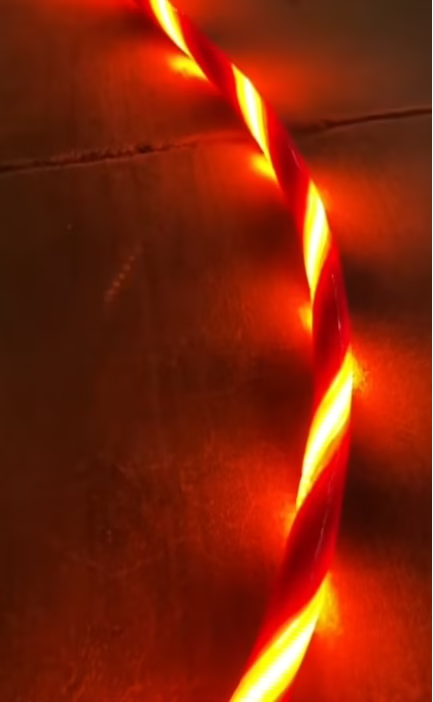
The (N)TSCGEH3S, commercially known under the TENAX-LUMEN product family originally developed by Prysmian Group in Germany, represents a breakthrough solution: a self-luminous medium-voltage trailing cable that glows visibly in darkness — even when de-energized — thanks to integrated electroluminescent (EL) or LED elements embedded beneath a transparent thermoplastic polyurethane (TPU) outer sheath. (N)TSCGEH3S 是一种自发光中压拖曳电缆,即使在断电状态下也能在黑暗中清晰可见,其发光元件嵌入透明TPU外护套之下。
In heavy-duty industrial cables — the kind used in port container cranes, mining draglines, tunnel boring machines, and steel-mill transfer cars — visual identification of cable status is a serious safety concern. Operators need to know at a glance whether a cable is energized, which phase it carries, or simply where it runs in a dark, congested environment. Embedding small LED indicators directly into the cable sheath is one solution, but doing so raises an immediate engineering question: how do you power those LEDs?
在重型工业电缆(如港口集装箱起重机、矿山拖拽线、隧道掘进机和钢厂转运车使用的电缆)中,电缆状态的可视化识别是一个严肃的安全问题。将 LED 指示灯嵌入电缆护套是一种解决方案,但随之而来的工程难题是:如何为这些 LED 供电?
The type designation (N)TSCGEH3S follows the German DIN VDE cable nomenclature system, which uses sequential letters to encode every aspect of a cable’s construction, insulation material, and intended service conditions. Under DIN VDE 0292, the leading N (in parentheses) indicates the cable is manufactured to a recognized VDE type standard with permissible manufacturer variations, while subsequent characters specify the conductor type, shielding, elastomeric insulation, and special functional elements embedded in the cable assembly.
型号标识 (N)TSCGEH3S 遵循德国 DIN VDE 电缆命名规范,每个字母依次编码了电缆的结构、绝缘材料及适用工况。括号中的”N”表示该型号依据 VDE 标准制造,允许制造商做出一定的变型设计。
Load-Haul-Dump (LHD) loaders are the backbone of underground ore movement—more than 75% of the world’s underground metal mines rely on LHDs for material handling. Electric-motor LHD units typically operate at medium voltages of 380–550 V (and up to 3.3/6.6 kV for larger units), drawing power through flexible trailing cables that must reel and unreel as the machine moves through narrow, irregular headings. In the permanent darkness of underground drifts, these cables face an acute visibility problem: personnel and equipment cannot easily see trailing cables on the ground, leading to run-over damage, unplanned outages, and serious safety hazards.
In the German DIN VDE cable designation system — widely considered the most comprehensive national nomenclature for industrial cables in the world — every letter and number encodes a specific material, construction feature, or functional characteristic. This convention, governed by standards such as DIN VDE 0292 (Type Designation Codes) and DIN VDE 0250 Part 813 (flexible reeling and trailing cables), allows an engineer to identify a cable’s conductor type, insulation, screening, protective earth, sheath, and special integrations simply by reading its alphanumeric type code.
在德国 DIN VDE 电缆命名体系中——被公认为全球工业电缆领域最完善的国家级命名规范——每一个字母和数字都编码了特定的材料、结构特征或功能属性。该体系由 DIN VDE 0292(型号代码标准)和 DIN VDE 0250 第 813 部分(柔性卷筒与拖曳电缆)等标准统一管理。
In large-scale open-pit mining, unplanned cable damage caused by low-visibility equipment movement is a leading source of operational downtime and safety incidents. The TENAX-LUMEN self-illuminating trailing cable—designated (N)TSCGEH3S—was developed by Prysmian Group precisely to address this problem. It embeds active electroluminescent (EL) lighting elements under a transparent polyurethane (TPU) outer sheath, making the cable visible in complete darkness even when it is not energized. But an essential question arises for mine electrical engineers: does adding self-illumination change the cable’s core mechanical and electrical characteristics compared to the well-established (N)TSCGEWÖU standard rubber trailing cable?
This is a question that arises frequently on Australian and New Zealand mining and industrial project sites: a contractor has Olex Instalex XLPE/PVC cable specified for a fixed high-voltage (HV) power transmission run, but Type 275 EPR/CSP cable is readily available in stock or already on-site for mining equipment. Can one be substituted for the other?
(这个问题经常出现在澳大利亚和新西兰的矿业及工业项目现场:设计指定了 Olex Instalex XLPE/PVC 电缆用于固定高压传输,但现场已有 Type 275 EPR/CSP 矿用电缆库存。两者能否互换?)
Electrical cables deployed in polar regions, northern mining sites, and cryogenic industrial facilities must retain mechanical flexibility at temperatures far below the freezing point of water. While standard Chlorinated Polyethylene (CPE) jacketing provides excellent flame retardance, oil resistance, and UV stability, it becomes increasingly stiff as ambient temperatures drop below approximately −25 °C. This presents a serious engineering challenge: a rigid cable jacket cannot be routed, bent around pulleys, or connected to moving machinery without risking cracks, insulation damage, or total conductor exposure.
(在极地、北方矿区及低温工业环境中运行的电缆必须在远低于 0 °C 的温度下保持机械柔性。标准 CPE 护套虽具有优异的阻燃、耐油和耐紫外线性能,但在约 −25 °C 以下会变得僵硬,给布线、弯曲和动态连接带来开裂风险。)
Shielded Heavy-Duty Ground Check Cables (SHD-GC) are specialized power supply and connection cables designed for large material handling equipment such as excavators in opencast mining operations. These cables withstand extremely high mechanical stresses and are particularly suitable for trailing operations where abrasion and chafing stresses are expected.
TUNNELFLEX-R-PUR HF represents a specialized category of halogen-free, flame-retardant flexible power cables engineered specifically for the demanding requirements of underground mining and tunneling operations. This cable combines advanced polyurethane (PUR) sheathing technology with integrated antitwisting protection to deliver exceptional mechanical durability, environmental resistance, and most importantly, enhanced safety through its halogen-free construction that significantly reduces toxic gas emissions during fire incidents.
TUNNELFLEX-R-PUR HF电缆是专为地下采矿和隧道作业的苛刻要求而设计的无卤阻燃柔性电力电缆。该电缆结合了先进的聚氨酯护套技术和集成的防扭转保护,提供卓越的机械耐久性、环境抵抗力,以及通过无卤结构在火灾事故中显著减少有毒气体排放的增强安全性。
TROMMELFLEX-M-PUR represents a specialized category of flexible low voltage reeling cables engineered specifically for the demanding conditions of underground mining and tunneling operations. This cable features optimized dimensions and a flame-retardant, halogen-free polyurethane outer sheath, making it ideal for power supply to mobile underground equipment including drilling machines, Load-Haul-Dump (LHD) loaders, and scoops that operate under frequently changing dynamic loads during reeling operations.
TROMMELFLEX-M-PUR电缆是专为地下采矿和隧道作业的苛刻条件而设计的特种柔性低压卷筒电缆。该电缆具有优化的尺寸设计和阻燃、无卤聚氨酯外护套,特别适合为钻机、装载-运输-卸载(LHD)装载机和铲运机等移动地下设备提供电力,这些设备在卷绕操作中承受频繁变化的动态负载。
(M)R-(N)TSCGEWOEU series represents a highly engineered family of medium voltage flexible reeling cables specifically designed for demanding applications in open-cast mining operations and heavy industrial environments. These cables are manufactured according to the stringent requirements of DIN VDE 0250-813 standard, which is recognized globally as the definitive specification for flexible trailing cables used in heavy industrial applications where extreme mechanical stresses are expected.
PROTOLON系列电缆专为露天矿山的大型物料搬运设备(如挖掘机、卸料车、移动式破碎机)设计,能够承受极高的机械应力,适用于单螺旋卷筒和圆柱形卷筒的灵活卷绕操作。
Type 409 cables represent a specialized category of flexible mining cables designed specifically for demanding applications in material handling equipment, surface mining operations, and industrial environments. These cables are manufactured according to the Australian and New Zealand Standard AS/NZS 2802:2000, which establishes rigorous requirements for reeling and trailing cables used in mining and general industrial applications outside underground coal mining environments. (409型电缆是专为物料搬运设备、露天采矿作业和工业环境中的高要求应用而设计的一类特种柔性矿用电缆。这些电缆按照澳大利亚和新西兰标准AS/NZS 2802:2000制造,该标准对用于煤矿井下以外的采矿和一般工业应用的卷筒电缆和拖曳电缆制定了严格要求。)
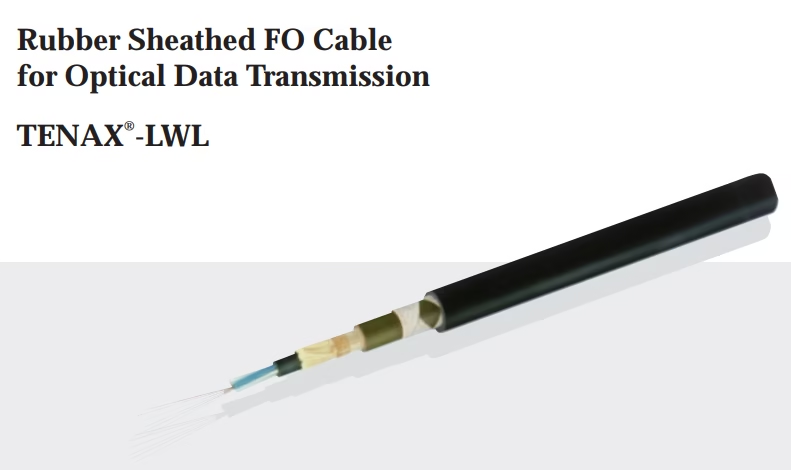
In the context of VDE (Verband der Elektrotechnik) cable standards, the suffixes “-FO” and “LWL” unequivocally refer to the inclusion of Fiber Optic elements within the cable structure.
在VDE(德国电气工程师协会)电缆标准中,后缀 “-FO” 和 “LWL” 明确表示电缆结构中包含光纤元件。
(N)TSCGEWOEU — это высокопроизводительный гибкий тяговый кабель среднего напряжения, разработанный в соответствии со стандартом DIN VDE 0250, часть 813 для подключения крупного передвижного оборудования, работающего в условиях экстремальных механических нагрузок. Данный кабель представляет собой стандартную конструкцию серии TENAX-T, оптимизированную для применения в открытых горных разработках, на экскаваторах, самосвалах и дробилках.






![MYP cables must obtain MA (煤安) certification before they can be legally used in Chinese coal mines. The MA mark, administered by the National Coal Mine Safety Mark Office (煤矿安全标志办公室), represents mandatory safety certification for all underground coal mining equipment and materials. MYP cables, as mobile power supply cables for coal mining machinery, fall under the strictly regulated product categories defined in the Mining Product Safety Sign Management Catalog and must comply with Chinese national standards MT 818 series and GB 12972.[1][2] 是的,MYP电缆在中国煤矿使用前必须获得MA(煤安)认证。由国家煤矿安全标志办公室管理的MA标志,代表了所有井下煤矿设备和材料的强制性安全认证。MYP电缆作为煤矿机械的移动电源电缆,属于《矿用产品安全标志管理目录》中严格管制的产品类别,必须符合中国国家标准MT 818系列和GB 12972。](https://feichuncables.com/blog/wp-content/uploads/image-653.avif "PROTOLON (M)R-(N)TSCGEWOEU 6-35 KV 26")