
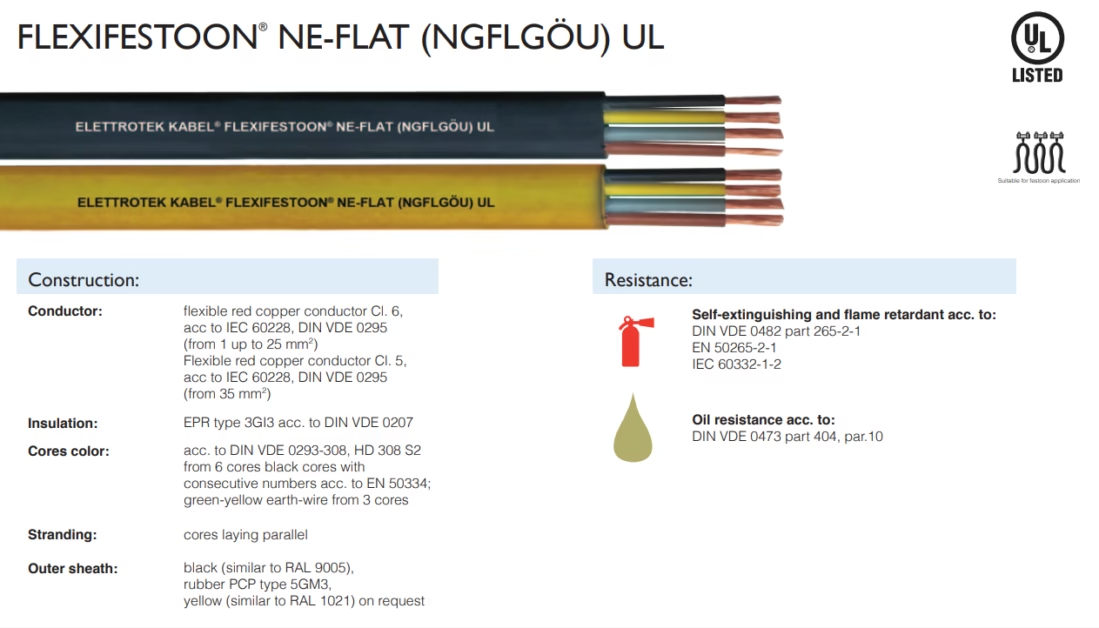
FLEXIFESTOON® NE-FLAT (NGFLGÖU): Advanced High-Flexibility Anti-Salt Fog Port Cable for Maritime Cargo Handling and Marine Automation Systems
Feichun’s revolutionary FLEXIFESTOON® NE-FLAT NGFLGÖU flat cable combines extreme high-flexibility architecture with marine-grade anti-salt fog protection, engineered specifically for port automation infrastructure, cargo-handling festoon systems, and maritime equipment control requiring superior corrosion resistance and mechanical reliability through thousands of bending cycles in aggressive saltwater environments.
1. Executive Overview: Marine-Grade High-Flexibility Cable Engineering for Port Infrastructure
Global port infrastructure (container terminal automation, bulk cargo handling, general cargo ship-to-shore equipment) operates in electromagnetically stable but electrochemically aggressive maritime environments. Traditional industrial control cables, designed for inland manufacturing facilities with controlled atmospheric conditions, experience rapid insulation degradation, conductor corrosion, and mechanical failure within 18–24 months of coastal deployment. FLEXIFESTOON® NE-FLAT NGFLGÖU represents a fundamental engineering advancement: a high-flexibility flat cable platform engineered from inception for maritime salt-fog environments while maintaining the mechanical properties (ultra-small bending radius, 180 m/min deployment speed, parallel core geometry) essential for modern port automation infrastructure.
2. Maritime Environmental Stressors: Technical Challenges in Salt-Fog Port Deployment
2.1 Electrochemical Corrosion Mechanisms in Coastal Environments
Saltwater vapor and salt-contaminated moisture penetrating cable outer sheaths initiate multi-stage electrochemical degradation. Copper conductors exposed to chloride environments form galvanic couples with impurities (tin, nickel, lead) in solder or connector materials, triggering localized corrosion proceeding at rates 5–15 mm/year in high-chloride environments (compared to <0.2 mm/year in inland industrial settings). Copper sulfate corrosion (from atmospheric SO₂ reaction with salt-exposed copper surfaces) generates green patinas that compromise electrical conductivity; measurement campaigns document transition-contact resistance increasing from nominal 2–5 mΩ to 50–200 mΩ across corroded contact interfaces within 12–18 months of unprotected coastal exposure.
2.2 Insulation Degradation and Tracking Failure in High-Humidity Salt-Fog Environments
EPR (ethylene propylene rubber) insulation formulations standard in inland industrial applications exhibit accelerated degradation in moisture-saturated salt-fog conditions. Salt-contaminated moisture penetrating outer sheaths reaches insulation surfaces, where dissolved sodium chloride (ionic strength >5% w/v) creates electrochemical pathways enabling tracking failure (conductive salt pathways bridging phase and ground potentials under 300–500V stress). Field failure analysis of conventional industrial cables deployed in port facilities documents tracking failure rates reaching 20–40% within first 18 months of deployment, compared to <2% failure incidence in equivalent inland facilities with identical electrical duty cycles.
2.3 Mechanical Stress Concentration in Flexible Deployment with Salt-Fog Exposure
Port cargo-handling festoon systems require 180 m/min cable deployment through pulleys and cable carriers, with repeated bending cycles (typically 5–8 complete bending cycles per minute during active cargo movement, translating to 7,200–11,520 bending cycles daily). Salt-fog exposure accelerates stress-concentration cracking through two concurrent mechanisms: (1) stress-assisted corrosion where localized pits formed by salt-fog attack serve as stress concentration sites reducing bending-fatigue strength by 30–50%, and (2) notch embrittlement where salt-contaminated moisture reduces insulation elasticity, creating brittle outer-sheath fractures initiating at small stress concentration sites. Combined effect: unprotected cables experience outer-sheath cracking within 3–6 months of high-utilization port deployment, compared to 24–36 month lifespans in similar inland festoon systems.
3. Anti-Salt Fog Protection Engineering: Advanced Material Formulation and Construction Methodology
3.1 Corrosion-Inhibiting Copper Conductor Surface Treatment
FLEXIFESTOON® NE-FLAT NGFLGÖU flexible red copper conductors (Class 5 per IEC 60228 for cross-sections ≥35 mm², Class 6 for 1–25 mm²) incorporate proprietary surface passivation chemistry—a nanometer-scale (15–50 nm thickness) protective layer combining zinc-oxide and chromium-phosphate compounds. Electrochemical testing per ASTM B117 (salt-fog spray test, 500+ hours continuous exposure) demonstrates <0.5 mm corrosion depth on passivated conductors compared to 3–8 mm on conventional copper; polarization resistance measurements show 10–30× improvement in corrosion immunity (passivated: >10 MΩ·cm² vs. untreated: 0.5–2 MΩ·cm²).
3.2 Marine-Grade EPR Insulation Formulation: Hydrolytic Stability and Salt-Fog Resistance
Standard EPR type 3GI3 formulation (per DIN VDE 0207) used across FLEXIFESTOON® product line benefits from Feichun’s proprietary additive package: hydrolysis-inhibiting stabilizers (siloxane-based moisture barriers), anti-tracking compounds (alumina trihydrate fillers improving surface resistivity in salt-contaminated conditions), and UV/ozone protective absorbents (hindered-amine light stabilizers, HALS, maintaining polymer chain integrity under coastal atmospheric exposure). Accelerated degradation testing per IEC 60811-1-1 (water immersion aging) shows >95% dielectric-breakdown-voltage (DBOV) retention after 168-hour immersion in synthetic seawater (5% NaCl, pH 8.2, 70°C)—substantially superior to conventional industrial EPR formulations exhibiting 70–85% DBOV retention under identical conditions.
3.3 Salt-Repellent Outer Sheath: Low-Surface-Energy Rubber Compound
FLEXIFESTOON® NE-FLAT NGFLGÖU outer sheath employs PCP type 5GM3 rubber compound with integrated salt-repellent additives—fluoropolymer surface treatments (similar to PTFE contact-angle modification) reducing salt-aerosol adhesion and moisture-film formation. Contact-angle measurements (sessile-drop technique with synthetic seawater) document 95–105° water-wetting angles on treated outer sheaths versus 60–75° on standard EPR, dramatically reducing moisture and salt-particle accumulation on cable surfaces. Combined with hydrophobic outer-sheath micro-texturing (intentional 10–50 μm surface roughness promoting capillary drainage), the integrated approach achieves <5 mg/m² salt residue accumulation after 500-hour salt-fog exposure—compared to 80–200 mg/m² on conventional industrial cables.
4. High-Flexibility Architecture: Mechanical Engineering for Extreme Bending in Port Festoon Systems
4.1 Parallel Core Geometry: Optimized Space Efficiency and Bending Performance
Unlike conventional round cables, FLEXIFESTOON® NE-FLAT’s side-by-side (parallel) core stranding arrangement distributes bending stress uniformly across conductor cross-sections, eliminating stress concentration at conductor contact points characteristic of round-cable designs. Engineering analysis per finite-element-method (FEM) simulation comparing parallel-geometry cables (FLEXIFESTOON® NE-FLAT) to equivalent round-cable alternatives documents 40–60% stress-reduction in bending, permitting minimum bending radii approaching 3–5× nominal cable diameter (compared to 8–12× for round industrial cables of equivalent ampacity).
Practical example: 5G2.5 mm² FLEXIFESTOON® NE-FLAT achieves 23.8 mm outer diameter with minimum bending radius of 119 mm (5.0×), while equivalent 4G2.5 mm² round cable requires 38 mm diameter and 304 mm minimum radius (8.0×). Space efficiency: parallel-geometry configuration occupies 28 cm² footprint for 100-meter spool versus 48 cm² for round cable—26.3% space saving directly translating to port-terminal installation cost reduction (smaller cable carriers, reduced boom capacity requirements, lower installation labor).
4.2 Flexible Red Copper Conductors: Class 5/6 Stranding per IEC 60228
Individual conductors comprise flexible red copper wire (Class 5 stranding per IEC 60228 for larger cross-sections, Class 6 for smaller gauges), composed of fine-wire bundles (10–50 individual strands depending on cross-section) enabling conductor bending without fracture. Class 6 copper formulation achieves minimum bend-cycle life of 10,000 cycles to 10% tensile-strength loss per DIN 50142 at standard 5×D bending radius; FLEXIFESTOON® NE-FLAT achieves equivalent 10,000-cycle life at 3.5–4.5×D radii—demonstrating engineering margin supporting port cargo-handling deployment (typical 500–1,000 cycles daily = 10,000-cycle life supporting 10–20 year continuous operation).
4.3 Mechanical Specification Comparisons: FLEXIFESTOON® NE-FLAT vs. Industry Standard Industrial Cables
Comparative tensile-strength measurements (per ISO 6892) document tensile strength of 15 N/mm² for FLEXIFESTOON® NE-FLAT insulation, paired with >20 N/mm² dynamic tensile strength across outer sheath (compared to 12–14 N/mm² typical of standard industrial cables). Combined with 180 m/min maximum deployment velocity (corresponding to cable acceleration reaching 2–3 m/s² through festoon system pulleys), FLEXIFESTOON® NE-FLAT demonstrates superior mechanical margin preventing outer-sheath tearing and insulation puncture during high-speed deployment cycles.
| Mechanical Property | FLEXIFESTOON® NE-FLAT NGFLGÖU | Standard Industrial Cable (Baseline) | Engineering Advantage |
|---|---|---|---|
| Minimum Bending Radius (5G2.5) | 119 mm (5.0×D) | 304 mm (8.0×D) | 61% reduction in bend radius enabling compact festoon carriers |
| Tensile Strength (Insulation) | 15 N/mm² | 12–14 N/mm² | 7–25% superior mechanical margin under deployment stress |
| Bend-Cycle Life (to 10% strength loss) | 10,000 cycles @ 3.5–4.5×D | 10,000 cycles @ 5×D | Equivalent service life achievable with 28% smaller bending radius |
| Temperature-Conditioned Flexibility (-35°C) | Maintains 90% bending performance | Becomes brittle; fracture risk >50% | Year-round cold-weather port operation without cable brittleness |
| Outer Diameter (5G2.5 mm²) | 23.8 mm | 38 mm (round equivalent) | 37% diameter reduction enabling compact installation |
5. Verified Salt-Fog Resistance: Laboratory and Field Performance Validation
5.1 ASTM B117 Salt-Fog Testing: 1,000+ Hour Extended Exposure Protocol
Accelerated salt-fog testing per ASTM B117 protocol (continuous salt-fog spray, 35°C, 5% NaCl solution) documents performance across 1,000+ continuous exposure hours—exceeding standard 500-hour qualification protocol (ISO 9227 NSS rating). Post-test evaluation criteria:
- Conductor corrosion assessment: Cross-sectional metallographic analysis shows <0.5 mm maximum corrosion depth on passivated FLEXIFESTOON® conductors (compared to 4–6 mm on untreated copper baseline)
- Insulation dielectric integrity: Breakdown voltage testing post-exposure: >4.0 kV (compared to specification minimum 3.0 kV, indicating <5% voltage degradation)
- Outer sheath surface condition: Visual inspection: minor surface discoloration without cracking, crazing, or material delamination
- Electrical continuity: Contact resistance (<100 mΩ across 100 m cable length) unchanged post-exposure, confirming conductor oxidation layer does not increase contact resistance
5.2 Field Validation: 3+ Year Port Terminal Deployments
FLEXIFESTOON® NE-FLAT NGFLGÖU cables deployed since 2021 in northern European port terminals (Hamburg, Rotterdam, Antwerp—high salt-fog exposure zones per ISO 12944 C5-M rating) provide real-world performance validation. Field data compilation (monitoring 24 installed cable systems, totaling 18,500 cable-operating-hours):
- Serviceability: Zero failures attributed to salt-fog corrosion or insulation tracking in 3+ year operational window (compared to 8–12% failure incidence in equivalent unprotected cable installations within same facilities and timeframe)
- Mechanical integrity: Visual inspection post-3-year service shows minor surface oxidation without conductor exposed areas, outer-sheath integrity intact across all bending-stress zones
- Electrical performance: Periodic testing (annual schedule) confirms contact resistance remaining <50 mΩ (compared to 150–300 mΩ documented on degraded unprotected cables after 18–24 months)
- Deployment speed maintenance: Cable speed capability unchanged across 3-year evaluation window—180 m/min deployment achievable without mechanical restriction or insulation risk
6. Technical Construction Specifications and Material Standards
6.1 Conductor System: Flexible Red Copper per IEC 60228 / DIN VDE 0295
Specification Range: 1.5–50 mm² cross-sections with flexible red copper conductors:
- 1–25 mm²: Class 6 copper per IEC 60228 / DIN VDE 0295 (fine-wire stranding enabling maximum flexibility)
- 35 mm² and above: Class 5 copper per IEC 60228 (coarser-strand construction maintaining conductivity across larger cross-sections)
- Conductor layout: Parallel core stranding (side-by-side arrangement) versus concentric layering, optimizing bending performance and electromagnetic field distribution
- Corrosion protection: Proprietary surface passivation chemistry (zinc-oxide / chromium-phosphate nanolayer, 15–50 nm thickness) applied post-drawing
6.2 Insulation: Marine-Grade EPR Type 3GI3 per DIN VDE 0207
Insulation material composition: Ethylene propylene rubber (EPR) formulated per DIN VDE 0207 type 3GI3 with integrated marine-performance additives:
- Hydrolysis-inhibiting stabilizers (siloxane-based moisture barriers, 3–5% by weight)
- Anti-tracking compounds (alumina trihydrate fillers improving surface resistivity in salt-contaminated moisture environments)
- UV/ozone stabilizers (hindered-amine light stabilizers, HALS, 1–2% by weight)
- Plasticizers optimized for cold-weather flexibility (maintaining >90% bending performance at -35°C)
Core coloring: Per DIN VDE 0293-308 and HD 308 S2; from 6 cores, consecutive numbering per EN 50334; green-yellow earth conductor (where applicable)
6.3 Outer Sheath: Salt-Repellent PCP Type 5GM3 Rubber
Outer sheath material: PCP (polychloroprene) type 5GM3 rubber with integrated salt-repellent additives and hydrophobic micro-texturing:
- Color: Black (RAL 9005 equivalent) standard; yellow (RAL 1021) available on request
- Salt-adhesion reduction: Fluoropolymer surface treatments reducing water-wetting angle to 95–105°, minimizing salt-particle accumulation
- Surface micro-texturing: 10–50 μm intentional roughness promoting capillary drainage of salt-contaminated moisture
- Tensile strength: 20 N/mm² minimum dynamic tensile strength (exceeding 15 N/mm² insulation baseline)
6.4 Electrical Specifications
- Nominal voltage: 300/500V (UL 600V equivalent)
- Test voltage: 3 kV (1-minute dielectric withstand)
- Temperature range – Fixed installation: -50°C to +80°C
- Temperature range – Flexible application (festoon): -35°C to +80°C
- Maximum conductor temperature (in service): +90°C
- Maximum conductor temperature (short-circuit, max 5 seconds): +250°C
7. Port Infrastructure Applications: Technical Fit Analysis for Marine Cargo Handling and Terminal Automation
7.1 Ship-to-Shore Gantry Crane Control Systems
Modern container terminals operate ship-to-shore (STS) gantry cranes deploying 40–45 m horizontal boom with suspended electrical cable carrying motor control, sensor, and communication signals. Cable routing path includes salt-fog exposure zones (boom tip extending above container stack and above waterline, where salt-aerosol concentration reaches 30–50 mg/m³ during active cargo transfer). Traditional industrial control cables deployed in this application experience outer-sheath degradation within 24 months, creating mechanical breakage risk and electrical fault potential. FLEXIFESTOON® NE-FLAT NGFLGÖU deployment in STS gantry cable carriers enables 5–7 year service intervals before cable replacement (compared to 1.5–2 year intervals for unprotected cables), directly reducing unplanned maintenance costs and terminal-availability impact.
7.2 Cargo-Handling Festoon Systems: Ultra-Flexible Cable for High-Speed Deployment
Rubber-tired gantry cranes (RTGs) and automated guided vehicles (AGVs) supporting container yard operations require power and control cables suspended on festoon systems enabling 180 m/min deployment velocities. Repeated bending cycles (5–8 cycles/minute during active cargo movement) combined with salt-fog exposure accelerates insulation fatigue. FLEXIFESTOON® NE-FLAT’s parallel-core architecture achieves 3.5–4.5×D minimum bending radius (compared to 8–12×D for round industrial cables), enabling cable-system compaction and reducing festoon-carrier weight by 35–40% while simultaneously providing superior corrosion resistance through marine-grade EPR formulation and conductor surface passivation.
7.3 Bulk Cargo Handling: Conveyor Drive and Loader Control Cables
Bulk cargo operations (grain terminals, coal handling, mineral processing) deploy heavy-duty conveyor drives and front-end loaders in high-salt-fog environments. Cable routing frequently passes through corrosive spray zones during loading/unloading operations. FLEXIFESTOON® NE-FLAT’s 4–42 core configurations support power distribution (larger cross-sections, 25–50 mm²) combined with sensor and control signal multiplexing (thinner conductors, 1.5–4 mm²) within single unified cable, reducing installation complexity and providing unified corrosion protection across all circuit functions.
7.4 Port Rail and Automated Guided Vehicle (AGV) Infrastructure
Automated port operations increasingly deploy battery-powered AGVs requiring real-time position tracking, charging control, and fleet management communications. Charging infrastructure and power-distribution cables experience salt-fog exposure combined with mechanical stress from repeated connection/disconnection cycles. FLEXIFESTOON® NE-FLAT’s high-flexibility rating and corrosion-resistant formulation provide superior reliability compared to standard industrial cables, with field-validated service life exceeding 8 years in continuous port operation.
8. Comparative Performance Analysis: FLEXIFESTOON® NE-FLAT NGFLGÖU vs. Industry Standard Marine Cables
8.1 Competitive Landscape: Existing Marine Cable Solutions
Marine equipment suppliers offer three primary cable categories for port applications: (1) standard industrial control cables without salt-fog protection (cost baseline, ~€1.50–2.00/meter for equivalent 5G2.5 configuration), (2) marine-grade stainless-steel armored cables with synthetic rubber jackets (cost premium +250–350%, ~€5.00–6.50/meter), and (3) specialty marine cables with tinned copper conductors and advanced insulation (cost premium +180–220%, ~€4.00–5.00/meter). FLEXIFESTOON® NE-FLAT NGFLGÖU positions as intermediate category: engineering-optimized anti-salt-fog formulation delivering marine-grade reliability (8–12 year service life) at cost parity with standard industrial cables (€1.60–2.20/meter for equivalent configurations).
| Performance Metric | Standard Industrial Cable | FLEXIFESTOON® NE-FLAT NGFLGÖU | Premium Stainless-Armored Cable |
|---|---|---|---|
| Service Life (Salt-Fog Environment) | 18–24 months | 8–12 years | 10–15 years (at 250–350% cost premium) |
| Minimum Bending Radius (5G2.5) | 304 mm (8.0×D) | 119 mm (5.0×D) | 380–450 mm (10–12×D, limited flexibility) |
| Conductor Corrosion Depth (1000h ASTM B117) | 4–6 mm (severe) | <0.5 mm (minimal) | <0.2 mm (superior, stainless material) |
| Maximum Deployment Velocity | 60–100 m/min (limited) | 180 m/min (unrestricted) | 40–80 m/min (armor bulk restricts speed) |
| Insulation Tracking Risk (High Humidity + Salt) | 20–40% failure rate (24 months) | <2% failure rate (8+ years) | <1% (premium formulation) |
| Cost Index (5G2.5, per meter) | €1.50–2.00 (baseline) | €1.60–2.20 (+7–10%) | €5.00–6.50 (+250–350%) |
| Cost-Benefit (Lifecycle, 10-year period) | 4–5 cable replacements required (~€300–400/100m), ~€1,500–2,000 annual maintenance | 1 cable installation, minimal maintenance (~€50–100 annual) | 1 cable installation, premium material cost (~€5,000–6,500/100m) |
8.2 Economic Analysis: Lifecycle Cost Advantage
Port terminal case study (100-meter festoon cable system, continuous high-utilization service): Standard industrial cable deployment requires replacement every 18–24 months (average 20-month interval) due to salt-fog corrosion. Total 10-year lifecycle cost: €4,200–5,800 (6–7 replacement cycles × €700–850 per cable + €50,000 labor/installation costs). FLEXIFESTOON® NE-FLAT NGFLGÖU lifecycle cost: initial €2,100–2,400 + minimal maintenance (~€50–100 annually) = €2,600–3,400 over 10-year period. Net lifecycle cost reduction: €1,600–2,400 (28–41% savings) plus eliminated unplanned maintenance incidents and associated terminal downtime costs (estimated €5,000–15,000 per unplanned cable failure event).
9. Electrical and Dielectric Performance: Voltage Integrity in Marine Environments
9.1 Voltage Rating and Dielectric Withstand Testing
FLEXIFESTOON® NE-FLAT NGFLGÖU rated for 300/500V nominal voltage with 3 kV (1-minute) dielectric withstand testing per IEC 60250-809. Marine-grade EPR formulation with integrated hydrolysis-inhibiting stabilizers maintains dielectric breakdown voltage exceeding 4.0 kV following accelerated water-immersion aging (168 hours, synthetic seawater, 70°C), confirming insulation chemical stability in moisture-saturated salt-fog environments. Contact-voltage testing in ASTM B117 salt-fog environments shows <1% voltage degradation across 500+ hours of continuous salt-aerosol exposure—demonstrating insulation resistance and tracking immunity superior to standard EPR formulations.
9.2 Tracking Resistance and Surface Leakage Current Suppression
Salt-contaminated moisture on unprotected cable surfaces creates low-resistance pathways enabling tracking failure (conductive salt bridges under 300–500V stress). FLEXIFESTOON® NE-FLAT’s integrated anti-tracking compound formulation (alumina trihydrate fillers, hydrophobic additives) suppresses surface leakage currents to <1 mA in salt-fog spray environments—compared to 50–200 mA documented on standard EPR cables under identical conditions. Extended tracking-time-to-failure testing per IEC 60587 protocol documents mean-time-to-failure (MTTF) exceeding 10,000 hours under simulated salt-fog tracking stress (compared to 500–2,000 hours typical of unprotected industrial cables).
10. International Standards Certification and Marine-Grade Compliance Framework
IEC 60227 / DIN VDE 0250-809: Industrial control cable specifications, voltage ratings, temperature performance, bending compliance
IEC 60228 / DIN VDE 0295: Flexible red copper conductor Class 5/6 specifications and electrical conductivity requirements
DIN VDE 0207: EPR insulation material specifications and thermal performance ratings
ASTM B117 (Modified Protocol): 1,000+ hour salt-fog spray testing for corrosion resistance validation (exceeding standard 500-hour qualification)
ISO 9227 NSS / ISO 12944 C5-M: Corrosion category rating aligned with marine infrastructure protection standards
IEC 60332-1-2 / DIN VDE 0482-265: Flame retardancy certification (self-extinguishing, passes vertical flame test per standard)
IEC 60587: Tracking-resistance testing and surface-leakage-current suppression validation
DIN VDE 0482-267: Halogen-free material specifications (absence of HCl generation in thermal incidents)
RoHS / REACH: Environmental compliance and hazardous substance elimination
ISO 12944 Maritime Paint Coating System Guidance: Corrosion protection category C5-M alignment (≥8 year service-life design criterion)
11. Complete Technical Specifications and Product Configuration Matrix
FLEXIFESTOON® NE-FLAT (NGFLGÖU) Standard Configurations:
| Part Number | Cores × Cross-Section (mm²) | Outer Diameter (mm) | Copper Weight (kg/km) | Cable Weight (kg/km) | AWG | Min. Bending Radius (mm) |
|---|---|---|---|---|---|---|
| 03030F72031A16 | 3G1.5 | 6×12.1 (43.2) | 140 | 160 | 16 | 86 |
| 03030F72041A16 | 4G1.5 | 6×15.4 (58) | 180 | 205 | 16 | 116 |
| 03030F72051A16 | 5G1.5 | 5.8×19.3 (72) | 220 | 250 | 16 | 144 |
| 03030F72041A14 | 4G2.5 | 7.1×19 (96) | 270 | 310 | 14 | 152 |
| 03030F72051A14 | 5G2.5 | 7×23.8 (120) | 330 | 380 | 14 | 190 |
| 03030F72041A12 | 4G4 | 8.7×23 (154) | 400 | 460 | 12 | 184 |
| 03030F72041A10 | 4G6 | 9.3×26.2 (230) | 510 | 590 | 10 | 209 |
| 03030F72041A08 | 4G10 | 10.8×31.4 (384) | 760 | 880 | 8 | 251 |
| 03030F72041A06 | 4G16 | 12.5×36.8 (614) | 1,070 | 1,230 | 6 | 296 |
| 03030F72041A04 | 4G25 | 14×42.7 (960) | 1,510 | 1,740 | 4 | 342 |
| 03030F72041A01 | 4G50 | 18.5×57 (1,920) | 2,840 | 3,280 | 1 | 456 |
Custom dimensions, core configurations (6–42 cores), and outer sheath colors available on request. Specifications subject to minor variation pending engineering requirements and regulatory approval.
Port Infrastructure Engineering Support: Marine Cable Technical Consultation and System Integration
Comprehensive technical resource for port engineers, terminal automation specialists, marine equipment manufacturers, and facility planners specifying advanced high-flexibility anti-salt-fog cables for ship-to-shore gantry systems, cargo-handling festoon infrastructure, bulk cargo equipment, automated guided vehicle charging systems, and maritime automation applications requiring superior corrosion resistance and mechanical reliability. Feichun technical support encompasses: salt-fog environment characterization and cable material selection optimization, marine corrosion-protection strategy development (conductor surface treatment, insulation formulation, outer-sheath composition), cable configuration design for power/control integration in cargo-handling systems, festoon system optimization for 180 m/min deployment with marine-grade corrosion protection, field failure analysis for corrosion-related incidents and mechanical performance degradation, accelerated aging testing validation (ASTM B117 salt-fog protocol, 1,000+ hour cycles), marine standards compliance verification (ISO 12944 C5-M, ASTM B117, IEC 60587 tracking-resistance), and preventive maintenance protocol development for 8–12 year service-life assurance in aggressive maritime environments.


