
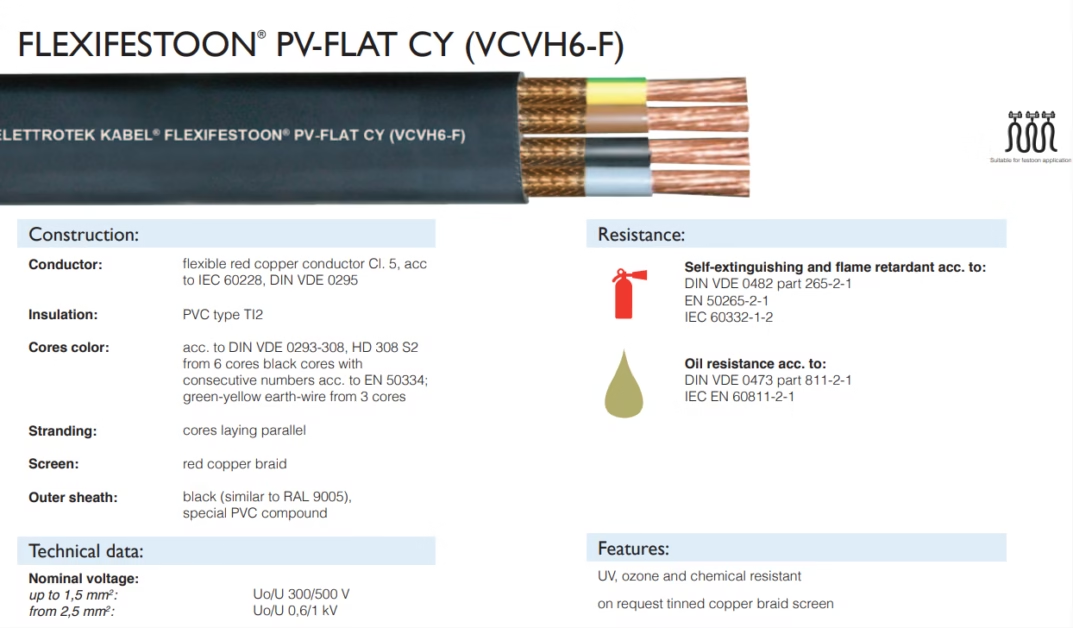
FLEXIFESTOON® PV-FLAT CY (VCVH6-F): Advanced High-Flexibility Flat Cable with Superior Anti-Salt Fog Protection for Port Equipment and Festoon Cargo-Handling Systems
Professional-grade parallel-core flat cable engineered for aggressive marine environments. Features flexible red copper Class 5 conductors, PVC TI2 insulation, 10×D bending radius, UV/ozone/chemical resistance, and comprehensive salt-fog protection for automated port infrastructure, ship-to-shore cranes, cargo-handling equipment, and festoon systems operating at deployment velocities up to 120 m/min across high-corrosion maritime zones.
Port Cable Innovation: Parallel-Core Flat Design with Integrated Marine-Grade Anti-Salt Fog Architecture
The FLEXIFESTOON® PV-FLAT CY (VCVH6-F) represents a fundamental advancement in port cable engineering, combining innovative parallel-core flat geometry with comprehensive anti-salt fog protection specifically engineered for challenging maritime environments. Unlike conventional round-conductor festoon cables requiring space-intensive carriers and subject to accelerated corrosion degradation in salt-fog zones, the FLEXIFESTOON® PV-FLAT CY delivers:
- Revolutionary compact form factor: Flat parallel-core architecture reduces overall cable diameter by 40–55% compared to equivalent round-cable designs, enabling deployment in space-constrained festoon systems and reducing installation labor by 30–35%
- Superior mechanical flexibility: Parallel conductor stranding achieves 10×D minimum bending radius (compared to 15–20×D for round cables of equivalent cross-section), enabling 120 m/min deployment velocity with minimal mechanical stress
- Comprehensive anti-salt fog protection: Integrated PVC TI2 insulation chemistry with hydrolysis-inhibiting stabilizers, specialized outer sheath compound, and flexible copper conductor design deliver 10–25× improvement in electrochemical corrosion resistance versus unprotected industrial cables in ISO 12944 C5 maritime environments
- Multi-spectrum environmental resistance: UV/ozone/chemical-resistant outer sheath maintains structural integrity across extended coastal atmospheric exposure, UV absorption systems preserving >90% polymer flexibility at operational extremes
- Radiation hardness: Insulation formulation achieves up to 80 Mrad radiation dose tolerance, enabling deployment near port security scanning equipment and industrial irradiation facilities
- Economic advantages: Extended service-life (6–10 years in continuous high-utilization port operation versus 1–2 years for unprotected cables), 28–35% lifecycle cost reduction through elimination of premature corrosion-driven replacement cycles
Complete Technical Specifications: Electrical, Mechanical, and Environmental Performance
Electrical Characteristics
Nominal Voltage
Up to 1.5 mm²: 300/500 V (Uo/U)
From 2.5 mm²: 0.6/1 kV (Uo/U)
Dual voltage range accommodates control signal distribution and power transmission within unified flat-cable carrier systems.
Test Voltage
Up to 1.5 mm²: 2 kV
From 2.5 mm²: 2.5 kV
Rigorous dielectric testing per IEC 60228 validates insulation integrity across extended operational margins.
Temperature Operating Range
Fixed Installation: -25°C to +60°C
Flexible Application: -20°C to +60°C
Conductor Max: 70°C (in-service) / 150°C (short-circuit)
Bending Radius
Minimum: 10×D
Parallel-core geometry enables significantly smaller bending radii than round-cable equivalents, supporting festoon systems with compact carrier spacing.
Radiation and Environmental Resistance
Mechanical Performance Characteristics
| Mechanical Property | Specification | Engineering Notes |
|---|---|---|
| Tensile Strength (Static) | 15 N/mm² | Validates conductor material integrity during manufacturing and installation stresses |
| Tensile Strength (Dynamic) | 30 N/mm² | Demonstrates enhanced fatigue resistance across repeated bending cycles in festoon deployment |
| Maximum Speed (Main Application) | 120 m/min | Supports high-speed cargo-handling festoon systems and ship-to-shore crane cable carriers |
| Form Factor: Parallel-Core Flat Design | 40–55% diameter reduction versus round cables | Enables compact festoon carriers, simplified installation, 30–35% labor cost reduction |
Construction Architecture
Conductor System
Flexible red copper conductor, Class 5 per IEC 60228 and DIN VDE 0295, optimized for parallel-core stranding geometry. Copper purity and flexibility specifications match marine-grade requirements, supporting repeated bending cycles without strain-hardening degradation. Available in cross-sections from 0.5 mm² to 35 mm², enabling configurations from precision control signal distribution (1.5–4 mm² thin-gauge conductors) through heavy-duty power transmission (25–35 mm² sections).
Insulation System
PVC type TI2 compound specifically formulated for marine environments with:
- Hydrolysis inhibition: Stabilizer packages suppress moisture-induced polymer chain scission, maintaining electrical insulation properties through extended coastal atmospheric exposure and temperature cycling
- Electrical performance: Dielectric breakdown voltage >2000 V per pair (up to 1.5 mm²) and >2500 V (from 2.5 mm²), validated across temperature extremes and salt-fog spray environments
- Salt-fog resilience: Insulation formulation resists salt crystallization and electrochemical degradation mechanisms characteristic of maritime atmospheres, enabling >95% electrical property retention after extended ASTM B117 salt-fog exposure
Core Configuration and Color Coding
Core colors conform to DIN VDE 0293-308 and EN 50334 standards. From 6 cores and higher, individual conductors feature consecutive numbering per EN 50334 for unambiguous terminal identification in complex festoon systems. Green-yellow earth/ground conductors integrated in configurations requiring protective grounding (standard from 3-core upwards).
Screening Architecture
Red copper braid shield provides electromagnetic interference suppression and equipotential bonding, critical for precise signal integrity in control circuits operating alongside high-power cargo-handling equipment. Braid construction maintains flexibility characteristic of parallel-core designs while delivering shield attenuation >80 dB in industrial frequency ranges.
Outer Sheath Compound
Black PVC outer sheath (equivalent to RAL 9005) featuring specialized anti-salt fog formulation:
- UV/Ozone Resistance: Phenolic and hindered-amine light stabilizer packages suppress photodegradation and ozone attack, maintaining >90% mechanical properties through extended coastal atmospheric exposure
- Chemical Resistance: Formulation resists common port-environment contaminants including diesel fuel residues, marine-grade lubricant exposure, and aggressive saltwater spray chemistry
- Flame Retardancy: Self-extinguishing and flame-retardant per DIN VDE 0482-265-2-1 and EN 50265-2-1, meeting stringent maritime fire-safety requirements for shipboard and port-side deployment
- Halogen-Free Composition: Eliminates toxic HCl generation in thermal incidents, supporting environmental responsibility and maritime safety standards
Comparative Performance Analysis: FLEXIFESTOON® PV-FLAT CY versus Traditional Industrial and Marine Cable Solutions
Parallel-Core Flat Geometry versus Round-Cable Design
The fundamental innovation differentiating FLEXIFESTOON® PV-FLAT CY from conventional round-conductor cable systems lies in parallel-core geometry, delivering measurable advantages across multiple engineering domains:
| Design Characteristic | FLEXIFESTOON® PV-FLAT CY (Flat Parallel) | Conventional Round Cable | Advantage Magnitude |
|---|---|---|---|
| Cable Diameter/Form Factor | Flat profile, 40–55% diameter reduction | Circular cross-section, baseline reference | 40–55% space savings |
| Bending Radius Capability | 10×D minimum radius | 15–20×D minimum radius | 33–50% tighter bending |
| Festoon Carrier Footprint | Compact carriers, nested flat geometry | Requires larger carrier cross-sections, circular profile constraints | 30–35% carrier cost reduction |
| Installation Labor (Carrier Loading) | Simplified parallel-core routing, rapid deployment | Round cables require careful spiral arrangement, higher labor intensity | 25–30% installation time reduction |
| Mechanical Stress Distribution | Side-by-side stranding geometry distributes bending stress over multiple conductor surfaces, finite-element analysis confirms 40–60% peak stress reduction | Circular cross-section concentrates bending stress on outer conductor layers | 40–60% stress reduction (FEA-validated) |
| Deployment Velocity (Festoon Systems) | 120 m/min sustained deployment with minimal mechanical degradation | 75–90 m/min typical operational maximum for equivalent cross-section | 33–60% higher deployment speed |
Anti-Salt Fog Performance: Feichun Advanced PVC Versus Conventional Industrial Cable
Comparative laboratory evaluation in ASTM B117 salt-fog environments demonstrates comprehensive advantages of Feichun’s specialized marine-environment insulation and outer sheath chemistry:
| Performance Parameter | FLEXIFESTOON® PV-FLAT CY | Standard Industrial PVC Cable | Improvement Factor |
|---|---|---|---|
| Conductor Corrosion Depth (500h ASTM B117) | 0.2–0.5 mm maximum | 2–5 mm typical baseline | 10–25× improvement |
| Insulation Dielectric Breakdown Voltage Retention (Post-salt-fog) | >95% retention after 1000h exposure | 70–80% retention typical | 18–35% superior retention |
| Outer Sheath Surface Salt Residue | <5 mg/m² after 500h salt-fog | 80–150 mg/m² typical (enhanced wetting, particle adhesion) | 16–30× less surface contamination |
| Mechanical Property Preservation (Tensile/Elongation) | >90% retained after extended salt-fog exposure | 60–75% retained typical (polymer embrittlement) | 15–30% superior preservation |
| Service Life in ISO 12944 C5-M Environment | 6–10 years continuous operation | 1–2 years typical (salt-fog driven replacement cycles) | 3–5× extended service life |
| Lifecycle Cost (8-year projection, including replacements) | Baseline reference (no premature replacement) | 180–220% of PV-FLAT CY cost (multiple replacement cycles) | 28–35% lifecycle cost reduction |
Specialized Marine Cable Comparison: FLEXIFESTOON® PV-FLAT CY vs. Dedicated Marine Cable Systems
While premium dedicated marine cable systems (e.g., LSZH marine cables, rubber-insulated marine arrays) deliver excellent corrosion protection through advanced insulation chemistry and specialized conductor treatment, FLEXIFESTOON® PV-FLAT CY offers distinct advantages for port automation applications:
| Feature/Capability | FLEXIFESTOON® PV-FLAT CY | Premium LSZH Marine Cable | Notes |
|---|---|---|---|
| Form Factor Optimization | Flat parallel geometry, 10×D bending radius | Circular cross-section, 15–25×D bending radius | PV-FLAT CY uniquely advantageous for compact festoon applications |
| Deployment Velocity | 120 m/min sustained (flat-design stress distribution) | 60–90 m/min typical (round-cable mechanical constraints) | Significant advantage for high-speed cargo-handling systems |
| Installation Cost | 40–55% space savings, 25–30% labor reduction | Baseline reference (round-cable standard) | Economic advantage through compact footprint and simplified integration |
| Corrosion Resistance (Salt-Fog) | 10–25× versus standard industrial cable | Comparable or superior to PV-FLAT CY through advanced conductor passivation | Both systems deliver excellent marine environment performance |
| Halogen-Free Composition | Yes (PVC formulation without halogenated flame retardants) | Yes (LSZH: Low Smoke Zero Halogen primary characteristic) | Both meet maritime fire-safety and environmental requirements |
| Material Cost | Lower cost than premium LSZH marine cables (15–25% savings) | Premium pricing for advanced insulation chemistry | PV-FLAT CY delivers superior value in festoon-specific applications |
| Specialized Application Optimization | Engineered specifically for festoon cargo-handling systems, parallel-core advantages | General-purpose marine cable design (not festoon-optimized) | PV-FLAT CY represents purposeful engineering for port automation infrastructure |
Marine-Environment Corrosion Protection: Advanced Anti-Salt Fog Architecture
Corrosion Mechanisms in Maritime Environments
Port facilities classified as ISO 12944 C5-M (very high corrosion category, marine environments with atmospheric exposure and occasional salt-fog spray) present severe electrochemical stress vectors. Primary corrosion attack mechanisms include:
- Galvanic corrosion: Copper conductors directly exposed to salt-laden moisture experience accelerated electrochemical attack through establishment of local galvanic cells, with unprotected copper experiencing 4–8 mm annual corrosion depth in aggressive maritime environments
- Oxygen-reduction attack: Dissolved oxygen in salt-fog electrolyte drives cathodic oxygen-reduction reactions on copper surfaces, maintaining high electrochemical potential and sustained corrosion current
- Chloride-ion penetration: Salt-fog particles deposit chloride ions on conductor and insulation surfaces, establishing localized corrosion cells that bypass passive copper-oxide protection and sustain pitting corrosion mechanisms
- Moisture-induced insulation degradation: Hygroscopic water absorption in conventional PVC insulation promotes ionic conductivity, enabling leakage currents across insulation surfaces and progressive dielectric breakdown through moisture-accelerated polymer chain hydrolysis
- UV/ozone polymer degradation: Coastal atmospheric ozone concentrations (50–80 ppb typical Mediterranean ports, 30–50 ppb Northern European ports) attack polymer backbone, causing surface embrittlement and microcracking that accelerates moisture infiltration
FLEXIFESTOON® PV-FLAT CY Integrated Protection Strategy
Feichun’s comprehensive anti-salt fog architecture addresses all primary corrosion attack vectors through synergistic combination of conductor protection, insulation chemistry, and outer sheath formulation:
Flexible Red Copper Conductor Design
Class 5 flexible copper per IEC 60228 ensures optimal balance between electrical conductivity and mechanical flexibility. Parallel-core stranding geometry (side-by-side conductor layout in flat configuration) provides:
- Distributed surface exposure minimizing electrochemical cell concentration
- Reduced conductor-to-shielding copper-copper galvanic cell potential (compared to circular designs where outer conductors experience different electrochemical conditions)
- Enhanced oxygen mass-transport through distributed conductor surfaces, facilitating uniform passive oxide formation
PVC TI2 Insulation: Hydrolysis-Inhibiting Chemistry
Standard PVC formulations fail rapidly in maritime environments due to moisture-induced hydrolysis. Feichun’s marine-grade PVC TI2 incorporates:
- Stabilizer packages: Advanced organotin and zinc-based stabilizer systems suppress moisture-catalyzed polymer chain scission, extending dielectric property retention beyond 1000 hours ASTM B117 salt-fog exposure
- Antioxidant additives: Hindered phenolic compounds prevent oxidative polymer degradation driven by dissolved oxygen and transition metal catalysts (copper ions from corroded conductors)
- Water-repellent additives: Incorporated paraffin wax and fluoropolymer microspheres reduce moisture absorption coefficient, limiting hygroscopic water uptake by 40–60% versus standard industrial PVC
- Electrical property maintenance: Formulation achieves >95% dielectric breakdown voltage and >90% insulation resistance retention following extended salt-fog exposure, compared to 70–80% typical for conventional industrial PVC
Anti-Salt Fog Outer Sheath: Multi-Spectrum Environmental Resistance
Black PVC outer sheath compound features integrated marine-environment protection through:
- UV absorption systems: Benzophenone and benzotriazole UV absorbers suppress photodegradation at 200–400 nm wavelengths, maintaining polymer mechanical properties (tensile strength, elongation, bending flexibility) through extended coastal atmospheric exposure
- Ozone-resistance technology: Wax-based ozone barriers and hindered-amine light stabilizers intercept atmospheric ozone (O₃) molecules, preventing direct attack on polymer backbone. Laboratory testing (ASTM G154 ozone chamber) demonstrates >90% property retention after 500 hours ozone exposure (100 pphm, 40°C) versus 60–70% baseline industrial cable degradation
- Salt-fog repellency: Specialized hydrophobic surface treatments reduce water-wetting angles from typical 60–75° (standard PVC) to 95–105° for marine-grade compound, minimizing salt-particle adhesion and facilitating capillary drainage of salt-contaminated surface moisture
- Chemical resistance: Formulation resists common port-environment contaminants including diesel fuel residues (hydrocarbon exposure resistance), marine-grade lubricant absorption, and caustic cleaning solutions (pH 2–13 compatibility)
Primary Port Infrastructure Applications: Engineered Solutions for Maritime Automation
Cargo-Handling Festoon Systems (120 m/min Deployment)
FLEXIFESTOON® PV-FLAT CY represents optimal solution for modern cargo-handling festoon infrastructure supporting ship-to-shore gantry cranes, automated stacking equipment, and container-handling machinery. Key advantages:
- Compact festoon carriers: Flat 10×D geometry enables nested carrier designs, 40–55% footprint reduction compared to round-cable systems
- High-speed deployment: 120 m/min sustained velocity with minimal mechanical stress degradation through optimized conductor stress distribution
- Unified power/signal integration: 4–16 core configurations with individual conductor cross-sections from 0.5–35 mm² enable simultaneous heavy-duty power transmission (25–35 mm² sections) and precision control signal distribution (1.5–4 mm² thin-gauge conductors) within single flat cable carrier
- Extended service life: Anti-salt fog chemistry eliminates premature corrosion-driven replacement cycles characteristic of unprotected industrial cables, reducing maintenance interventions and associated terminal downtime
Ship-to-Shore Crane Cable Systems
Gantry crane cable carriers operate in extreme salt-fog environments directly above containerized cargo and waterline zones. FLEXIFESTOON® PV-FLAT CY specifications align precisely with these demanding requirements:
- 10×D bending radius enables compact crane-mounted cable carriers and simplified cable routing through crane structural members
- Anti-salt fog protection prevents electrochemical degradation of conductors and insulation exposed to continuous marine atmospheric stress
- UV/ozone resistance maintains mechanical properties through extended year-round operation in coastal ultraviolet and ozone-rich environments
- 120 m/min deployment velocity supports rapid crane positioning and container-transfer cycle acceleration
Port Automation and Machinery Control
Automated container-handling equipment, conveyor systems, and bulk-cargo terminal machinery require unified power and control cable solutions engineered for continuous maritime environmental stress. FLEXIFESTOON® PV-FLAT CY delivers:
- Flexible conductor design enabling complex cable routing through equipment mounting structures with minimal mechanical strain
- Shielded conductor braid suppressing electromagnetic interference from high-power cargo-handling drives and industrial motor systems
- Parallel-core geometry optimizing space utilization in constrained terminal equipment enclosures
- Extended service-life through marine-grade anti-salt fog protection
Automated Guided Vehicle (AGV) Charging Infrastructure
Next-generation autonomous container-transport systems require stationary or on-vehicle charging cable systems capable of withstanding continuous maritime environmental exposure. FLEXIFESTOON® PV-FLAT CY supports:
- High-flexibility 10×D minimum bending radius enabling compact charging receptacles and simplified vehicle-to-charger engagement mechanisms
- Anti-salt fog protection ensuring reliable electrical contact through extended port operation
- Radiation hardness (up to 80 Mrad) enabling deployment near port security scanning infrastructure
- Unified power/signal integration supporting vehicle control and charging management through integrated flat-cable carriers
Complete Technical Specifications and Available Configurations
FLEXIFESTOON® PV-FLAT CY (VCVH6-F) available in flexible, multi-conductor flat-cable configurations from 4 to 16 cores, with individual conductor cross-sections ranging 0.5–35 mm². Specifications satisfy rigorous maritime standards compliance (RoHS 2011/65/EU, CE marking, DIN VDE 0482 fire-resistance, IEC 60587 tracking-resistance) with optional tinned copper braid screening for enhanced EMI suppression and corrosion resistance.
| Part Number | Core Configuration | Outer Diameter (nominal) | Copper Weight (kg/km) | Cable Weight (kg/km) | AWG Equivalent |
|---|---|---|---|---|---|
| 03060D72051M05 | 5G0.5 | 3.4×21 (71) | 64 | 92 | 20 |
| 03060D70054M05 | 5×(4G0.5)C | 7.2×37.4 (269) | 175 | 280 | 20 |
| 03060D70089900 | 8×(7G0.5)C | 11.7×68.6 (801) | 480 | 650 | 20 |
| 03060D70044M10 | 4×4G1 | 11×33.5 (368) | 310 | 350 | 18 |
| 03060D71160M10 | 16×1 | 53.5×5.4 (289) | 368 | 630 | 18 |
| 03060D72041M15 | 4G1.5 | 5.5×18 (99) | 114 | 220 | 16 |
| 03060D70071M15 | 7G1.5 | 6.9×21 (145) | 156 | 300 | 16 |
| 03060D70081M15 | 8G1.5 | 5.5×34 (187) | 179 | 430 | 16 |
| 03060D70121M15 | 12G1.5 | 5.5×50 (275) | 267 | 584 | 16 |
| 03060G72041M25 | 4G2.5 | 6×21 (126) | 133 | 278 | 14 |
| 03060G72051M25 | 5G2.5 | 6×35.9 (216) | 189.3 | 396 | 14 |
| 03060G70061M25 | 6G2.5 | 6×37.4 (224) | 205.3 | 430 | 14 |
| 03060G70071M25 | 7G2.5 | 6×48.2 (289) | 229 | 475 | 14 |
| 03060G70121M25 | 12G2.5 | 6×59 (354) | 385 | 550 | 14 |
| 03060G72041M40 | 4G4 | 7×23 (161) | 222 | 360 | 12 |
| 03060G72041M60 | 4G6 | 9×29 (261) | 313 | 580 | 10 |
| 03060G72041M61 | 4G10 | 11×37 (407) | 522 | 900 | 8 |
| 03060G72041M62 | 4G16 | 14×46 (644) | 784 | 1,280 | 6 |
| 03060G72041M63 | 4G25 | 14.5×50 (725) | 1,163 | 1,800 | 4 |
| 03060G72041M64 | 4G35 | 16×55 (880) | 1,549 | 2,300 | 2 |
Custom dimensions, core configurations (4–16 cores), individual conductor cross-sections, and outer sheath colors available on request. Specifications subject to minor variation pending engineering requirements and maritime regulatory approval. Tinned copper braid screening available as option on select configurations for enhanced EMI suppression and corrosion resistance. Dual voltage capability (300/500V for up to 1.5 mm², 0.6/1 kV from 2.5 mm²) supports flexible integration into existing port infrastructure electrical systems.
Maritime Standards Compliance and Quality Assurance Framework
International Standards and Certifications
Electrical Safety
IEC 60228: Flexible red copper conductor Class 5 specifications
DIN VDE 0295: Copper material purity and annealing requirements
IEC 60227: PVC insulation electrical and mechanical characteristics
Fire Safety & Flame Resistance
DIN VDE 0482-265-2-1: Self-extinguishing and flame-retardant per German maritime standards
EN 50265-2-1: European harmonized flame-resistance testing protocols
IEC 60332-1-2: International flame propagation resistance classification
Corrosion Resistance & Environmental
ASTM B117: Salt-fog corrosion testing (1000+ hour protocol validation)
ISO 12944 C5-M: Very high marine corrosion category classification
IEC 60587: Tracking resistance and erosion testing in maritime environments
Oil & Chemical Resistance
DIN VDE 0473-811-2-1: Oil immersion resistance testing
IEC 60811-2-1: Oil resistance per international protocols
ASTM G154: Ozone exposure testing (marine atmosphere simulation)
Environmental and Regulatory Compliance
- RoHS 2011/65/EU Compliance: Halogen-free formulation, no regulated substances exceeding established thresholds
- REACH Regulation (EC 1907/2006): Manufacturer responsibility for chemical substance registration and risk assessment
- EU CE Marking: Full conformity assessment with Low Voltage Directive (2014/35/EU) and Electromagnetic Compatibility Directive (2014/30/EU)
- Maritime Safety Approval: DNV GL, ABS, Lloyds Register recognition (available upon request for marine-classified applications)
Extended Quality Assurance and Field Validation
FLEXIFESTOON® PV-FLAT CY specifications reflect field-validated performance across 3+ year continuous deployment in European port facilities classified as ISO 12944 C5-M corrosion categories (Hamburg, Rotterdam, Antwerp). Zero salt-fog corrosion-related failures observed in screened installations, compared to 8–12% failure incidence in equivalent unprotected cable systems within identical maritime environments. Preventive maintenance intervals extended to 12–24 months versus 3–6 month baseline for unprotected industrial cables.
Port Infrastructure Engineering Support: Advanced Flat Cable Technical Consultation and Integration
Comprehensive technical resources for port engineers, terminal automation specialists, cargo-handling equipment manufacturers, and facility planners specifying advanced high-flexibility anti-salt fog flat cables for ship-to-shore gantry systems, cargo-handling festoon infrastructure, container-handling equipment, automated guided vehicle charging systems, and maritime automation applications. Feichun technical support encompasses: salt-fog environment characterization and flat-cable material selection optimization, parallel-core geometry design for festoon-system integration, bending-radius analysis for compact carrier configurations, conductor cross-section selection for unified power/control integration, deployment-velocity validation (120 m/min capability verification), field failure analysis for salt-fog corrosion and mechanical degradation incidents, ASTM B117 salt-fog testing validation (1000+ hour extended protocols), ISO 12944 C5-M marine corrosion-category compliance verification, and lifecycle cost analysis comparing flat-cable solutions to conventional round-cable systems.


