flexible control cable

What Are UNE 22560 and UNE 22561? Scope, Definitions, and Core Purpose The UNE 22560 and UNE 22561 standards represent the final and often most underestimated element of the Spanish and Latin American underground mining cable ecosystem. Where UNE 22511 and UNE 22512 govern the power distribution cables that energize mining equipment, the 22560 and 22561 standards govern the signal, control, and interlock cables that command and protect that equipment. These are the "nervous system" cables of a mine — the communication network that tells a continuous miner when to advance and when to halt, that triggers emergency stops, that monitors hoisting rope tension on shaft equipment, that controls conveyor sequencing, and that enables the protective interlocking that prevents a piece of equipment from operating unless all safety preconditions are met. UNE 22560 formally defines flexible multi-core cables for underground mining with voltage ratings up to 500 V or 0.6/1 kV, with no metallic armour protection — designed for installation within equipment enclosures, along protected cable trays in main gate roads, or in areas where mechanical damage risk is minimal. UNE 22561 is its armoured sister standard, incorporating steel wire braid or steel tape protection, specified for installation in rough terrain areas where mechanical damage from rock fall, equipment collision, or floor contact is a credible risk. Both standards mandate that the cable be designed as a multi-core concentric stranded bundle — not the parallel-laid three or four conductors common in power cables, but rather seven, twelve, nineteen, or more individually insulated cores twisted concentrically around a central axis, allowing compact packaging of numerous independent control circuits within a single cable jacket. The distinction between these standards is not merely mechanical armour presence or absence. Control cables are tested against an entirely different set of safety criteria than power cables because their failure mode is fundamentally different. A power cable failure results in loss of energy to equipment — dangerous but localized. A control cable failure can disable the interlock system that prevents a continuous miner from advancing into unsafe ground, or can disable the emergency stop circuit that should halt a conveyor if a worker falls into it. A control cable fire, burning in a tightly bundled cable tray with other control cables, must not spread flame between cables because control cables are typically routed in shared ducts and cable carriers where one cable's ignition could cascade to adjacent circuits. Therefore, control cables are tested for bundle flame propagation (EN 60332-3) rather than single-cable flame propagation tests — a more stringent requirement that demands careful attention to outer sheath formulation and cable spacing in bundle installation.

Что такое PANZERFLEX-L 0,6/1 kV – Instrumentation and Control: инженерный обзор гибкого кабеля управления для Mining, Reeling и Festoon Systems

PANZERFLEX-L 0,6/1 kV – Instrumentation and Control — это многожильный гибкий кабель для цепей управления, приборных линий, вспомогательного питания и сигнализации на подвижных частях машин, горнодобывающего оборудования и material handling systems. Он предназначен для кабельных барабанов и festoon systems, где кабель постоянно изгибается, частично скручивается, ускоряется и работает под механическим натяжением. Его ключевые признаки — лужёная медная жила class 5 IEC 60228, HEPR crushproof insulation, короткая скрутка ≤7,5× диаметра укладки, чёрные жилы с печатной нумерацией, опциональная зелёно-жёлтая жила, полихлоропреновые оболочки и антискручивающие синтетические нити между внутренней и наружной оболочкой.
(N)GRDGÖU-J Nomenclature (VDE 0250 part 813): (N) = Nominal voltage prefix (0.6/1 kV implicit in designation) G = Gummiert (rubber-insulated) R = Rubber outer sheath D = Dynamisch (dynamic/flexing application) G = Gummiert inner sheath (intermediate layer) Ö = German standard designation (ö indicates European origin) U = Unarmoured (no metal sheath) J = Jacked (multi-sheath design: intermediate + outer) Full meaning: Rubber-insulated, rubber-sheathed, dynamic-rated, multi-sheath construction, unarmoured festoon cable VDE 0250 part 813 scope: Published by: VDE (Verband der Elektrotechnik, German standards body) Applies to: Flexible cables for crane installations (particularly festoon systems) Coverage: Voltage, temperature, mechanical properties, installation methods Festoon-specific requirements: - High bending flexibility (4×D minimum typical) - Fast rewind capability (240+ m/min rated speed) - Sustained torsion tolerance (±25°/1m continuous) - Extended temperature range (−50 to +80°C) - UV/ozone/moisture resistance (outdoor exposure) Alternate designations (similar cables): IEC 60811-1-1: International equivalent (less specific) DIN VDE 0298 part 3: German mechanical property standard DIN VDE 0482-265-2-1: German flame test standard EN 50265-2-1: European flame test equivalent GRDGÖU-J advantage: Combines all standards into single VDE designation Procurement simplified for European buyers

Что такое ÖLFLEX CONTROL 610T: PVC Control Cable for a Wide Range of Applications — инженерный анализ и сравнение с высокогибкими кабелями Feichun для горной техники, портовых кранов и тяжёлого мобильного оборудования

ÖLFLEX CONTROL 610T — это компактный PVC-кабель управления для измерительных, мониторинговых и управляющих цепей, применяемый в промышленном оборудовании, системах отопления и кондиционирования, офисной технике и других установках со средними механическими нагрузками. Его ключевая идея — уменьшенный наружный диаметр, проводники тонкопроволочной конструкции по IEC 60228 class 5, негорючее поведение по IEC 60332-1-2 и рабочая гибкость для периодических, не непрерывно повторяющихся перемещений без растягивающей нагрузки. Для инженеров портов, карьеров и тяжёлой техники этот кабель полезен как эталон компактного промышленного control cable, но не как полный ответ на задачи рудников, кабельных барабанов, тяговых нагрузок, абразивного износа и ударного воздействия. Именно здесь инженерная логика Feichun делает шаг дальше: от компактного PVC control cable к высокогибкому специальному кабелю с усиленной стойкостью к растяжению, истиранию и динамическим нагрузкам.
FLEXIFESTOON® NE-FLAT (NGFLGÖU): Advanced High-Flexibility Anti-Salt Fog Port Cable for Maritime Cargo Handling and Marine Automation Systems Feichun's revolutionary FLEXIFESTOON® NE-FLAT NGFLGÖU flat cable combines extreme high-flexibility architecture with marine-grade anti-salt fog protection, engineered specifically for port automation infrastructure, cargo-handling festoon systems, and maritime equipment control requiring superior corrosion resistance and mechanical reliability through thousands of bending cycles in aggressive saltwater environments.

FLAT (NGFLGÖU) UL Reeling Cable

FLEXIFESTOON® NE-FLAT (NGFLGÖU): Advanced High-Flexibility Anti-Salt Fog Port Cable for Maritime Cargo Handling and Marine Automation Systems Feichun’s revolutionary FLEXIFESTOON® NE-FLAT NGFLGÖU flat cable combines extreme high-flexibility architecture with marine-grade anti-salt fog protection, engineered specifically for port automation infrastructure, cargo-handling festoon systems, and maritime equipment control requiring superior corrosion resistance and mechanical reliability through thousands of bending cycles in aggressive saltwater environments.
Feichun MARITIME-FLEX® HT-CORR (VCVH6-F) Marine Port Salt-Fog Resistant Control Cables: Corrosion-Hardened Flexible Systems (0.6/1kV Maritime Standard Voltage, Advanced PVC Type TI2 Sheath with Copper-Based & Hindered Amine Corrosion Inhibitors, 80+ Mrad Cumulative Salt-Spray Radiation Tolerance, High-Flexibility Festoon Design for Dual-Motion Container Cranes & Cargo Handling Equipment, −25 to +70°C Polar-to-Tropical Service Temperature Envelope, 120 m/min High-Speed Festoon Certification for Port Terminal Dynamics, 32 Complete Product SKU Configurations 4–12 Cores, 1.5–95 mm² Conductor Range, VCVH6-F European Maritime Cable Standard Compliance, DNV/ABS/Lloyd's Register Certification, RoHS/CE Approved): Comprehensive Technical Analysis Integrating Electrochemical Salt-Corrosion Mechanisms, PVC Polymer Stabilization Chemistry, Marine Voltage & Environmental Degradation Modeling, Cargo Terminal Cable Engineering & Global Port Infrastructure Integration Modern port and maritime infrastructure—container terminals with dual-axis gantry cranes, bulk cargo loading systems, offshore platform interconnections, and polar region shipping operations—demands electrical cabling fundamentally different from standard industrial control specifications: persistent chloride salt-spray exposure (NaCl aerosol concentration 50–500 mg/m³ in near-shore marine zones, accelerating electrochemical corrosion of unprotected copper conductors and steel armor sheaths through galvanic couple formation), continuous thermal cycling from Arctic nighttime minimums (−25 °C polar operations) to tropical daytime heating (+70 °C sun-exposed cable trays on equatorial container terminals), moisture ingress penetration and salt-water embrittlement of insulation polymers under waterfront humidity (85–100% relative humidity continuously), and mechanical flexure fatigue from dual-axis crane motion (millions of bend cycles per year from spreader bar reeling and trolley lateral traverse on STS/RTG systems). Conventional maritime power cables (0.6/1 kV IEC 60811 industrial specification) designed for stationary offshore platforms or rigid cable tray installations fail catastrophically in dynamic port environments, suffering rapid galvanic corrosion penetration through unprotected copper braid, insulation embrittlement from salt-catalyzed oxidation chemistry, and premature conductor strand fracture under fatigue-assisted corrosion. MARITIME-FLEX® HT-CORR (VCVH6-F) represents a specialized marine infrastructure engineering platform achieving simultaneous optimization across the complete port automation voltage spectrum (0.6/1 kV nominal—matching international container terminal hoist and drive motor ratings across IEC 60320 standardized deck equipment) through advanced PVC type TI2 sheath formulation incorporating dual-mechanism salt-corrosion protection: first, copper-based electrochemical corrosion inhibitors (cuprous oxide nanoparticles, copper(II) phosphate coordination complexes) creating passivation layers on exposed copper braid, and second, hindered amine light stabilizers (HALS) and benzophenone UV absorbers providing 20–30 year service life under combined salt-spray, thermal cycling, and solar UV exposure—delivering port terminal engineers and cargo handling system integrators with specialized festoon cabling architected for global maritime operations across Arctic shipping corridors, tropical equatorial ports, and saline coastal regions with proven 15–20 year service life under aggressive chloride environments and full DNV/ABS/Lloyd's Register maritime certification. Definitive technical reference for maritime electrical engineers designing container terminal automation systems and port gantry crane networks, cargo handling system architects optimizing STS (Ship-to-Shore) and RTG (Rubber-Tyred Gantry) electrical infrastructure, offshore platform engineers integrating shipboard and dockside interconnection cabling, port facility maintenance managers specifying corrosion-resistant marine cables, materials scientists evaluating electrochemical salt-fog degradation mechanisms and stabilizer chemistry, system reliability engineers modeling 15–20 year cable lifetime under continuous maritime salt-spray exposure, port planning specialists designing next-generation container terminal electrification, DNV/ABS compliance managers ensuring marine cable certification across multiple port jurisdictions, electrical procurement professionals specifying VCVH6-F certified marine cables, and technical decision-makers selecting electrical infrastructure for container terminals, bulk cargo facilities, offshore platforms, polar region shipping operations, and hybrid port-to-ship power systems requiring certified marine-rated cabling with demonstrated salt-fog corrosion resistance and 15–20 year operational reliability in the world's most aggressive corrosive marine environments.

FLEXIFESTOON® PV-FLAT CY (VCVH6-F)

Feichun MARITIME-FLEX® HT-CORR (VCVH6-F) Marine Port Salt-Fog Resistant Control Cables: Corrosion-Hardened Flexible Systems (0.6/1kV Maritime Standard Voltage, Advanced PVC Type TI2 Sheath with Copper-Based & Hindered Amine Corrosion Inhibitors, 80+ Mrad Cumulative Salt-Spray Radiation Tolerance, High-Flexibility Festoon Design for Dual-Motion Container Cranes & Cargo Handling Equipment, −25 to +70°C Polar-to-Tropical Service Temperature Envelope, 120 m/min High-Speed Festoon Certification for Port Terminal Dynamics, 32 Complete Product SKU Configurations 4–12 Cores, 1.5–95 mm² Conductor Range, VCVH6-F European Maritime Cable Standard Compliance, DNV/ABS/Lloyd’s Register Certification, RoHS/CE Approved): Comprehensive Technical Analysis Integrating Electrochemical Salt-Corrosion Mechanisms, PVC Polymer Stabilization Chemistry, Marine Voltage & Environmental Degradation Modeling, Cargo Terminal Cable Engineering & Global Port Infrastructure Integration Modern port and maritime infrastructure—container terminals with dual-axis gantry cranes, bulk cargo loading systems, offshore platform interconnections, and polar region shipping operations—demands electrical cabling fundamentally different from standard industrial control specifications: persistent chloride salt-spray exposure (NaCl aerosol concentration 50–500 mg/m³ in near-shore marine zones, accelerating electrochemical corrosion of unprotected copper conductors and steel armor sheaths through galvanic couple formation), continuous thermal cycling from Arctic nighttime minimums (−25 °C polar operations) to tropical daytime heating (+70 °C sun-exposed cable trays on equatorial container terminals), moisture ingress penetration and salt-water embrittlement of insulation polymers under waterfront humidity (85–100% relative humidity continuously), and mechanical flexure fatigue from dual-axis crane motion (millions of bend cycles per year from spreader bar reeling and trolley lateral traverse on STS/RTG systems). Conventional maritime power cables (0.6/1 kV IEC 60811 industrial specification) designed for stationary offshore platforms or rigid cable tray installations fail catastrophically in dynamic port environments, suffering rapid galvanic corrosion penetration through unprotected copper braid, insulation embrittlement from salt-catalyzed oxidation chemistry, and premature conductor strand fracture under fatigue-assisted corrosion. MARITIME-FLEX® HT-CORR (VCVH6-F) represents a specialized marine infrastructure engineering platform achieving simultaneous optimization across the complete port automation voltage spectrum (0.6/1 kV nominal—matching international container terminal hoist and drive motor ratings across IEC 60320 standardized deck equipment) through advanced PVC type TI2 sheath formulation incorporating dual-mechanism salt-corrosion protection: first, copper-based electrochemical corrosion inhibitors (cuprous oxide nanoparticles, copper(II) phosphate coordination complexes) creating passivation layers on exposed copper braid, and second, hindered amine light stabilizers (HALS) and benzophenone UV absorbers providing 20–30 year service life under combined salt-spray, thermal cycling, and solar UV exposure—delivering port terminal engineers and cargo handling system integrators with specialized festoon cabling architected for global maritime operations across Arctic shipping corridors, tropical equatorial ports, and saline coastal regions with proven 15–20 year service life under aggressive chloride environments and full DNV/ABS/Lloyd’s Register maritime certification. Definitive technical reference for maritime electrical engineers designing container terminal automation systems and port gantry crane networks, cargo handling system architects optimizing STS (Ship-to-Shore) and RTG (Rubber-Tyred Gantry) electrical infrastructure, offshore platform engineers integrating shipboard and dockside interconnection cabling, port facility maintenance managers specifying corrosion-resistant marine cables, materials scientists evaluating electrochemical salt-fog degradation mechanisms and stabilizer chemistry, system reliability engineers modeling 15–20 year cable lifetime under continuous maritime salt-spray exposure, port planning specialists designing next-generation container terminal electrification, DNV/ABS compliance managers ensuring marine cable certification across multiple port jurisdictions, electrical procurement professionals specifying VCVH6-F certified marine cables, and technical decision-makers selecting electrical infrastructure for container terminals, bulk cargo facilities, offshore platforms, polar region shipping operations, and hybrid port-to-ship power systems requiring certified marine-rated cabling with demonstrated salt-fog corrosion resistance and 15–20 year operational reliability in the world’s most aggressive corrosive marine environments.
PANZERFLEX-L (N)SHTÖU-JZ / -OZ 0.6/1 kV: HEPR Rubber Insulation Chemistry, Black Polychloroprene (PCP) Outer Sheath, Numbered Multi-Core Conductor Identification System, Anti-Torsion Synthetic Yarn Architecture, Class 5 Tinned-Copper Control Conductors, 15 N/mm² Tensile Design for Flexible Reeling & Festoon Systems, 240 m/min Speed Certification, Thermal Stability (-25°C to +90°C Flexible Operation), Environmental Durability (UV, Oil, Moisture, Chemical Resistance), Port Crane Control Applications, STS Container Cranes, Ship-to-Shore Cranes, Stacker Reclaimers, Ship Unloaders, Cable Reel Systems, Festoon Systems, Auxiliary Power Supply, Comparative Analysis vs. Standard PVC Control Cables & PANZERFLEX Variants (Power vs. Control Versions), European Port Terminal Field Performance Validation, and Complete Technical Specification Guidance

PANZERFLEX-L (N)SHTÖU-JZ / -OZ 0.6/1 kV

PANZERFLEX-L (N)SHTÖU-JZ / -OZ 0.6/1 kV: HEPR Rubber Insulation Chemistry, Black Polychloroprene (PCP) Outer Sheath, Numbered Multi-Core Conductor Identification System, Anti-Torsion Synthetic Yarn Architecture, Class 5 Tinned-Copper Control Conductors, 15 N/mm² Tensile Design for Flexible Reeling & Festoon Systems, 240 m/min Speed Certification, Thermal Stability (-25°C to +90°C Flexible Operation), Environmental Durability (UV, Oil, Moisture, Chemical Resistance), Port Crane Control Applications, STS Container Cranes, Ship-to-Shore Cranes, Stacker Reclaimers, Ship Unloaders, Cable Reel Systems, Festoon Systems, Auxiliary Power Supply, Comparative Analysis vs. Standard PVC Control Cables & PANZERFLEX Variants (Power vs. Control Versions), European Port Terminal Field Performance Validation, and Complete Technical Specification Guidance
Full technical breakdown Aristoncavi PANZERLITE 0.6/1 kV: revolutionary lightweight polyurethane cable for Ship-to-Shore basket operation. "LITE" (Lightweight) reflects core philosophy: every kg of weight saved directly reduces kinetic energy of 50–80 m free fall, cuts impact shock on basket, prevents tangling in rings, radically lowers peak tension in central Kevlar strength element. Configuration 44G2.5 or 54G2.5: multiple thin cores (44–54 cores) × 2.5 mm² each, powering spreader motors + control signals. Mass 25–35% lower than standard spreader cables of same section (thin-wall insulation, light PUR sheath). Unique anti-twist wrap between cores and sheath acts as mechanical damper: during unwinding, actively returns cable to natural straight state, prevents spiral deformation and overtwist. Central Kevlar (aramid) strength element, 18–22 kN tensile, carries full suspended cable weight (80 m). EPR insulation, halogen-free yellow PUR sheath, flame retardant IEC 60332-3 + low smoke ISO 1182. OD ~16–20 mm, weight ~0.65–0.85 kg/m (30% lighter than CORDAFLEX K). FeiChun Lightweight Basket Cable — drop-in equivalent with anti-twist innovation and perfect weight-strength balance.

PANZERLITE Облегченный кабель для крановых корзин STS: инновационная конструкция против скручивания — FeiChun Lightweight Basket Cable, аналог Aristoncavi

Full technical breakdown Aristoncavi PANZERLITE 0.6/1 kV: revolutionary lightweight polyurethane cable for Ship-to-Shore basket operation. “LITE” (Lightweight) reflects core philosophy: every kg of weight saved directly reduces kinetic energy of 50–80 m free fall, cuts impact shock on basket, prevents tangling in rings, radically lowers peak tension in central Kevlar strength element. Configuration 44G2.5 or 54G2.5: multiple thin cores (44–54 cores) × 2.5 mm² each, powering spreader motors + control signals. Mass 25–35% lower than standard spreader cables of same section (thin-wall insulation, light PUR sheath). Unique anti-twist wrap between cores and sheath acts as mechanical damper: during unwinding, actively returns cable to natural straight state, prevents spiral deformation and overtwist. Central Kevlar (aramid) strength element, 18–22 kN tensile, carries full suspended cable weight (80 m). EPR insulation, halogen-free yellow PUR sheath, flame retardant IEC 60332-3 + low smoke ISO 1182. OD ~16–20 mm, weight ~0.65–0.85 kg/m (30% lighter than CORDAFLEX K). FeiChun Lightweight Basket Cable — drop-in equivalent with anti-twist innovation and perfect weight-strength balance.
Full technical breakdown Draka CORDAFLEX (K) 0.6/1 kV: specialized low-voltage polyurethane cable for Ship-to-Shore (STS) container crane spreaders. "K" (German Korb = basket) = gravity-fed basket operation: cable drops freely into circular basket on spreader, forming perfect rings without tangling. Bright yellow PUR sheath = international port safety standard (maximum visibility for dock workers). Configuration 54G3.5 or 44G3.5: multiple thin cores (44–54 cores) × 3.5 mm² each, powering spreader motors (~50–70 kW) + transmitting control signals (twistlock solenoids, cameras, weight sensors). Kevlar (aramid) central strength element carries full weight of suspended cable (50–80 m free hang), unloading copper strands from mechanical stress. EPR insulation, halogen-free PUR extrusion, flame retardant IEC 60332-3 + low smoke ISO 1182 (critical for ship decks). OD ~19–24 mm, weight ~0.9–1.2 kg/m, current ~110–140 A. FeiChun Spreader Basket Cable — drop-in equivalent with perfect PUR extrusion ensuring natural gravity fall into spreader baskets (Bromma, RAM, Stinis, ZPMC).

CORDAFLEX (K) Расшифровка: Желтый полиуретановый кабель для спредеров STS кранов — FeiChun Spreader Basket Cable, аналог Draka/Prysmian

Full technical breakdown Draka CORDAFLEX (K) 0.6/1 kV: specialized low-voltage polyurethane cable for Ship-to-Shore (STS) container crane spreaders. “K” (German Korb = basket) = gravity-fed basket operation: cable drops freely into circular basket on spreader, forming perfect rings without tangling. Bright yellow PUR sheath = international port safety standard (maximum visibility for dock workers). Configuration 54G3.5 or 44G3.5: multiple thin cores (44–54 cores) × 3.5 mm² each, powering spreader motors (~50–70 kW) + transmitting control signals (twistlock solenoids, cameras, weight sensors). Kevlar (aramid) central strength element carries full weight of suspended cable (50–80 m free hang), unloading copper strands from mechanical stress. EPR insulation, halogen-free PUR extrusion, flame retardant IEC 60332-3 + low smoke ISO 1182 (critical for ship decks). OD ~19–24 mm, weight ~0.9–1.2 kg/m, current ~110–140 A. FeiChun Spreader Basket Cable — drop-in equivalent with perfect PUR extrusion ensuring natural gravity fall into spreader baskets (Bromma, RAM, Stinis, ZPMC).
Complete specifications and comparative pricing analysis SPREADERFLEX BSKT XPRT 3GSLTOE 42×2.5 0.6/1 kV BK for basket (gravity-fed) spreader applications: OD 40.0–45.0 mm, weight ~2,300–2,500 kg/km, copper index ~1,008 kg/km, current 26 A/core base (9–11 A derated for 42-core bundle), central aramid load-bearing element 25,000 N, bending 10–12×OD, speed 160 m/min, temp -30°C/+80°C. Construction: bare copper class 5/6, TPE/EPR insulation, central Kevlar support, extruded PUR outer sheath (black) — superior abrasion/UV/oil/marine resistance. Pricing: European original €1,200–1,800/km, Feichun FC-SFB €500–720/km (55–60% savings), Russian analogs €700–950/km. 5-year TCO calculator for STS/RTG cranes. DIN VDE 0250, IEC 60502-1. EAC, GOST-R, CE, DNV certified.

Характеристики и цена: спредерный кабель SPREADERFLEX BSKT XPRT 3GSLTOE 42×2.5 0.6/1 kV BK

Complete specifications and comparative pricing analysis SPREADERFLEX BSKT XPRT 3GSLTOE 42×2.5 0.6/1 kV BK for basket (gravity-fed) spreader applications: OD 40.0–45.0 mm, weight ~2,300–2,500 kg/km, copper index ~1,008 kg/km, current 26 A/core base (9–11 A derated for 42-core bundle), central aramid load-bearing element 25,000 N, bending 10–12×OD, speed 160 m/min, temp -30°C/+80°C. Construction: bare copper class 5/6, TPE/EPR insulation, central Kevlar support, extruded PUR outer sheath (black) — superior abrasion/UV/oil/marine resistance. Pricing: European original €1,200–1,800/km, Feichun FC-SFB €500–720/km (55–60% savings), Russian analogs €700–950/km. 5-year TCO calculator for STS/RTG cranes. DIN VDE 0250, IEC 60502-1. EAC, GOST-R, CE, DNV certified.
The PVC-FLACH-CY 5X4X0.5mm² shielded flat control cable has a minimum dynamic bending radius of 72–108 millimeters when calculated across standard industrial practice. This specification is expressed as a ratio to the cable's physical thickness, which in this case is 7.2 millimeters. The 72–108mm range corresponds to 10–15 times the cable thickness (10× T to 15× T, where T represents thickness). However, for equipment that will experience millions of flexure cycles over its operational lifetime—such as festoon systems on overhead cranes or umbilical lines on material handling equipment—Feichun's engineering team recommends 110 millimeters as the practical standard, which equals approximately 15.3× the cable thickness. This conservative specification provides a meaningful safety margin that protects against the cumulative effects of repeated flexing, preventing both immediate mechanical failure and the gradual degradation of the copper shield wires that could compromise electromagnetic compatibility performance.

Minimum Dynamic Bending Radius for PVC-FLACH-CY 5X4X0.5mm² Shielded Control Cable: Complete Design Guide

The PVC-FLACH-CY 5X4X0.5mm² shielded flat control cable has a minimum dynamic bending radius of 72–108 millimeters when calculated across standard industrial practice. This specification is expressed as a ratio to the cable’s physical thickness, which in this case is 7.2 millimeters. The 72–108mm range corresponds to 10–15 times the cable thickness (10× T to 15× T, where T represents thickness). However, for equipment that will experience millions of flexure cycles over its operational lifetime—such as festoon systems on overhead cranes or umbilical lines on material handling equipment—Feichun’s engineering team recommends 110 millimeters as the practical standard, which equals approximately 15.3× the cable thickness. This conservative specification provides a meaningful safety margin that protects against the cumulative effects of repeated flexing, preventing both immediate mechanical failure and the gradual degradation of the copper shield wires that could compromise electromagnetic compatibility performance.
To understand tensile strength and why it matters for industrial crane cables, imagine the experience of hanging from a rope. Your body weight creates a downward pulling force—tension—that the rope must support without breaking. If the rope is strong enough, it successfully supports your weight. If the rope is too weak or has internal flaws, it snaps under the load. This pulling force is tensile stress, and it creates mechanical stress fundamentally different from bending stress. When a cable bends, as in drag chain applications, the stress is distributed through the cable's cross-section with the outer surface experiencing tension and the inner surface experiencing compression. Tensile stress, by contrast, is uniform throughout the entire cable cross-section—every fiber of every conductor, every layer of insulation, and every section of the outer sheath must collectively resist the pulling force. Now imagine a cable that has never been designed for sustained vertical loading. A standard flexible control cable like many ÖLFLEX variants is engineered for signal transmission and moderate power delivery in fixed or gently bending installations where the cable's weight and the connected equipment weight are supported by external structures (mounting points, cable trays, junction boxes). Such a cable experiences minimal tensile stress because the infrastructure—not the cable itself—supports the load. However, when that same cable is attached to a crane hook or reeling drum, the situation changes dramatically. The cable must now support the weight of equipment hanging below it, the weight of the cable itself accumulating as the cable extends downward, and dynamic shock loads when equipment is suddenly engaged or when the cable experiences jerking motions from crane acceleration. The cable is subjected to sustained tension for hours during a working day, and it experiences repeated tension cycles as equipment is lifted, held at elevated height, and lowered. This sustained and repetitive tensile loading creates stress states that standard flexible cables cannot safely tolerate. The ÖLFLEX CRANE 4G2.5 is specifically engineered to handle this sustained tensile loading through a special central supporting element (strain relief core), optimized rubber compound formulation, and carefully engineered conductor geometry that will be the focus of this technical guide.

Rubber Reeling Specs: Equivalent Tensile Strength for ÖLFLEX CRANE 4G2.5 0.5kV

To understand tensile strength and why it matters for industrial crane cables, imagine the experience of hanging from a rope. Your body weight creates a downward pulling force—tension—that the rope must support without breaking. If the rope is strong enough, it successfully supports your weight. If the rope is too weak or has internal flaws, it snaps under the load. This pulling force is tensile stress, and it creates mechanical stress fundamentally different from bending stress. When a cable bends, as in drag chain applications, the stress is distributed through the cable’s cross-section with the outer surface experiencing tension and the inner surface experiencing compression. Tensile stress, by contrast, is uniform throughout the entire cable cross-section—every fiber of every conductor, every layer of insulation, and every section of the outer sheath must collectively resist the pulling force. Now imagine a cable that has never been designed for sustained vertical loading. A standard flexible control cable like many ÖLFLEX variants is engineered for signal transmission and moderate power delivery in fixed or gently bending installations where the cable’s weight and the connected equipment weight are supported by external structures (mounting points, cable trays, junction boxes). Such a cable experiences minimal tensile stress because the infrastructure—not the cable itself—supports the load. However, when that same cable is attached to a crane hook or reeling drum, the situation changes dramatically. The cable must now support the weight of equipment hanging below it, the weight of the cable itself accumulating as the cable extends downward, and dynamic shock loads when equipment is suddenly engaged or when the cable experiences jerking motions from crane acceleration. The cable is subjected to sustained tension for hours during a working day, and it experiences repeated tension cycles as equipment is lifted, held at elevated height, and lowered. This sustained and repetitive tensile loading creates stress states that standard flexible cables cannot safely tolerate. The ÖLFLEX CRANE 4G2.5 is specifically engineered to handle this sustained tensile loading through a special central supporting element (strain relief core), optimized rubber compound formulation, and carefully engineered conductor geometry that will be the focus of this technical guide.
To understand reeling cables and why the ÖLFLEX CRANE NSHTÖU design is fundamentally different from standard control or power cables, let me start with a basic distinction about how cables experience mechanical stress. When we discussed drag chain cables in previous technical guides, we focused on cables that bend repeatedly in a predictable path—the cable enters the chain at one end, navigates tight curves, and exits the other end. The stress is primarily bending stress, and the cable's design is optimized for flexing along a fixed path millions of times. Reeling cables experience a completely different mechanical environment. A reeling cable is wound around a rotating drum, and as the drum rotates, the cable either winds onto the drum (spooling) or unwinds from the drum (unreeling). This seemingly simple mechanical action creates a unique set of stresses that standard cables cannot tolerate. First, imagine the cable as it winds onto a rotating drum. The first wrap of cable lies directly against the drum surface. The second wrap lies on top of the first wrap. The third wrap lies on top of the second wrap. This layering continues until the drum is completely spooled. Now here is the critical insight: cables on the outer layers of a spooled drum experience completely different mechanical stress than cables on the inner layers. A cable on the inner layer, wrapped tightly against the drum, experiences primarily circumferential compression and bending. A cable on the outer layer, wrapped loosely over all the inner layers, experiences tension (pulling force) as the drum rotates. More importantly, as the outer-layer cable unwinds, it must rotate to accommodate the unwinding motion. This rotation creates torsional stress—twisting forces that attempt to rotate the cable around its central axis. Standard control cables or drag chain cables are not engineered to tolerate torsional stress. They fail when subjected to this twisting motion, typically through a mechanism called the corkscrew effect where the cable's multi-conductor core separates and twists relative to the outer sheath. The ÖLFLEX CRANE NSHTÖU cable is specifically engineered to prevent this failure through sophisticated mechanical design including a supporting braid with Aramid fibers that maintains conductor bundle cohesion even during intense torsional stress. This is why the distinction between standard cables and specialized reeling cables is not merely academic—it is the difference between equipment that functions reliably for years versus equipment that experiences cable failure every few months.

Spreader Basket Standard: Equivalent to LAPP ÖLFLEX CRANE NSHTÖU 30G1.5 Reeling Cable

To understand reeling cables and why the ÖLFLEX CRANE NSHTÖU design is fundamentally different from standard control or power cables, let me start with a basic distinction about how cables experience mechanical stress. When we discussed drag chain cables in previous technical guides, we focused on cables that bend repeatedly in a predictable path—the cable enters the chain at one end, navigates tight curves, and exits the other end. The stress is primarily bending stress, and the cable’s design is optimized for flexing along a fixed path millions of times. Reeling cables experience a completely different mechanical environment. A reeling cable is wound around a rotating drum, and as the drum rotates, the cable either winds onto the drum (spooling) or unwinds from the drum (unreeling). This seemingly simple mechanical action creates a unique set of stresses that standard cables cannot tolerate. First, imagine the cable as it winds onto a rotating drum. The first wrap of cable lies directly against the drum surface. The second wrap lies on top of the first wrap. The third wrap lies on top of the second wrap. This layering continues until the drum is completely spooled. Now here is the critical insight: cables on the outer layers of a spooled drum experience completely different mechanical stress than cables on the inner layers. A cable on the inner layer, wrapped tightly against the drum, experiences primarily circumferential compression and bending. A cable on the outer layer, wrapped loosely over all the inner layers, experiences tension (pulling force) as the drum rotates. More importantly, as the outer-layer cable unwinds, it must rotate to accommodate the unwinding motion. This rotation creates torsional stress—twisting forces that attempt to rotate the cable around its central axis. Standard control cables or drag chain cables are not engineered to tolerate torsional stress. They fail when subjected to this twisting motion, typically through a mechanism called the corkscrew effect where the cable’s multi-conductor core separates and twists relative to the outer sheath. The ÖLFLEX CRANE NSHTÖU cable is specifically engineered to prevent this failure through sophisticated mechanical design including a supporting braid with Aramid fibers that maintains conductor bundle cohesion even during intense torsional stress. This is why the distinction between standard cables and specialized reeling cables is not merely academic—it is the difference between equipment that functions reliably for years versus equipment that experiences cable failure every few months.
A high-flex control cable is a specialized electrical cable designed to carry low-voltage control signals, sensor data, and feedback information in industrial automation equipment that requires mechanical flexibility for repeated bending and flexing. Unlike power cables that carry large amounts of electrical energy with relatively straightforward requirements, control cables face a different set of engineering challenges: they must maintain signal integrity (the accuracy and clarity of transmitted information) while navigating tight curves in drag chain systems, remain flexible enough to route through space-constrained equipment, and do so at a cost point that makes equipment economically viable for manufacturers and end users. The cost dimension is fundamentally important because control cables represent a significant portion of bill-of-materials cost in industrial automation equipment, especially when a single machine might require dozens of separate control cable runs for sensors, positioning systems, safety interlocks, and feedback mechanisms. Equipment manufacturers constantly seek cost-effective solutions that maintain necessary performance while reducing material expenses. The LAPP ÖLFLEX FD CLASSIC 810 CY 12G1 cable represents a carefully engineered balance point in this cost-performance spectrum: it delivers the essential high-flex capabilities and EMC shielding required for reliable control signal transmission while utilizing material selections and conductor geometries that keep cost significantly lower than premium servo or power cables. Understanding how to specify this cable appropriately, and how to evaluate cost-effective alternatives, enables equipment designers to reduce equipment cost without compromising reliability or performance. This is the practical reality of industrial engineering: making tradeoff decisions that deliver acceptable performance at sustainable cost. The ÖLFLEX FD CLASSIC 810 CY cable is specifically engineered to excel in this practical middle ground between maximum performance and minimum cost.

High-Flex Control Cable Alternative: Cost-Saving Replacement for LAPP ÖLFLEX FD CLASSIC 810 CY 12G1

A high-flex control cable is a specialized electrical cable designed to carry low-voltage control signals, sensor data, and feedback information in industrial automation equipment that requires mechanical flexibility for repeated bending and flexing. Unlike power cables that carry large amounts of electrical energy with relatively straightforward requirements, control cables face a different set of engineering challenges: they must maintain signal integrity (the accuracy and clarity of transmitted information) while navigating tight curves in drag chain systems, remain flexible enough to route through space-constrained equipment, and do so at a cost point that makes equipment economically viable for manufacturers and end users. The cost dimension is fundamentally important because control cables represent a significant portion of bill-of-materials cost in industrial automation equipment, especially when a single machine might require dozens of separate control cable runs for sensors, positioning systems, safety interlocks, and feedback mechanisms. Equipment manufacturers constantly seek cost-effective solutions that maintain necessary performance while reducing material expenses. The LAPP ÖLFLEX FD CLASSIC 810 CY 12G1 cable represents a carefully engineered balance point in this cost-performance spectrum: it delivers the essential high-flex capabilities and EMC shielding required for reliable control signal transmission while utilizing material selections and conductor geometries that keep cost significantly lower than premium servo or power cables. Understanding how to specify this cable appropriately, and how to evaluate cost-effective alternatives, enables equipment designers to reduce equipment cost without compromising reliability or performance. This is the practical reality of industrial engineering: making tradeoff decisions that deliver acceptable performance at sustainable cost. The ÖLFLEX FD CLASSIC 810 CY cable is specifically engineered to excel in this practical middle ground between maximum performance and minimum cost.
To understand bending radius in the context of electrical cables, imagine a cable being bent around a curved path. The bending radius is the radius of curvature of that path—specifically, it measures the distance from the center point of the curve to the centerline of the cable as it follows the curve. For a cable being routed around a small pulley or through a tight corner in a power chain, the bending radius is the radius of the pulley or corner curve. The reason bending radius matters profoundly is that when a cable bends, the material on the inside of the curve is compressed and the material on the outside is stretched. This creates mechanical stress throughout the cable's cross-section. The conductors on the inside of the bend are under compressive stress, while those on the outside are under tensile stress. The insulation around the conductors experiences similar stress. If the bending is too tight—if the radius of curvature is too small—the mechanical stress exceeds what the conductor strands and insulation materials can tolerate, leading to permanent deformation, cracking of the insulation, or even breaking of individual conductor strands. Over time, repeated bending at excessive stress levels leads to progressive damage accumulation and eventual cable failure. The specified minimum bending radius is the tightest curve the cable can safely navigate repeatedly without suffering mechanical damage. Understanding this distinction is essential for mechanical and electrical engineers designing cable routing systems for moving equipment.

Bending Radius Guide: How Tight Can You Bend ÖLFLEX FD 855 P 18G1.5 Continuous Flex Cable?

To understand bending radius in the context of electrical cables, imagine a cable being bent around a curved path. The bending radius is the radius of curvature of that path—specifically, it measures the distance from the center point of the curve to the centerline of the cable as it follows the curve. For a cable being routed around a small pulley or through a tight corner in a power chain, the bending radius is the radius of the pulley or corner curve. The reason bending radius matters profoundly is that when a cable bends, the material on the inside of the curve is compressed and the material on the outside is stretched. This creates mechanical stress throughout the cable’s cross-section. The conductors on the inside of the bend are under compressive stress, while those on the outside are under tensile stress. The insulation around the conductors experiences similar stress. If the bending is too tight—if the radius of curvature is too small—the mechanical stress exceeds what the conductor strands and insulation materials can tolerate, leading to permanent deformation, cracking of the insulation, or even breaking of individual conductor strands. Over time, repeated bending at excessive stress levels leads to progressive damage accumulation and eventual cable failure. The specified minimum bending radius is the tightest curve the cable can safely navigate repeatedly without suffering mechanical damage. Understanding this distinction is essential for mechanical and electrical engineers designing cable routing systems for moving equipment.
The actual current carrying capacity of the ÖLFLEX CLASSIC 110 25G1.5 multicore cable presents an important distinction that often confuses engineering professionals who are unfamiliar with multicore cable ampacity concepts. The baseline ampacity, calculated under idealized conditions where a single conductor is installed in isolation and carries current at 30°C ambient temperature, is approximately 18 amperes per conductor. However, when all twenty-five conductors are bundled together in the cable and simultaneously carry load—as would occur in an industrial facility where a multiconductor cable distributes power or control signals to numerous equipment connection points—the actual safe current rating for each conductor drops dramatically to approximately 7.2 to 8.1 amperes. This profound reduction from 18 amperes (baseline) to 7.2–8.1 amperes (practical) represents the aggregate effect of multiple derating factors that reflect real-world thermal conditions: the thermal coupling between adjacent conductors (where heat generated in one conductor makes it harder for neighboring conductors to dissipate their own heat), the insulating effect of the cable's outer sheath (which traps heat rather than allowing free convection cooling), and the reduced heat dissipation efficiency when multiple cables are installed together in cable trays or conduit. Understanding why this reduction occurs and how to calculate it accurately is essential for electrical engineers designing safe, reliable control systems and power distribution systems using multicore cables.

Ampacity Rating: Current Carrying Capacity for ÖLFLEX CLASSIC 110 25G1.5 Multicore Cable

The actual current carrying capacity of the ÖLFLEX CLASSIC 110 25G1.5 multicore cable presents an important distinction that often confuses engineering professionals who are unfamiliar with multicore cable ampacity concepts. The baseline ampacity, calculated under idealized conditions where a single conductor is installed in isolation and carries current at 30°C ambient temperature, is approximately 18 amperes per conductor. However, when all twenty-five conductors are bundled together in the cable and simultaneously carry load—as would occur in an industrial facility where a multiconductor cable distributes power or control signals to numerous equipment connection points—the actual safe current rating for each conductor drops dramatically to approximately 7.2 to 8.1 amperes. This profound reduction from 18 amperes (baseline) to 7.2–8.1 amperes (practical) represents the aggregate effect of multiple derating factors that reflect real-world thermal conditions: the thermal coupling between adjacent conductors (where heat generated in one conductor makes it harder for neighboring conductors to dissipate their own heat), the insulating effect of the cable’s outer sheath (which traps heat rather than allowing free convection cooling), and the reduced heat dissipation efficiency when multiple cables are installed together in cable trays or conduit. Understanding why this reduction occurs and how to calculate it accurately is essential for electrical engineers designing safe, reliable control systems and power distribution systems using multicore cables.
The ÖLFLEX CLASSIC 115 CY 4G1.5 cable represents a precision-engineered control cable where every dimensional and electrical specification has been optimized through extensive testing and field validation across diverse industrial applications. The 8.2-millimeter outer diameter establishes the space requirements for cable routing in panel layouts, cable trays, and conduit systems. To understand this specification in practical terms, consider that 8.2 millimeters is approximately the width of a standard pencil—this compact size enables routing through narrow spaces between equipment, through small penetrations in enclosure walls, and through dense cable bundles where space is precious. The 4G1.5 designation specifies that the cable contains four conductors, each with a 1.5 square millimeter cross-sectional area, meaning each conductor is composed of fine copper wire strands twisted together in a flexible Class 5 stranding pattern. One of these four conductors is the distinctive green-yellow (dual-color) protective earth/ground conductor, while the other three are typically color-coded according to VDE 0293-308 standards (often black, brown, and grey for three-phase applications, or black, brown, and blue for single-phase applications). The current carrying capacity is approximately 18 amperes under standard conditions (30°C ambient air temperature, cables routed in free air rather than enclosed in conduit or cable trays), establishing the maximum safe electrical load for any single conductor. The voltage rating of 300/500V classifies this as a control-voltage cable rather than a high-voltage power cable, appropriate for control circuits, instrumentation systems, and signaling applications rather than main power distribution.

VDE Cross-Reference: Drop-in Alternative for ÖLFLEX CLASSIC 115 CY 4G1.5 VDE 0250

The ÖLFLEX CLASSIC 115 CY 4G1.5 cable represents a precision-engineered control cable where every dimensional and electrical specification has been optimized through extensive testing and field validation across diverse industrial applications. The 8.2-millimeter outer diameter establishes the space requirements for cable routing in panel layouts, cable trays, and conduit systems. To understand this specification in practical terms, consider that 8.2 millimeters is approximately the width of a standard pencil—this compact size enables routing through narrow spaces between equipment, through small penetrations in enclosure walls, and through dense cable bundles where space is precious. The 4G1.5 designation specifies that the cable contains four conductors, each with a 1.5 square millimeter cross-sectional area, meaning each conductor is composed of fine copper wire strands twisted together in a flexible Class 5 stranding pattern. One of these four conductors is the distinctive green-yellow (dual-color) protective earth/ground conductor, while the other three are typically color-coded according to VDE 0293-308 standards (often black, brown, and grey for three-phase applications, or black, brown, and blue for single-phase applications). The current carrying capacity is approximately 18 amperes under standard conditions (30°C ambient air temperature, cables routed in free air rather than enclosed in conduit or cable trays), establishing the maximum safe electrical load for any single conductor. The voltage rating of 300/500V classifies this as a control-voltage cable rather than a high-voltage power cable, appropriate for control circuits, instrumentation systems, and signaling applications rather than main power distribution.
The nominal outer diameter (OD) of a LAPP ÖLFLEX CLASSIC 115 CY 4G1.5 VDE 0250 four-conductor shielded control cable (Article number 1136304) is precisely 8.2 millimeters (0.323 inches), representing one of the most compact shielded multi-conductor control cables available in the industrial market. This exceptionally small diameter represents the deliberate design philosophy behind the CLASSIC 115 series: eliminating the inner protective sheath layer found in many competing control cables, thereby minimizing overall cable diameter while maintaining complete EMC shielding through a high-coverage tinned copper braided shield. The cable contains exactly four conductors, each with a 1.5 square millimeter cross-sectional area (the 4G1.5 designation), with one conductor specifically designated as the green-yellow protective earth/ground conductor per VDE 0293-308 color coding standards. The total copper conductor mass is approximately 100 kilograms per kilometer, while the complete assembled cable including PVC insulation, outer sheath, and braided copper shield weighs only approximately 135 kilograms per kilometer—among the lightest shielded four-conductor cables available for control applications. This compact, lightweight design makes the ÖLFLEX CLASSIC 115 CY ideally suited for space-constrained installations such as densely wired control panels, measurement and control technology systems, data processing equipment, and industrial machinery where cable routing must navigate tight spaces and equipment enclosure penetrations with minimal material volume.

VDE Cross-Reference: Drop-in Alternative for ÖLFLEX CLASSIC 115 CY 4G1.5 VDE 0250

The nominal outer diameter (OD) of a LAPP ÖLFLEX CLASSIC 115 CY 4G1.5 VDE 0250 four-conductor shielded control cable (Article number 1136304) is precisely 8.2 millimeters (0.323 inches), representing one of the most compact shielded multi-conductor control cables available in the industrial market. This exceptionally small diameter represents the deliberate design philosophy behind the CLASSIC 115 series: eliminating the inner protective sheath layer found in many competing control cables, thereby minimizing overall cable diameter while maintaining complete EMC shielding through a high-coverage tinned copper braided shield. The cable contains exactly four conductors, each with a 1.5 square millimeter cross-sectional area (the 4G1.5 designation), with one conductor specifically designated as the green-yellow protective earth/ground conductor per VDE 0293-308 color coding standards. The total copper conductor mass is approximately 100 kilograms per kilometer, while the complete assembled cable including PVC insulation, outer sheath, and braided copper shield weighs only approximately 135 kilograms per kilometer—among the lightest shielded four-conductor cables available for control applications. This compact, lightweight design makes the ÖLFLEX CLASSIC 115 CY ideally suited for space-constrained installations such as densely wired control panels, measurement and control technology systems, data processing equipment, and industrial machinery where cable routing must navigate tight spaces and equipment enclosure penetrations with minimal material volume.
The nominal outer diameter (OD) of a Lapp ÖLFLEX CLASSIC 110 CY 12G1.5 shielded multi-conductor control cable is approximately 14.8 millimeters (0.583 inches). This specification represents a 12-core cable where each core has a nominal cross-section of 1.5 square millimeters, with one of those cores designated as a green-yellow (dual-color) protective earth/ground conductor in compliance with VDE 0293-334 color coding standards. The cable contains a high-coverage tinned copper braid shield surrounding the insulated conductors, providing exceptional electromagnetic interference (EMC) mitigation with a transfer impedance specification of maximum 250 Ω/km at 30 MHz. The total copper weight (conductor mass) is approximately 280 kilograms per kilometer, while the complete cable (including PVC insulation, outer sheath, and metallic shield) weighs approximately 393 kilograms per kilometer. This cable is designed specifically for control and signal applications in industrial automation environments where electrical noise immunity and mechanical reliability are critical performance requirements.

Direct Equivalent: Cost-Effective Replacement for ÖLFLEX CLASSIC 110 CY 12G1.5 Shielded Cable

The nominal outer diameter (OD) of a Lapp ÖLFLEX CLASSIC 110 CY 12G1.5 shielded multi-conductor control cable is approximately 14.8 millimeters (0.583 inches). This specification represents a 12-core cable where each core has a nominal cross-section of 1.5 square millimeters, with one of those cores designated as a green-yellow (dual-color) protective earth/ground conductor in compliance with VDE 0293-334 color coding standards. The cable contains a high-coverage tinned copper braid shield surrounding the insulated conductors, providing exceptional electromagnetic interference (EMC) mitigation with a transfer impedance specification of maximum 250 Ω/km at 30 MHz. The total copper weight (conductor mass) is approximately 280 kilograms per kilometer, while the complete cable (including PVC insulation, outer sheath, and metallic shield) weighs approximately 393 kilograms per kilometer. This cable is designed specifically for control and signal applications in industrial automation environments where electrical noise immunity and mechanical reliability are critical performance requirements.
Slag transfer cars represent one of the most thermally demanding applications in modern industrial operations. In an integrated steel mill, molten slag—a byproduct of iron ore reduction and steel refining processes—emerges from the blast furnace or electric arc furnace at temperatures approaching 1,400 to 1,600°C. This extremely hot slag must be transported from the furnace area to cooling and processing areas, sometimes over distances of 50 to 200 meters. The slag pots or ladles are suspended from overhead cranes and transferred between station points via specialized transfer cars, which are essentially motorized flatbed vehicles that roll on rails beneath the suspended load. The reeling cable that powers the electromagnetic magnet holding the slag pot, or that supplies power to the transfer car's motor and control systems, is exposed to radiant heat from the slag pot itself, heated air rising from the slag, and ambient air that may be heated to 80 to 100°C by the nearby furnace operations. The cable must operate continuously—sometimes 18 to 24 hours per day—in this thermal environment without failure, while simultaneously handling the mechanical stresses of starting and stopping a 100+ ton load, acceleration forces, and repeated coiling and uncoiling on the transfer car's reel system. 渣罐转运设备代表现代工业运营中最具热挑战性的应用之一。在综合钢厂中,熔融渣(铁矿石还原和钢精炼工艺的副产品)从高炉或电弧炉产生的温度接近1,400至1,600°C。

Slag Transfer Cars: Heat-Resistant Reeling Cables (Up to 120°C) for Steel Mill Transfer Operations

Slag transfer cars represent one of the most thermally demanding applications in modern industrial operations. In an integrated steel mill, molten slag—a byproduct of iron ore reduction and steel refining processes—emerges from the blast furnace or electric arc furnace at temperatures approaching 1,400 to 1,600°C. This extremely hot slag must be transported from the furnace area to cooling and processing areas, sometimes over distances of 50 to 200 meters. The slag pots or ladles are suspended from overhead cranes and transferred between station points via specialized transfer cars, which are essentially motorized flatbed vehicles that roll on rails beneath the suspended load. The reeling cable that powers the electromagnetic magnet holding the slag pot, or that supplies power to the transfer car’s motor and control systems, is exposed to radiant heat from the slag pot itself, heated air rising from the slag, and ambient air that may be heated to 80 to 100°C by the nearby furnace operations. The cable must operate continuously—sometimes 18 to 24 hours per day—in this thermal environment without failure, while simultaneously handling the mechanical stresses of starting and stopping a 100+ ton load, acceleration forces, and repeated coiling and uncoiling on the transfer car’s reel system. 渣罐转运设备代表现代工业运营中最具热挑战性的应用之一。在综合钢厂中,熔融渣(铁矿石还原和钢精炼工艺的副产品)从高炉或电弧炉产生的温度接近1,400至1,600°C。
Scrap metal recycling yards represent one of the most mechanically punishing environments for industrial electrical cables. Unlike controlled manufacturing facilities or even mining operations where equipment operates within defined parameters and spaces, scrap yards combine continuous mechanical abuse, unpredictable sharp debris, contamination with oils and cutting fluids, and the psychological pressure of near-zero downtime expectations. An electromagnet suspended from a reeling cable must lift payloads of 20 to 40 metric tons repeatedly throughout the day, while the cable itself is dragged across jagged metal shards, torn aluminum siding, concrete floors embedded with sharp steel fragments, and rusted edge conditions that would immediately puncture or notch a conventional rubber sheath. When a notch forms on a neoprene (CR) cable—which happens within weeks in aggressive scrap environments—the material's inherent brittleness means that continued mechanical flexing and abrasion at that point of weakness leads to catastrophic tearing and complete cable failure. Polyurethane (PUR) cables like LAPP ÖLFLEX® CRANE PUR were specifically engineered to resist this exact failure mode through fundamentally different material physics.

LAPP ÖLFLEX® CRANE PUR vs. Neoprene (CR): Is Polyurethane Really Superior for Scrap Yard Lifting Magnet Cables?

Scrap metal recycling yards represent one of the most mechanically punishing environments for industrial electrical cables. Unlike controlled manufacturing facilities or even mining operations where equipment operates within defined parameters and spaces, scrap yards combine continuous mechanical abuse, unpredictable sharp debris, contamination with oils and cutting fluids, and the psychological pressure of near-zero downtime expectations. An electromagnet suspended from a reeling cable must lift payloads of 20 to 40 metric tons repeatedly throughout the day, while the cable itself is dragged across jagged metal shards, torn aluminum siding, concrete floors embedded with sharp steel fragments, and rusted edge conditions that would immediately puncture or notch a conventional rubber sheath. When a notch forms on a neoprene (CR) cable—which happens within weeks in aggressive scrap environments—the material’s inherent brittleness means that continued mechanical flexing and abrasion at that point of weakness leads to catastrophic tearing and complete cable failure. Polyurethane (PUR) cables like LAPP ÖLFLEX® CRANE PUR were specifically engineered to resist this exact failure mode through fundamentally different material physics.
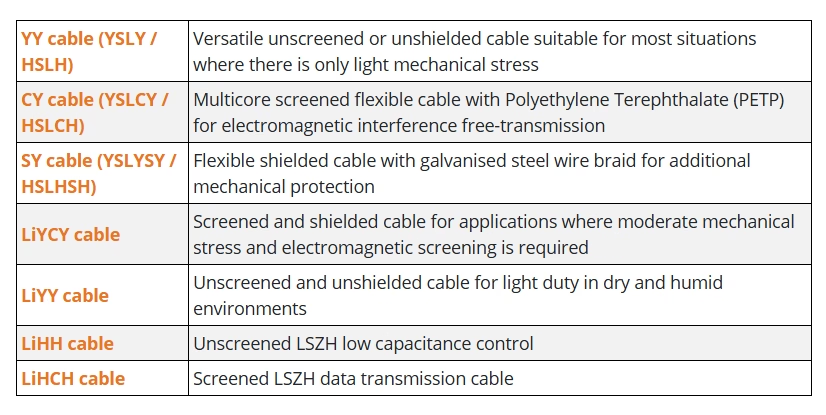
The Veriflex range encompasses control cables (SY, CY, YY series), fieldbus cables (Profibus DP/PA, DeviceNet), and Industrial Ethernet cables (Profinet, PUR Ethernet). Available in both PVC and LSZH (Low Smoke Zero Halogen) variants, the portfolio addresses diverse installation environments from standard industrial settings to fire-sensitive locations requiring enhanced safety performance.

What is Veriflex Cable?

Veriflex CY PVC YSLCY, Veriflex SY PVC YSLYSY, Veriflex YY PVC YSLY, Veriflex YY LSZH HSLH, Veriflex CY LSZH HSLCH, Veriflex Screened Bedded LSZH HSLHCH, Veriflex YSLYCY 1kV cable, Veriflex Control PUR-JZ, Veriflex 2XSL(st)CH LSZH, Veriflex DeviceNet Thick FRNC-LSZH, Veriflex DeviceNet Thin LSZH, Veriflex Profibus DP FC L2/FIP PVC, Veriflex Profibus DP FC L2/FIP LSZH, Veriflex Profibus PA PVC, Veriflex Profibus PA FRNC-LSZH, Veriflex Profinet Type A, Veriflex PUR Industrial Ethernet, Veriflex Interface BUS Cable
DIN VDE 0812 is a German national standard issued in 1988 that contains specifications for equipment wires and stranded equipment wires used within telecommunications and data processing systems. The standard covers flexible, multi-conductor cables designed for electronic control system connections, voice frequency transmission, and signal communications in fixed installations. These cables represent popular European alternatives to American-style data and control cables, featuring cores twisted into pairs to reduce crosstalk and electromagnetic interference.

What is DIN VDE 0812 Cable?

DIN VDE 0812 cables are designed for electronic control system connections, voice frequency transmission, and signal communications in fixed installations. They are widely used across various industries where reliable data and signal transmission is required in environments requiring flexibility and compact cable routing.
El GAALFLEX® CONTROL 600 es un cable de control multiconductor de PVC altamente flexible, diseñado para aplicaciones industriales exigentes que requieren certificación dual según normas europeas (IEC/DIN VDE) y norteamericanas (UL/CSA). Este cable combina la robustez de los estándares alemanes VDE con la versatilidad de las certificaciones UL AWM, haciéndolo ideal para mercados globales y maquinaria de exportación.

¿Qué es GAALFLEX® CONTROL 600?

CONTROL 600 cable, PVC control cable, flexible control cable, multi-conductor control cable, IEC 60228 Class 5, DIN VDE 0281, UL AWM 2587, 600V control cable, 450/750V cable, industrial control cable, machine tool cable, IEC 60228, DIN VDE 0295, DIN VDE 0281, UL 1581, CSA AWM, HD 21.1, HD 21.2, EN 50334, EN 50265-2-1, IEC 60332-1-2, IEC 60332-3C, DIN EN 50290-2-22, VDE 0819-102,UL AWM 2587, UL AWM Style 2587, AWM style 21179, AWM style 21216, 90°C 600V cable, 105°C cable, CSA AWM I/II A/B, UL recognized cable, cUL listed cable